
A complete issue · 23 pages · 1912
Judge — March 16, 1912
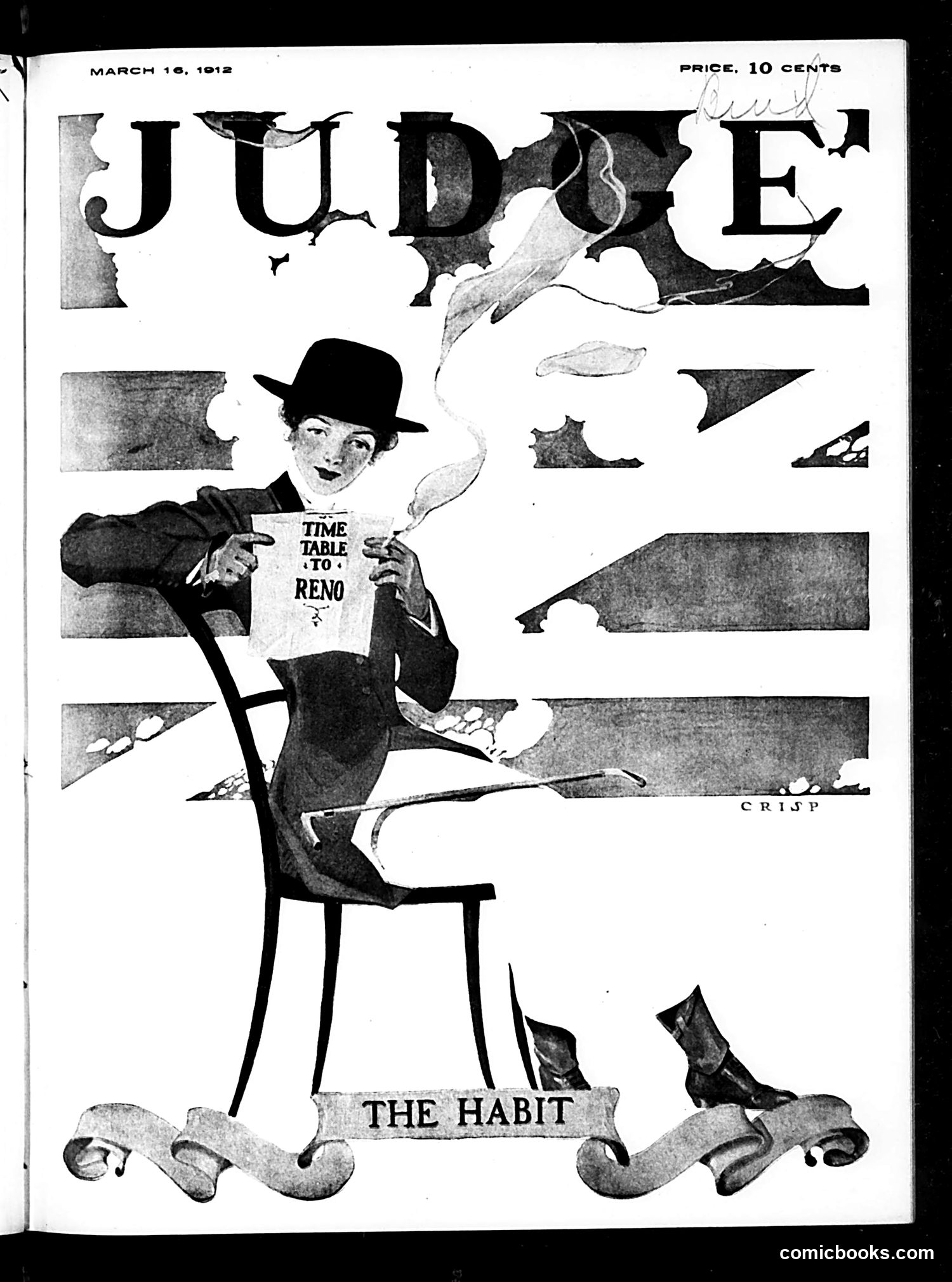
This cover satirizes habitual behavior, featuring a well-dressed man sitting on a chair holding a "Time Table to Reno"—a reference to Reno, Nevada, which was known for its lenient divorce laws at this time. The man is surrounded by torn papers labeled "THE HABIT," suggesting repeated, compulsive divorces. The cartoon mocks what appears to be a trend of wealthy individuals using Reno's permissive divorce statutes to dissolve marriages repeatedly. The title "Judge" and artist credit "CRISP" indicate this is satirical commentary on contemporary divorce culture among the affluent. The scattered papers and casual pose suggest the subject treats marriage dissolution as an unremarkable routine rather than a serious legal matter, criticizing both the practice and Nevada's role in enabling it.
This page is primarily **advertising and subscription information** rather than political satire. The main content includes: - **RémohGems advertisement** (synthetic gems) - **Challenge Collars & Cuffs ad** (waterproof clothing) - **Old I.W. Harper Whiskey advertisement** (emphasizing original packaging) - **Subscription rates and publication details** for Judge magazine The **only substantive content** is a right-side advertisement for "Her Favorite 'Him'" — an artist's color proof service priced at 25 cents. The accompanying photograph appears to show two men at a desk, but without clearer context, its specific satirical meaning is **unclear**. The page reflects early 1900s consumer advertising and magazine business practices rather than containing identifiable political commentary.
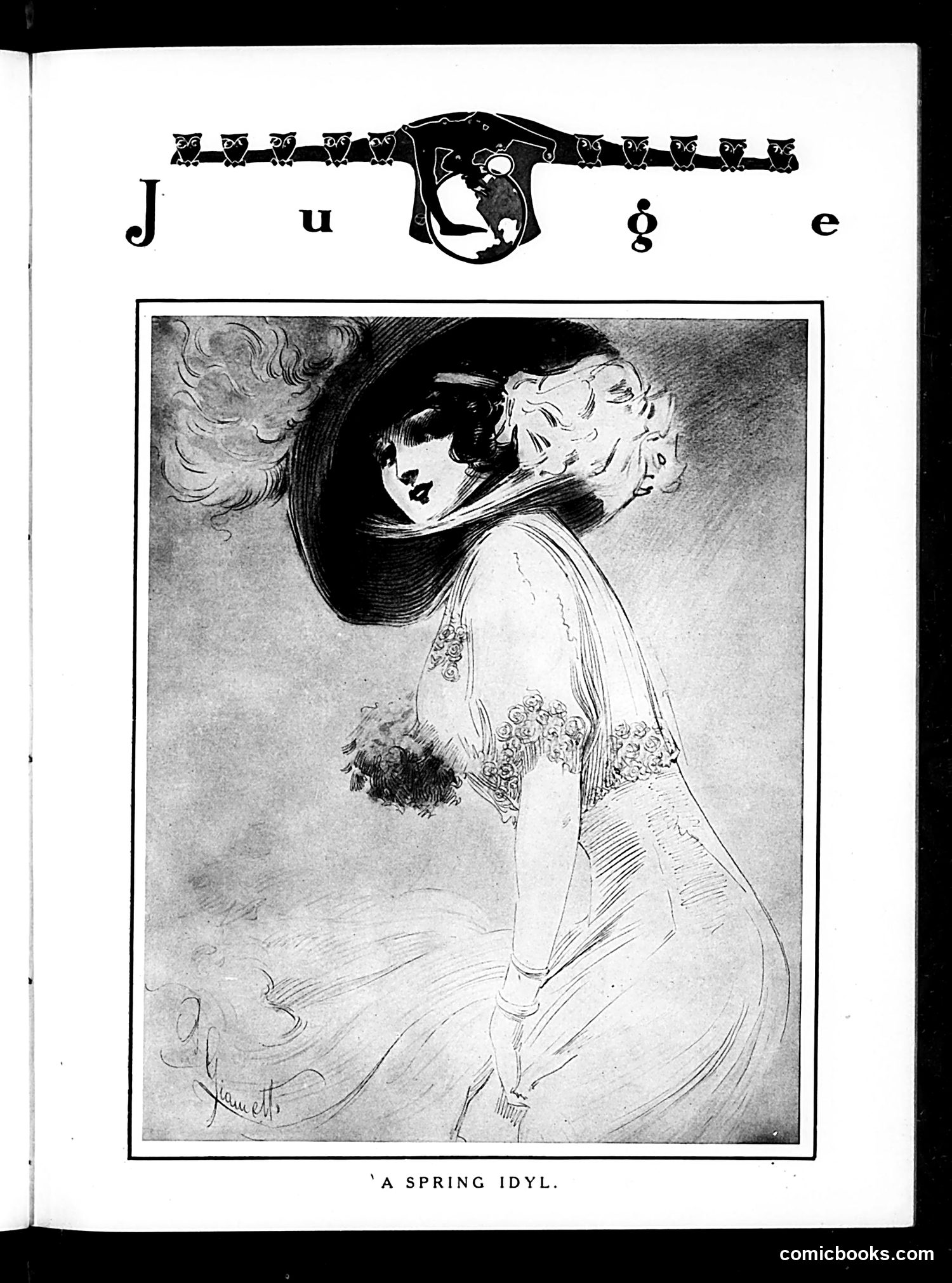
This illustration shows a woman in fashionable early 20th-century dress, viewed from behind, with long dark hair and an ornate, revealing garment. The caption "A Spring Idyl" suggests seasonal leisure and romance. The artistic style and composition appear to emphasize physical form in a way typical of Judge's satirical approach to gender and fashion. Without additional context from surrounding pages, the specific satirical target is unclear—it may mock contemporary fashion trends, the idealization of women in art, or social attitudes toward spring courtship customs. The decorative owl headers and magazine branding confirm this is from Judge's satirical content section. The quality of the etched/engraved illustration was typical for the publication's higher-end art sections.
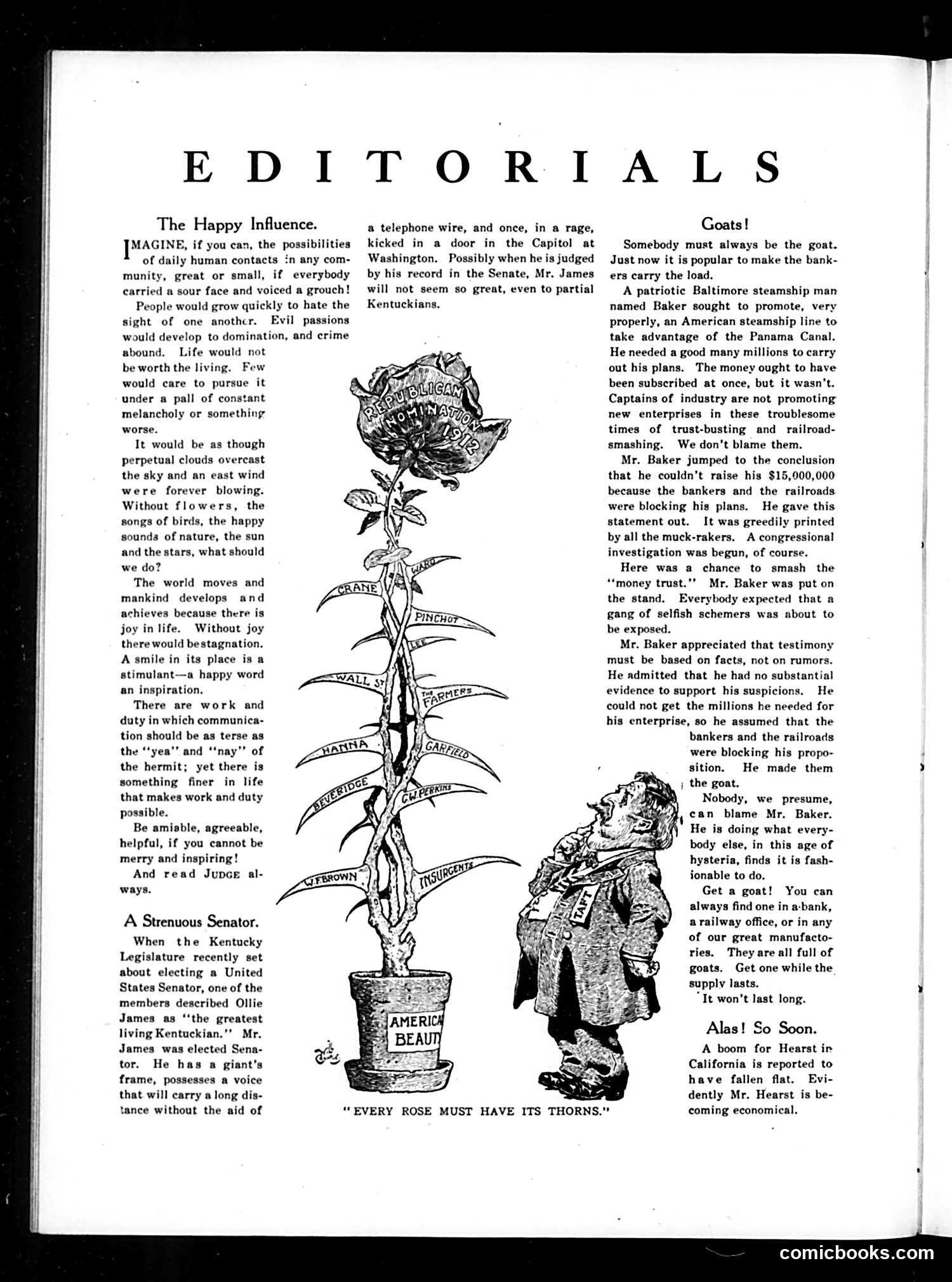
This page contains three separate editorials with accompanying illustrations. The central cartoon depicts a thorny rose labeled "America's Beauty" with leaves identifying various problems: "Graft," "Pinchot," "Wall Street," "Harriman," "Carriage Trust," "Injunction," and others. A caricatured figure (likely representing political leadership or the nation) stands beside it. The editorials criticize: 1. **"The Happy Influence"** — advocates for optimism and positive human contact 2. **"A Strenuous Senator"** — praises Kentucky Senator James (likely Ollie James) for his oratory skills 3. **"Coats!"** — satirizes shipping magnate Baker's failed attempt to secure financing for a steamship line, blaming bankers and railroads as "goats" (scapegoats) The rose cartoon's message: America has inherent problems ("thorns") despite its beauty.
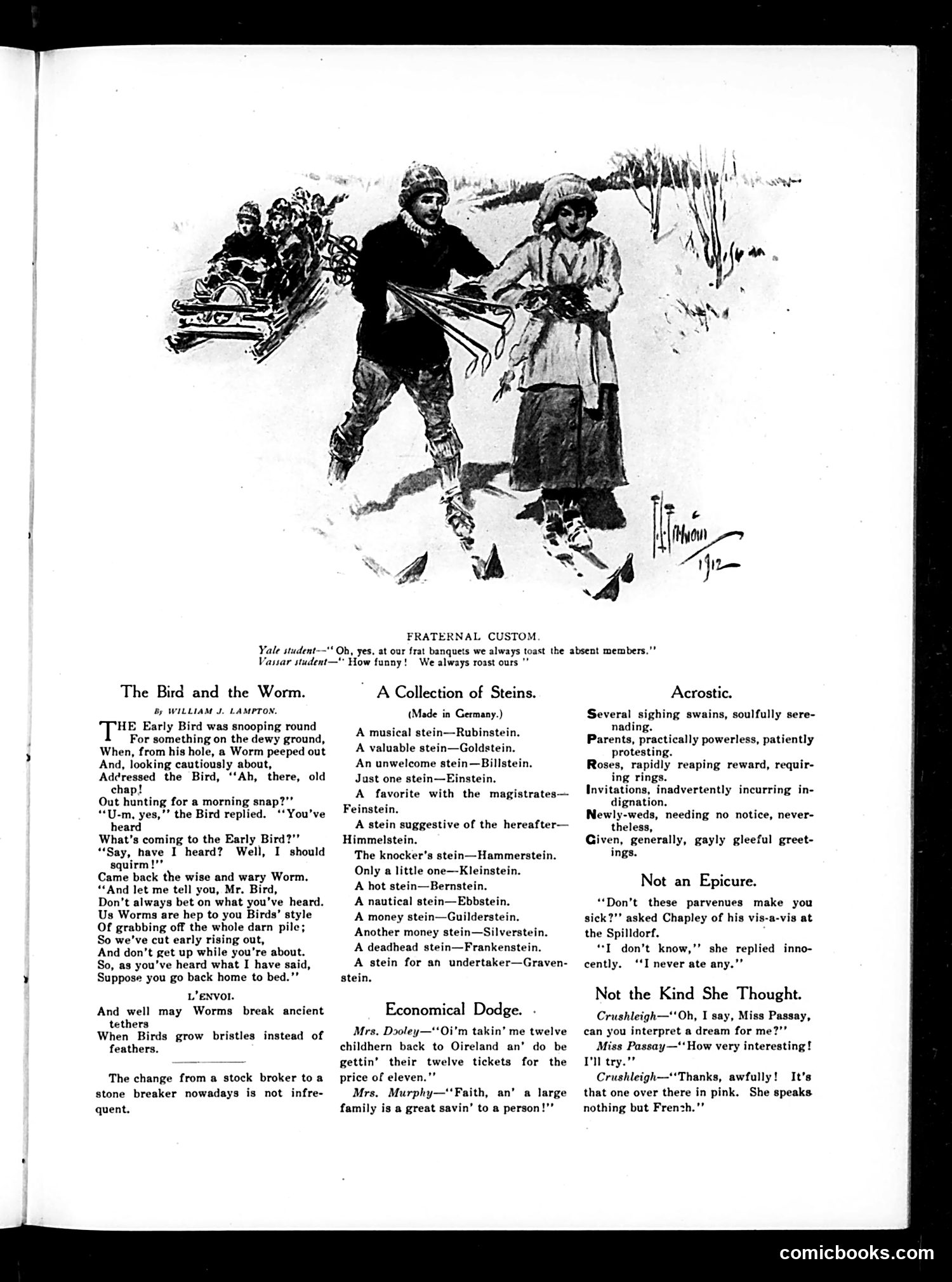
The top illustration depicts a "Fraternal Custom" at Yale, showing students in winter clothing on skates or skis. The caption quotes students toasting "absent members" at fraternity banquets—a ritual that appears mundane to modern readers but was apparently noteworthy enough for satire in this era. The page primarily contains literary content: "The Bird and the Worm" (a poem by William J. Lampton), brief humorous pieces like "A Collection of Steins" (German beer steins with punning names), and short comic dialogues ("Acrostic," "Not an Epicure," "Not the Kind She Thought," "Economical Dodge"). The humor relies on wordplay, puns, and domestic/social scenarios rather than political commentary. This appears to be a general humor and entertainment page rather than political satire.
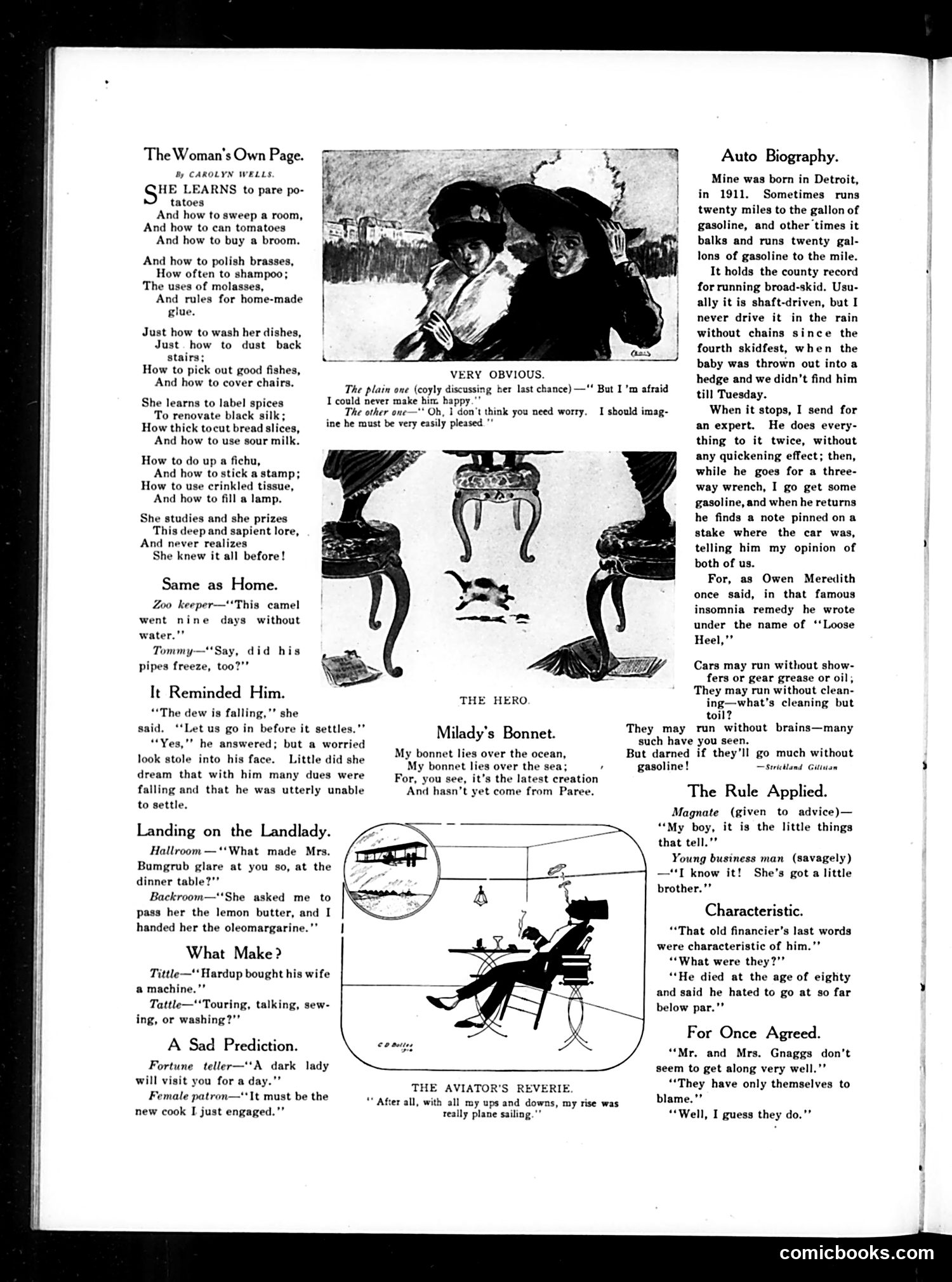
This page from *Judge* (a satirical weekly) contains humor pieces and cartoons typical of early 20th-century American satire, targeting domestic life and contemporary technology. **"The Woman's Own Page"** parodies ladies' magazine instruction columns by listing household skills women supposedly must learn—then punchlines that they "knew it all before," mocking both the condescension of such instruction and women's actual competence. **The cartoons satirize**: - Modern marriage anxieties ("Very Obvious": a woman unsure she can make a man happy, told he's "easily pleased") - Automobile unreliability ("Auto Biography"): a humorous "biography" of a temperamental 1911 car, personifying mechanical failures - The "Aviator's Reverie": a pun on "plane sailing" about flight - Urban landlord-tenant friction and oleomargarine passing as butter **Overall tone**: Gentle domestic humor aimed at middle-class readers dealing with new technologies, changing gender roles, and modern marriage—common *Judge* fare for this era.
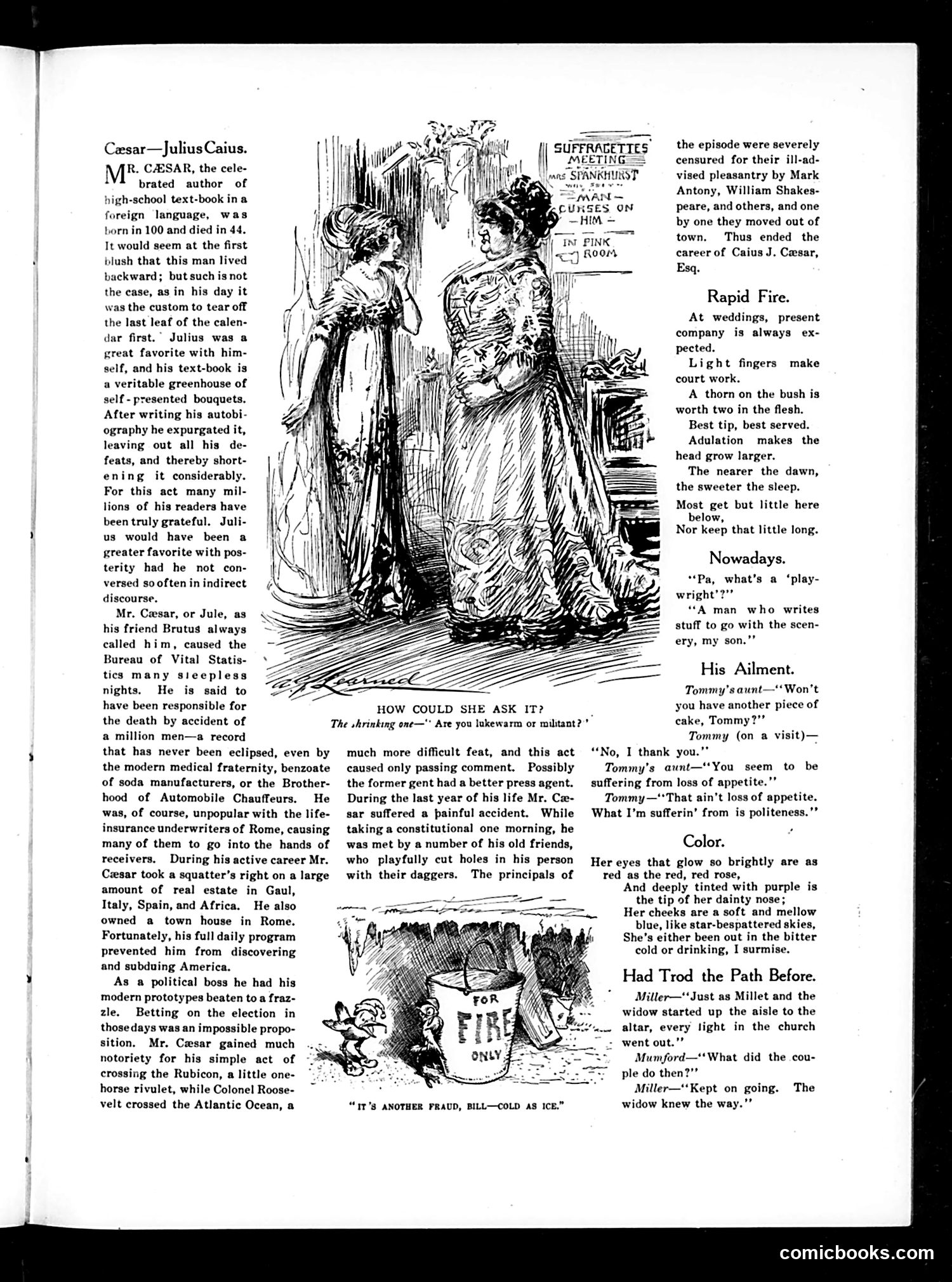
This page contains several satirical pieces, primarily a humorous essay mocking Julius Caesar presented as a high-school textbook subject. **Main Article - "Caesar—Julius Caius":** The satire ridicules both Caesar himself (portrayed as self-aggrandizing and responsible for countless deaths) and American educational pretensions. It sarcastically compares Caesar's crossing the Rubicon to Theodore Roosevelt crossing the Atlantic, suggesting Roosevelt's feat was more impressive yet received less attention—a dig at contemporary press manipulation and celebrity culture. The essay mocks Caesar's assassination with dark humor ("playfully cut holes in his person with their daggers"), then notes the assassins were "censured" and "moved out of town"—likely satirizing how political violence was handled in both ancient Rome and contemporary America. **Cartoons and "Rapid Fire" Section:** The accompanying illustrations and aphorisms are light, unrelated humor—wedding etiquette, wordplay, and domestic comedies typical of Judge's filler content. The page primarily serves as satire of classical education, political power, and American comparisons to Rome.
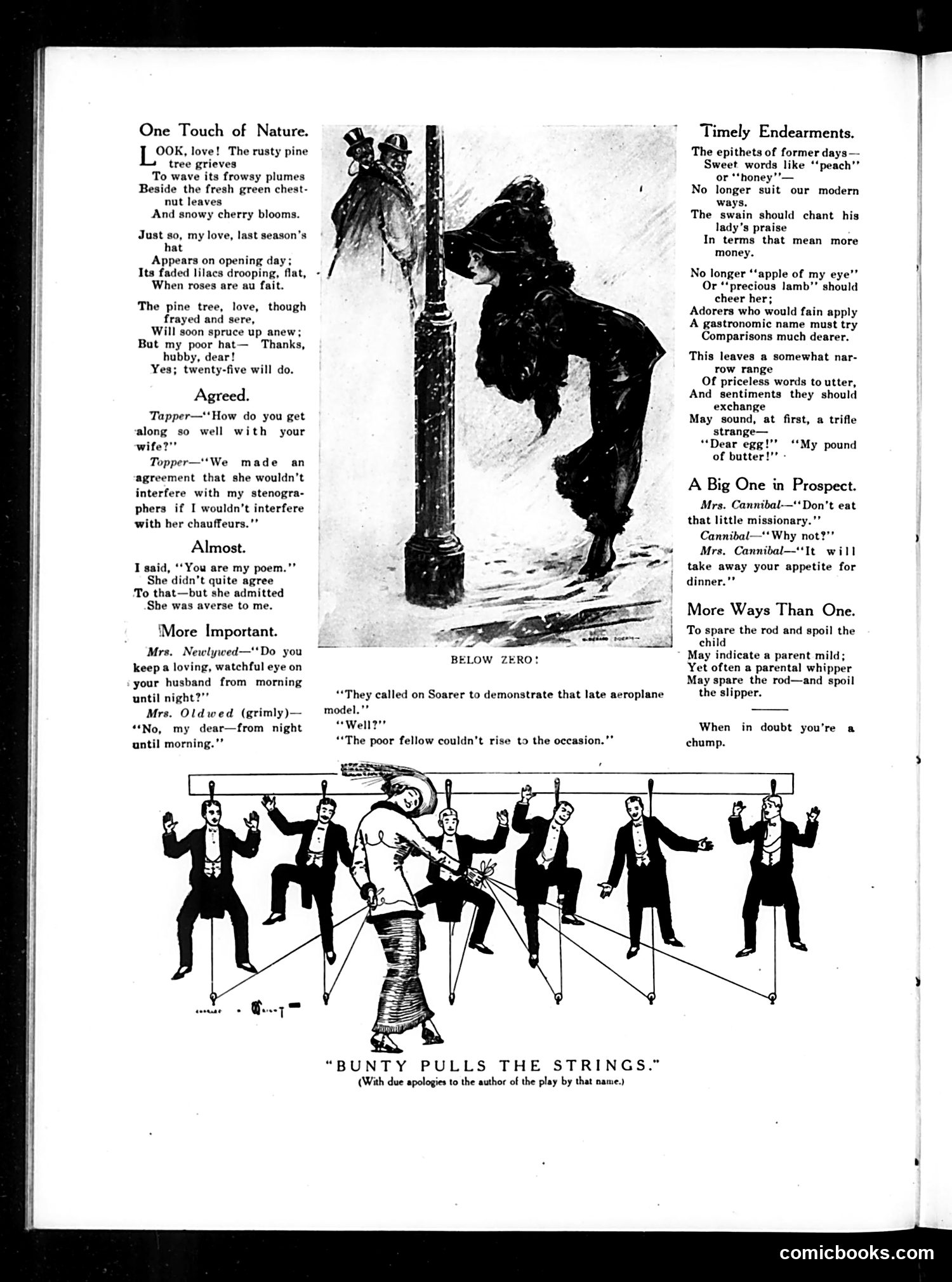
This page contains multiple short humor pieces satirizing early 20th-century social customs: **"One Touch of Nature"** and **"Timely Endearments"** mock how modern courtship language has become materialistic. Old romantic epithets ("peach," "apple of my eye," "precious lamb") are replaced with food comparisons and crude monetary references—reflecting anxieties about commercialization of romance and changing gender dynamics. **"Agreed"** jokes about a modern marriage contract where spouses ignore each other's professional staff (stenographers/chauffeurs), suggesting commentary on both marital independence and class assumptions. **"A Big One in Prospect"** uses cannibals as a comedic device to comment on appetite and marriage—a common racist trope of the era with no deeper satirical point beyond the punchline. **"More Ways Than One"** discusses child discipline philosophies, reflecting contemporary debates about parenting methods. The bottom illustration, **"Bunty Pulls the Strings,"** references a contemporary play, showing a woman controlling multiple men like puppets—satirizing female power and manipulation in relationships. The overall theme: critiques of modern dating, marriage materialism, and shifting gender relations.
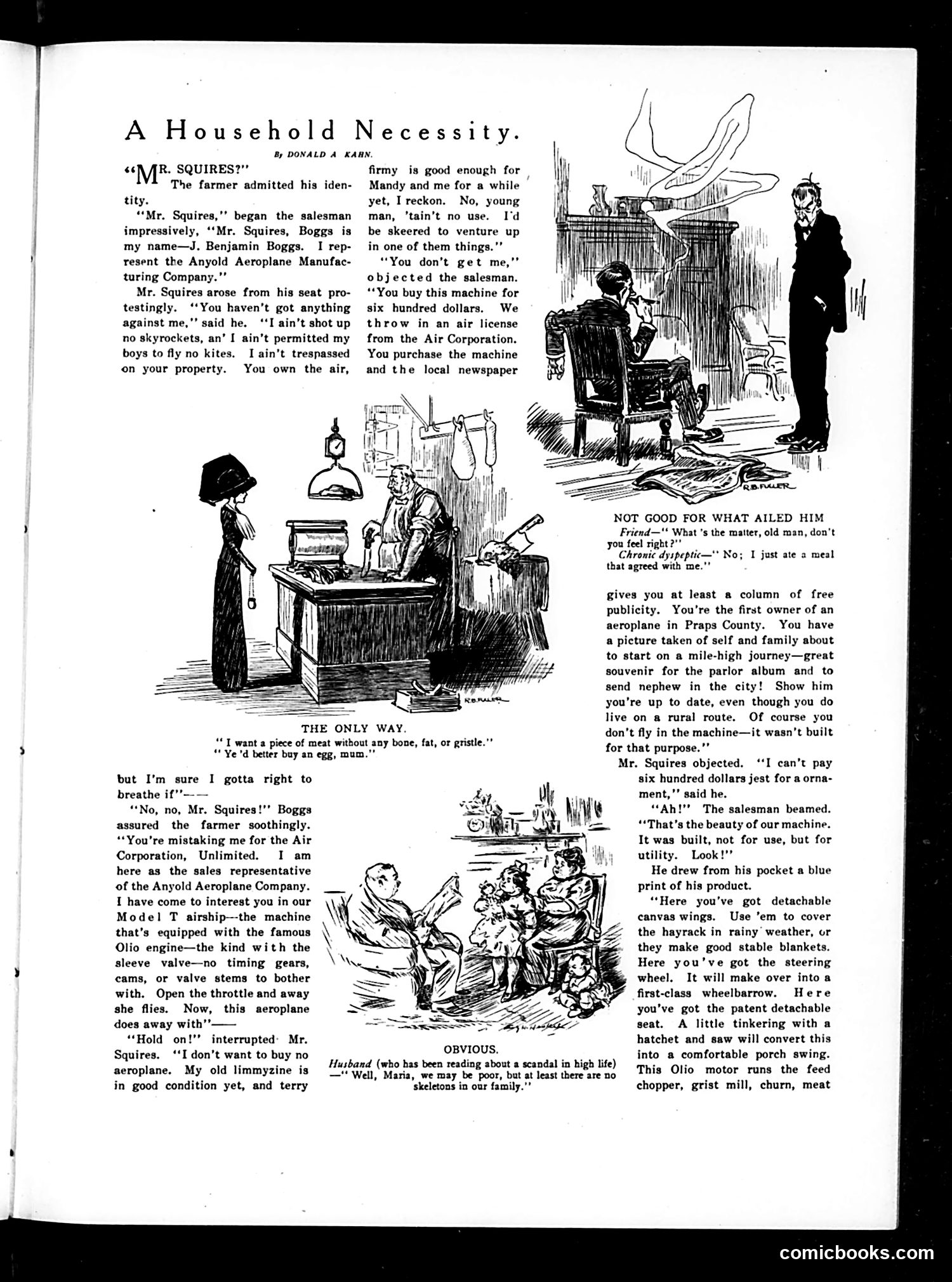
This story satirizes early-20th-century sales culture and rural America's skepticism toward newfangled technology. Salesman J. Benjamin Boggs attempts to sell farmer Mr. Squires a Model T airplane—not for actual flying, but as a status symbol and "household necessity." The joke: The airplane's real value isn't utility but *publicity*—being photographed as the first airplane owner in the county, impressing city relatives. When Squires objects to the $600 price, Boggs pivots brilliantly, marketing the aircraft's *parts* as practical farm equipment: detachable wings become hayrack covers, the steering wheel converts to a wheelbarrow, the seat becomes a porch swing. The satire mocks both aggressive American salesmanship and rural resistance to modernity. Side panels offer additional jokes about impractical desires ("meat without bone, fat, or gristle") and ironic observations. The humor relies on the absurdity of selling something explicitly built "not for use, but for utility"—pure appearance over function.
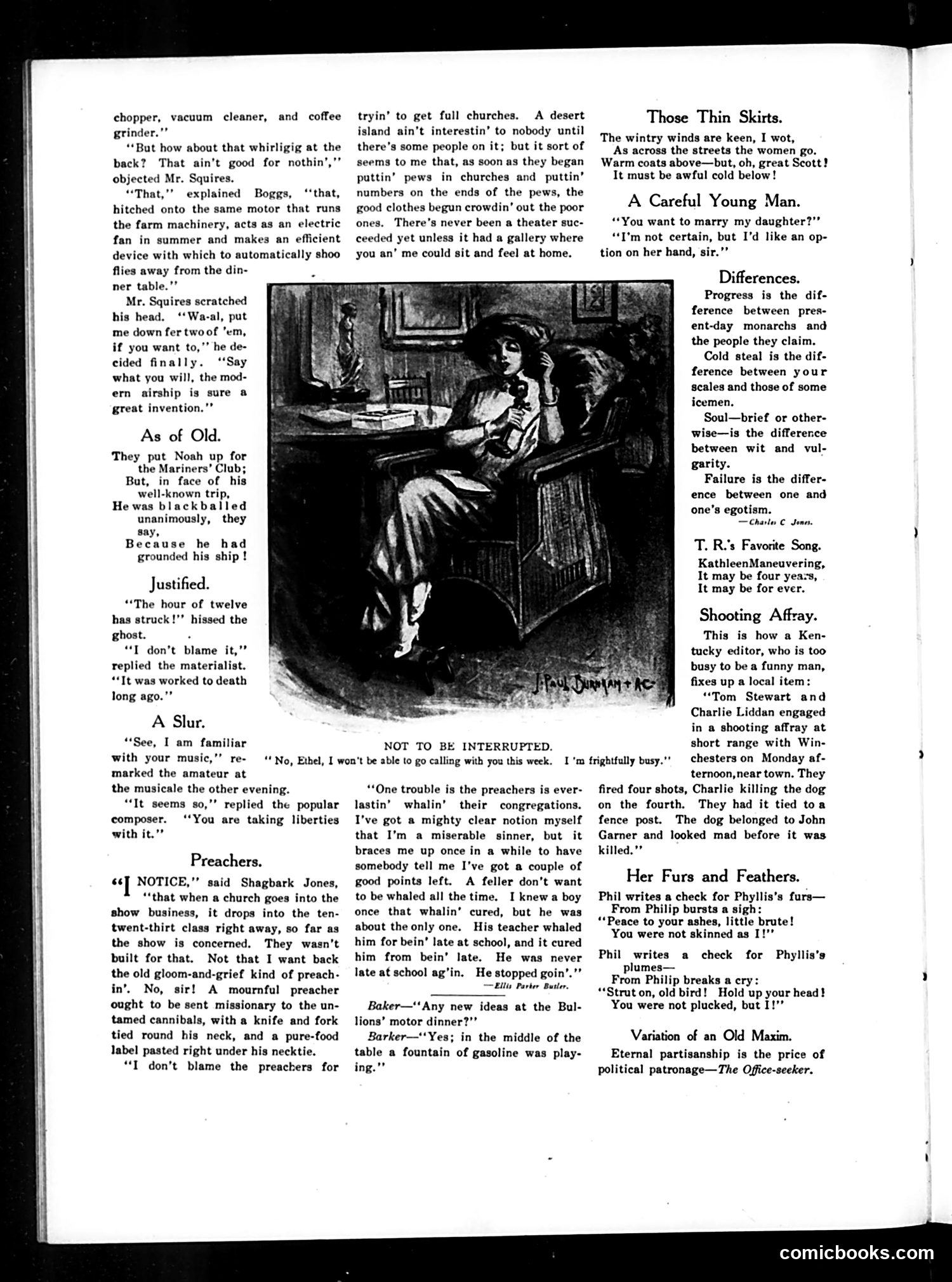
This page from *Judge* contains multiple short satirical pieces typical of early 20th-century American humor: The main cartoon depicts a domestic scene with the caption "NOT TO BE INTERRUPTED," showing a woman telling a caller she's too busy—likely satirizing women's increasingly busy modern lives. The text pieces mock various social targets: preachers who compromise church dignity by adopting "show business" tactics to attract congregants; the fashion of women wearing thin skirts despite cold weather (the joke being exposed legs freeze while upper bodies stay warm); and a Kentucky editor's clumsy attempt at reporting a shooting incident. Other brief jokes ridicule Noah's club rejection (based on his maritime disaster), a composer annoyed at liberties taken with his music, and a suitor seeking a conditional engagement "option." The reference to "T.R.'s Favorite Song" likely alludes to Theodore Roosevelt, popular during this era. The humor reflects Progressive-era concerns about modernization, social propriety, and everyday absurdities.
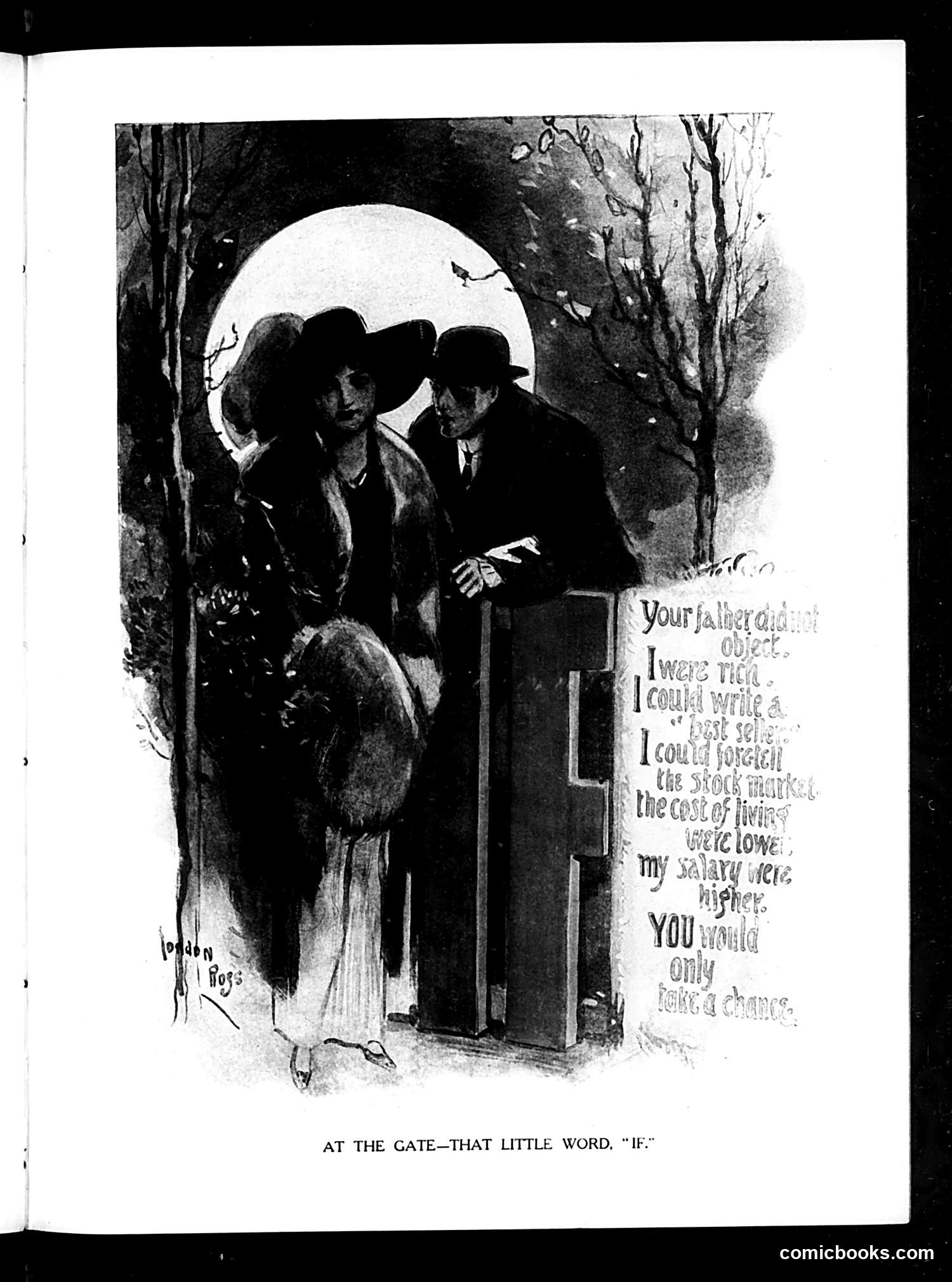
This appears to be a regretful fantasy illustration showing two figures at a gate beneath a large moon, with a small child looking on. The accompanying text presents a counterfactual lament: had the speaker objected to something (implied to be a significant life decision), they could have written poetry, forgotten financial troubles, lowered living costs, and earned higher wages. The satire targets the human tendency toward wishful thinking and retrospective regret. The "little word, 'If'"—suggesting conditional statements—represents missed opportunities and paths not taken. The gate symbolizes a threshold moment when intervention might have changed everything. The emotional tone suggests this critiques how people fantasize about alternate realities rather than taking action in the present, making it a commentary on passivity and regret rather than direct political satire.
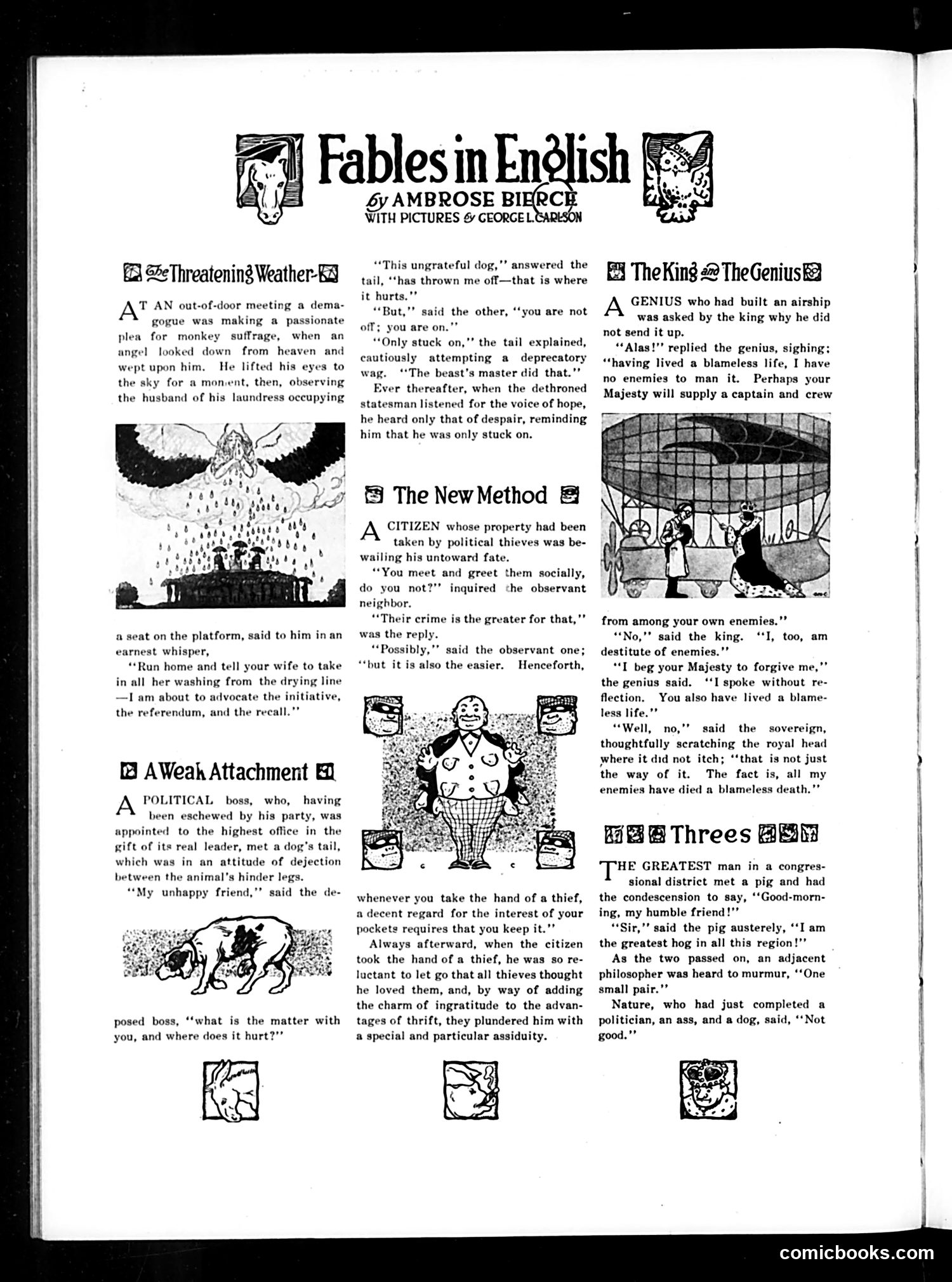
This page presents five satirical fables mocking Progressive Era politics and human folly: **"Threatening Weather"** ridicules popular reform movements (monkey suffrage, initiative, referendum, recall) by suggesting they're so disastrous that even angels weep—and the common man should flee rather than support them. **"A Weak Attachment"** compares a disgraced political boss to a dog's tail: both cling to power despite being cast off, yet insist they remain "stuck on." It mocks politicians who pretend relevance after losing influence. **"The New Method"** uses paradoxical logic to satirize corrupt politics: befriending thieves (politicians) actually encourages them to steal more thoroughly, since they mistake tolerance for affection. **"The King & The Genius"** suggests that both rulers and inventors are so morally compromised that neither has enemies—implying leadership requires ruthlessness or dishonesty. **"Threes"** concludes that greatness and pettiness are indistinguishable—a cynic's jab at pretension. Bierce's characteristic pessimism pervades: reform, politics, and human nature are all fundamentally absurd.
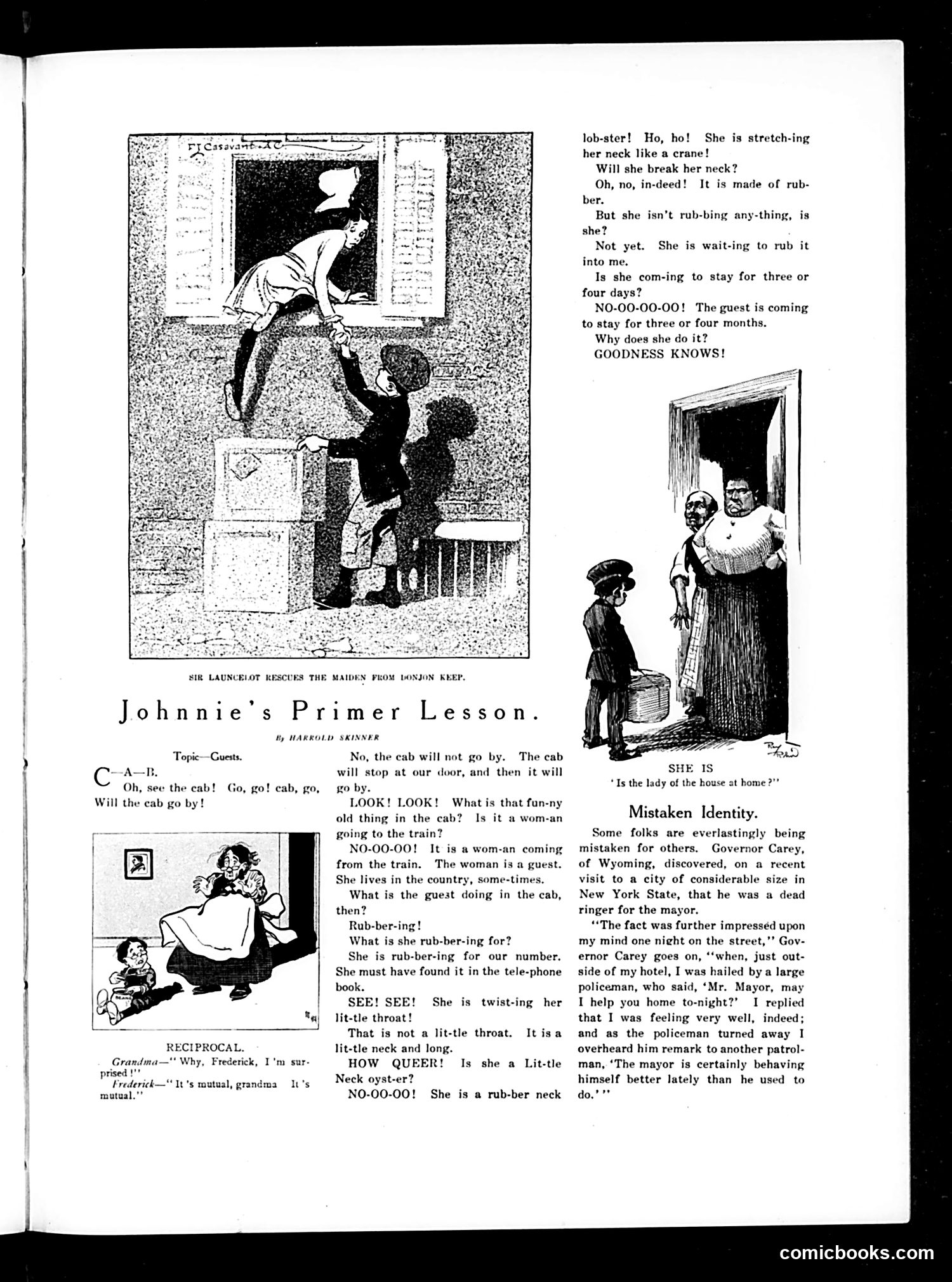
This page contains two satirical pieces from *Judge* magazine. **"Johnnie's Primer Lesson"** (main feature) is a children's educational parody that teaches vocabulary through a visiting country woman's behavior. The humor centers on "rubber-necking"—the contemporary slang for nosily gawking at surroundings. The piece playfully extends this metaphor, describing the guest as literally having a "rubber neck" like a lobster or crane, stretching and twisting to observe everything in the city home. The joke mocks both tourists' intrusive curiosity and their extended stays (three to four months). It's satirizing the annoying habit of uninvited guests who pry into household affairs while overstaying their welcome. **"Mistaken Identity"** (right column) humorously recounts Wyoming Governor Carey being repeatedly mistaken for the mayor of a New York city. A policeman even offers to escort him home, assuming drunkenness. The satire gently mocks both the governor's apparent resemblance to a local politician and small-town authorities' presumptions about mayoral behavior.
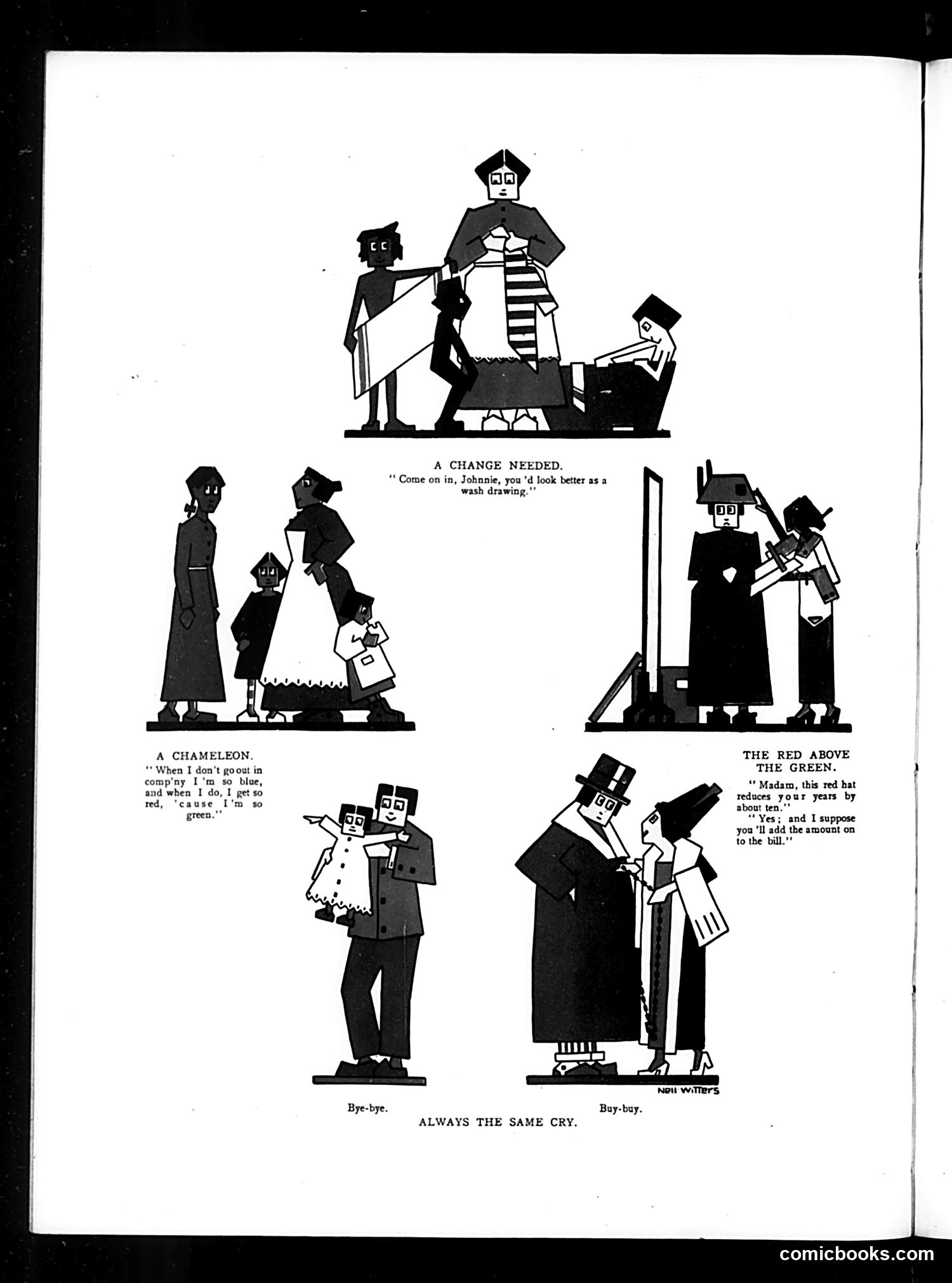
This page contains four separate satirical comic vignettes mocking social vanity and hypocrisy: **"A Change Needed"** ridicules a mother pressuring her son to improve his appearance, suggesting he'd look better as a "wash drawing" (simplified sketch)—implying real life disappoints. **"A Chameleon"** mocks someone who changes personality based on social context: appearing melancholy alone, flushed from embarrassment in company, yet fundamentally "green" (naive/inexperienced). The title suggests social phoniness. **"The Red Above the Green"** satirizes a hat salesman's deceptive flattery and dishonest pricing: he claims a red hat reduces her apparent age by ten years, then implies he'll add that savings onto the bill anyway—exposing the con beneath superficial compliments about appearance. **"Always the Same Cry"** (overall theme) suggests these vignettes represent recurring human follies: vanity, pretense, and gullibility to flattery, regardless of circumstance.
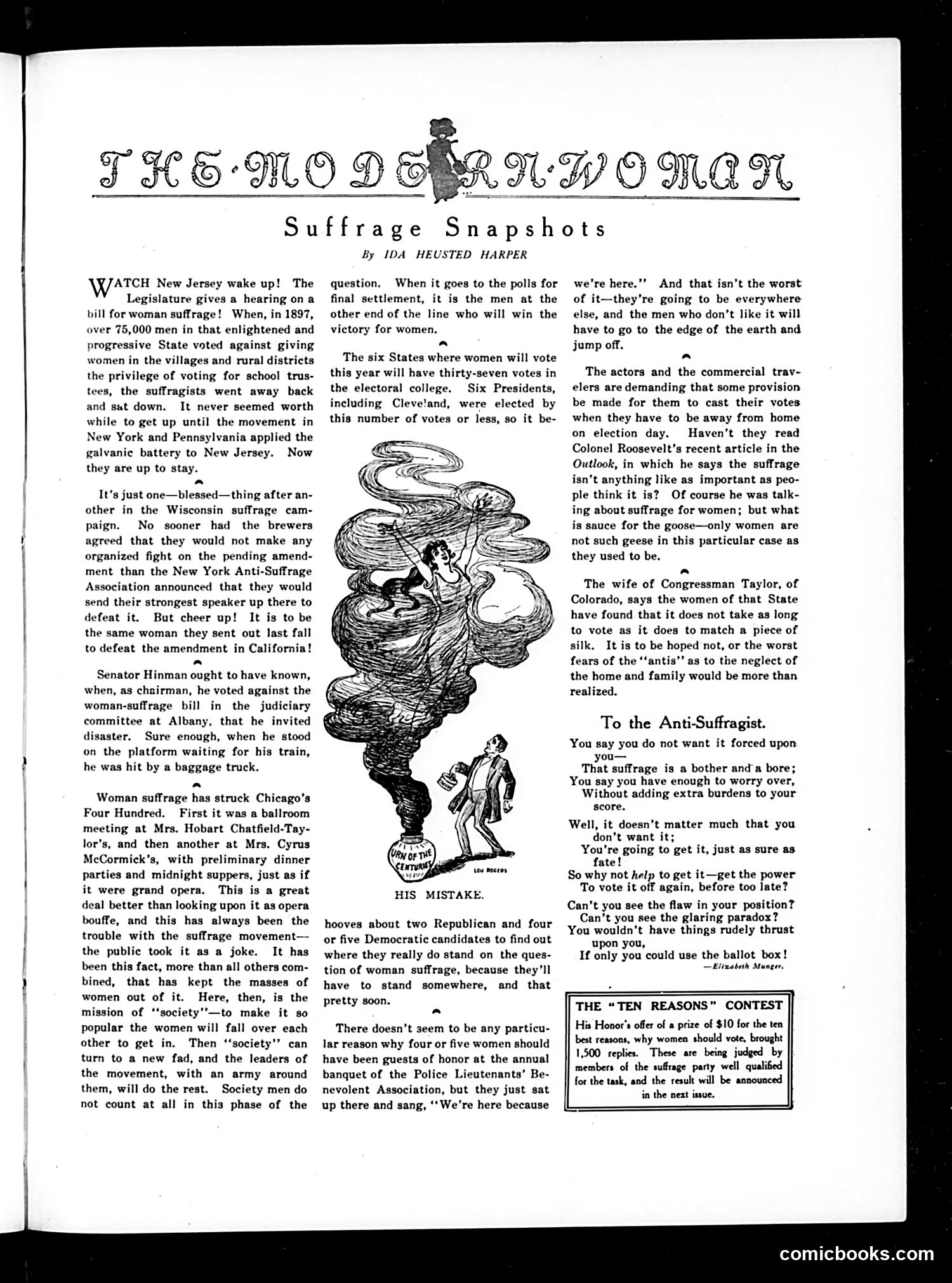
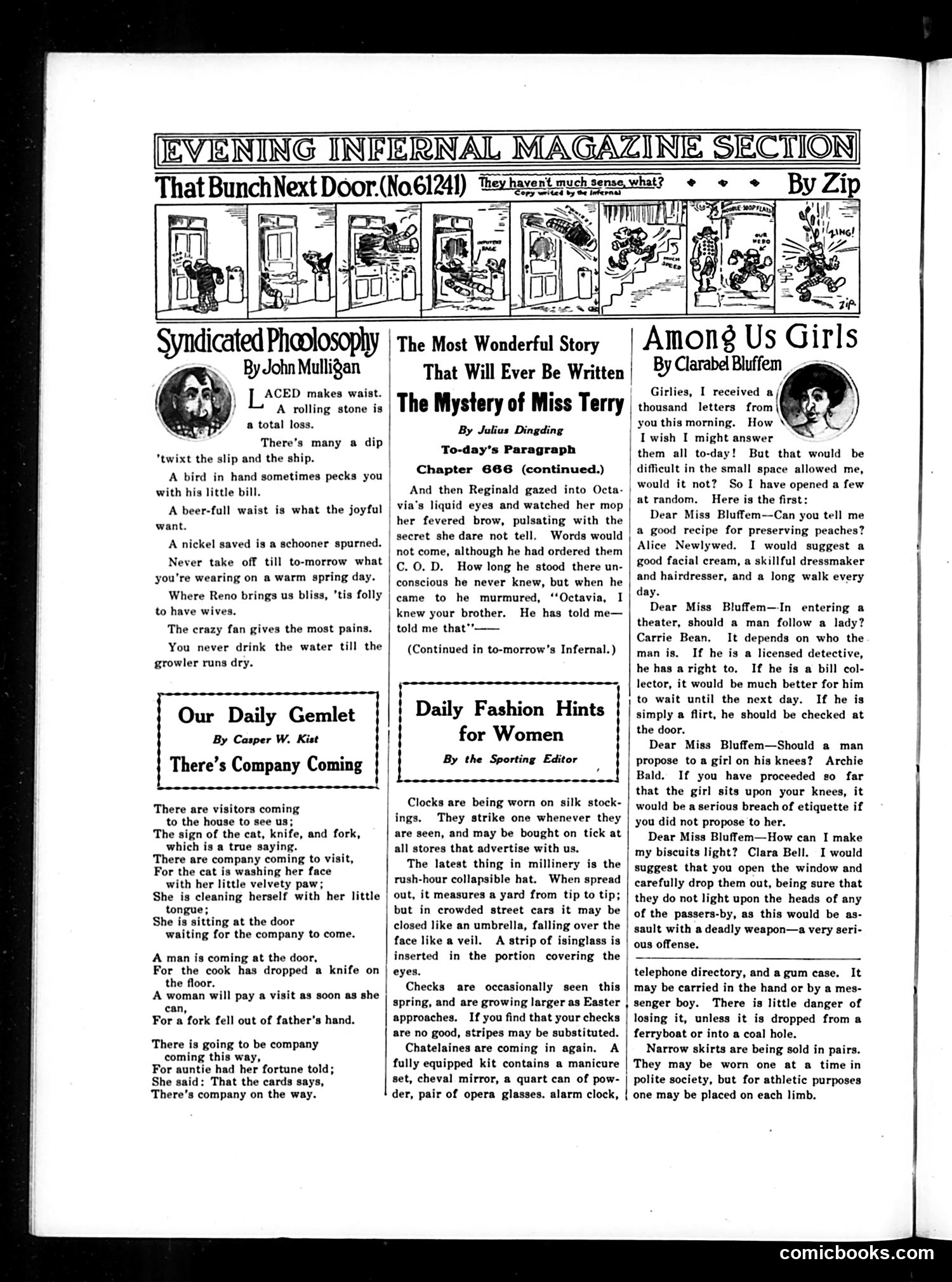
This is a satirical humor page from Judge's "Evening Infernal Magazine Section"—a parody mimicking serious publications. The main comic strip "That Bunch Next Door" uses absurdist humor typical of early 20th-century comics, depicting domestic chaos with no coherent narrative. The page's satire lies in its **mock-serious format**: sections like "Syndicated Philosophy" and "Our Daily Gemlet" parody genuine advice columns and philosophy features, but offer nonsensical or circular wisdom ("A rolling stone is a total loss"). "Daily Fashion Hints" mocks women's fashion trends through exaggeration—clocks on stockings, collapsible hats, larger checks (both the pattern and bounced checks as a joke). This targets rapid, frivolous fashion cycles. The advice column "Among Us Girls" satirizes agony aunt responses by giving absurdly impractical answers to relationship questions, poking fun at both advice-giving and courtship conventions. The overall message: Judge ridicules contemporary social conventions, consumer culture, and the proliferation of trivial advice literature.
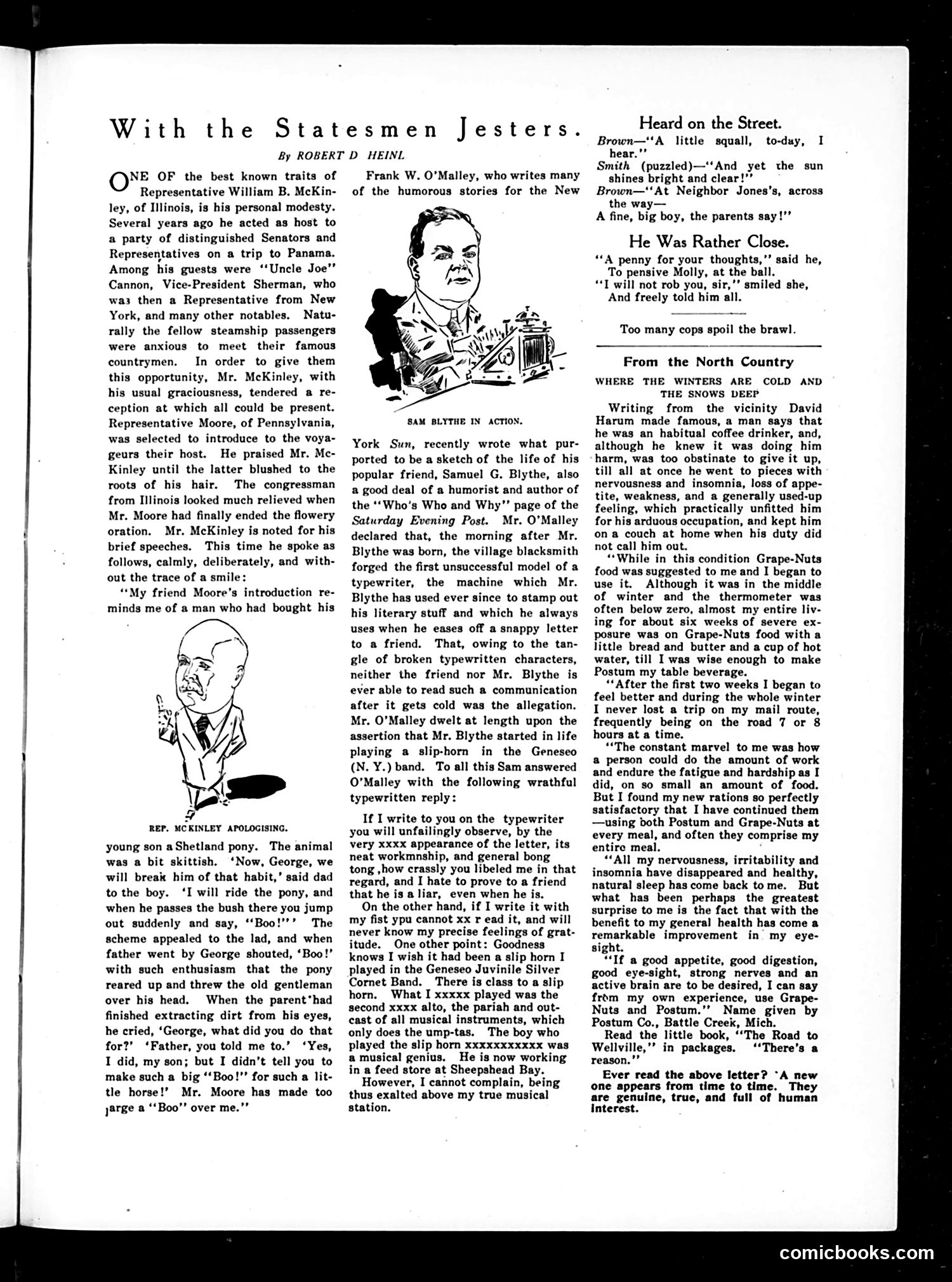
This page from *Judge* magazine contains humorous anecdotes about prominent American political figures and writers, circa early 1900s. **The McKinley Story:** Representative William B. McKinley of Illinois is portrayed as modestly deflecting excessive praise. His self-deprecating anecdote about a pony and an over-enthusiastic "Boo!" suggests his discomfort with Representative Moore's flowery introduction—the satire being McKinley's deadpan wit in response to flattery. **The Blythe-O'Malley Exchange:** Writer Frank W. O'Malley had humorously mocked fellow humorist Samuel G. Blythe, claiming he'd used the same broken typewriter since birth and once played in a band. Blythe's mock-angry typewritten reply (shown with intentional x's and typos) sarcastically "proves" O'Malley's points by demonstrating his typewriter's poor condition—a clever joke on himself. The satire pokes fun at both writers' competitive banter. Both pieces celebrate the wit of these public figures through self-deprecating humor.
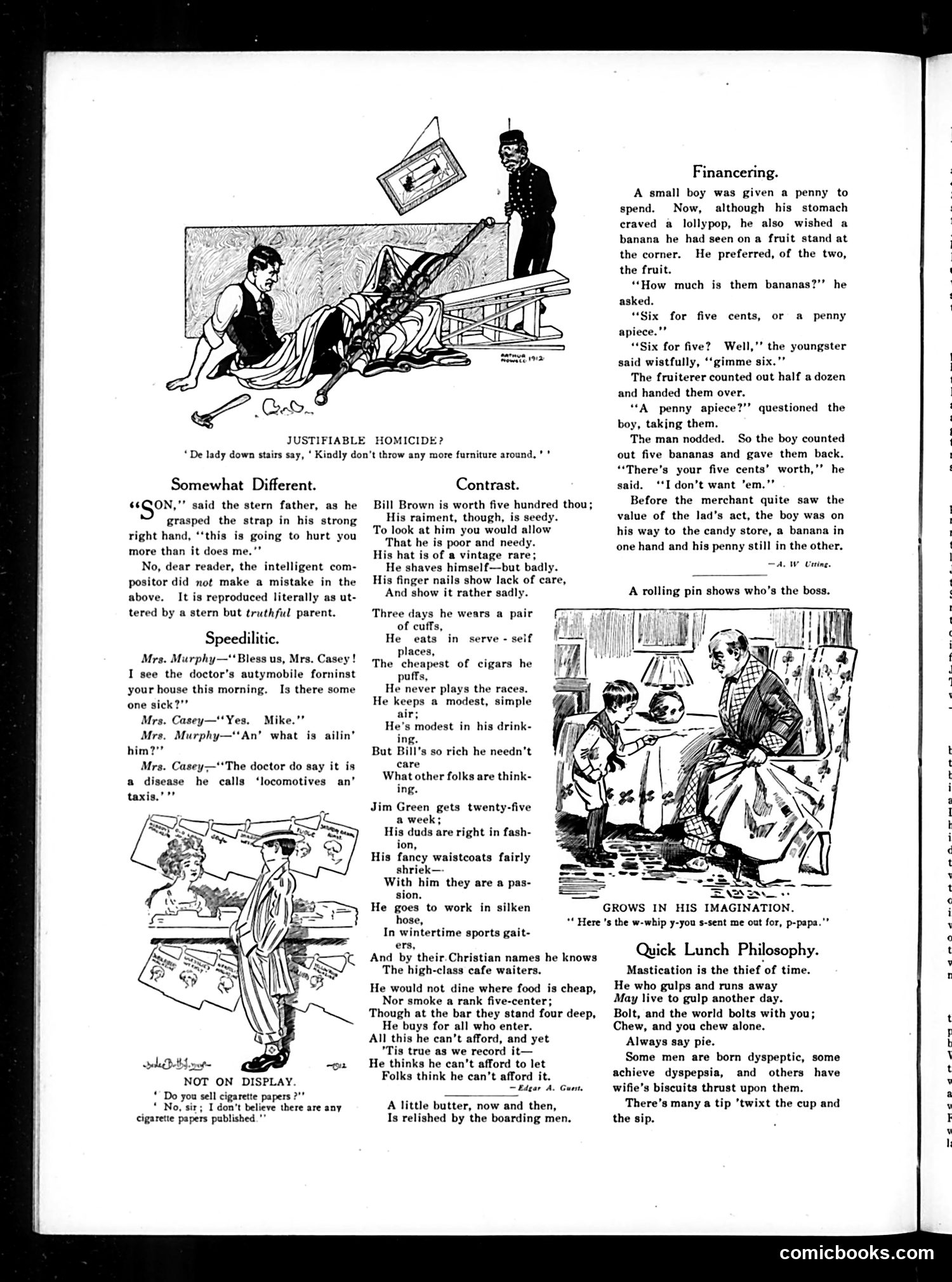
This page from Judge magazine contains several satirical pieces mocking early 20th-century social behaviors and class pretensions: **"Justifiable Homicide?"** depicts a child throwing furniture, sardonically suggesting corporal punishment is justified—dark humor about parenting. **"Somewhat Different"** and **"Contrast"** mock wealthy but shabby men and working-class men living beyond their means to appear prosperous—satirizing class anxiety and status-seeking. **"Financering"** tells of a clever poor boy who negotiates a banana deal shrewdly, keeping his penny—celebrating working-class cunning over merchant deception. **"Grows in His Imagination"** shows a child fantasizing about violence, suggesting children's vivid inner lives. **"Quick Lunch Philosophy"** parodies hasty American eating habits and digestive consequences—a jab at rushing through meals for profit. The cartoons collectively critique American materialism, class performance, and the gap between appearance and reality among different social strata.
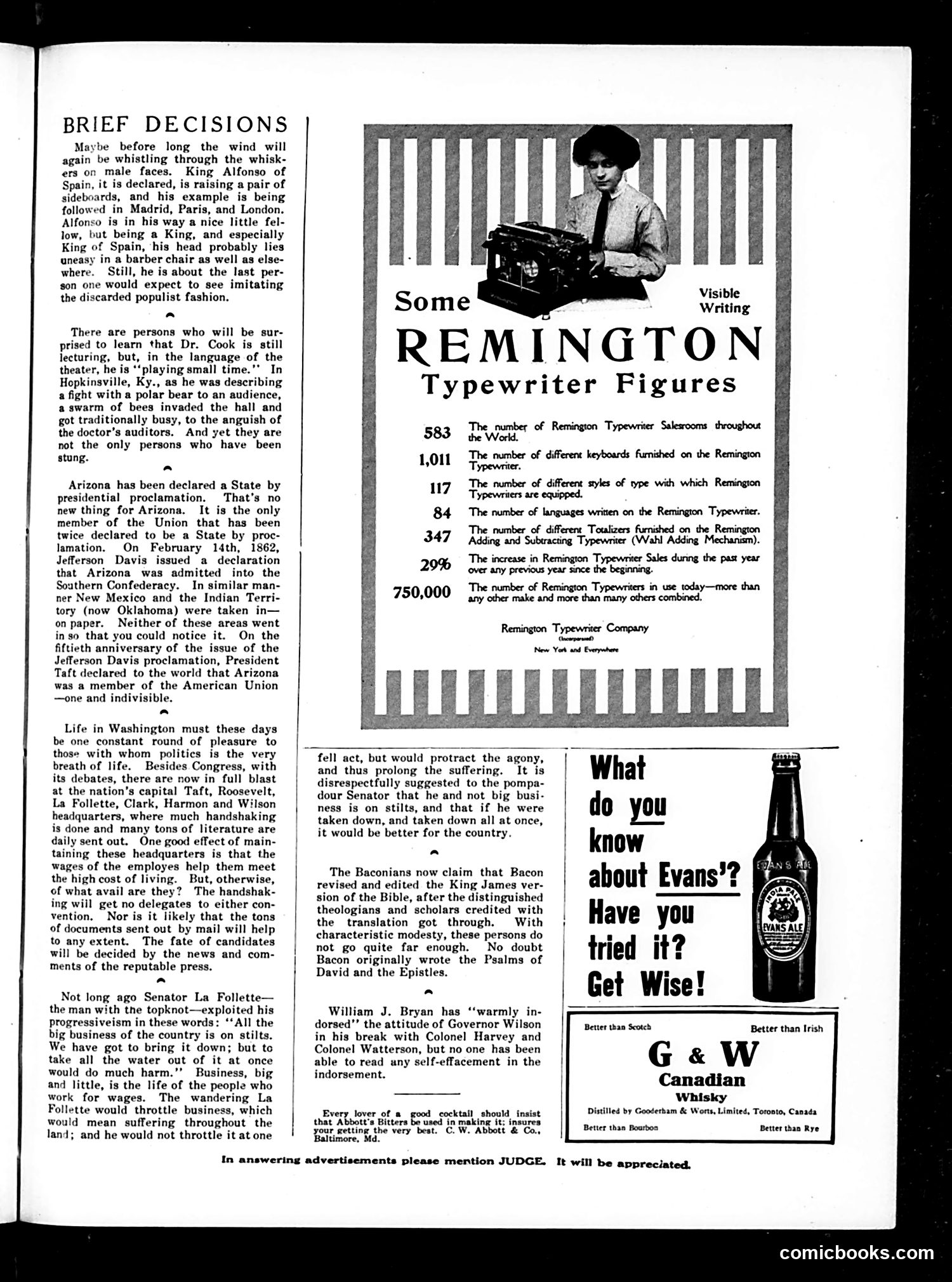
This page from Judge magazine contains political commentary and advertising rather than cartoon satire. The "Brief Decisions" column critiques several political figures of the era (appears to be early 1910s based on references to President Taft). **Key targets:** - King Alfonso of Spain for adopting facial hair fashion - Dr. Cook (explorer Frederick Cook), mocked for still lecturing despite being exposed as a fraud - Senator Robert La Follette, attacked for his "progressive" anti-business stance, portrayed as recklessly damaging the economy - Arizona statehood, presented ironically given its previous Confederate declaration The commentary reflects conservative Judge editorial positions: skepticism toward reformers and progressives, and support for business interests. The large Remington Typewriter advertisement dominates the right side, presenting market statistics. A smaller Evans Scotch whisky ad appears at bottom.
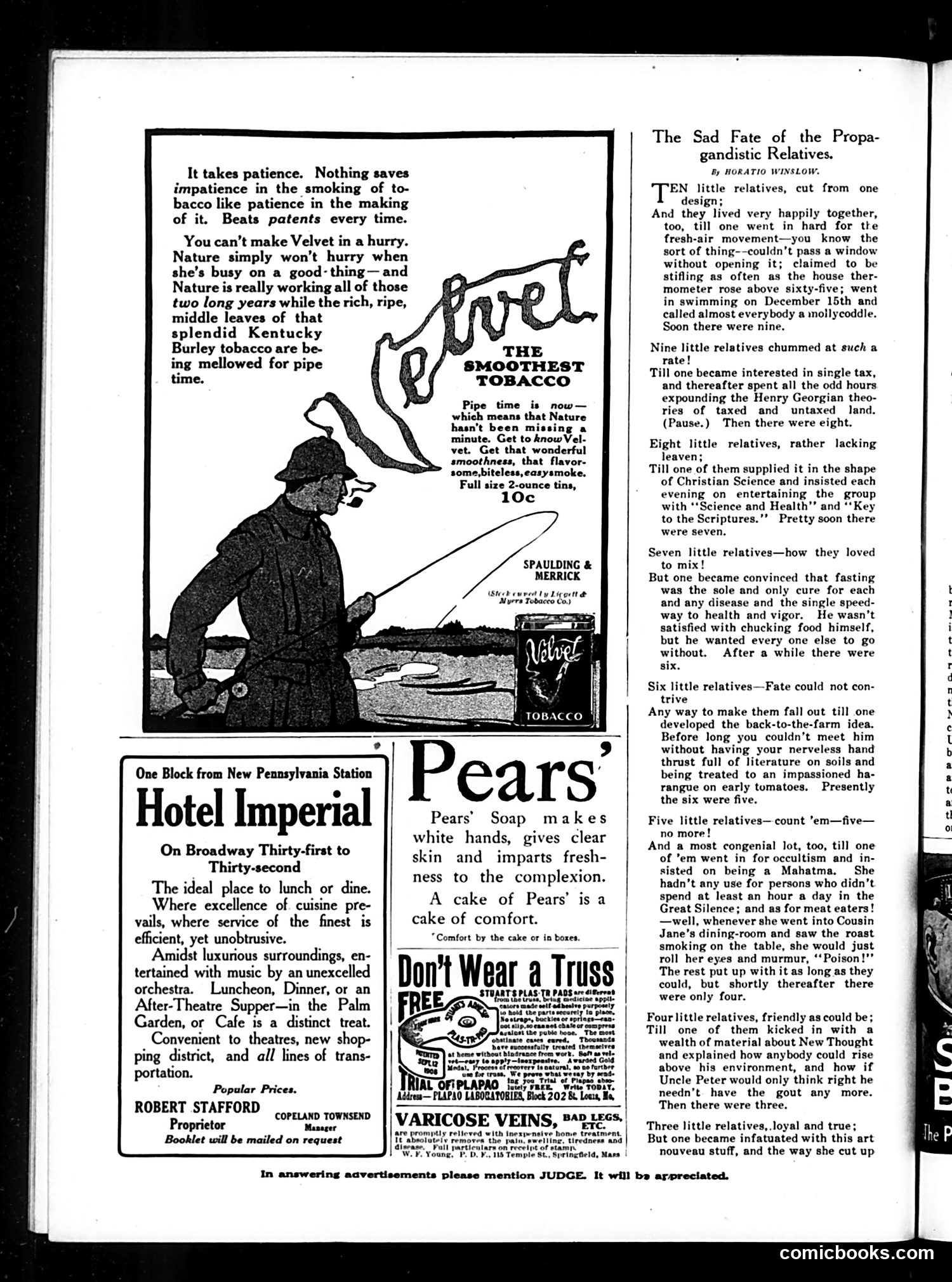
This page contains primarily **advertisements** (Velvet tobacco, Hotel Imperial, Pears' Soap, medical remedies) alongside a satirical story titled "The Sad Fate of the Propagandistic Relatives" by Horatio Winslow. The story is a **social satire** mocking the tendency of early 20th-century relatives to become obsessed with various reform and health movements. Starting with ten relatives, the narrative tracks how each person's adoption of a different fad causes them to leave or separate from the group: - Fresh-air enthusiast - Single-tax advocate (Henry George's economic theories) - Christian Science devotee - Fasting/dietary extremist - Back-to-the-farm idealist - Occultist/Mahatma practitioner The satire **ridicules propagandistic zeal**—how people adopting fashionable ideologies become insufferable, preachy, and isolate themselves from normal society. Judge's humor targets both the movements themselves and people's tendency toward sanctimonious fanaticism about whatever cause captures their attention.
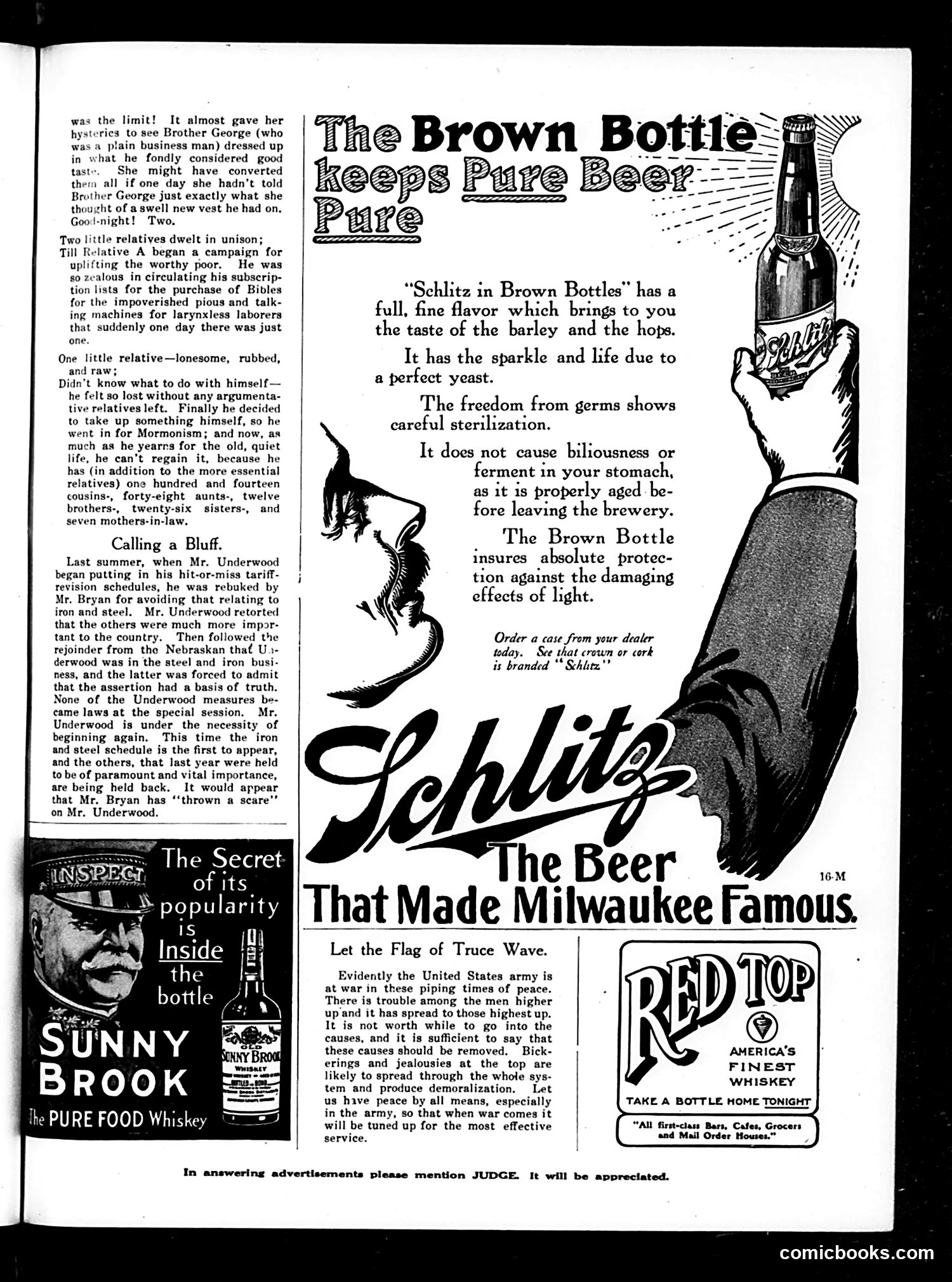
This page contains **satirical stories and period advertisements** rather than traditional political cartoons. **The "Two Little Relatives" Stories:** These are humorous moral tales satirizing reform movements. The first mocks a woman imposing her aesthetic standards on family members. The second ridicules a self-righteous "uplifter" who campaigns for charitable causes (Bibles, talking machines for the poor) with such zeal that he alienates everyone—then desperately seeks community by converting to Mormonism, acquiring 114 cousins and multiple mothers-in-law. The satire targets sanctimonious do-gooders and their unintended consequences. **"Calling a Bluff":** This references **Mr. Underwood's tariff revision** (likely Oscar Underwood, 1911-era congressman) and **Mr. Bryan's** challenge regarding iron and steel schedules. Bryan accused Underwood of avoiding iron/steel tariffs because Underwood had business interests in those industries. The joke: Underwood now prioritizes those exact schedules, suggesting Bryan "called his bluff." The rest is **period beer and whiskey advertising**—standard for Judge magazine of this era.
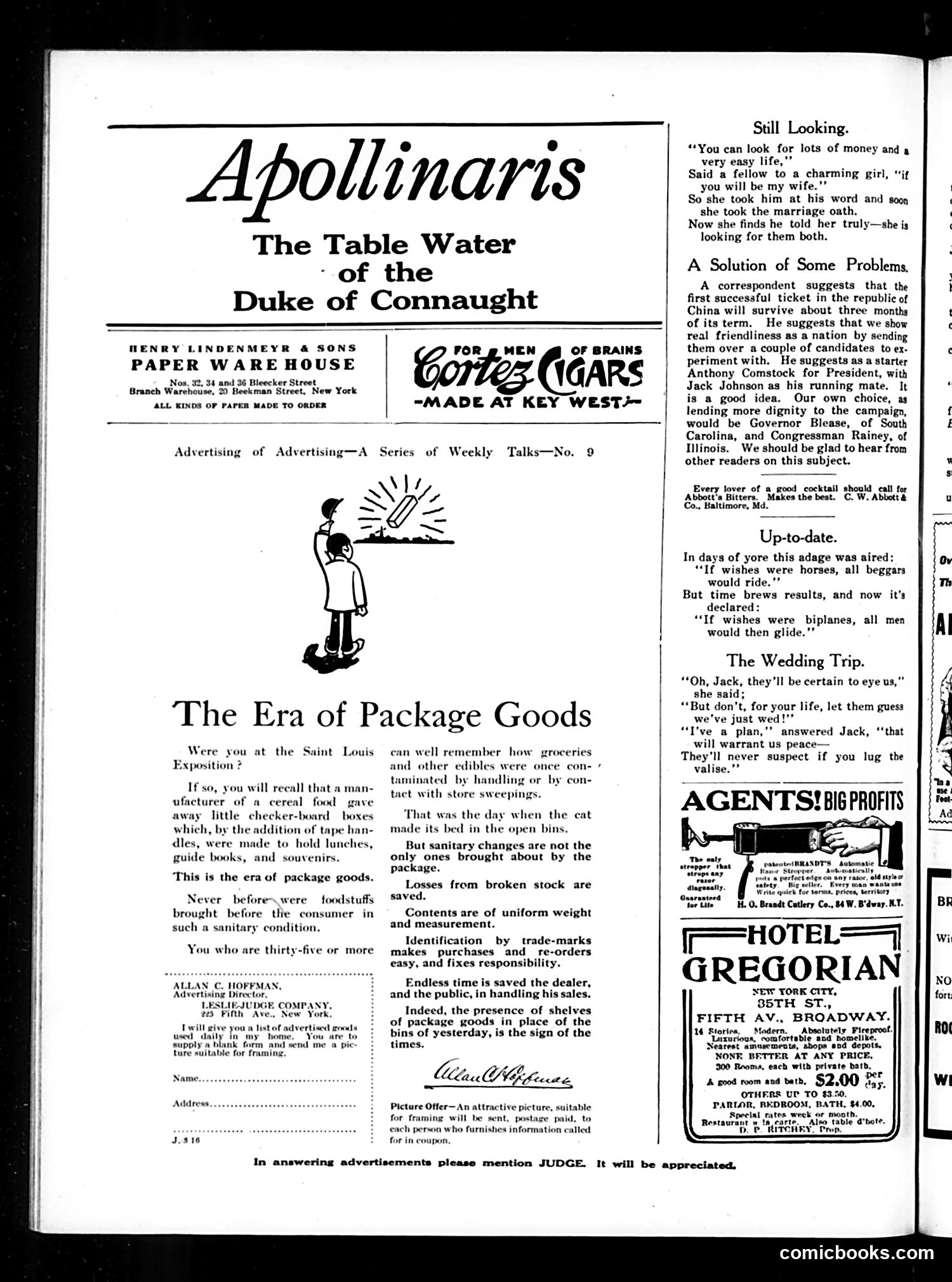
This is primarily an **advertising and editorial page** rather than a political cartoon page. The main content consists of: **Editorial Section ("The Era of Package Goods"):** A nostalgic piece crediting the 1904 Saint Louis Exposition with popularizing packaged goods. It celebrates how pre-packaged food improved sanitation and consumer trust compared to loose goods sold from bins exposed to contamination. **Satirical Humor Pieces:** Short jokes about everyday life—a woman marrying for money who discovers the groom was truthful about having none; dated wordplay updating an old proverb about wishes (horses become airplanes, reflecting early aviation enthusiasm); a newlywed couple trying to hide their status. **Advertisements:** Primarily for hotels, cigars, paper goods, and bitters—typical Judge revenue sources. **Notable:** A brief political comment suggests exporting American politicians (Anthony Comstock, Jack Johnson, South Carolina's Governor Blease) to a struggling new Chinese republic—satirizing both American political figures and China's political instability, though the exact reference is unclear without more context. The page reflects Judge's mixed model: advertising revenue supporting satirical commentary on consumer culture and politics.
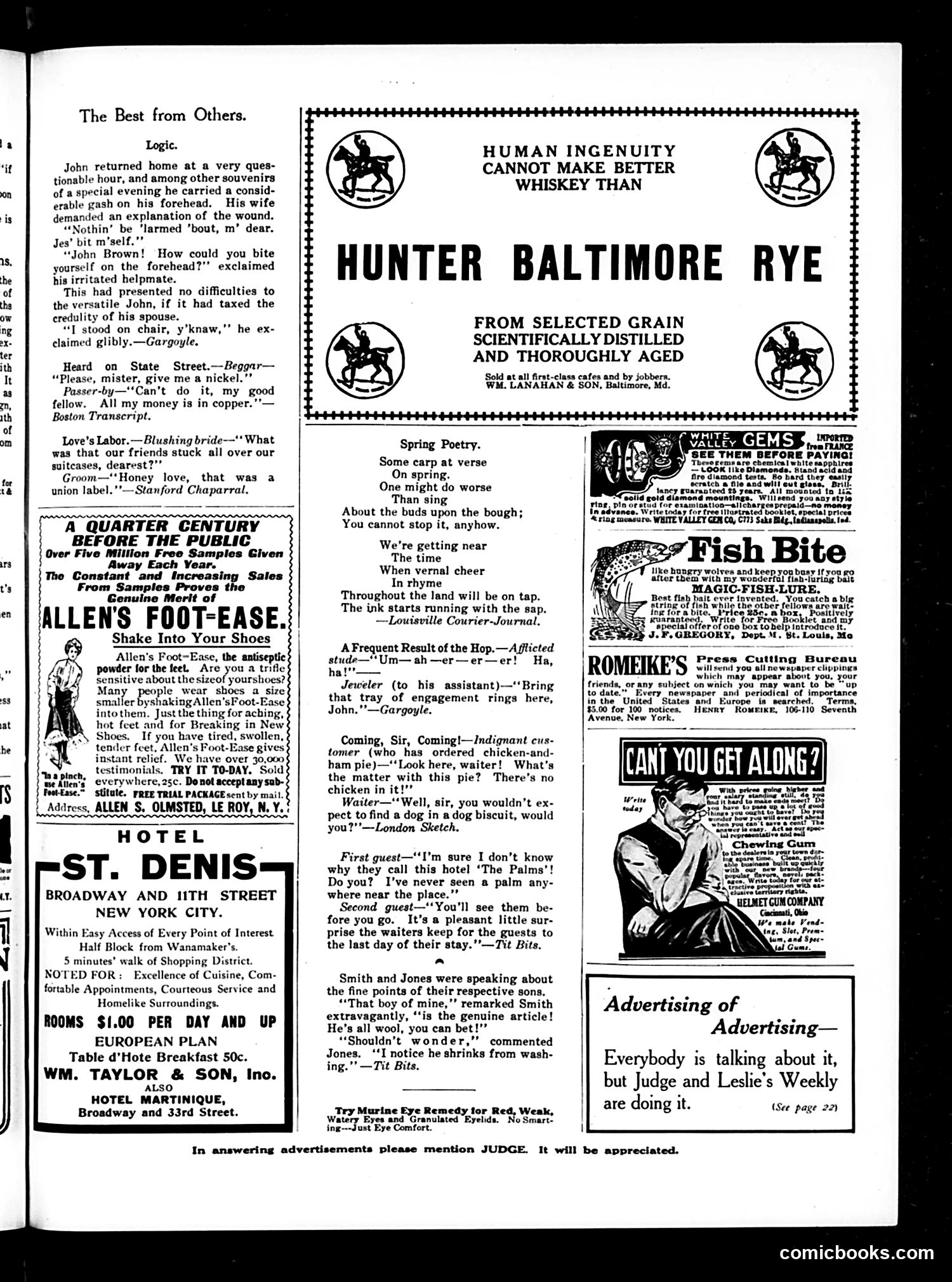
This page is primarily **advertising with humor content**, typical of early 20th-century Judge magazine format. The main content includes brief comic anecdotes ("The Best from Others") employing simple, slapstick humor: a man claiming he bit his own forehead while standing on a chair; absurdist jokes about shoe sizes and hotel "palms" (slang for gratuities). **Advertisements dominate**: Hunter Baltimore Rye whiskey, Allen's Foot-Ease powder, Hotel St. Denis, and other products use period-typical marketing claims ("25 years before the public"). The **"Spring Poetry"** section offers light verse mocking overwrought spring poetry—a gentle satire of literary pretension. Overall, this page reflects Judge's formula: mixing lowbrow humor with consumer advertising, targeting middle-class American readers. No specific political commentary or identifiable caricatures appear here—it's entertainment and commerce aimed at contemporary audiences.