
Judge, 1912-03-16 · page 7 of 23
Judge — March 16, 1912 — page 7: what you’re looking at
What you’re looking at
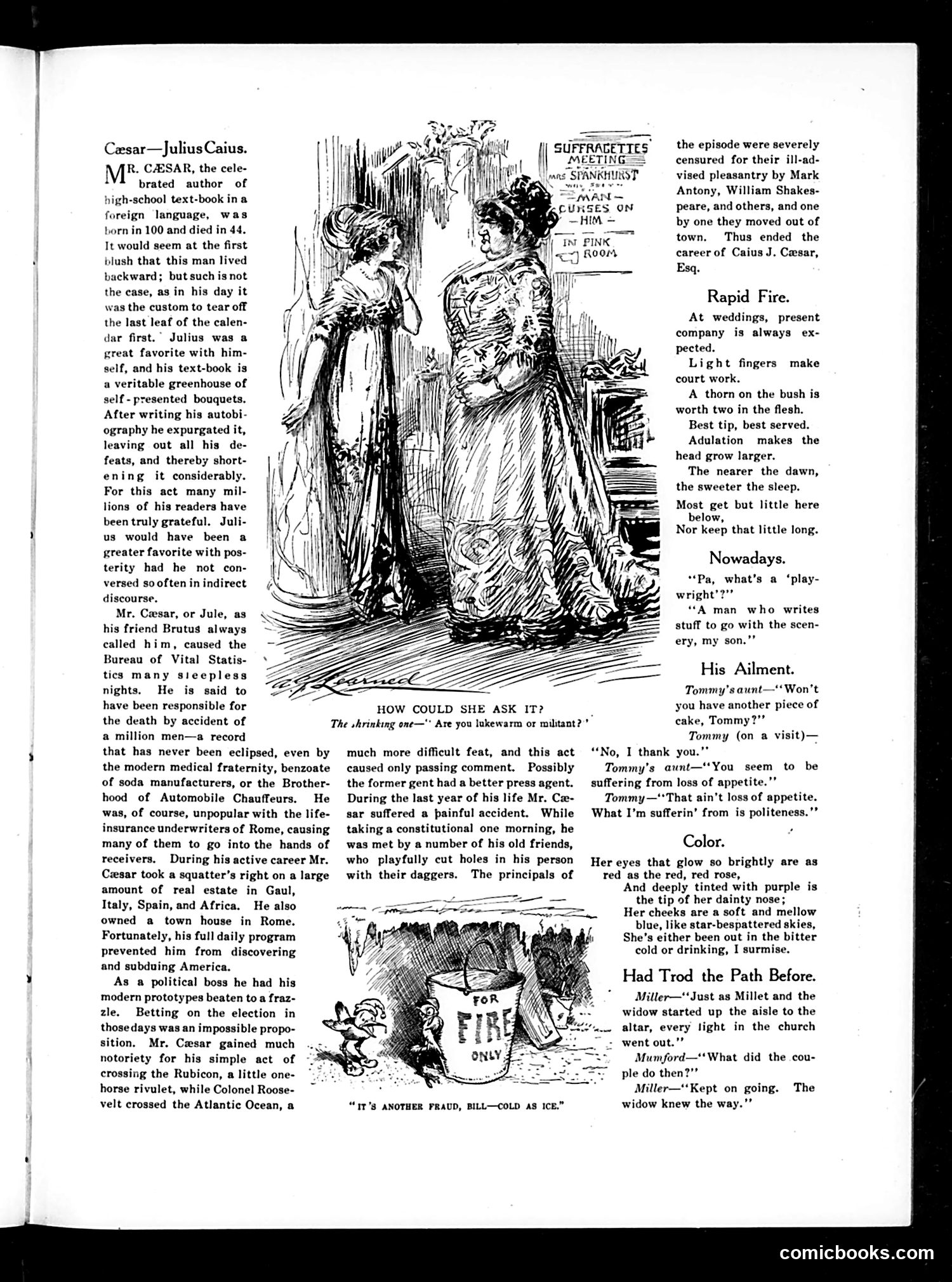
This page contains several satirical pieces, primarily a humorous essay mocking Julius Caesar presented as a high-school textbook subject. **Main Article - "Caesar—Julius Caius":** The satire ridicules both Caesar himself (portrayed as self-aggrandizing and responsible for countless deaths) and American educational pretensions. It sarcastically compares Caesar's crossing the Rubicon to Theodore Roosevelt crossing the Atlantic, suggesting Roosevelt's feat was more impressive yet received less attention—a dig at contemporary press manipulation and celebrity culture. The essay mocks Caesar's assassination with dark humor ("playfully cut holes in his person with their daggers"), then notes the assassins were "censured" and "moved out of town"—likely satirizing how political violence was handled in both ancient Rome and contemporary America. **Cartoons and "Rapid Fire" Section:** The accompanying illustrations and aphorisms are light, unrelated humor—wedding etiquette, wordplay, and domestic comedies typical of Judge's filler content. The page primarily serves as satire of classical education, political power, and American comparisons to Rome.
📄 Transcribed text from this page (OCR, searchable)
Machine-transcribed from the original scan — historical spelling and the odd misread are preserved.
Cesar—Julius Caius. R. CASSAR, the cele- 1 brated author of high-school text-book in a foreign language, was born in 100 and died in 44. It would seem at the first blush that this man lived backward; but such is not the case, as in his day it was the custom to tear off the last leaf of the calen- dar first.” Julius was a great favorite with him- self, and his text-book is a veritable greenhouse of self- presented bouquets. After writing his autobi- ography he expurgated it, leaving out all his de- feats, and thereby short- ening it considerably. For this act many mil- lions of his readers have been truly grateful. Juli- us would have been a greater favorite with pos- terity had he not con- versed so often in indirect discourse, Mr. Cesar, or Jule, as his friend Brutus always called him, caused the Bureau of Vital Statis- tics many sieepless nights. He is said to have been responsible for the death by accident of a million men—a record that has never been eclipsed, even by the modern medical fraternity, benzoate of soda manufacturers, or the Brother- hood of Automobile Chauffeurs. He was, of course, unpopular with the life- insurance underwriters of Rome, causing many of them to go into the hands of receivers. During his active career Mr. Cesar took a squatter’s right on a large amount of real estate in Gaul, Italy, Spain, and Africa. He also owned a town house in Rome. Fortunately, his full daily program prevented him from discovering and subduing America. As a political boss he had his modern prototypes beaten to a fraz- zle. Betting on the election in those days was an impossible propo- sition, Mr. Cesar gained much notoriety for his simple act of crossing the Rubicon, a little one- horse rivulet, while Colonel Roose- velt crossed the Atlantic Ocean, a — [WAN — CURSES ON HOW COULD SHE ASK IT? The shrinking one—"* Are you lukewarm or militant?” much more difficult feat, and this act caused only passing comment. Possibly the former gent had a better press agent. During the last year of his life Mr. Cx- sar suffered a painful accident. While taking a constitutional one morning, he was met by a number of his old friends, who playfully cut holes in his person with their daggers. The principals of “IT’S ANOTHER PRAUD, BILL—COLD AS ICE.” the episode were severely censured for their ill-ad- vised pleasantry by Mark Antony, William Shakes- peare, and others, and one by one they moved out of town. Thus ended the career of Caius J. Caxsar, Esq. Rapid Fire. At weddings, present company is always ex- pected. Light fingers make court work. A thorn on the bush is worth two in the flesh. Best tip, best served. Adulation makes the head grow larger. The nearer the dawn, the sweeter the sleep. Most get but little here below, Nor keep that little long. Nowadays. “Pa, what’s a ‘play- wright’?”” “A man who writes stuff to go with the scen- ery, my son.’” His Ailment. Tommy's aunt—*Won't you have another piece of cake, Tommy?” Tommy (on a visit)— “No, I thank you.” Tommy's aunt—You seem to be suffering from loss of appetite.”” Tommy —That ain’t loss of appetite. What I’m sufferin’ from is politeness.’” Color. Her eyes that glow so brightly are as red as the red, red rose, And deeply tinted with purple is the tip of her dainty nose; Her cheeks are a soft and mellow blue, like star-bespattered skies, She’s either been out in the bitter cold or drinking, I surmise. Had Trod the Path Before. Miller—‘‘Just as Millet and the widow started up the aisle to the altar, every light in the church : went out.’” Mumford—‘‘What did the cou- ple do then?” Miller—‘Kept on going. widow knew the way.’” The comicbooks.com