
Judge, 1912-03-16 · page 17 of 23
Judge — March 16, 1912 — page 17: what you’re looking at
What you’re looking at
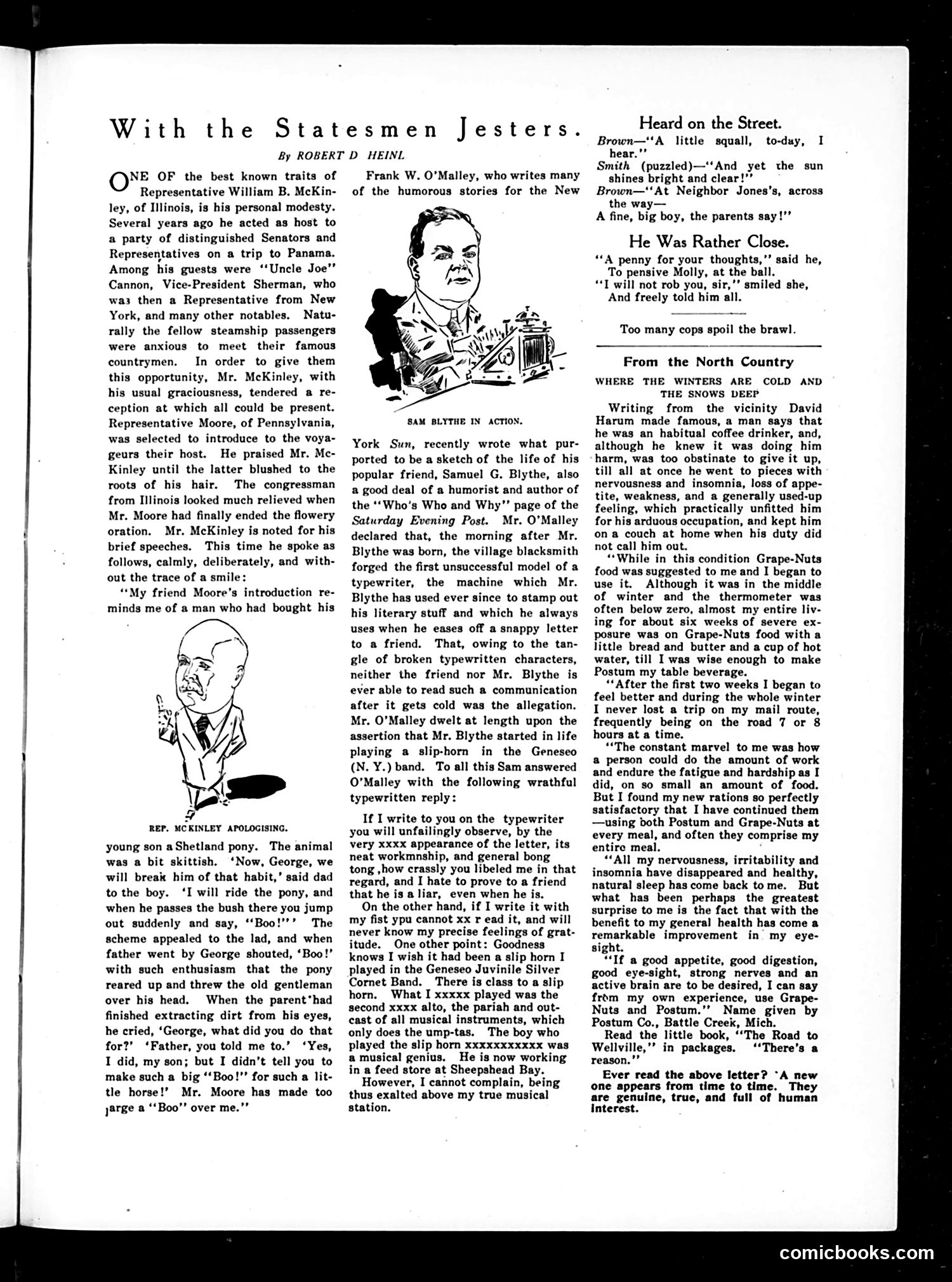
This page from *Judge* magazine contains humorous anecdotes about prominent American political figures and writers, circa early 1900s. **The McKinley Story:** Representative William B. McKinley of Illinois is portrayed as modestly deflecting excessive praise. His self-deprecating anecdote about a pony and an over-enthusiastic "Boo!" suggests his discomfort with Representative Moore's flowery introduction—the satire being McKinley's deadpan wit in response to flattery. **The Blythe-O'Malley Exchange:** Writer Frank W. O'Malley had humorously mocked fellow humorist Samuel G. Blythe, claiming he'd used the same broken typewriter since birth and once played in a band. Blythe's mock-angry typewritten reply (shown with intentional x's and typos) sarcastically "proves" O'Malley's points by demonstrating his typewriter's poor condition—a clever joke on himself. The satire pokes fun at both writers' competitive banter. Both pieces celebrate the wit of these public figures through self-deprecating humor.
📄 Transcribed text from this page (OCR, searchable)
Machine-transcribed from the original scan — historical spelling and the odd misread are preserved.
With the Statesmen Jesters. By ROBERT D HEINL NE OF the best known traits of Representative William B. McKin- ley, of Illinois, is his personal modesty. Several years ago he acted as host to a party of distinguished Senators and Representatives on a trip to Panama. Among his guests were ‘‘Uncle Joe’ Cannon, Vice-President Sherman, who was then a Representative from New York, and many other notables. Natu- rally the fellow steamship passengers were anxious to meet their famous countrymen. In order to give them this opportunity, Mr. McKinley, with his usual graciousness, tendered a re- ception at which all could be present. Representative Moore, of Pennsylvani: was selected to introduce to the voya- geurs their host. He praised Mr. Mc- Kinley until the latter blushed to the roots of his hair. The congressman from Illinois looked much relieved when Mr. Moore had finally ended the flowery oration. Mr. McKinley is noted for his brief speeches. This time he spoke as follows, calmly, deliberately, and with- out the trace of a smile: “*My friend Moore’s introduction re- minds me of a man who had bought his REP. MCKINLEY APOLOGISING. young son aShetland pony. The animal was a bit skittish. ‘Now, George, we will break him of that habit,’ said dad to the boy. ‘I will ride the pony, and when he passes the bush there you jump out suddenly and say, ‘‘Boo!’”’’ The scheme appealed to the lad, and when father went by George shouted, ‘Boo!’ with such enthusiasm that the pony reared up and threw the old gentleman over his head. When the parent*had finished extracting dirt from his eyes, he cried, ‘George, what did you do that for?’ ‘Father, you told me to.’ ‘Yes, I did, my son; but I didn’t tell you to make such a big ‘‘Boo!’’ for such a lit- tle horse!’ Mr. Moore has made too j8rge a ‘Boo’? over me.’” Frank W. O'Malley, who writes many of the humorous stories for the New SAM BLYTHE IN ACTION. York Sun, recently wrote what pur- ported to be a sketch of the life of his popular friend, Samuel G. Blythe, also a good deal of a humorist and author of the ‘‘Who’s Who and Why”’ page of the Saturday Evening Post. Mr. O'Malley declared that, the morning after Mr. Blythe was born, the village blacksmith forged the first unsuccessful model of a typewriter, the machine which Mr. Blythe has used ever since to stamp out his literary stuff and which he always uses when he eases off a snappy letter to a friend. That, owing to the tan- gle of broken typewritten characters, neither the friend nor Mr. Blythe is ever able to read such a communication after it gets cold was the allegation. Mr. O'Malley dwelt at length upon the assertion that Mr. Blythe started in life playing a slip-horn in the Geneseo (N. Y.) band. To all this Sam answered O'Malley with the following wrathful typewritten reply: If I write to you on the typewriter you will unfailingly observe, by the very xxxx appearance of the letter, its neat workmnship, and general bong tong ,how crassly you libeled me in that regard, and I hate to prove to a friend that he is a liar, even when he is. On the other hand, if I write it with my fist ypu cannot xx r ead it, and will never know my precise feelings of grat- itude. One other point: Goodness knows I wish it had been a slip horn I played in the Geneseo Juvinile Silver Cornet Band. There is class to a slip horn. What I xxxxx played was the second xxxx alto, the pariah and out- cast of all musical instruments, which only does the ump-tas. The boy who played the slip horn xxxxxxxxxxx was a musical genius. He is now working in a feed store at Sheepshead Bay. However, I cannot complain, being thus exalted above my true musical station. Heard on the Street. ‘A little squall, to-day, I Brown. hear. Smith (puzzled)—‘‘And yet the sun shines bright and clear!’’ Brown—'‘At Neighbor Jones's, across the way— A fine, big boy, the parents say!’’ He Was Rather Close. “‘A penny for your thoughts,’’ said he, To pensive Molly, at the ball. “I will not rob you, sir,’’ smiled she, And freely told him all, Too many cops spoil the brawl. From the North Country WHERE THE WINTERS ARE COLD AND THE SNOWS DEEP Writing from the vicinity David Harum made famous, a man says that he was an habitual coffee drinker, and, although he knew it was doing him harm, was too obstinate to give it up, till all at once he went to pieces with nervousness and insomnia, loss of appe- tite, weakness, and a generally used-up feeling, which practically unfitted him for his arduous occupation, and kept him on a couch at home when his duty did not call him out. “While in this condition Grape-Nuts food was suggested to me and I began to use it, Although it was in the middle of winter and the thermometer was often below zero, almost my entire liv- ing for about six weeks of severe ex- posure was on Grape-Nuts food with a little bread and butter and a cup of hot water, till I was wise enough to make Postum my table beverage. “After the first two weeks I began to feel better and during the whole winter I never lost a trip on my mail route, frequently being on the road 7 or 8 hours at a time. “The constant marvel to me was how @ person could do the amount of work and endure the fatigue and hardship as I did, on so small an amount of food. But I found my new rations so perfectly satisfactory that I have continued them —using both Postum and Grape-Nuts at every meal, and often they comprise my entire meal. “All my nervousness, irritability and insomnia have disappeared and healthy, natural sleep has come back tome. But what has been perhaps the greatest surprise to me is the fact that with the benefit to my general health has come a remarkable improvement in my eye- sight. “If a good appetite, good digestion, good eye-sight, strong nerves and an active brain are to be desired, I can say from my own experience, use Grape- Nuts and Postum.’’ Name given by Postum Co., Battle Creek, Mich, Read the little book, ‘‘The Road to Wellville,’’ in packages. ‘‘There’s a reason.’”” Ever read the above letter? “A new one appears from time to time. They are genuine, true, and full of human interest. comicbooks.com