
A complete issue · 24 pages · 1911
Judge — December 2, 1911
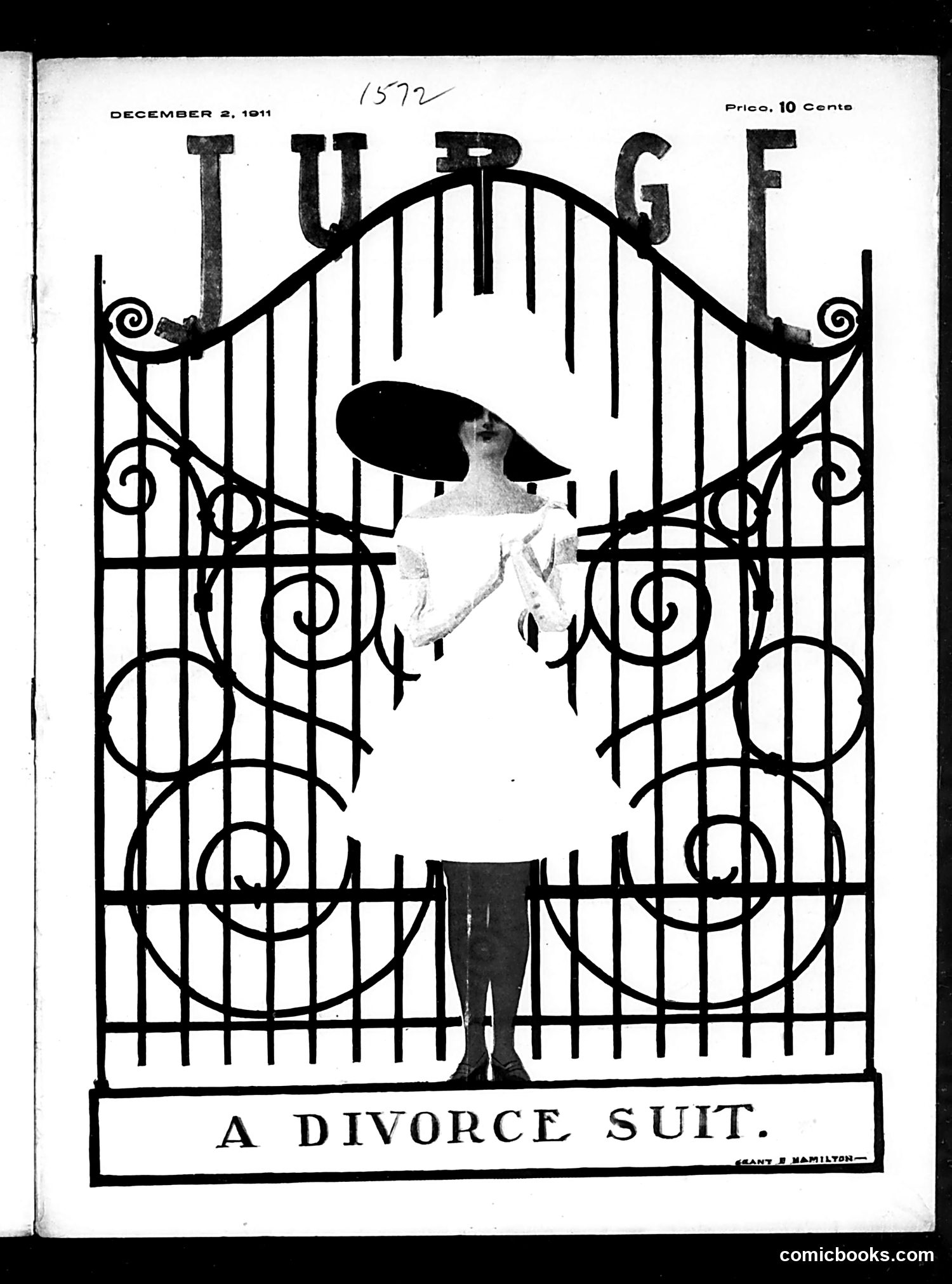
This cover cartoon satirizes divorce proceedings through a visual metaphor. A woman in an elegant white dress stands behind ornate iron gates labeled "JUDGE" — the gates themselves featuring decorative ironwork that frames her like a prisoner or specimen. The caption "A DIVORCE SUIT" puns on the legal term "suit" (lawsuit) and "suit" (clothing). The woman's fashionable dress represents the expensive clothing and material goods at stake in divorce settlements of the era, when women's access to property and money was heavily contested. The locked gate suggests the judicial system's role in controlling the dissolution of marriage and asset division. The satire critiques both the contentious nature of divorce proceedings and the focus on material wealth rather than human welfare during this period.
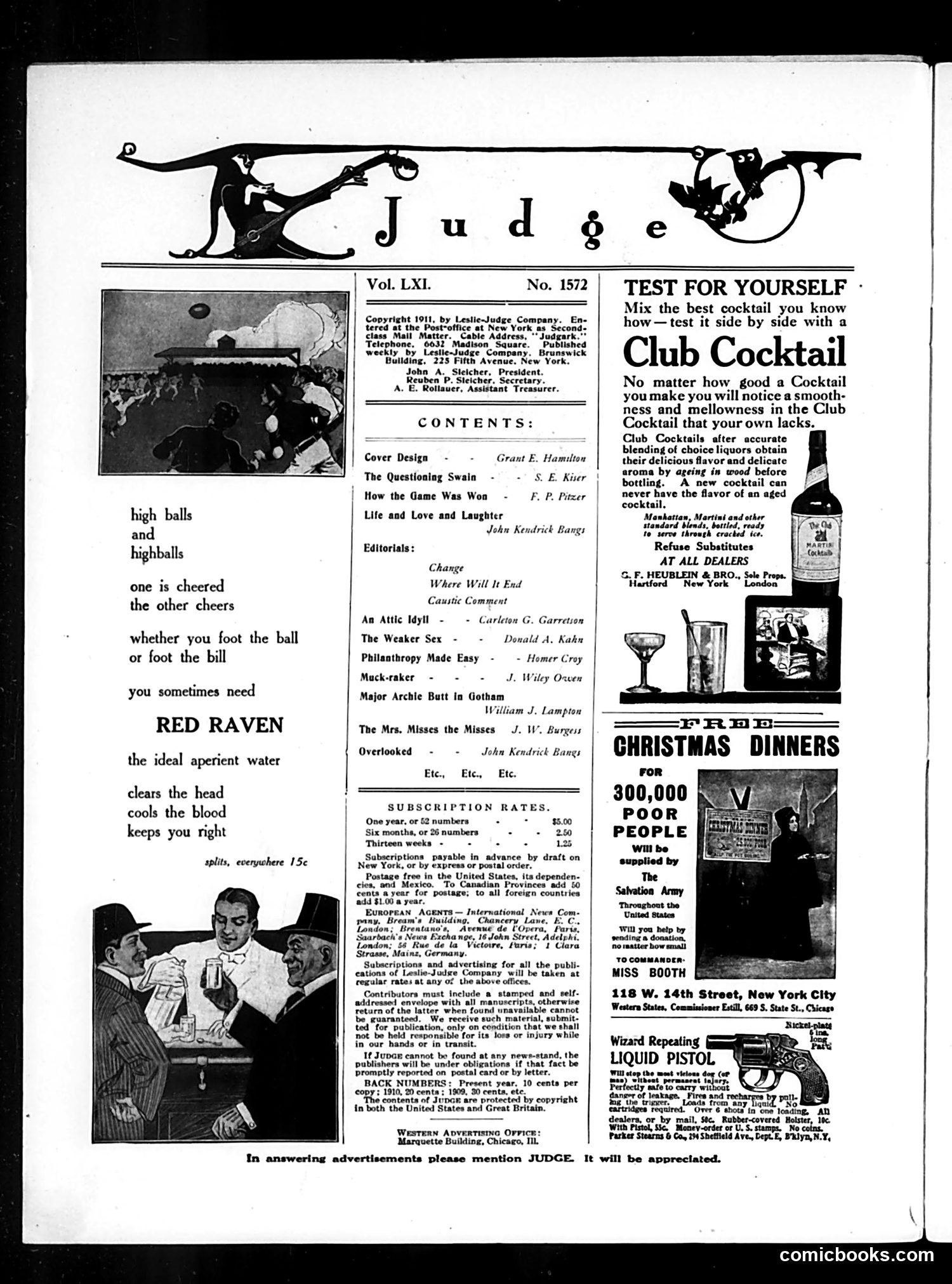
This page is primarily **advertising and editorial content** rather than political satire. The main cartoon shows a man in formal attire holding drinks, accompanying an advertisement for "Club Cocktail" liquor—likely promoting the product's smoothness and quality. The left sidebar contains a Red Raven aperitif advertisement with the phrase "high balls and highballs / one is cheered / the other cheers," a pun on sports terminology and drinking culture. The bottom right advertises Christmas dinners for 300,000 poor people supplied by the Salvation Army, reflecting 1911 charitable efforts during economic hardship. Overall, this is a typical Judge magazine page mixing light humor, social commentary, and commercial advertisements targeting affluent readers.
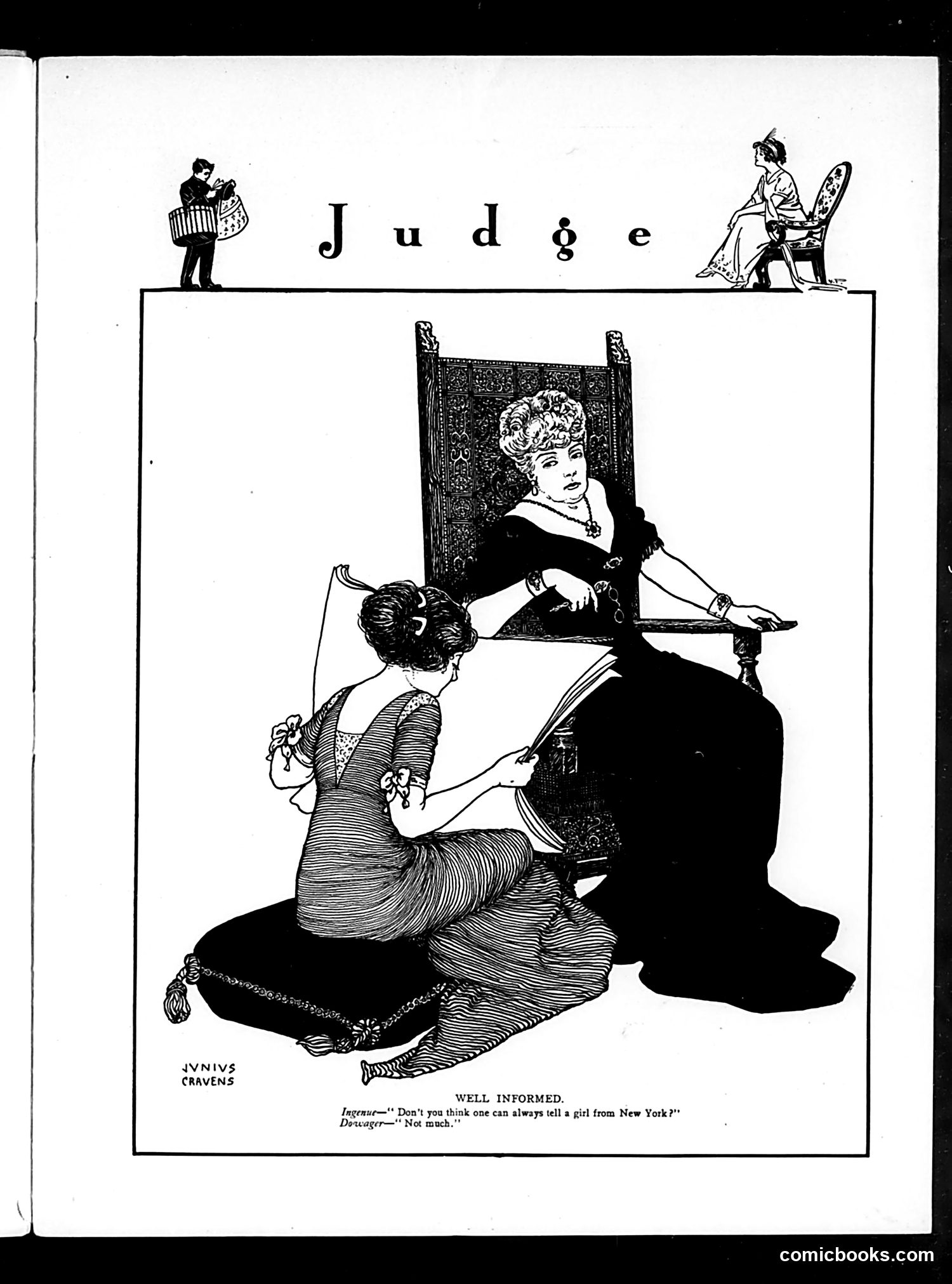
This cartoon satirizes gender stereotypes about women's knowledge and sophistication. The caption presents a dialogue between an *Ingenue* (naive young woman) and a *Debutante* (socially established woman): **Ingenue:** "Don't you think one can always tell a girl from New York?" **Debutante:** "Not much." The humor relies on the ingenue's assumption that New York girls possess distinctive refinement or worldliness, while the debutante dismissively suggests this isn't true—implying that girls claiming sophistication are often indistinguishable from those without such pretense. The illustration shows two women in an intimate, gossiping moment with an older woman supervising from a chair above, adding commentary on social hierarchies and women's private conversations about appearance and status. The satire targets both female vanity and false claims of cosmopolitan superiority.
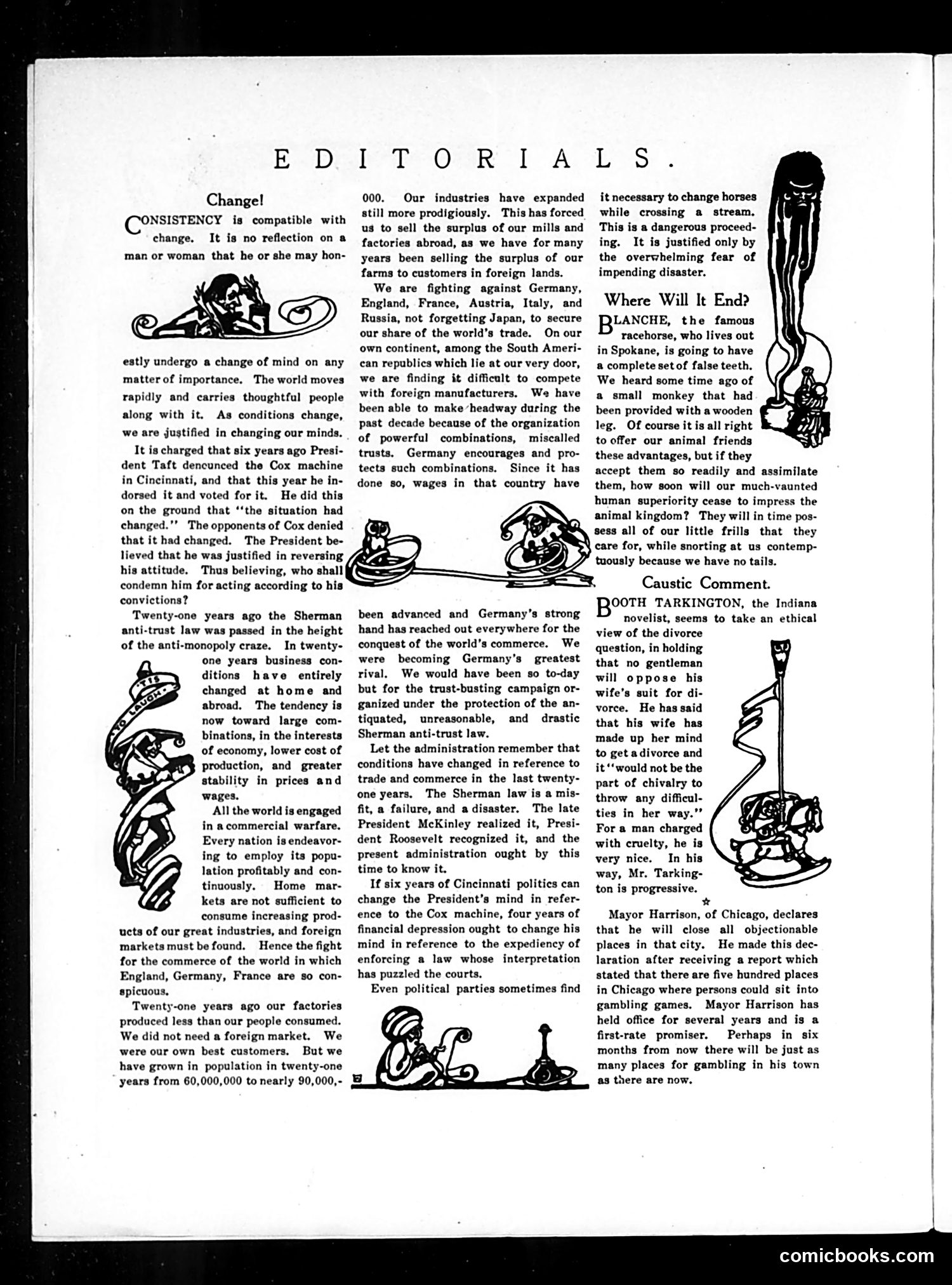
This page contains three editorial pieces satirizing early 20th-century American politics and social issues. **"Change!"** argues that President Taft's shift from Roosevelt's anti-monopoly stance was justified by altered economic conditions. The Cox machine reference appears to relate to Cincinnati politics. **"Where Will It End?"** mocks the advantages offered to racehorses (false teeth, a monkey companion) while questioning whether humans will soon demand similar absurd accommodations. **"Caustic Comment"** discusses novelist Booth Tarkington's ethical stance on divorce, while a separate item criticizes Chicago Mayor Harrison's insufficient efforts closing gambling establishments—suggesting he's complicit with corruption. The cartoons employ anthropomorphized animals and exaggerated scenarios typical of Judge's satirical style to critique political hypocrisy and social inconsistency.
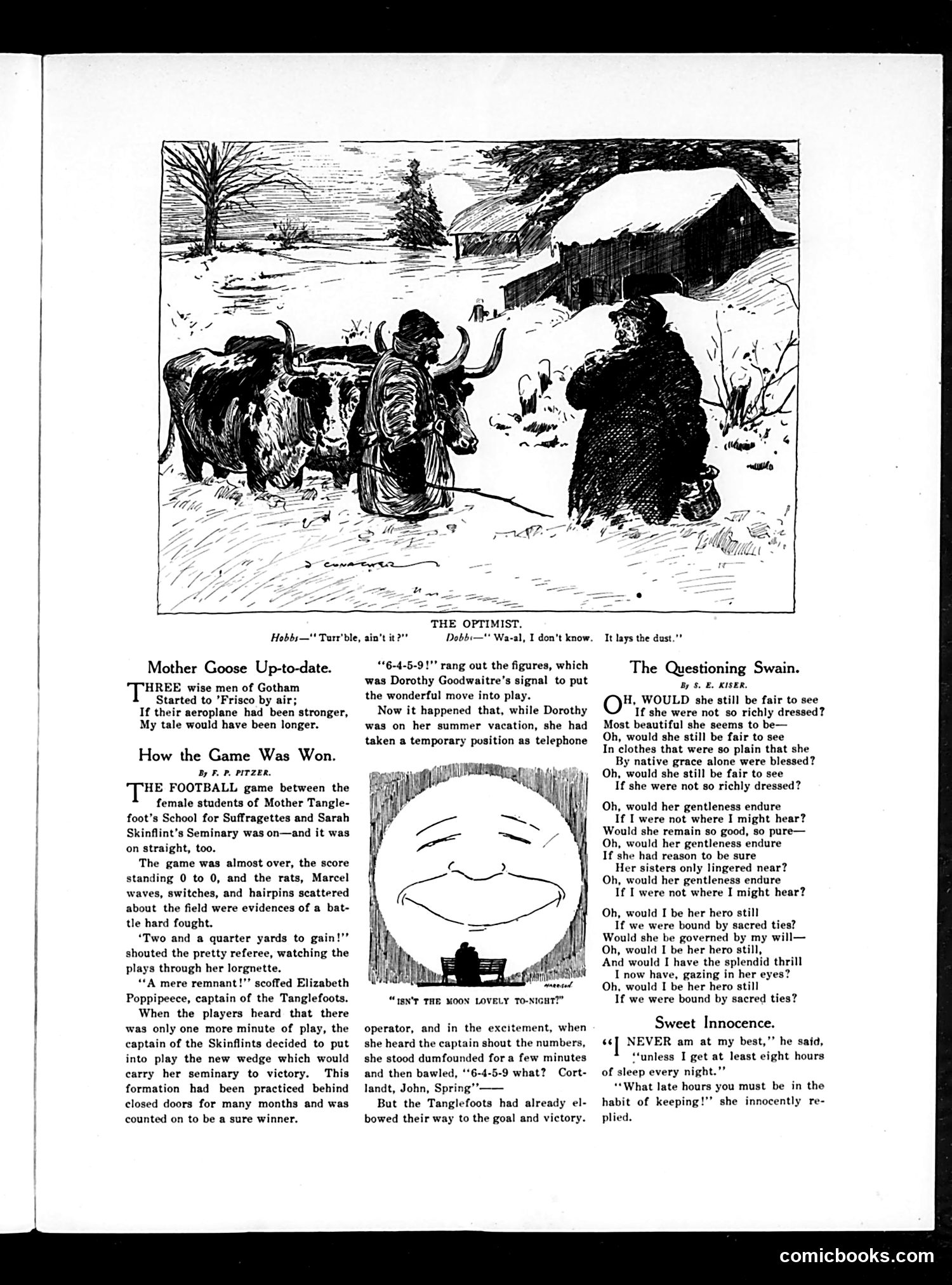
The top illustration depicts a winter rural scene with two figures and oxen, captioned "The Optimist" with dialogue about laying dares. This appears to be a generic humorous scene rather than political satire. Below are several short stories and poems: "Mother Goose Up-to-date" modernizes the nursery rhyme; "How the Game Was Won" describes a football victory at a female seminary through unconventional tactics; "The Questioning Swain" is a romantic poem; and "Sweet Innocence" is a brief anecdote about sleep habits. The page contains a simple cartoon face sketch labeled "ISN'T THE MOON LOVELY TO-NIGHT?" This page appears to be primarily **humorous fiction and light verse** rather than political satire. The content focuses on domestic life, romance, and whimsy typical of Judge's entertainment sections.
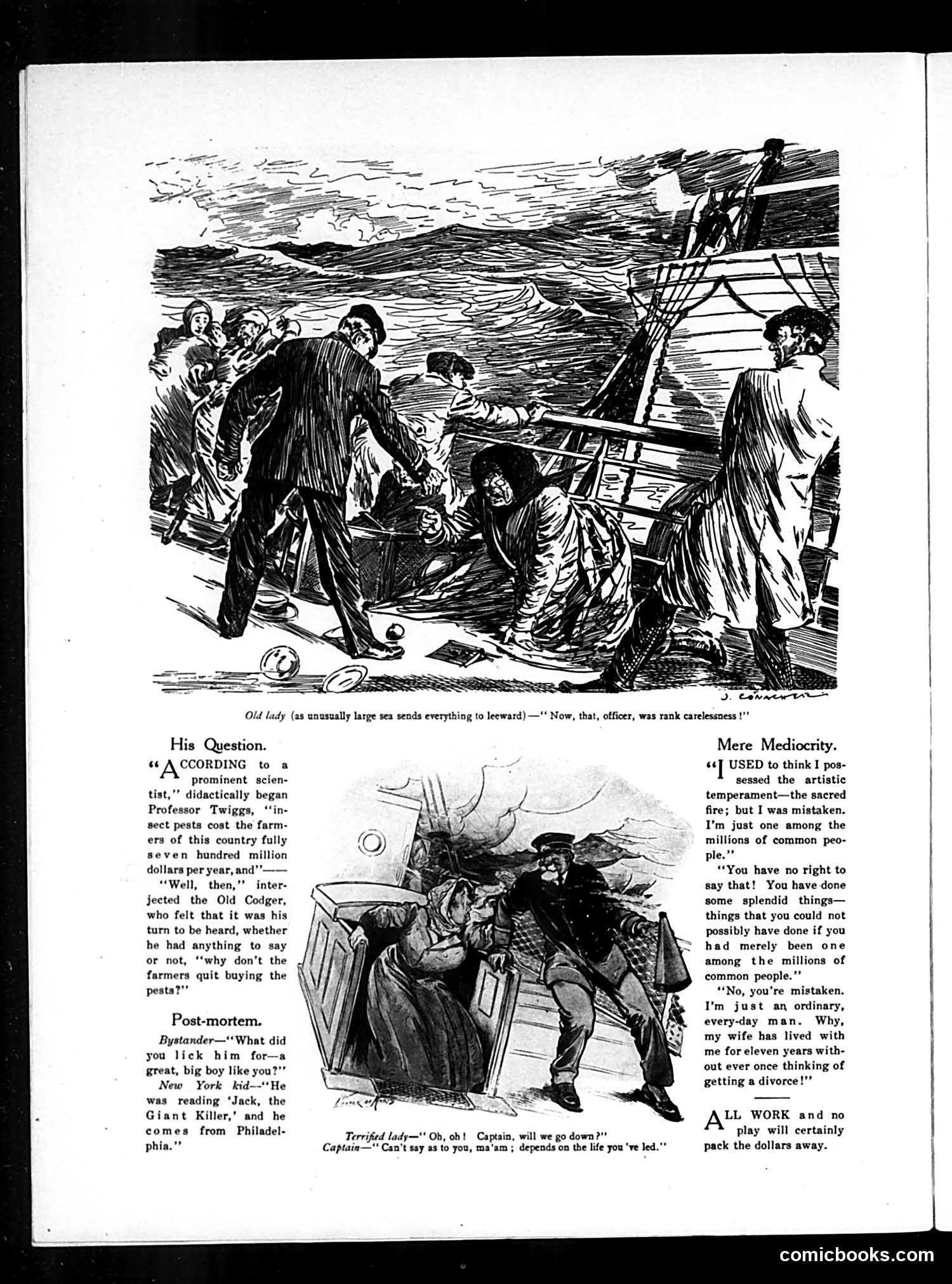
This page contains four separate satirical pieces typical of Judge's humor: 1. **Top cartoon**: A ship in rough seas. An elderly woman scolds an officer for "rank carelessness" as a wave swamps the deck—satirizing how passengers blame crew for circumstances beyond anyone's control. 2. **"His Question"**: Professor Twiggs cites statistics about insect damage costing farmers $700 million annually. An old codger interrupts with obvious logic: why don't farmers stop *buying* the pests? The joke mocks pseudo-intellectual lectures that overlook simple solutions. 3. **"Post-mortem"**: A New York child explains beating a Philadelphia boy who was reading "Jack the Giant Killer"—because the boy comes from Philadelphia (a rival city). This satirizes childish regional prejudices. 4. **"Mere Mediocrity"**: A man claims ordinariness; a friend argues he's accomplished too much to be ordinary. The punchline: his wife hasn't sought divorce in eleven years—equating marital stability with mediocrity. Dark humor about marriage. 5. **"Terrified Lady"**: A drowning woman asks if they'll sink; the captain says it depends on "the life you've led"—suggesting moral judgment determines survival.
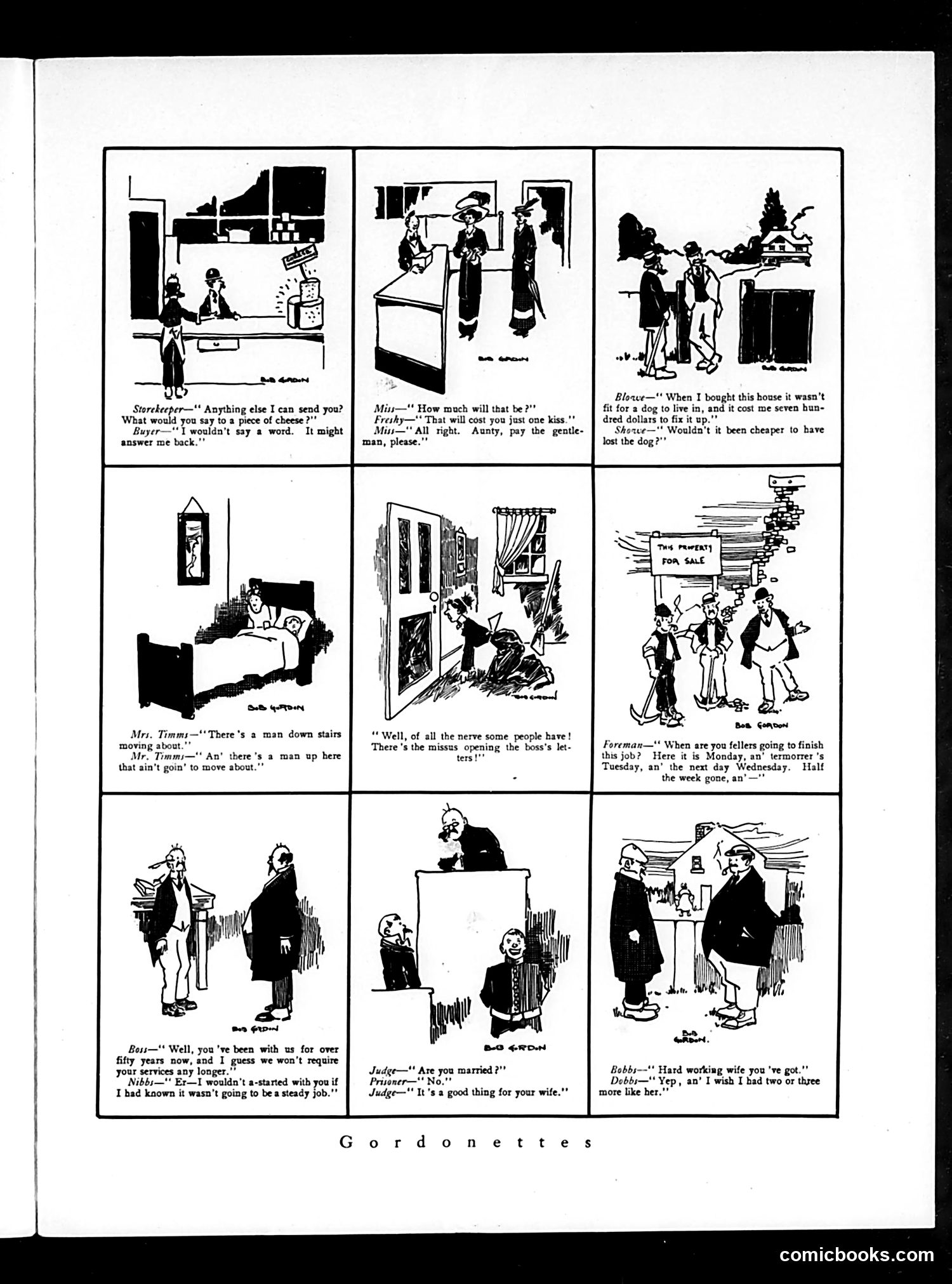
This page from *Judge* magazine collects nine separate single-panel joke comics, typical of early 20th-century American humor magazines. The cartoons feature everyday social situations used for satirical effect: **Key recurring themes:** - **Marital discord**: Multiple jokes mock wives and husbands, particularly wives' perceived nagging or interference (opening the boss's letters) - **Class dynamics**: Servant/employer relationships, payment negotiations, and social awkwardness - **Working-class struggles**: An employee fired after 50 years; workers questioned about delays - **Gender satire**: Women portrayed as troublesome (the judge's quip about the prisoner's hypothetical wife; the complaint about a "hard working wife") **The humor** relies on period stereotypes: shrewd business dealings, spousal incompatibility, and workplace hierarchy. The "Gordonettes" byline suggests cartoonist attribution rather than a coherent narrative. These jokes would resonate with *Judge*'s audience through relatable domestic and workplace frustrations, though the misogynistic undertone—particularly the equation of marriage with burden—reflects attitudes now considered dated.
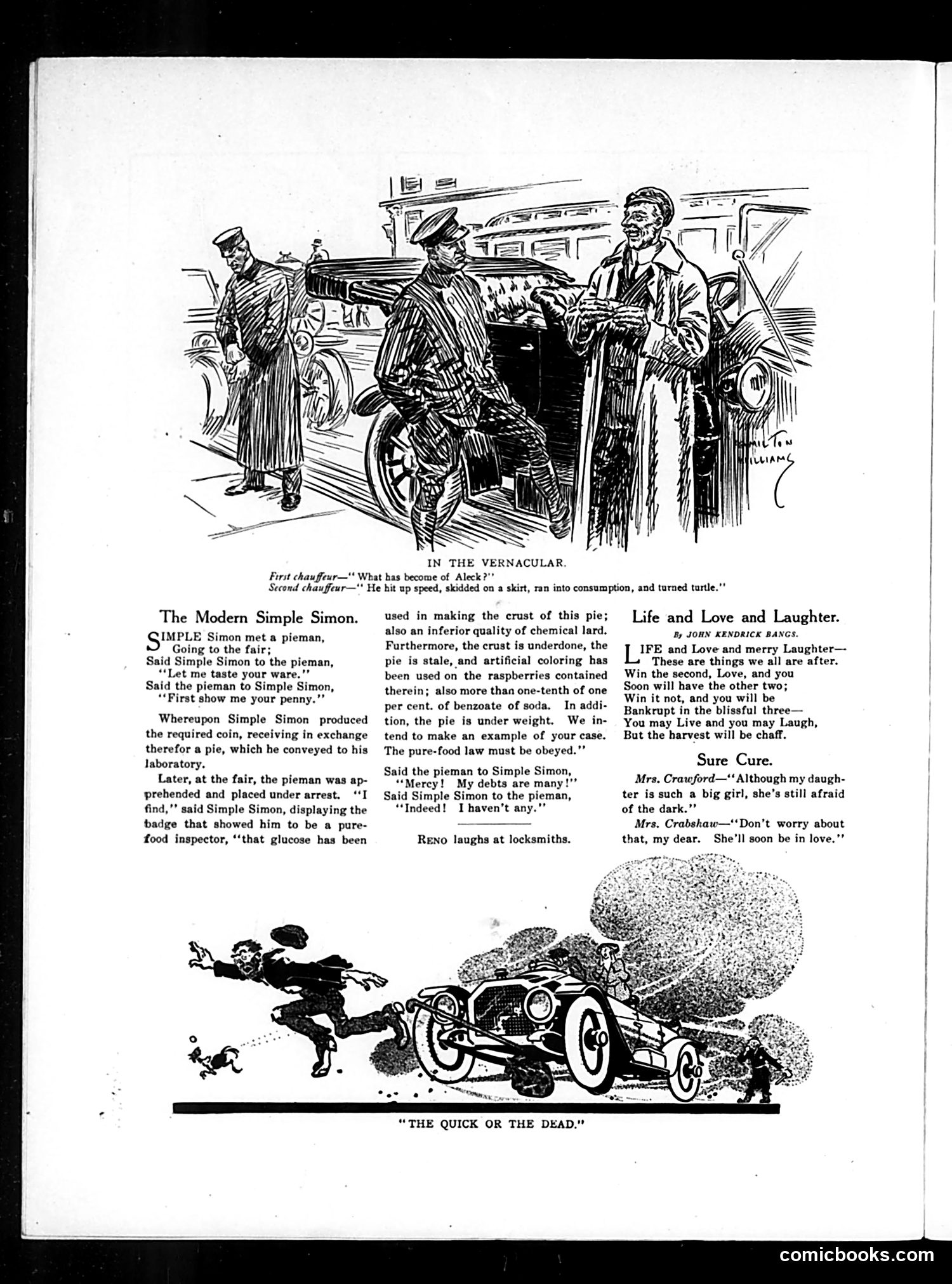
**"The Modern Simple Simon"** updates the nursery rhyme to mock early 20th-century food safety enforcement. A pure-food inspector poses as a customer, purchases a pie, then arrests the baker for violations (glucose in crust, inferior lard, underweight product, artificial coloring, excess soda benzoate). The joke: the pieman claims poverty while the "Simple Simon" inspector claims to have no debts—suggesting inspectors were seen as either overzealous bureaucrats or uncomfortably wealthy. This satirizes the **Pure Food and Drug Act** (1906), a progressive reform that established federal food safety standards. Judge magazine mocks both the law's strict enforcement and the inspectors' apparent hypocrisy or absurdity. **"The Quick or the Dead"** cartoon depicts a reckless motorist ("hit up speed, skidded...ran into consumption, turned turtle") as a danger to pedestrians and small animals, satirizing dangerous early automobile culture. The remaining pieces are humorous verse and social jokes unrelated to political satire.
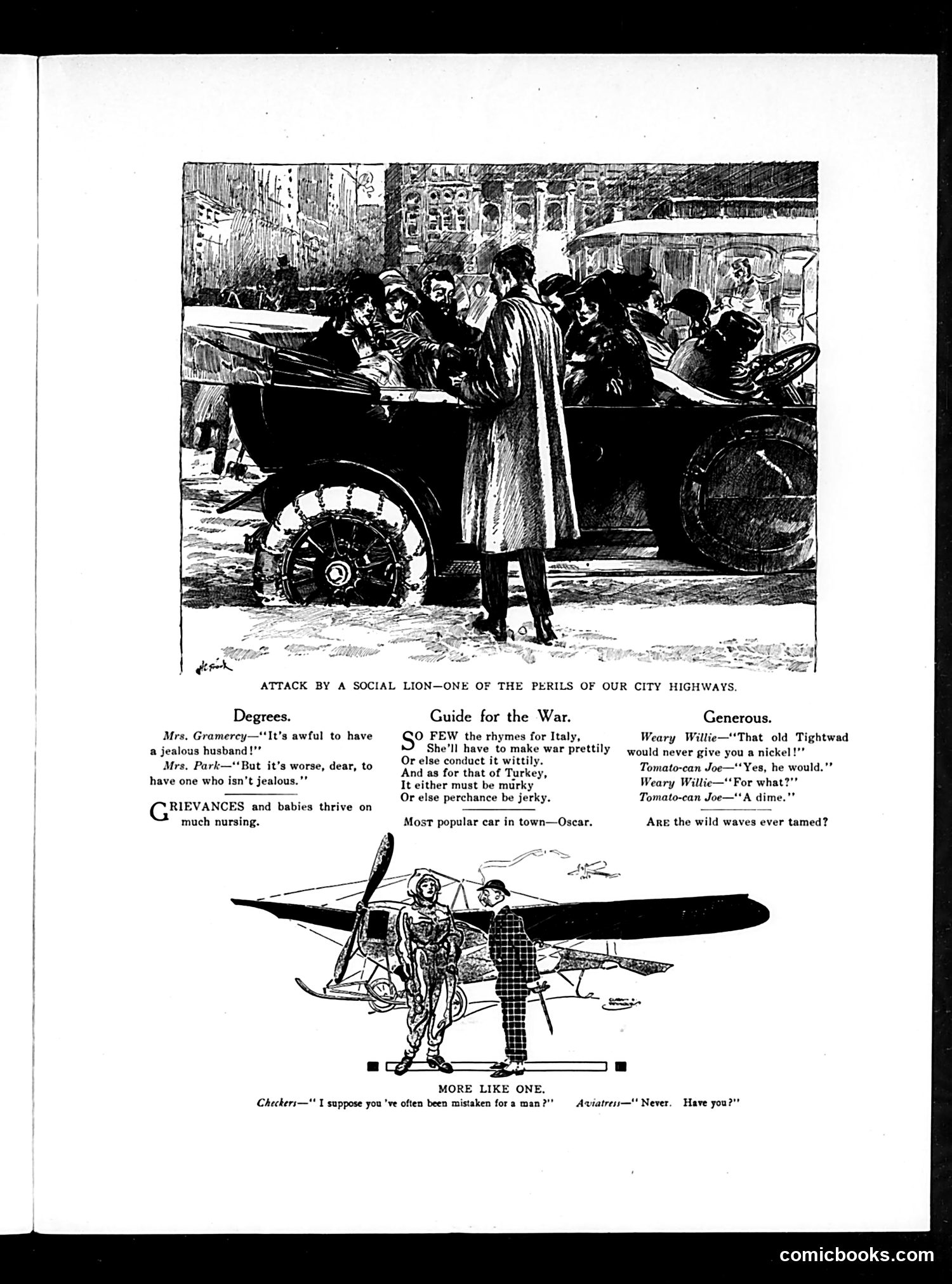
The top cartoon satirizes wealthy society women ("social lions") as hazards to traffic. A well-dressed woman stands before automobiles on a city street, captioned as a "peril of our city highways"—the joke being that fashionable ladies distract drivers or cause accidents through their prominence and self-importance. Below are three separate joke sections: "Degrees" mocks marital jealousy among society women; "Guide for the War" appears to reference WWI (Italy and Turkey are mentioned), joking about writing patriotic verse; "Generous" presents hobo dialogue about stingy wealthy men. The bottom cartoon features an aviator and "aviatress" (female pilot) making a joke about gender: when asked if she's been mistaken for a man, she retorts "Never. Have you?"—suggesting the male pilot appears feminine or unmanly. The page satirizes American high society, gender roles, and early aviation's novelty, likely from the WWI era.
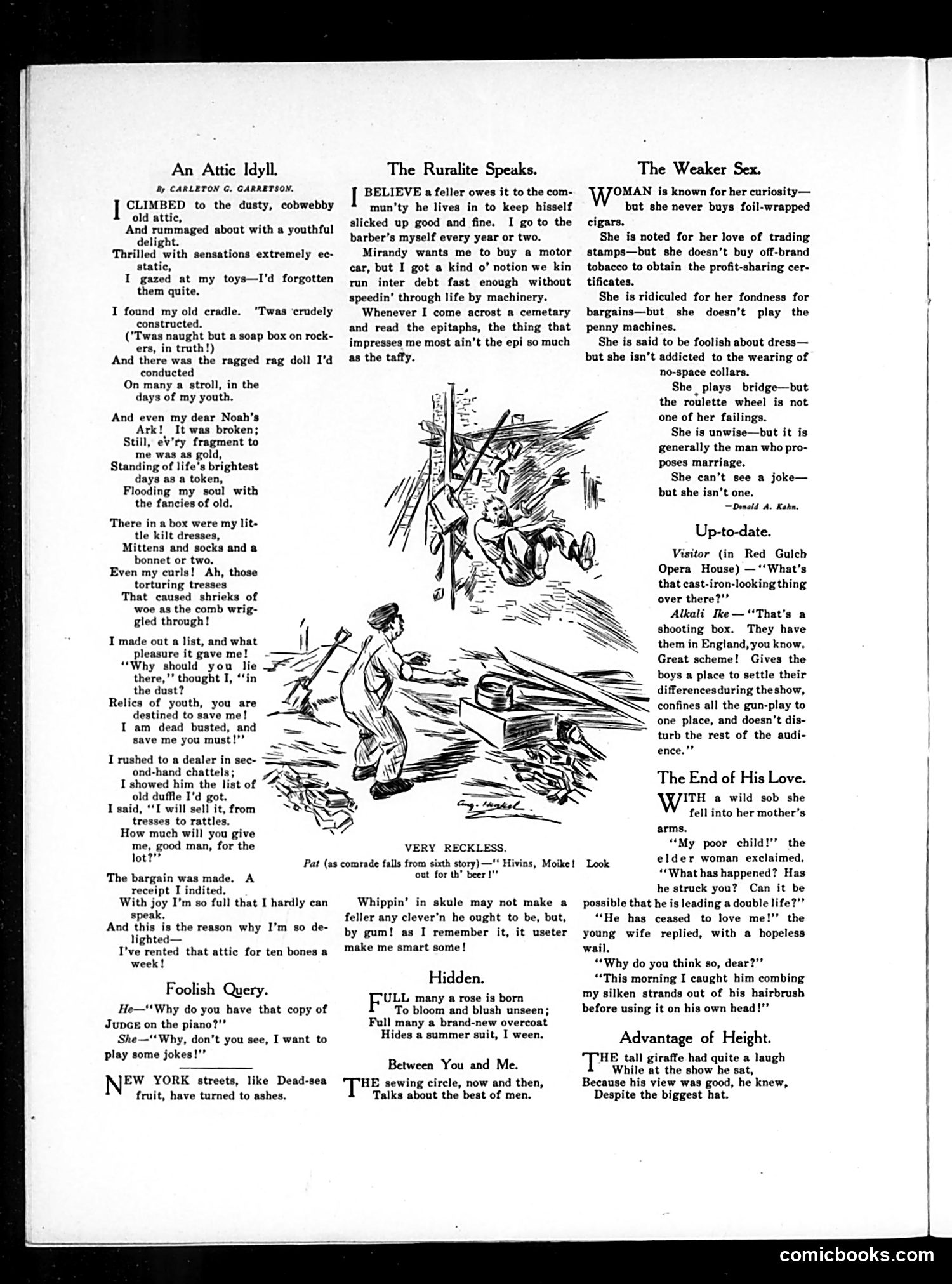
This Judge magazine page contains multiple satirical pieces typical of early-20th-century American humor: **"An Attic Idyll"** (poem): A nostalgic narrator finds childhood toys in an attic, initially moved by memories, then cynically sells them because he's broke ("dead busted"). The satire targets financial desperation masked by sentimentality. **"The Ruralite Speaks"**: Rural stereotypes—a farmer espouses modest values (yearly haircuts, avoiding motor cars) while his wife wants modern conveniences. The satire gently mocks rural conservatism. **"The Weaker Sex"**: A series of contradictions about women—they're supposedly illogical about shopping yet make sensible choices; can't appreciate jokes yet aren't foolish. The satire ironically defends women by exposing male stereotyping as baseless. **Miscellaneous items**: "Very Reckless" (a drunk falls from a building), "Hidden" (new overcoats hide summer suits—Depression-era thriftiness), and "Up-to-date" (a Western saloon has a "shooting box" to contain gunfights). The overall tone is light domestic and social satire.
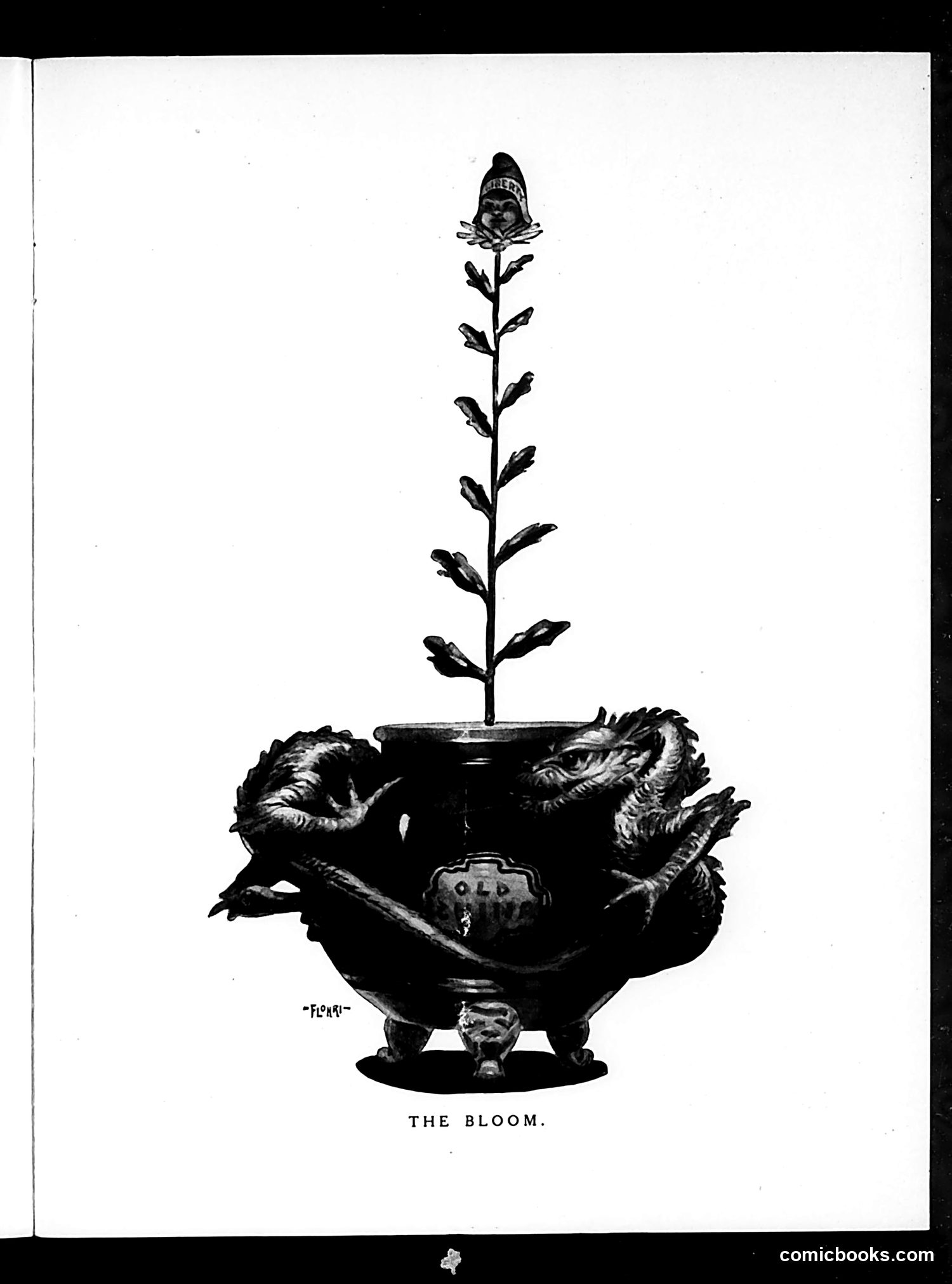
This cartoon from *Judge* magazine depicts a demonic or grotesque creature holding a large cauldron or vessel from which a single plant stem with leaves emerges, topped by a flower with a human face wearing a hat. The title "The Bloom" suggests the cartoon satirizes something growing from corruption or evil sources. The creature's monstrous form likely represents either a political opponent, corrupt institution, or malevolent force. The delicate flower emerging from this grotesque base creates ironic contrast—suggesting something beautiful or innocent is actually rooted in something dark or sinister. Without additional context (date, byline, or accompanying article text), the specific political target remains unclear, though the allegorical technique was common in *Judge*'s political satire.
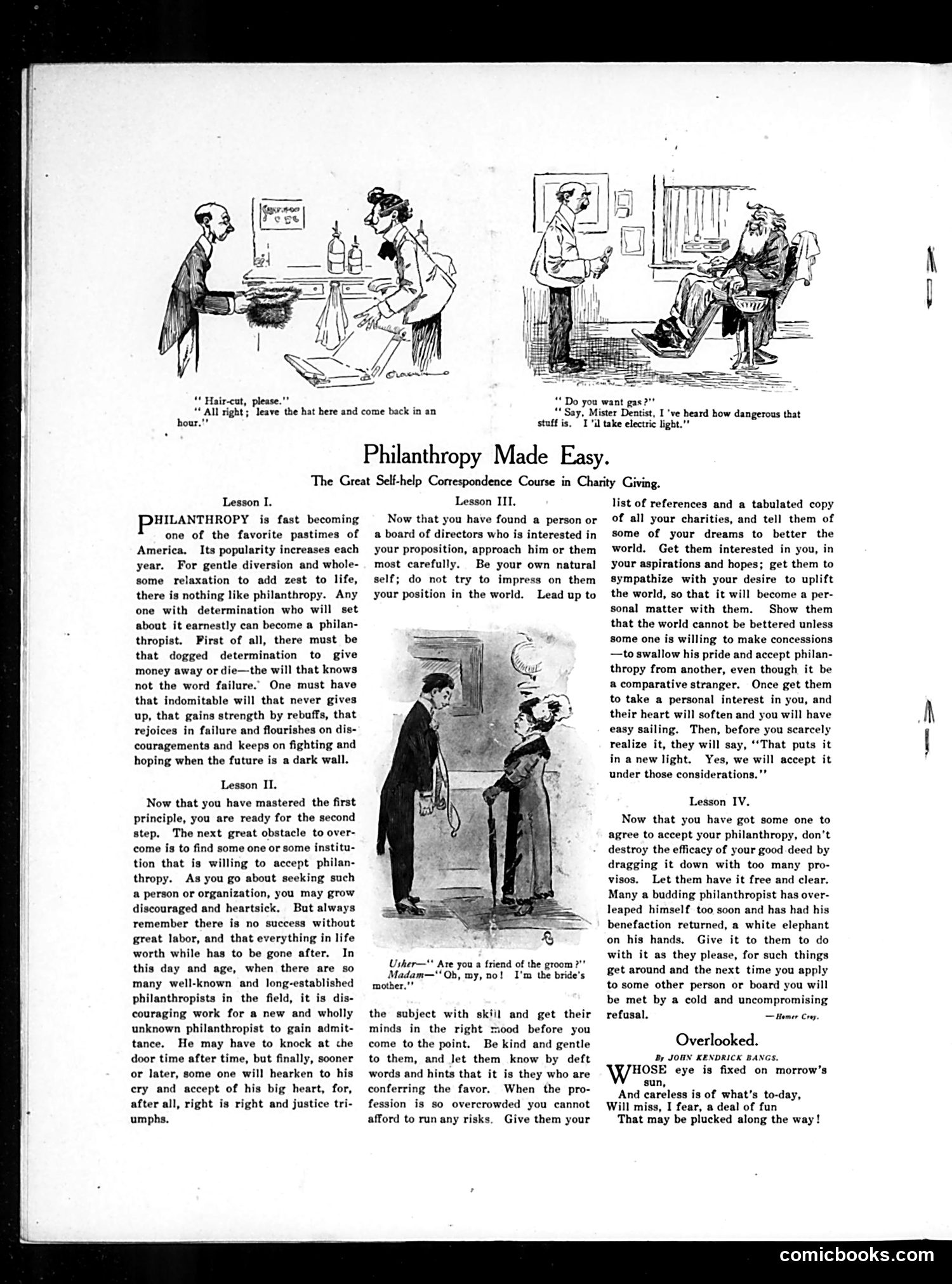
This satirical article mocks the *fashionable trend* of American philanthropy—presenting "charity giving" as an increasingly popular social pastime pursued by the wealthy. Judge sarcastically frames philanthropy as a self-centered endeavor requiring "dogged determination" and strategic marketing rather than genuine altruism. The satire's target: wealthy philanthropists who treat charity as a vanity project. The "correspondence course" format humorously suggests philanthropy requires instruction because donors struggle to find *willing* recipients—implying charities must flatter and manipulate wealthy givers into accepting their "generosity." Lesson IV's warning against "provisos" (strings attached) suggests donors impose controlling conditions on gifts. The joke throughout is that so-called "philanthropy" is actually narcissistic: donors care more about recognition, control, and self-image than genuine charitable impact. The scattered cartoons (a barber, a dentist) illustrate service providers with skeptical clients—mirroring the donor-recipient power dynamic.
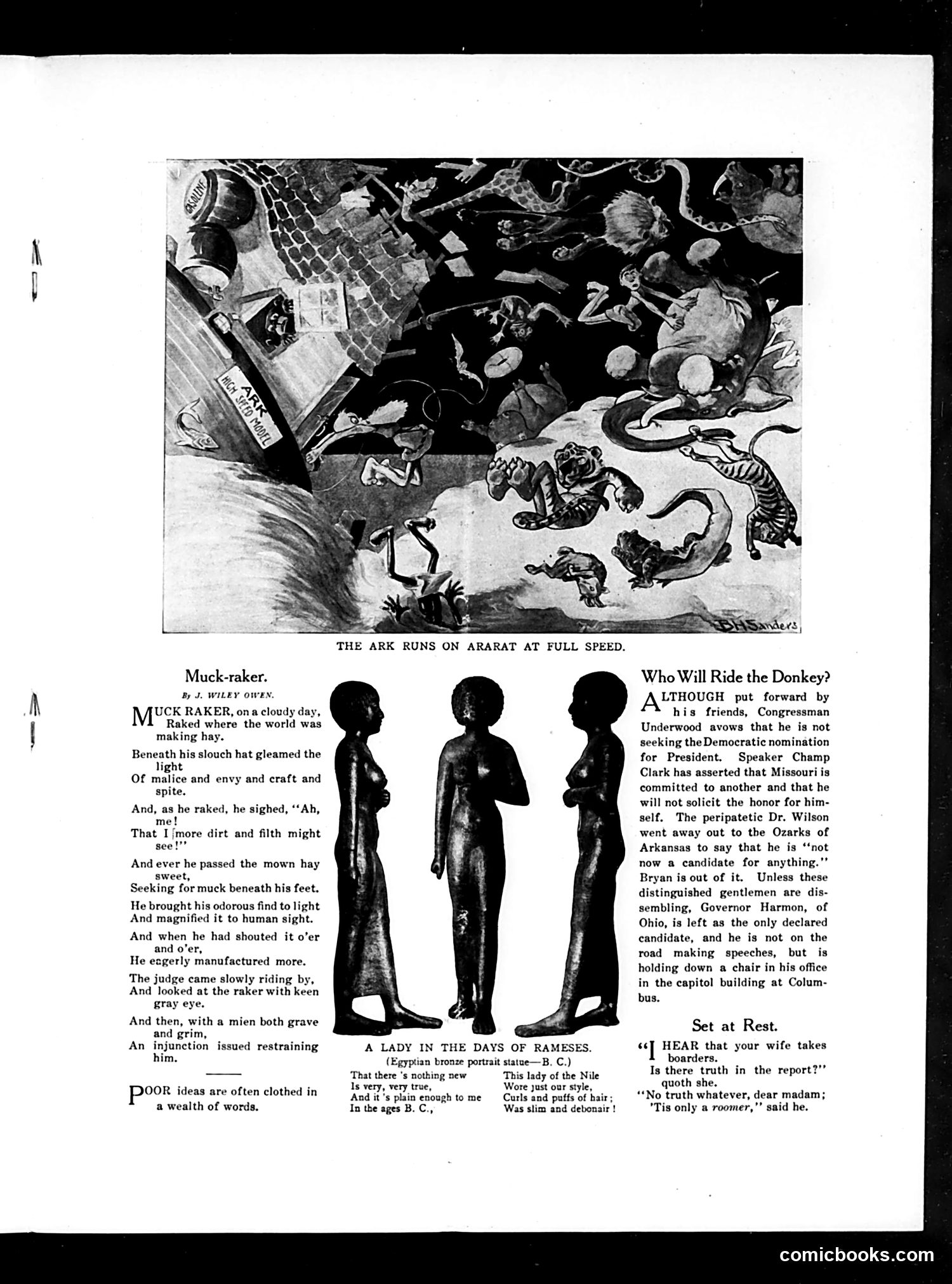
This Judge magazine page contains three distinct satirical pieces: **"Muck-raker"**: A poem attacking investigative journalists ("muckrakers") who expose corruption. The cartoon depicts a figure obsessively seeking scandal, manufacturing outrage, and spreading negativity. A judge issues an injunction against him—Judge magazine's editorial position that aggressive reform journalism should be legally restrained. **"A Lady in the Days of Rameses"**: A lighthearted observation that ancient Egyptian fashion (shown in a statue) mirrors modern women's styles, suggesting nothing is truly new. **"Who Will Ride the Donkey?"**: Political commentary on the 1912 Democratic presidential race. Multiple potential candidates (Underwood, Clark, Wilson, Bryan) publicly deny seeking nomination while maneuvering for it. Only Governor Harmon remains openly uncommitted. The "donkey" is the Democratic Party symbol—the satire suggests everyone wants to "ride" it (lead it) despite their denials. **"Set at Rest"**: A brief joke about euphemism—a wife taking "boarders" versus a "roomer" (sexual innuendo implied).
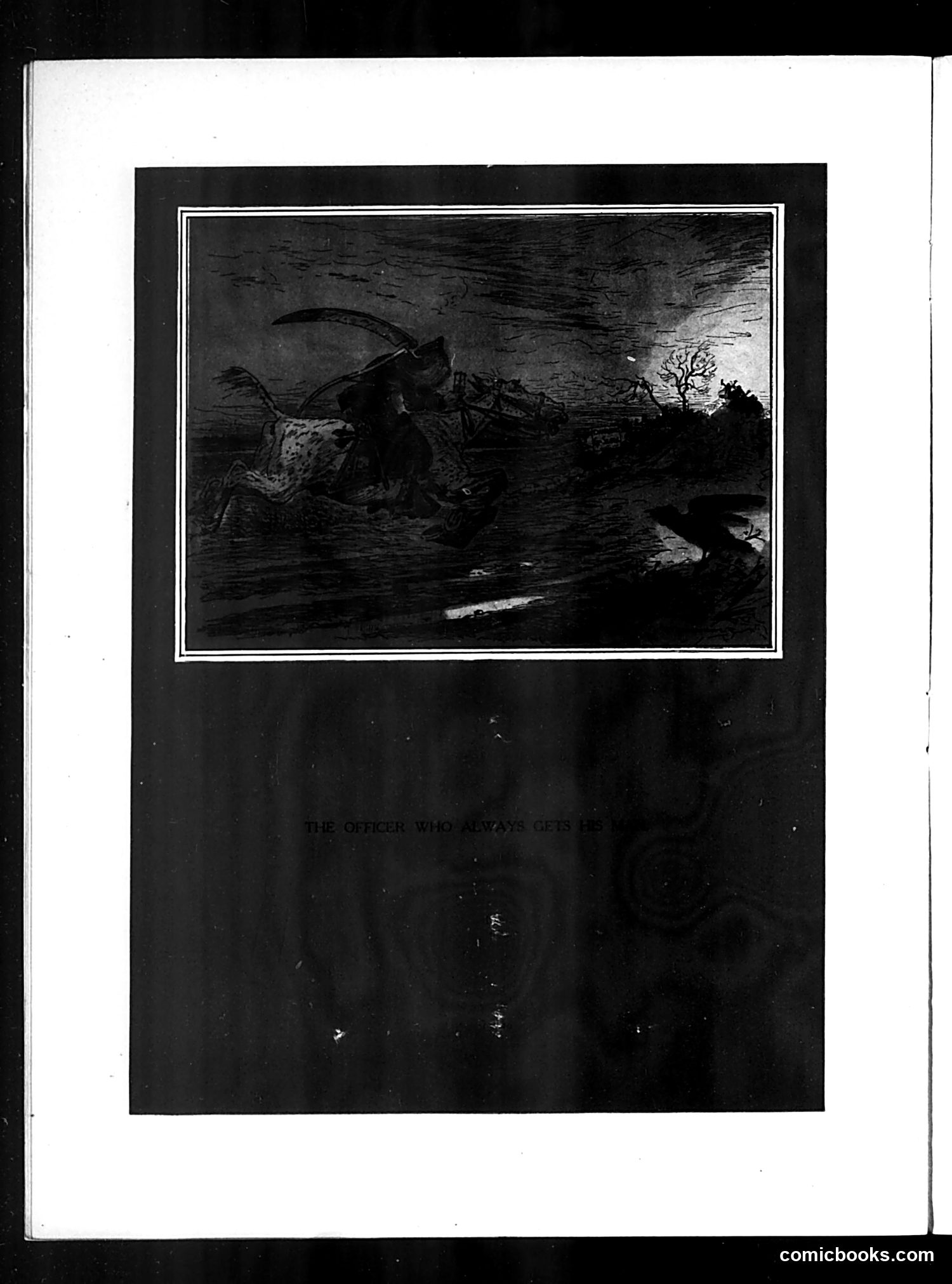
This page from *Judge* magazine features a dark, dramatic engraving depicting what appears to be a nighttime military or cavalry scene—a horseman in motion with what looks like a wagon or carriage in the background, set against a stormy sky. The caption reads: "THE OFFICER WHO ALWAYS GETS HIS MAN." Without additional context or visible publication date, the specific historical reference remains unclear. The phrase "gets his man" suggests this satirizes either a military officer known for successful captures/pursuits, or possibly critiques law enforcement overreach. The romantic, dramatic engraving style contrasts with the caption's implication, which may itself be part of the satire—perhaps mocking sensationalized accounts of military prowess or questioning the ethics of relentless pursuit.
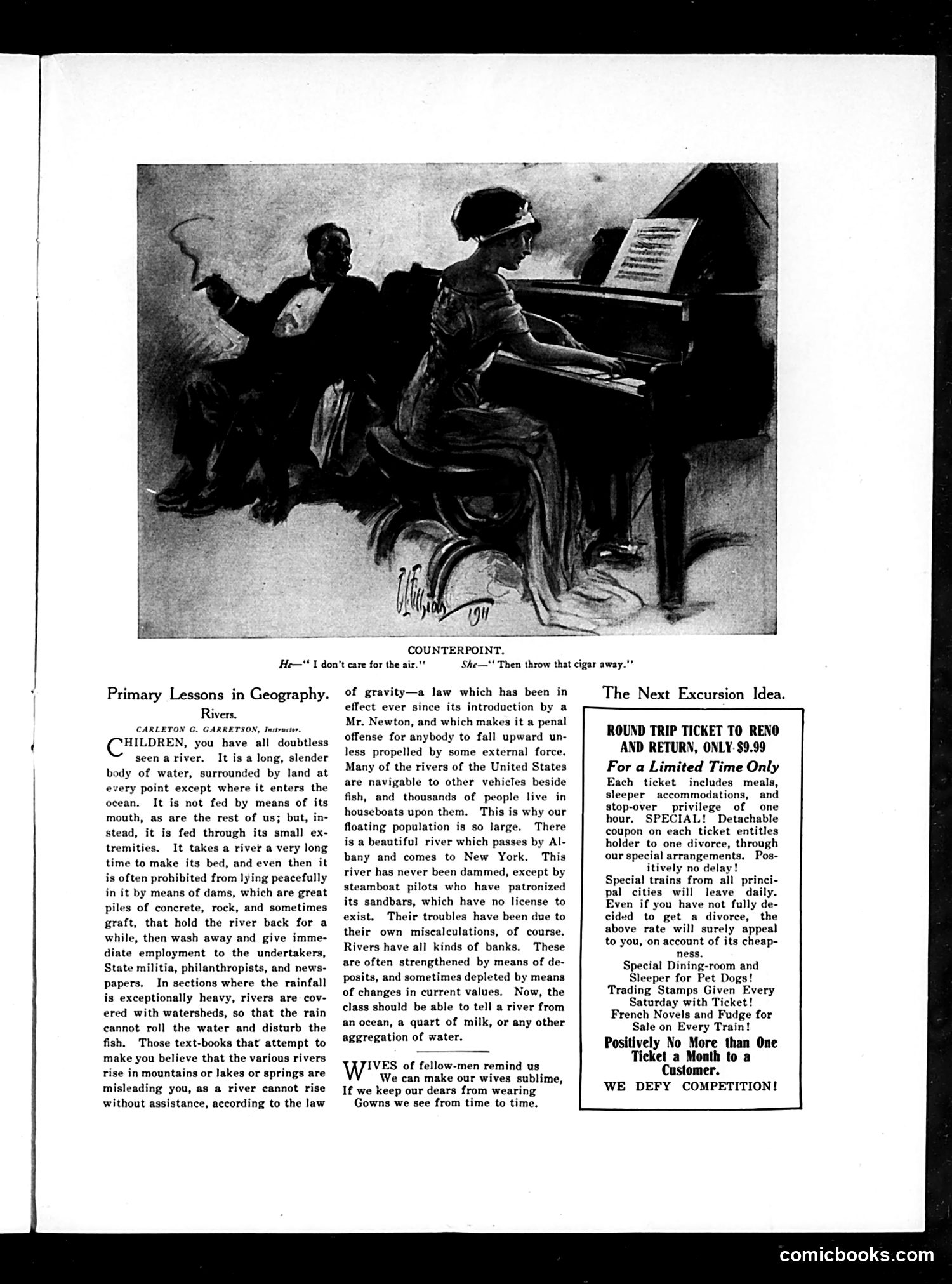
The page contains two satirical pieces: **"Counterpoint" (top cartoon):** A couple argues about air quality. He dismisses it; she retorts he should discard his cigar. The joke mocks marital bickering over minor grievances while ignoring larger issues. **"Primary Lessons in Geography" (main text):** A mock educational lecture deliberately misdefines rivers with absurd logic—claiming they're "fed" from small ends, that dams cause death ("employment to undertakers"), and that gravity prevents upward falling unless "propelled by external force." It's intellectual satire ridiculing pseudo-scientific explanations and bureaucratic incompetence. **"The Next Excursion Idea" (advertisement parody):** Advertises discount train tickets to Reno, Nevada—historically the divorce capital where people went for quick divorces. The satirical "perk" of including a divorce coupon and the limit of "one ticket a month per customer" mocks the era's high divorce rates and Reno's reputation as a divorce mill, treating it like a commercial commodity rather than serious legal matter.
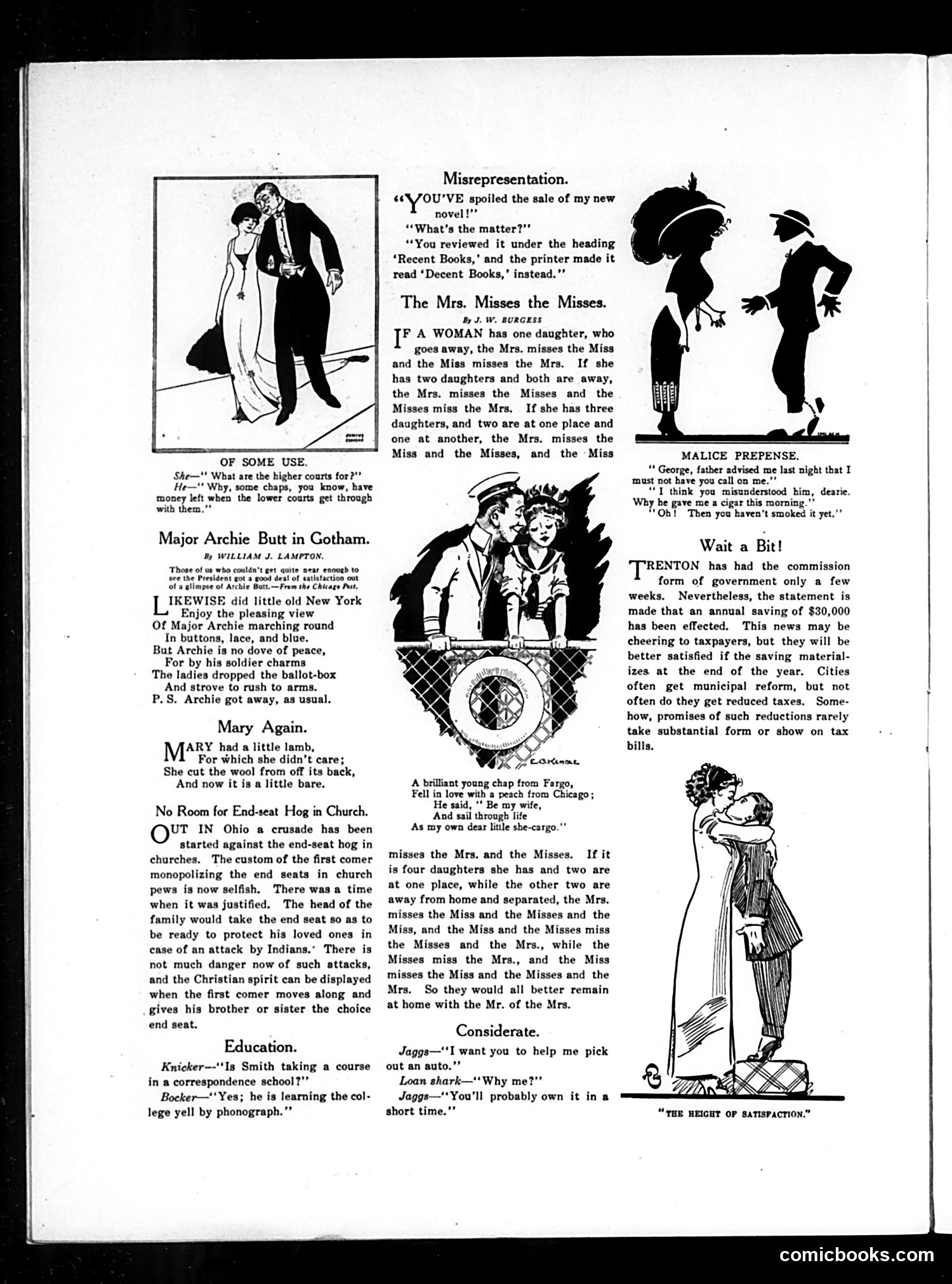
This page contains multiple short satirical pieces typical of Judge's early 20th-century humor: **"Major Archie Butt in Gotham"** celebrates a real presidential aide whose visit to New York caused public excitement. The satire mocks both the public's fascination with him and the ladies' romantic interest, ending with the dry observation that "Archie got away, as usual"—likely referencing his frequent travels. **"The Mrs. Misses the Misses"** is a linguistic tongue-twister satirizing the formality of addressing women by marital status ("Mrs." vs. "Miss"), playing on the repetitive confusion of who misses whom when daughters visit. **"No Room for End-seat Hog in Church"** critiques selfish pew behavior, noting the historical justification (protecting family from Indian attacks) is obsolete, so Christian charity should now apply. Other pieces lampoon: misread book reviews, correspondence school education via phonograph, municipal reform promises that don't materialize, and various romantic/social situations. The humor is genteel, pun-heavy, and focused on contemporary middle-class social conventions and etiquette.
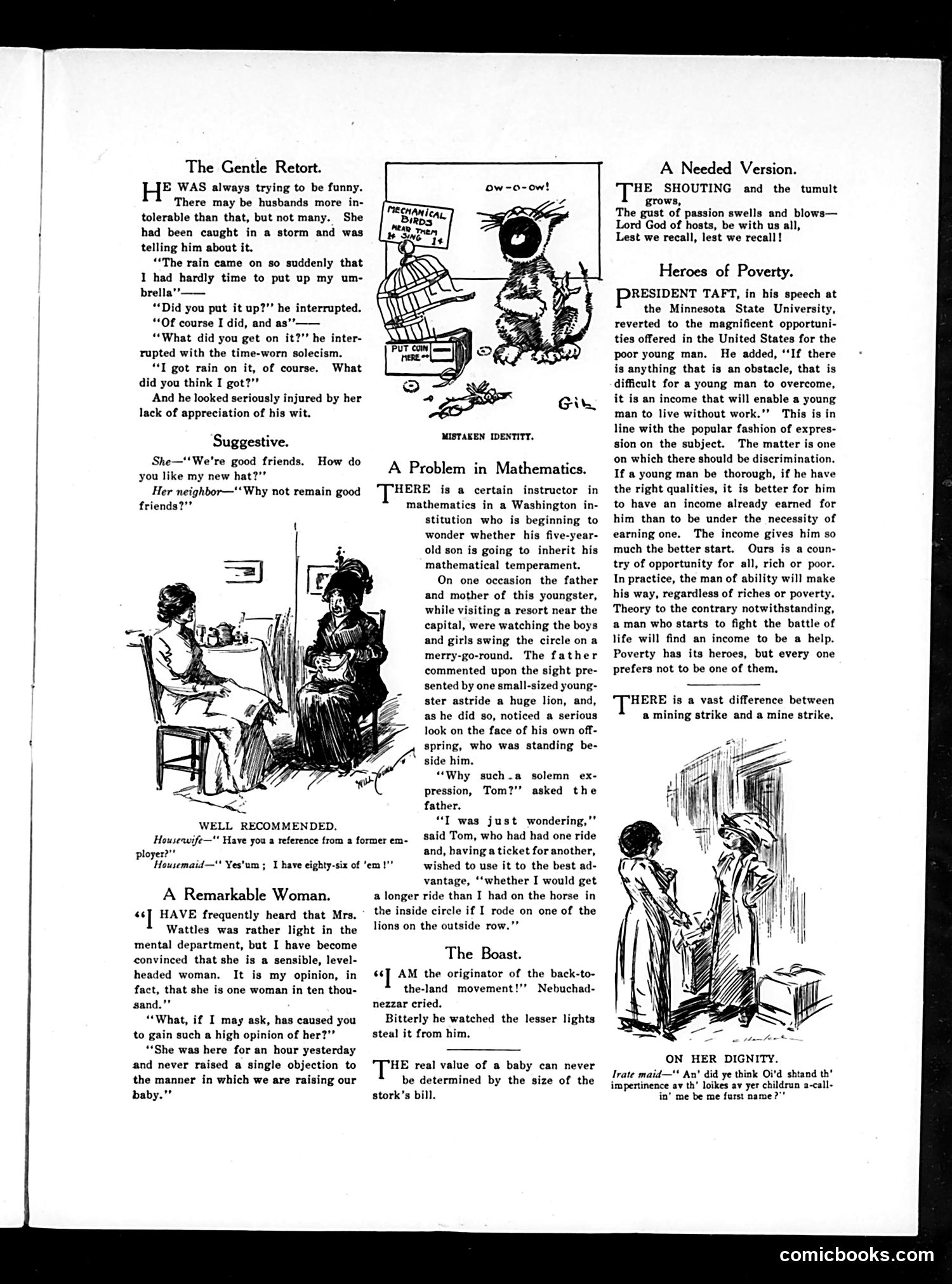
This page contains multiple short satirical pieces typical of early 20th-century American humor: **"The Gentle Retort"** mocks husbands who interrupt their wives with tired jokes. The husband makes a worn pun ("What did you get on it?") about rain on an umbrella, then feels hurt when she doesn't appreciate his wit—satirizing both predictable male humor and thin-skinned male egos. **"Suggestive"** uses a woman's blunt response to reject a friendship offer, implying the insult ("Why not remain good friends?") reveals their relationship was superficial. **"A Problem in Mathematics"** humorously depicts a child calculating optimal merry-go-round rides using geometry—satirizing overly analytical thinking. **"Heroes of Poverty"** critiques President Taft's recent speech claiming poverty builds character. Judge argues that inherited income actually helps talented young men succeed, directly contradicting Taft's moralizing about hardship as virtue. This reflects Progressive-era debates about economic opportunity versus inherited advantage. The other pieces are brief jokes on domestic life and vanity typical of the magazine's format.
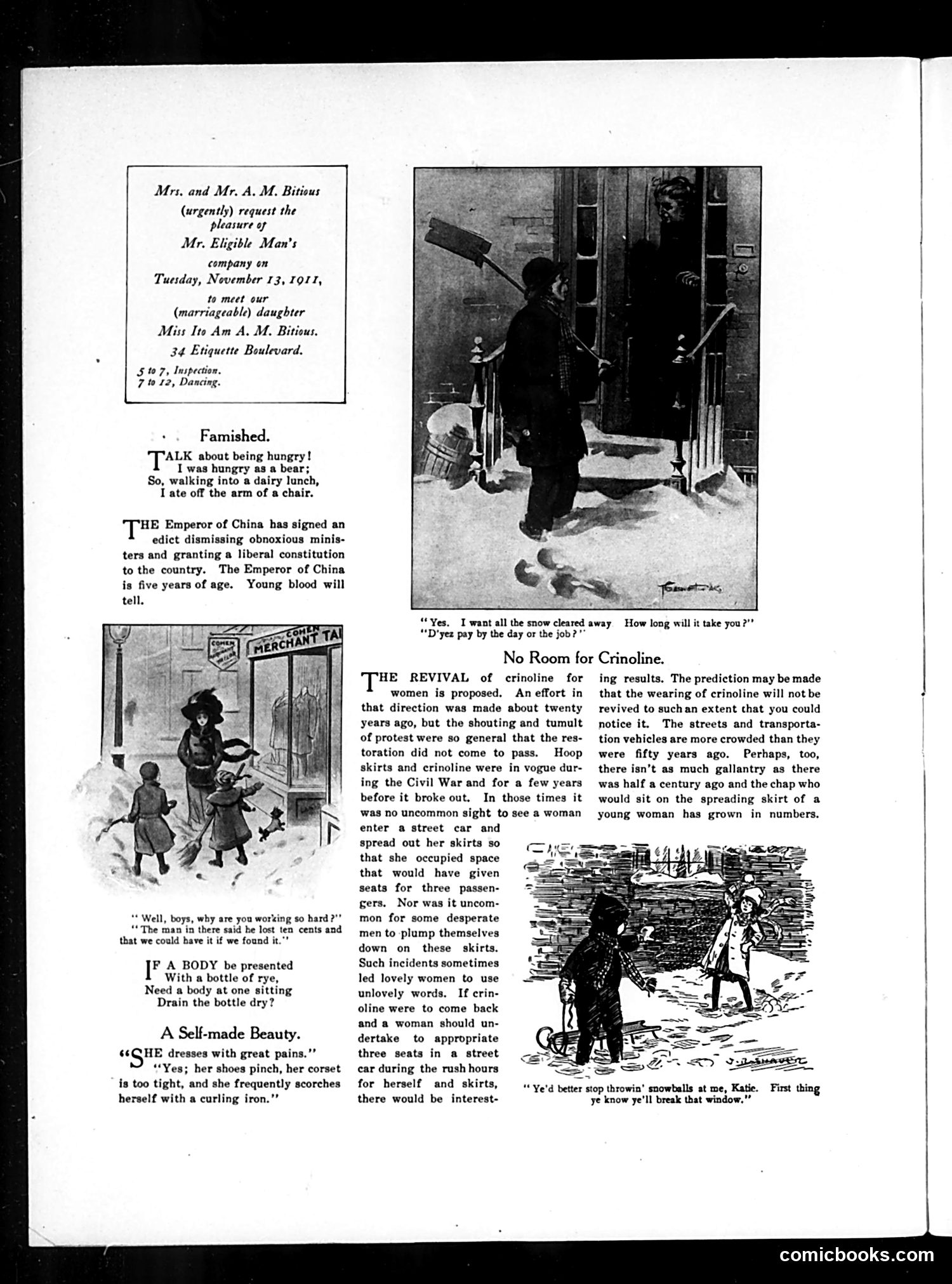
This page contains several satirical pieces typical of Judge's social humor: **Top**: A mock wedding invitation parodies social climbing—the "Bitious" family eagerly advertises their marriageable daughter to "Mr. Eligible Man," with inspection and dancing scheduled like a commercial transaction. **"Famished"**: A brief joke about extreme hunger, using exaggeration for comedic effect. **China Editorial**: Mocks the recent Chinese Revolution (1911) by noting the Emperor is five years old—implying that granting constitutional reforms through a child figurehead is meaningless ("Young blood will tell"). **"Self-made Beauty"**: Satirizes women who suffer through tight corsets and hot curling irons to achieve fashionable appearance, calling such self-inflicted pain absurd. **"No Room for Crinoline"**: The main article argues that even if hoop skirts return to fashion, modern crowded streetcars make them impractical. It also suggests men lack the old-fashioned gallantry to tolerate women monopolizing seats with their skirts—a commentary on changing social manners and urban congestion.
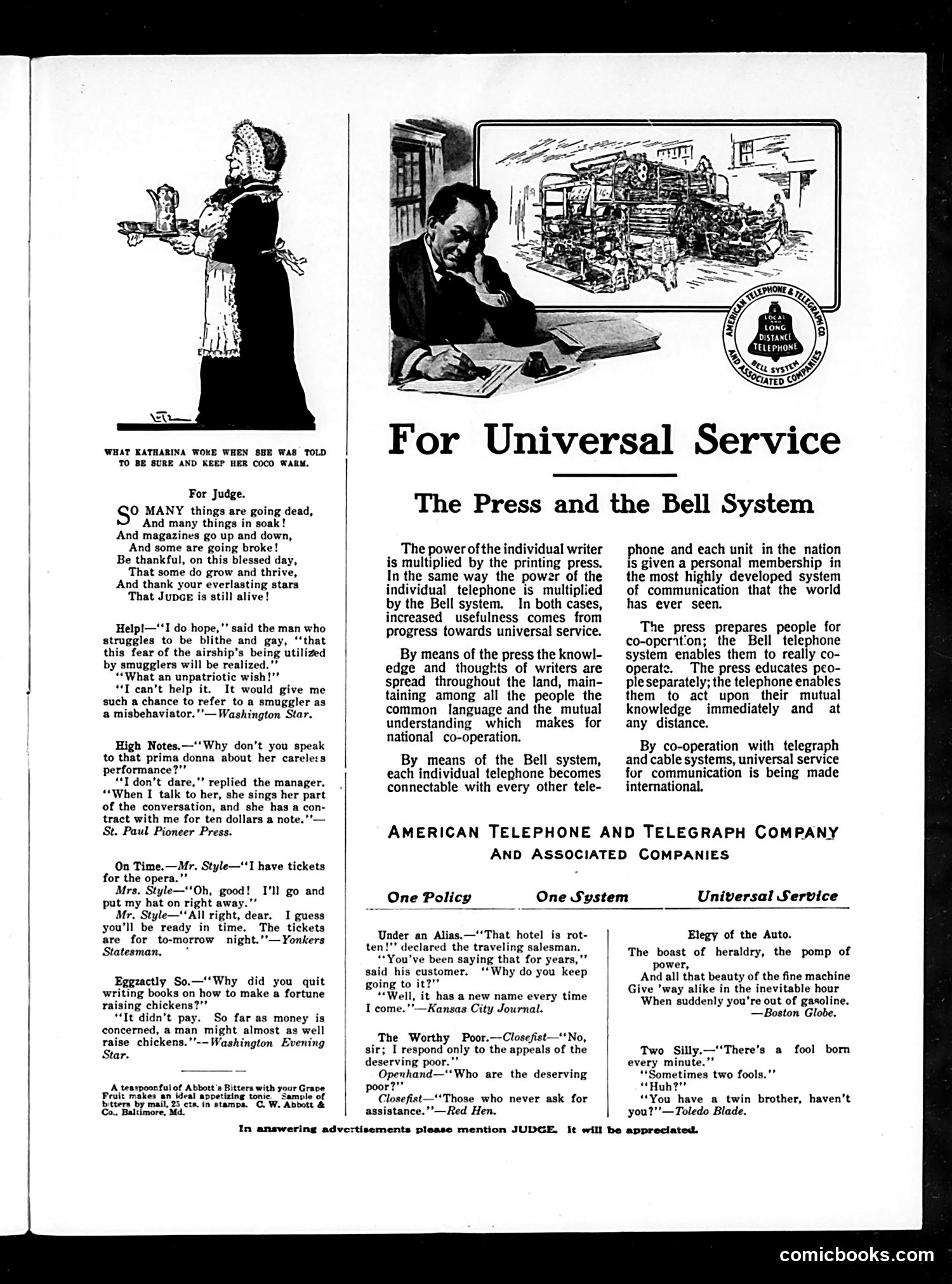
This page mixes advertisements with satirical content typical of early 20th-century Judge magazine. The left side contains short humorous anecdotes—jokes about opera singers charging per note, fortune-telling chicken-farming books, and travel mishaps. These are lighthearted social commentary rather than political satire. The dominant content is a **Bell Telephone System advertisement** disguised as editorial praise. It compares the printing press's democratization of information to the telephone's role in creating "universal service"—connecting all Americans into one communication network. This is corporate propaganda presenting the Bell monopoly as a patriotic, nation-building infrastructure. The right column continues with more brief jokes, including a mock-serious "Elegy of the Auto" mocking automobiles running out of gasoline—a contemporary concern as cars were still novel. The page reflects Judge's era: advertising was increasingly sophisticated and editorial, while humor remained safely apolitical and domestic-focused rather than challenging power structures.
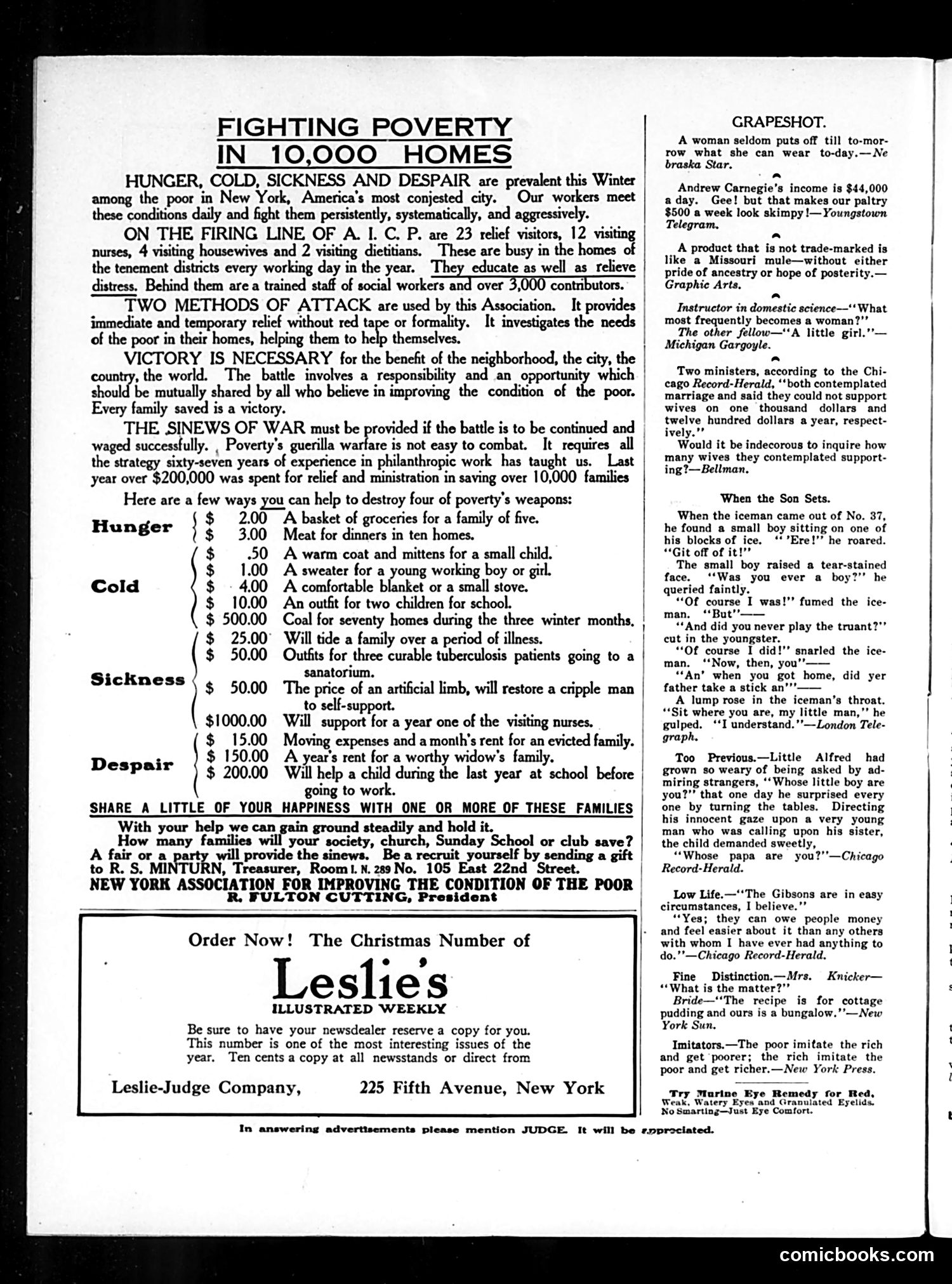
This is primarily a **fundraising appeal**, not a political cartoon. The page features an article by the Association for Improving the Condition of the Poor (A.I.C.P.) soliciting donations to fight poverty in New York City during winter. **Main Content:** The left side lists specific ways donations combat "four weapons" of poverty—hunger, cold, sickness, and despair—with itemized costs ($2 for groceries, $4 for blankets, $1,000 to support a visiting nurse yearly, etc.). It claims over $200,000 was spent the previous year helping 10,000 families. **Right Side:** Brief humorous anecdotes and quips unrelated to the main appeal—jokes about women's fashion, definitions, and a touching story about an iceman and boy. These appear designed to provide light relief amid the serious fundraising pitch. **Historical Context:** This reflects early 20th-century Progressive Era charitable work, before government social safety nets existed. The A.I.C.P. was a genuine New York organization addressing genuine urban poverty through systematic, professional social work.
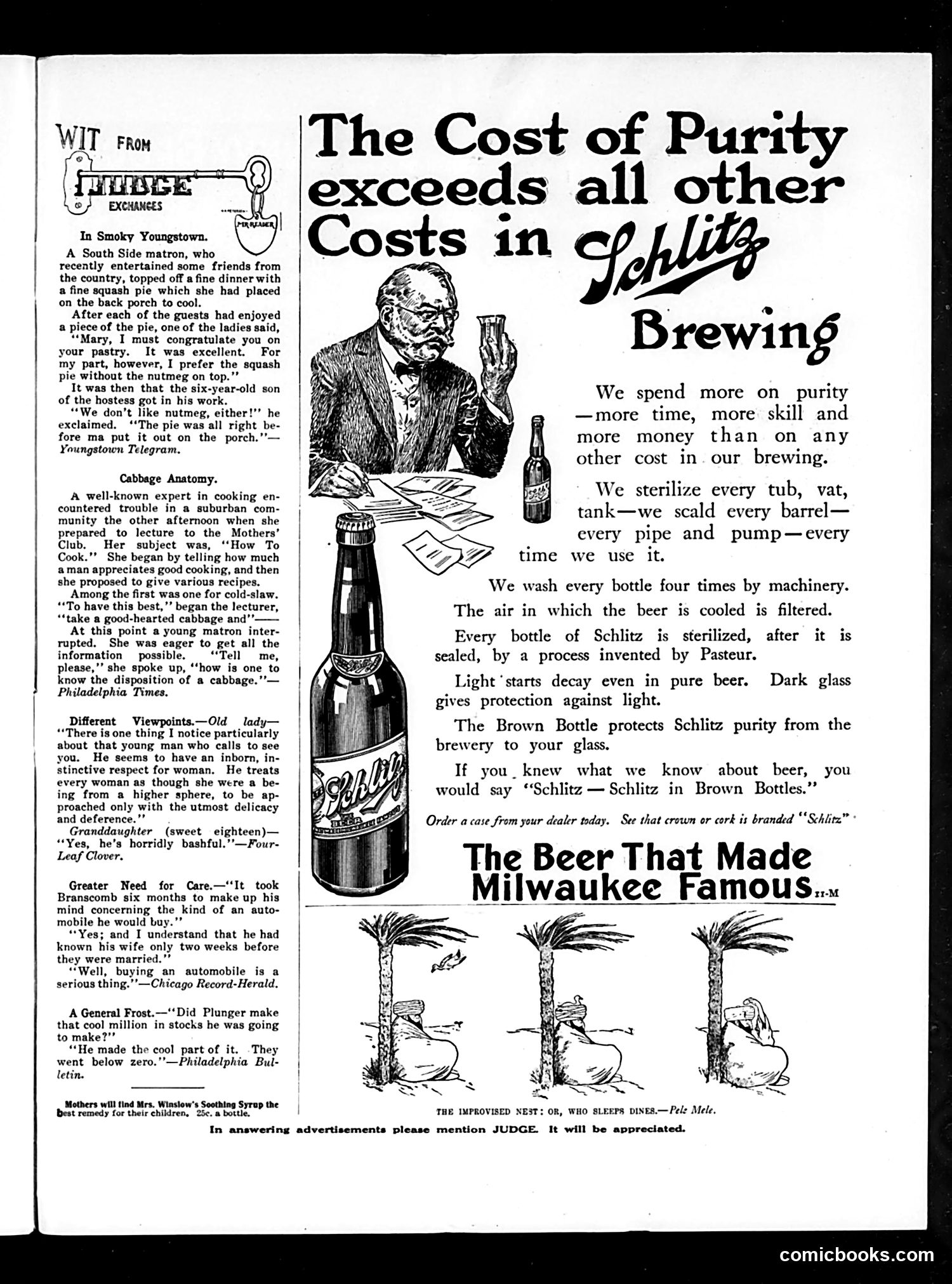
This page combines **short humorous anecdotes** (left side) with a **Schlitz beer advertisement** (right side). ## The Humor Pieces Five brief jokes mock everyday situations: a child's innocent remark about a pie cooling on a porch; confusion over a cabbage's "disposition"; contrasting views on respectful young men; prioritizing car-buying over marriage decisions; and stock market losses ("went below zero"). These are gentle domestic comedies typical of early-20th-century humor magazines, relying on wordplay and observation of middle-class life. ## The Schlitz Advertisement The dominant right-side ad features a stern-faced man (likely representing the brewery) gesturing at detailed purity claims. Schlitz emphasizes sterilization, Pasteur's process, dark brown bottles (protecting from light decay), and machinery-washed bottles—marketing beer as a scientifically rigorous, sanitary product. ## Context for Modern Readers This reflects the **Pure Food and Drug Act era** (post-1906), when breweries competed by emphasizing hygiene and scientific methods as selling points. The serious advertisement contrasts sharply with the page's lightweight humor, showing how advertising used emerging scientific credibility to build consumer trust.
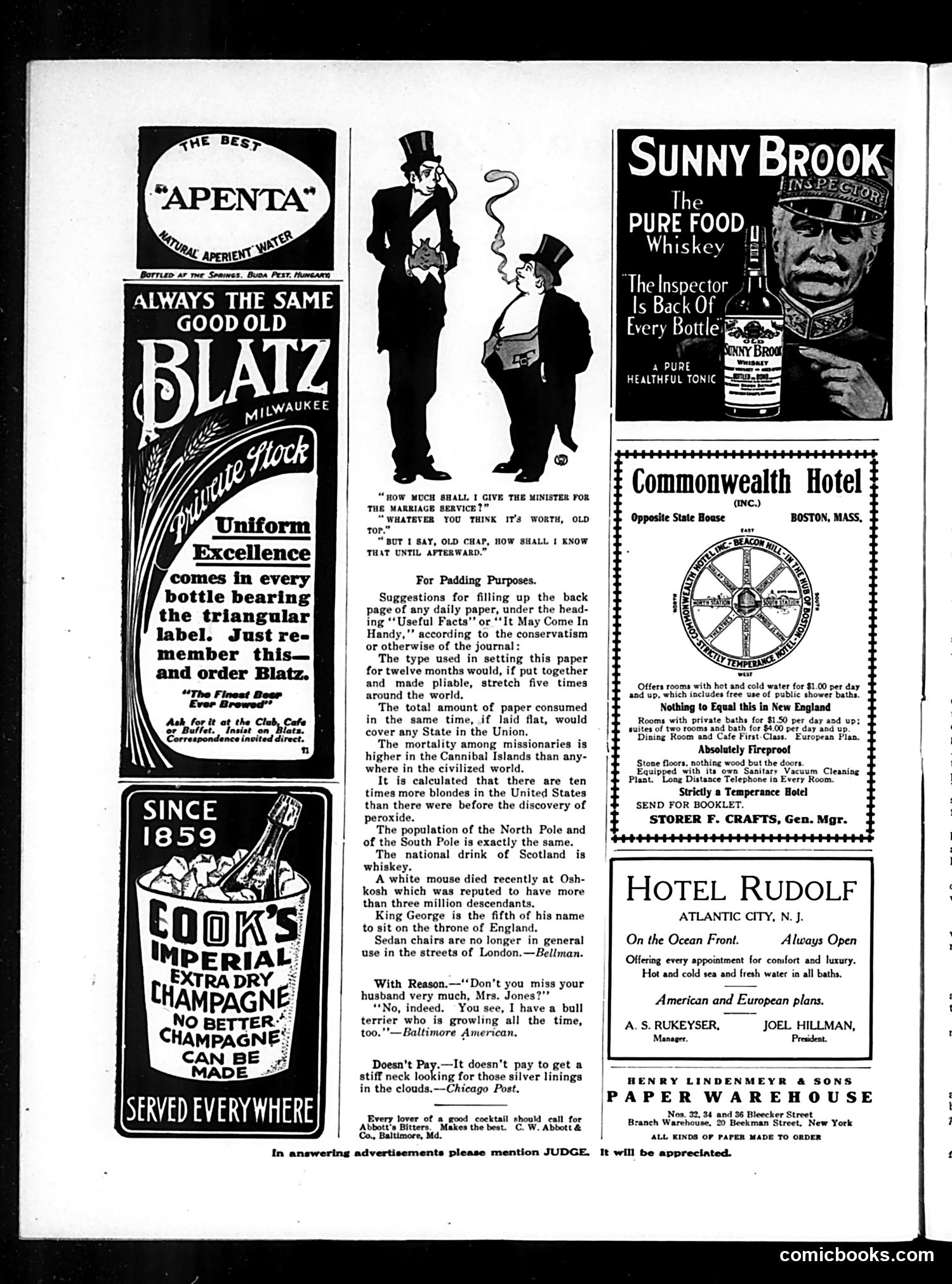
This page is primarily **advertising and filler content** rather than political satire. The main cartoon depicts two men in formal attire discussing payment for a marriage ceremony—one asks "how much shall I give the minister?" and the other replies it's worth "whatever you think," prompting the first to say he won't know the value "until afterward." This is a mild **joke about the uncertainty of clergy fees** and the awkwardness of negotiating religious services. The remainder consists of advertisements (Blatz beer, Cook's champagne, Sunny Brook whiskey, various hotels) and "padding" filler articles—humorous trivia and jokes ("Don't you miss your husband?" / "No, I have a bull terrier growling instead"). There are **no identifiable political figures or significant satirical commentary** on this page. It represents typical Judge magazine commercial content from the early 20th century.
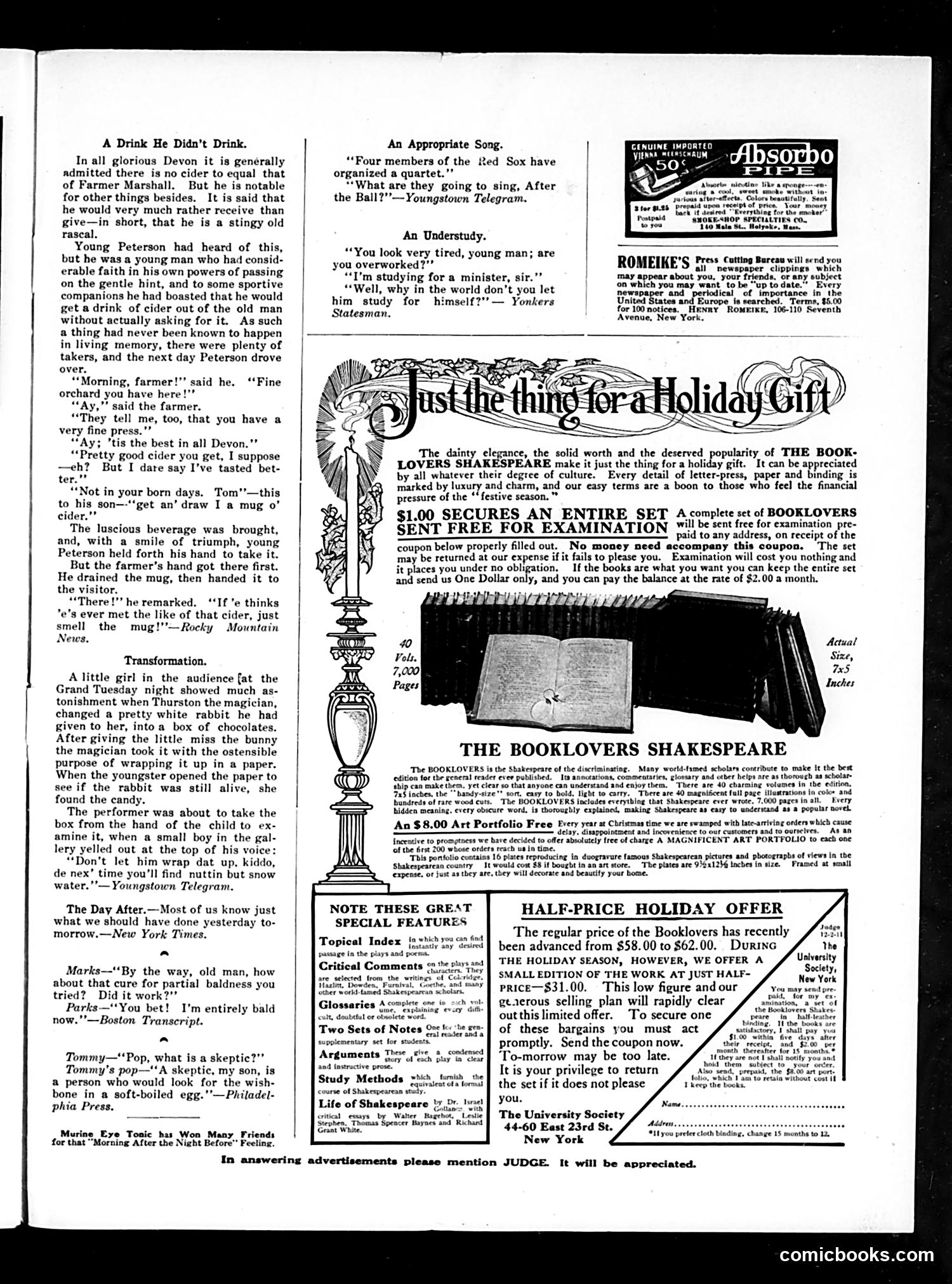
This page is primarily **advertising and light humor pieces**, not political satire requiring historical context. The main content consists of brief anecdotal jokes: - **"A Drink He Didn't Drink"**: A rural English tale about a stingy farmer who outsmarts a young man's attempt to obtain free cider. The humor relies on character types (the miserly farmer) rather than topical reference. - **"An Appropriate Song"**: A one-liner joke about Red Sox players forming a quartet (the punchline is cut off). - **"Transformation"** and other short quips: Simple observational humor about everyday situations. The page is dominated by **advertising**—notably for "The Booklovers Shakespeare" (a discounted book set at $31 instead of $58), Absorbo cigars, and Romeike's press clipping service. These ads reflect early 20th-century consumer culture. There is **no political cartoon or satirical commentary** on this page. It represents typical Judge magazine filler: entertainment and commercial content rather than social commentary.
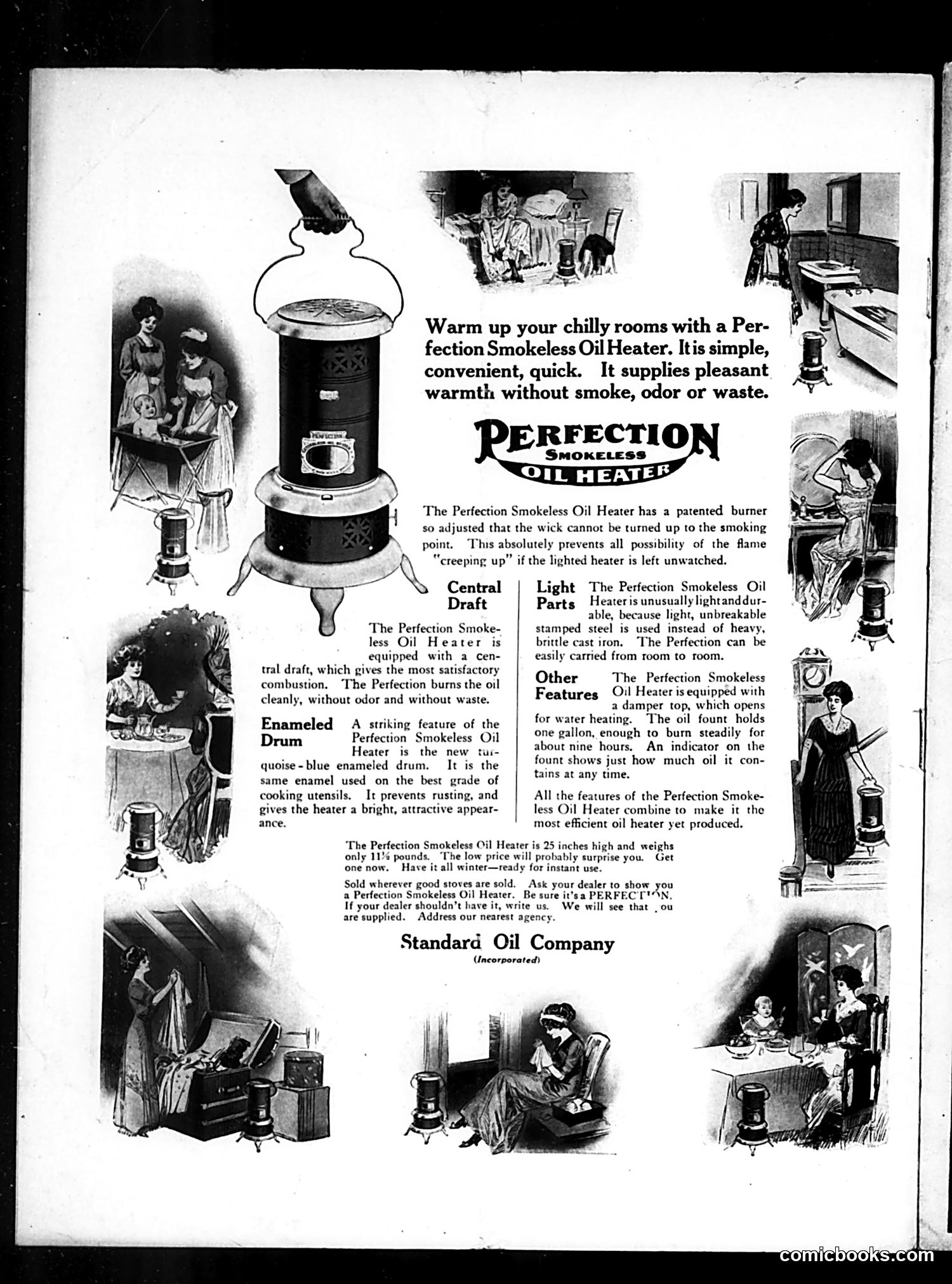
This is **not a cartoon or satire**—it's a full-page advertisement for the Perfection Smokeless Oil Heater, manufactured by Standard Oil Company. The page features product marketing rather than editorial content. It displays the heater's technical specifications (central draft, enameled drum, light construction, water-heating capability, one-gallon fuel capacity) alongside numerous illustrative vignettes showing women and families using the device in domestic settings—bedrooms, kitchens, living rooms. The accompanying text emphasizes practical benefits: warmth without smoke, odor, or waste; safety features preventing the flame from "creeping up"; portability between rooms; and affordability. This represents typical early 20th-century advertising strategy: using domestic scenes and family comfort imagery to market heating technology to homemakers. No satire or political commentary is present—Judge magazine simply sold advertising space to major corporations like Standard Oil.