
Judge, 1911-12-02 · page 4 of 24
Judge — December 2, 1911 — page 4: what you’re looking at
What you’re looking at
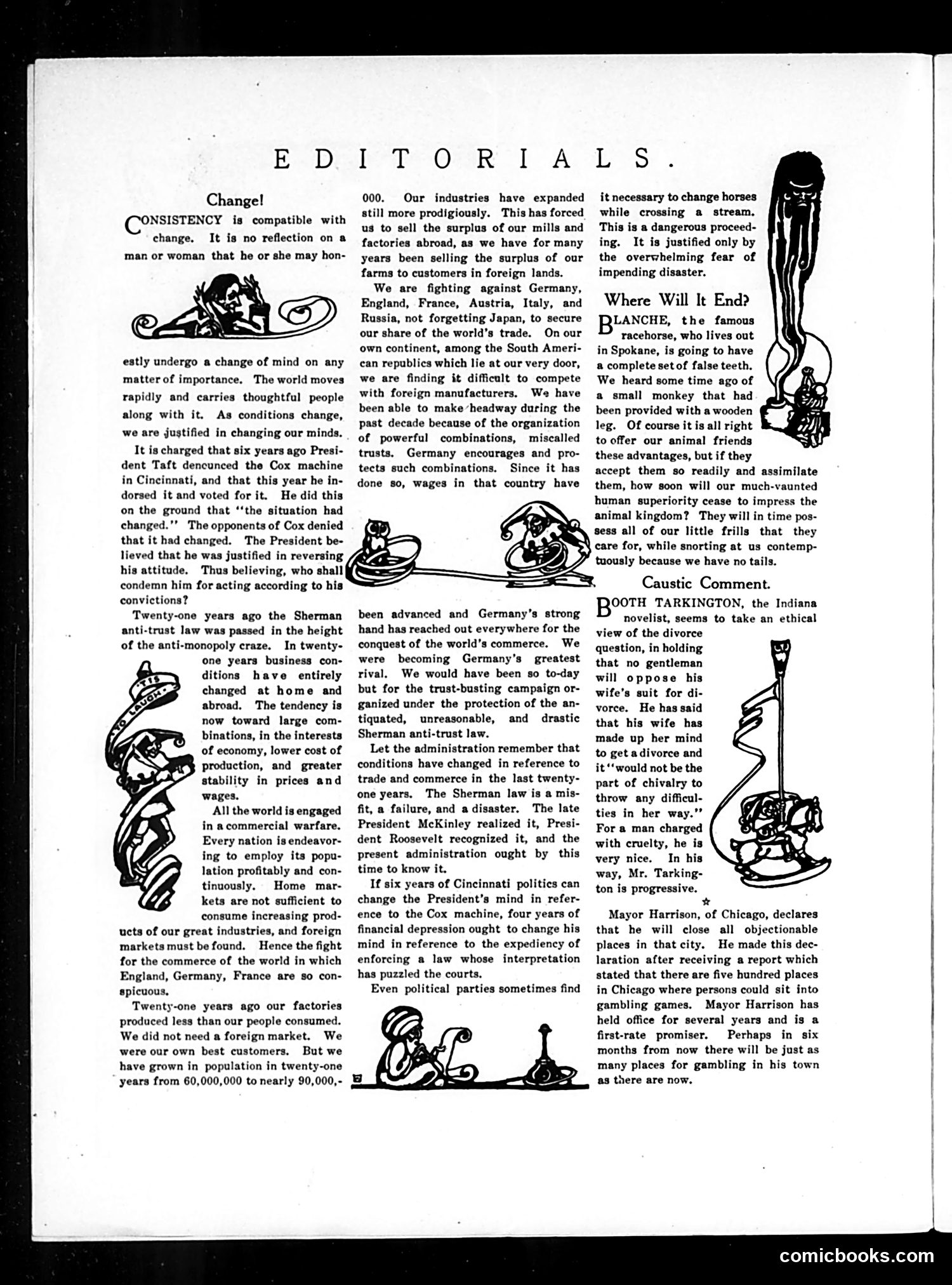
This page contains three editorial pieces satirizing early 20th-century American politics and social issues. **"Change!"** argues that President Taft's shift from Roosevelt's anti-monopoly stance was justified by altered economic conditions. The Cox machine reference appears to relate to Cincinnati politics. **"Where Will It End?"** mocks the advantages offered to racehorses (false teeth, a monkey companion) while questioning whether humans will soon demand similar absurd accommodations. **"Caustic Comment"** discusses novelist Booth Tarkington's ethical stance on divorce, while a separate item criticizes Chicago Mayor Harrison's insufficient efforts closing gambling establishments—suggesting he's complicit with corruption. The cartoons employ anthropomorphized animals and exaggerated scenarios typical of Judge's satirical style to critique political hypocrisy and social inconsistency.
📄 Transcribed text from this page (OCR, searchable)
Machine-transcribed from the original scan — historical spelling and the odd misread are preserved.
Change! @ONSISTENGY, is compatible with change. It is no reflection on a man or woman that he or she may hon- estly undergo a change of mind on any matter of importance. The world moves rapidly and carries thoughtful people along with it. As conditions change, we are justified in changing our minds. It is charged that six years ago Presi- dent Taft dencunced the Cox machine in Cincinnati, and that this year he in- dorsed it and voted for it. He did this on the ground that ‘‘the situation had changed.’’ The opponents of Cox denied that it had changed. The President be- lieved that he was justified in reversing his attitude. Thus believing, who shall condemn him for acting according to his convictions? Twenty-one years ago the Sherman anti-trust law was passed in the height of the anti-monopoly craze. In twenty- one years business con- ditions have entirely changed at home and abroad. The tendency is now toward large com- binations, in the interests of economy, lower cost of production, and greater stability in prices and wages. All the world is engaged in acommercial warfare. Every nation is endeavor- ing to employ its popu- lation profitably and con- tinuously. Home mar- kets are not sufficient to consume increasing prod- ucts of our great industries, and foreign markets must be found. Hence the fight for the commerce of the world in which England, Germany, France are so con- spicuous, Twenty-one years ago our factories produced less than our people consumed. We did not need a foreign market. We were our own best customers. But we have grown in population in twenty-one years from 60,000,000 to nearly 90,000,- E~DeIrT-OSR I ALS . 000. Our industries have expanded still more prodigiously. This has forced us to sell the surplus of our mills and factories abroad, as we have for many years been selling the surplus of our farms to customers in foreign lands. We are fighting against Germany, England, France, Austria, Italy, and Russia, not forgetting Japan, to secure our share of the world’s trade. On our own continent, among the South Ameri- can republics which lie at our very door, we are finding it difficult to compete with foreign manufacturers. We have been able to make ‘headway during the past decade because of the organization of powerful combinations, miscalled trusts. Germany encourages and pro- tects such combinations. Since it has done so, wages in that country have been advanced and Germany’s strong hand has reached out everywhere for the conquest of the world’s commerce. We were becoming Germany’s greatest rival. We would have been so to-day but for the trust-busting campaign or- ganized under the protection of the an- tiquated, unreasonable, and drastic Sherman anti-trust law. Let the administration remember that conditions have changed in reference to trade and commerce in the last twenty- one years. The Sherman law is a mis- fit, a failure, and adisaster. The late President McKinley realized it, Presi- dent Roosevelt recognized it, and the present administration ought by this time to know it. If six years of Cincinnati politics can change the President’s mind in refer- ence to the Cox machine, four years of financial depression ought to change his mind in reference to the expediency of enforcing a law whose interpretation has puzzled the courts. Even political parties sometimes find it necessary to change horses while crossing a stream. This is a dangerous proceed- ing. It is justified only by the overwhelming fear of impending disaster. Where Will It End? LANCHE, the famous racehorse, who lives out in Spokane, is going to have a complete set of false teeth. We heard some time ago of a small monkey that had been provided with a wooden leg. Of course it is all right to offer our animal friends these advantages, but if they accept them so readily and assimilate them, how soon will our much-vaunted human superiority cease to impress the animal kingdom? They will in time pos- sess all of our little frills that they care for, while snorting at us contemp- tuously because we have no tails. Caustic Comment. OOTH TARKINGTON, the Indiana novelist, seems to take an ethical view of the divorce question, in holding that no gentleman will oppose his wife’s suit for di- vorce. He has said that his wife has made up her mind to get adivorce and it ‘‘would not be the part of chivalry to throw any difficul- ties in her way.’’ For a man charged with cruelty, he is very nice. In his way, Mr. Tarking- ton is progressive. * Mayor Harrison, of Chicago, declares that he will close all objectionable places in that city. He made this dec- laration after receiving a report which stated that there are five hundred places in Chicago where persons could sit into gambling games. Mayor Harrison has held office for several years and is a first-rate promiser. Perhaps in six months from now there will be just as many places for gambling in his town as there are now. comicbooks.com