
Judge, 1911-12-02 · page 17 of 24
Judge — December 2, 1911 — page 17: what you’re looking at
What you’re looking at
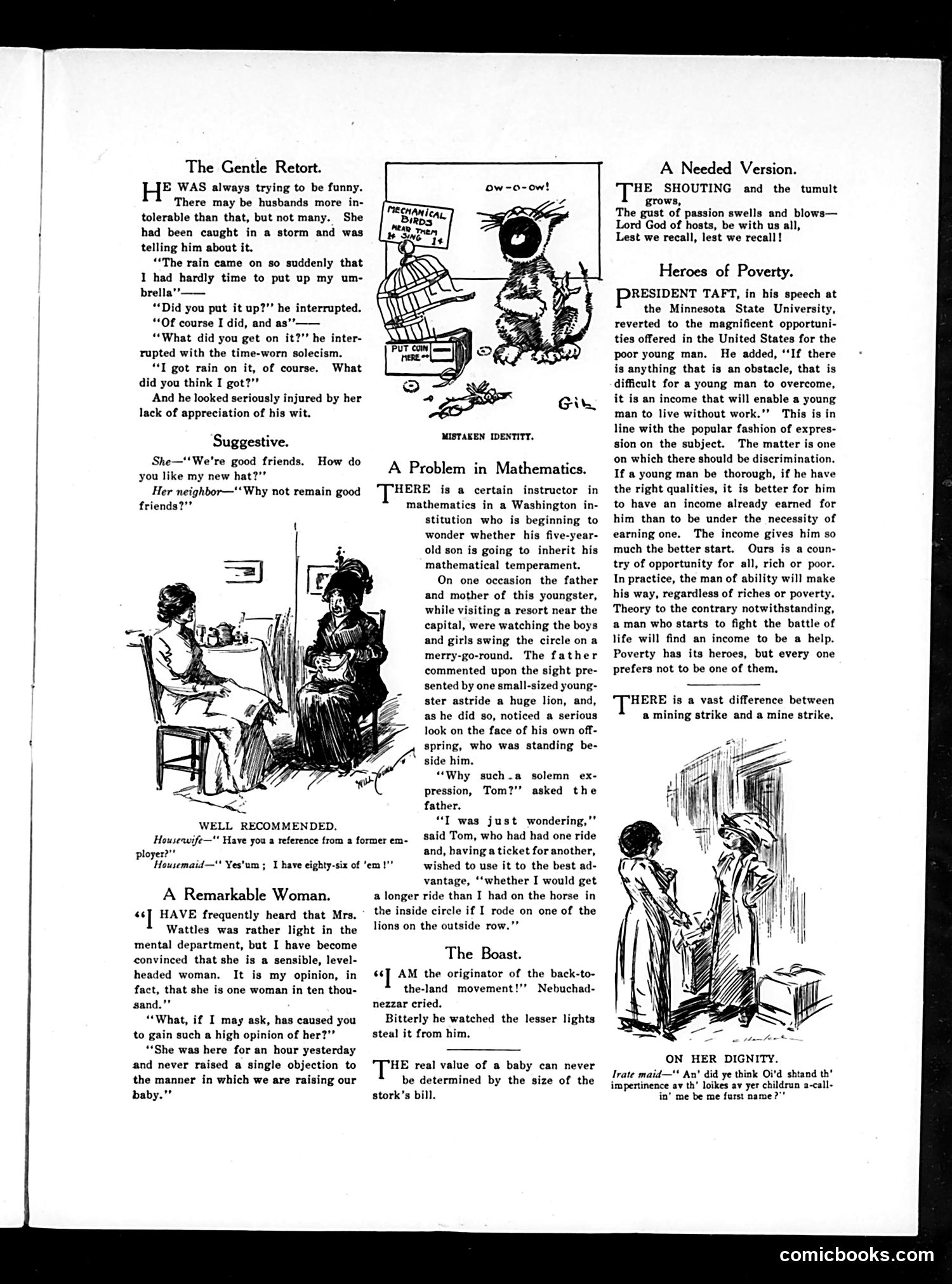
This page contains multiple short satirical pieces typical of early 20th-century American humor: **"The Gentle Retort"** mocks husbands who interrupt their wives with tired jokes. The husband makes a worn pun ("What did you get on it?") about rain on an umbrella, then feels hurt when she doesn't appreciate his wit—satirizing both predictable male humor and thin-skinned male egos. **"Suggestive"** uses a woman's blunt response to reject a friendship offer, implying the insult ("Why not remain good friends?") reveals their relationship was superficial. **"A Problem in Mathematics"** humorously depicts a child calculating optimal merry-go-round rides using geometry—satirizing overly analytical thinking. **"Heroes of Poverty"** critiques President Taft's recent speech claiming poverty builds character. Judge argues that inherited income actually helps talented young men succeed, directly contradicting Taft's moralizing about hardship as virtue. This reflects Progressive-era debates about economic opportunity versus inherited advantage. The other pieces are brief jokes on domestic life and vanity typical of the magazine's format.
📄 Transcribed text from this page (OCR, searchable)
Machine-transcribed from the original scan — historical spelling and the odd misread are preserved.
The Gentle Retort. H® WAS always trying to be funny. There may be husbands more in- tolerable than that, but not many. She had been caught in a storm and was telling him about it. “The rain came on so suddenly that I had hardly time to put up my um- brella’’—— “Did you put it up?’ he interrupted. “‘Of course I did, and as’’—— “What did you get on it?” he inter- rupted with the time-worn solecism. “I got rain on it, of course. What did you think I got?”” And he looked seriously injured by her lack of appreciation of his wit. Suggestive. She—‘‘We're good friends. you like my new hat?”” Her neighbor—‘‘Why not remain good friends?” How do WELL RECOMMENDED. Housewife ployes?"” Housemaid—"' Yes'um ; I have eighty-six of 'em!'’ A Remarkable Woman. <¢] HAVE frequently heard that Mra, Wattles was rather light in the mental department, but I have become convinced that she is a sensible, level- headed woman. It is my opinion, in fact, that she is one woman in ten thou- sand.”” “‘What, if I may ask, has caused you to gain such a high opinion of her?’’ “She was here for an hour yesterday and never raised a single objection to the manner in which we are raising our baby.” —"' Have you a reference from a former em- MISTAKEN IDENTITY. A Problem in Mathematics. HERE is a certain instructor in mathematics in a Washington in- stitution who is beginning to wonder whether his five-year- old son is going to inherit his mathematical temperament. On one occasion the father and mother of this youngster, while visiting a resort near the capital, were watching the boys and girls swing the circle on a merry-go-round. The father commented upon the sight pre- sented by one small-sized young- ster astride a huge lion, and, as he did so, noticed a serious look on the face of his own off- spring, who was standing be- side him. “Why such.a solemn ex- pression, Tom?’’ asked the father. “I was just wondering,” said Tom, who had had one ride and, having a ticket for another, wished to use it to the best ad- vantage, ‘‘whether I would get a longer ride than I had on the horse in the inside circle if I rode on one of the lions on the outside row.’’ The Boast. 6s] AM the originator of the back-to- the-land movement!’ Nebuchad- nezzar cried. Bitterly he watched the lesser lights steal it from him. HE real value of a baby can never be determined by the size of the stork’s bill. A Needed Version. HE SHOUTING and the tumult grows, The gust of passion swells and blows— Lord God of hosts, be with us all, Lest we recall, lest we recall! Heroes of Poverty. PRESIDENT TAFT, in his speech at the Minnesota State Universi reverted to the magnificent opportuni- ties offered in the United States for the poor young man. He added, ‘If there is anything that is an obstacle, that is difficult for a young man to overcome, it is an income that will enable a young man to live without work.’ This is in line with the popular fashion of expres- sion on the subject. The matter is one on which there should be discrimination. If a young man be thorough, if he have the right qualities, it is better for him to have an income already earned for him than to be under the necessity of earning one. The income gives him so much the better start. Ours is a coun- try of opportunity for all, rich or poor. In practice, the man of ability will make his way, regardless of riches or poverty. Theory to the contrary notwithstanding, a man who starts to fight the battle of life will find an income to be a help. Poverty has its heroes, but every one prefers not to be one of them. 'HERE is a vast difference between a mining strike and a mine strike. ON HER DIGNITY. Irate maid—'* An’ did ye think i'd shtand th’ impertinence ay th’ loikes av yer childrun a-call- in’ me be me furst name?” comicbooks.com