
Judge, 1911-12-02 · page 19 of 24
Judge — December 2, 1911 — page 19: what you’re looking at
What you’re looking at
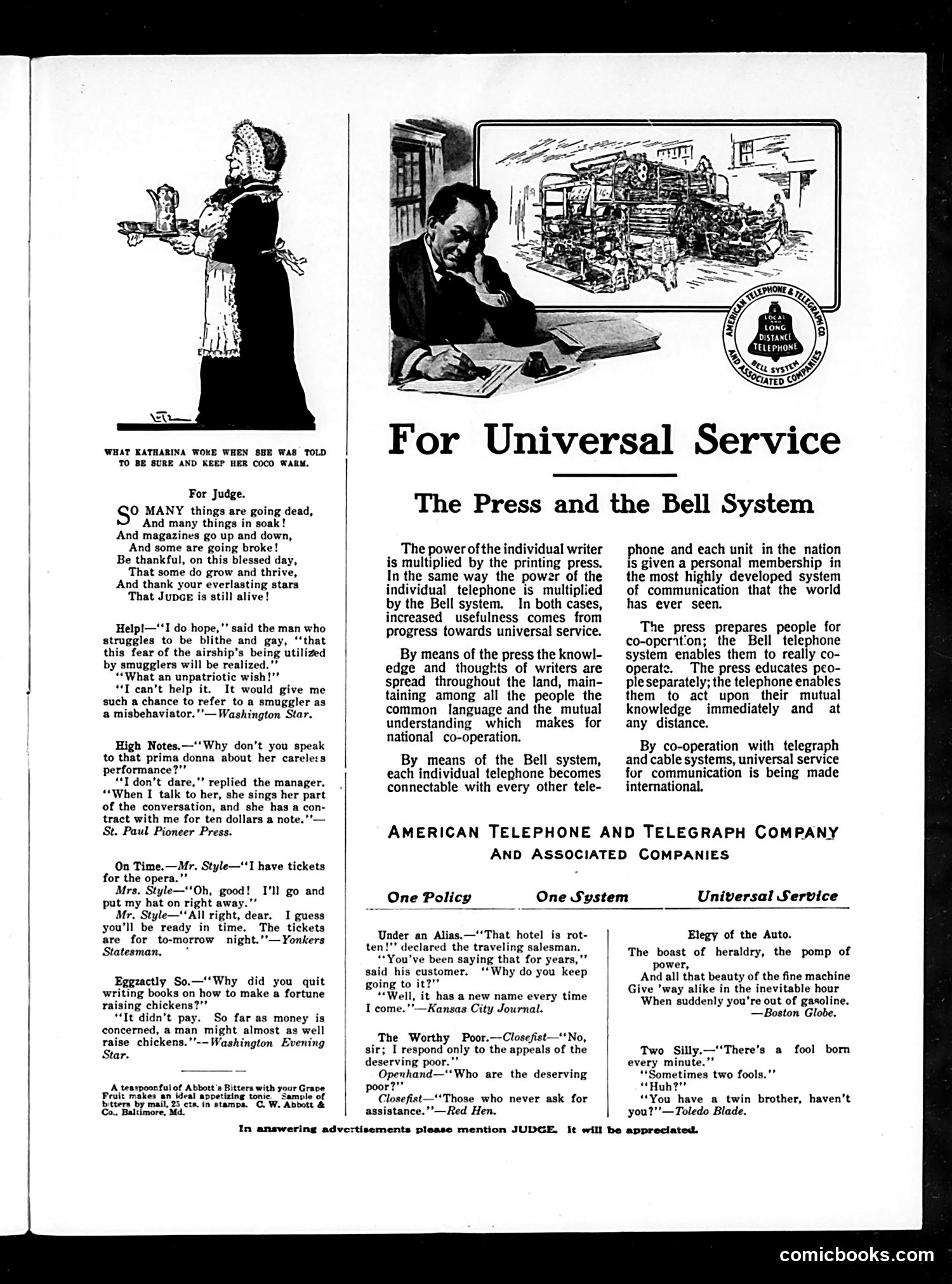
This page mixes advertisements with satirical content typical of early 20th-century Judge magazine. The left side contains short humorous anecdotes—jokes about opera singers charging per note, fortune-telling chicken-farming books, and travel mishaps. These are lighthearted social commentary rather than political satire. The dominant content is a **Bell Telephone System advertisement** disguised as editorial praise. It compares the printing press's democratization of information to the telephone's role in creating "universal service"—connecting all Americans into one communication network. This is corporate propaganda presenting the Bell monopoly as a patriotic, nation-building infrastructure. The right column continues with more brief jokes, including a mock-serious "Elegy of the Auto" mocking automobiles running out of gasoline—a contemporary concern as cars were still novel. The page reflects Judge's era: advertising was increasingly sophisticated and editorial, while humor remained safely apolitical and domestic-focused rather than challenging power structures.
📄 Transcribed text from this page (OCR, searchable)
Machine-transcribed from the original scan — historical spelling and the odd misread are preserved.
WHAT KATHARINA WOKE WHEN SHE WAS TOLD TO BE SURE AND KEEP HER COCO WARM. For Judge. SO MANY things are going dead, And many things in soak! And magazines go up and down, And some are going broke! Be thankful, on this blessed day, That some do grow and thrive, And thank your everlasting stars That Jupce is still alive! Help!—‘‘I do hope,"’ said the man who struggles to be blithe and gay, ‘that this fear of the airship’s being utilized by smugglers will be realized.”” “*What an unpatriotic wish!”’ “T can't help it. It would give me such a chance to refer to a smuggler as a misbehaviator.”"— Washington Star. High Notes.—‘‘Why don’t you speak to that prima donna about her carele:s performance?” “IT don’t dare,’ replied the manager. “When I talk to her, she sings her part of the conversation, and she has a con- tract with me for ten dollars a note.’’— St. Paul Pioneer Press. On Time.—Mr. Style—‘‘I have tickets for the opera.”” Mrs. Style—‘Oh, good! I'll go and put my hat on right away.’’ Mr. Style—‘‘All right, dear. I guess you'll be ready in time. The tickets are for to-morrow night.'’"—Yonkers Statesman. . Eggzactly So.—‘‘Why did you quit writing books on how to make a fortune raising chickens?”’ “It didn’t pay. So far as money is concerned, a man might almost as well raise chickens.'’-—-Washington Evening Star. A teaspoonful of Abbott's Bitters with your Grave Fruit makes an ideal appetizing tonic Sample of bitters by mail, 25 cte. in stampa. C. W. Abbott & Co,, Baltimore, Md. For Universal Service The Press and the Bell System The power of the individual writer is multiplied by the printing press. In the same way the power of the individual telephone is multiplied by the Bell system. In both cases, increased usefulness comes from Progress towards universal service. By means of the press the knowl- edge and thoughts of writers are spread throughout the land, main- taining among all the people the common language and the mutual understanding which makes for national co-operation. By means of the Bell system, each individual telephone becomes connectable with every other tele- phone and each unit in the nation is given a personal membership in the most highly developed system of communication that the world has ever seen. The press prepares people for co-operition; the Bell telephone system enables them to really co- operate. The press educates peo- ple separately; the telephone enables them to act upon their mutual knowledge immediately and at any distance. By co-operation with telegraph and cable systems, universal service for communication is being made international, AMERICAN TELEPHONE AND TELEGRAPH COMPANY AND ASSOCIATED COMPANIES One Policy One System Universal Service Under an Alias.—‘‘That hotel is rot- ten!’’ declared the traveling salesman. “You've been saying that for years,”” said his customer. ‘Why do you keep going to it?”” “Well, it has a new name every time I come.’’—Kansas City Journal. The Worthy Poor.—Closefist—‘‘No, sir; I respond only to the appeals of the deserving poor."” Openhand—‘‘Who are the deserving —“ Closefist—‘‘Those who never ask for assistance.’’—Red Hen. In answering adve:tisements please mention JUDGE. It will be appreciated. Elegy of the Auto. The boast of heraldry, the pomp of power, And all that beauty of the fine machine Give ’way alike in the inevitable hour When suddenly you're out of gasoline. —Boston Globe. Two Silly.—‘‘There’s a fool born every minute.” “Sometimes two fools.’ “Huh?” “You have a twin brother, haven’t you?’’—Toledo Blade. comicbooks.com