
Judge, 1911-12-02 · page 12 of 24
Judge — December 2, 1911 — page 12: what you’re looking at
What you’re looking at
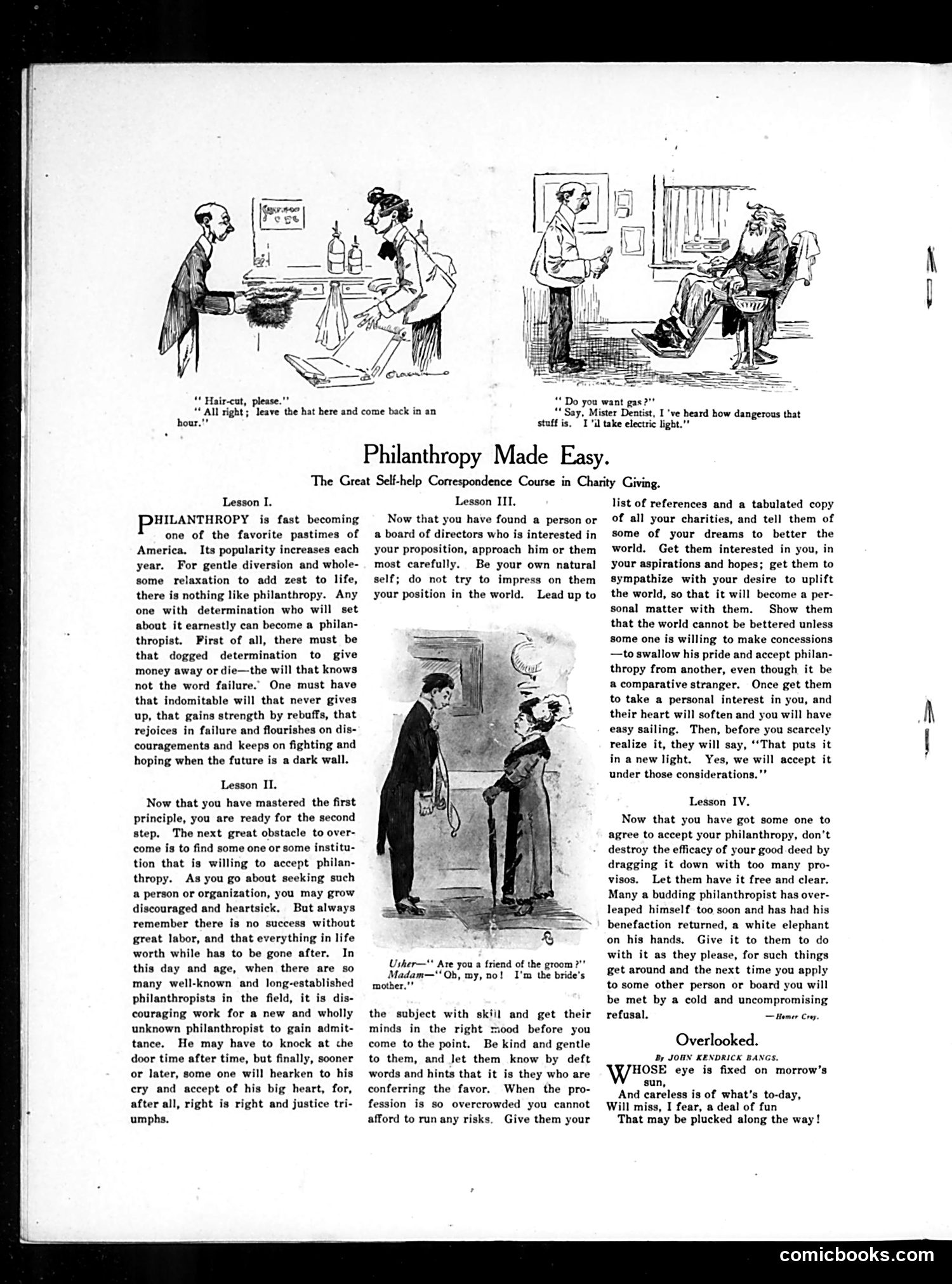
This satirical article mocks the *fashionable trend* of American philanthropy—presenting "charity giving" as an increasingly popular social pastime pursued by the wealthy. Judge sarcastically frames philanthropy as a self-centered endeavor requiring "dogged determination" and strategic marketing rather than genuine altruism. The satire's target: wealthy philanthropists who treat charity as a vanity project. The "correspondence course" format humorously suggests philanthropy requires instruction because donors struggle to find *willing* recipients—implying charities must flatter and manipulate wealthy givers into accepting their "generosity." Lesson IV's warning against "provisos" (strings attached) suggests donors impose controlling conditions on gifts. The joke throughout is that so-called "philanthropy" is actually narcissistic: donors care more about recognition, control, and self-image than genuine charitable impact. The scattered cartoons (a barber, a dentist) illustrate service providers with skeptical clients—mirroring the donor-recipient power dynamic.
📄 Transcribed text from this page (OCR, searchable)
Machine-transcribed from the original scan — historical spelling and the odd misread are preserved.
a Hair-cut, II right’; Lesson I. HILANTHROPY is fast becoming one of the favorite pastimes of America. Its popularity increases each year. For gentle diversion and whole- some relaxation to add zest to life, there is nothing like philanthropy. Any one with determination who will set about it earnestly can become a philan- thropist. First of all, there must be that dogged determination to give money away or die—the will that knows not the word failure. One must have that indomitable will that never gives up, that gains strength by rebuffs, that rejoices in failure and flourishes on dis- couragements and keeps on fighting and hoping when the future is a dark wall. Lesson II. Now that you have mastered the first principle, you are ready for the second step, The next great obstacle to over- come is to find some one or some institu- tion that is willing to accept philan- thropy. As you go about seeking such a person or organization, you may grow discouraged and heartsick. But always remember there is no success without great labor, and that everything in life worth while has to be gone after. In this day and age, when there are so many well-known and long-established philanthropists in the field, it is dis- couraging work for a new and wholly unknown philanthropist to gain admit- tance. He may have to knock at che door time after time, but finally, sooner or later, some one will hearken to his ery and accept of his big heart, for, after all, right is right and justice tri- umphs. please. ’ eave the hat here and come back in an stuff is. “Do you want gas?” “' Say, Mister Dentist, I 've heard how dangerous that T'il take electric light.”” Philanthropy Made Easy. The Great Self-help Correspondence Course in Charity Giving. Lesson III. Now that you have found a person or a board of directors who is interested in your proposition, approach him or them most carefully. Be your own natural self; do not try to impress on them your position in the world. Lead up to Usher—"* Are you a friend of the groom ?"* Madam—“'Oh, my, no! I'm the bride's mother,"” the subject with skill and get their minds in the right mood before you come to the point. Be kind and gentle to them, and Jet them know by deft words and hints that it is they who are conferring the favor. When the pro- fession is so overcrowded you cannot afford to run any risks. Give them your list of references and a tabulated copy of all your charities, and tell them of some of your dreams to better the world. Get them interested in you, in your aspirations and hopes; get them to sympathize with your desire to uplift the world, so that it will become a per- sonal matter with them. Show them that the world cannot be bettered unless some one is willing to make concessions —to swallow his pride and accept philan- thropy from another, even though it be a comparative stranger. Once get them to take a personal interest in you, and their heart will soften and you will have easy sailing. Then, before you scarcely realize it, they will say, ‘‘That puts it in a new light. Yes, we will accept it under those considerations.’’ Lesson IV. Now that you have got some one to agree to accept your philanthropy, don’t destroy the efficacy of your good deed by dragging it down with too many pro- visos. Let them have it free and clear. Many a budding philanthropist has over- leaped himself too soon and has had his benefaction returned, a white elephant on his hands. Give it to them to do with it as they please, for such things get around and the next time you apply to some other person or board you will be met by a cold and uncompromising refusal. Homer Cray. Overlooked. By JOHN KENDRICK BANGS. HOSE eye is fixed on morrow’s sun, And careless is of what's to-day, Will miss, I fear, a deal of fun That may be plucked along the way! comicbooks.com