
A complete issue · 20 pages · 1891
Judge — March 7, 1891
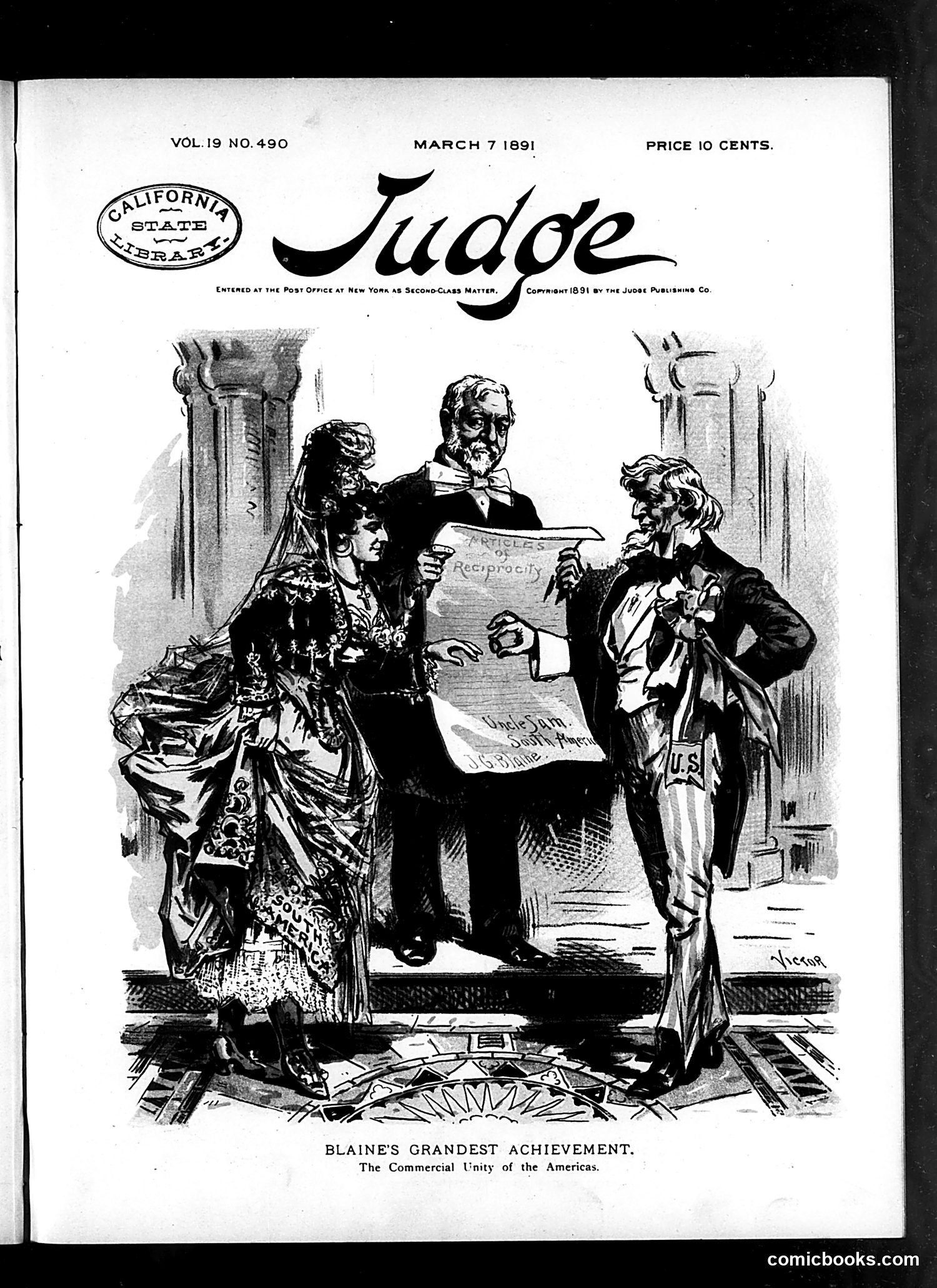
This political cartoon satirizes **James G. Blaine's** diplomatic achievement regarding commercial reciprocity agreements among American nations. The central bearded figure (likely Blaine, U.S. Secretary of State) presents a document titled "Articles of Reciprocity" to two allegorical female figures representing nations or continents—one appears to be Latin America (ornately dressed, left) and the other the United States (right, marked "U.S."). The caption "Blaine's Grandest Achievement: The Commercial Unity of the Americas" treats the reciprocity treaty as his major political accomplishment. The formal classical setting with columns suggests importance and legitimacy. The satire's exact point—whether celebrating or mocking the agreement—remains somewhat ambiguous from the image alone, though Judge's generally critical tone suggests skepticism about the deal's actual benefit.
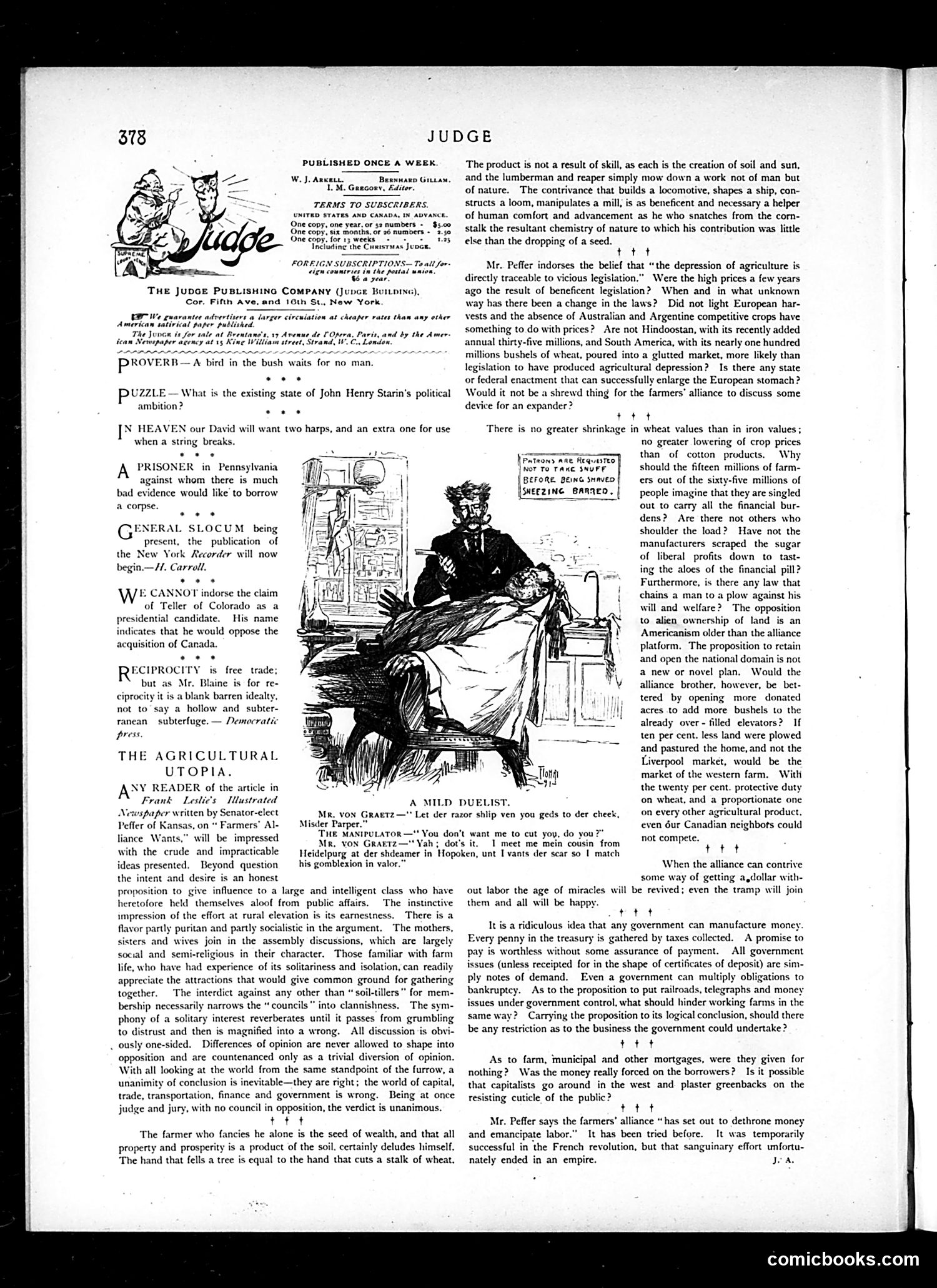
This cartoon satirizes a debate between two German figures identified by their dialect dialogue (von Graetz and Heidelberg). The "duel" is purely verbal—they're arguing while one sits comfortably in a chair, mocking the tradition of German academic honor duels (Mensur). The joke plays on the contrast between the genteel, ritualistic German duel culture and this mundane, seated quarrel over trivial matters ("You don't want me to cut you, do you?"). The accompanying text discusses agricultural policy and farmers' alliances, suggesting the cartoon may commentary on ineffectual political debate versus serious substantive conflict. The satire targets both German pretension and broader political ineffectiveness—talking about problems without meaningfully addressing them.
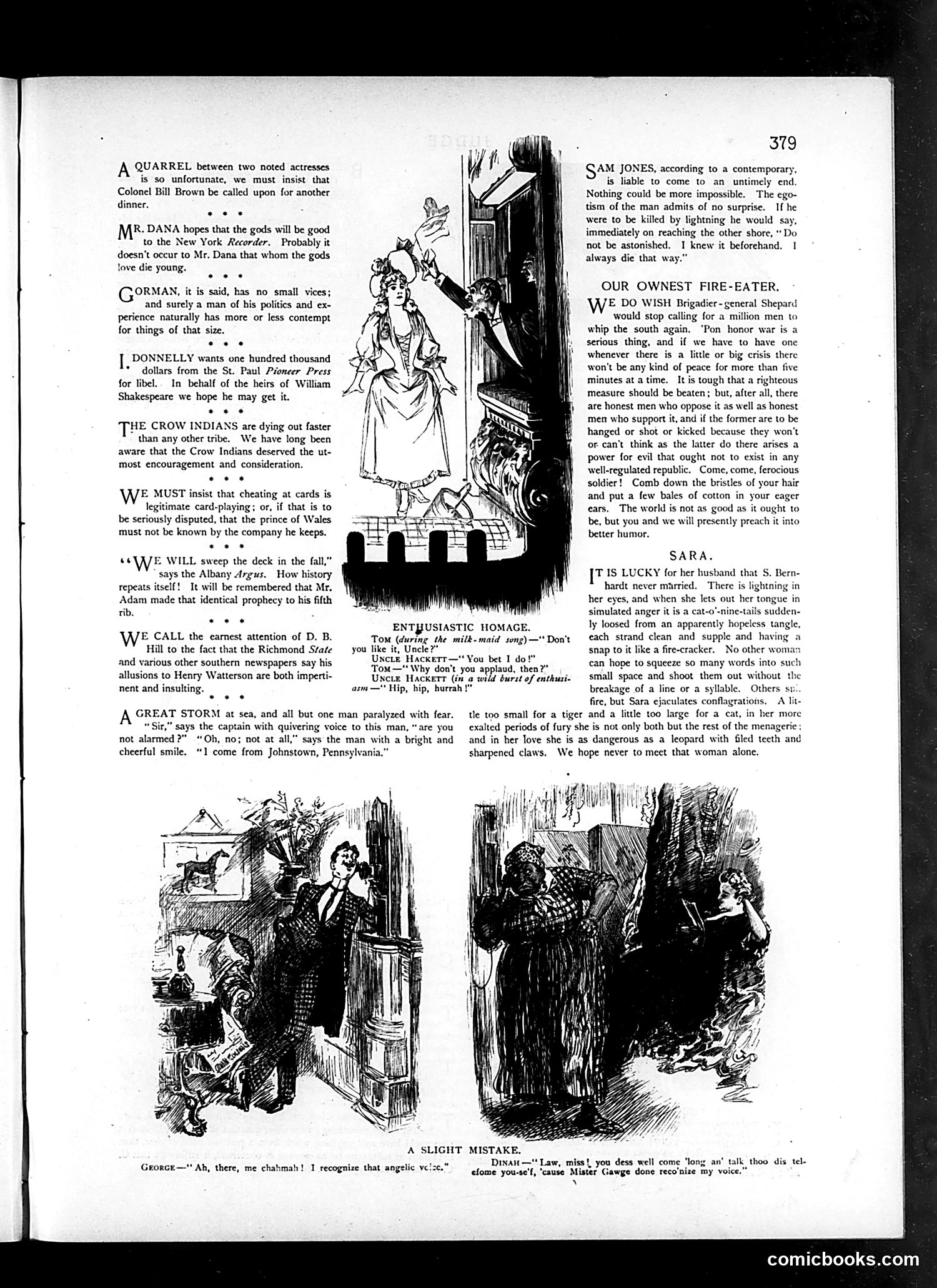
This Judge magazine page contains several brief satirical items and illustrations: **"A Quarrel"** jokes about Colonel Bill Brown's misfortune at dinner, likely referencing a contemporary political figure. **"Our Ownest Fire-Eater"** critiques General Sheridan's calls for military aggression in the South, sarcastically praising his warmongering while mocking the idea that five minutes of peace is impossible. This appears to reference Reconstruction-era tensions. **"Enthusiastic Homage"** shows a humorous exchange between Uncle Hackett and a milk-maid, playing on rural dialect humor. **"A Slight Mistake"** depicts a mistaken identity scene where George believes he recognizes someone. The illustrations are typical of Judge's satirical style, using exaggerated caricature and sketch-work. Without clearer identification of all figures, specific contemporary references remain partially unclear.
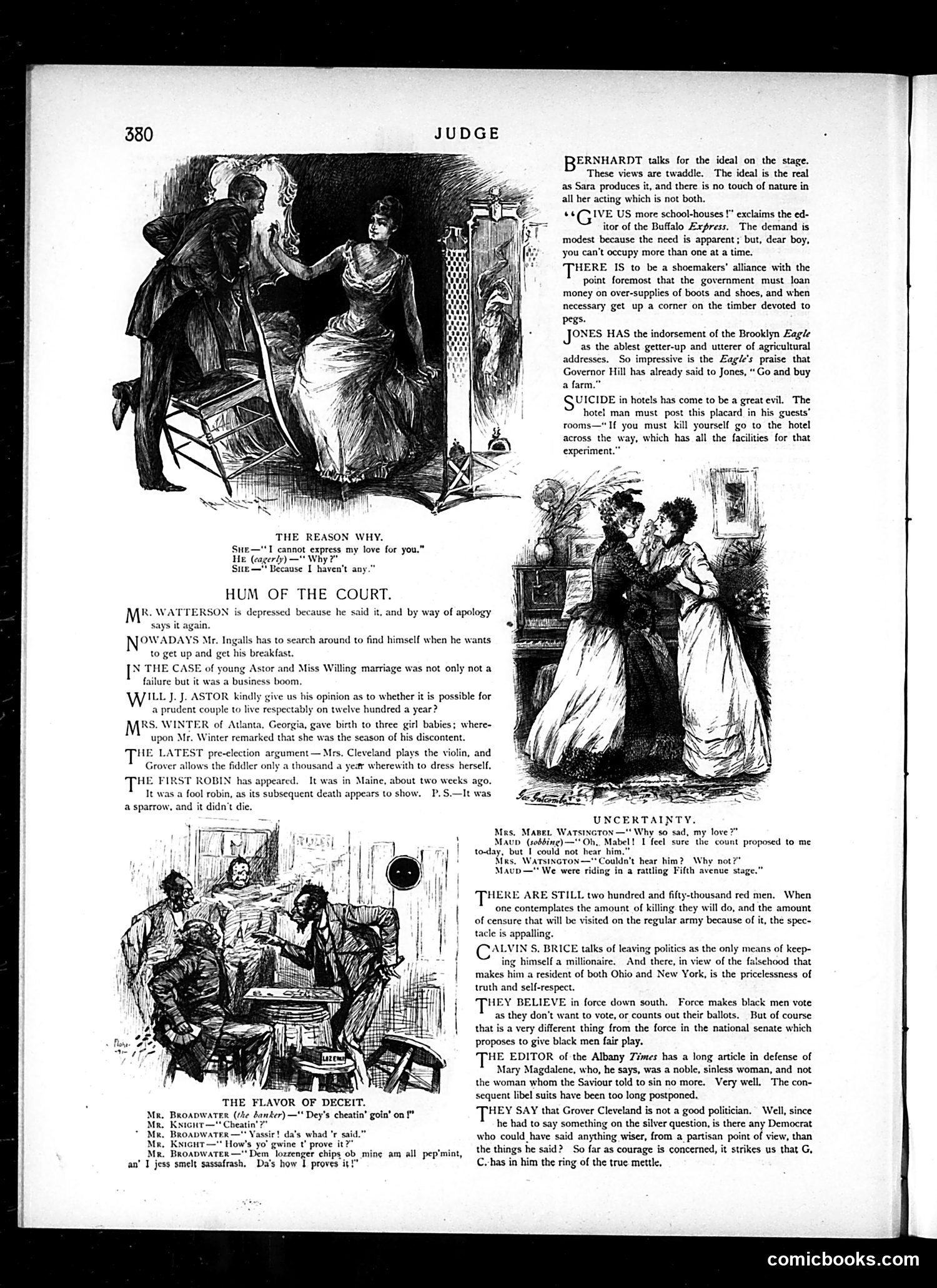
This page from Judge magazine contains satirical commentary on 1880s-90s American politics and society: **Key Targets:** - **Sarah Bernhardt** — Criticized for idealistic acting philosophy versus realistic performance - **Agricultural/Economic Policy** — Mocked proposals for government loans on boot/shoe surpluses and timber monopolies - **Grover Cleveland Administration** — Multiple jibes: Mrs. Cleveland's violin allowance, his handling of the "silver question" (monetary policy debate), and general political incompetence - **Race and Southern Politics** — Bitter satire about force used to suppress Black voting rights while condemning similar federal coercion as unfair - **Calvin S. Brice** — Ohio politician criticized for claiming residency in multiple states while profiting politically **Overall Tone:** Judge mixes cynical humor about wealthy industrialists, Republican skepticism toward Democratic governance, and commentary on contemporary social issues like hotel suicides and women's roles. The cartoons use exaggerated caricature and paradox to expose hypocrisy in politics and society.
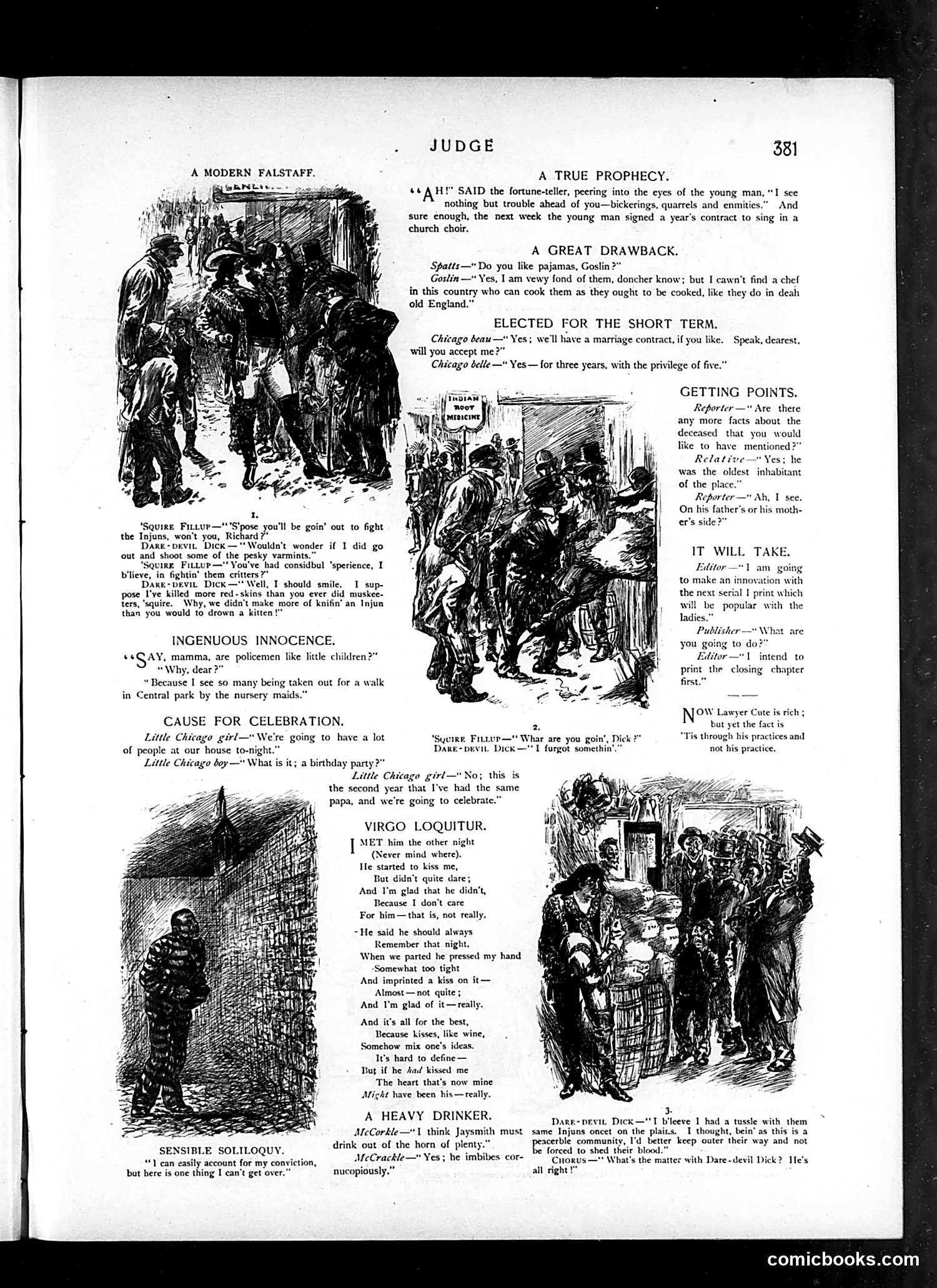
This page contains multiple short satirical pieces typical of early Judge magazine humor: **"A Modern Falstaff"** depicts a wealthy, rotund man (the Falstaff reference suggests pretentious excess), with dialogue mocking Indian fighters and their violent boasts—likely satirizing frontier mythology or contemporary military figures. **"A True Prophecy"** jokes that signing a church choir contract brings misery, mocking both marriage and religious commitment. **"Elected for the Short Term"** satirizes Chicago courtship customs where a woman accepts a three-year marriage "contract" with renewal options—mocking transactional attitudes toward marriage as business deals. **"Virgo Loquitur"** is a woman's monologue expressing romantic ambivalence—she claims indifference while contradicting herself, satirizing feminine affectation and emotional dishonesty. Other pieces mock: English snobbery about pajama cuisine, journalists exploiting grief for stories, and heavy drinking. The overall tone ridicules American social pretension, commercialism, and romantic hypocrisy of the era.
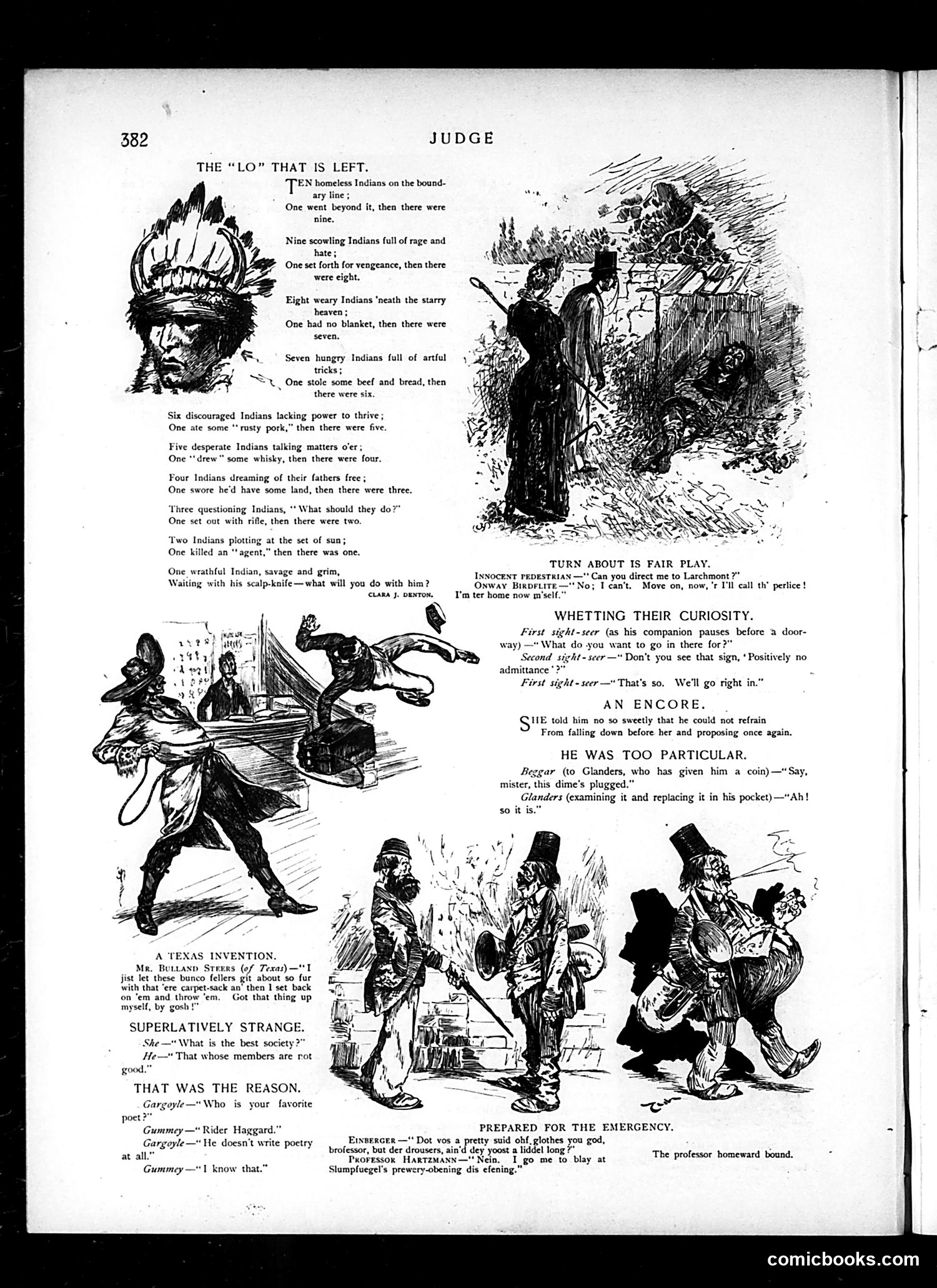
**"The 'Lo' That Is Left"** (main poem with Native American imagery): This is a darkly satirical counting-out rhyme depicting the systematic disappearance of Native Americans through poverty, violence, and desperation. Each verse shows Indians dying or vanishing due to starvation, alcohol, disease, or hopelessness—culminating in one committing murder. "Lo" was a derogatory term for Native Americans (from Longfellow's "Lo, the poor Indian"). The satire critiques American indifference to Native American suffering and displacement. **Other cartoons** employ gentler humor: "Turn About Is Fair Play" jokes about an irritable city dweller; "Whetting Their Curiosity" plays on human nature; remaining items are domestic comedies about begging, courtship, and social pretension. The page reflects Judge's mix of cutting social commentary (the Indian satire) alongside lighter fare—characteristic of late 19th/early 20th-century American satirical magazines that could range from progressive to deeply offensive by modern standards.
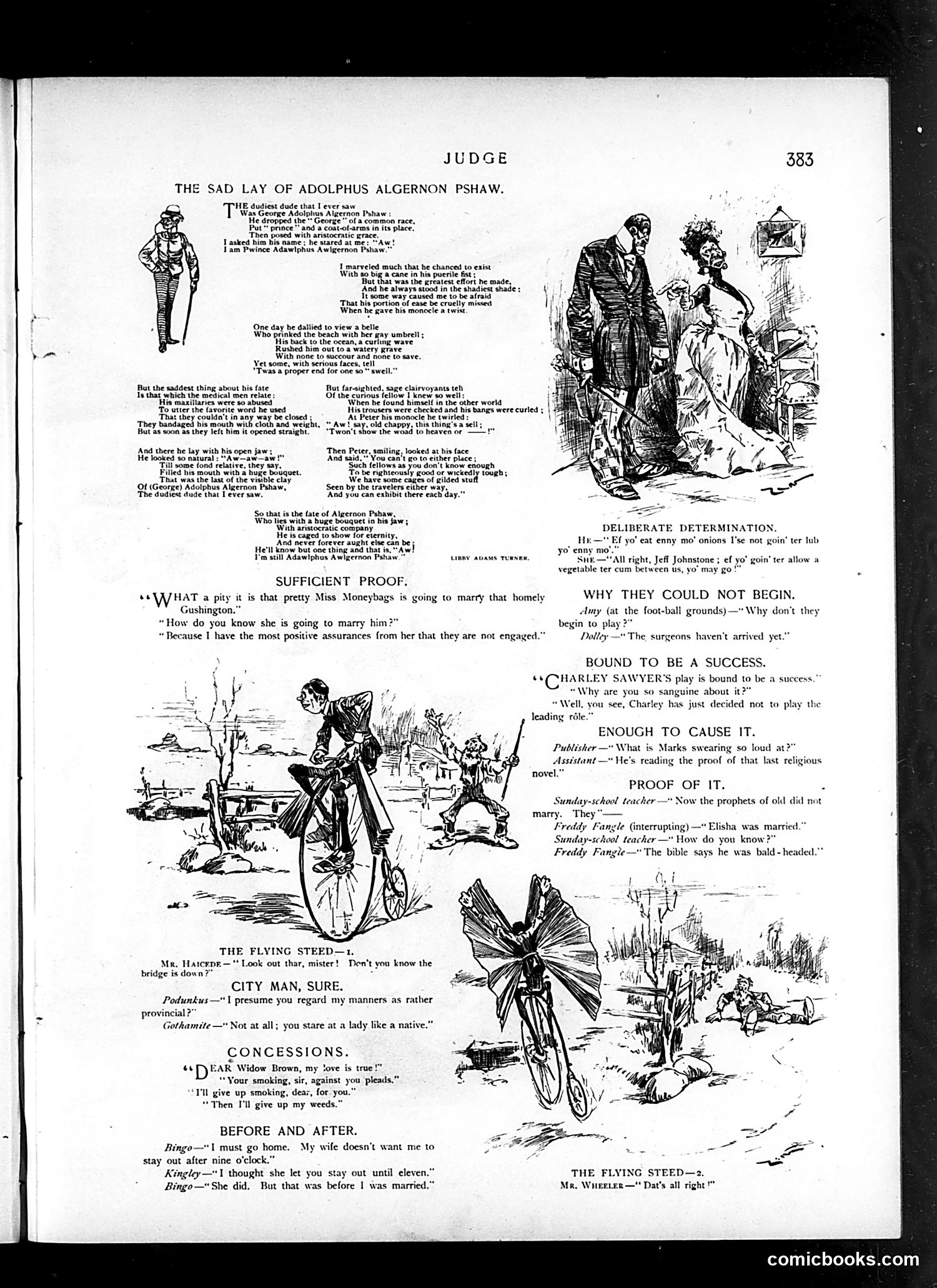
This page satirizes the "dude" — a fashionable but vapid young man obsessed with aristocratic affectation. The protagonist is a pretentious American who adopts fake British mannerisms, dropping his common name "George" for the affected "Prince Adolphus Algernon Pshaw." He's characterized by exaggerated speech ("Aw"), a monocle, and an oversized cane. The satire culminates in dark comedy: waves sweep him out to sea, and his mouth becomes so habituated to saying "Aw" that it cannot close even in death — he's buried with flowers stuffed in his gaping mouth. St. Peter consigns him to a "gilded cage" for those neither sufficiently good nor evil. The humor targets American social pretension and the absurdity of aping British upper-class mannerisms. Supporting cartoons mock engagement rumors, theatrical flops, and miscellaneous social foibles. This reflects *Judge* magazine's typical satirical approach to contemporary American life.
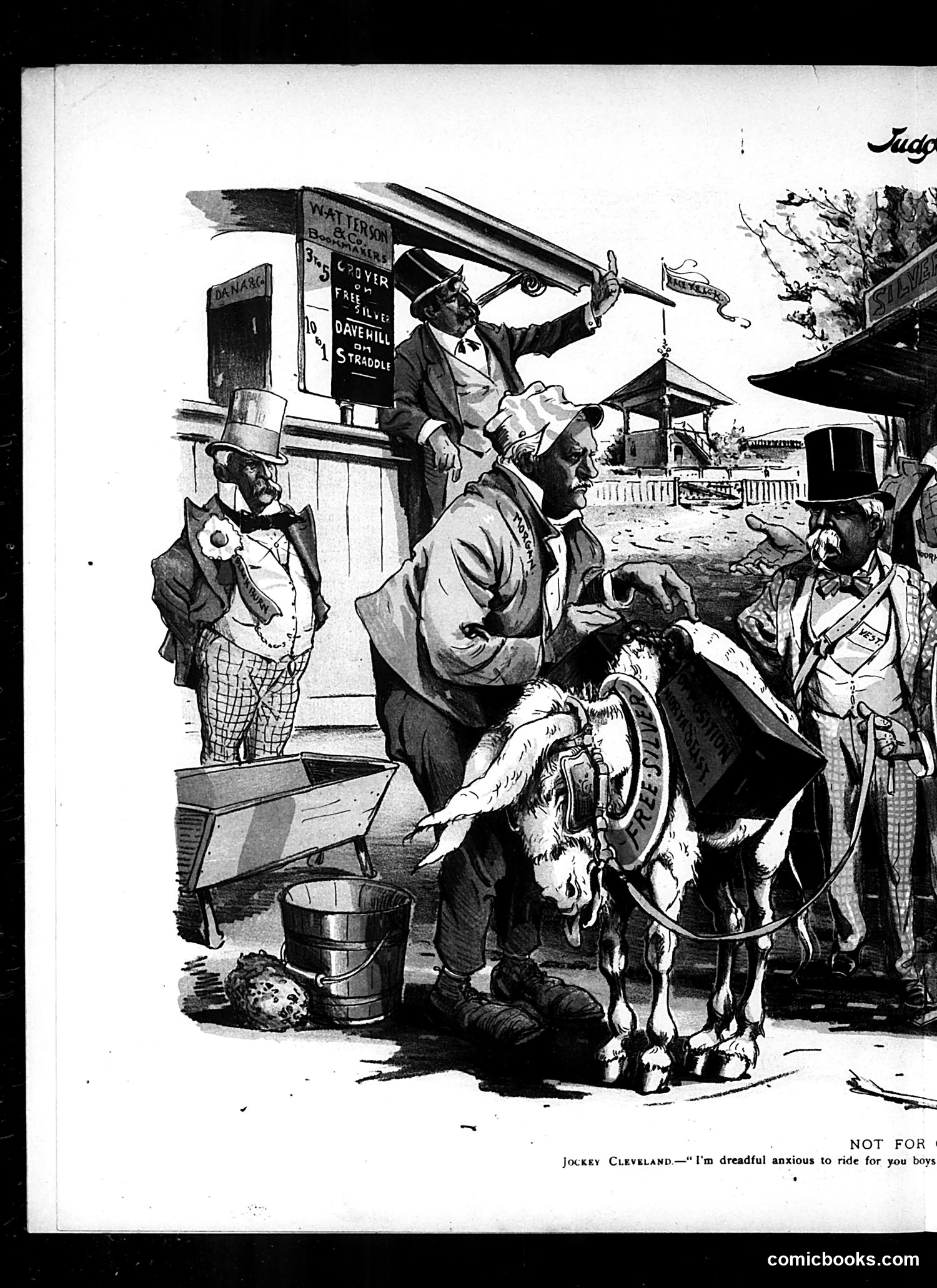
This is a satirical cartoon referencing Grover Cleveland, who served as U.S. President (likely depicting events from his administrations in the 1880s-90s). The cartoon depicts Cleveland as a jockey, anxiously offering to "ride for you boys"—a metaphor suggesting he's willing to serve political interests or factions. The figures around him appear to be political operatives or party bosses wearing top hats, representing different political interests. The horse and carnival-like setting suggest the unpredictability and spectacle of politics. The satire critiques Cleveland's political maneuvering or his willingness to accommodate various political factions to gain or maintain power, portraying him as eager to serve whoever will "ride" him into office or influence.
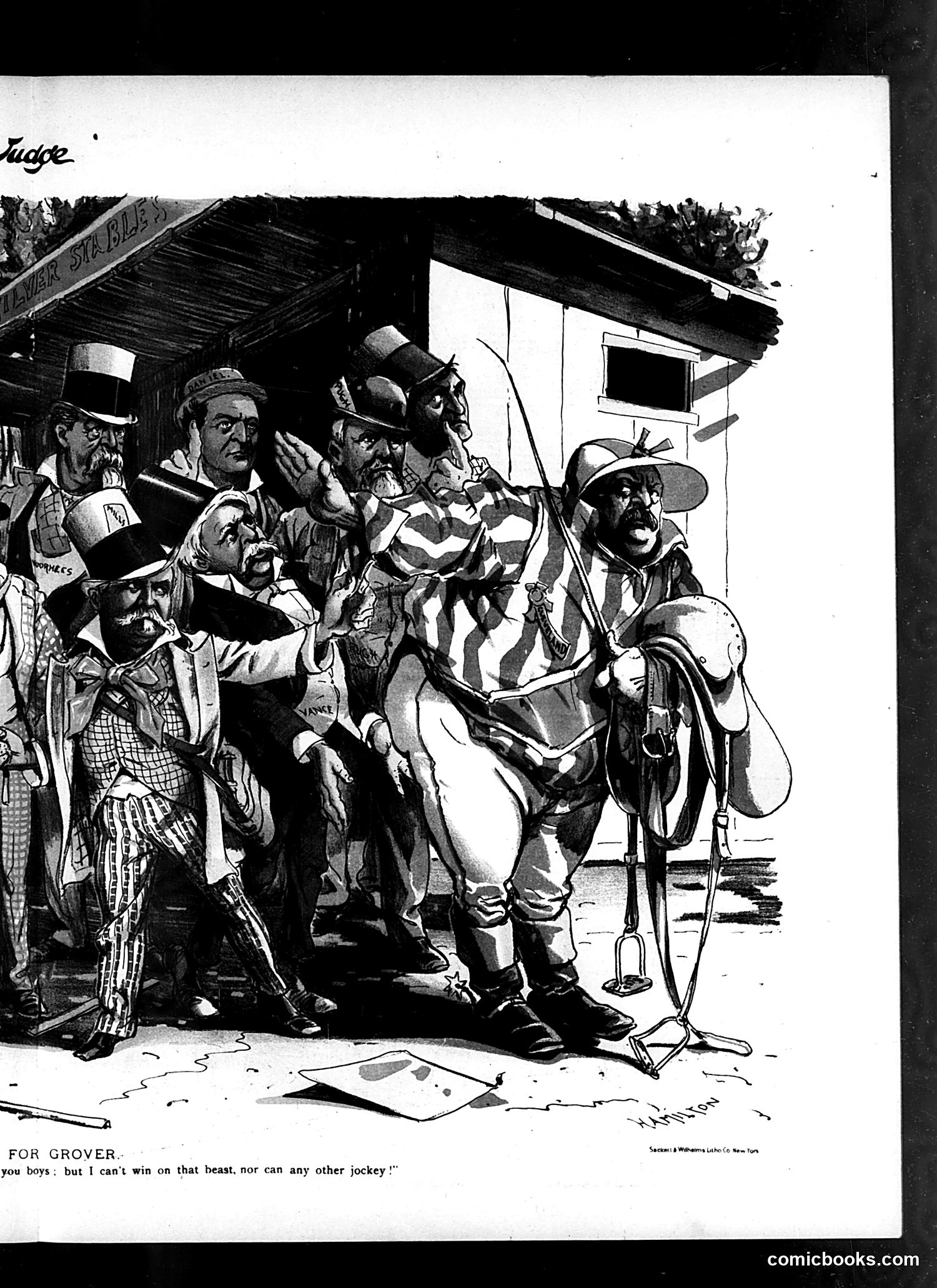
This is a satirical cartoon titled "For Grover," referencing President Grover Cleveland. The image shows a group of men (likely political operatives or party members) gathered around a horse, with one figure mounted on it speaking the incomplete caption: "you boys: but I can't win on that beast, nor can any other jockey." The cartoon satirizes Cleveland's political prospects or electoral chances, using the horse as a metaphor for his candidacy or political position. The assembled crowd of men with various hats and expressions represents political supporters or operatives questioning whether even Cleveland can succeed with their current political "vehicle." The satire suggests skepticism about Cleveland's viability as a candidate despite backing from party members.
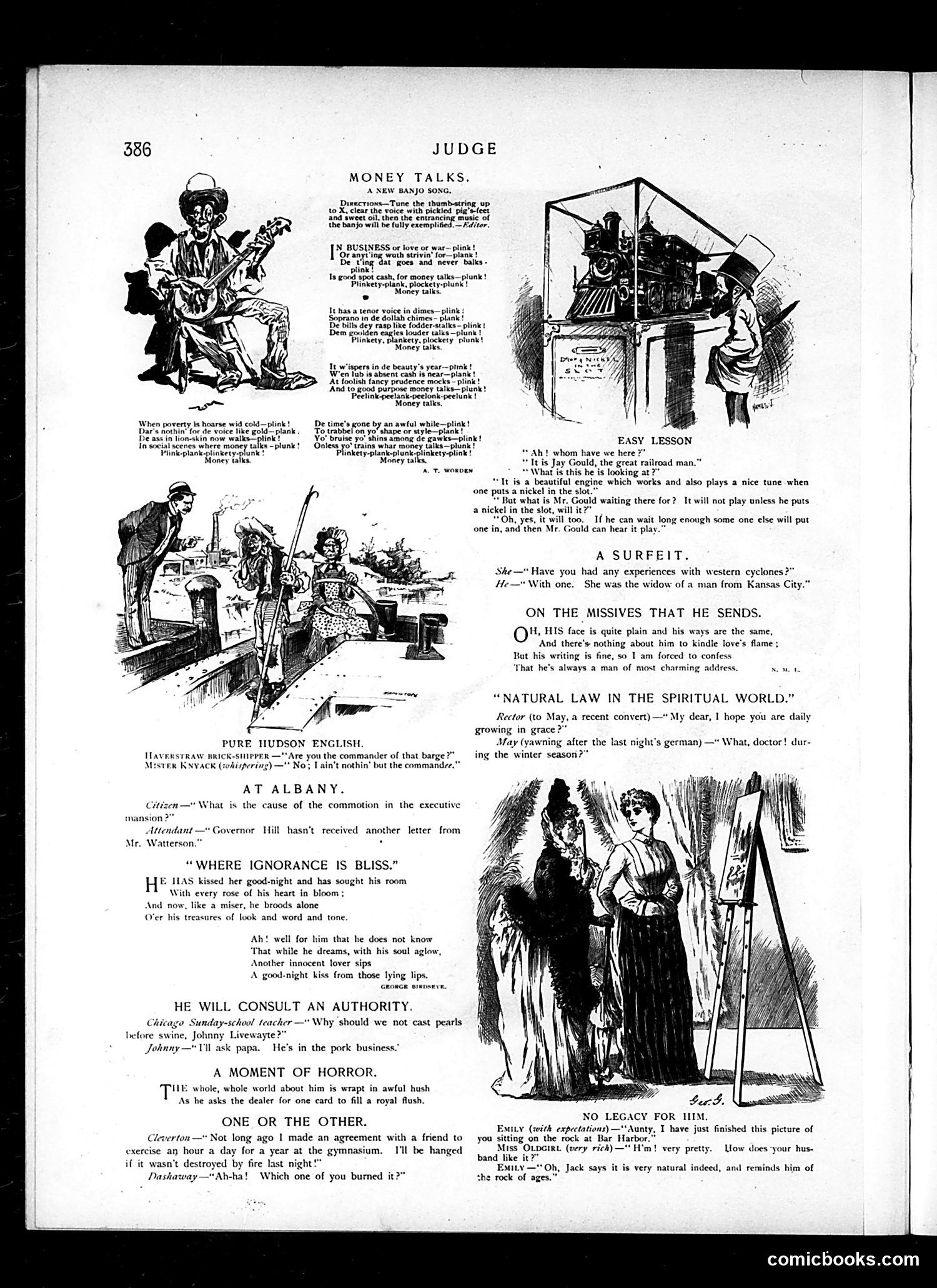
This page collects various humorous satirical pieces typical of late 19th-century American humor: **"Money Talks"** is a banjo song lampooning materialism—how money motivates everything from business to romance. The repeated "plink-plank" sounds mock the obsession with cash. **"Easy Lesson"** satirizes Jay Gould, the famously wealthy railroad magnate, suggesting he's so greedy he won't even pay a nickel to hear music unless someone else pays first—mocking wealthy misers. **Other sketches** target various social absurdities: a brick shipper's malapropism ("commandee" vs. "commander"), Governor Hill's silence suggesting incompetence, a suitor unknowingly kissed by a rival, and a child whose father works in "the pork business" (meaning slaughterhouses), humorously unfit to discuss biblical pearls. The humor relies on wordplay, character types, and social observation rather than specific political events. The overall message reflects Gilded Age cynicism about greed, pretension, and human folly.
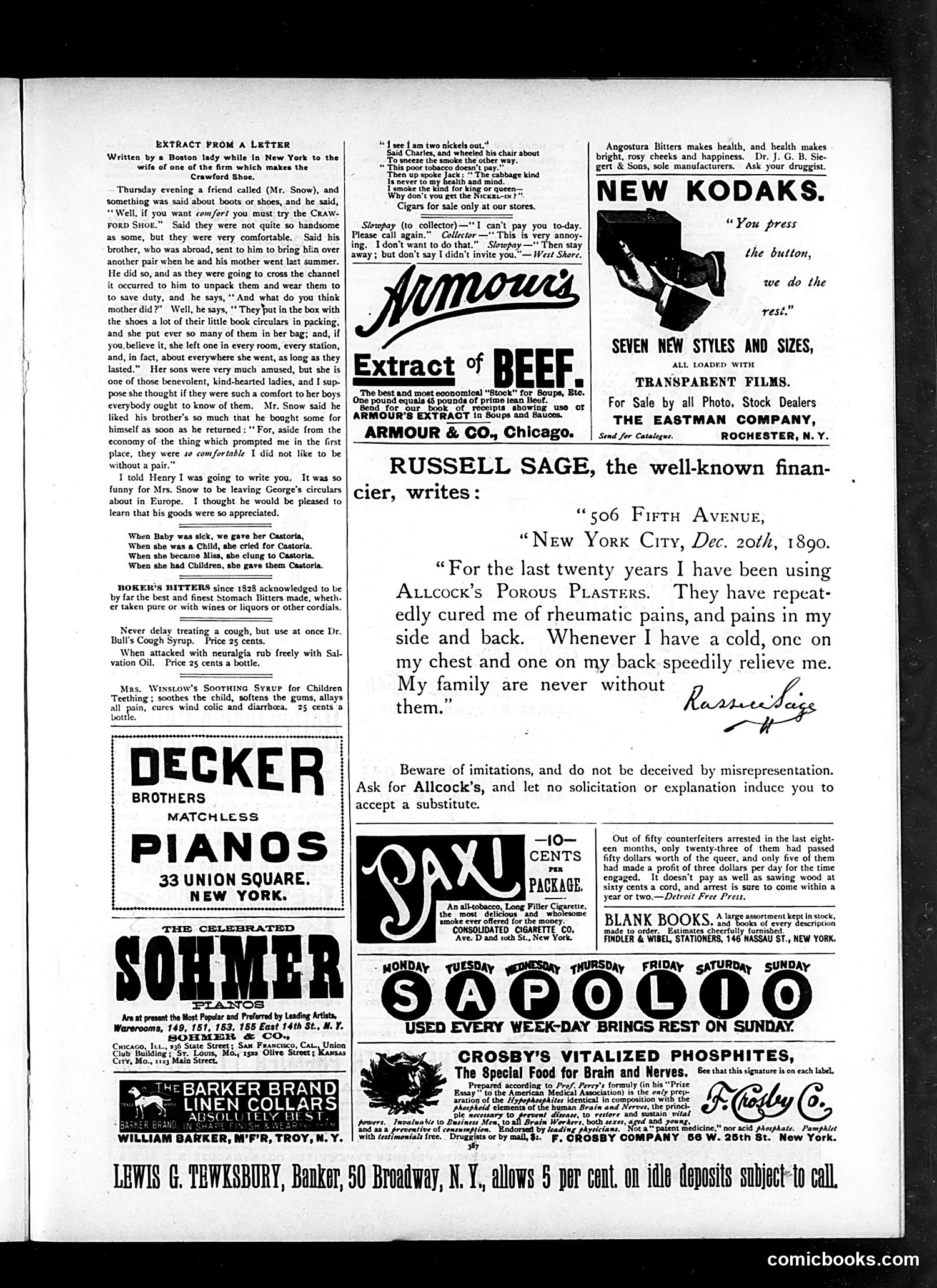
This is primarily an **advertising page** from Judge magazine (circa 1890, based on the Russell Sage letter dated Dec. 20th, 1890). There are no political cartoons visible. The page contains mostly **product testimonials and advertisements** typical of the era: - **Crawford Shoe** advertisement (anecdotal letter about comfort) - **Castoria** (children's medicine) - **Armour's Beef Extract** - **Sohmer Pianos** - **Barker Brand Linen Collars** - **New Kodaks** (cameras with transparent film) - **Crosby's Vitalized Phosphites** (brain food supplement) There are **two brief comedic text pieces** rather than cartoons: one about counting nickels, another about a debt collector's awkward visit. The **Russell Sage endorsement** for Allcock's Porous Plasters is noteworthy—Sage was a famous financier, and his celebrity endorsement was valuable advertising. The plasters claimed to cure rheumatic pain. The page reflects **late-19th century consumer culture** and the prevalence of patent medicine advertising before FDA regulations.
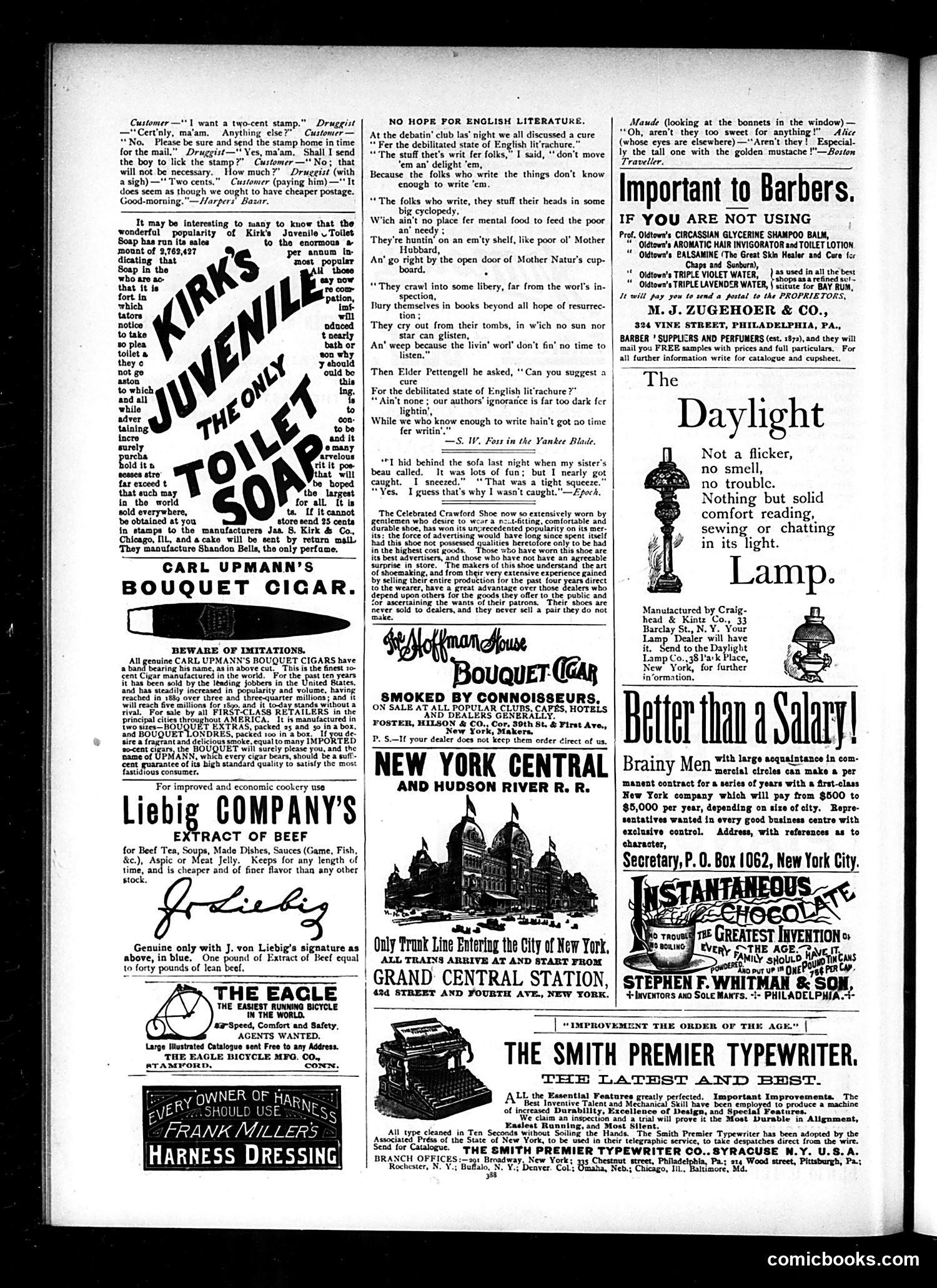
This page is primarily **advertising**, with one satirical piece about English literature. The main satirical content is titled "NO HOPE FOR ENGLISH LITERATURE," presenting a dialect-heavy monologue criticizing contemporary English writers. The speaker argues that writers fail because they isolate themselves in libraries and encyclopedias rather than observing real life ("Mother Natur's cupboard"). They're portrayed as disconnected from living people and contemporary experience—creating sterile, bookish work that audiences ignore. The piece satirizes **ivory-tower intellectualism** and the gap between academic literary culture and popular audiences. It suggests English literature's decline stems from authors being too learned and detached rather than too ignorant, which is ironic social commentary on late-19th-century literary pretension. The remainder is period advertising for Kirk's Soap, Carl Upmann's cigars, Liebig beef extract, bicycles, and other consumer goods—typical of Judge's revenue model.
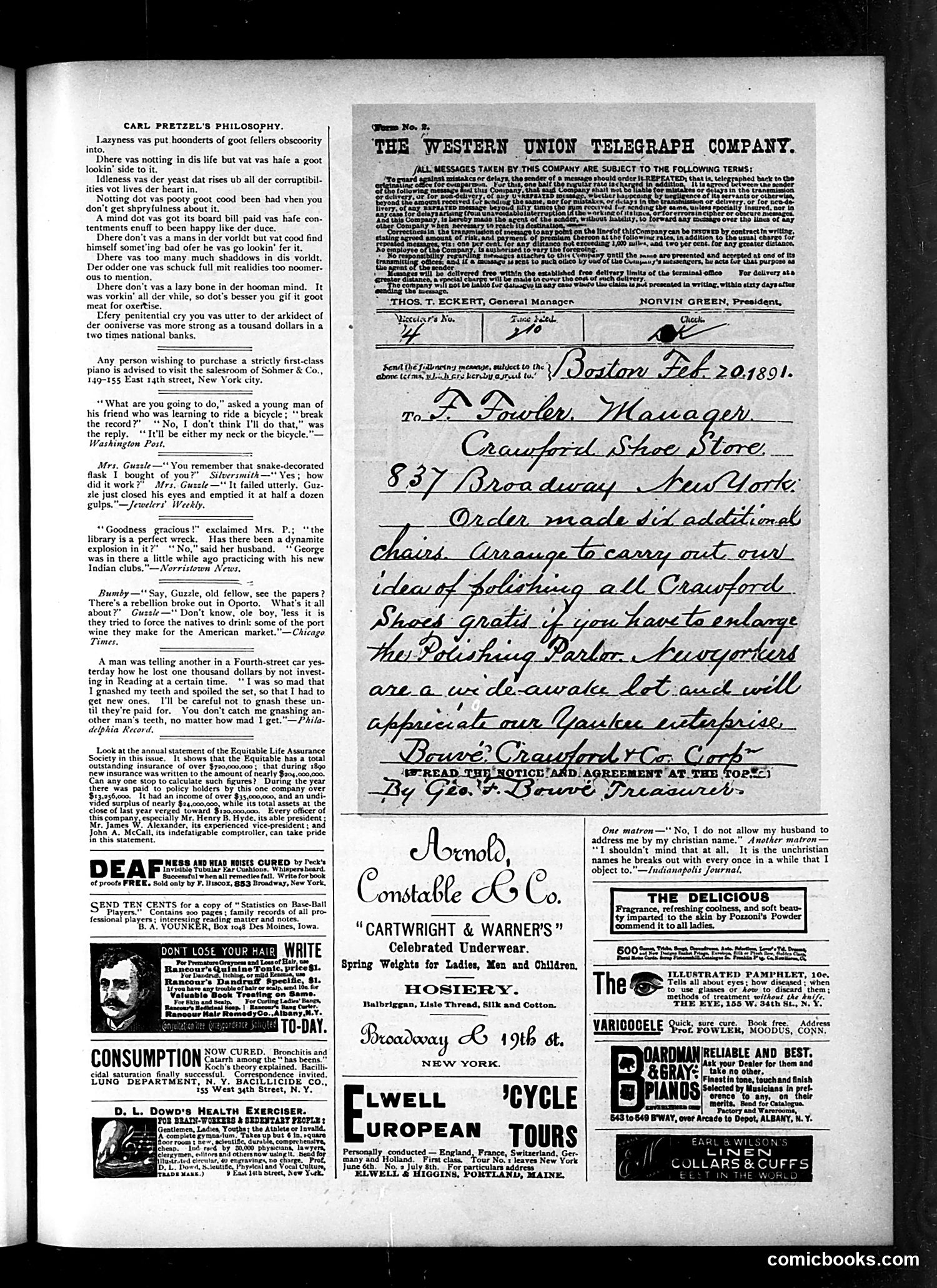
This page is primarily **advertising and miscellaneous content** rather than political cartoons. The dominant feature is a handwritten **Western Union telegram** dated February 20, 1891, from "D. Bowlery, Manager" at Crawford Shoe Store (837 Broadway, New York) to Arnold Constable & Co., ordering additional chairs to accommodate their publishing enterprise. The left column contains **"Carl Pretzel's Philosophy,"** a recurring humor feature using heavy German-accented dialect ("Lazyness vas put hoonderts of goot fellers obscoority into"). This represents period humor mocking German immigrants through broken English—a common but now-offensive comedic trope of the 1890s. The page also includes: - Various brief jokes and anecdotes - An article on the Equitable Life Assurance Society's financial success - Period advertisements (pianos, hair remedies, bicycles, consumables) **No identifiable political satire or caricatures appear on this page.** It reflects late-19th-century Judge magazine's mixed format of humor, business announcements, and advertising.
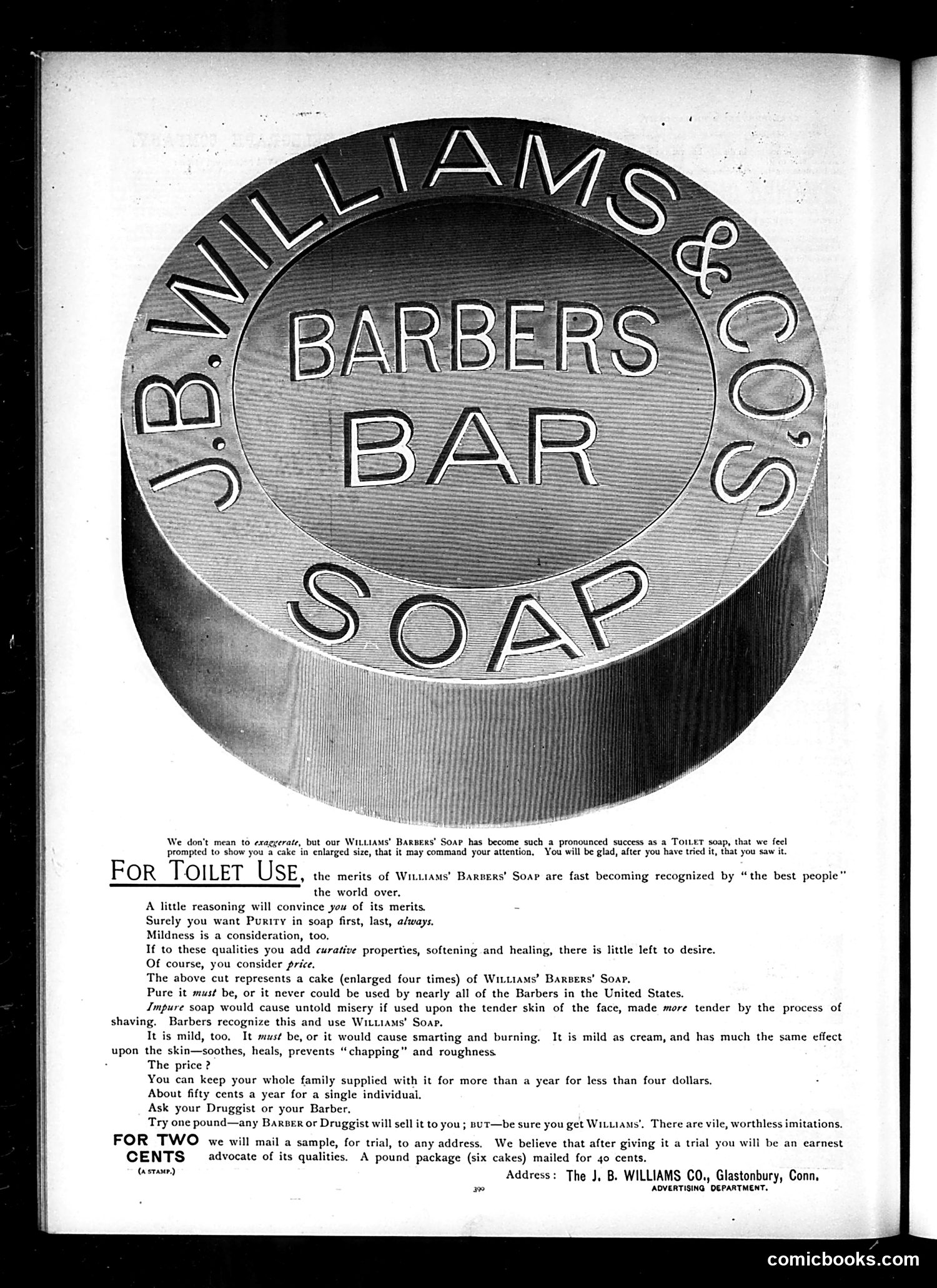
This is a **product advertisement, not satire or political content**. It promotes Williams' Barbers' Soap as a toilet soap, featuring an enlarged image of a soap cake. The ad targets middle-class consumers by emphasizing the product's endorsement by professional barbers across the United States—positioning barber approval as a mark of quality and purity. Key selling points include: mildness (important for post-shave skin), curative properties, and affordability (under four dollars yearly for a family). The copy addresses consumer concerns about counterfeits ("vile, worthless imitations"), a common problem in patent medicine and consumer goods of the era. The two-cent trial offer (mail 40 cents for a pound package) was a standard marketing tactic to build brand loyalty. This appears in *Judge*, likely because the magazine accepted paid advertisements alongside satirical content.
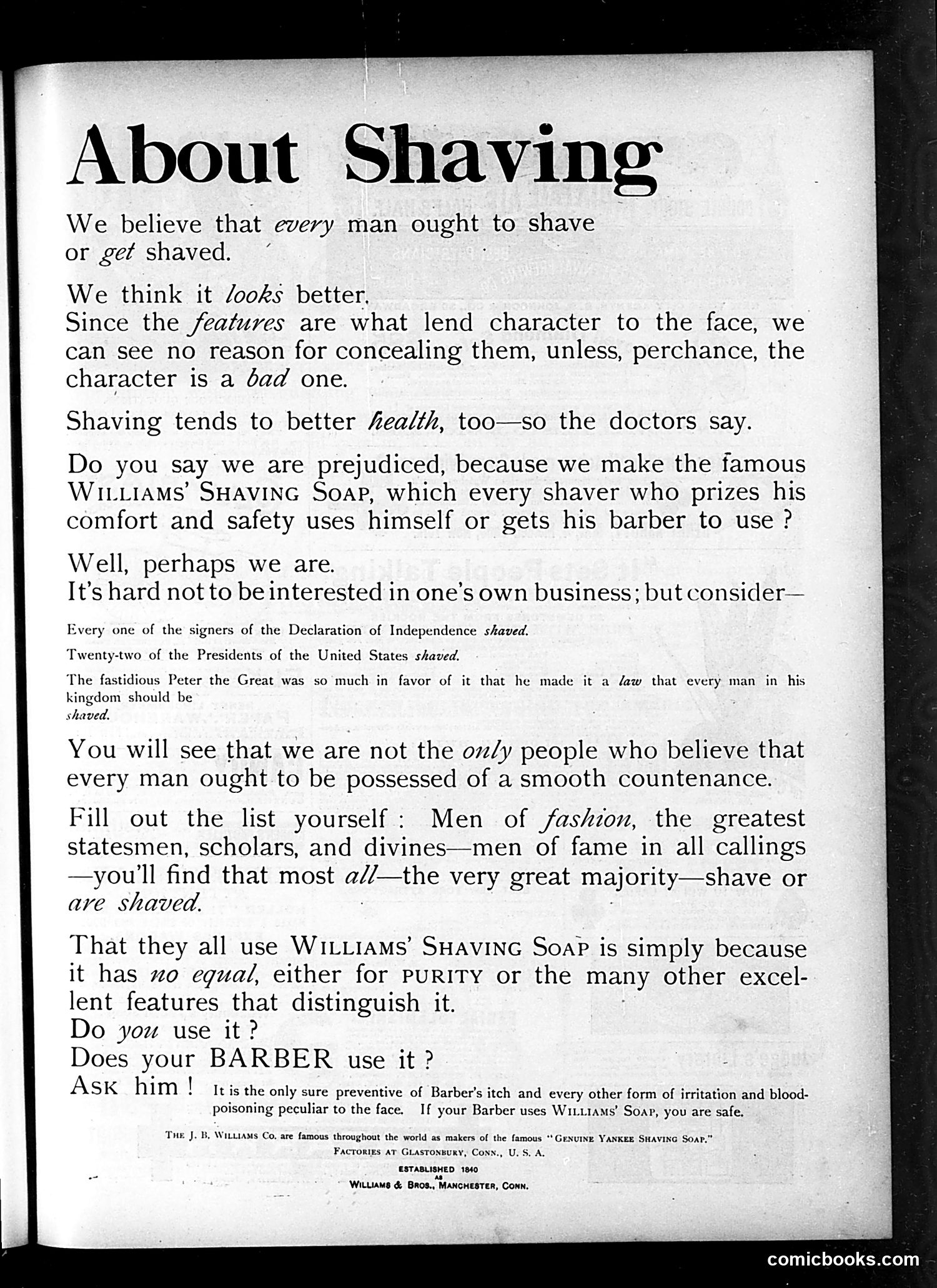
This is primarily a **product advertisement**, not political satire. Williams Shaving Soap uses nationalist and historical appeals to sell their product. The ad argues that shaving is universally practiced by great men—citing the Founding Fathers, U.S. Presidents, and even Peter the Great making it law. This constructs shaving as a marker of civilization, health, and character. The humor lies in the self-aware admission: "Perhaps we are prejudiced, because we make the famous Williams' Shaving Soap." The ad acknowledges its obvious bias while simultaneously using historical/authoritative figures to legitimize the product. The closing pitch warns that Williams' Soap prevents "Barber's itch"—suggesting competitor products were associated with skin irritation, making safety a selling point. This reflects late 19th/early 20th-century advertising strategy: wrapping commercial interests in patriotic and scientific language to appear impartial while clearly promoting self-interest.
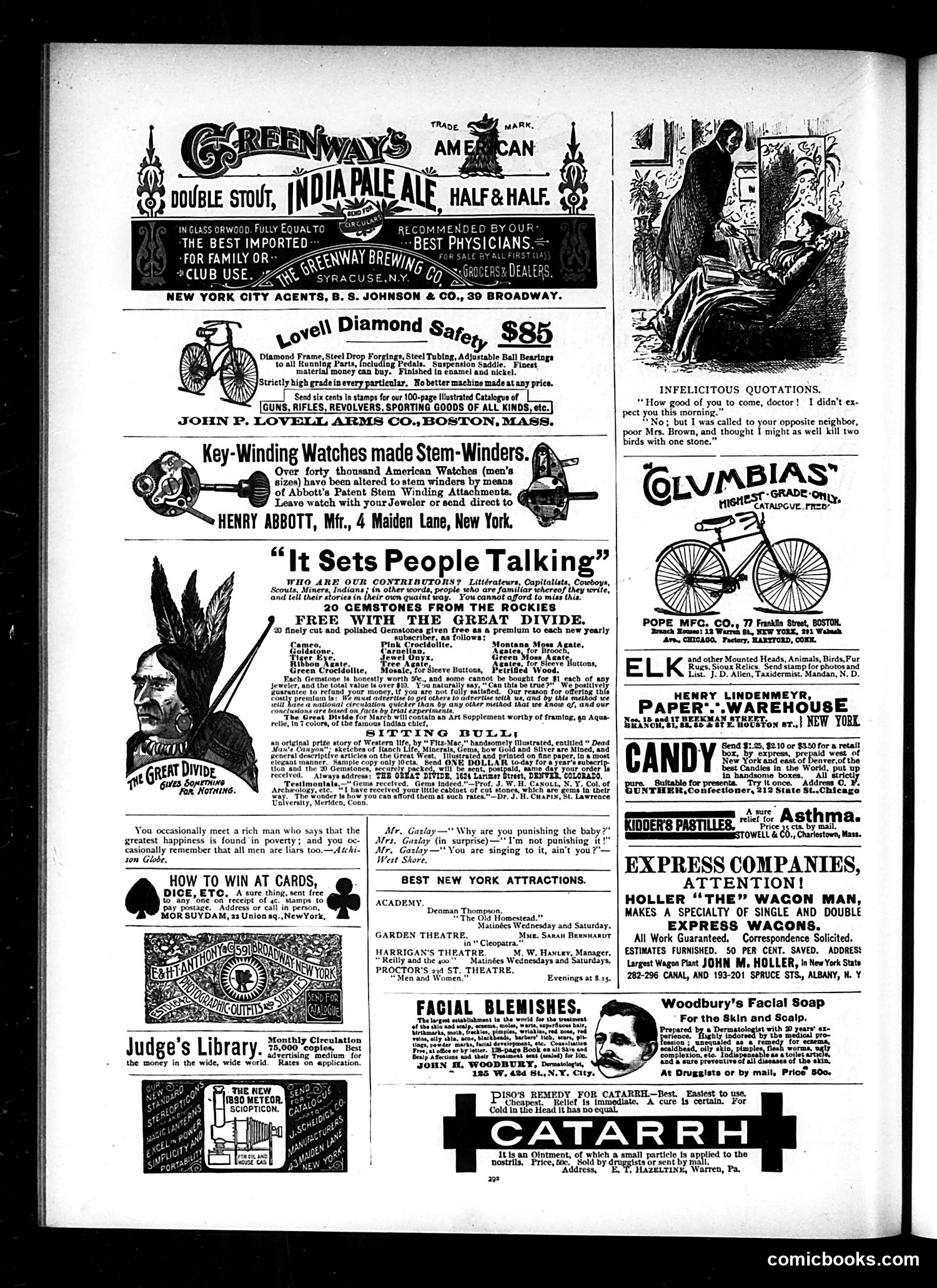
This is primarily an **advertising page** with minimal editorial content. The notable satirical element is a small cartoon titled **"Unavoidable Situations"** depicting a doctor visiting a patient (Mrs. Brown) while also attending to a neighbor, with the joke being the doctor conveniently "kills two birds with one stone." The page is dominated by product advertisements typical of the 1890s: bicycles (Lowell and Columbia brands), watches, firearms, and patent medicines (notably "Catarrh" treatment at bottom). One advertisement features **"Sitting Bull"** imagery promoting "The Great Divide" publication about Western life—likely referencing the famous Lakota leader for sensationalist appeal. A brief text joke mocks wealthy men who claim happiness comes from poverty, calling them liars. The content reflects Judge's dual nature: a satirical weekly that sustained itself financially through advertising, mixing social commentary with commercial appeals to readers interested in emerging consumer goods and Western frontier mythology.
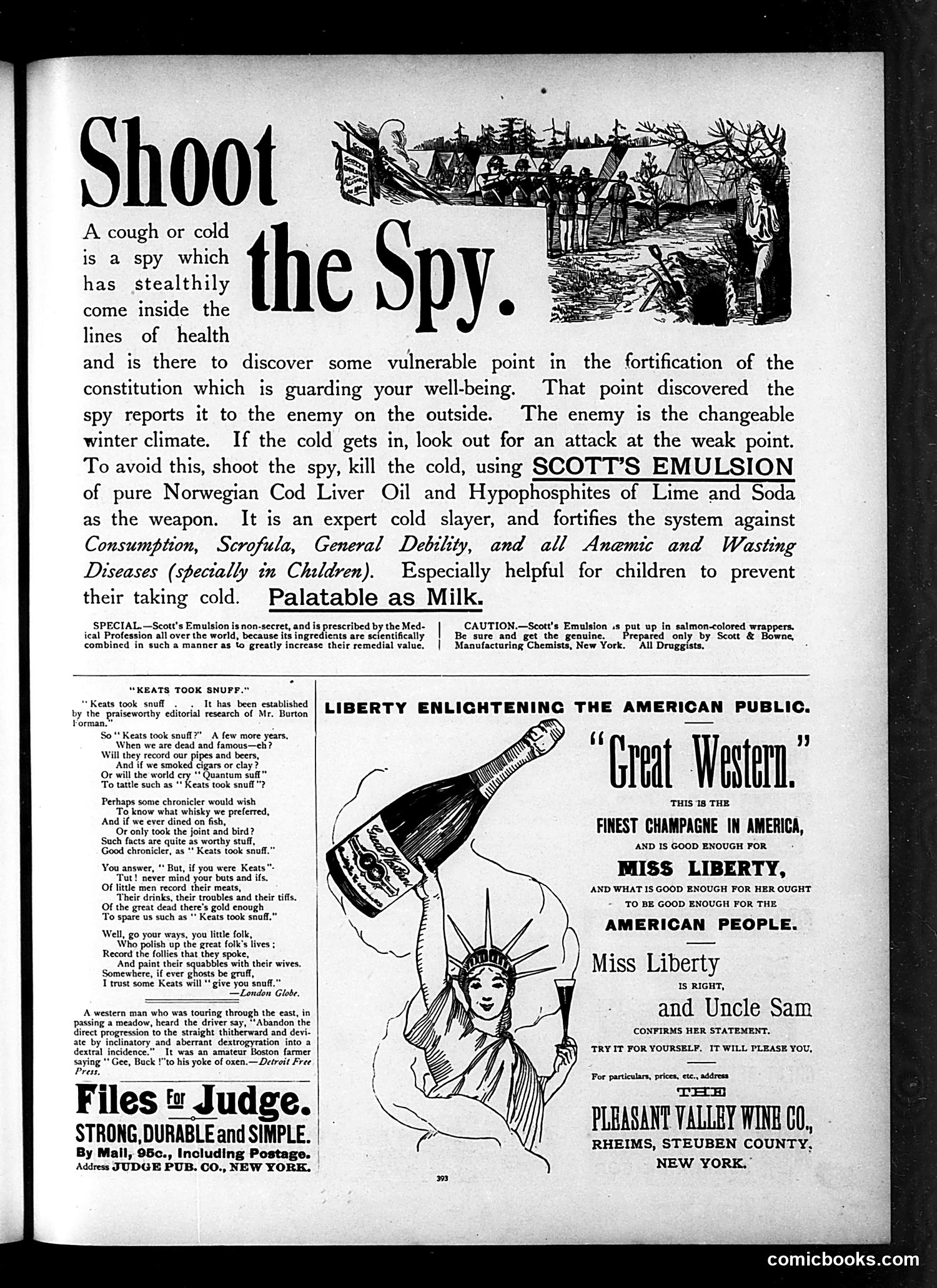
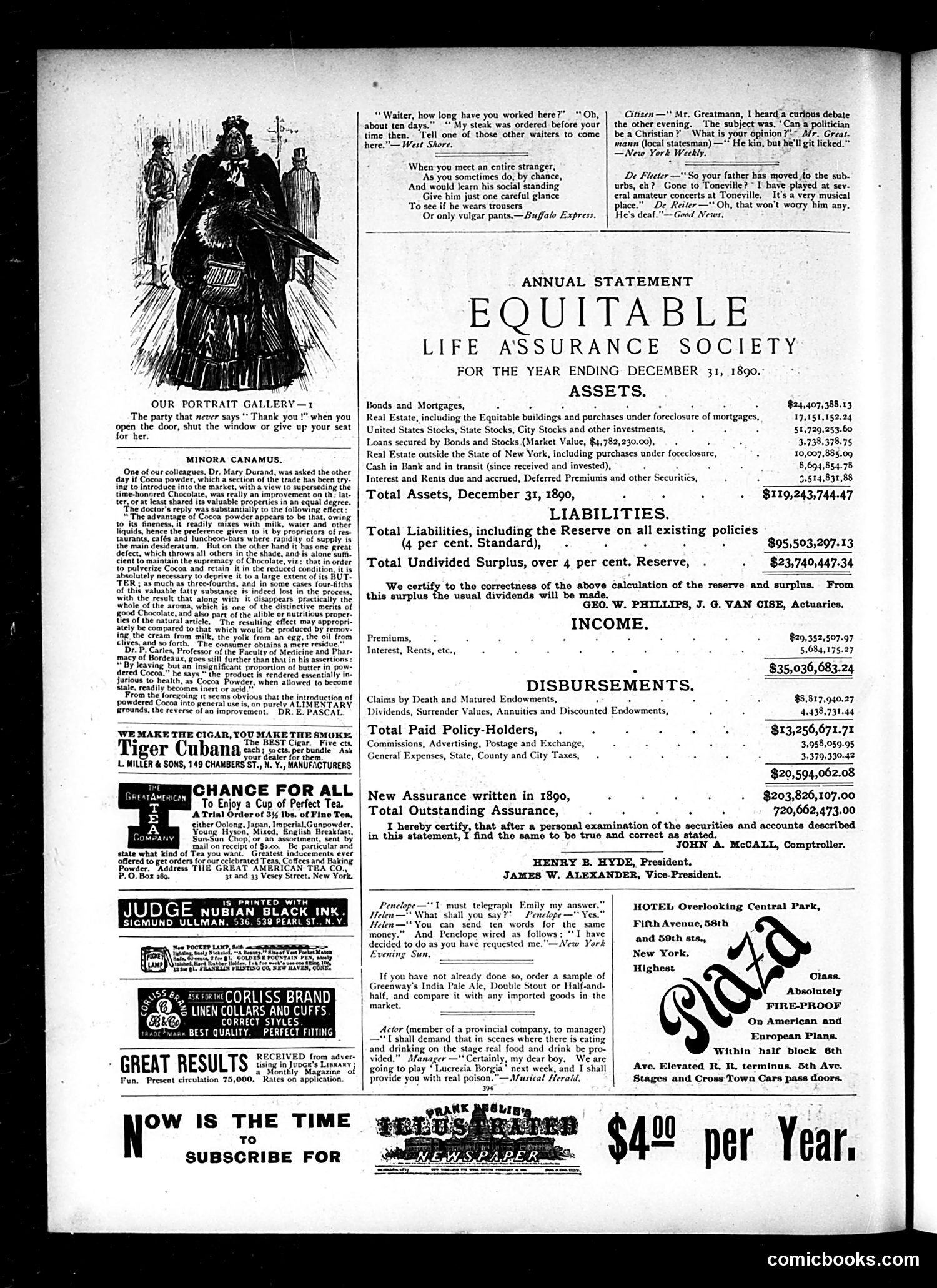
This page from Judge (circa 1890) contains mostly **advertisements and filler content** rather than substantial political cartoons. The main illustrated feature, "Our Portrait Gallery," shows a caricatured woman in Victorian dress—likely depicting a rude female passenger who fails to thank others for courtesies like opening doors or offering seats. The satire targets what the magazine presents as inconsiderate modern manners, specifically among women. The page also includes brief humorous anecdotes mocking: - An impatient diner complaining about slow service - A joke about distinguishing social class by observing whether men wear proper trousers or "vulgar pants" - A politician's admission that Christians can't succeed in politics without hypocrisy ("He kin, but he'll git licked") The bulk of the page, however, comprises **advertisements** for cigars, tea, cocoa, and an insurance company statement—typical filler for 1890s satirical magazines.
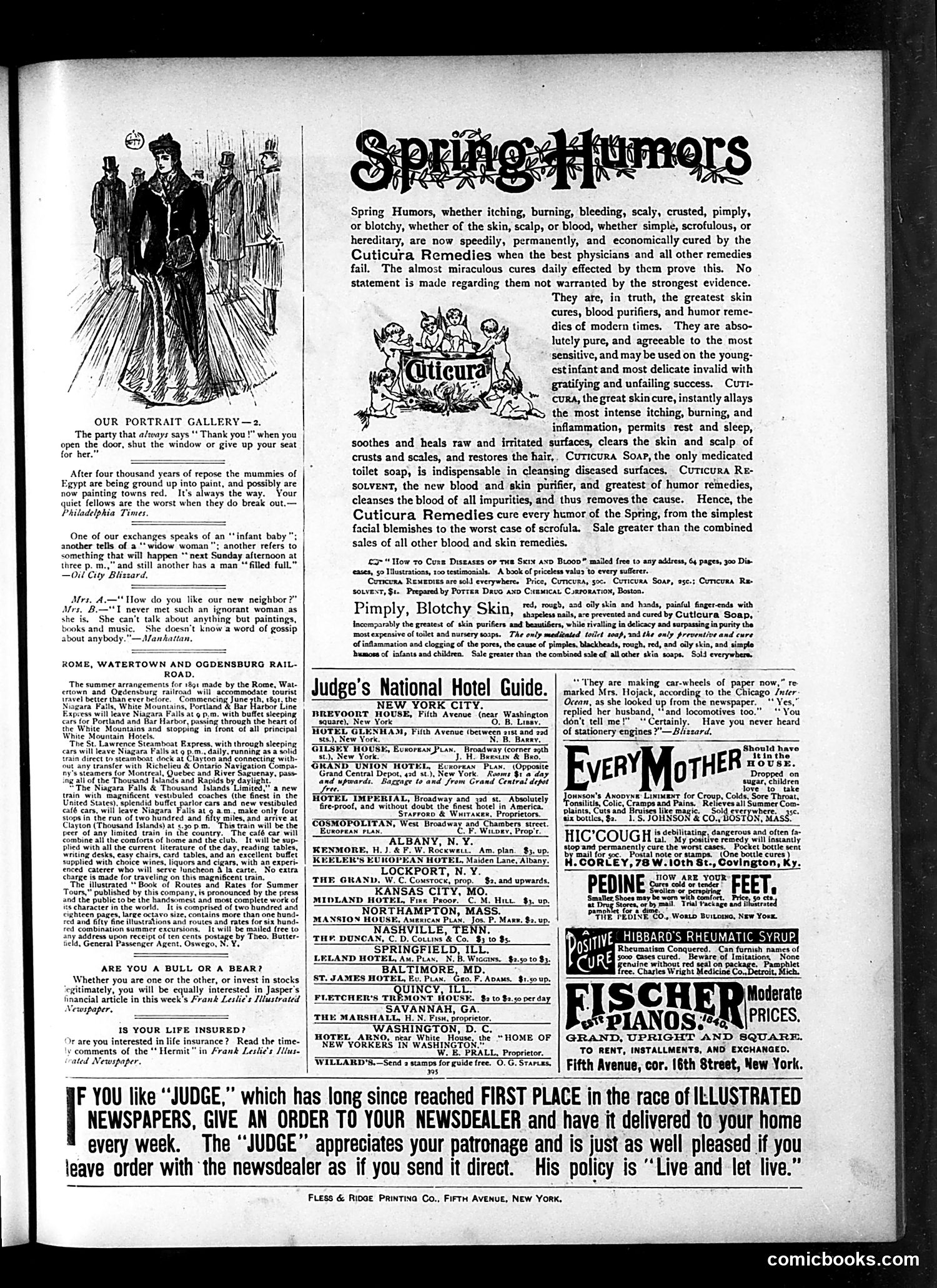
This page is primarily **advertising and filler content** rather than satirical cartoons. The small "Portrait Gallery" sketch at top left shows three fashionably dressed women and mocks genteel social conventions—specifically satirizing women who say "thank you" for minor courtesies like opening doors. The accompanying text jokes about redundant phrases ("infant baby," "widow woman") found in other newspapers. The bulk of the page consists of **commercial advertisements**: railroad schedules for the Rome, Watertown & Ogdensburg line promoting tourist travel to Niagara Falls and the Thousand Islands; medicinal advertisements for "Cuticura Remedies" (skin treatments); a hotel guide; and piano sales. Brief humorous notes reference mummies being ground into paint, and a gossipy exchange about an "ignorant woman" who discusses art and literature instead of scandal. The page concludes with promotional copy encouraging readers to subscribe to Judge magazine itself through their local newsdealer. This appears to be a typical **late-19th-century magazine format**, mixing advertising revenue with light editorial content.
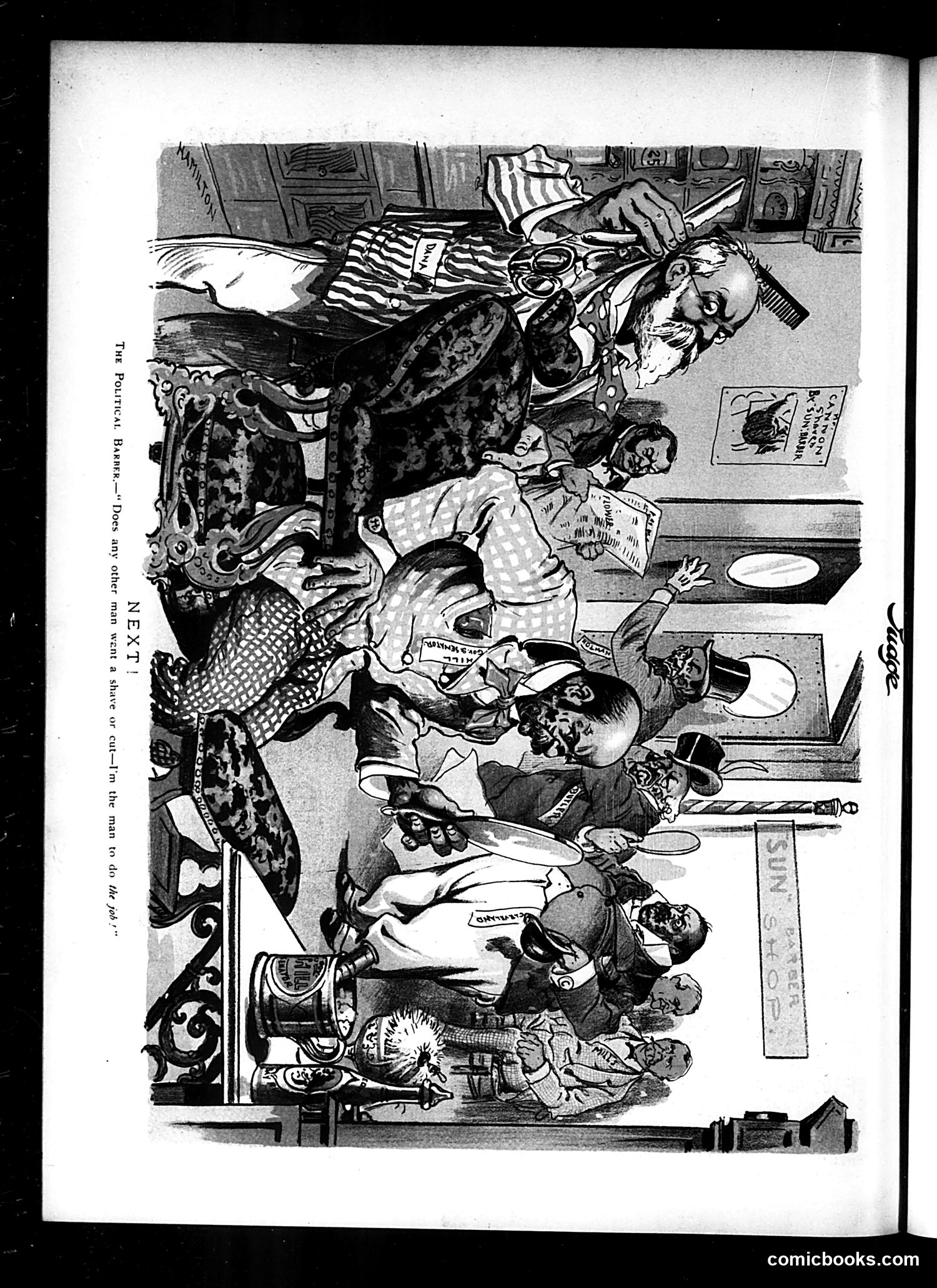
This appears to be a political cartoon titled "The Political Barber," with the caption asking if anyone else needs "a shave or cut" because the speaker is "the man to do the job." The cartoon depicts a barber shop scene with multiple figures. The barber (likely representing a political figure or reformer) appears positioned to "cut" or remove various elements from other figures' appearances—a metaphor for political reform or elimination of rivals. Without being able to definitively identify the specific individuals caricatured or the precise historical moment referenced, the cartoon's core satire appears to target political ambition and the wielding of power to "trim down" opponents or competition. The barber shop setting suggests both grooming and dangerous cutting instruments, playing on the double meaning of political "cuts." The exact political context and identities remain unclear from the image alone.