
Judge, 1891-03-07 · page 6 of 20
Judge — March 7, 1891 — page 6: what you’re looking at
What you’re looking at
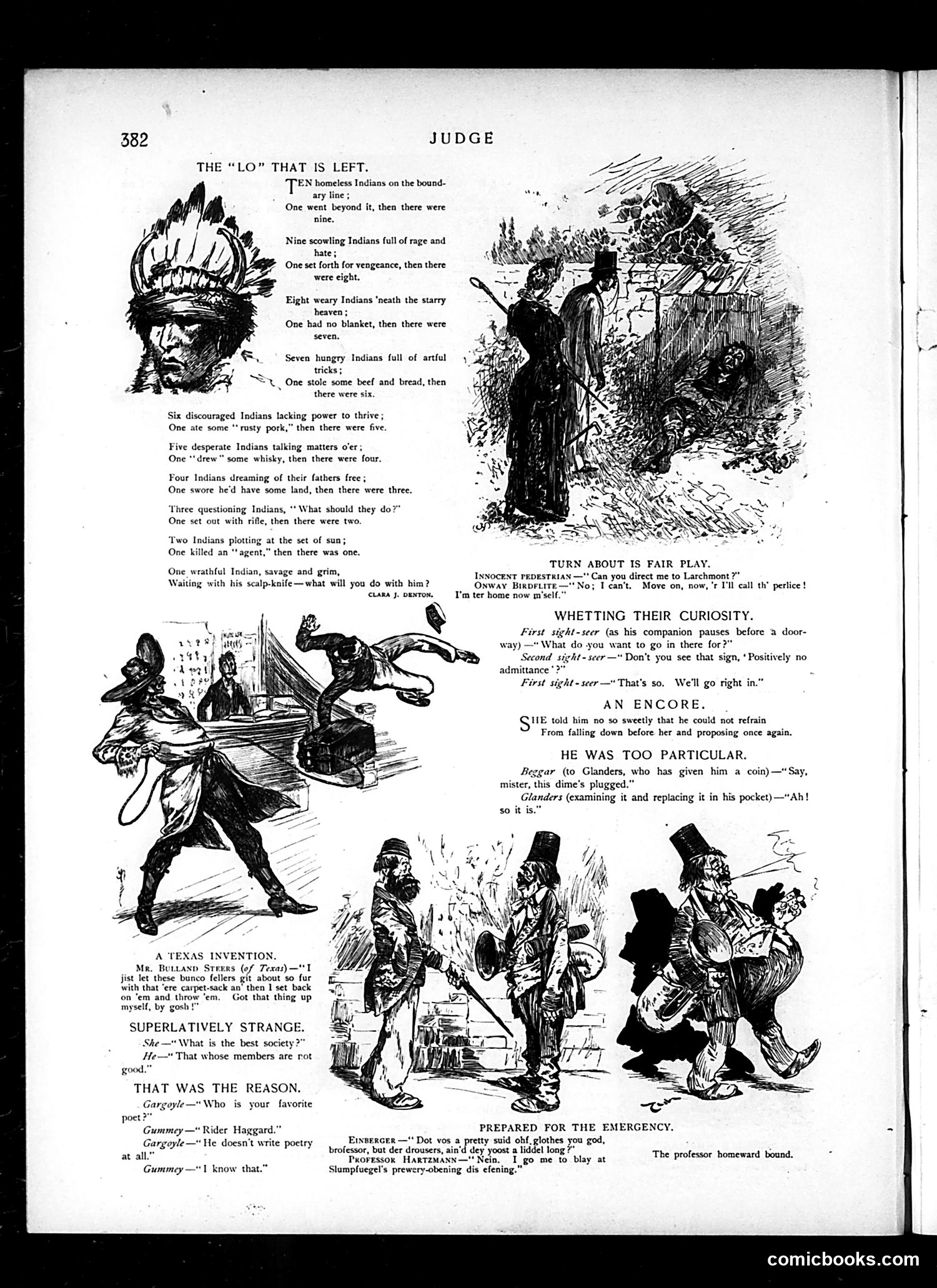
**"The 'Lo' That Is Left"** (main poem with Native American imagery): This is a darkly satirical counting-out rhyme depicting the systematic disappearance of Native Americans through poverty, violence, and desperation. Each verse shows Indians dying or vanishing due to starvation, alcohol, disease, or hopelessness—culminating in one committing murder. "Lo" was a derogatory term for Native Americans (from Longfellow's "Lo, the poor Indian"). The satire critiques American indifference to Native American suffering and displacement. **Other cartoons** employ gentler humor: "Turn About Is Fair Play" jokes about an irritable city dweller; "Whetting Their Curiosity" plays on human nature; remaining items are domestic comedies about begging, courtship, and social pretension. The page reflects Judge's mix of cutting social commentary (the Indian satire) alongside lighter fare—characteristic of late 19th/early 20th-century American satirical magazines that could range from progressive to deeply offensive by modern standards.
📄 Transcribed text from this page (OCR, searchable)
Machine-transcribed from the original scan — historical spelling and the odd misread are preserved.
JUDGE THE “LO” THAT IS LEFT. EN homeless Indians on the bound- ary line ; One went beyond it, then there were nine. Nine scowling Indians full of rage and hate; One set forth for vengeance, then there were eight. Eight weary Indians ‘neath the starry = i ‘ heaven ; wf 3 ; One had no blanket, then there were seven, Seven hungry Indians full of artful tricks ; X_ One stole some beef and bread, then r there were six. Six discouraged Indians lacking power to thrive; One ate some **rusty pork,” then there were five. Five desperate Indians talking matters o'er ; One “drew some whisky, then there were four. Four Indians dreaming of their fathers free; One swore he'd have some land, then there were three. ‘Three questioning Indians, ‘* What should they do?" One set out with rifle, then there were two. ‘Two Indians plotting at the set of sun; One killed an “agent,” then there was one. “ TURN ABOUT IS FAIR PLAY. One, wrathful Indian, savage and grim, a Innocent repesteiaN —" Can you direct me to Larchmont 7" Waiting with his scalp-knife—what will you do with him? Oxway BikpFLtte—"No; Tcan't. Move on, now, 'r I'll call th’ perlice! CLARA J. DEwTox. I'm ter home now m'self. WHETTING THEIR CURIOSITY. First sight-seer (as his companion pauses before a door- way) —" What do you want to go in there for?” Second sight-seer—“ Don’t you see that sign, ‘Positively no admittance *?" First sight -seer —"That’s so. We'll go right i AN ENCORE. HIE told him no so sweetly that he could not refrain From falling down before her and proposing once again, HE WAS TOO PARTICULAR. Beggar (to Glanders, who has given him a coin)—"Say, mister, this dime’s plugged.” Glanders (examining it and replacing it in his pocket) —“Ah! so it is.” Mr. BULLAND Steers (of Texas) —"'1 let these bunco fellers git about so fur ith that ‘ere carpet-sack an’ then 1 set back on ‘em and throw ‘em. Got that thing up myself, by gosh!" SUPERLATIVELY STRANGE. She —"What is the best society?” He—" That whose members are rot good.” THAT WAS THE REASON. Gargoyle—*Who is your favorite poet?” Gummey —" Rider Haggard.” PREPARED FOR THE EMERGENCY. Frain. OW Lie doesn C Wille poeey E1xnercer—"‘ Dot vos a pretty suid obf.glothes you god, Gargoyle —" He doesnt write Poetry ofessor, but der drousers, vy yoost a liddel long?" at all. : Peoressox Hatz Nein, Igo me to blay at Gummey —"1 know that.” Slampfuegel’s prewery-obening dis efening.”” The professor homeward bound, comicbooks.com