A complete issue · 116 pages · 1941
10-Story Detective, March 1941
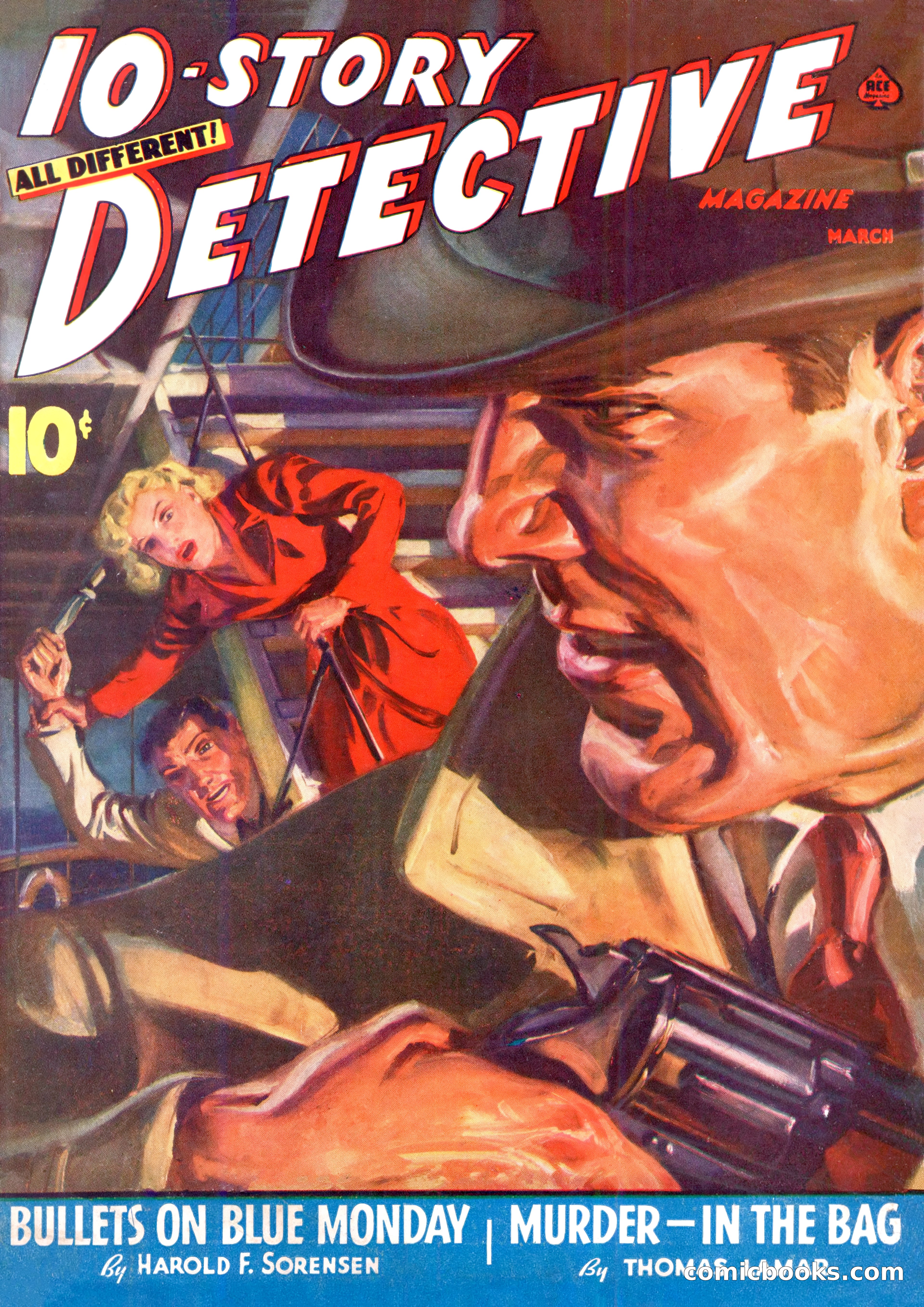
This is the cover of a 10-cent pulp detective magazine from March. The cover features dramatic illustration showing a menacing man in a tan suit and fedora in the foreground, with a woman in a red coat and a smaller figure visible in the background. A revolver is prominently displayed. The magazine advertises two stories: "Bullets on Blue Monday" by Harold F. Sorensen and "Murder—in the Bag" by Thomas (last name unclear in OCR). The cover promises "10 Story" content and emphasizes that the stories are "All Different." The illustration captures the noir aesthetic typical of hardboiled detective pulp fiction of this era.
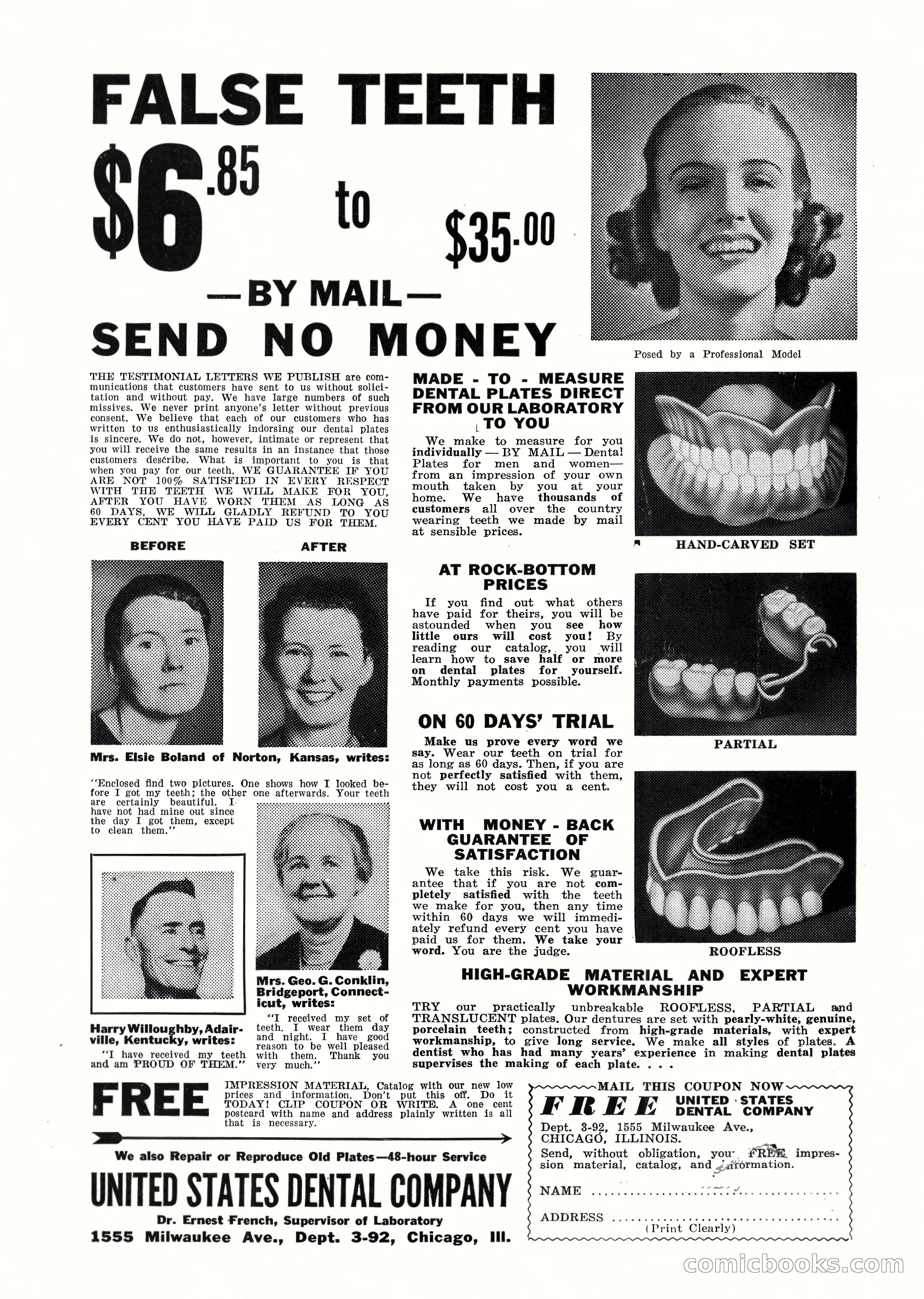
This is a **full-page advertisement** from a pulp magazine. It advertises mail-order false teeth from the United States Dental Company in Chicago, offering custom dental plates ranging from $6.85 to $35.00. The ad features before-and-after photographs of satisfied customers, testimonial letters praising the product, images of different denture styles (partial, roofless, hand-carved sets), and emphasizes a 60-day trial period with money-back guarantee. A coupon at the bottom invites readers to request free impression materials and a catalog.
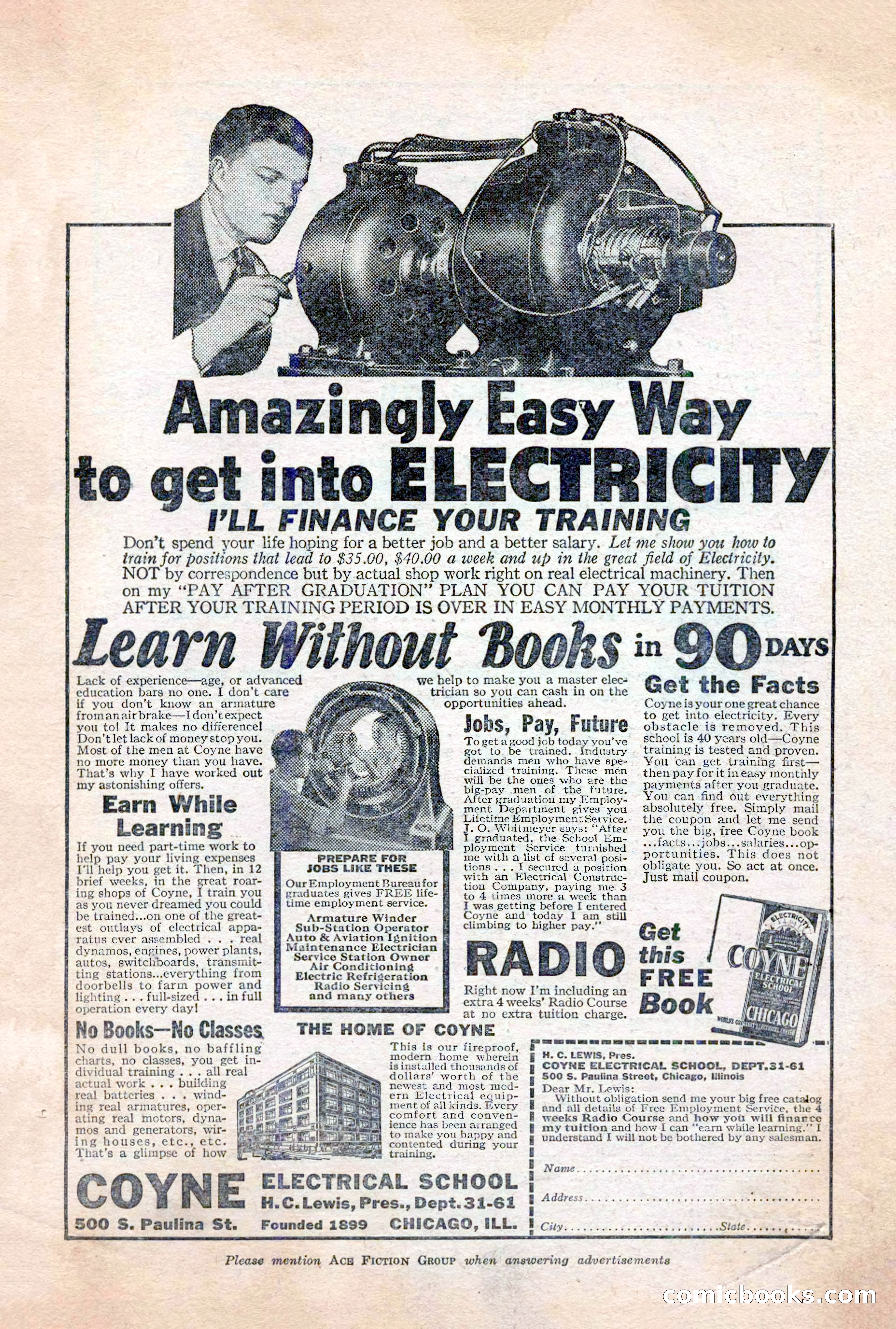
# Advertisement Page This is a full-page advertisement for Coyne Electrical School in Chicago. The ad promotes vocational training in electricity, promising students can "learn without books" in 90 days through hands-on shop work on real machinery, earn while learning through part-time employment, and pay tuition only after graduation. The school claims to offer lifetime employment services and positions paying $35-$40+ weekly, and currently includes a free four-week radio course with enrollment.
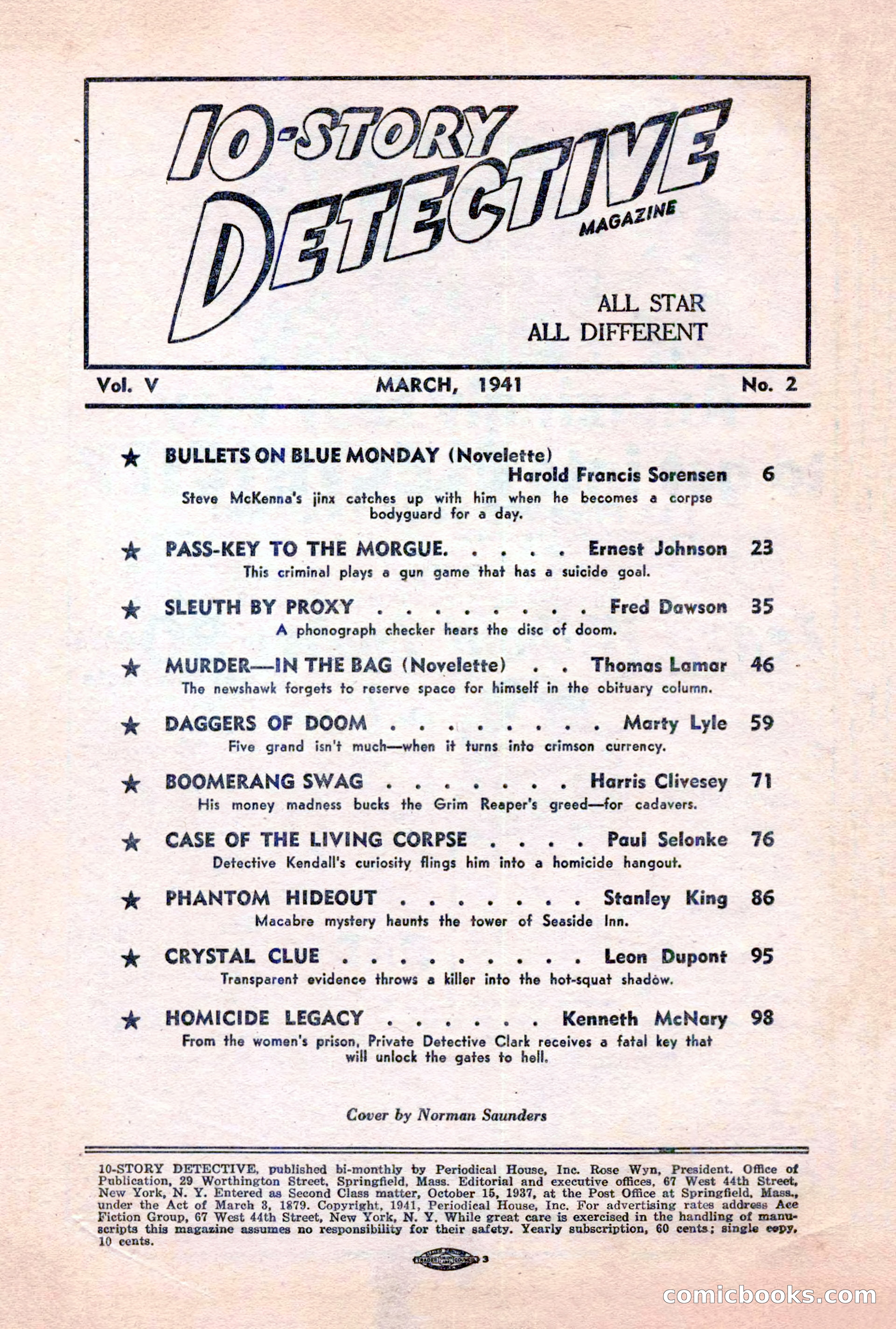
This is a table of contents page from the March 1941 issue of *10-Story Detective Magazine* (Vol. V, No. 2). The page lists ten crime and detective stories by various authors, including titles like "Bullets on Blue Monday," "Pass-Key to the Morgue," and "Homicide Legacy," with brief plot descriptions and page numbers for each. At the bottom is standard publication information indicating the magazine was published bi-monthly by Periodical House, Inc. in Springfield, Massachusetts, with editorial offices in New York.
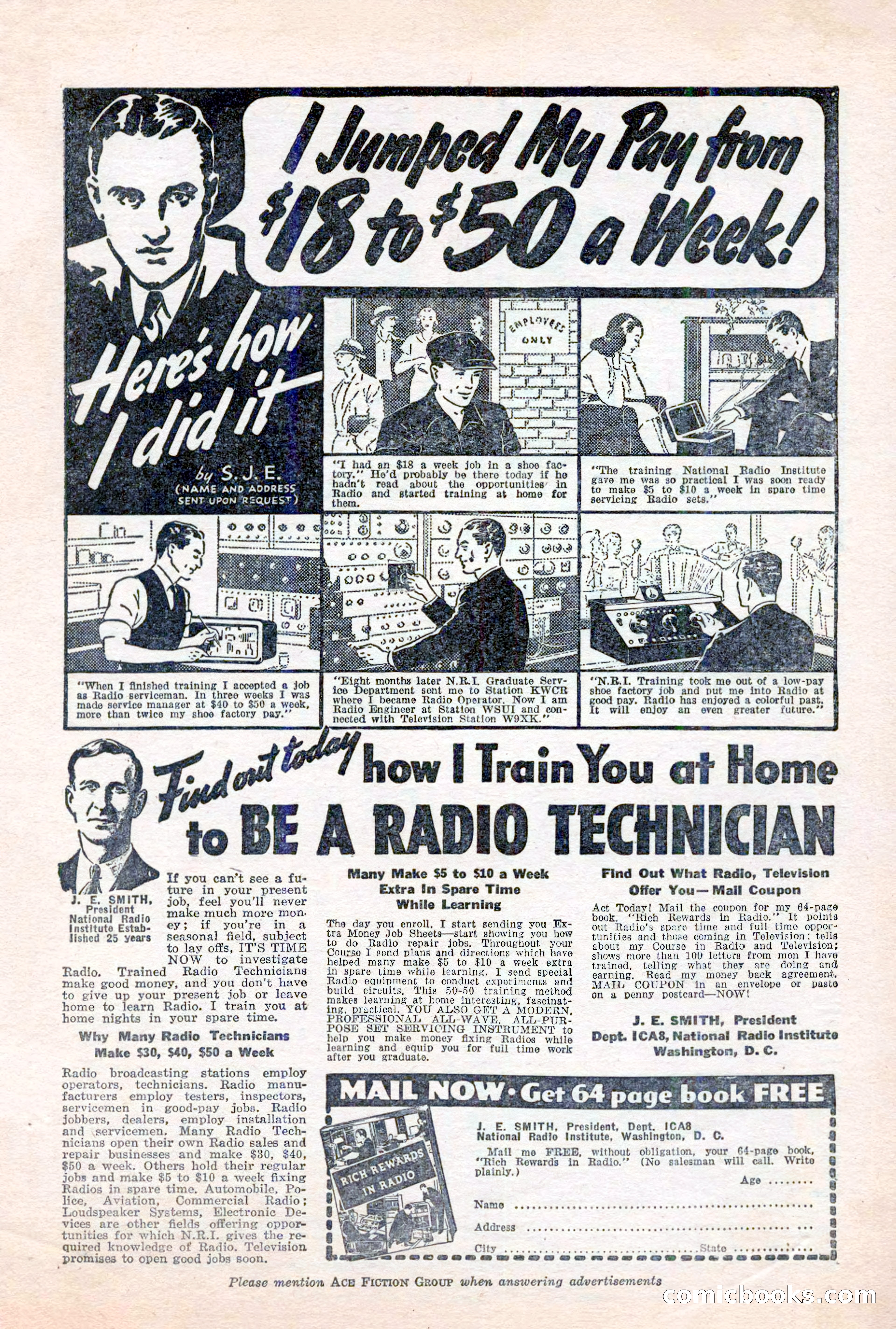
This page is an advertisement for the National Radio Institute's home-study program in radio technology. It features testimonials from people who claim to have increased their weekly earnings from $18 or $40-50 per week through the program's training. The ad describes job opportunities in radio broadcasting, manufacturing, repair, and other related fields, and promotes the institute's spare-time training method that allegedly allows students to earn money while learning. A coupon at the bottom invites readers to request a 64-page instructional book.
This page is mostly advertising from a pulp-fiction magazine, with one notable editorial section. The bulk consists of classified and display ads for various consumer products and services—tire sales, patent protection, false teeth, radio chassis kits, and tombstones. Near the bottom, there is a promotional section announcing the February issue of *Lone Wolf Detective* magazine, which features five complete novels including stories by W. T. Ballard, H. Q. Masur, Ronald Flagg, Paul Adams, and Grant Mason.
This page is primarily **advertising and promotional content** from an early-20th-century pulp magazine. The visible advertisements promote correspondence courses (LaSalle Extension University), self-help treatments for stomach ulcers and asthma, religious study groups, used educational courses, and government job preparation through the Franklin Institute. Additional ads advertise cushioned shoes, music composition services, and wholesale drug sales. At the bottom is a brief news item about goitre treatment. This is a typical back-of-magazine advertisements page rather than story content.
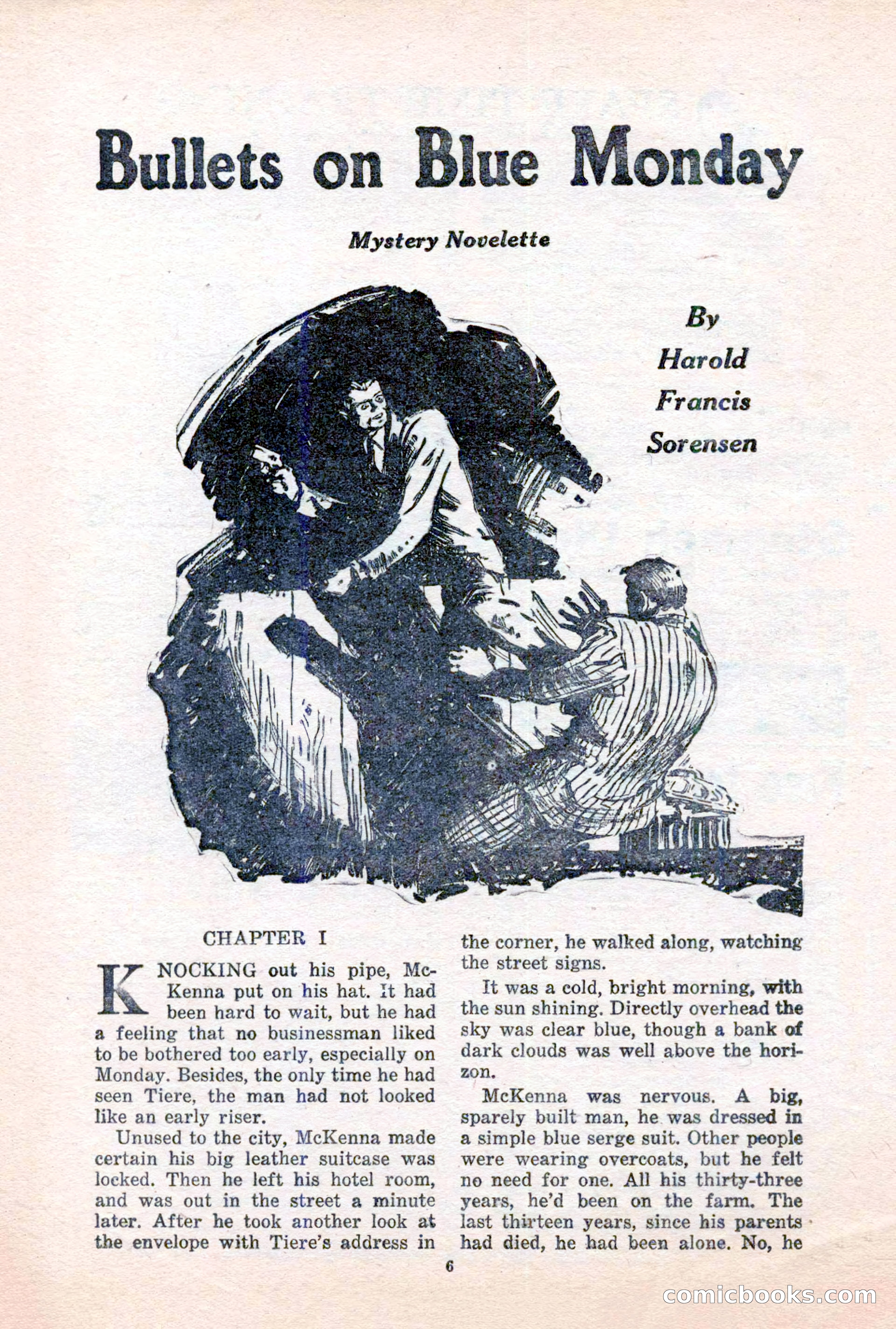
# Page Analysis: Story Opening from "Bullets on Blue Monday" This is the opening page of a mystery novelette by Harold Francis Sorensen. It shows Chapter I prose text describing a character named McKenna—a nervous, thirty-three-year-old farm man newly arrived in the city—preparing to meet someone named Tiere on a Monday morning. The page includes a dramatic illustration at the top depicting figures in a noir style, showing what appears to be the story's action. The text establishes mood and character background while McKenna walks the streets looking for an address, uncertain about his urban surroundings. No plot details beyond this setup are yet revealed.
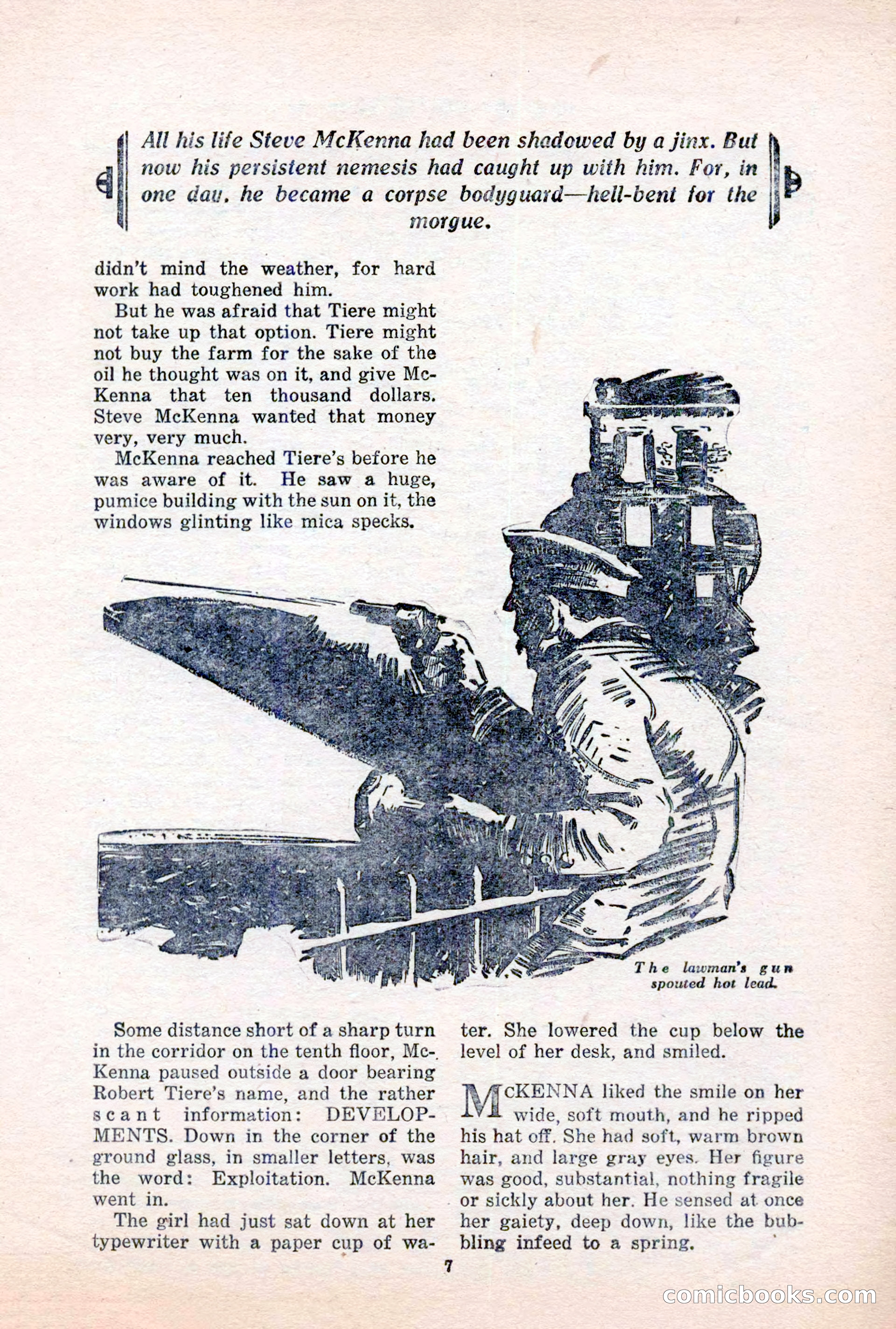
# Page Analysis This is an interior story page from a pulp magazine, containing prose narrative with an integrated illustration. The text follows protagonist Steve McKenna as he arrives at Robert Tiere's office building seeking a business deal involving farmland and oil, then enters to meet Tiere's secretary—a woman whose appearance and demeanor immediately attract him. The illustration depicts a man aiming a gun, captioned "The lawman's gun spouted hot lead," though its narrative connection to the surrounding text remains unclear on this page alone.
# Page Analysis: 10-Story Detective This page contains story prose from what appears to be a hardboiled crime detective magazine. The narrative follows detective Steve McKenna, who arrives at an office for an appointment with a man named Tiere, only to discover Tiere dead at his desk with a knife in his neck. Police arrive and initially suspect McKenna of the murder. The scene develops with other visitors to the office appearing—including a man named Harvey Logan claiming a prior appointment—while detectives investigate the crime scene. The page ends as Captain Pearson prepares to question McKenna, interrupted by the arrival of a well-dressed, haughty man being identified as someone (the text cuts off).
# Page Content Analysis This page contains story prose from a hardboiled crime pulp fiction titled "Bullets on Blue Monday." The narrative, now in Chapter II, depicts Captain Pearson interrogating multiple suspects regarding a murder victim named Tiere, who apparently owned land that McKenna occupies. Pearson arrests McKenna and has him transported to a police station for processing—booking, questioning, searching, and measuring. The text focuses on dialogue revealing business dealings around potential oil on McKenna's property and introduces the character Betty Dunbar, Tiere's secretary, whom McKenna finds attractive.
# 10-Story Detective Page Analysis This page contains **story prose** from what appears to be a hardboiled detective fiction story titled "10-Story Detective." The narrative follows a character named McKenna, a farmer, through police interrogation by Captain Pearson regarding an apparent murder. McKenna has been fingerprinted, photographed, and questioned intensely about his whereabouts and potential connection to a victim named Tiere, who was killed with a ten-cent store kitchen knife. After being released (as Pearson lacks sufficient evidence), McKenna reflects bitterly on the interrogation while smoking his pipe in his hotel room, contemplating his own lack of attachment to farming despite his family heritage.
# Page Analysis This is **story prose** from page 11 of a hardboiled crime pulp magazine titled "Bullets on Blue Monday." The text follows protagonist Steve McKenna as he grapples with suspicion over a murder victim named Tiere, considers Betty Dunbar's potential guilt, and decides to visit a man named Wesley Allen to discuss purchasing land. McKenna travels through cold, threatening weather to Allen's house, where he finds Allen ill with a cold by a roaring fire. The narrative focuses on McKenna's internal conflict and his investigative maneuvering regarding a farm purchase apparently connected to the murder.
# Page Analysis: "10-Story Detective" Pulp Fiction This is a prose story page from a pulp detective magazine titled "10-Story Detective." The text continues a murder mystery narrative in which detective Steve McKenna visits a man named Wesley Allen to discuss a recent murder victim named Tiere. During their conversation, Allen goes to answer the door but doesn't return. McKenna investigates and discovers Allen has been murdered—stabbed with a knife identical to the weapon used on Tiere that morning. McKenna then calls the police, who arrive and enter through the parlor window to avoid disturbing the body. The passage suggests a serial killer is at work.
This is story prose from a hardboiled crime pulp magazine titled "Bullets on Blue Monday." The page depicts an interrogation scene at a police station where Captain Pearson questions Harvey Logan about his whereabouts during Wesley Allen's murder. Logan claims he was in a car accident and couldn't reach Allen's house on time, but Pearson suggests Logan could be the killer. When McKenna (apparently a suspect or witness) and Logan nearly come to blows, Pearson ejects Logan and confronts McKenna about his suspicious silence.
# Page Analysis: *10-Story Detective* Pulp Fiction This is a **story prose page** from a hardboiled detective pulp magazine. The narrative follows Steve McKenna, a man suspected of murder who is warned by Captain Pearson to leave the city. After eating alone at a hotel, McKenna impulsively visits Betty Dunbar's apartment despite knowing he shouldn't contact her. The page depicts his internal conflict—he's in love with Betty but also facing property buyout offers and murder investigation complications—as he arrives at her door seeking emotional connection rather than addressing his practical troubles.
# Analysis of Page This is **story prose** from a hardboiled crime pulp magazine titled "Bullets on Blue Monday." The page depicts a dramatic crime scene: Detective McKenna arrives at his apartment to find the lights suddenly extinguished and his romantic interest Betty Dunbar injured with a bleeding shoulder. Police and Captain Pearson burst in; though McKenna tends to Betty's wound, he's immediately suspected of attempted murder. A bloody kitchen knife is discovered on the floor, and McKenna is arrested despite Betty's protestations of his innocence. The narrative emphasizes McKenna's internal conflict—he's already under suspicion for a previous murder and fears his presence endangers Betty.
# Page Analysis This is story prose from a pulp detective magazine titled "10-STORY DETECTIVE" (page 16). The text depicts a criminal investigation where detectives discover evidence of an electrical attack using tweezers jammed into an outlet. Captain Pearson interrogates a suspect named McKenna, who is eventually confined to a hotel room. The passage concludes with McKenna, shaken after learning how close his associate Betty came to death, attempting to calm himself by disassembling his watch while someone approaches his locked door. The narrative employs the hardboiled crime fiction style typical of early pulp magazines.
This page contains story prose from a hardboiled crime pulp fiction magazine titled "Bullets on Blue Monday." The narrative depicts a tense confrontation between characters Logan and McKenna, involving accusations of murder and a woman named Betty Dunbar. After a violent struggle in a hotel, McKenna flees through cellar passages, steals electrical wire from a shop, and escapes to Betty's apartment. The scene ends with McKenna drawing a jackknife as he prepares to explain his escape to Betty, maintaining the pulp fiction genre's characteristic blend of action, romance, and suspense.
# Page Analysis: 10-Story Detective This page contains story prose from what appears to be a hardboiled detective magazine. The narrative follows a character named McKenna, who is rigging an apartment with improvised alarm systems using wires connected to a bell. After establishing his innocence to a woman named Betty, McKenna methodically installs electrical triggers on windows and doors to detect intruders. The text describes his systematic approach to protecting the apartment, including a dangerous trap on the bedroom window using a weighted electric iron. The chapter break appears mid-page as the story continues.
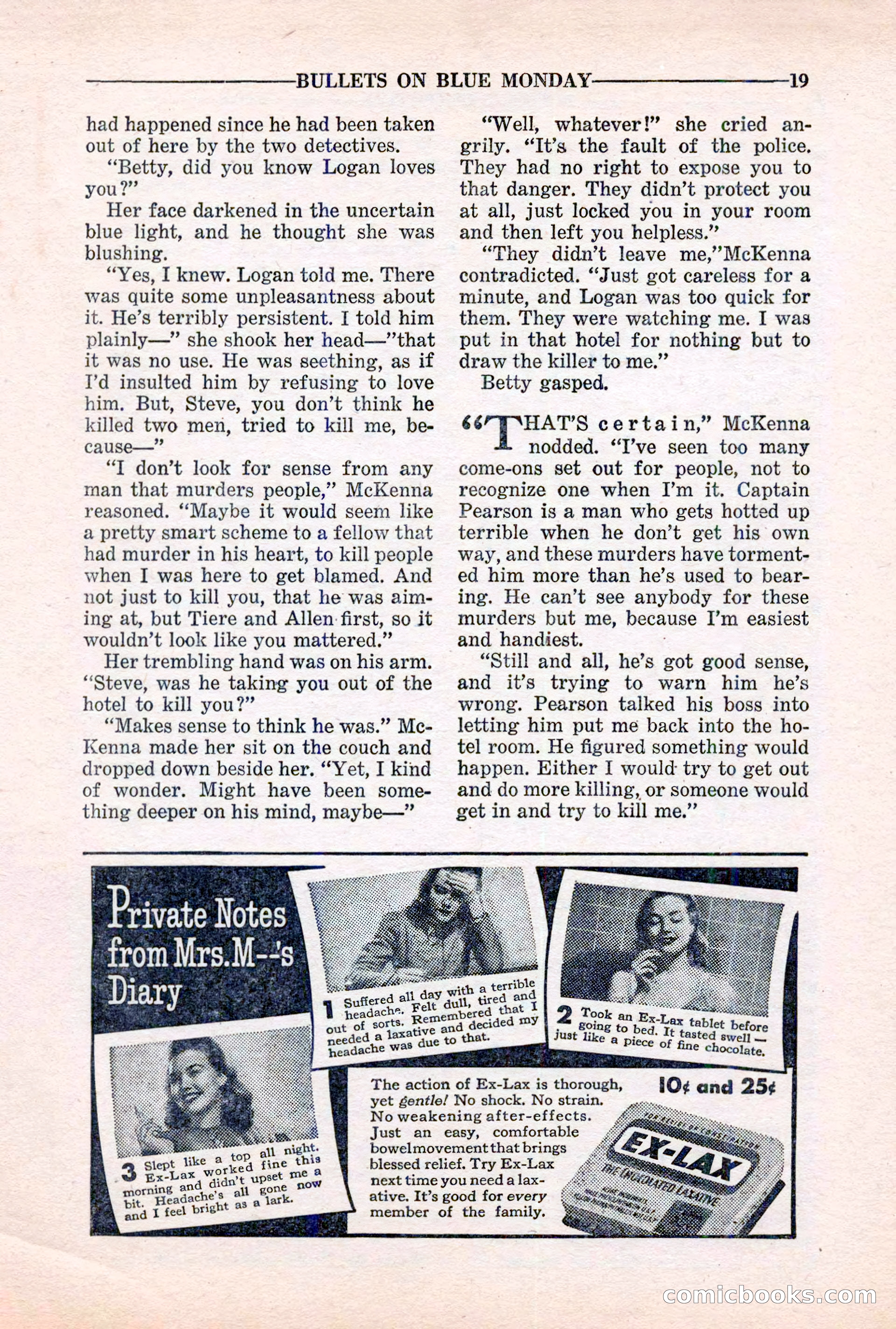
# Page 19: "Bullets on Blue Monday" This is a story prose page from a hardboiled crime pulp magazine. The visible text depicts a dialogue between detective McKenna and a woman named Betty, discussing a murder case where Logan appears to be a suspect. McKenna explains that he was used as bait by Captain Pearson to draw out the killer, reasoning that either Logan would attempt further murders or someone would try to kill him. The page includes an advertisement for Ex-Lax laxative at the bottom, presented as "Private Notes from Mrs. M--'s Diary" with illustrations of a woman's experiences.
# Page Analysis This is **story prose** from a pulp detective magazine (page 20 of "10-Story Detective"). The visible text depicts a conversation between characters named McKenna and Betty about a murder investigation. McKenna explains to Betty that a killer likely wants her dead because she knows something incriminating, and that he suspects the motive for previous murders relates to valuable land with an option held by someone named Tiere. McKenna has apparently rigged an alarm system to protect Betty, while also discussing how Captain Pearson (likely a police officer) may misinterpret the situation. The passage ends mid-sentence as Betty begins to overcome her fear.
# Page Analysis: "Bullets on Blue Monday" This is story prose from a pulp fiction magazine (page 21). The text depicts the climactic action sequence of what appears to be a hardboiled crime story. McKenna pursues a murderer through a residential setting, leading to a violent confrontation at a fence where the killer is revealed to be James Nisbet, a financially desperate man. As Nisbet lies dying from gunshot wounds inflicted during the struggle, he begins confessing his crimes to McKenna and Captain Pearson, explaining that he murdered for money to cover embezzled client funds from his investment service business.
# Page Analysis: "10-Story Detective" This page contains the concluding prose of a hardboiled crime story alongside a commercial advertisement. The narrative text resolves a murder mystery involving characters named McKenna, Nisbet, Logan, and Betty—detailing how a man named Nisbet committed killings over a disputed farm property worth more than ten thousand dollars, and how Logan sought vigilante justice before the case concludes romantically. Below the story text is a full-page advertisement for Thin Gillette razor blades, featuring illustrated sailors and pricing information ("four for ten"), emphasizing quality at low cost.
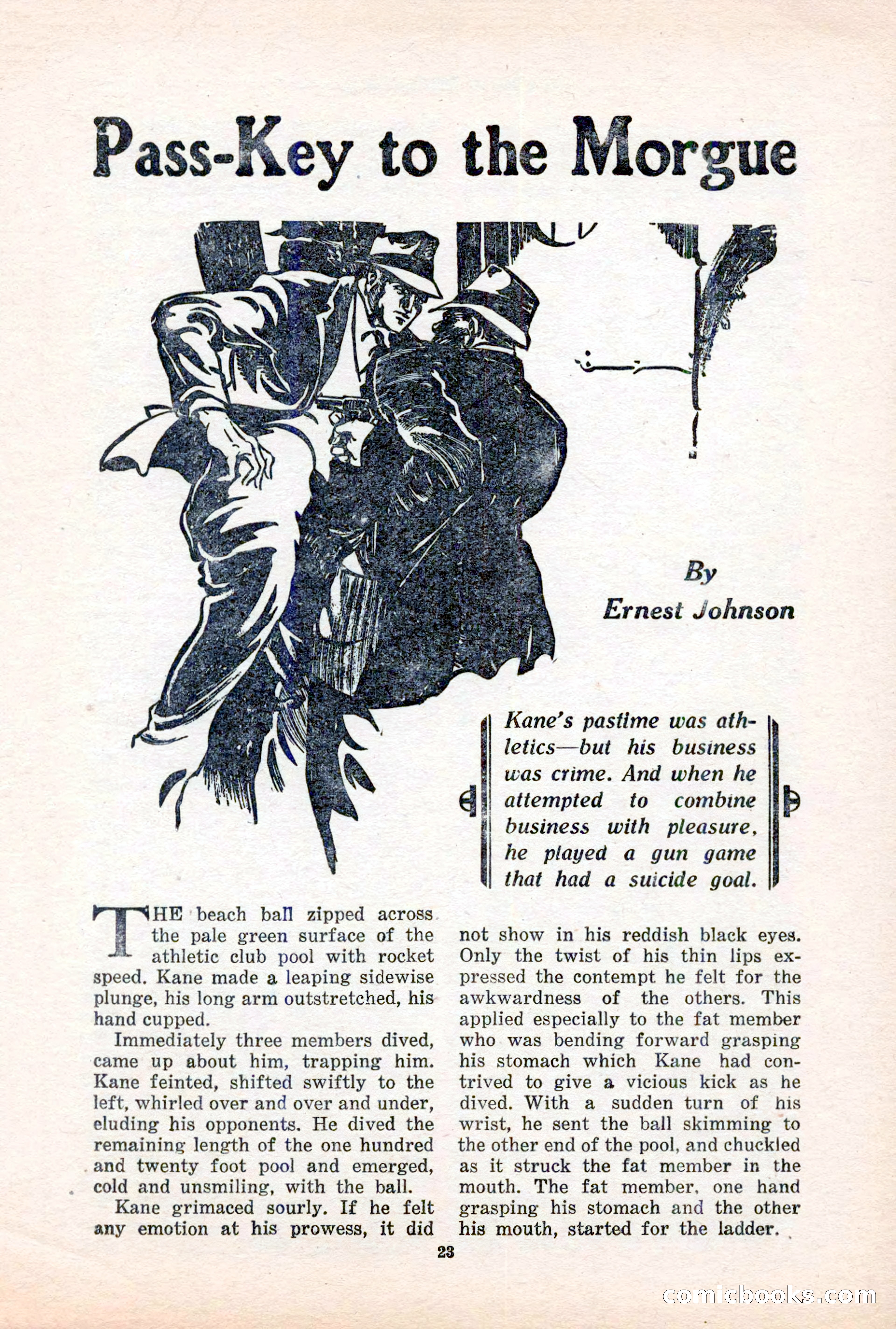
# Analysis of Page This is an interior story page from an early-20th-century pulp magazine, featuring the opening of a crime fiction story titled "Pass-Key to the Morgue" by Ernest Johnson. The page displays an illustration at the top showing a man in action poses (appearing to be the character Kane), along with a subtitle describing Kane as an athlete whose business is crime. The bulk of the page contains prose narrative describing Kane playing beach ball at an athletic club pool—a scene that establishes his athletic prowess, callous nature, and contempt for others. The text emphasizes his cruel treatment of fellow swimmers, particularly a heavier member whom he deliberately injures.
# 10-Story Detective - Page 24 This is **story prose** from a hardboiled detective pulp magazine. The page depicts a tense poolside encounter between two men: Kane, a confident swimmer, and Lawler, a nervous, fastidious visitor who arrives with urgent news. Kane learns that Mrs. Sanford, wife of a wealthy banker and club member, has died unexpectedly in Honolulu. Lawler appears anxious to discuss something significant with Kane, hinting at criminal implications, while Kane deflects with casual indifference before heading to the locker room.
# Page Analysis: "Pass-Key to the Morgue" This page contains story prose from a hardboiled crime fiction tale titled "Pass-Key to the Morgue." The narrative follows two characters, Kane and Lawler, who meet at what appears to be a gentleman's club. Lawler brings urgent news about a wealthy man named Sanford who has left his mountain house unattended while traveling to San Francisco. Lawler proposes stealing valuable jewelry—a diamond necklace, emerald clasp, bracelet, and other items worth approximately $105,000—left behind at the property, guarded only by an elderly caretaker named Quinn. The passage depicts their conversation escalating from dismissive small talk to the criminal proposition.
# Page Analysis This is **story prose** from a hardboiled crime pulp magazine titled "10-Story Detective." The page depicts two criminals, Kane and Lawler, planning a theft of jewelry from a summer home belonging to a wealthy woman named Sanford. After preparing weapons in Kane's hotel room, they descend to the lobby where Lawler attempts to phone accomplices Fred and Alicia to join the heist. Kane violently objects, forcibly stopping Lawler and insisting they proceed alone, establishing Kane as the dominant, ruthless partner in their criminal enterprise.
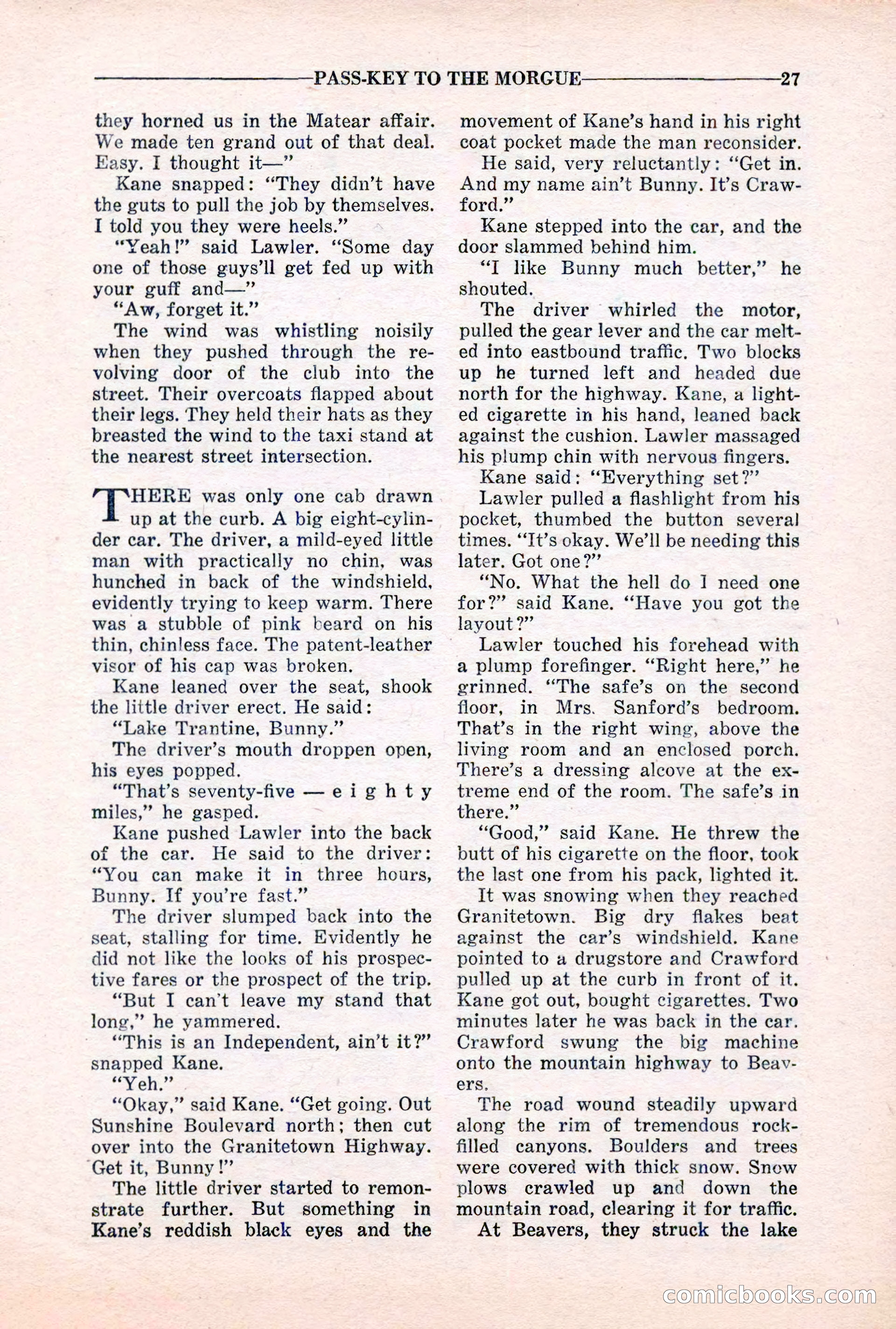
# Page Description This is story prose from a hardboiled crime pulp fiction magazine, page 27 of "Pass-Key to the Morgue." The text depicts a criminal planning scene in which a character named Kane coerces a taxi driver into driving him and an associate named Lawler northward toward Lake Trantine. During the drive, Lawler reveals details of their intended heist—specifically the location of a safe in Mrs. Sanford's second-floor bedroom. The narrative follows their journey through snowy mountain roads toward what appears to be the target location.
# Page Analysis This page contains **story prose** from a hardboiled detective narrative titled "10-Story Detective" (visible at page top). The text depicts Kane and Lawler, detectives arriving at a dark farmhouse to investigate. After entering through the back door, Kane discovers a body lying on the floor inside. When Lawler's flashlight finally illuminates the corpse, he drops the light in shock. Kane retrieves it and punches Lawler, warning him to stay quiet, apparently concerned about alerting whoever may be responsible for the body's presence. The scene emphasizes suspense and danger.
# Page Analysis This is story prose from a pulp fiction magazine (page 29 of "Pass-Key to the Morgue"). The text depicts a hardboiled crime/mystery narrative in which detectives Kane and Lawler discover a dead body—identified as Quinn—and search a house for a stolen necklace. After finding the safe untampered, Kane descends to the cellar where he plays billiards. Suddenly the lights turn on and Lawler appears, clutching a glittering necklace, his face pale with excitement. The page ends mid-dialogue as Kane demands to know what happened.
# Page Analysis: "10-Story Detective" This is a text-only story page (page 30) from a hardboiled crime pulp magazine. The narrative depicts a tense confrontation between a criminal named Kane and two armed men named Fred and Slats, along with a woman named Alicia, over a stolen Sanford necklace. When Kane unexpectedly cuts the house lights during the standoff, gunfire erupts in darkness. Kane escapes to an adjoining room, pockets the necklace, and prepares to ambush his rivals, apparently unconcerned about his accomplice Lawler's fate.
# Page Content Analysis This page contains **story prose** from a hardboiled crime narrative titled "Pass-Key to the Morgue" (page 31). The text depicts a violent gunfight in which the protagonist Kane shoots an intruder named Fred, who dies clutching an automatic pistol. Kane then observes blood trails suggesting others (Alicia and Slats) have fled in a car down a snowy hill. As Kane prepares to leave, he hears a group of young skiers arriving for a planned supper party, prompting him to hastily hide Fred's body in the kitchen before they enter. The passage emphasizes Kane's cool composure amid the chaos and violence.
# Page Analysis: "10-Story Detective" Pulp Magazine This page is **story prose** from a hardboiled detective pulp magazine. It depicts a private detective named Kane managing a tense situation at what appears to be a farmhouse party. Kane has discovered dead bodies in the kitchen and must now conceal them from arriving guests—a red-haired woman and others—while his escape route has been cut off by associates who've fled with the car. Kane serves the guests strong cocktails laced with extra gin, likely to keep them distracted and compliant while he figures out his next move.
# Page 33 of "Pass-Key to the Morgue" This is story prose—part of a hardboiled crime narrative. The page depicts a tense confrontation during a robbery at what appears to be a house party. A detective arrives investigating a stolen necklace from a safe, while Kane (apparently the thief) realizes he must kill the detective to escape. Just as Kane reaches for his gun, screams erupt from the kitchen, revealing additional bodies. The page ends mid-action as Kane apparently fires his weapon three times.
This page contains story prose from a hardboiled crime detective story titled "10-Story Detective." The text depicts a character named Kane escaping on skis from pursuers at night, fleeing down a snowy hillside toward a frozen lake after apparently stealing a necklace. The narrative follows Kane's clumsy initial attempts to master skiing, his growing confidence, and his final dangerous descent toward the icy lake surface and the distant lights of a town called Beavers, where the passage ends abruptly mid-sentence as he attempts to avoid something looming ahead.
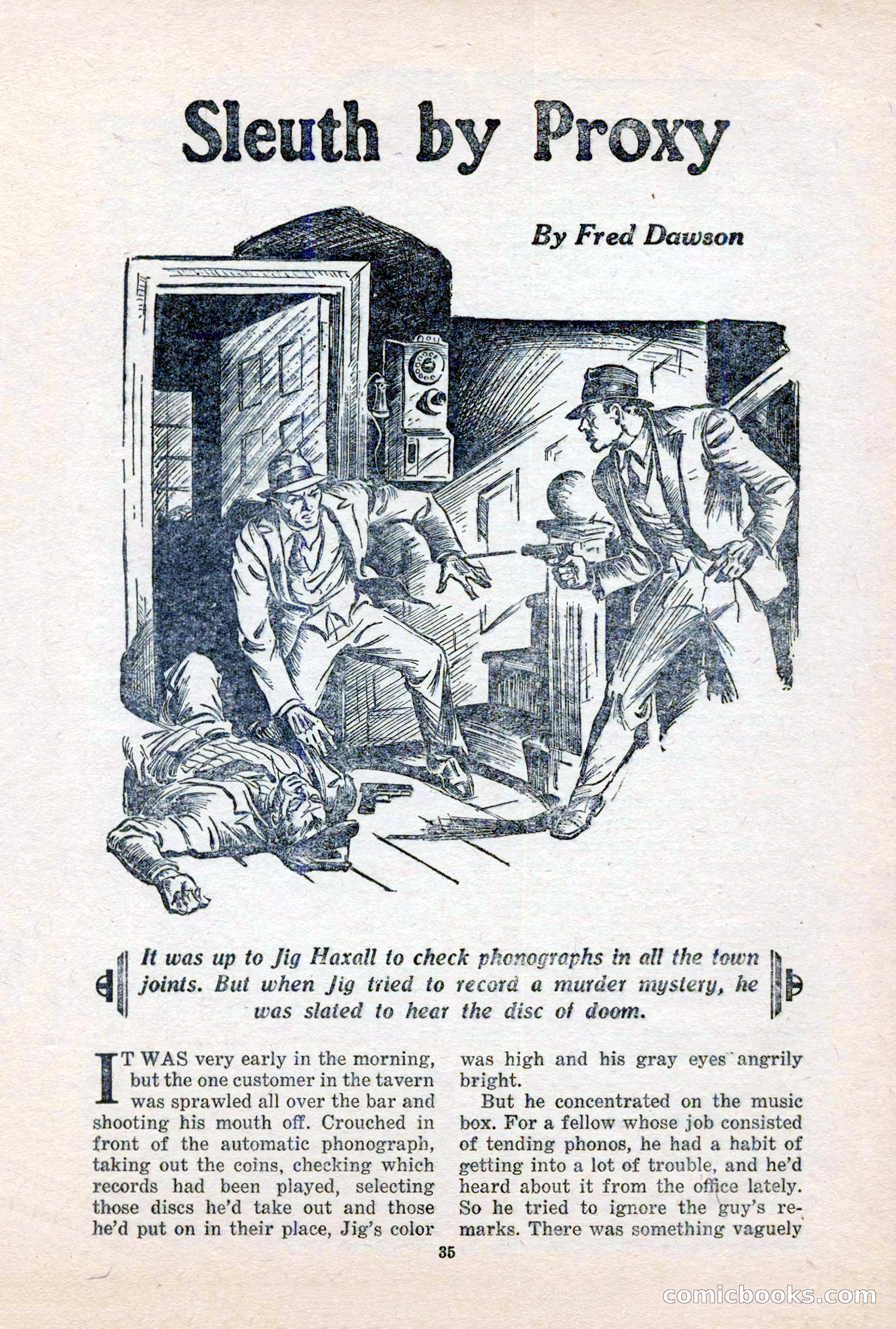
# "Sleuth by Proxy" by Fred Dawson This is an interior story page from a pulp magazine, featuring an illustration and the opening prose of a mystery story. The illustrated scene depicts a tavern setting where a character named Jig Haxall, who maintains automatic phonographs in town establishments, attempts to ignore a drunk customer while servicing a music box. The story opens with Jig confronting trouble after apparently attempting to record a murder mystery using the phonograph.
# Page Analysis This is **story prose** from a hardboiled crime/detective pulp magazine titled "10-Story Detective." The page shows the middle of a narrative following a character named Jig, a detective's associate. After a bar confrontation where Jig defends his friend Detective Lieutenant Vinson's reputation, Jig encounters the disheveled Vinson on the street and persuades him to share details about an apparently serious incident involving someone named Reuwer. The scene establishes tension around Vinson's involvement in a crime and his reluctance to discuss it repeatedly.
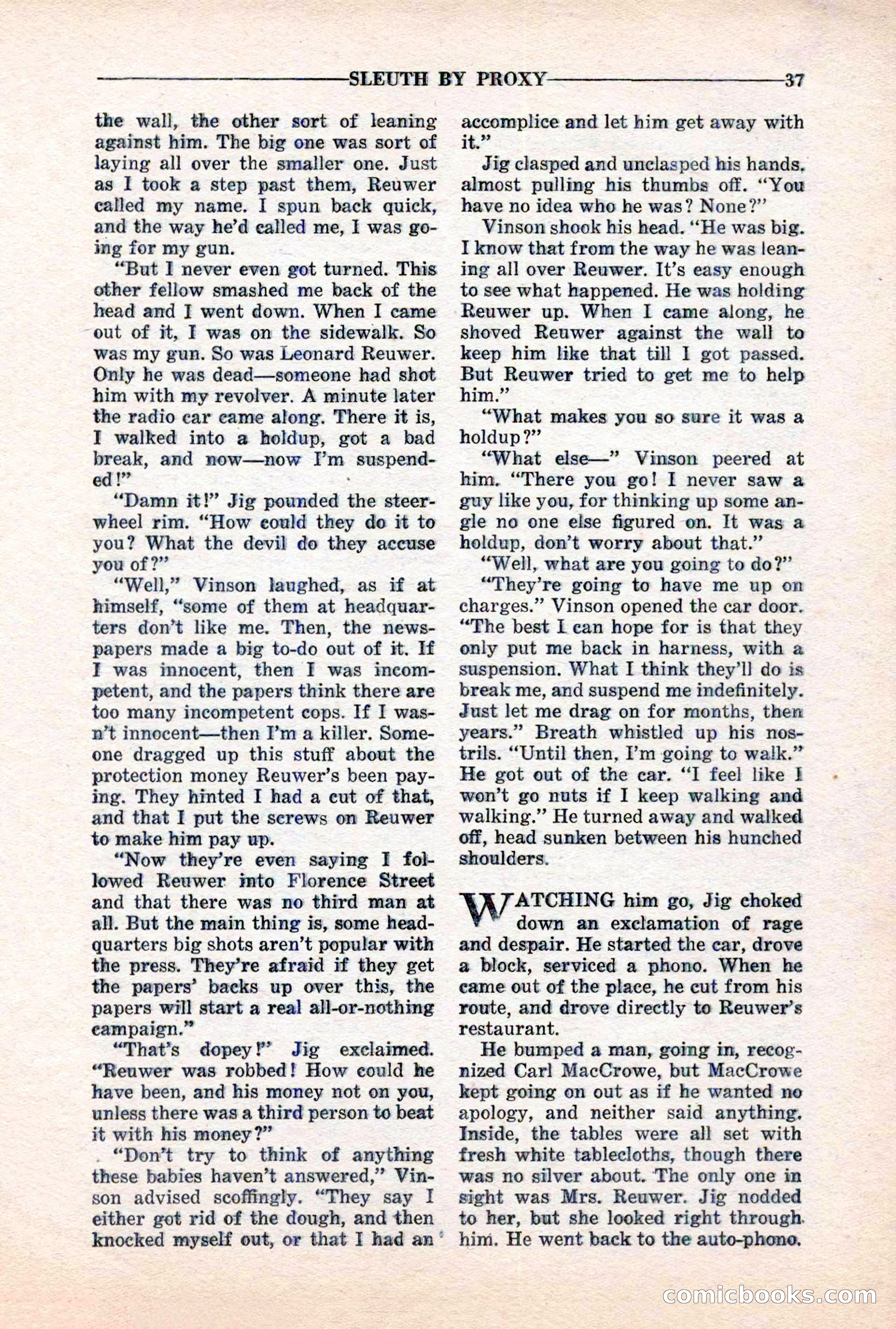
# Page Analysis: "Sleuth by Proxy" This page contains story prose from a hardboiled crime fiction tale titled "Sleuth by Proxy" (page 37). The narrative follows a character named Jig and his conversation with a suspended police detective named Vinson about a murder: Vinson claims he walked into a holdup where his gun was used to kill a man named Leonard Reuwer. Vinson insists a large third man was responsible, but police suspect Vinson himself. The passage concludes with Jig driving to Reuwer's restaurant, where he encounters a man named Carl MacCrowe leaving. The story depicts classic noir crime-fiction elements: police corruption, false accusations, and murky circumstances.
# Page Analysis: "10-Story Detective" Pulp Fiction This page contains **story prose** from a hardboiled detective narrative. The detective "Jig" investigates a phonograph machine at what appears to be a restaurant or bar, discovering a deliberately marked nickel. When confronted by the volatile cook Paul Adkins, Mrs. Reuwer intervenes. Jig then questions Mrs. Reuwer about who played the phonograph that morning, suggesting the suspect may be someone named MacCrowe. Edward Zieman, a waiter, enters with money from the bank. The page ends mid-sentence as Zieman heads into the kitchen.
# Page Analysis: "Sleuth by Proxy" This page contains story prose from a hardboiled crime or detective fiction tale titled "Sleuth by Proxy" (page 39). The narrative follows a character named Jig, apparently a phonograph serviceman who is investigating a case. The visible text depicts Jig questioning a restaurant worker named Zieman about a man called MacCrowe, then traveling to MacCrowe's address at Fourteen Astor Street. Upon entering the darkened building, Jig is attacked by an unseen assailant who grabs his ankle and pulls him down the stairs. Another character named Vinson arrives, apparently chasing off the attacker but claiming he tripped while pursuing. The passage emphasizes noir-style atmosphere and physical action typical of pulp crime fiction.
This page contains story prose from a pulp detective fiction magazine titled "10-Story Detective." The text depicts a confrontation between detective Jig, his associate Vinson, and a suspect named MacCrowe regarding the murder of a restaurant owner named Reuwer. Jig accuses MacCrowe of involvement in the crime, presenting evidence of Reuwer's lucky nickel found in a jukebox and suggesting MacCrowe was collecting protection money from the victim. MacCrowe becomes enraged and orders them to leave, while Vinson remains coldly composed throughout the tense interrogation scene.
# Page Analysis: "Sleuth by Proxy" This page contains story prose from a hardboiled crime fiction narrative titled "Sleuth by Proxy" (page 41). The text depicts a confrontation between detective Vinson and a man named MacCrowe, whom Vinson physically attacks after MacCrowe confesses to framing someone named Reuwer in a blackmail scheme. After the fight, Vinson and his companion Jig exit to the street, where they discuss the murder of Reuwer and speculate about possible suspects, including the possibility that Reuwer's wife—disguised as a man—could be responsible for his death.
# Page Analysis This page contains **story prose** from what appears to be a hardboiled crime detective story titled "10-Story Detective" (visible at page header 42). The text depicts a conversation between two characters—Jig and Vinson—investigating a case. Vinson reports on his questioning of suspects (Zieman, Adkins, and Mrs. Reuwer) regarding someone's whereabouts, finding alibis that either check out or seem suspicious. Despite skepticism from Jig about Mrs. Reuwer's alibi for Adkins, Vinson insists on following his instinct to investigate MacCrowe instead. The passage shows detective work through interrogation and deductive reasoning typical of pulp crime fiction.
# Page Analysis This is **story prose** from page 43 of a pulp fiction magazine titled "Sleuth by Proxy." The text depicts a dramatic confrontation in a restaurant kitchen where the protagonist Jig confronts Paul Adkins about a murder. After Jig produces a marked nickel as evidence, Adkins attacks him with a knife and potato masher, then locks him inside a large walk-in refrigerator. Jig, now trapped in the freezing cold room with hanging meat, struggles to survive while contemplating whether Adkins will be forced to release him.
# Page 44 from "10-Story Detective" This is story prose from a hardboiled crime pulp magazine. The page depicts the climactic action sequence of what appears to be a murder mystery involving characters named Jig, Zieman, and Adkins in a kitchen/meat locker setting. Jig, weakened from being trapped in a freezing refrigerator, struggles to prevent Zieman from using a gun against Adkins, the restaurant owner. After a violent fight where Adkins strikes Zieman with a cleaver, Jig gains control of the weapon and begins confronting both men about their involvement in what seems to be Reuwer's death and a missing coin or money.
# Page Analysis: "Sleuth by Proxy" This is **prose fiction** from a hardboiled crime/detective pulp magazine, showing page 45 of a story titled "Sleuth by Proxy." The passage depicts the climax of a murder investigation. Detective Jig has apprehended Zieman, who confesses to robbing murder victim Reuwer with a gun taken from a cigar counter—though he claims he only intended robbery, not murder. Jig deduces Zieman is lying about the gun's origin through a logical detail: Reuwer reported searching for his missing gun the previous night. Zieman's arrest exonerates the wrongly-accused Vinson, a police officer. The scene concludes with Zieman's confession and Vinson's gratitude toward Jig.
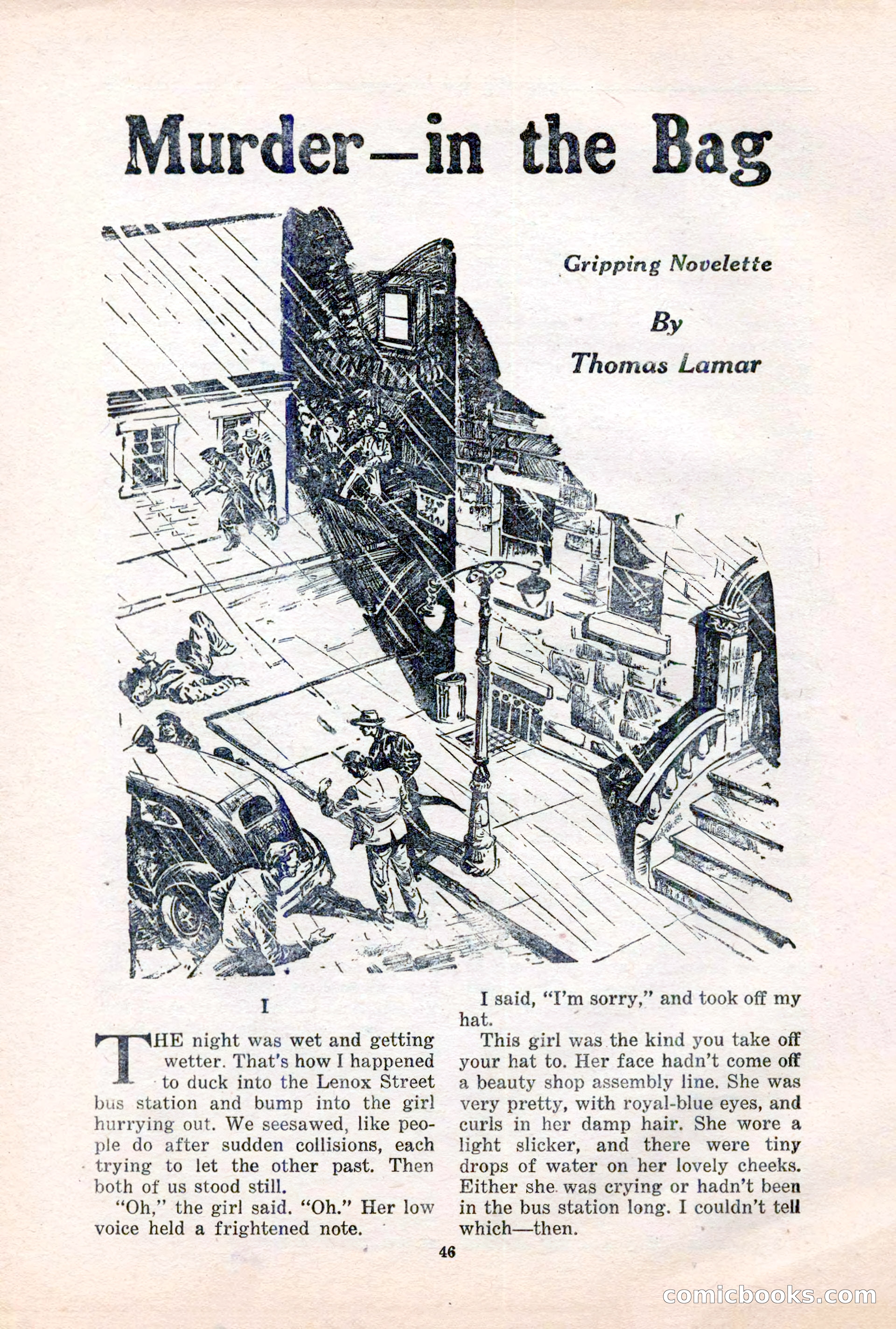
# Murder—in the Bag This page contains story prose from a pulp-fiction crime novelette by Thomas Lamar. The narrative opens with the protagonist accidentally colliding with an attractive young woman at a bus station on a rainy night. The unnamed narrator describes the woman's appearance—blue eyes, damp curls, pretty features—and notes her apparent distress, though he cannot immediately determine whether she has been crying or simply arrived recently. The story begins building mystery around this chance encounter. An illustration above the text depicts the bus station scene with period vehicles and figures on an urban street.
# Page Analysis This is **story prose** from a hardboiled crime pulp magazine. The page shows the continuation of a narrative in which Morgan Butler, a newspaper reporter, discovers a dead woman lying on a bench in a train station. After a brief earlier encounter with a young woman at the station, Butler finds the corpse and contacts police. Detective Lieutenant Munson arrives and begins questioning Butler about the circumstances, with Butler notably thinking about the girl he'd just met rather than focusing on the dead woman—who was carrying a bag of Lima beans.
# 10-Story Detective, Page 48 This page contains prose fiction narrative from a hardboiled detective story. The text depicts a detective investigating the death of a woman named Myra Withington, found on a bus station floor. A coroner determines she died of natural causes (coronary thrombosis), allowing the detective to file a routine story and return home. The narrative then shifts to an unexpected nighttime visitor—Willie Fargo, a small-time hustler—who arrives at the detective's apartment demanding "them beans," suggesting the detective has inadvertently obtained something valuable that others are seeking.
# Page Analysis: "Murder—in the Bag" This page contains story prose from a hardboiled crime fiction narrative titled "Murder—in the Bag" (page 49). The text depicts a confrontation where an armed man forces the narrator to hand over a bag of beans, followed by a mysterious phone call from a woman named Audrey McHale who desperately wants the package back. The narrator, Butler, refuses to return the beans after learning that someone was willing to kill for them, leaving McHale distressed. The plot involves unclear motivations surrounding ordinary lima beans that multiple parties pursue with apparent urgency.
# Page 50 of "10-Story Detective" This is a story prose page from a hardboiled crime pulp magazine. The narrative follows a detective narrator who refuses to return mysterious property to a woman named Audrey McHale, leading her to pull a gun on him in frustration. After she leaves, the narrator walks through a rainy city to find a cab, but takes an alley shortcut where he discovers a dead body—Willie Fargo, shot through the head. Police arrive and find a small gun in the narrator's pocket, suspecting him of the murder. A detective named Munson orders the narrator arrested despite his protests.
# Page Analysis This page contains **story prose** from a hardboiled crime fiction narrative titled "Murder—in the Bag." The text depicts a confrontation at a police detective bureau where the narrator, Butler (apparently a newspaper reporter), is being held for questioning in connection with two deaths—a man named Willie Fargo and a woman found in a bus depot. When powerful crime boss Nick Canalli arrives and intervenes on Butler's behalf, the lieutenant releases him. Butler then leaves the station with a concealed bag, aware he's being followed, and heads toward Market Street where crowds might help him lose his tail.
# Page Analysis This page contains **story prose** from a hardboiled crime pulp fiction titled "Murder—in the Bag." The narrative follows a newspaper reporter (Butler) investigating a kidnapping involving a prominent man and his daughter, Audrey McHale. The plot centers on a mysterious sack of beans that serves as ransom. The reporter interrogates the daughter about how she received her father's belongings, a cryptic phone call threatening murder, and an attempted ransom exchange where a woman (Myra Withington) died mysteriously. The page ends with police detective Munson arriving armed, claiming to have followed criminals who were themselves following Butler, suggesting the situation is escalating into danger.
This page contains story prose from a hardboiled crime detective narrative titled "10-Story Detective." The text depicts a confrontation where the narrator, Morgan Butler, protects a woman named Audrey McHale from kidnappers who are attempting to steal a mysterious bag of beans. After a violent street encounter involving gunfire and a dead detective, Butler pursues the criminals to a tennis court, shoots one of them, and recovers the bean sack. The page ends with Butler negotiating by phone with a kidnapper, claiming he recovered the beans without police involvement.
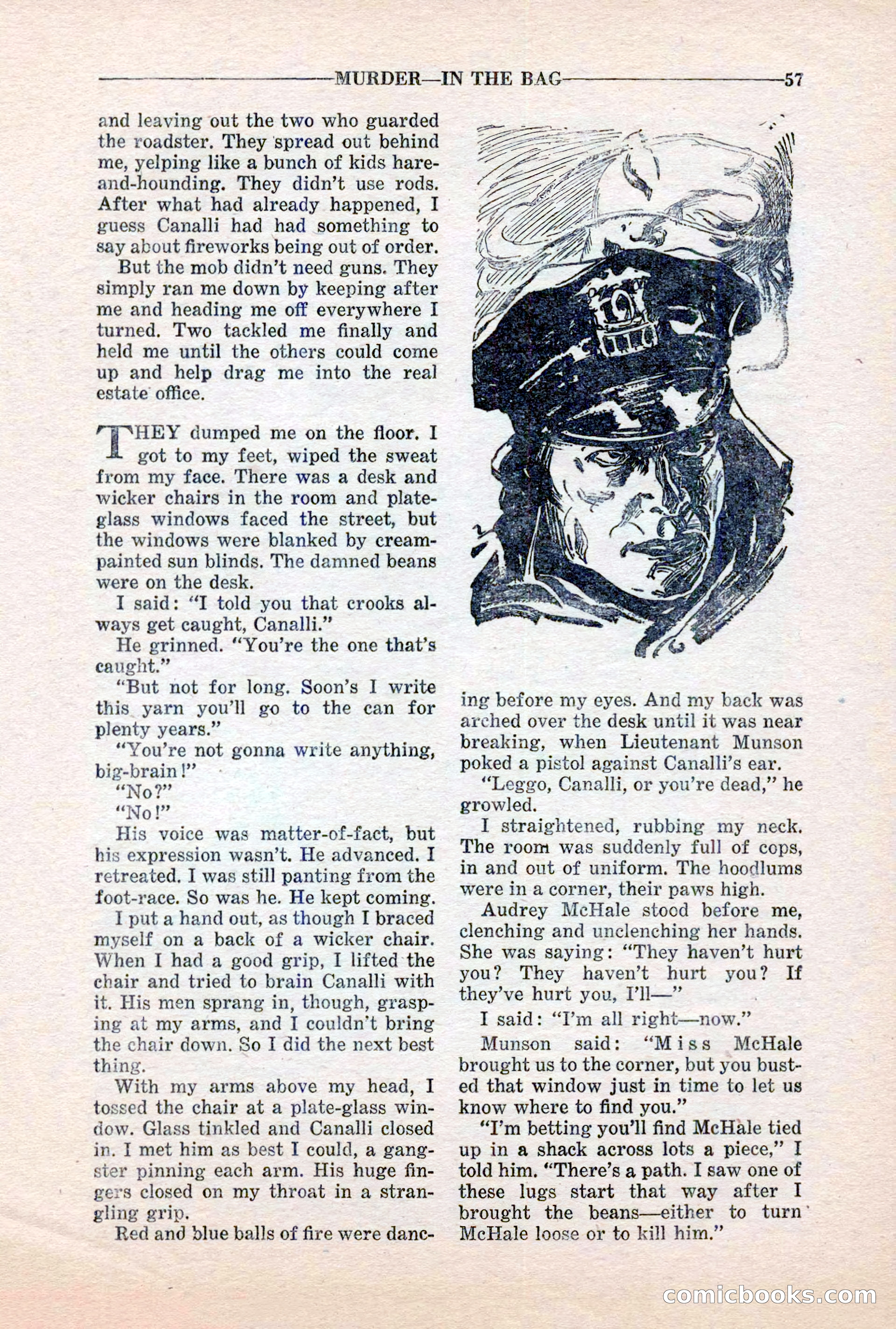
This page contains prose from a hardboiled crime story titled "Murder—in the Bag," showing a tense telephone negotiation between the narrator and a mobster regarding a kidnapping involving Lima beans and a ransom exchange at Park and Russell. Below the story narrative is an advertisement for a self-help teaching called "I Talked with God," attributed to Dr. Frank B. Robinson, which claims to bring supernatural power and material success to practitioners.
# Page Analysis This is story prose from a hardboiled crime pulp magazine titled "10-Story Detective." The narrative follows a detective narrator who has disguised himself in a woman's clothing and used a decoy to lure a criminal gang. The page shows the narrator escaping after his ruse is discovered—he ditches the disguise, attempts to slip away through an alley, but is cornered by armed mobsters led by someone named Nick Canalli. The narrator fights one attacker and flees toward open fields, only to find himself surrounded by five additional adversaries. The passage exemplifies the action-packed, fast-paced style typical of early 20th-century crime pulp fiction.
# Page Analysis: *Murder—In the Bag*, Page 57 This is a **story prose page** from a hardboiled crime pulp magazine, accompanied by a single illustration of a man's head wearing what appears to be a cap or hat. The text depicts a violent confrontation in a real estate office where the narrator is attacked by a mob working for someone named Canalli. After a struggle involving a thrown chair that breaks a window, police led by Lieutenant Munson arrive and intervene at gunpoint. The narrator then reveals that an associate named McHale has been taken to a shack, and the mob may be headed there either to release or kill them. The illustration appears to depict Canalli or another character from the scene.
This page is story prose from a hardboiled crime detective pulp magazine. The narrative follows a detective (apparently named Morgan Butler) investigating a kidnapping case involving a criminal named Canalli. The page reveals the plot's central mystery: Canalli kidnapped John V. McHale to obtain rare lima bean seeds that could yield a monopoly and substantial profits. The detective learns these are the only plants of their kind in the world, worth controlling. The page concludes with the detective accepting an invitation for a drink from McHale's daughter, Audrey, after the case is resolved.
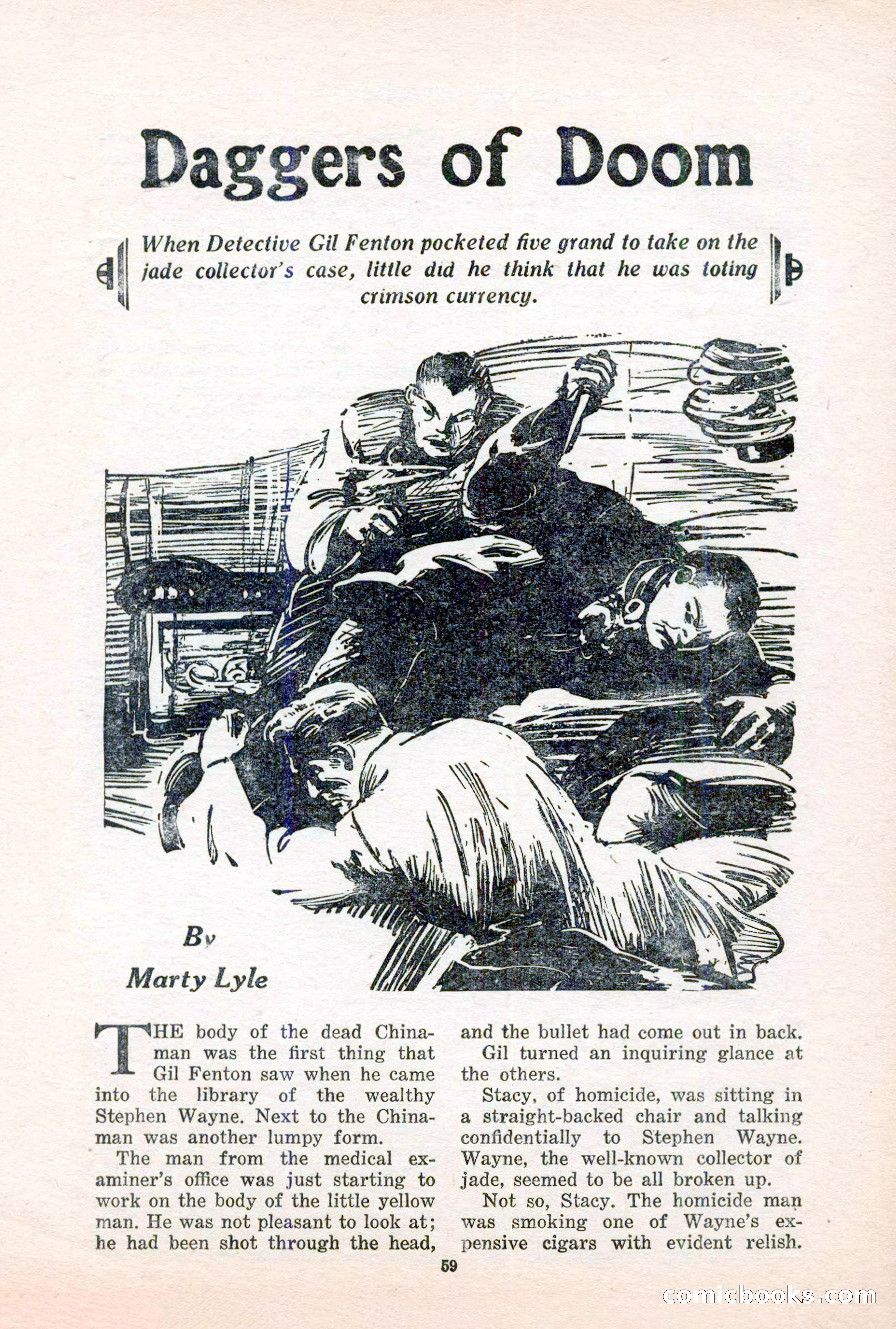
# Daggers of Doom This is a story page from a pulp magazine featuring the beginning of a hardboiled crime detective story by Marty Lyle. The page includes an illustration showing Detective Gil Fenton discovering a dead Chinese man in the library of wealthy jade collector Stephen Wayne, with a homicide detective named Stacy also present. The story opens with Fenton having accepted five grand to investigate a jade collector's case, unaware he's become entangled in a murder involving "crimson currency."
# Page Analysis This is **story prose** from a hardboiled detective pulp magazine titled "10-STORY DETECTIVE." The page depicts a crime scene investigation following a shooting and stabbing at a jade collector's home. Detective Gil Fenton arrives to find that the homeowner, Wayne, has shot a Chinese man caught stealing from his safe—the intruder allegedly having stabbed Wayne's secretary, Krell. Gil discovers a significant clue: an inscription on the dead man's gold ring, which he recognizes from his time in the East. The page concludes with Wayne producing two pieces of jade with jagged edges that, when fitted together, form a single object.
# Page Analysis This is **story prose** from a pulp fiction narrative titled "Daggers of Doom" (page 61). The text depicts a hardboiled crime or mystery story in which a detective named Gil (likely Gil Fenton) is hired by a man named Wayne to protect a valuable ancient Chinese jade figurine of Confucius from the Kung Tong, a Chinese gang. After accepting payment, Gil travels to a brownstone house on Marley Street to meet with someone named Charley Mee, entering through a door opened by a suspicious servant wearing a ring identical to one worn by a dead Chinaman. The narrative builds tension through dialogue and observation as Gil investigates the case.
# Page Description This is story prose from a pulp detective magazine titled "10-Story Detective" (page 62). The text depicts a confrontation between a detective named Gil and Charlie Mee, the apparent head of the Kung Tong, a Chinese criminal organization. Gil explains that he's been hired to protect Stephen Wayne, a jade collector whose home was recently burglarized by a tong member whom Wayne killed in self-defense. Gil attempts to negotiate with Charlie Mee to prevent the tong from seeking revenge, even offering a cash settlement. Charlie Mee cryptically warns that Wayne is destined to die and that Gil will fail his task.
# Page Analysis This is story prose from a hardboiled crime or action pulp magazine titled "Daggers of Doom" (page 63). The text depicts a tense confrontation between Gil (apparently a detective or operative) and Charlie Mee, a fat Chinese crime figure. What begins as a tense conversation in Mee's house escalates into sudden violence when Mee reveals a hidden gunman and activates a steel barrier to shield himself. The passage describes the gunfight that erupts, with Gil rolling away from the table as the hatchet-man's Browning rapid-firer opens fire, the bullets striking the floor where Gil had been standing. The scene exemplifies typical pulp-fiction action: swift violence, sharp dialogue, and ethnic stereotyping common to early-20th-century crime fiction.
# Page 64 of "10-Story Detective" This page contains story prose from a hardboiled crime/detective narrative. The text depicts an action sequence in which the protagonist Gil engages in gunfight and hand-to-hand combat with multiple "hatchet-men" (appears to be Chinese assassins) in a metal-lined, soundproof corridor. After killing one attacker and discovering that a suspect named Charlie Mee has escaped, Gil fights his way through the building, shoots a second assailant, and escapes into a back yard where he must evade detection from above. The narrative emphasizes danger, violence, and narrow escapes typical of pulp detective fiction.
# Page Analysis This is story prose from a pulp fiction magazine (page 65 of "Daggers of Doom"). The text depicts a hardboiled crime narrative in which a character named Gil escapes from a violent confrontation with Chinese adversaries in a yard, killing at least one attacker. After fleeing through alleys and hailing a cab to avoid police, Gil arrives at Wayne's house to discover police vehicles and an ambulance already present at the scene, suggesting an unexpected emergency has occurred. The passage combines action-adventure with noir crime elements typical of early pulp fiction.
# 10-Story Detective, Page 66 This page is story prose from a hardboiled crime pulp magazine. The narrative describes a chaotic scene where detective Gil Fenton arrives at a crime scene to find his operatives injured and a colleague named Wayne kidnapped by Chinese attackers who used a sawed-off shotgun. Inspector Glenn and Joe Baird explain that the raiders arrived in a delivery truck, shot up the location, and abducted Wayne—apparently unaware he was not carrying the valuable jade figure they sought, which Baird had secured in his pocket. Glenn questions Fenton's whereabouts during the attack.
# Page Analysis This is story prose from a hardboiled crime pulp fiction magazine titled "Daggers of Doom" (page 67). The text depicts a detective named Gil in conflict with another character named Glenn over a jade figure that serves as evidence. Gil takes the jade and travels by cab to Hoboken, where he visits a hand laundry operated by a Chinese man named Sam Mee. The passage emphasizes noir elements: tension over evidence, terse dialogue, and a confrontation suggesting danger and deception in the laundry scene.
# Page 68: Story Prose from "10-Story Detective" This page contains prose fiction—specifically, a dramatic action sequence from a hardboiled detective story. The narrative follows a character named Gil as he infiltrates what appears to be a Tong house operation. Gil confronts Sam Mee at a store counter, then discovers a hidden room where he encounters a torturer attacking a captive named Wayne, who is strapped to a table and blindfolded. The text describes Gil's tense infiltration, a knife fight, and his discovery of Wayne being tortured with a pin-studded implement by multiple assailants. The scene culminates with Gil drawing his gun to cover the attackers.
# Page Analysis: "Daggers of Doom" This page contains story prose from what appears to be a hardboiled crime or mystery pulp magazine (page 69). The narrative depicts an interrogation scene where Charlie Mee, seemingly a figure of authority within a Chinese tong organization, questions a captive named Wayne about murders he committed—specifically the killing of a Chinaman and someone named Krell—to obtain halves of a precious jade Confucius statue. A character named Gil, previously thought dead, observes hidden. After Wayne's confession, Charlie Mee reveals the tong's code of silence regarding their grievances, then returns a jade piece to Gil, suggesting a resolution to their conflict.
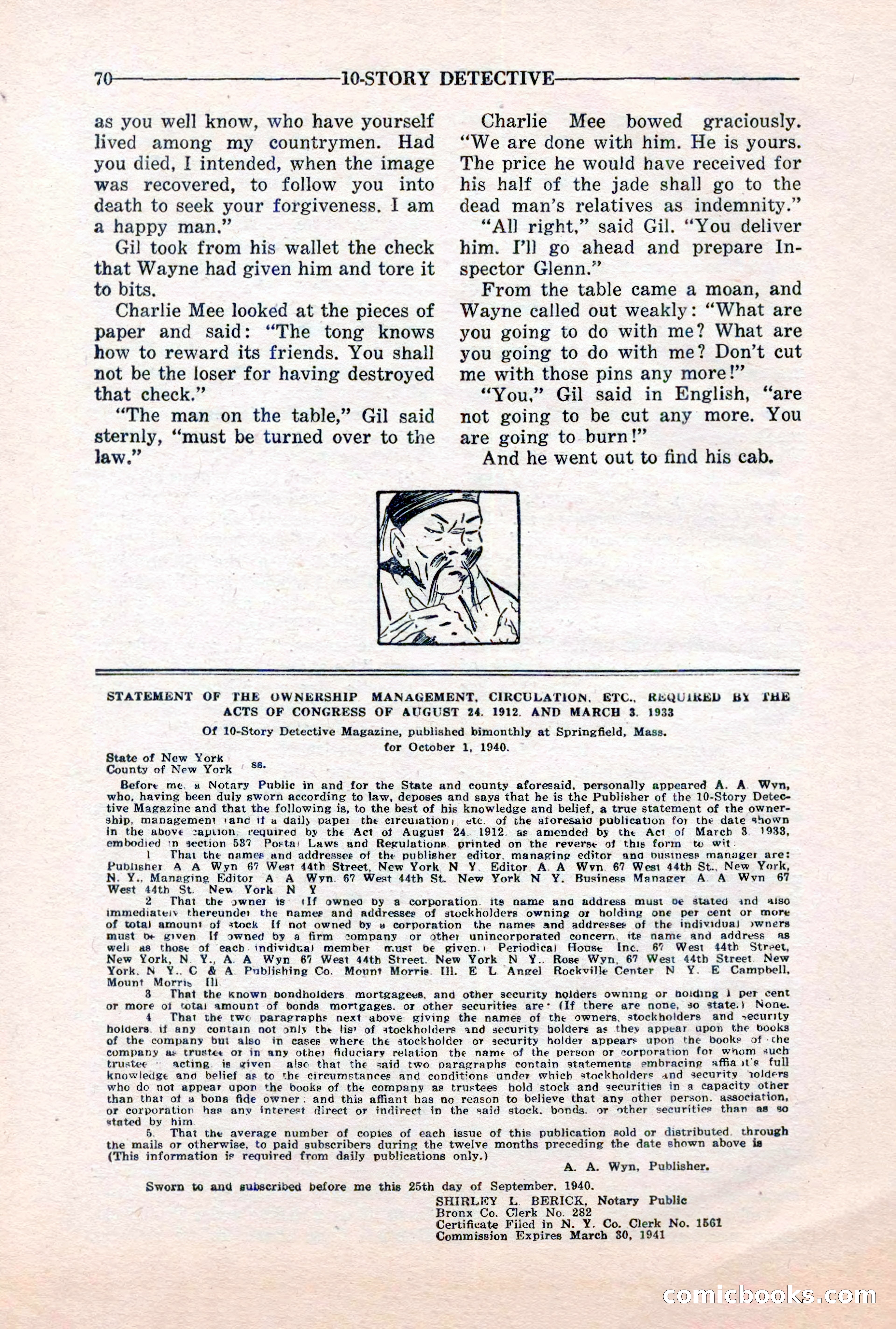
# Page Analysis This page from *10-Story Detective Magazine* (October 1, 1940) contains two distinct sections: story prose at the top and legal documentation below. The story prose depicts the climax of a crime narrative involving characters named Gil, Charlie Mee, and Wayne. Gil confronts Wayne about crimes (appearing to involve a jade theft and torture with pins), declares Wayne will "burn," and exits to find a cab. Charlie Mee agrees to turn Wayne over to authorities. The remainder of the page consists of the magazine's required ownership and circulation statement, sworn by publisher A. A. Wyn, listing corporate ownership details and stockholder information as mandated by Congressional acts from 1912 and 1933.
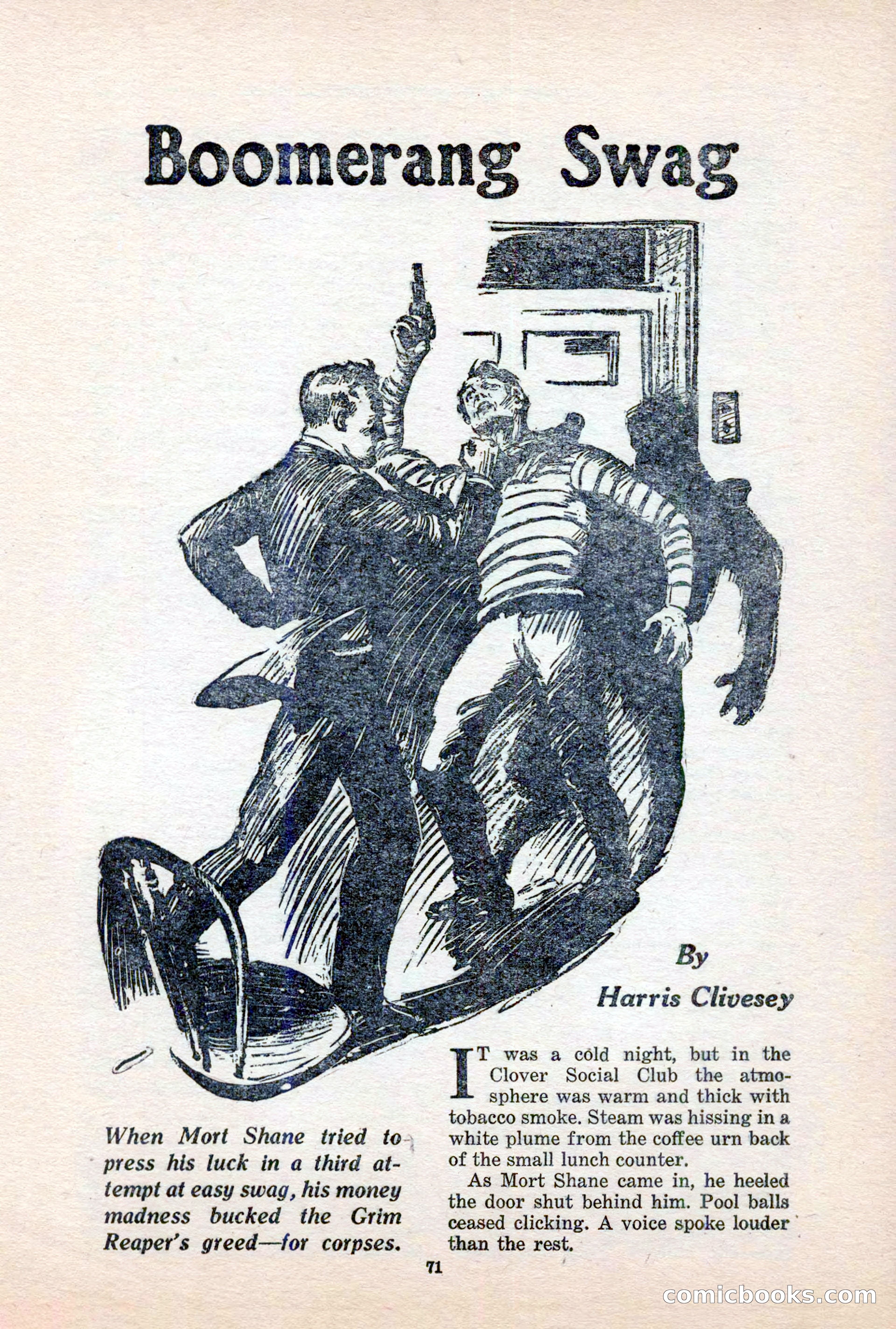
# Boomerang Swag This is an interior story page from a pulp magazine featuring an illustration and prose opening. The page shows "Boomerang Swag" by Harris Clivesey, a crime story about a character named Mort Shane who attempts some form of criminal act ("easy swag"). The illustration depicts men in suits engaged in what appears to be a physical altercation. The story's opening establishes an atmospheric scene at the Clover Social Club on a cold night, where pool players fall silent upon Shane's arrival—suggesting danger or criminal activity. The caption warns that Shane's "money madness bucked the Grim Reaper's greed."
# Page 72 of "10-Story Detective" This page contains story prose from a hardboiled crime narrative. The text depicts a scene in a poolroom or club where a man named Shane, described as a large, rough-featured ex-convict, has won a raffle prize (a case of whisky). When others congratulate him and a hanger-on named Rick Vargo tries to claim a cut, Shane violently attacks Vargo. The passage shows Shane's aggressive personality, his sensitivity about his criminal past, and his subsequent sale of the whisky. The scene ends with Shane watching men gamble at a machine in the clubroom's back area.
# Page Analysis This page contains story prose from what appears to be a hardboiled crime pulp fiction narrative titled "Boomerang Swag" (page 73). The text follows a character named Shane as he wins money from a slot machine, observes a cigar store's cash register, retrieves a hidden revolver, and then positions himself to rob a clerk who carries the store's nightly bank deposits along Miller Street. The narrative depicts Shane's planning and execution of an armed robbery, with the passage ending as he confronts the clerk at gunpoint and orders him into an alley.
# Page Analysis: "10-Story Detective" Pulp Fiction **Type:** Story prose (interior page from a hardboiled crime pulp magazine) **Content:** This page depicts a criminal robbery and murder. A character named Shane robs a cigar store clerk at gunpoint in an alley. When the clerk attempts to resist, Shane shoots and kills him. Shane then escapes with the money ($91 total), hides it under a floorboard in his apartment, and later overhears people on the street discussing the murder—described as a "cigar store clerk—shot through the heart—A holdup." The narrative follows Shane's tense moments avoiding detection, including a close call when he nearly encounters a man named Rick Vargo.
# Page 75 from "Boomerang Swag" This is story prose from a hardboiled crime pulp fiction magazine. The text depicts a violent climax in which a character named Shane, having been informed he's been identified to police, engages in a gunfight with a policeman on a stairwell. Shane is shot and killed. The passage reveals that Shane committed the "Allied Cigar job" robbery, and that he was actually reported to police by an informant (Rick Vargo) not for the robbery itself, but for selling liquor without a license—a detail that undercuts the apparent seriousness of the crime and death.
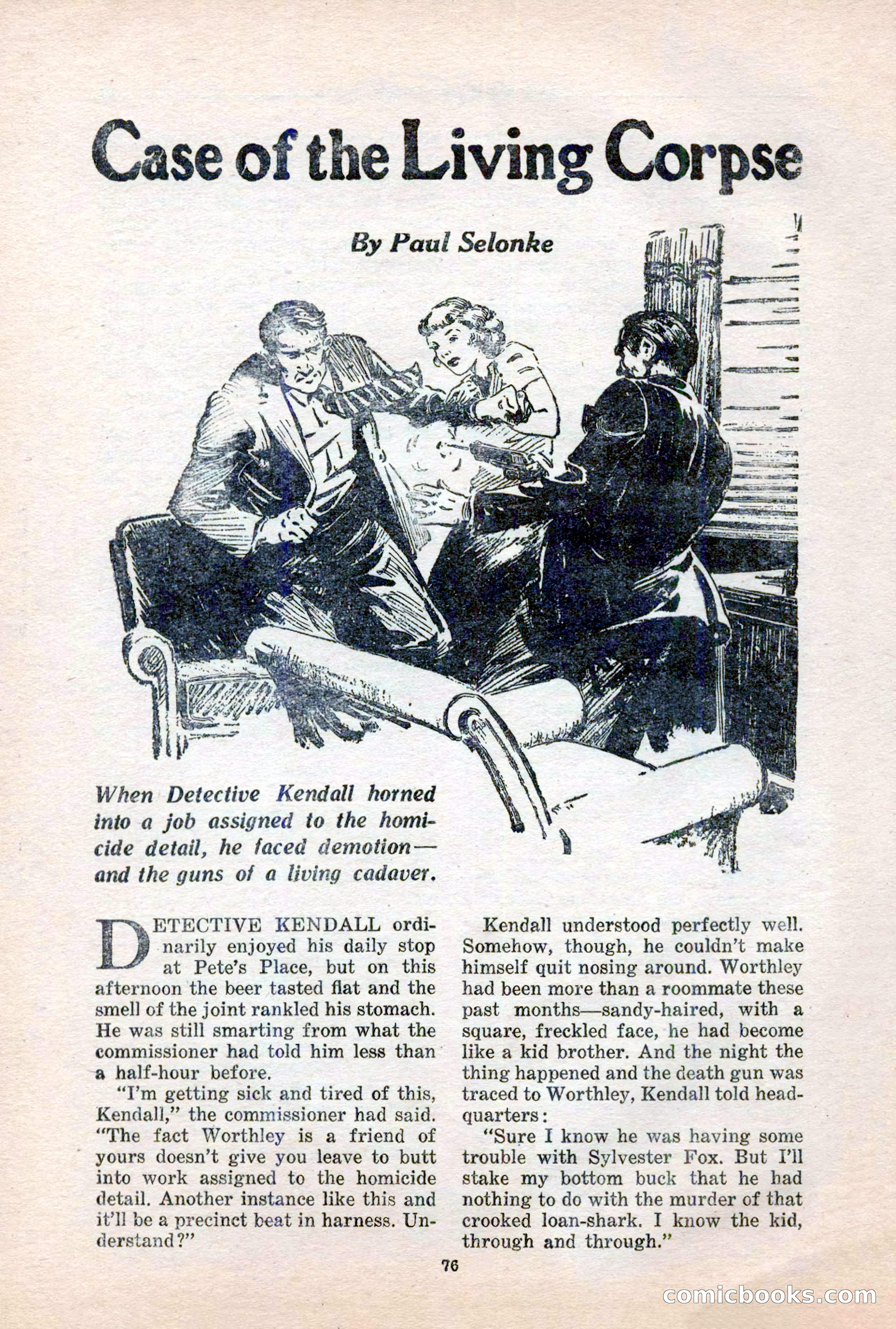
# Page Analysis This is an interior story page from a pulp crime/detective magazine. It presents the opening of "Case of the Living Corpse" by Paul Selonke, featuring an illustration and prose text. Detective Kendall, frustrated by his commissioner's warnings about involving himself in cases outside homicide, learns that his friend Worthley has been connected to a murder involving a crooked loan-shark and a "death gun." Kendall insists Worthley is innocent despite the evidence, asserting his conviction that he knows the young man well enough to vouch for him.
# Page Analysis This is **story prose** from a hardboiled crime fiction tale titled "Case of the Living Corpse" (page 77). Detective Kendall investigates the murder of Sylvester Fox and the mysterious disappearance of a suspect named Worthley. While examining leads, Kendall encounters Joe Sweeny, a reformed safecracker from New York, who claims an unknown muscular man with a half-paralyzed face recently approached him to crack a safe in a Hyde Park house. Sweeny identifies the man as Ed Garvey—though Garvey supposedly died of a heart attack before the murder investigation began, creating a central mystery.
# Page Analysis: "10-Story Detective" Pulp Magazine This page contains **story prose** from a hardboiled crime detective narrative. The text depicts detective Kendall meeting with Sweeny, a safe-cracker, to discuss a dangerous plan: Kendall will impersonate Sweeny to intercept someone named Ed Garvey at Sweeny's shack on Fourth Street. The passage reveals that Kendall believes this scheme will prove that a man named Worthley is innocent of murder, while also suggesting someone—aside from police—is attempting to obstruct the investigation. The narrative emphasizes the peril both men face if the deception fails.
# Page Analysis This is **story prose** from a pulp fiction magazine, specifically a crime/detective story titled "Case of the Living Corpse" (page 79). The text depicts a dramatic confrontation in which detective Kendall stages a fake fight with a man named Sweeny to deceive someone arriving at the scene. Kendall is shocked to discover the visitor is Ed Garvey—a man he believed he had attended the funeral for and seen buried. Garvey appears alive and dangerous, carrying a .45 automatic, and coerces Kendall into committing a crime by threatening him. The passage combines elements of hardboiled crime fiction with apparent mystery elements involving the unexplained return of a supposedly dead man.
# Page Analysis This page contains **story prose** from a hardboiled crime pulp magazine titled "10-Story Detective." The narrative follows a character named Kendall, who is being forced by the criminal Ed Garvey to help rob a house in Hyde Park. Kendall is shocked to discover that Sheila Fox—daughter of a murdered loan-shark—is part of the scheme, and that the target is the home of a private detective named Carthers who has disappeared. The passage suggests these crimes are connected, with Kendall realizing the Fox murder and Carthers' disappearance are linked to Garvey's criminal operations.
# Page Analysis: "Case of the Living Corpse" This page contains story prose from a hardboiled crime pulp fiction tale. The narrative follows characters Kendall, Garvey, and Sheila Fox as they break into a house to access a wall safe. Garvey, armed and threatening, forces safecracker Kendall to open the safe at gunpoint to retrieve what Garvey claims is "a dead man's face." Kendall appears to be stalling, searching for an opportunity to escape or trap Garvey. The scene builds tension through dialogue and internal monologue as Kendall attempts the safe-cracking while mentally calculating his dangerous situation.
# Page Analysis This is **story prose** from a hardboiled detective magazine titled "10-Story Detective" (visible as page header B2). The text continues a crime narrative involving a character named Kendall who has been shot but survives thanks to a bulletproof vest. After discovering a mysterious photograph in a library desk—a portrait inscribed "To Dad, from his loving son, Tom"—Kendall realizes the subject is someone named Worthley, supposedly in California but actually connected to a murder case. Realizing he cannot reach police help in time, Kendall decides to travel alone to confront a character named Ed Garvey at Sweeny's shack, while puzzling over Sheila Fox's unexpected involvement in the murder plot.
# Page Analysis This is story prose from page 83 of a pulp-fiction magazine titled "Case of the Living Corpse." The text depicts a climactic action scene in which protagonist Kendall rushes into a shack to stop the villain Ed Garvey from shooting a woman named Sheila. Kendall discovers he left his bullet-proof vest in a taxi, then witnesses through a window as Sheila—apparently Garvey's daughter—confronts the man over her father's murder. When Garvey shoots at her, Kendall bursts in and engages Garvey in hand-to-hand combat, ultimately subduing him after a violent struggle.
# Page Analysis This is **story prose** from a hardboiled detective pulp magazine (10-Story Detective, page 84). The text presents a dramatic exposition scene where Detective Kendall questions Sheila Fox about a complex murder plot involving her fiancé Tom Carthers, a criminal named Garvey, and Tom's father. Sheila reveals that she and Tom orchestrated an elaborate scheme involving a exhumed corpse, a wax mask, and a hidden safe—ultimately leading to Tom shooting Garvey in self-defense. The dialogue centers on why Tom didn't go to police and whether their fabricated story will hold up in court against the murder charge.
# Page Content Description This page contains story prose from what appears to be a crime or mystery pulp fiction ("Case of the Living Corpse," page 85), followed by a full-page advertisement. The prose excerpt depicts a dramatic confrontation where character Kendall shoots Ed Garvey, who collapses with a gunshot wound. Below the story text is a large advertisement promoting *Prize Photography* magazine, highlighting its photography contests with cash prizes ($5-$25), instructional articles on darkroom techniques and camera accessories, and stories about photography applications in crime detection and other fields. The magazine costs 15 cents at newsstands.
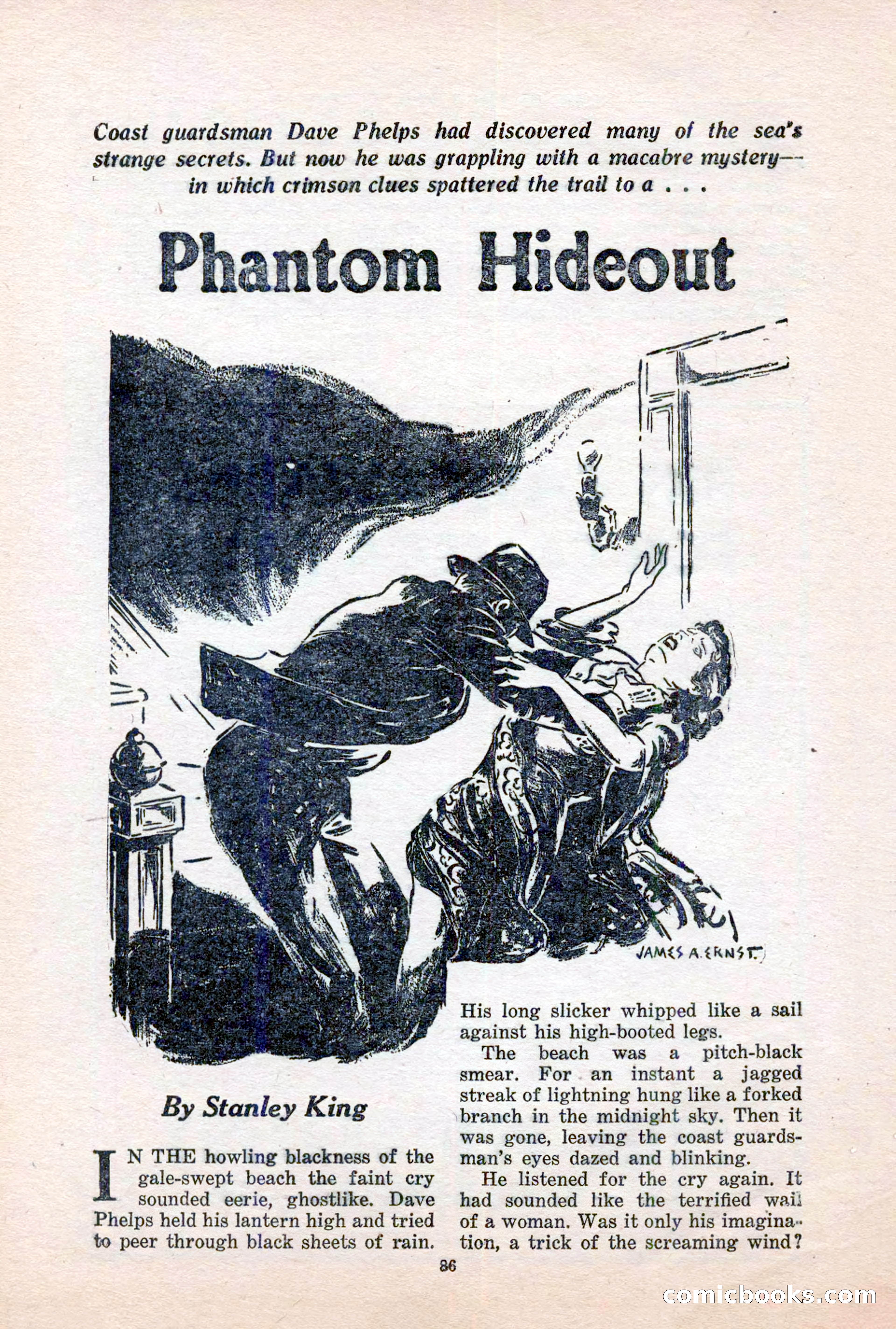
# Page Analysis This is an interior story page from a pulp magazine, presenting the opening of "Phantom Hideout" by Stanley King. The page combines illustration and prose: a dramatic pen-and-ink drawing (credited to James A. Ernst) depicts a coast guardsman apparently struggling with or confronting a figure on a storm-swept beach at night. The accompanying text introduces Dave Phelps, a coast guard officer investigating a mysterious cry heard during a violent storm, unsure whether it's a woman's scream or merely the wind's deception.
# Phantom Hideout, Page 87 This page contains story prose from what appears to be a pulp crime or mystery fiction. A coast guardsman named Phelps discovers an unconscious woman, Rita Daly, sheltering under beach bathing sheds during a storm. Rita regains consciousness confused and distressed, claiming she saw her brother Clem's dead, blood-covered face and has no memory of how she arrived at the beach. The narrative builds mystery around Rita's unexplained presence and apparent trauma, with implications that her brother may be involved in some dark incident.
# Page Analysis: 10-Story Detective This page contains **story prose** from what appears to be a crime or mystery pulp fiction magazine titled "10-Story Detective." The narrative follows a coast guardsman named Phelps interrogating a woman named Rita about her brother Clem's death. Rita describes a drugged, dreamlike memory of finding her brother covered in blood after a quarrel over money, his palms stained with fresh blood. Phelps carries the distressed girl from the beach back to the Seaside Inn to investigate, discovering someone lurking inside—apparently Tim, a local carpenter. The text emphasizes noir-style suspense and mystery.
# Page 89: Story Prose from "Phantom Hideout" This page contains prose fiction depicting a mystery/crime scene investigation. A coast guard officer named Phelps interrogates a carpenter named Tim who claims to have discovered the dead body of watchman Clem Daly on the dance floor of what appears to be a seaside establishment. When Phelps enters the building, the body has vanished, though blood smears and marks on the floor suggest someone recently cleaned up and left a trail of bloody footprints. A woman named Rita corroborates Tim's account, claiming the dead man was her brother. The passage emphasizes the mysterious disappearance of the corpse and the physical evidence remaining at the scene.
# Page Analysis This is story prose from a pulp detective magazine, specifically page 90 of "10-Story Detective." The text depicts a crime investigation at a dance pavilion where detective Dave Phelps discovers a body has mysteriously disappeared from the second floor—its blood trail ends abruptly in the hallway with no sign of the corpse being removed downstairs. Suspecting the killer is hiding the body in an attic above, Phelps forces the nervous carpenter Tim to retrieve a ladder. Sheriff Craig arrives in response to Phelps' call, and the two prepare to investigate the attic, with Phelps grimly noting the corpse must be hidden somewhere upstairs.
# Page Analysis This is story prose from page 91 of a pulp fiction magazine titled "Phantom Hideout." The text depicts a detective mystery scene where Sheriff Craig and investigator Phelps pursue a murderer into an attic. They discover the killer has used a ladder to access the space, left behind blood evidence, and—more significantly—hidden stolen silk bales from the Patterson Raw Silk Corporation, connecting the murder to a larger theft ring operating in the county. The narrative builds suspense as the characters realize the criminal case extends beyond a single murder.
# Page 92 of "10-Story Detective" This page contains story prose from what appears to be a detective or mystery story. The narrative describes characters named Craig and Phelps investigating a disturbance at a lighthouse tower during a violent storm. They discover a body or evidence of violence at the tower's top and attempt to pursue someone down the stairs. The text emphasizes atmospheric details—the howling wind, rain, and darkness—while building suspense around a possible murder or suicide involving what's described as a "sailor." The page is entirely text-based with no illustrations or advertisements visible.
# Page Content Analysis This page contains **story prose** from what appears to be a hardboiled crime or mystery pulp fiction tale titled "Phantom Hideout" (visible in the header). The narrative describes an intense climactic confrontation on a beach at night between a coast guardsman named Phelps and an armed fugitive murderer. Phelps pursues the killer through darkness and gunfire, discovers a dead body, engages in hand-to-hand combat, and ultimately subdues his opponent. The reveal indicates the killer is Ridley, the owner of Seaside Inn, who staged a Miami trip as an alibi while actually hiding in the inn's attic—apparently to silence someone named Clem Daly regarding blackmail.
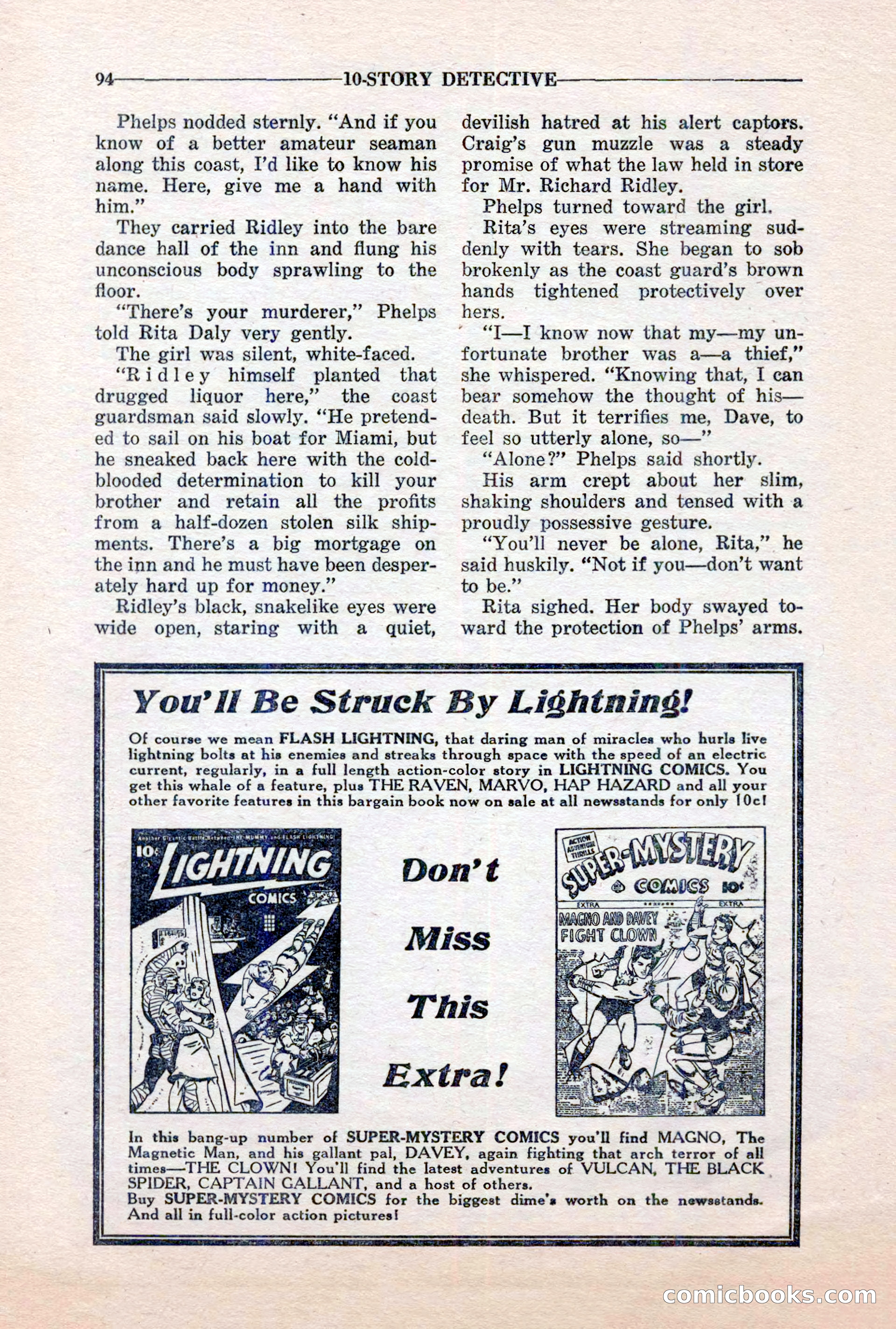
# Page Analysis: 10-Story Detective This page contains story prose from a pulp fiction magazine, specifically from a crime/detective story titled "10-Story Detective." The narrative describes a coast guard officer named Phelps confronting a murder suspect named Ridley at an inn, then consoling Ridley's sister Rita as she learns her brother was a thief who killed her other brother. The scene concludes with romantic tension between Rita and Phelps. The lower half is dominated by a full-page advertisement promoting two comic books: *Lightning Comics* and *Super-Mystery Comics*, both priced at ten cents, featuring various action heroes and promising "full-color action pictures."
# Crystal Clue by Leon Dupont This is a story prose page from a pulp magazine, appearing to be a crime or mystery story. The visible text depicts Henry York committing murder—he suffocates his elderly Uncle Walter York with a heavy robe to inherit his wealth. After killing his uncle, Henry carefully stages the scene to appear accidental, arranging the body in a bathtub and positioning clothing to suggest the uncle died during bathing. The story's header promises that York's "unbeatable plan" will be undone by "transparent evidence," suggesting this is a mystery story building toward the revelation of his crime.
# Page Analysis: "10-Story Detective" Crime Story This page contains story prose from a pulp crime/detective magazine. It depicts a detailed narrative of a murder staged as an accident: a man named Henry York drowns his uncle in a bathtub, carefully eliminating fingerprints, manipulating the corpse's position and a watch to suggest accidental death, then establishes an alibi before "discovering" the body. The text describes York's meticulous planning, his nervous behavior afterward (including drinking chlorinated tap water that disturbs him), and the arrival of police and a doctor who accept the drowning explanation. The passage emphasizes procedural detail and psychological suspense typical of hardboiled detective fiction.
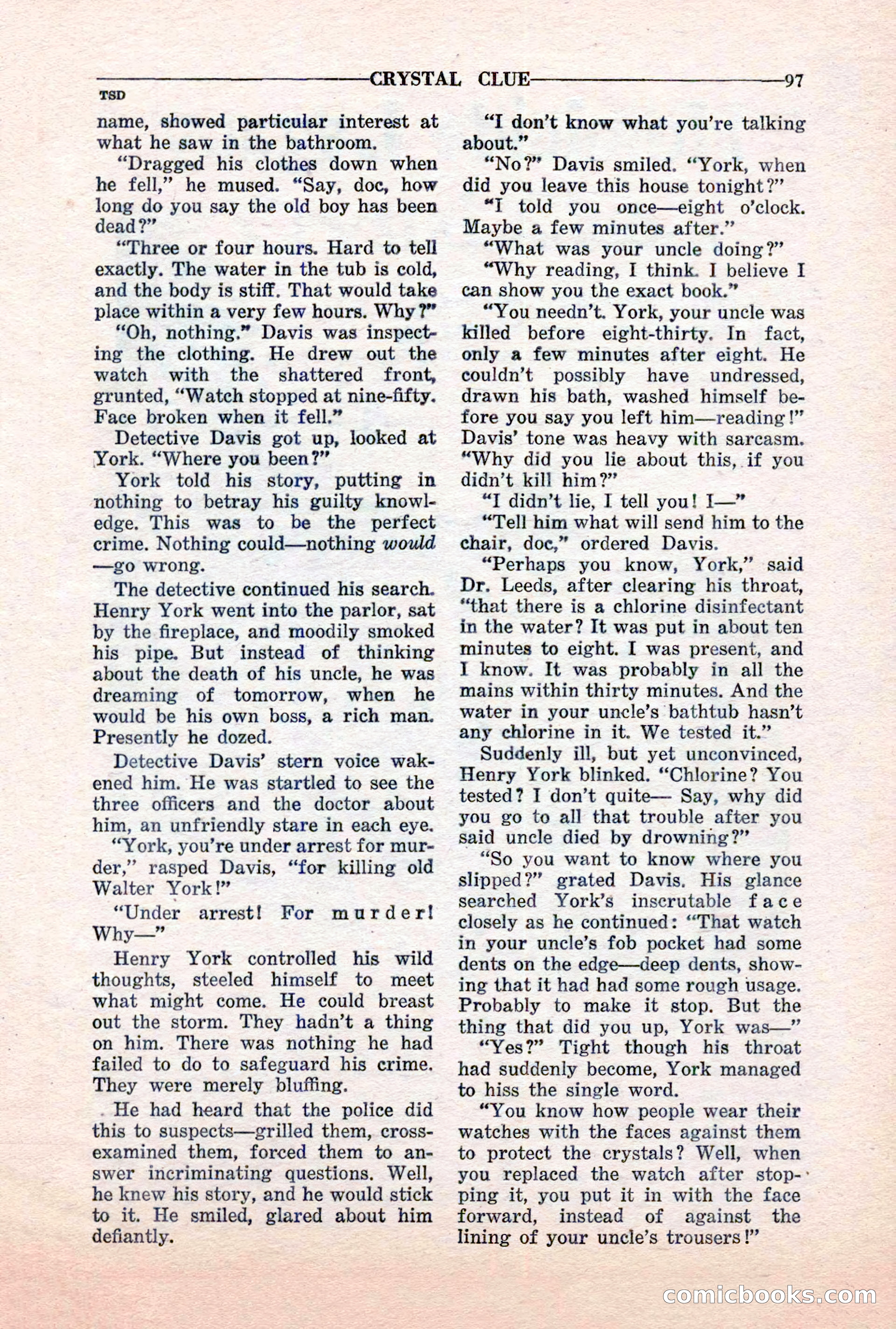
# Page from "The Crystal Clue" This page contains story prose from what appears to be a hardboiled crime/detective story titled "The Crystal Clue." Detective Davis has arrested Henry York for murdering his uncle, Walter York, who was found dead in a bathtub. The narrative follows York's internal panic as Davis methodically presents evidence: the uncle couldn't have bathed before York claims to have left (based on chlorine disinfectant timing), and York made a critical error when replacing his uncle's broken watch—he put it face-forward in the pocket instead of face-inward as people typically wear watches to protect the crystal.
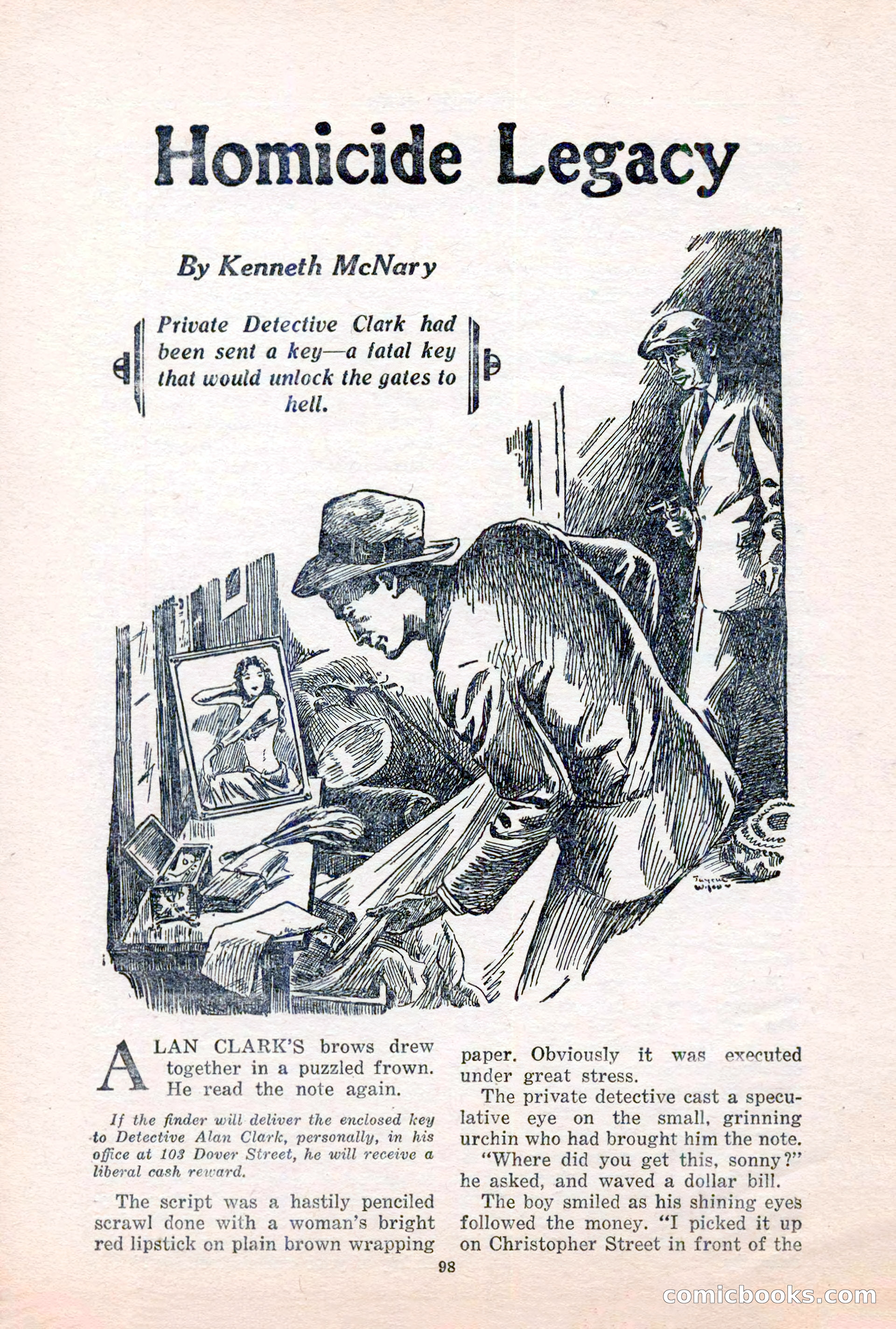
# Homicide Legacy This is an interior story page from a pulp magazine featuring both illustration and prose. The page shows the opening of "Homicide Legacy" by Kenneth McNary, a hardboiled crime story about Private Detective Alan Clark who receives a mysterious key wrapped in brown paper with a note written in red lipstick, promising a reward. The illustration depicts Clark examining the note while a street urchin watches. The text establishes an urgent mystery: the key is described as "fatal" and capable of unlocking "the gates to hell."
# Page Analysis This is story prose from a hardboiled crime pulp magazine titled "Homicide Legacy" (page 99). The text depicts a violent confrontation between Detective Clark and Pete Lynch, a criminal gang leader, who demand a mysterious key that Clark has hidden. Lynch and his associates—the gunman Slug Nixon and Butch Scott—brutally beat Clark to force him to reveal the key's location, which Clark had secretly placed in an inkstand moments before they arrived. The passage emphasizes the physical violence and Clark's deliberate silence under torture.
# 10-Story Detective This page contains story prose from a hardboiled detective pulp magazine. Private Detective Alan Clark, after being beaten and having his office ransacked by Pete Lynch's gang searching for a mysterious key, recovers the key from his desk inkwell. A veiled woman named Joan Hallet then arrives at his office, recently released from prison, seeking Clark's help regarding the key—which multiple parties appear to desperately want. The narrative establishes the key as central to the unfolding mystery.
# Homicide Legacy — Page 101 This page contains story prose from a hardboiled detective fiction titled "Homicide Legacy." Detective Clark interrogates a mysterious woman who claims to have thrown him a key wrapped in brown paper with a note. The woman describes the key's details and claims to have written the note in red pencil, but Clark deduces she's lying—she never wrote the note, proving she's working with criminals who found it and copied it, mistaking the red lipstick writing for pencil. Clark realizes she's in league with the "Lynch toughs" and lays the thousand-dollar payment back on his desk, deciding to confront her.
# Page Analysis This is **story prose** from a hardboiled detective pulp magazine (page 102 of "10-Story Detective"). The page depicts a confrontation between Detective Alan Clark and a veiled woman named Miss Hallet who demands a key he refuses to sell. When she draws a revolver, Clark disarms her through deception and physical force, then ejects her from his office. The text then follows Clark to a women's prison, where he contacts a matron friend to identify who occupied a specific cell that morning—discovering the answer is "Joan Hallet," the name of the veiled woman who attacked him.
# Page Analysis: "Homicide Legacy" This page contains story prose from what appears to be a hardboiled crime pulp fiction magazine. The narrative follows detective Clark as he identifies actress Doris Adair in a newspaper photograph, recognizing her as Joan Hallet—sister of someone he once knew. Clark plans to visit her at the Paradise theater, but when he arrives at his apartment, he finds it ransacked and encounters Wilson Drake, a powerful state politician, who offers Clark ten thousand dollars for "the key." Clark refuses to sell it, despite the substantial sum offered.
# Page Analysis This is story prose from a pulp detective magazine titled "10-Story Detective." The page shows a confrontation between detective Clark and a politician named Drake over a stolen key. After Drake threatens Clark's life and storms out, gunshots erupt in the hallway. Clark investigates and finds Drake dead, riddled with bullets. Neighbors and police arrive to discover Clark holding a gun beside the corpse, making him the apparent suspect. The story continues on the next page.
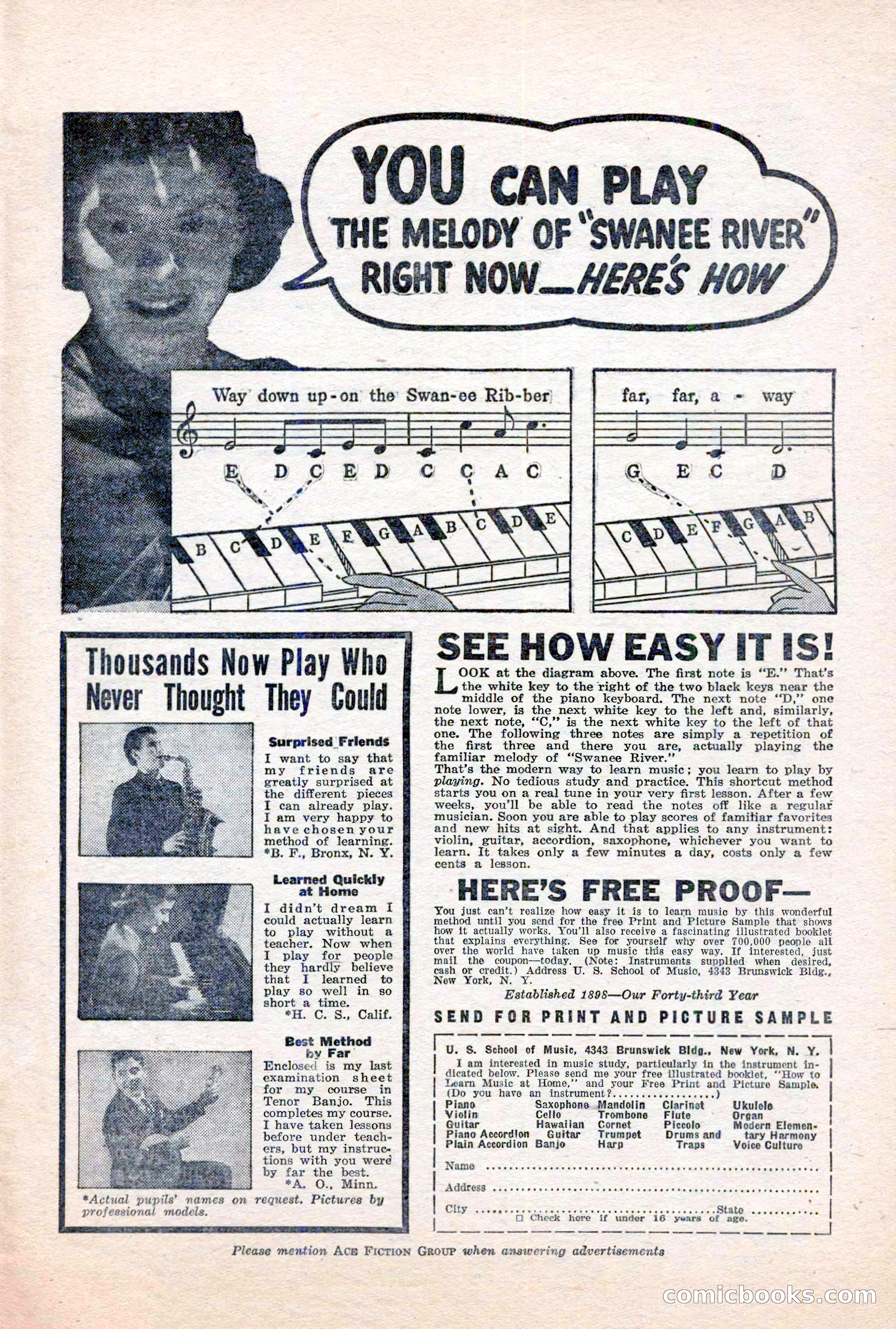
# This Page This is an advertisement for the U.S. School of Music, not story content. It promotes learning to play musical instruments through their correspondence course by demonstrating how easily one can play "Swanee River" on piano using their method. The page includes testimonials from satisfied students claiming they learned quickly without a teacher, musical notation showing the melody's opening notes with keyboard diagrams, and a mail-in coupon requesting free instructional materials. The advertisement emphasizes that music education can begin immediately and affordably through their shortcut method.
# Page Analysis: 10-Story Detective (Page 106) This page contains **story prose** from a hardboiled crime pulp fiction magazine. The text continues a detective narrative in which protagonist Clark, a detective, searches for the missing actress Doris Adair after a shooting incident involving Pete Lynch. Clark evades gunfire, visits the actress's apartment and theatrical haunts throughout the night, and returns to his own apartment at dawn—only to be confronted at gunpoint by Slug Nixon and Jim Hill. The page contains no illustrations or advertisements, only dense columns of typeset fiction text.
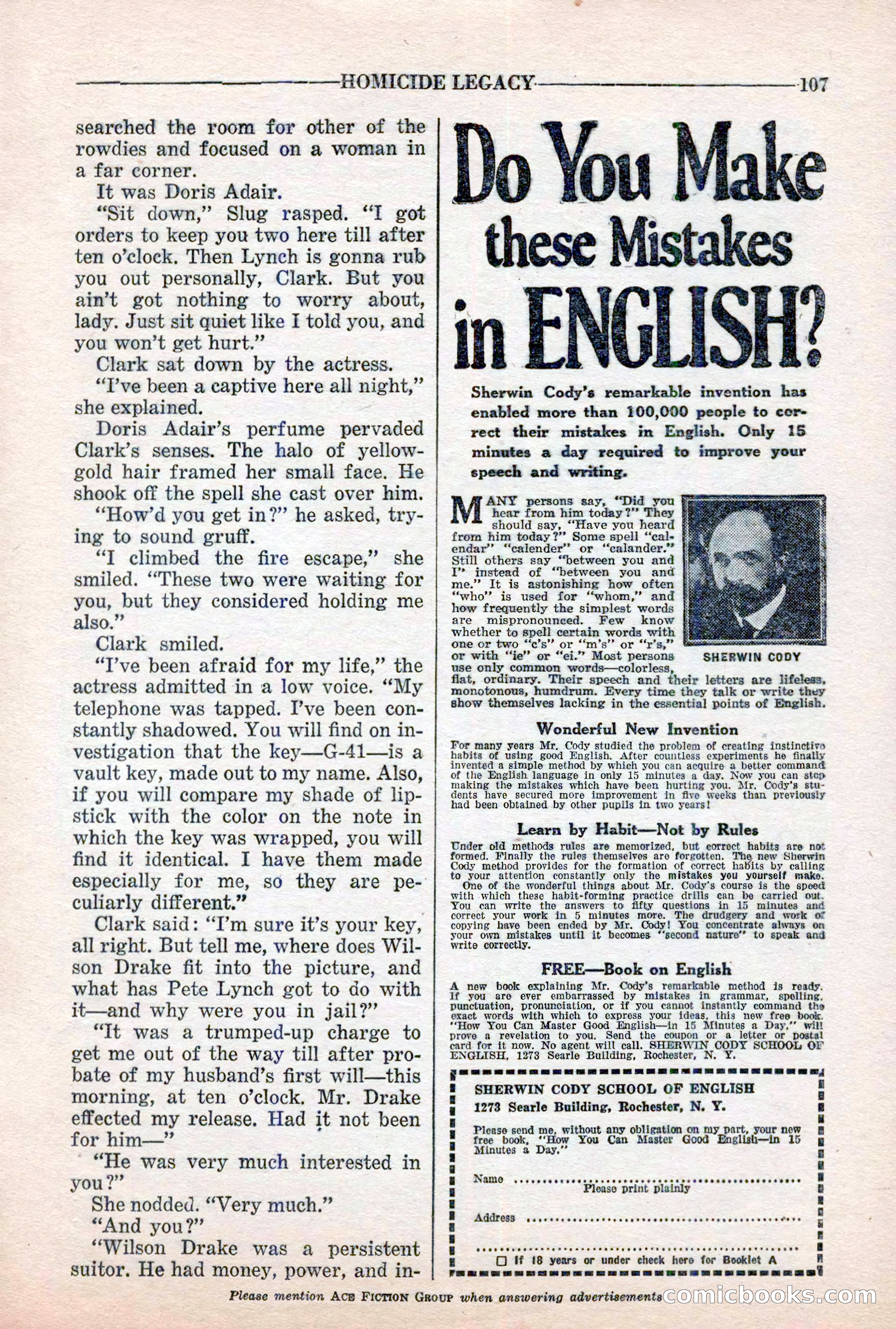
# Page Analysis This page contains story prose alongside advertising content. The left column continues a crime narrative involving characters Clark, Doris Adair, and others, with dialogue about a vault key, a murder plot by someone named Lynch, and Doris's involvement in suspicious circumstances. The right side features a prominent advertisement for Sherwin Cody's English language correction method, promoting a system that claims to help over 100,000 people correct mistakes in speech and writing through 15 minutes daily practice. A coupon and photo of Sherwin Cody appear at the bottom.
# Page Analysis: 10-Story Detective This page is primarily **story prose** with multiple **advertisements** interspersed. The main narrative appears to be part of a detective story titled "Childless Wives" (visible at top). The visible story text concerns a woman named Doris Adair explaining to someone (likely detective Clark) about a crucial will stored in a Downtown Bank vault that must be produced in court by ten o'clock that morning. The woman mentions a man named Wilson Drake who apparently tried to force her cooperation and hired thugs to obtain a key to her vault. The page is typical of pulp magazines, mixing serialized fiction with period advertisements for medical remedies, self-improvement courses, and novelty products.
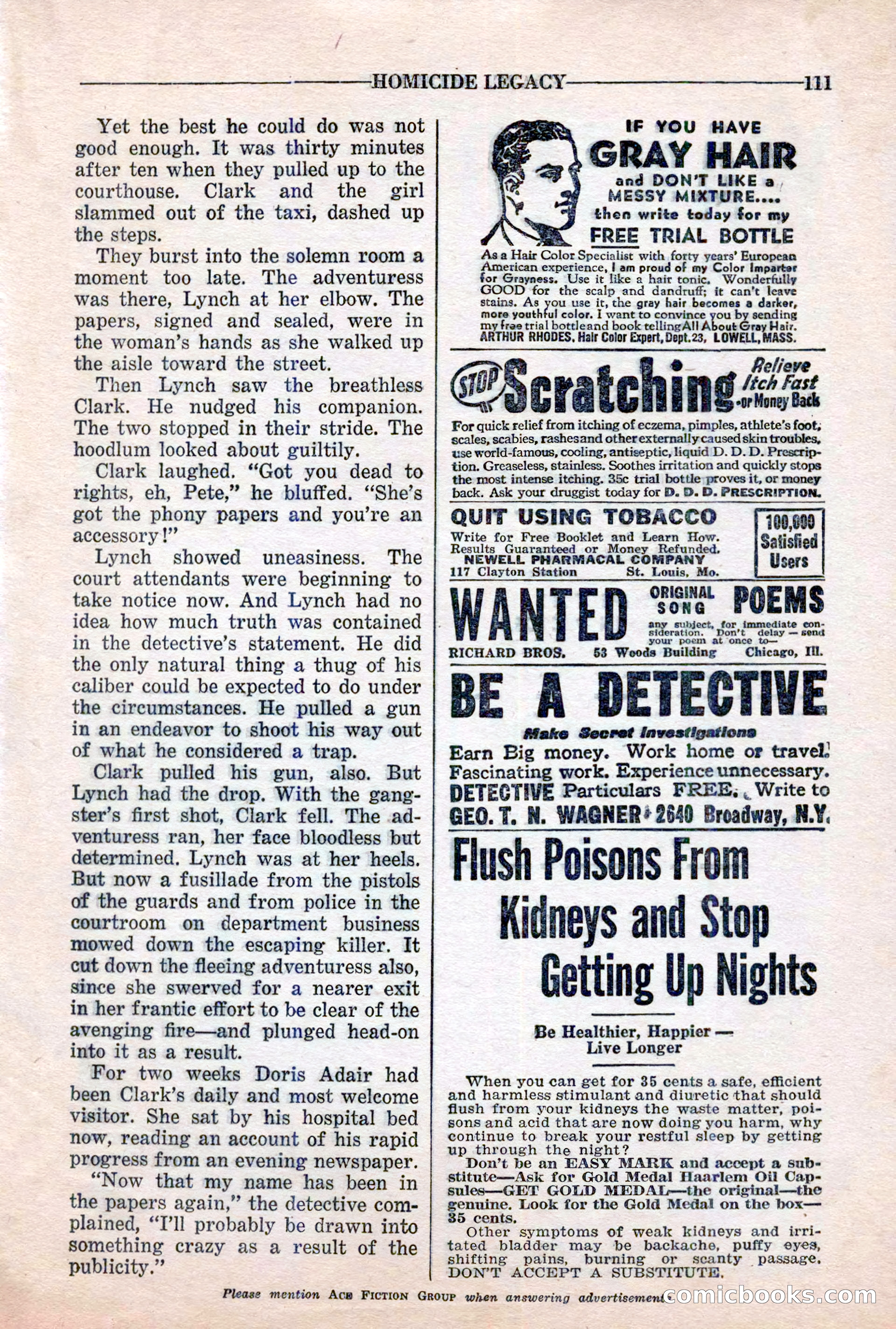
# Page Analysis This is **story prose with integrated advertisements** from a pulp crime magazine. The left column continues a hardboiled detective narrative titled "Homicide Legacy" (page 109), depicting an armed confrontation where detective Clark uses a chair as cover during a shootout with gangsters Slug Nixon and Jim Hill over a missing key and a captive actress. The right side contains period advertising for patent medicines and consumer goods (Cystex kidney treatment, tailored suits, false teeth, and hair dye), typical of early-20th-century pulp magazine formatting.
# Page Analysis: 10-Story Detective This page contains story prose from a pulp detective magazine, along with advertisements. The visible fiction text depicts a tense hostage situation where detective Clark confronts a gangster named Slug Nixon, who holds actress Doris as a shield. After Clark drops his gun, Doris uses quick footwork to startle Nixon into loosening his grip, allowing her to escape. Clark then retrieves an adhesive tape key from his shoe before he and Doris flee to the Fordham court in a taxi. The page is numbered 110 and includes period advertisements for stomach remedies, pest control training, and tear gas weapons.
# Page Content Summary This is a story prose page from a pulp crime/detective magazine titled "Homicide Legacy." The left column contains narrative text describing a dramatic courthouse confrontation where detective Clark attempts to stop a criminal named Lynch from escaping with forged documents. A shootout ensues, resulting in Clark being shot and both Lynch and an adventuress named the woman being killed by police gunfire. The right column consists entirely of period advertisements for various products including hair dye, skin treatments, tobacco cessation programs, detective correspondence courses, and kidney remedies—typical of early-20th-century pulp magazine advertising.
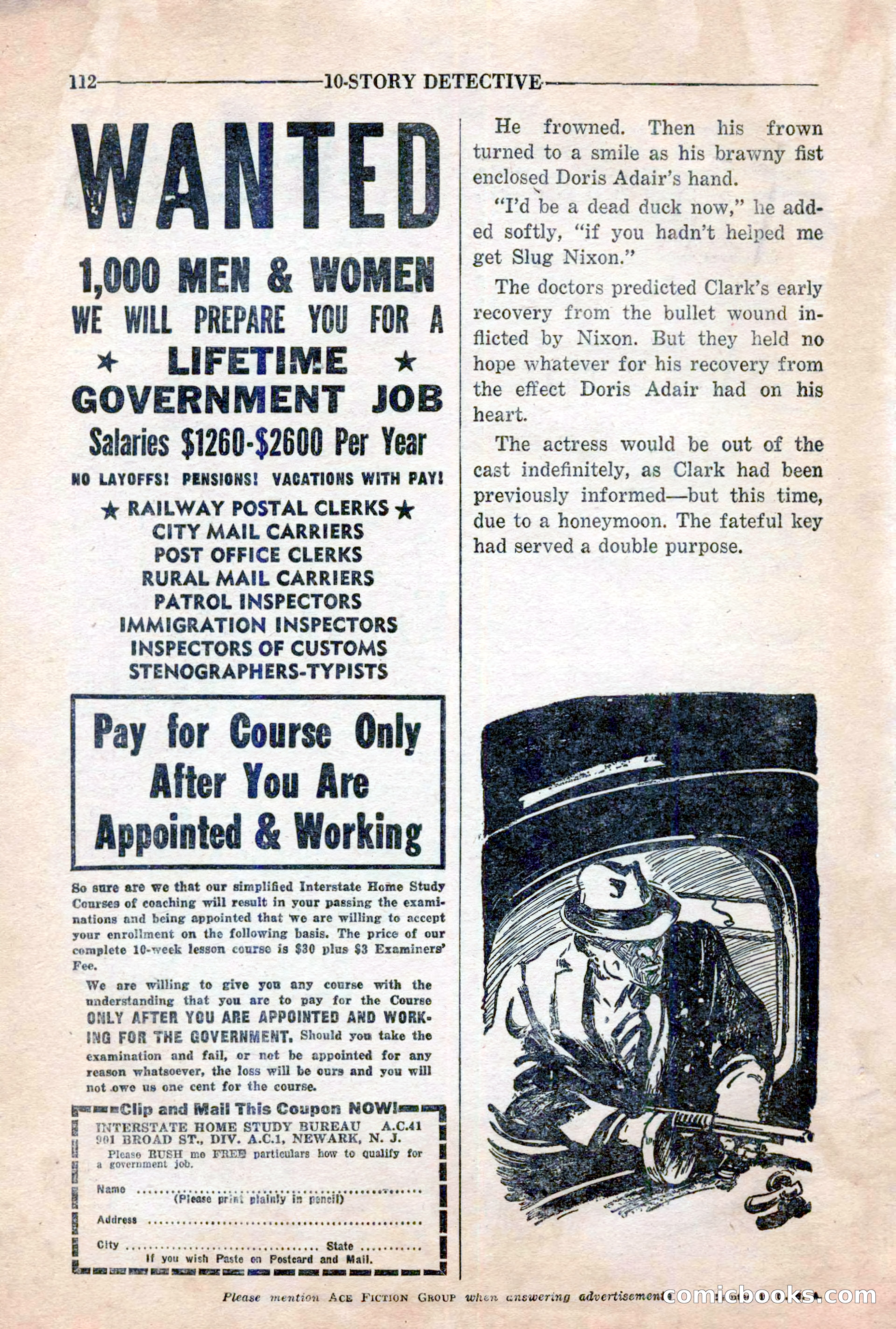
# Page Analysis: 10-Story Detective This page from a pulp-fiction magazine contains story prose alongside a full-page advertisement. The narrative text, appearing on the right side, concludes a crime story involving characters named Clark, Doris Adair, and Slug Nixon—apparently resolving a plot where Clark has been shot but recovers, while winning Doris's heart, who will now leave the cast for a honeymoon. The left side features a large employment recruitment advertisement for the Interstate Home Study Bureau, promoting government job training (postal clerks, mail carriers, inspectors) with salaries of $1,260–$2,600 annually and a mail-in coupon for interested readers.
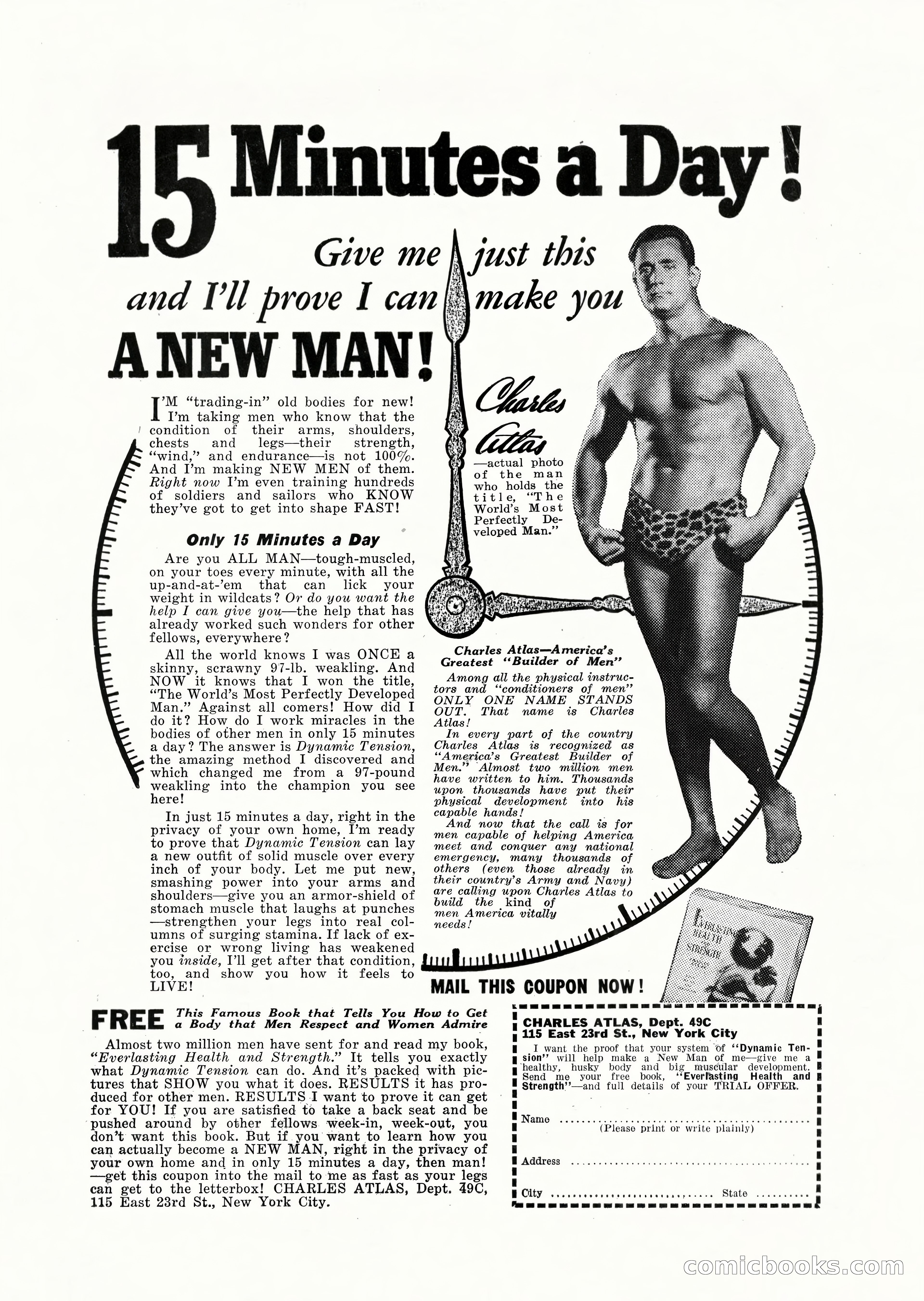
# Page Analysis This is a **full-page advertisement** from an early-20th-century pulp magazine. The ad promotes Charles Atlas's bodybuilding program "Dynamic Tension," claiming it can transform a weak man into a muscular "new man" in just 15 minutes daily. The page features a large photograph of a muscled man (identified as Atlas, who claims the title "The World's Most Perfectly Developed Man"), testimonial text describing his transformation from a 97-pound weakling, and a mail-in coupon at the bottom inviting readers to request a free instructional book. The copy emphasizes rapid results and appeals to patriotic duty, referencing soldiers and sailors needing physical fitness.
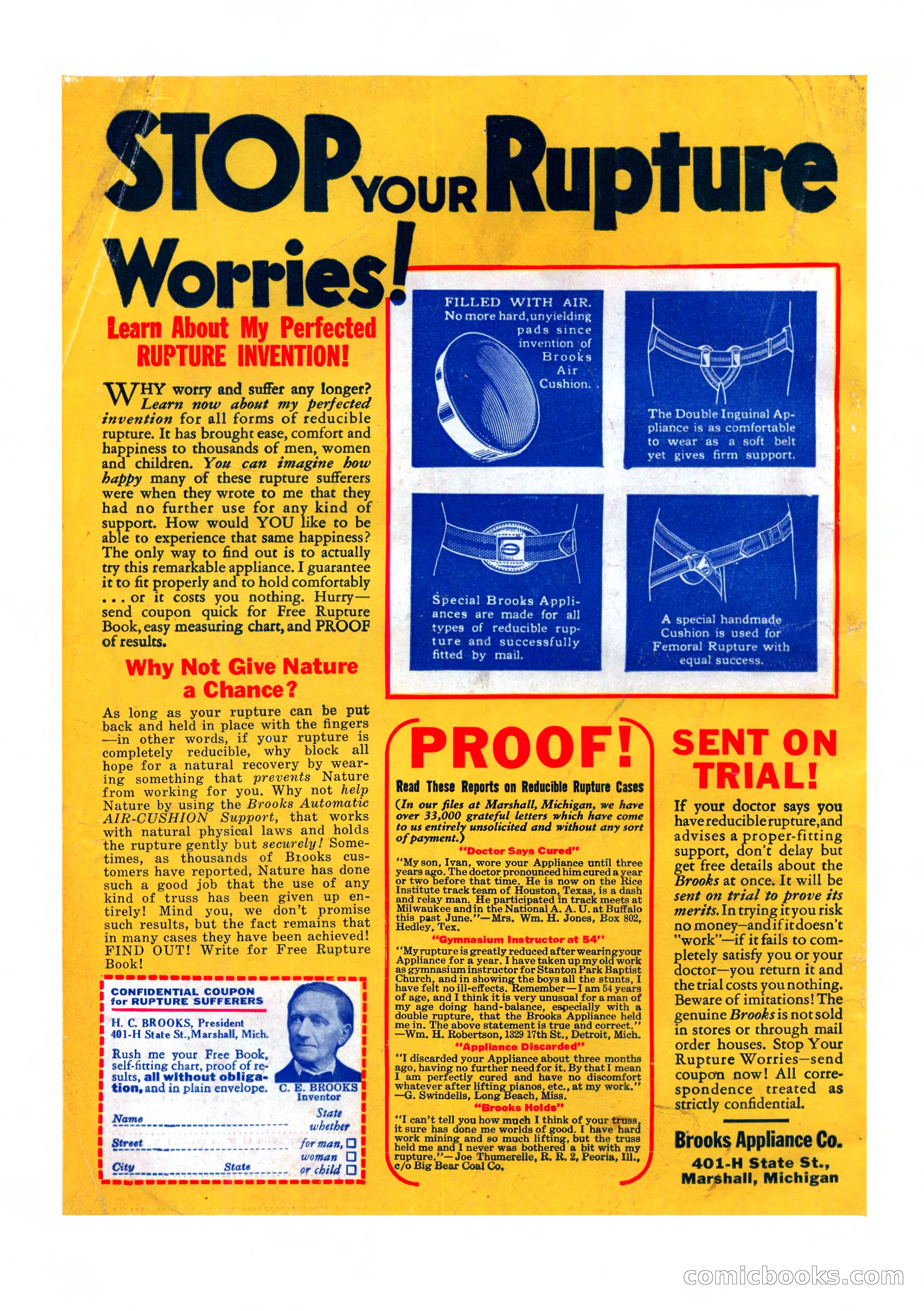
# Advertisement Page This is a full-page advertisement for the Brooks Air-Cushion Rupture Support, a medical appliance sold by the Brooks Appliance Company of Marshall, Michigan. The page features testimonial letters from satisfied customers claiming the device cured or greatly improved their hernias, along with product illustrations showing the air-cushion design and different appliance styles. The prominent headline promises relief from "rupture worries," and the company offers a free booklet and measuring chart to interested readers via a tear-out coupon at the bottom.