
Pulp Fiction, 1941 · page 40 of 116
10-Story Detective, March 1941 — page 40: what you’re looking at
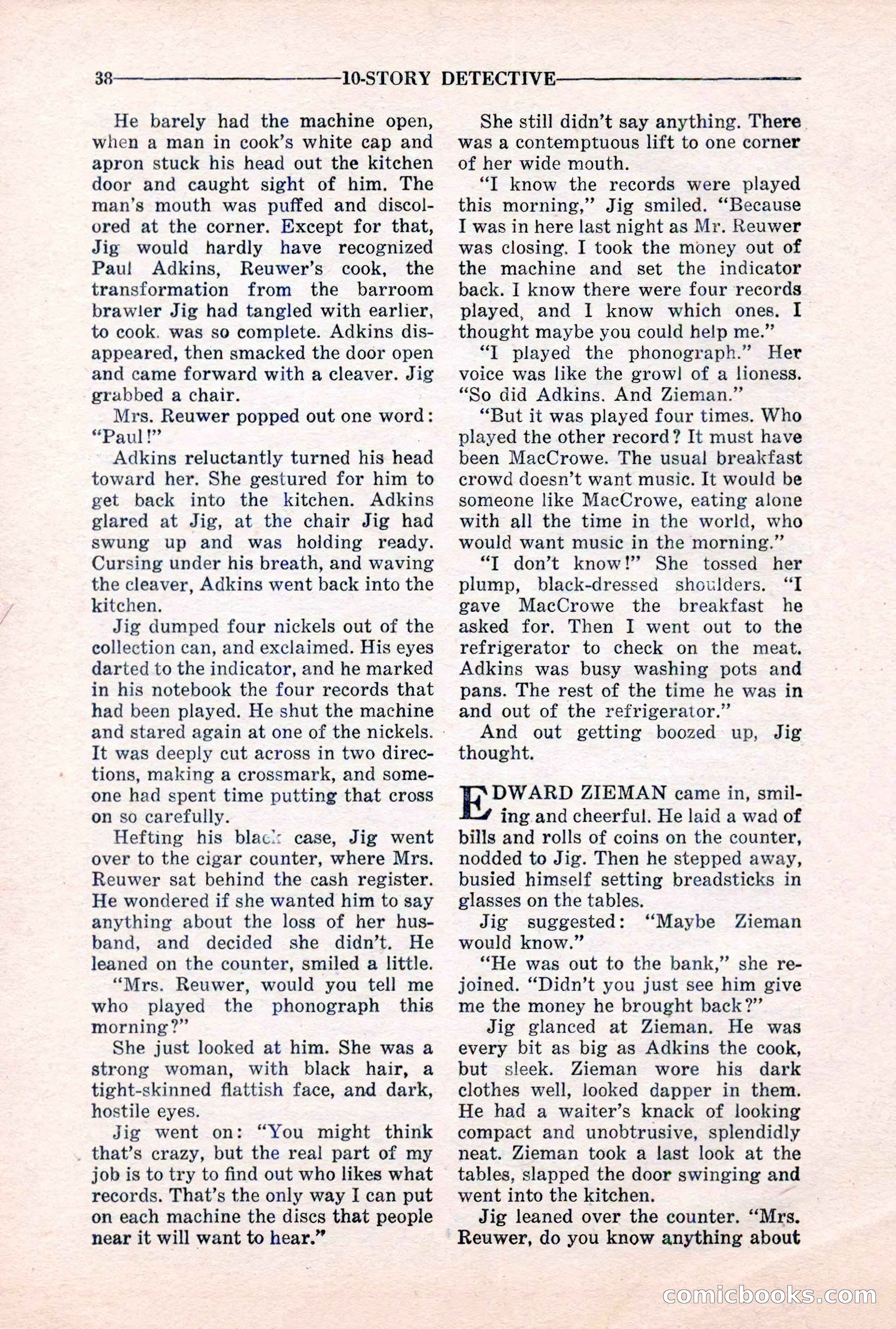
A restored page from Pulp Fiction, 1941. Page through the whole issue in the reader above.
📄 Transcribed text from this page (OCR, searchable)
Machine-transcribed from the original scan — historical spelling and the odd misread are preserved.
38———___—____-_——_10-STORY DETECTIVE He barely had the machine open, when a man in cook’s white cap and apron stuck his head out the kitchen door and caught sight of him. The man’s mouth was puffed and discol- ored at the corner. Except for that, Jig would hardly have recognized Pau! Adkins, Reuwer’s cook, the transformation from the barroom brawler Jig had tangled with earlier, to cook. was so complete. Adkins dis- appeared, then smacked the door open and came forward with a cleaver. Jig grabbed a chair. Mrs. Reuwer popped out one word: “Paul!” : Adkins reluctantly turned his head toward her. She gestured for him to get back into the kitchen. Adkins glared at Jig, at the chair Jig had swung up and was holding ready. Cursing under his breath, and waving the cleaver, Adkins went back into the kitchen. Jig dumped four nickels out of the collection can, and exclaimed. His eyes darted to the indicator, and he marked in his notebook the four records that had been played. He shut the machine and stared again at one of the nickels. » It was deeply cut across in two direc- tions, making a crossmark, and some- one had spent time putting that cross on so carefully. Hefting his blac:: case, Jig went over to the cigar counter, where Mrs. Reuwer sat behind the cash register. He wondered if she wanted him to say anything about the loss of her hus- band, and decided she didn’t. He leaned on the counter, smiled a little. “Mrs. Reuwer, would you tell me who played the phonograph this morning?” She just looked at him. She was a strong woman, with black hair, a tight-skinned flattish face, and dark, hostile eyes. Jig went on: “You might think _ that’s crazy, but the real part of my job is to try to find out who likes what records. That’s the only way I can put on each machine the discs that people near it will want to hear.” She still didn’t say anything. There was a contemptuous lift to one corner of her wide mouth. “IT know the records were played this morning,” Jig smiled. “‘Because I was in here last night as Mr. Reuwer was closing. I took the money out of the machine and set the indicator back. I know there were four records played, and I know which ones. I thought maybe you could help me.” “I played the phonograph.” Her voice was like the grow! of a lioness. “So did Adkins. And Zieman.” “But it was played four times. Who played the other record? It must have been MacCrowe. The usual breakfast crowd doesn’t want music. It would be someone like MacCrowe, eating alone with all the time in the world, who would want music in the morning.” “T don’t know!” She tossed her plump, black-dressed shoulders. “I gave MacCrowe the breakfast he asked for. Then I went out to the refrigerator to check on the meat. Adkins was busy washing pots and pans. The rest of the time he was in and out of the refrigerator.” And out getting boozed up, Jig thought. DWARD ZIEMAN came in, smil- ing and cheerful. He laid a wad of bills and rolls of coins on the counter, nodded to Jig. Then he stepped away, busied himself setting breadsticks in glasses on the tables. Jig suggested: would know.” “He was out to the bank,” she re- joined. “Didn’t you just see him give me the money he brought back?” Jig glanced at Zieman. He was every bit as big as Adkins the cook, but sleek. Zieman wore his dark clothes well, looked dapper in them. He had a waiter’s knack of looking compact and unobtrusive, splendidly neat. Zieman took a last look at the tables, slapped the door swinging and went into the kitchen. Jig leaned over the counter. “Mrs. Reuwer, do you know anything about “Maybe Zieman COPMICLOOOKS (E@