
Pulp Fiction, 1941 · page 55 of 116
10-Story Detective, March 1941 — page 55: what you’re looking at
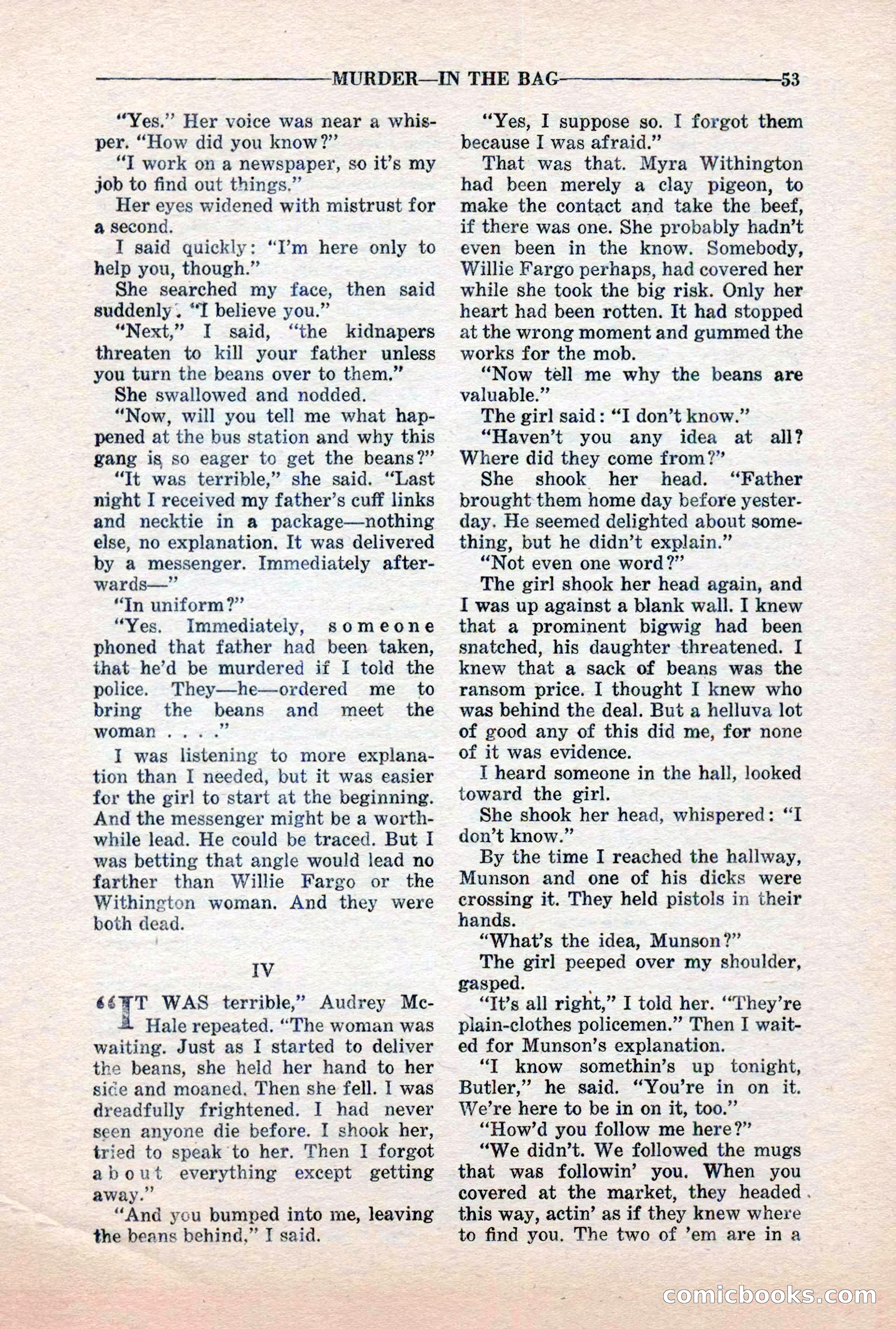
A restored page from Pulp Fiction, 1941. Page through the whole issue in the reader above.
📄 Transcribed text from this page (OCR, searchable)
Machine-transcribed from the original scan — historical spelling and the odd misread are preserved.
MURDER—IN THE BAG-—————————————3 “Yes.”’ Her voice was near a whis- per. “How did you know?” “I work on a newspaper, so it’s my job to find out things.”’ Her eyes widened with mistrust for a second. I said quickly: “I’m here only to help you, though.” She searched my face, then said suddenly. “I believe you.” “Next,” I said, “the kidnapers threaten to kill your father unless you turn the beans over to them.” She swallowed and nodded. “Now, will you tell me what hap- pened at the bus station and why this gang is so eager to get the beans?’ “It was terrible,” she said. “Last night I received my father’s cuff links and necktie in a package—nothing else, no explanation. It was delivered by a messenger. Immediately after- wards—” “In uniform?” “Yes. Immediately, someone phoned that father had been taken, that he’d be murdered if I told the police. They—he—ordered me _ to bring the beans and meet. the woman.... I was listening to more explana- tion than I needed, but it was easier for the girl to start at the beginning. And the messenger might be a worth- while lead. He could be traced. But I was betting that angle would lead no farther than Willie Fargo or the Withington woman, And they were both dead. IV é¢HT WAS terrible,’ Audrey Mc- Hale repeated. “The woman was waiting. Just as I started to deliver the beans, she held her hand to her side and moaned. Then she fell. I was dreadfully frightened. I had never seen anyone die before. I shook her, tried to speak to her. Then I forgot about everything except getting away.” “And you bumped into me, leaving the beans behind,” I said. “Yes, I suppose so. I forgot them because I was afraid.” That was that. Myra Withington had been merely a clay pigeon, to make the contact and take the beef, if there was one. She probably hadn’t even been in the know. Somebody, Willie Fargo perhaps, had covered her while she took the big risk. Only her heart had been rotten. It had stopped at the wrong moment and gummed the works for the mob. “Now tell me why the beans are valuable.” The girl said: “J don’t know.” “Haven’t you any idea at all? Where did they come from?” She shook her head. “Father brought them home day before yester- day. He seemed delighted about some- thing, but he didn’t explain.” “Not even one word?” The girl shook her head again, and I was up against a blank wall. I knew that a prominent bigwig had been snatched, his daughter threatened. I knew that a sack of beans was the ransom price. I thought I knew who was behind the deal. But a helluva lot of good any of this did me, for none of it was evidence. I heard someone in the hall, looked toward the girl. She shook her head, whispered: “I don’t know.” By the time I reached the hallway, Munson and one of his dicks were crossing it. They held pistols in their hands. “What's the idea, Munson?” The girl peeped over my shoulder, gasped. “Tt’s all right,” I told her. ‘“They’re plain-clothes policemen.” Then I wait- ed for Munson’s explanation. “I know somethin’s up tonight, Butler,” he said. “You’re in on it. We’re here to be in on it, too.” “How’d you follow me here?” “We didn’t. We followed the mugs that was followin’ you. When you covered at the market, they headed. this way, actin’ as if they knew where to find you. The two of ’em are in a Pe re EO PMIC DOOL< (E@)