
Pulp Fiction, 1941 · page 60 of 116
10-Story Detective, March 1941 — page 60: what you’re looking at
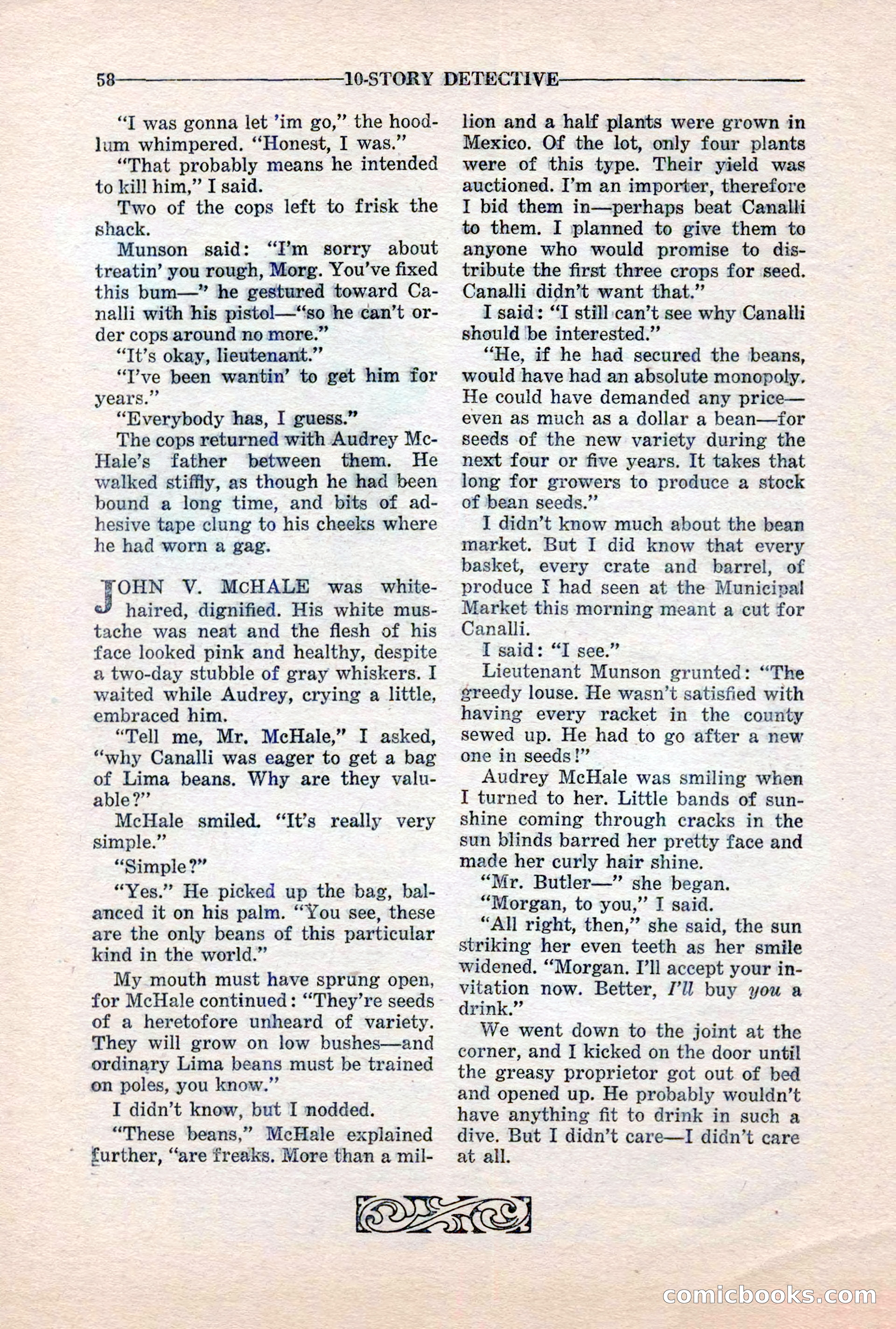
A restored page from Pulp Fiction, 1941. Page through the whole issue in the reader above.
📄 Transcribed text from this page (OCR, searchable)
Machine-transcribed from the original scan — historical spelling and the odd misread are preserved.
58—___—__—___—_——_——__]0-STORY DETECTIVE——_———___——_- “T was gonna let ’im go,” the hood- lum whimpered. “Honest, I was.” “That probably means he intended to kill him,” I said. Two of the cops left to frisk the shack. Munson said: “I’m sorry about treatin’ you rough, Morg. You’ve fixed this bum—” he gestured toward Ca- nalli with his pistel—‘“‘so he can’t or- der cops around no more.” “It’s okay, lieutenant.” “T’ve been wantin’ to get him for years.” “Hverybody has, I guess.” The cops returned with Audrey Mc- Hale’s father between them. He walked stiffly, as though he had been bound a long time, and bits of ad- hesive tape clung to his cheeks where he had worn a gag. OHN V. McHALE was white- haired, dignified. His white mus- tache was neat and the flesh of his face looked pink and healthy, despite a two-day stubble of gray whiskers. I waited while Audrey, crying a little, embraced him. “Tell me, Mr. McHale,” I asked, “‘why Canalli was eager to get a bag of Lima beans. Why are they valu- able?” McHale smiled. “It’s really very simple.” “Simple?” “Yes.” He picked up the bag, bal- anced it on his palm. “You see, these are the only beans of this particular kind in the world.” My mouth must have sprung open, for McHale continued: “They’re seeds of a heretofore unheard of variety. They will grow on low bushes—and ordinary Lima beans must be trained on poles, you know.” I didn’t know, but I nodded. “These beans,” McHale explained further, “are freaks. More than a mil- lion and a half plants were grown in Mexico. Of the lot, only four plants were of this type. Their yield was auctioned. I’m an importer, therefore I bid them in—perhaps beat Canalli to them. I planned to give them to anyone who would promise to dis- tribute the first three crops for seed. Canalli didn’t want that.” I said: “T still can’t see why Canalli should be interested.” “He, if he had secured the beans, would have had an absolute monopoly, He could have demanded any price— even as much as a dollar a bean—for seeds of the new variety during the next four or five years. It takes that long for growers to produce a stock of bean seeds.” I didn’t know much about the bean market. But I did know that every basket, every crate and barrel, of produce f had seen at the Municipal Market this morning meant a cut for Canalli. I said: “I see.” Lieutenant Munson grunted: “The greedy louse. He wasn’t satisfied with having every racket in the county sewed up. He had to go after a new one in seeds!” Audrey McHale was smiling when I turned to her. Little bands of sun- shine coming through cracks in the sun blinds barred her pretty face and made her curly hair shine. “Mr. Butler—” she began. “Morgan, to you,” I said. “All right, then,” she said, the sun striking her even teeth as her smile widened. “Morgan. I’ll accept your in- vitation now. Better, J’l] buy you a drink.” We went down to the joint at the corner, and I kicked on the door until the greasy proprietor got out of bed and opened up. He probably wouldn’t have anything fit to drink in such a dive. But I didn’t care—I didn’t care at all. CDC, EPIC OOOL< (E@)