
Pulp Fiction, 1941 · page 66 of 116
10-Story Detective, March 1941 — page 66: what you’re looking at
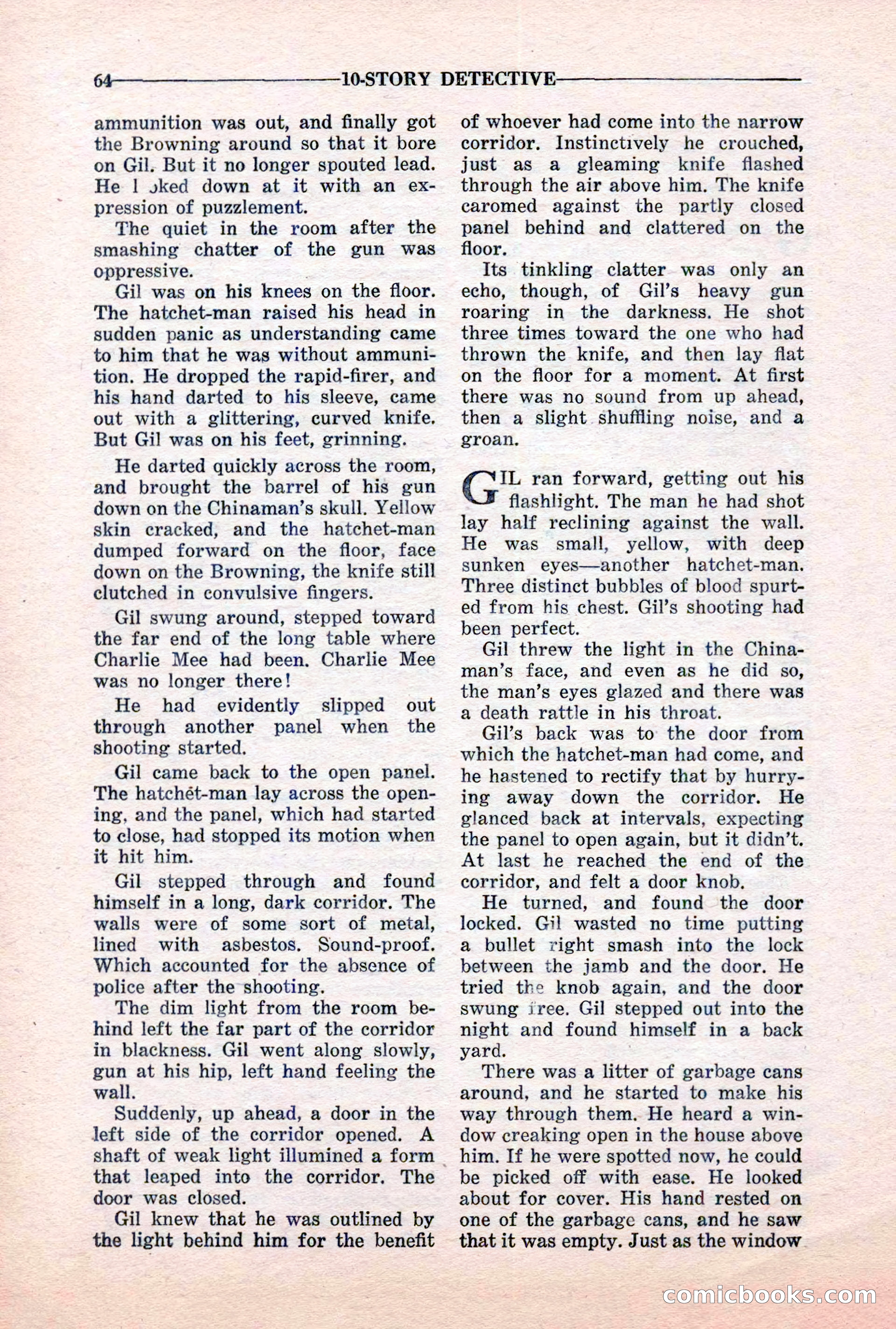
A restored page from Pulp Fiction, 1941. Page through the whole issue in the reader above.
📄 Transcribed text from this page (OCR, searchable)
Machine-transcribed from the original scan — historical spelling and the odd misread are preserved.
64 —___—__—_—__——10-STORY DETECTIVE ammunition was out, and finally got the Browning around so that it bore on Gil. But it no longer spouted lead. He | oked down at it with an ex- pression of puzzlement. The quiet in the room after the smashing chatter of the gun was oppressive. Gil was on his knees on the floor. The hatchet-man raised his head in sudden panic as understanding came to him that he was without ammuni- tion. He dropped the rapid-firer, and his hand darted to his sleeve, came out with a glittering, curved knife. But Gil was on his feet, grinning. He darted quickly across the room, and brought the barrel of his gun down on the Chinaman’s skull. Yellow skin cracked, and the hatchet-man dumped forward on the floor, face down on the Browning, the knife still clutched in convulsive fingers. Gil swung around, stepped toward the far end of the long table where Charlie Mee had been. Charlie Mee was no longer there! He had evidently slipped out through another panel when the shooting started. Gil came back to the open panel. The hatchét-man lay across the open- ing, and the panel, which had started to close, had stopped its motion when it hit him. Gil stepped through and found himself in a long, dark corridor. The walls were of some sort of metal, lined with asbestos. Sound-proof. Which accounted for the absence of police after the shooting. The dim light from the room be- hind left the far part of the corridor in blackness. Gil went along slowly, gun at his hip, left hand feeling the wall. Suddenly, up ahead, a door in the left side of the corridor opened. A shaft of weak light illumined a form — that leaped into the corridor. The door was closed. Gil knew that he was outlined by the light behind him for the benefit of whoever had come into the narrow corridor. Instinctively he crouched, just as a gleaming knife flashed through the air above him. The knife earomed against the partly closed panel behind and clattered on the floor. Its tinkling clatter was only an echo, though, of Gil’s heavy gun roaring in the darkness. He shot three times toward the one who had thrown the knife, and then lay flat on the floor for a moment. At first there was no sound from up ahead, then a slight shuffling noise, and a groan. IL ran forward, getting out his flashlight. The man he had shot lay half reclining against the wall. He was small, yellow, with deep sunken eyes—another hatchet-man. Three distinct bubbles of blood spurt- ed from his chest. Gil’s shooting had been perfect. Gil threw the light in the China- man’s face, and even as he did so, the man’s eyes glazed and there was a death rattle in his throat. Gil’s back was to the door from which the hatchet-man had come, and he hastened to rectify that by hurry- ing away down the corridor. He glanced back at intervals, expecting the panel to open again, but it didn’t. At last he reached the end of the corridor, and felt a door knob. He turned, and found the door locked. Gil wasted no time putting a bullet right smash into the lock between the jamb and the door. He tried the knob again, and the door swung iree. Gil stepped out into the night and found himself in a back yard. There was a litter of garbage cans around, and he started to make his way through them. He heard a win- dow creaking open in the house above him. If he were spotted now, he could be picked off with ease. He looked about for cover. His hand rested on one of the garbage cans, and he saw that it was empty. Just as the window. CONNIE OOLKS (CE)