
Pulp Fiction, 1941 · page 14 of 116
10-Story Detective, March 1941 — page 14: what you’re looking at
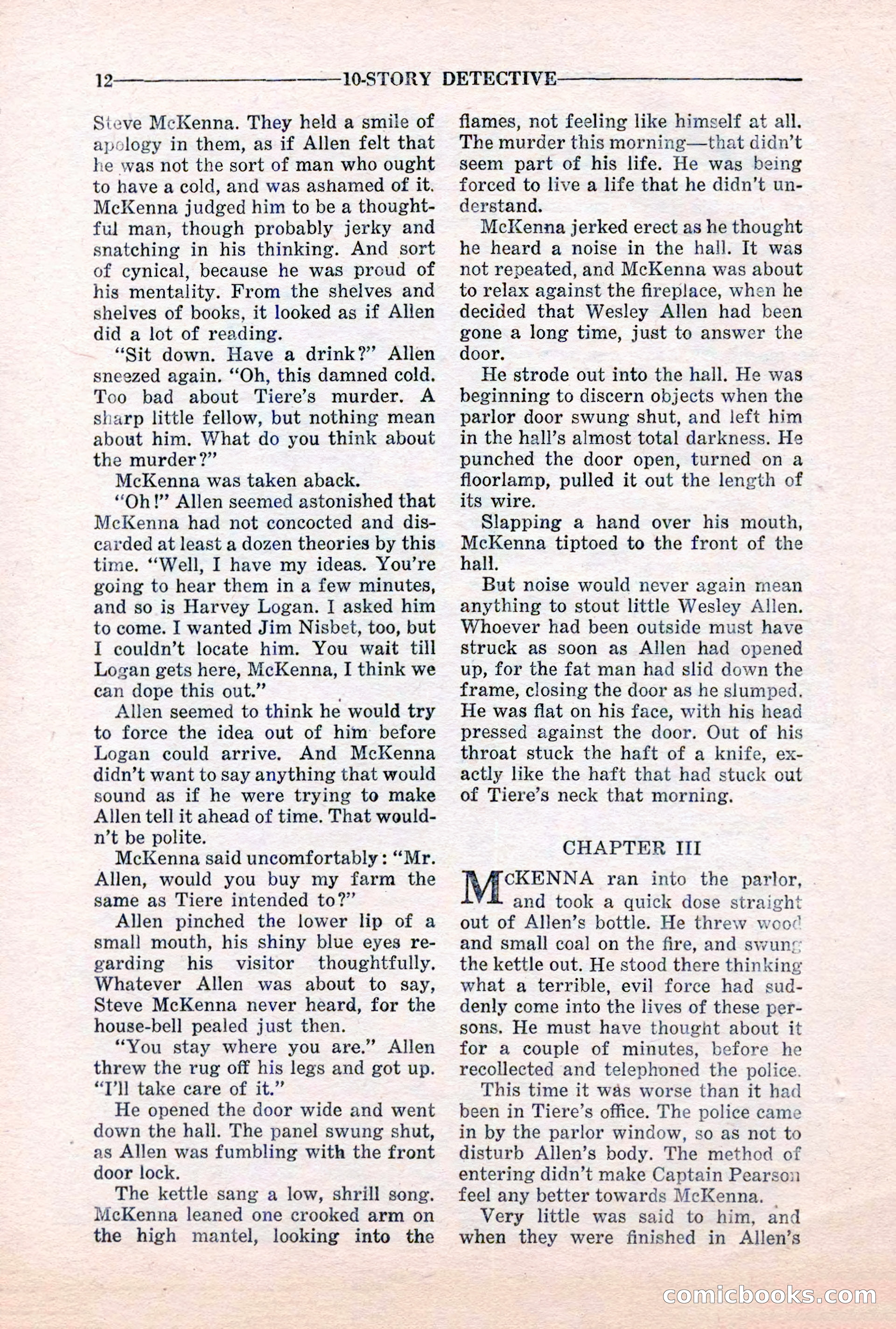
A restored page from Pulp Fiction, 1941. Page through the whole issue in the reader above.
📄 Transcribed text from this page (OCR, searchable)
Machine-transcribed from the original scan — historical spelling and the odd misread are preserved.
12 10-STORY DETECTIVE Steve McKenna. They held a smile of apology in them, as if Allen felt that he was not the sort of man who ought to have a cold, and was ashamed of it. McKenna judged him to be a thought- ful man, though probably jerky and snatching in his thinking. And sort of cynical, because he was proud of his mentality. From the shelves and shelves of books, it looked as if Allen did a lot of reading. “Sit down. Have a drink?” Allen sneezed again. “Oh, this damned cold. Too bad about Tiere’s murder. A sharp little fellow, but nothing mean about him. What do you think about the murder?” McKenna was taken aback. “Oh!” Allen seemed astonished that McKenna had not concocted and dis- carded at least a dozen theories by this time. ‘“‘Well, I have my ideas. You’re going to hear them in a few minutes, and so is Harvey Logan. I asked him to come. I wanted Jim Nisbet, too, but I couldn’t locate him. You wait till Logan gets here, McKenna, I think we can dope this out.” Allen seemed to think he would try to force the idea out of him before Logan could arrive. And McKenna didn’t want to say anything that would sound as if he were trying to make Allen tell it ahead of time. That would- n’t be polite. McKenna said uncomfortably: “Mr. Allen, would you buy my farm the same as Tiere intended to?” _ Allen pinched the lower lip of a small mouth, his shiny blue eyes re- garding his visitor thoughtfully. Whatever Allen was about to say, Steve McKenna never heard, for the house-bell pealed just then. “You stay where you are.” Allen threw the rug off his legs and got up. “T’ll take care of it.” He opened the door wide and went down the hall. The panel swung shut, as Allen was fumbling with the front door lock. The kettle sang a low, shrill song. McKenna leaned one crooked arm on the high mantel, looking into the flames, not feeling like himself at all. The murder this morning—that didn’t seem part of his life. He was being forced to live a life that he didn’t un- derstand. McKenna jerked erect as he thought he heard a noise in the hall. It was not repeated, and McKenna was about to relax against the fireplace, when he decided that Wesley Allen had been gone a long time, just to answer the door. He strode out into the hall. He was beginning to discern objects when the parlor door swung shut, and left him in the hall’s almost total darkness. He punched the door open, turned on a floorlamp, pulled it out the length of its wire. Slapping a hand over his mouth, McKenna tiptoed to the front of the hall. But noise would never again mean anything to stout little Wesley Allen. Whoever had been outside must have struck as soon as Allen had opened up, for the fat man had slid down the frame, closing the door as he slumped, He was flat on his face, with his head pressed against the door. Out of his throat stuck the haft of a knife, ex- actly like the haft that had stuck out of Tiere’s neck that morning. CHAPTER III CKENNA ran into the parlor, and took a quick dose straight out of Allen’s bottle. He threw wood and small coal on the fire, and swuns: the kettle out. He stood there thinking what a terrible, evil force had sud- denly come into the lives of these per- sons. He must have thought about it for a couple of minutes, before he recollected and telephoned the police. This time it was worse than it had been in Tiere’s office. The police came in by the parlor window, so as not to disturb Allen’s body. The method of entering didn’t make Captain Pearson feel any better towards McKenna. _ Very little was said to him, and when they were finished in Allen’s COPMICLOOOKS (E@)