
Pulp Fiction, 1941 · page 106 of 116
10-Story Detective, March 1941 — page 106: what you’re looking at
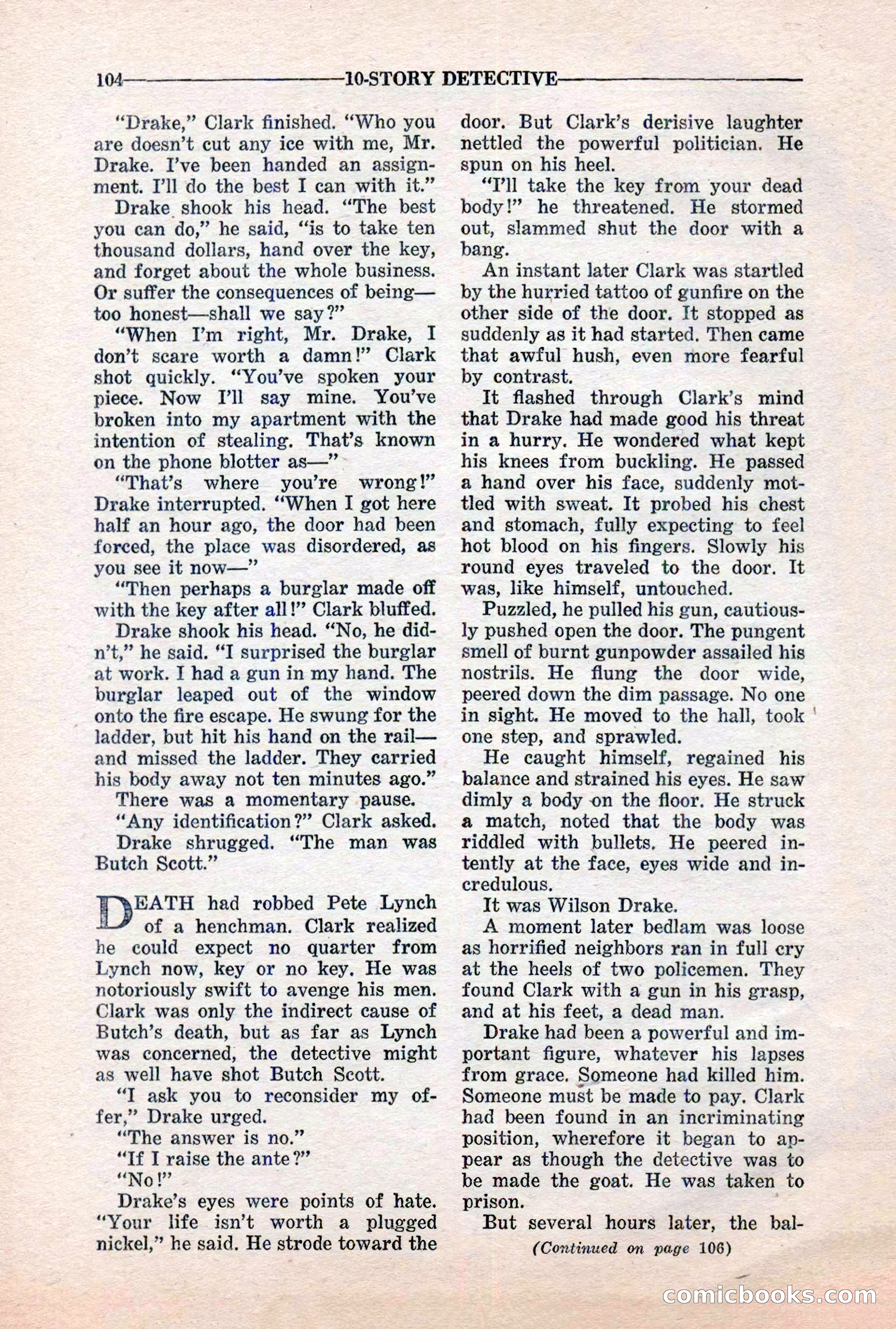
A restored page from Pulp Fiction, 1941. Page through the whole issue in the reader above.
📄 Transcribed text from this page (OCR, searchable)
Machine-transcribed from the original scan — historical spelling and the odd misread are preserved.
104—-_—__———————-—_10-STORY DETECTIVE “Drake,” Clark finished. “Who you are doesn’t cut any ice with me, Mr. Drake. I’ve been handed an assign- ment. I’ll do the best I can with it.” Drake shook his head. “The best you can do,” he said, “‘is to take ten thousand dollars, hand over the key, and forget about the whole business. Or suffer the consequences of being— too honest—shall we say?” “When I’m right, Mr. Drake, I don’t scare worth a damn!” Clark shot quickly. “You’ve spoken your piece. Now I’ll say mine. You’ve broken into my apartment with the intention of stealing. That’s known on the phone blotter as—” “That’s where youre wrong!” Drake interrupted. ‘‘When I got here half an hour ago, the door had been forced, the place was disordered, as you see it now—” “Then perhaps a burglar made off with the key after all!’’ Clark bluffed. Drake shook his head. “No, he did- n’t,” he said. “I surprised the burglar at work. I had a gun in my hand. The burglar leaped out of the window onto the fire escape. He swung for the ladder, but hit his hand on the rail— and missed the ladder. They carried his body away not ten minutes ago.” There was a momentary pause. “Any identification?” Clark asked. Drake shrugged. “The man was Butch Scott.” EATH had robbed Pete Lynch of a henchman. Clark realized he could expect no quarter from Lynch now, key or no key. He was notoriously swift to avenge his men. Clark was only the indirect cause of Butch’s death, but as far as Lynch was concerned, the detective might as well have shot Butch Scott. “T ask you to reconsider my of- fer,” Drake urged. “The answer is no.” “Tf I raise the ante?’ “No Drake’s eyes were points of hate. “Your life isn’t worth a plugged nickel,” he said. He strode toward the door. But Clark’s derisive laughter nettled the powerful politician. He spun on his heel. “T’ll take the key from your dead body!” he threatened. He stormed out, slammed shut the door with a bang. : An instant later Clark was startled by the hurried tattoo of gunfire on the other side of the door. It stopped as suddenly as it had started. Then came that awful hush, even more fearful by contrast. It flashed through Clark’s mind that Drake had made good his threat in a hurry. He wondered what kept his knees from buckling. He passed a hand over his face, suddenly mot- tled with sweat. It probed his chest and stomach, fully expecting to feel hot blood on his fingers. Slowly his round eyes traveled to the door. It was, like himself, untouched. Puzzled, he pulled his gun, cautious- ly pushed open the door. The pungent smell of burnt gunpowder assailed his nostrils. He flung the door wide, peered down the dim passage. No one in sight. He moved to the hall, took one step, and sprawled. He caught himself, regained his balance and strained his eyes. He saw dimly a body on the floor. He struck a match, noted that the body was riddled with bullets. He peered in- tently at the face, eyes wide and in- credulous. It was Wilson Drake. A moment later bedlam was loose as horrified neighbors ran in full ery at the heels of two policemen. They found Clark with a gun in his grasp, and at his feet, a dead man. Drake had been a powerful and im- portant figure, whatever his lapses from grace. Someone had killed him. Someone must be made to pay. Clark had been found in an incriminating position, wherefore it began to ap- pear as though the detective was to be made the goat. He was taken to prison. 3 But several hours later, the bal- (Continued on page 106) — COMEE DOOKS (E@)