
Pulp Fiction, 1941 · page 50 of 116
10-Story Detective, March 1941 — page 50: what you’re looking at
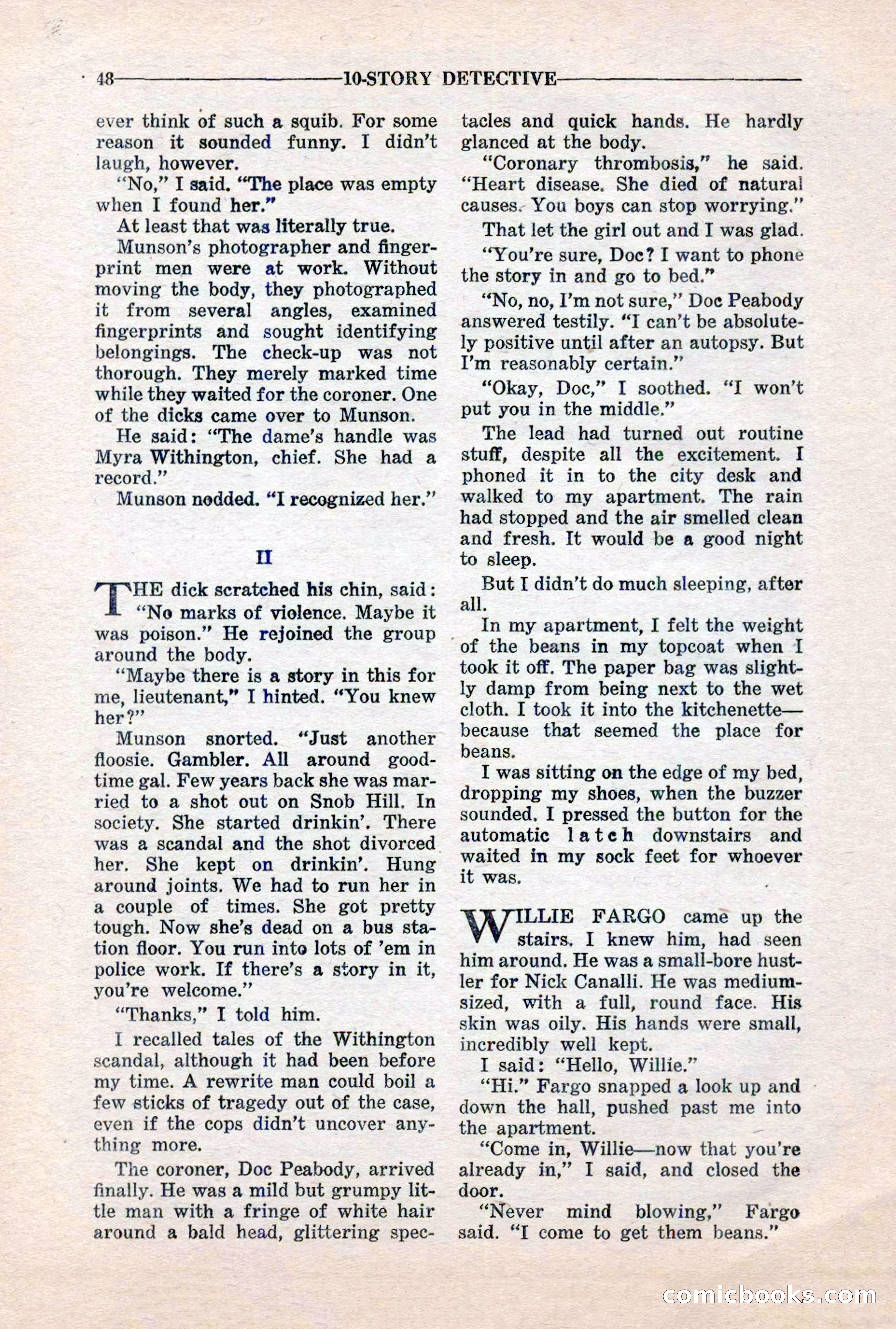
A restored page from Pulp Fiction, 1941. Page through the whole issue in the reader above.
📄 Transcribed text from this page (OCR, searchable)
Machine-transcribed from the original scan — historical spelling and the odd misread are preserved.
' 48-———___———_—————-10-STORY DETECTIVE ever think of such a squib. For some reason it sounded funny. I didn’t laugh, however. “No,” I said. “The place was empty when I found her.” At least that was literally true. Munson’s photographer and finger- print men were at work. Without moving the body, they photographed it from several angles, examined fingerprints and sought identifying belongings. The check-up was not thorough. They merely marked time while they waited for the coroner. One of the dicks came over to Munson. He said: “The dame’s handle was Myra Withington, chief. She had a record.” Munson nedded. “I recognized her.” I HE dick scratched his chin, said: “No marks of violence. Maybe it was poison.” He rejoined the group around the body. “Maybe there is a story in this for me, lieutenant,” I hinted. “You knew her?” Munson snorted. “Just another floosie. Gambler. All around good- time gal. Few years back she was mar- ried to a shot out on Snob Hill. In society. She started drinkin’. There was a scandal and the shot divorced her. She kept on drinkin’. Hung around joints. We had to run her in a couple of times. She got pretty tough. Now she’s dead on a bus sta- tion floor. You run inte lots of ’em in police work. If there’s a story in it, you’re welcome.” “Thanks,” I told him. I recalled tales of the Withington scandal, although it had been before my time. A rewrite man could boil a few sticks of tragedy out of the case, even if the cops didn’t uncover any- thing more. The coroner, Doc Peabody, arrived finally. He was a mild but grumpy lit- tle man with a fringe of white hair around a bald head, glittering spec- tacles and quick hands. He hardly glanced at the body. “Coronary thrombosis,” he said. “Heart disease. She died of natural causes. You boys can stop worrying.” That let the girl out and I was glad. *You’re sure, Doc? I want to phone the story in and go to bed.” “‘No, no, I’m not sure,’ Doe Peabody answered testily. “I can’t be absolute- ly positive until after an autopsy. But I’m reasonably certain.” “Okay, Doc,” I soothed. “I won’t put you in the middle.” The lead had turned out routine stuff, despite all the excitement. I phoned it in to the city desk and walked to my apartment. The rain had stopped and the air smelled clean and fresh. It would be a good night to sleep. But I didn’t do much sleeping, after all. In my apartment, I felt the weight of the beans in my topcoat when I took it off. The paper bag was slight- ly damp from being next to the wet cloth. I took it into the kitchenette— because that seemed the place for beans. I was sitting on the edge of my bed, dropping my shoes, when the buzzer sounded, I pressed the button for the automatic lateh downstairs and waited in my sock feet for whoever it was. LLIE FARGO came up the stairs. I knew him, had seen him around. He was a small-bore hust- ler for Nick Canalli. He was medium- sized, with a full, round face. His skin was oily. His hands were small, incredibly well kept. I said: “Hello, Willie.” “Hi.” Fargo snapped a look up and - down the hall, pushed past me into the apartment. “Come in, Willie—now that you’re already in,” I gaid, and closed the door. “Never mind blowing,” Fargo said. “I come to get them beans.” COPNICG OOOLK< (E@)