
Pulp Fiction, 1941 · page 34 of 116
10-Story Detective, March 1941 — page 34: what you’re looking at
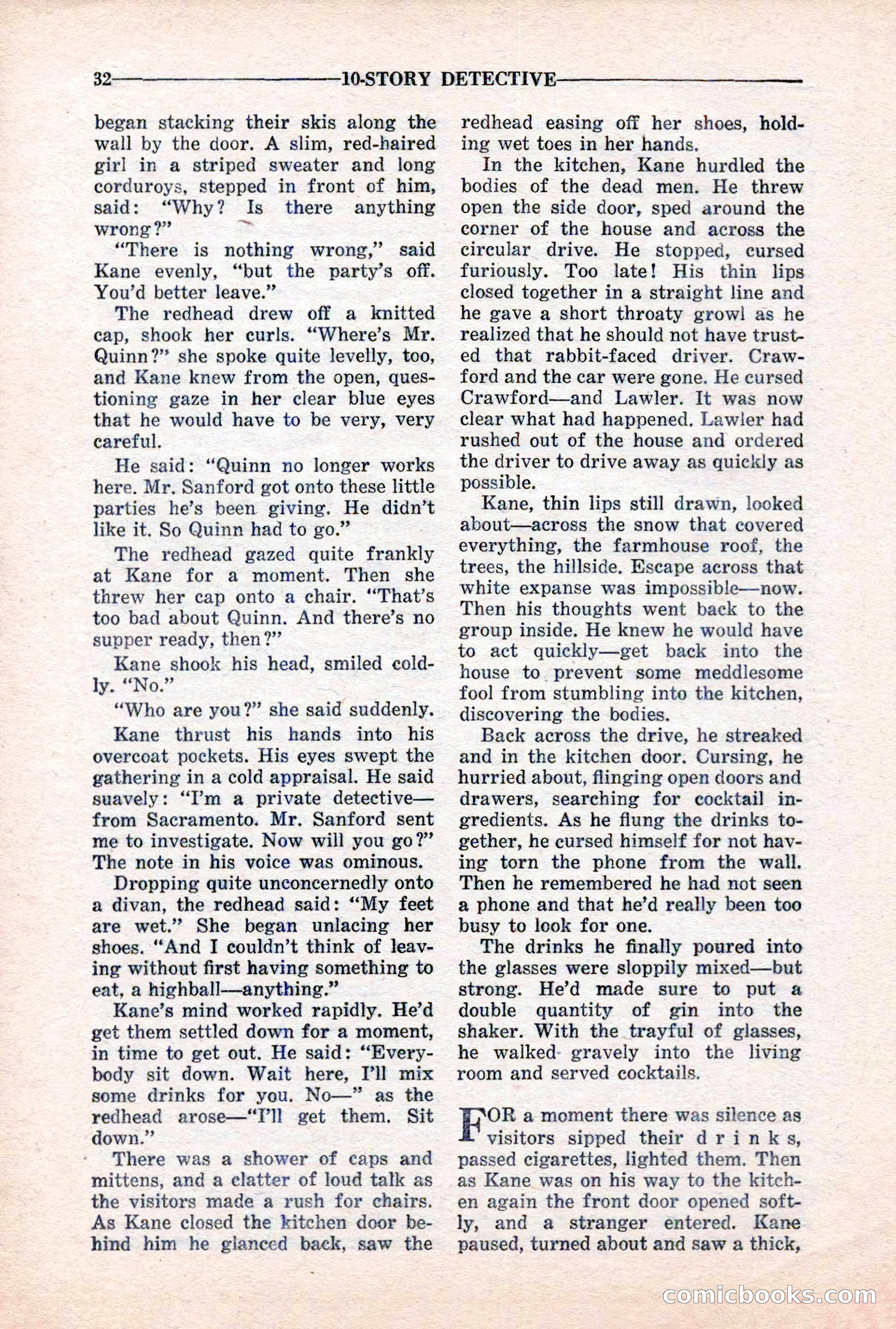
A restored page from Pulp Fiction, 1941. Page through the whole issue in the reader above.
📄 Transcribed text from this page (OCR, searchable)
Machine-transcribed from the original scan — historical spelling and the odd misread are preserved.
32-——_—_—_—_——————_10-STORY DETECTIVE began stacking their skis along the wall by the door. A slim, red-haired girl in a striped sweater and long corduroys, stepped in front of him, said: “Why? Is there anything wrong?” = “There is nothing wrong,” said Kane evenly, “but the party’s off. You’d better leave.” The redhead drew off a knitted cap, shook her curls. “Where’s Mr. Quinn?” she spoke quite levelly, too, and Kane knew from the open, ques- tioning gaze in her clear blue eyes that he would have to be very, very careful. He said: “Quinn no longer works here. Mr. Sanford got onto these little parties he’s been giving. He didn’t like it. So Quinn had to go.” The redhead gazed quite frankly at Kane for a moment. Then she threw her cap onto a chair. “That’s too bad about Quinn. And there’s no supper ready, then?” Kane shook his head, smiled cold- ly. “No.” “Who are you?” she said suddenly. Kane thrust his hands into his overcoat pockets. His eyes swept the gathering in a cold appraisal. He said suavely: “I’m a private detective— from Sacramento. Mr. Sanford sent me to investigate. Now will you go?” The note in his voice was ominous. Dropping quite unconcernedly onto a divan, the redhead said: ‘“‘“My feet are wet.’ She began unlacing her shoes. ‘And I couldn’t think of leav- ing without first having something to eat, a highball—anything.” Kane’s mind worked rapidly. He’d get them settled down for a moment, in time to get out. He said: “Every- body sit down. Wait here, I'll mix some drinks for you. No—” as the redhead arose—“T’ll get them. Sit down.” There was a shower of caps and mittens, and a clatter of loud talk as the visitors made a rush for chairs. As Kane closed the kitchen door be- hind him he glanced back, saw the redhead easing off her shoes, hold- ing wet toes in her hands. In the kitchen, Kane hurdled the bodies of the dead men. He threw open the side door, sped around the corner of the house and across the circular drive. He stopped, cursed furiously. Too late! His thin lips closed together in a straight line and he gave a short throaty growl as he realized that he should not have trust- ed that rabbit-faced driver. Craw- ford and the car were gone. He cursed Crawford—and Lawler. It was now clear what had happened. Lawler had rushed out of the house and ordered the driver to drive away as quickly as possible. Kane, thin lips still drawn, looked about—across the snow that covered everything, the farmhouse roof, the trees, the hillside. Escape across that white expanse was impossible—now. Then his thoughts went back to the group inside. He knew he would have to act quickly—get back into the house to prevent some meddlesome fool from stumbling into the kitchen, discovering the bodies. Back across the drive, he streaked and in the kitchen door. Cursing, he hurried about, flinging open doors and drawers, searching for cocktail in- gredients. As he flung the drinks to- gether, he cursed himself for not hav- ing torn the phone from the wall. Then he remembered he had not seen a phone and that he’d really been too busy to look for one. The drinks he finally poured into the glasses were sloppily mixed—but strong. He’d made sure to put a double quantity of gin into the shaker. With the trayful of glasses, he walked- gravely into the living room and served cocktails. OR a moment there was silence as visitors sipped their drinks, passed cigarettes, lighted them. Then as Kane was on his way to the kitch- en again the front door opened soft- ly, and a stranger entered. Kane paused, turned about and saw a thick, CORICLOOOLKK (E@