
Pulp Fiction, 1941 · page 105 of 116
10-Story Detective, March 1941 — page 105: what you’re looking at
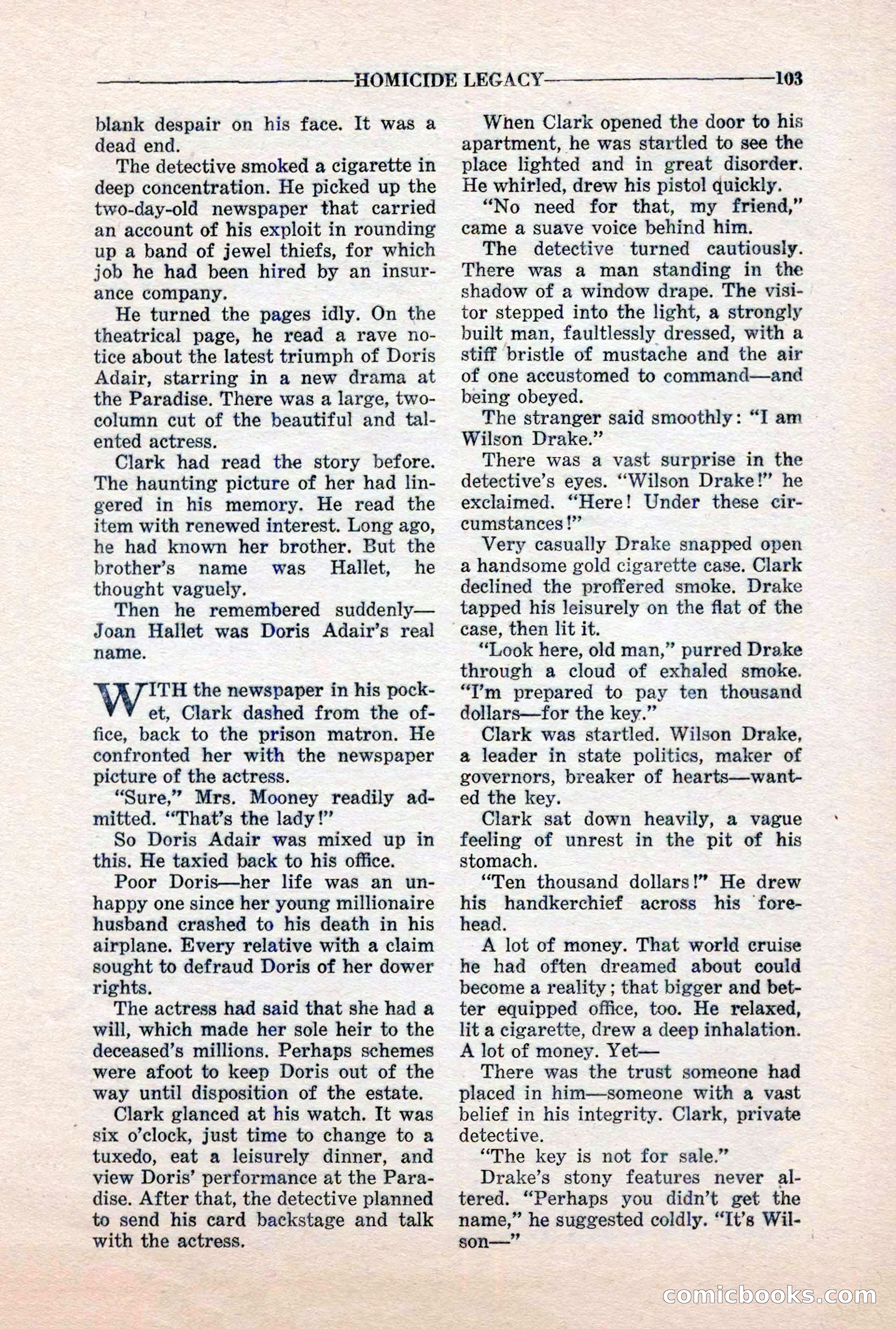
A restored page from Pulp Fiction, 1941. Page through the whole issue in the reader above.
📄 Transcribed text from this page (OCR, searchable)
Machine-transcribed from the original scan — historical spelling and the odd misread are preserved.
———HOMICIDE LEGACY blank despair on his face. It was a dead end. The detective smoked a cigarette in deep concentration. He picked up the two-day-old newspaper that carried an account of his exploit in rounding up a band of jewel thiefs, for which job he had been hired by an insur- ance company. He turned the pages idly. On the theatrical page, he read a rave no- tice about the latest triumph of Doris Adair, starring in a new drama at the Paradise. There was a large, two- column cut of the beautiful and tal- ented actress. Clark had read the story before. The haunting picture of her had lin- gered in his memory. He read the item with renewed interest. Long ago, he had known her brother. But the brother’s name was Hallet, he thought vaguely. Then he remembered suddenly— Joan Hallet was Doris Adair’s real name. ITH the newspaper in his pock- et, Clark dashed from the of- fice, back to the prison matron. He confronted her with the newspaper picture of the actress. “Sure,” Mrs. Mooney readily ad- mitted. “That’s the lady!’ So Doris Adair was mixed up in this. He taxied back to his office. Poor Doris—her life was an un- happy one since her young millionaire husband crashed to his death in his airplane. Every relative with a claim sought to defraud Doris of her dower rights. The actress had said that she had a will, which made her sole heir to the deceased’s millions. Perhaps schemes were afoot to keep Doris out of the way until disposition of the estate. Clark glanced at his watch. It was six o’clock, just time to change to a tuxedo, eat a leisurely dinner, and view Doris’ performance at the Para- dise. After that, the detective planned to send his card backstage and talk with the actress. 103 When Clark opened the door to his apartment, he was startled to see the place lighted and in great disorder. He whirled, drew his pistol! quickly. “No need for that, my friend,” came a suave voice behind him. The detective turned cautiously. There was a man standing in the shadow of a window drape. The visi- tor stepped into the light, a strongly built man, faultlessly dressed, with a stiff bristle of mustache and the air of one accustomed to command—and being obeyed. The stranger said smoothly: “I am Wilson Drake.” There was a vast surprise in the detective’s eyes. “Wilson Drake!” he exclaimed. “Here! Under these cir- cumstances!” Very casually Drake snapped open a handsome gold cigarette case. Clark declined the proffered smoke. Drake tapped his leisurely on the flat of the case, then lit it. “Look here, old man,” purred Drake through a cloud of exhaled smoke. “T’m prepared to pay ten thousand dollars—for the key.” Clark was startled. Wilson Drake, a leader in state politics, maker of governors, breaker of hearts—want- ed the key. Clark sat down heavily, a vague feeling of unrest in the pit of his stomach. “Ten thousand dollars!” He drew his handkerchief across his fore- head. A lot of money. That world cruise he had often dreamed about could become a reality; that bigger and bet- ter equipped office, too. He relaxed, lit a cigarette, drew a deep inhalation. A lot of money. Yet— There was the trust someone had placed in him—someone with a vast belief in his integrity. Clark, private detective. “The key is not for sale.” Drake’s stony features never al- tered. “Perhaps you didn’t get the name,” he suggested coldly. “It’s Wil- son—” COMIC OOO KS (E@