A complete issue · 68 pages · 1931
10-Story Book, July 1931
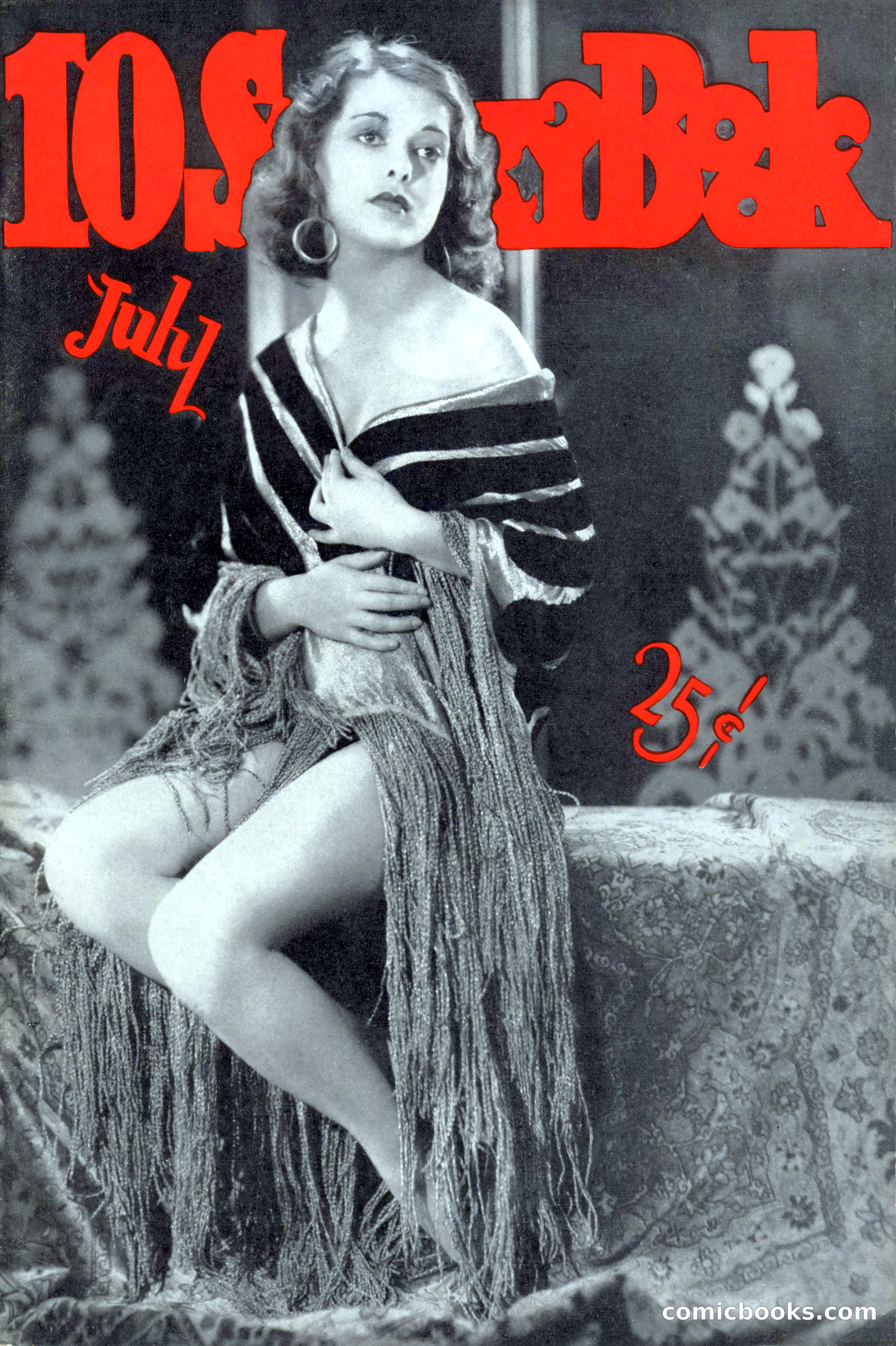
# Description This is the cover of a pulp magazine titled "10¢ BOOK" from July, priced at 25 cents. The cover features a black-and-white photograph of a woman in period costume—an off-shoulder black top paired with a fringed skirt—posed against a decorative background with ornamental patterns visible behind her. She wears hoop earrings and has styled hair typical of the 1930s-1940s era. The dramatic styling and theatrical costume suggest this magazine likely contained romance, adventure, or costume-drama fiction stories, though no specific story titles or plot details are visible on this cover.
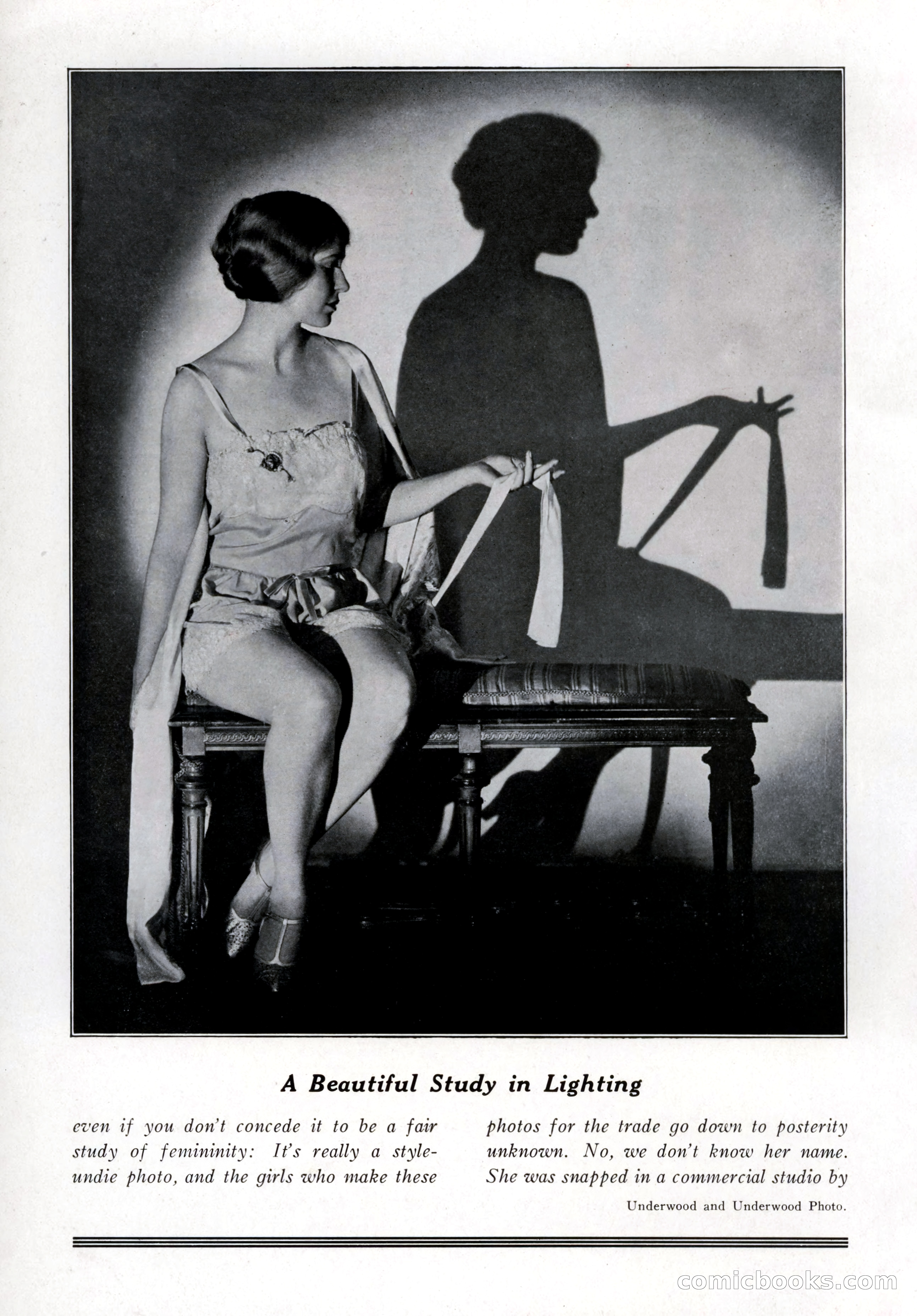
This is an interior illustration page titled "A Beautiful Study in Lighting." The image is a black-and-white photograph showing a woman and man in silhouette seated together on a bench. The accompanying text discusses the photograph as a "style-undie photo," noting it's a commercial studio study by Underwood and Underwood Photo. The text acknowledges uncertainty about the model's identity, stating "we don't know her name" and that she "was snapped in a commercial studio." The page appears to be from an early 20th-century pulp or trade magazine and focuses primarily on the photographic technique and lighting rather than narrative content.
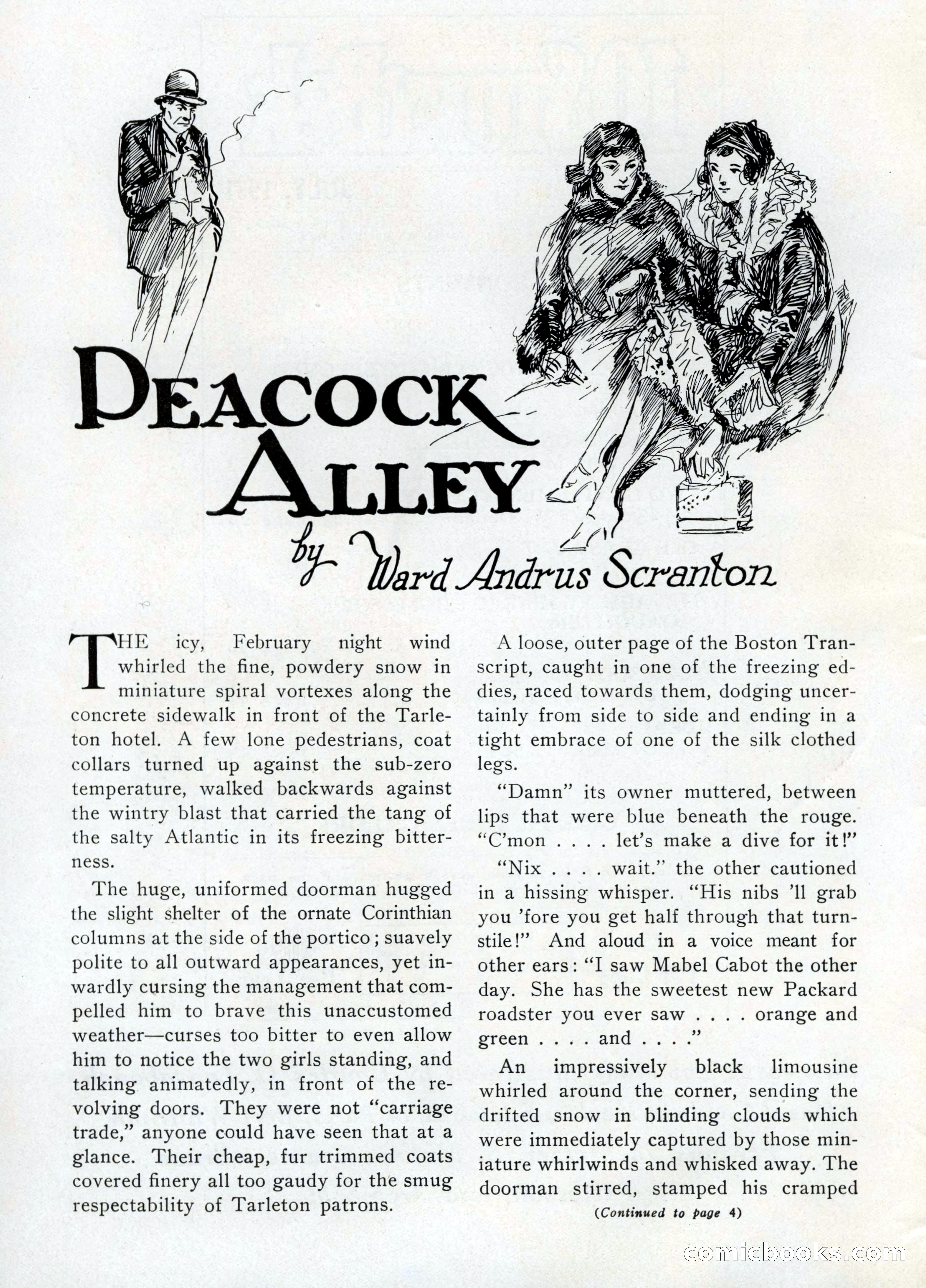
# Analysis of "Deacock Alley" Page This is an interior story page from a pulp magazine featuring the opening of a short story titled "Deacock Alley" by Ward Andrus Scranton. The page includes decorative illustrations above the title—a man in a hat on the left and two women on the right—rendered in pen-and-ink style typical of early 20th-century pulp design. The prose describes a freezing February night outside Boston's Tarleton hotel, where two poorly-dressed girls loiter near the entrance while a doorman shelters nearby. The narrative suggests the girls are soliciting or engaged in questionable activities, and mentions a passing limousine and gossip about someone named Mabel Cabot's new Packard automobile. The story appears to be crime or hardboiled fiction.
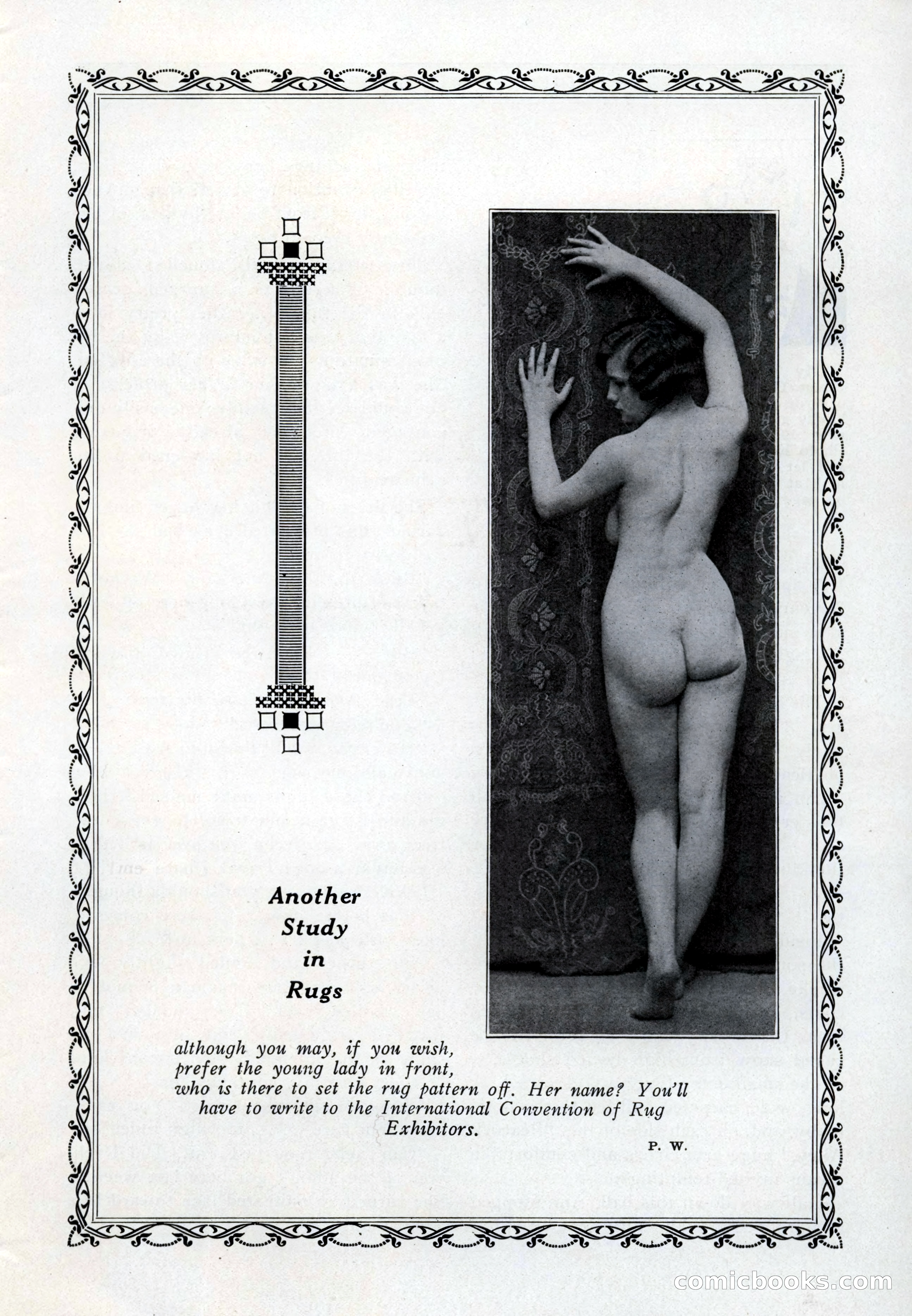
This page contains an illustration and accompanying text. On the left is a decorative Art Deco-style design featuring a tall ornamental column or pillar. On the right is a black-and-white photograph of a female nude figure posed from behind against a patterned backdrop. The text below reads "Another Study in Rugs" and includes a caption suggesting the reader might prefer "the young lady in front" to learn about a rug pattern, with instructions to contact the "International Convention of Rug Exhibitors" for her name. The caption is attributed to "P.W." This appears to be a humorous, tongue-in-cheek advertisement or filler piece common in early pulp magazines, combining artistic photography with cheeky wordplay about rugs.
This is page 4 of a pulp magazine story, containing narrative prose and a small cartoon illustration. The illustration shows a man's surprised face with the caption quoting "Count Omme" objecting to something in a 1931 10-Story Girl magazine. The main text continues a story about two young women—Ann and Kit—who enter a hotel lobby after being dismissed rudely by a man in an automobile. The narrative describes their shabby appearance, their exhaustion, and their conversation about their difficult circumstances, including hunger and homelessness. The story appears to be realistic fiction focusing on working-class struggles during what seems to be the Great Depression era.
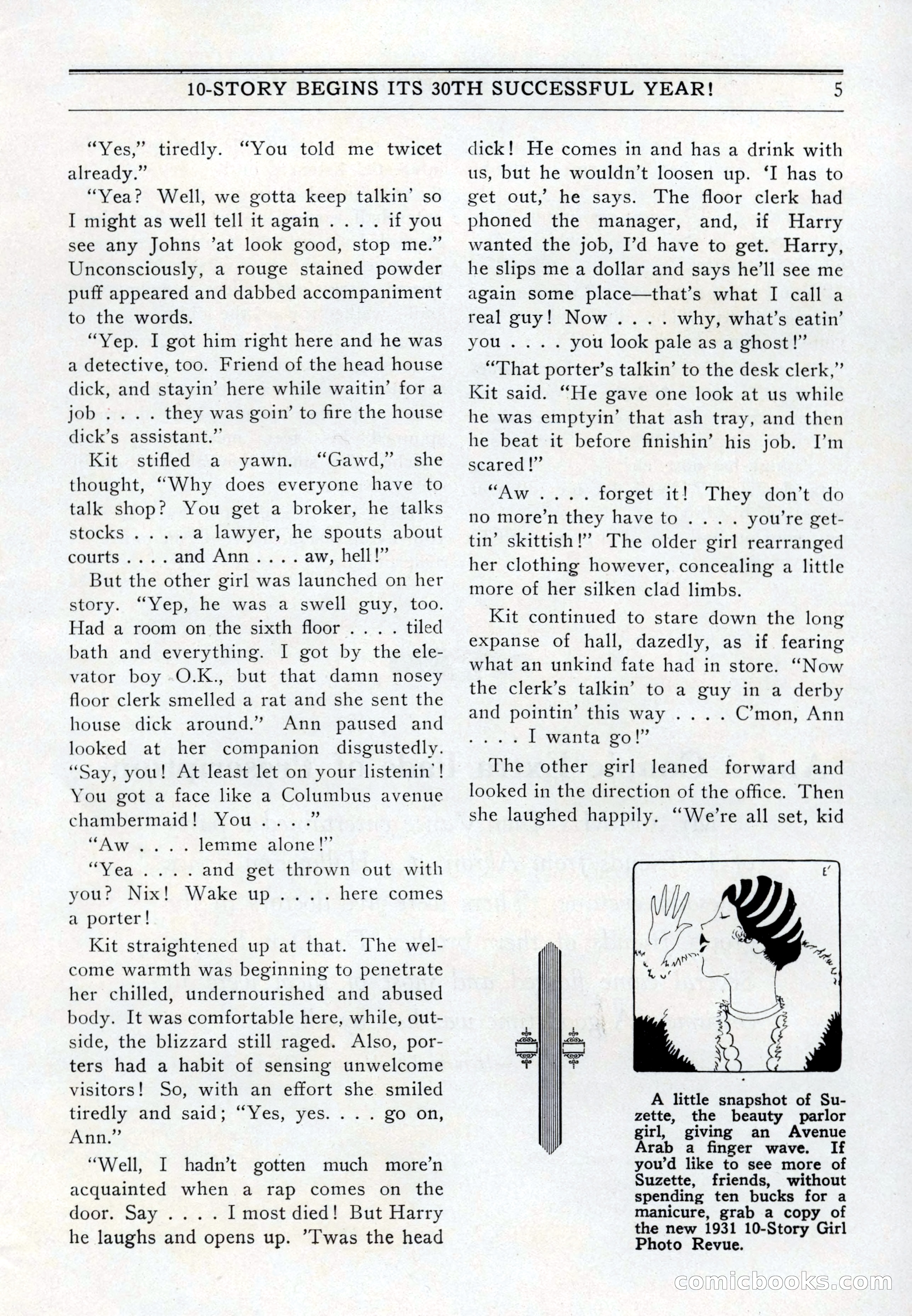
# Page Analysis This is a story prose page from a pulp magazine, specifically page 5 of what appears to be a 10-Story Girl publication (indicated by the header "10-STORY BEGINS ITS 30TH SUCCESSFUL YEAR!"). The page contains narrative text depicting a conversation between characters named Kit and Ann at what appears to be a hotel. Kit, exhausted and hungry, is discussing encounters with various men—including a detective and a porter—while waiting for employment. The dialogue captures period vernacular and working-class interactions. A small illustration appears in the lower right, captioned as showing "Suzette, the beauty parlor girl," waving, with a note directing readers to purchase the 10-Story Girl Photo Revue for ten cents. The text focuses on slice-of-life dialogue typical of 1930s pulp fiction.
# Page Analysis This is story prose from a pulp magazine's interior page. The visible text depicts a scene at what appears to be a nightclub or establishment called Peacock Alley, where two women are being ejected by a gruff man who tells them they're unwanted. One woman responds defiantly with threats. The narrative then shifts to describe cold, snowy weather outside, including a doorman's complaints about working in harsh conditions. Below the story excerpt is a brief society item from The Medina (Ohio) Sentinel about Mr. and Mrs. Glen Vance hosting a Halloween dance party with doctors from Akron.
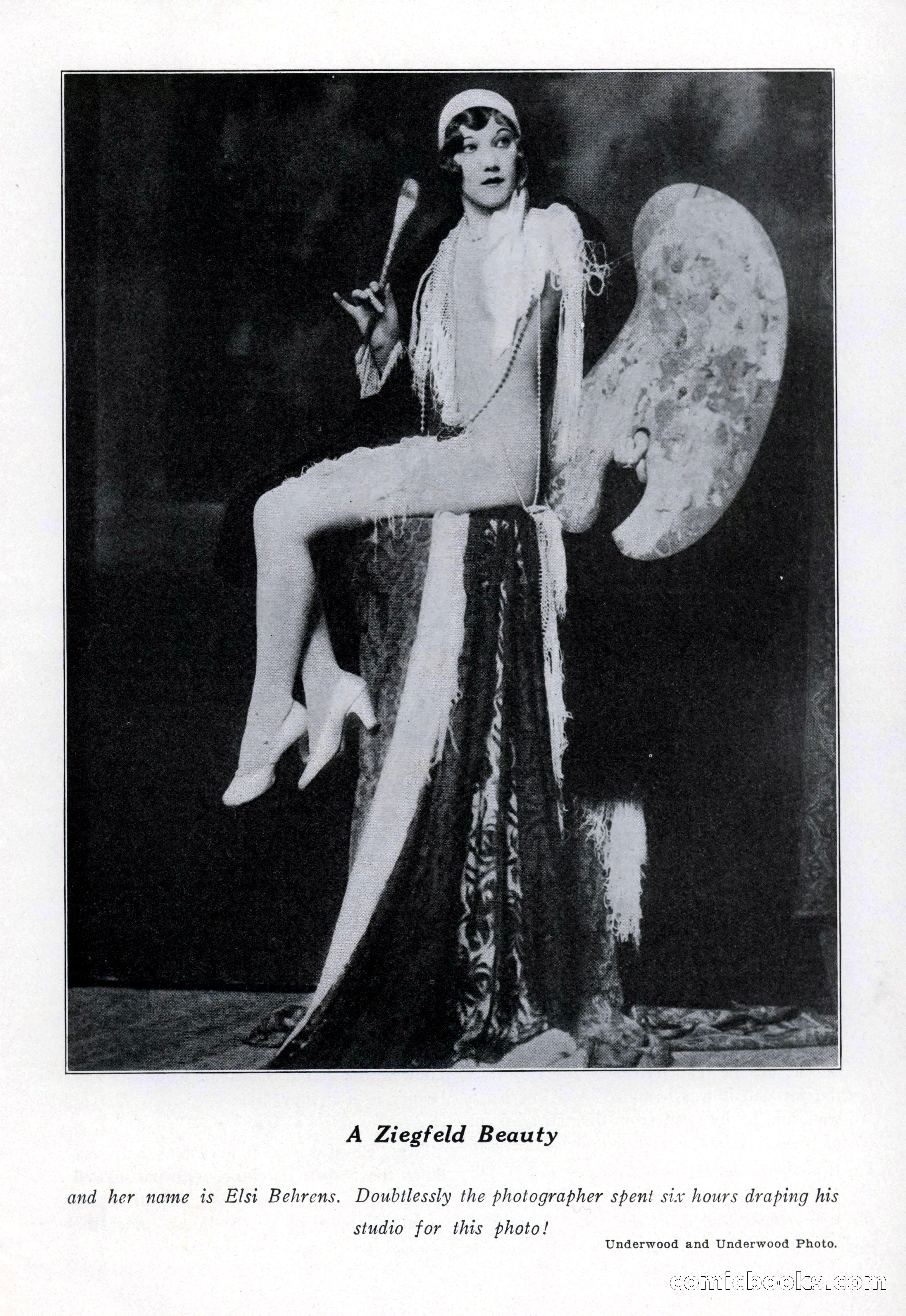
# Page Description This is a photograph page from an early-20th-century pulp magazine, featuring a glamorous studio portrait labeled "A Ziegfeld Beauty." The image shows a woman identified as Elsi Behrens in an elaborate costume with a large decorative fan, headband, and draped garment, posed against a dark background. The caption humorously notes that the photographer spent six hours preparing the studio for this photograph. The credit reads "Underwood and Underwood Photo." This appears to be a decorative or entertainment-focused insert typical of pulp magazines of the era, rather than story content.
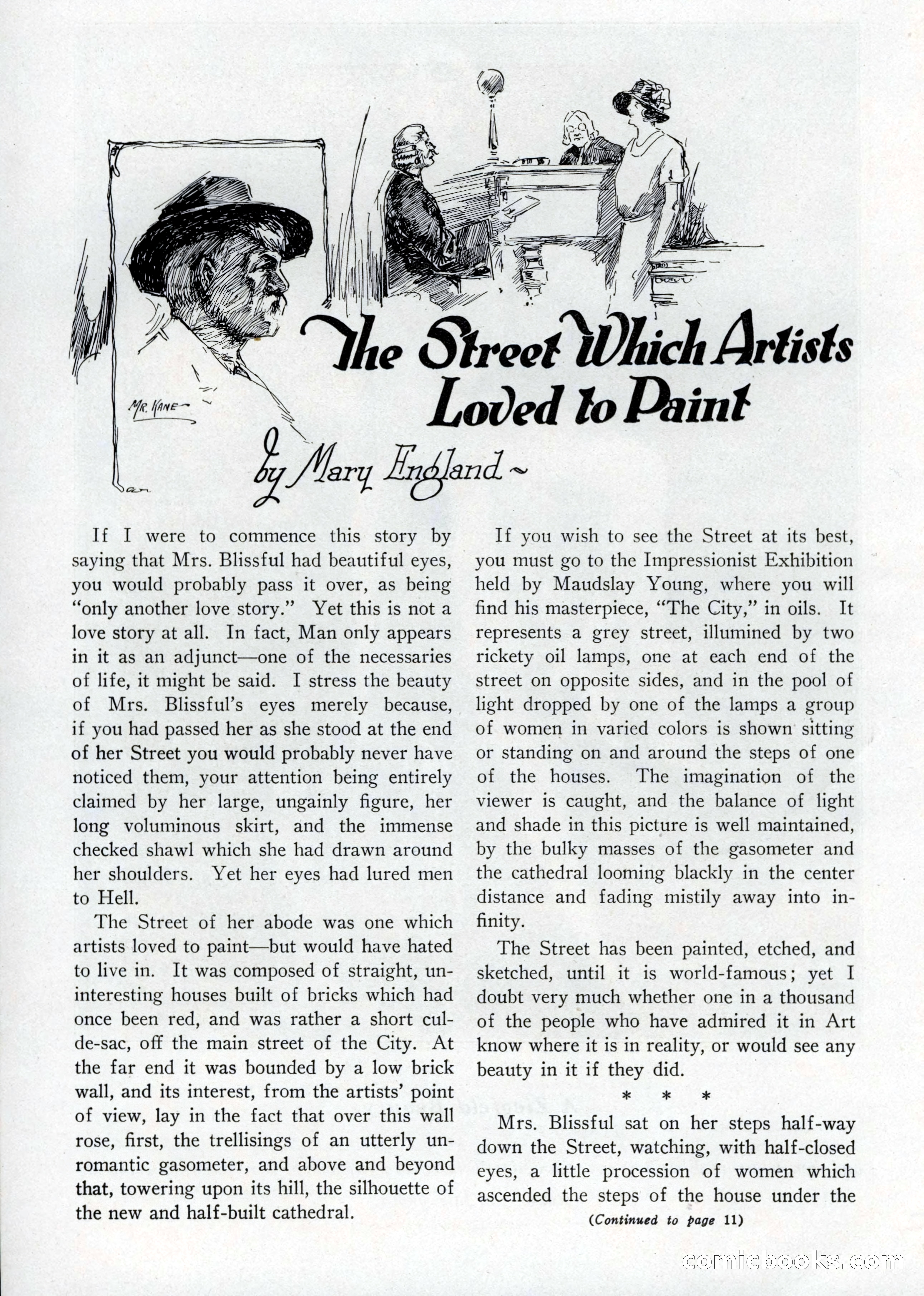
# "The Street Which Artists Loved to Paint" This is an interior story page featuring a sketch illustration at the top and prose text below. The story, by Mary England, concerns Mrs. Blissful, a woman with striking eyes living on an unprepossessing street that artists nevertheless loved to paint. The visible text describes the street's physical characteristics—brick houses, a gasometer, and a cathedral silhouette—and mentions an Impressionist painting of the street by someone named Maudslay Young. The narrative then shifts to Mrs. Blissful sitting on her steps, observing women ascending house steps. The story continues on page 11.
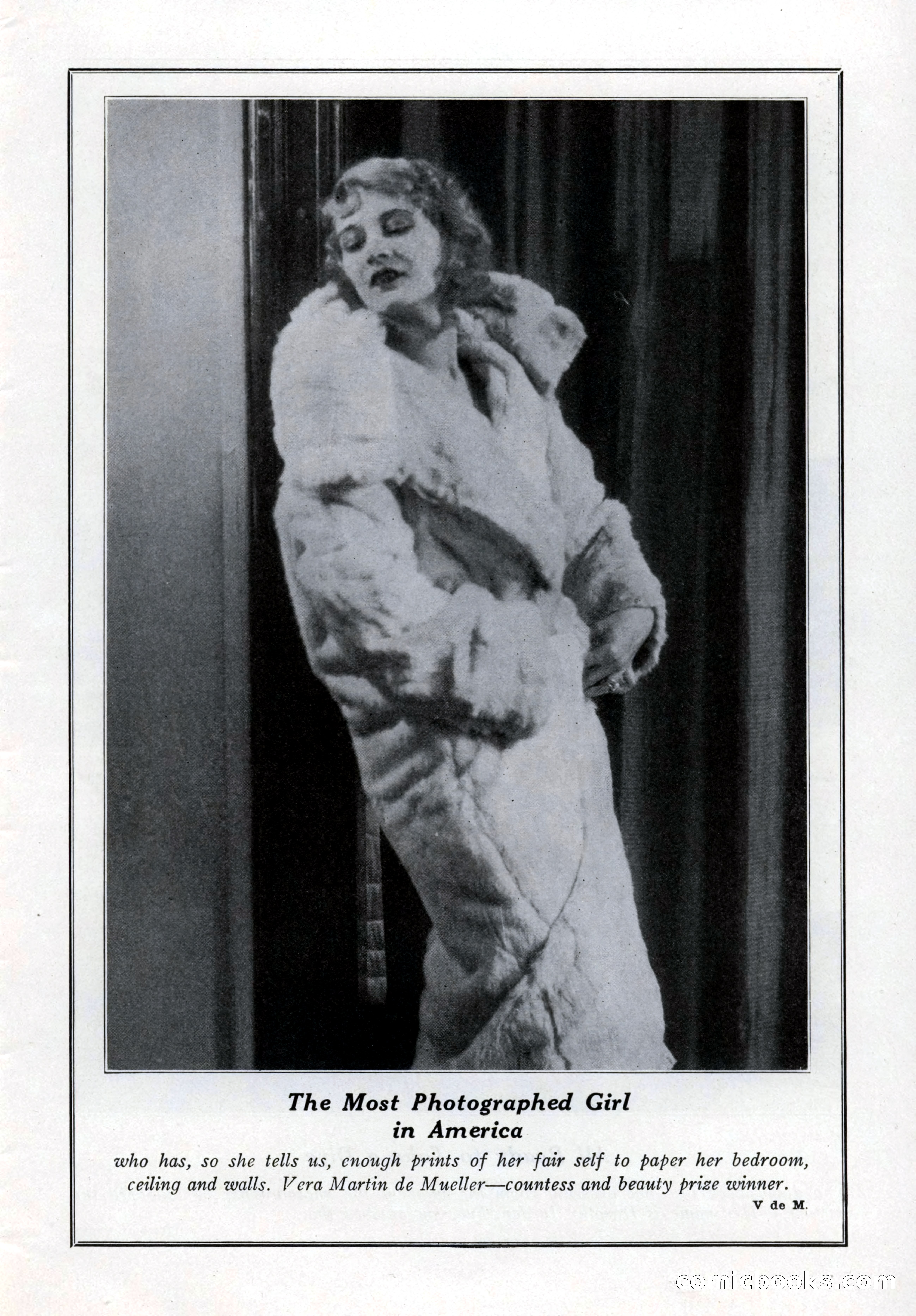
# Description This is a full-page photograph and caption from an early-20th-century publication. The image shows a woman in an elegant, draped white gown with fur collar, posed against dark curtains. The caption identifies her as "The Most Photographed Girl in America" and names her as Vera Martin de Mueller, described as a "countess and beauty prize winner." The accompanying text claims she has collected enough photographic prints of herself to paper her bedroom, ceiling, and walls. The page appears to be a celebrity portrait feature rather than fiction content.
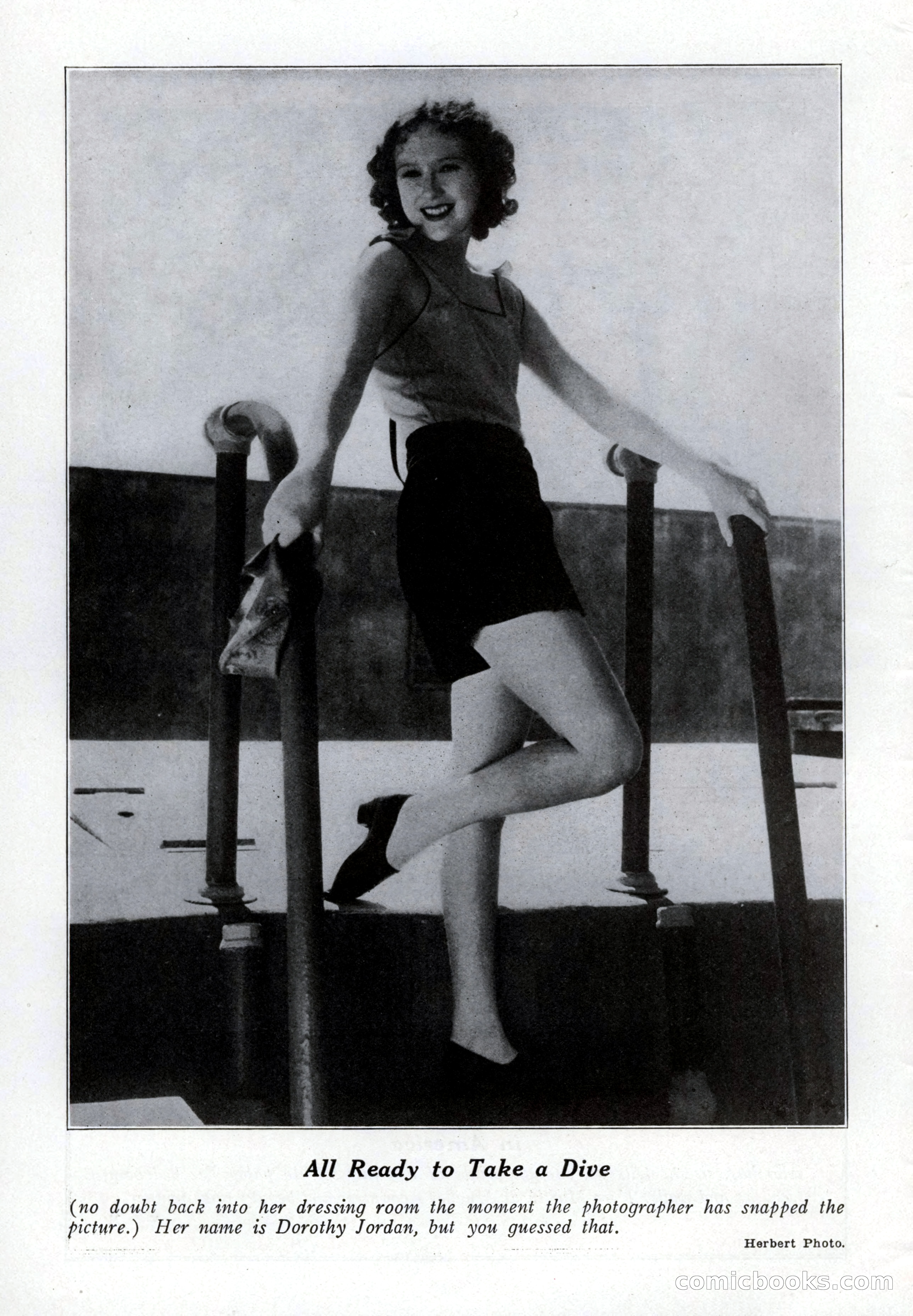
# Description This is a photograph page from a pulp magazine, featuring a black-and-white portrait photo labeled "All Ready to Take a Dive." The image shows a young woman in swimming attire posed on what appears to be a diving board. The caption identifies her as Dorothy Jordan and includes a humorous note suggesting she returned to her dressing room immediately after the photographer captured this shot. The photo credit reads "Herbert Photo." This appears to be a entertainment or lifestyle feature rather than fiction content, typical of pulp magazine filler between story sections.
# Page Analysis This is a **story prose page** from a pulp magazine, containing the continuation of a narrative set during World War I (referenced as 1916). The page depicts a domestic scene where Mrs. Blissful and Mrs. Mason encounter two soldiers on the street. The women invite the soldiers inside, where they share food and beer. The soldiers, needing to return to barracks, are escorted out by the women. Mrs. Blissful then counts money from a vase—apparently four pound ten—suggesting some financial transaction occurred, though the exact nature remains unclear from this excerpt alone. The narrative focuses on working-class life and wartime social interactions.
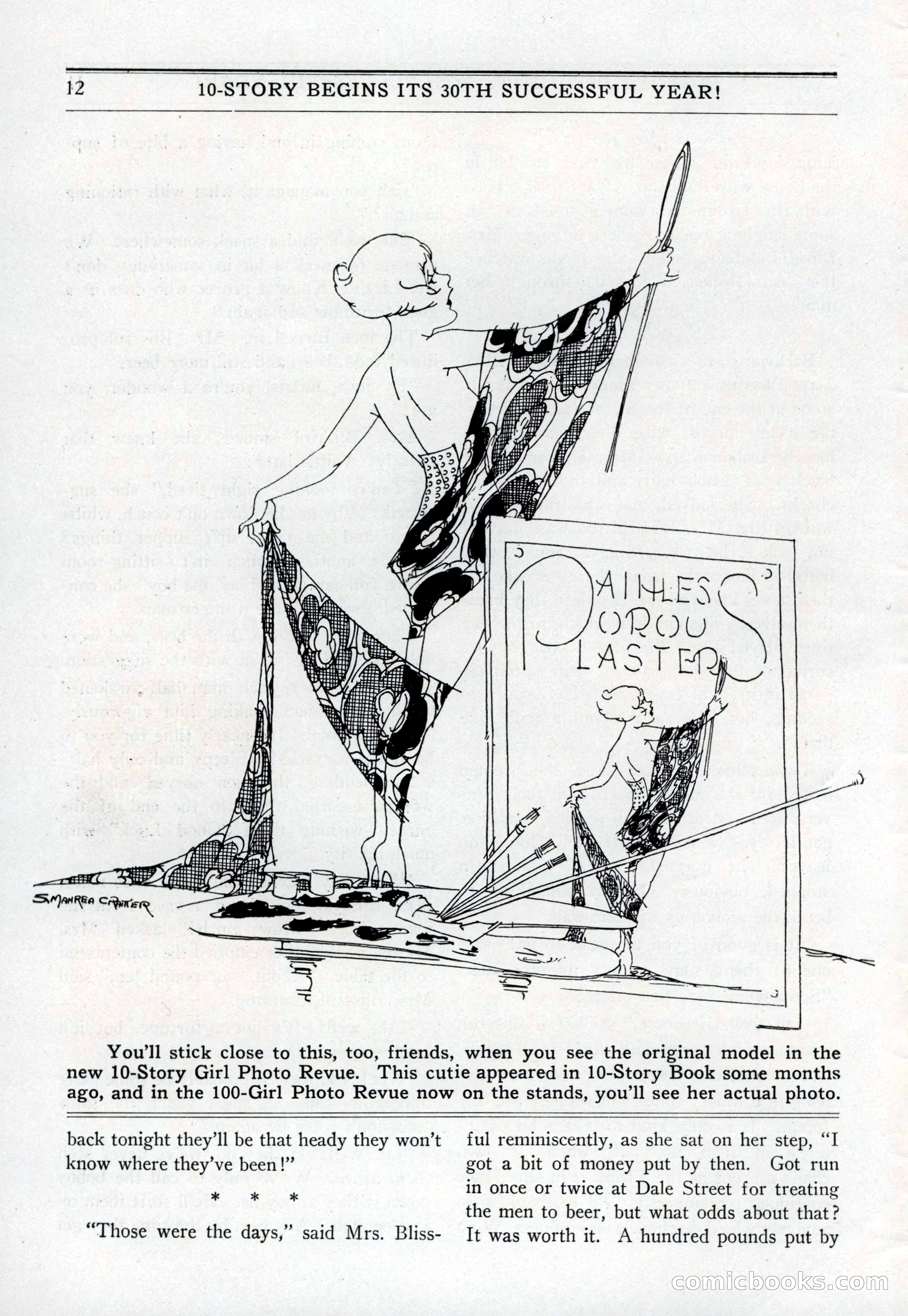
# Page Analysis This is an interior page from a pulp magazine featuring an illustration and accompanying prose text. The page includes a line drawing of a woman in 1920s-style clothing posing with fabric/clothing, advertising the "10-Story Girl Photo Revue." Below the illustration is story text that appears to be a dialogue or narrative passage. The visible prose discusses someone's reminiscences about money and visits to Dale Street for treating "the men to beer." The page header indicates this marks the publication's "30th successful year," suggesting this is from an established pulp magazine, likely focused on fiction with photographic content.
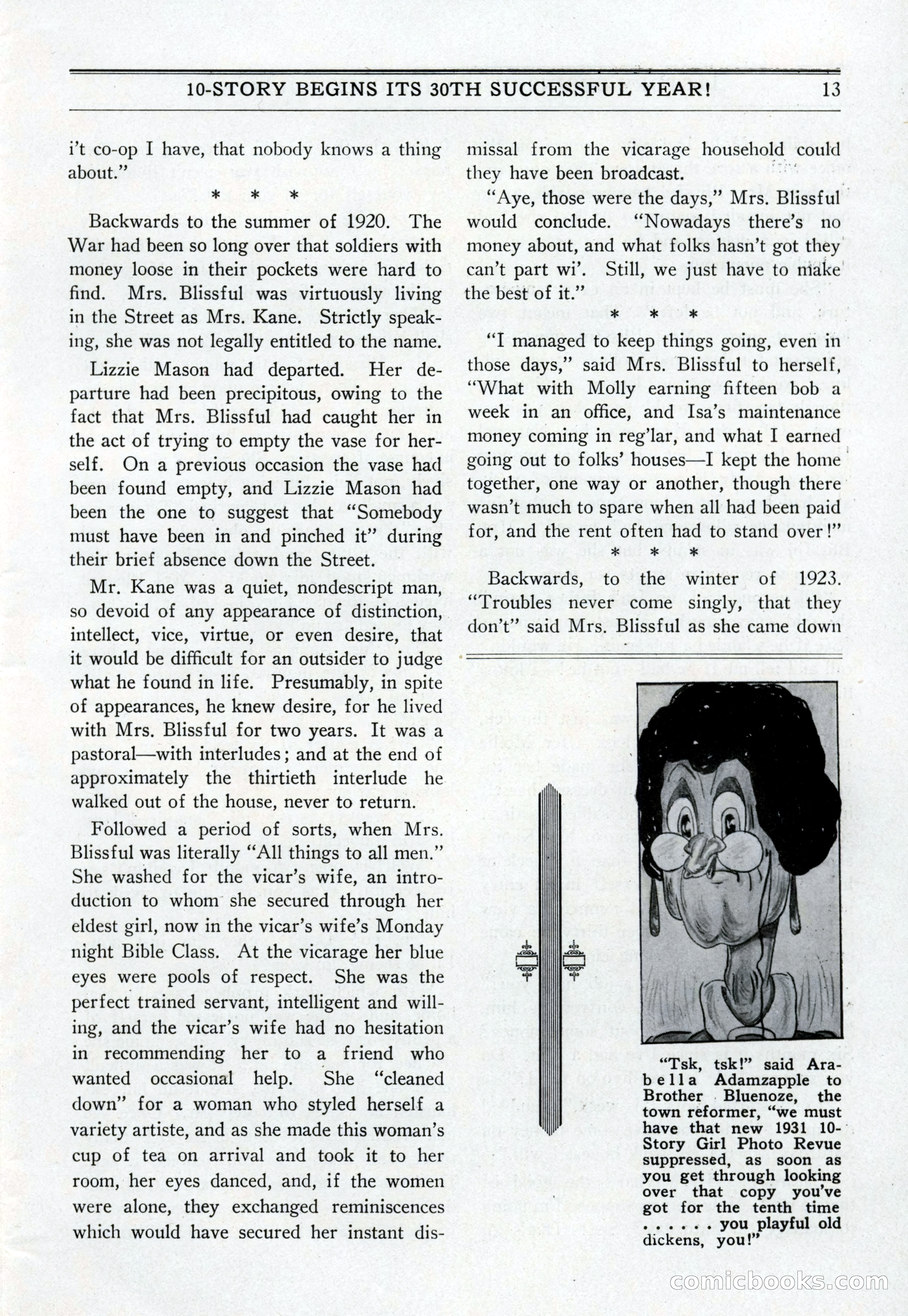
# Page 13: Story Prose with Illustration This page contains story prose continuing a narrative about Mrs. Blissful, a woman of modest means in early-20th-century Britain. The text describes her financial struggles after World War I, her departure from the Street, and her subsequent employment as a domestic servant. The passage covers events from summer 1920 through winter 1923, detailing her work for a vicar's wife and her resourcefulness during hard times. An illustration appears mid-page showing a cartoon character (Arabella Adamzaple, identified in the caption) with an exaggerated expression, advertising what appears to be a "1931 10-Story Girl Photo Revue" or similar pulp magazine feature. The illustration uses crude woodcut or similar printing style typical of pulp magazine graphics.
# Page 14: Story Prose This page contains story prose from what appears to be a serialized narrative. The visible text depicts Mrs. Blissful, facing financial hardship due to illness and unemployment in her household, attempting to track down Mr. Kane at a construction site to inquire about work opportunities. After a brief encounter with workers at a temporary office, she returns home to write an important letter. The passage focuses on her economic struggles supporting her family and her efforts to improve their circumstances through persistence and correspondence. No illustrations are visible on this page.
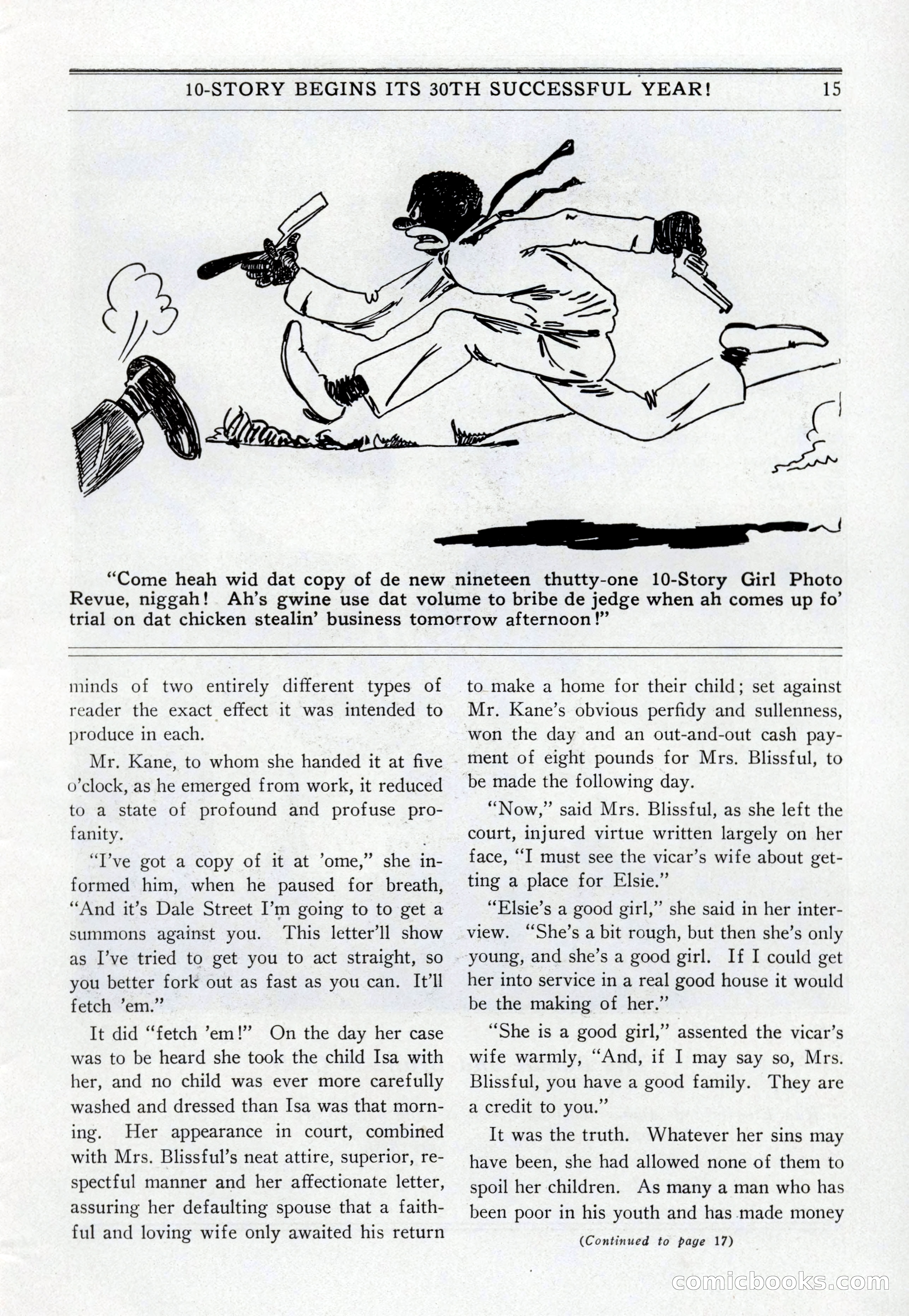
# Page Description This is page 15 of a pulp magazine celebrating "10-Story" magazine's 30th anniversary year. The page contains a cartoon illustration at the top depicting a woman in motion, apparently being chased or running while holding a camera, with comedic dialogue written in dialect about obtaining a copy of a "1931 10-Story Girl Photo Revue" to use as a bribe in a trial regarding chicken theft. Below the cartoon is story prose continuing a narrative involving characters named Mr. Kane, Mrs. Blissful, and Elsie. The text discusses a legal case outcome and Mrs. Blissful's statements about Elsie being "a good girl" who comes from a respectable family. The story continues to page 17.
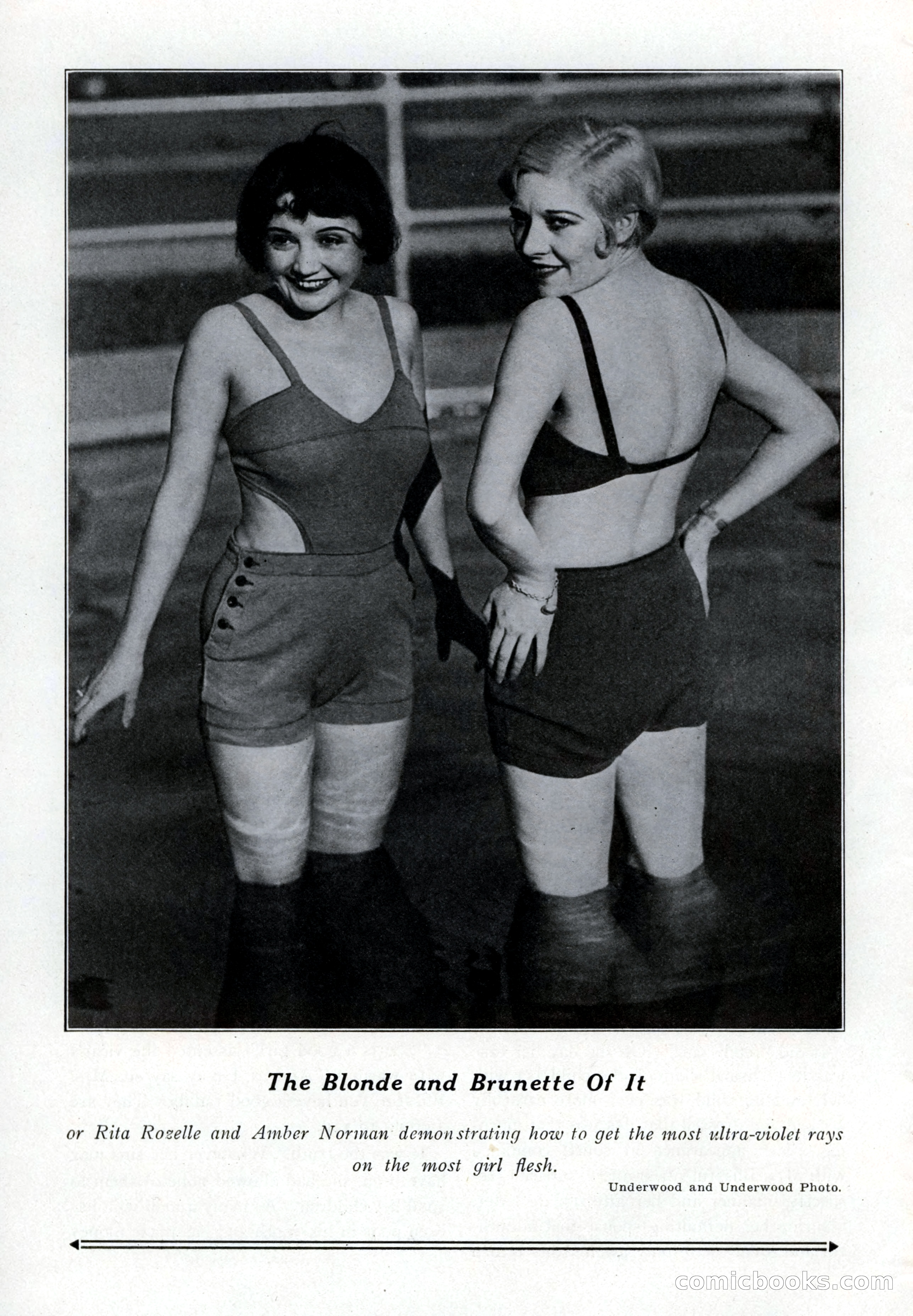
# Page Description This is an illustrated page from a pulp magazine featuring a black-and-white photograph of two women in 1920s-style bathing attire. The caption identifies them as "Rita Rozelle and Amber Norman demonstrating how to get the most ultra-violet rays on the most girl flesh," titled "The Blonde and Brunette Of It." The page appears to be promotional or lifestyle-oriented content related to sun exposure and tanning, a common topic in early twentieth-century magazines. The photograph credit reads "Underwood and Underwood Photo." This is not story prose but rather an illustrated feature, likely reflecting contemporary beauty and health trends of the era.
This page contains story prose from a pulp magazine, continuing a narrative that began on page 15. The text describes the romantic and financial fortunes of a character named Mollie, whose mother, Mrs. Blissful, has lived in reduced circumstances on a city street. The passage covers Mollie's rise in fortune through employment and romantic involvement with a man named Geoffrey, who runs fruiterer's shops. It details Mrs. Blissful's initial concerns about the match, her eventual acceptance when she recognizes Mollie's happiness, and a visit from Mrs. Holland. The narrative concludes with a neighbor's comment suggesting Mollie is making "a swell match."
This page contains story prose from what appears to be a serialized fiction piece. The text shows dialogue between Mrs. Blissful and her neighbor Mrs. Robinson, discussing a young woman named Mary Dawes who has recently married. Mrs. Blissful expresses disapproval of Mary's choices and lifestyle, commenting on changing social customs regarding motherhood and child-rearing. The passage includes Mrs. Blissful's reflections on how different modern mothers are from her generation, noting that babies are no longer constantly held and cared for at home. The text continues to an indicated page break at the bottom, suggesting this story continues elsewhere in the magazine.
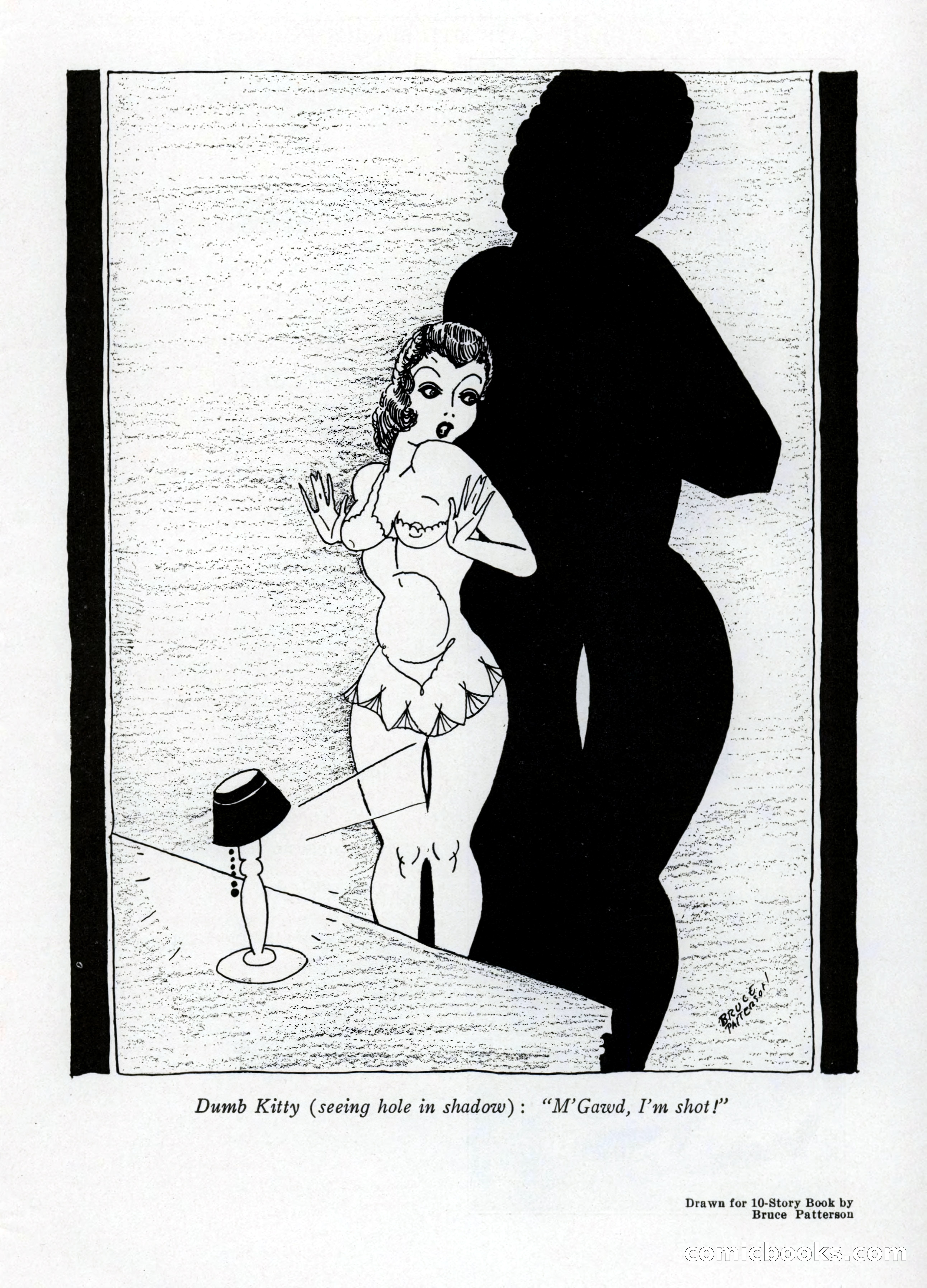
# Page Description This is an interior illustration from a pulp fiction story, drawn by Bruce Patterson for a 10-Story Book. The black-and-white cartoon depicts a woman in 1920s-style dress viewing her shadow on a wall, which appears to show a much larger, menacing silhouette behind her. The caption reads: "Dumb Kitty (seeing hole in shadow): 'M'Gawd, I'm shot!'" The artwork uses dramatic contrast between the detailed line drawing of the woman and the solid black shadow to create a comedic or suspenseful effect—the woman misinterprets the shadow's appearance as evidence of violence. The illustration appears designed to introduce or accompany a story moment in the publication.
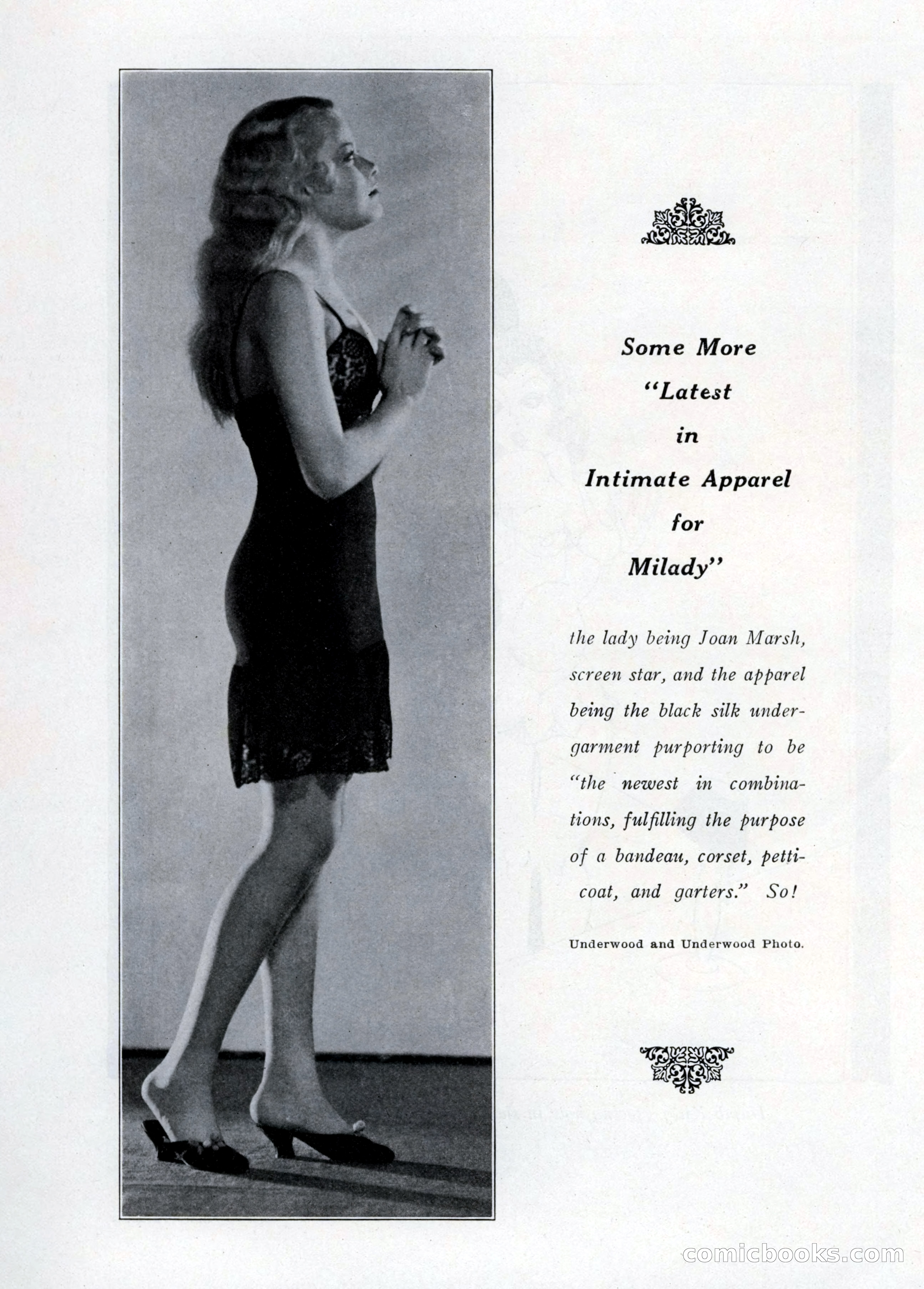
# Page Description This is an advertisement page, not story content. It features a black-and-white photograph of a woman in profile wearing a black silk undergarment, positioned to showcase intimate apparel. The ad promotes Milady brand undergarments, specifically highlighting a "black silk under-garment" described as combining "the newest in combinations, fulfilling the purpose of a bandeau, corset, petticoat, and garters." The model is identified as Joan Marsh, a screen star. The photograph credit reads "Underwood and Underwood Photo." This appears to be a typical early-20th-century fashion advertisement placed within a pulp magazine.
This is a text page from a pulp magazine containing the conclusion of a serialized story (continued from page 18). The passage depicts Mrs. Blissful, a compassionate woman who takes in a baby from a struggling young mother, offering to help raise the child rather than see it sent to a workhouse. The narrative emphasizes Mrs. Blissful's maternal kindness and her transformation when holding the infant. Below the story text is a humorous newspaper headline from The Greenfield (Ohio) Republican reading "One Way of Getting Even: Girl Marries Cop Who Arrested Her," which appears to be a filler item typical of pulp magazines of this era.
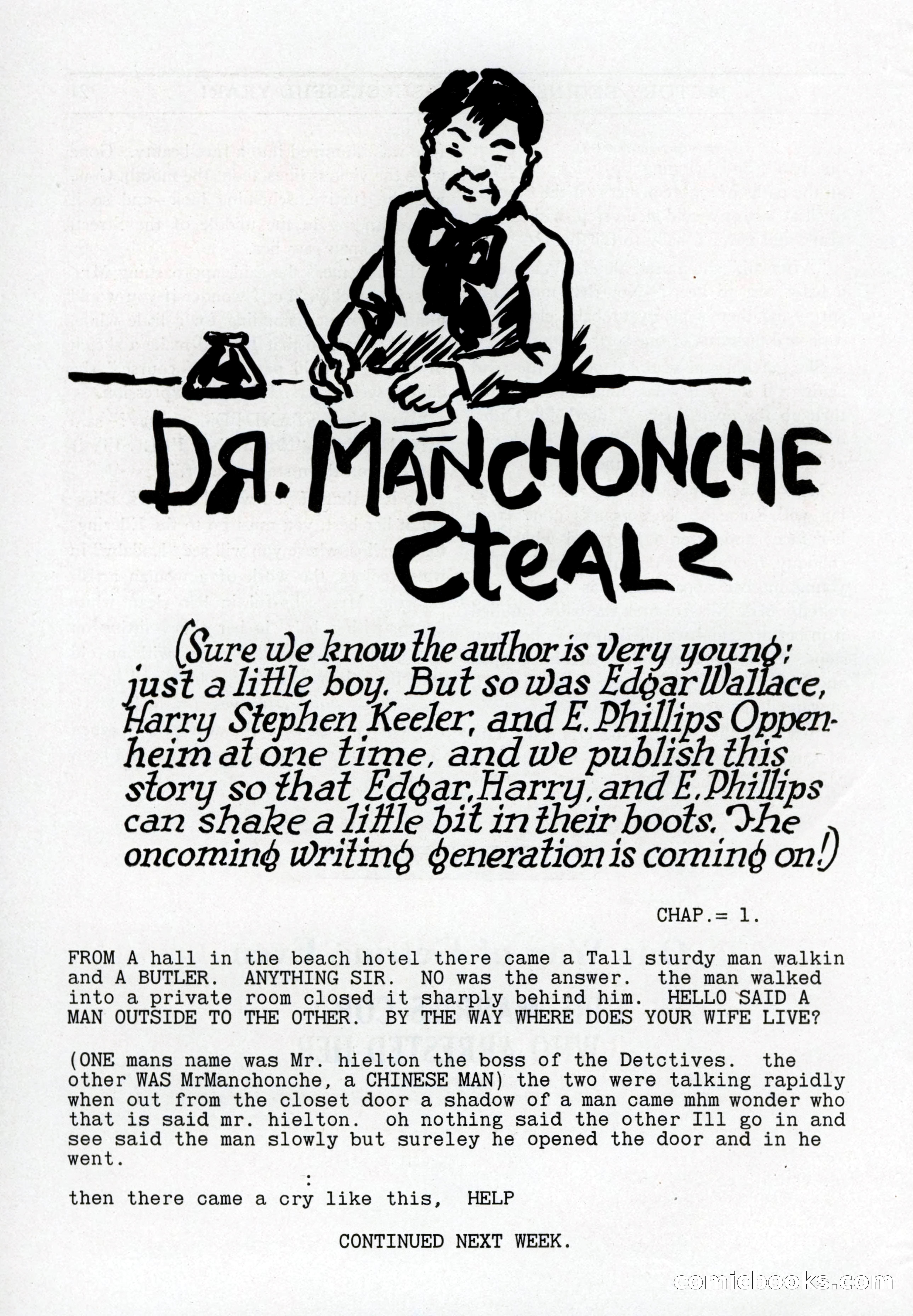
# Dr. Mancbonche Steals This is an interior story page from an early pulp magazine, featuring a title illustration and opening text of a detective story called "Dr. Manchonche Steals." The illustration shows a man in formal attire with a bow tie, drawn in bold black lines. The page includes an editorial note mentioning the author is young and comparing him to early literary figures like Edgar Wallace and Harry Stephen Keeler. The story begins with Chapter 1, describing a tall man and a butler at a beach hotel, with dialogue and a mysterious scene involving a detective named Mr. Hielton. The narrative breaks mid-sentence with "CONTINUED NEXT WEEK," indicating serialized publication.
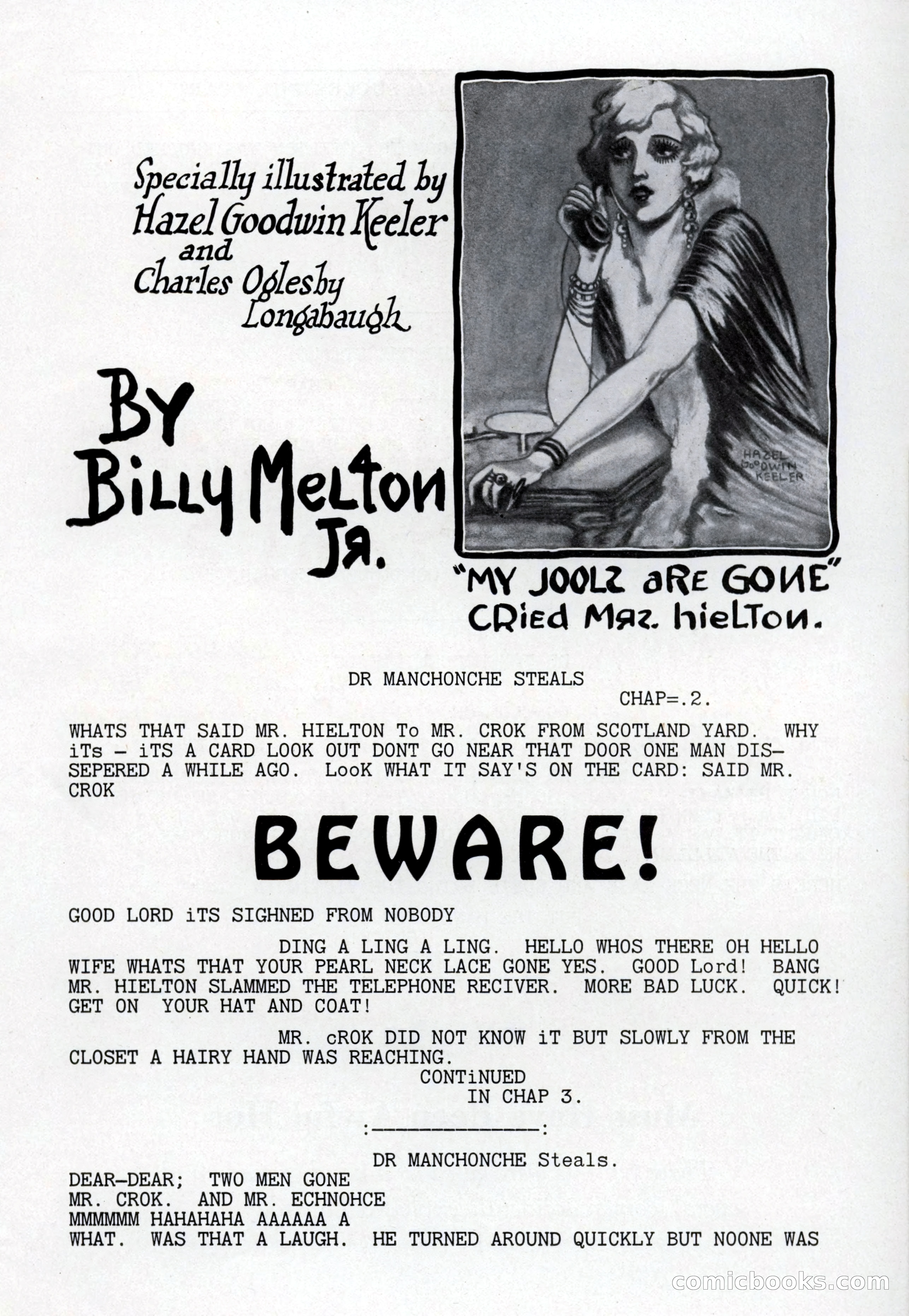
# Page Description This appears to be a story opening page from a pulp magazine titled "Dr Manchonche Steals," written by Billy Melton Jr. and illustrated by Hazel Goodwin Keeler and Charles Oglesby Longabaugh. The page features a dramatic illustration of a woman in 1920s style dress with the caption "My Jewels Are Gone," cried Maz. Hielton. Below the illustration, the story begins with dialogue establishing a mystery: Mr. Hielton has received a warning card from Mr. Crok, telling him to avoid a particular door. Shortly after, Mrs. Hielton's pearl necklace goes missing, and a mysterious hairy hand is reaching from a closet. The chapter ends with "CONTINUED IN CHAP 3," indicating this is chapter 2 of an ongoing serial crime story.
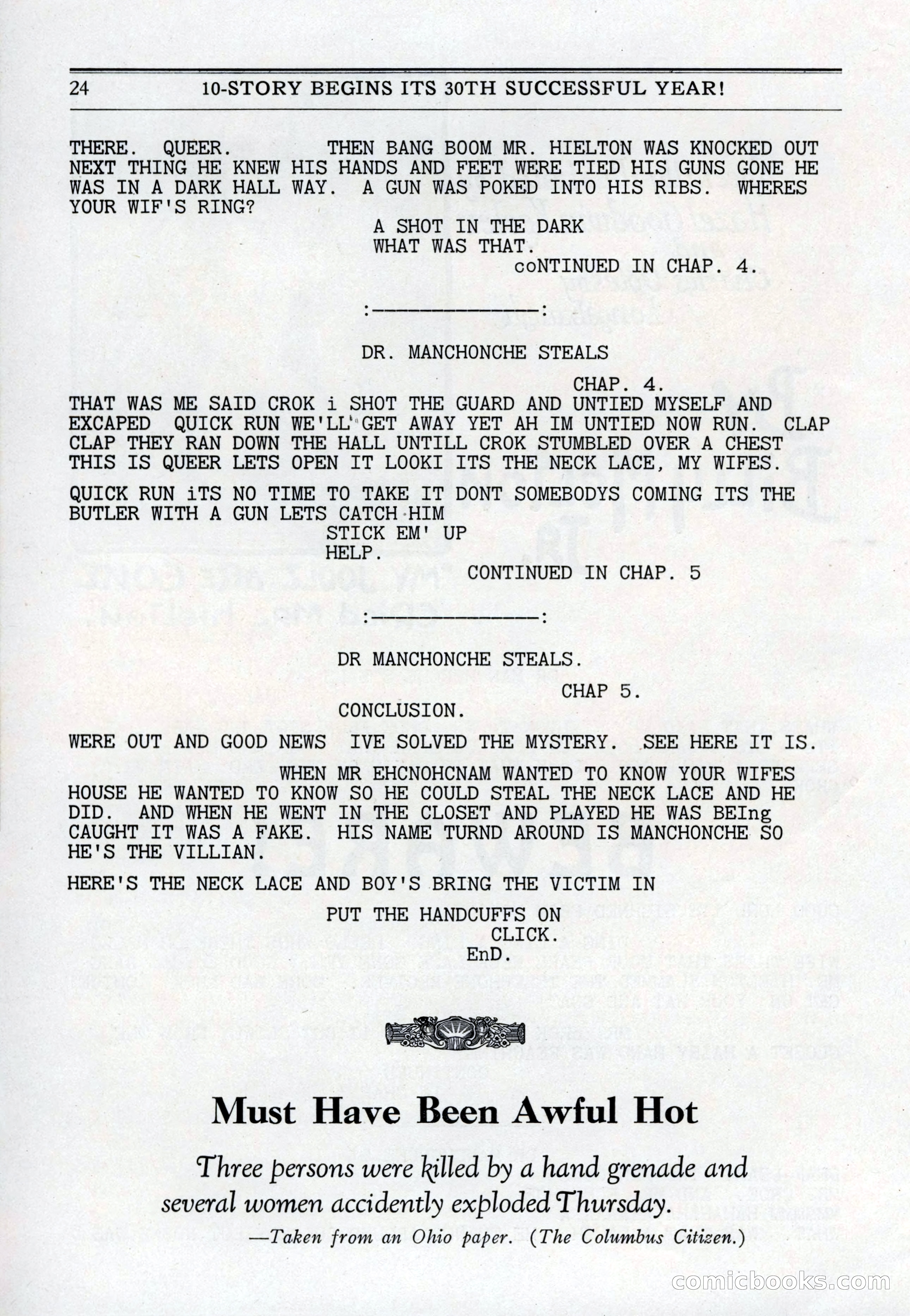
# Page Analysis This is a text page from a pulp fiction story that concludes a mystery plot. The narrative wraps up the case of a stolen neck lace, revealing that a character named Manchonche is the villain who targeted a victim's wife's house to locate and steal the jewelry. The page includes the story's final chapters (4-5) and conclusion, ending with the villain's capture and handcuffing. At the bottom is a humorous newspaper clipping excerpt titled "Must Have Been Awful Hot," describing a grenade accident. The page contains no illustrations, only printed text in typical pulp magazine format.
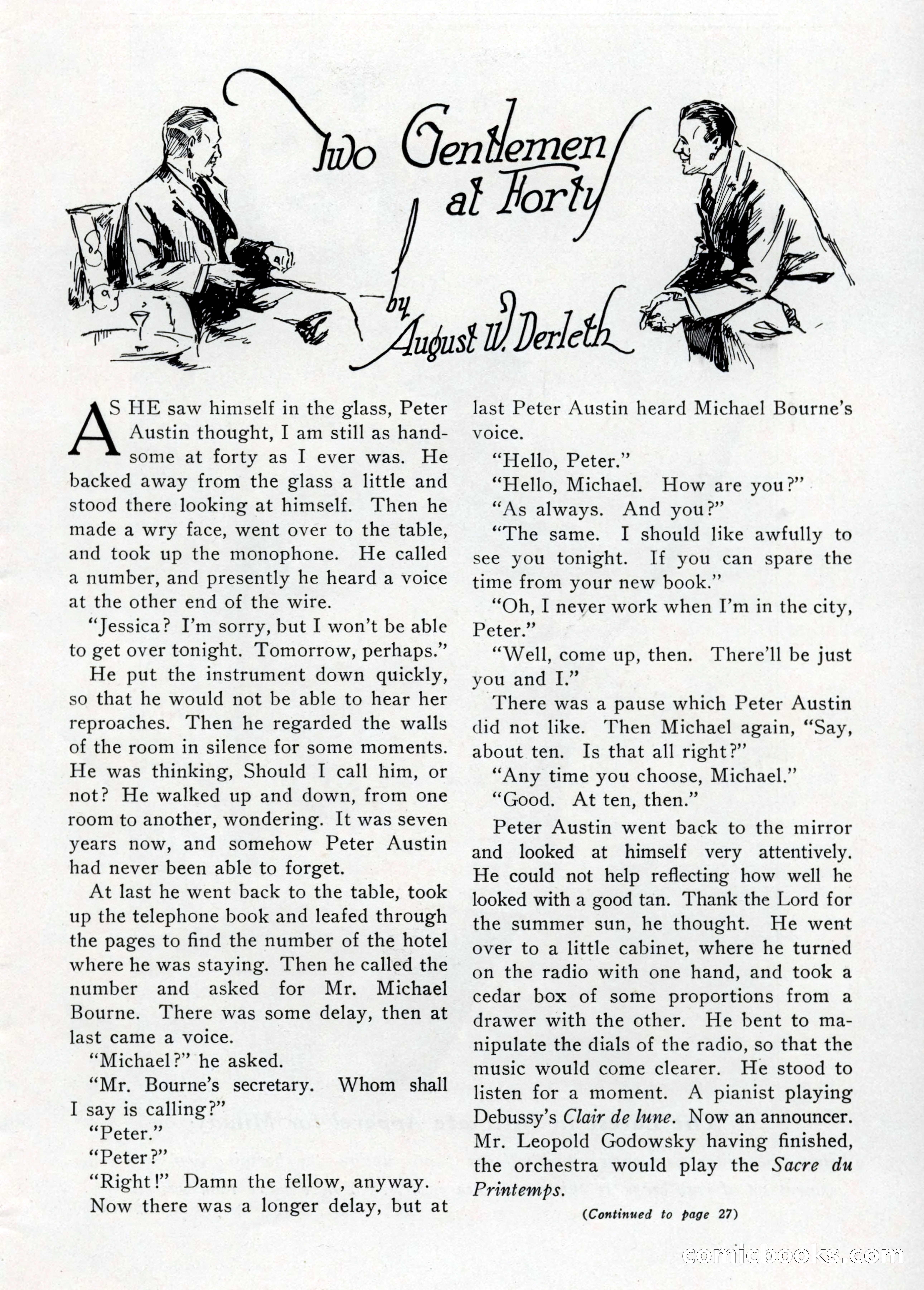
# Page Analysis This is a story page from a pulp magazine featuring prose fiction titled "Two Gentlemen at Forty" by August W. Derleth, illustrated with two sketch drawings of men in conversation. The visible text depicts Peter Austin, a man in his forties, looking at himself in a mirror and reflecting on his appearance, then calling his old friend Michael Bourne at a hotel to arrange an evening meeting. The narrative includes their brief telephone conversation where Michael suggests they meet around ten o'clock. Peter then adjusts a radio to listen to classical music—a pianist performing Debussy's *Clair de lune*—while waiting. The story appears to explore themes of old friendship and nostalgia. The page concludes with "(Continued to page 27)."
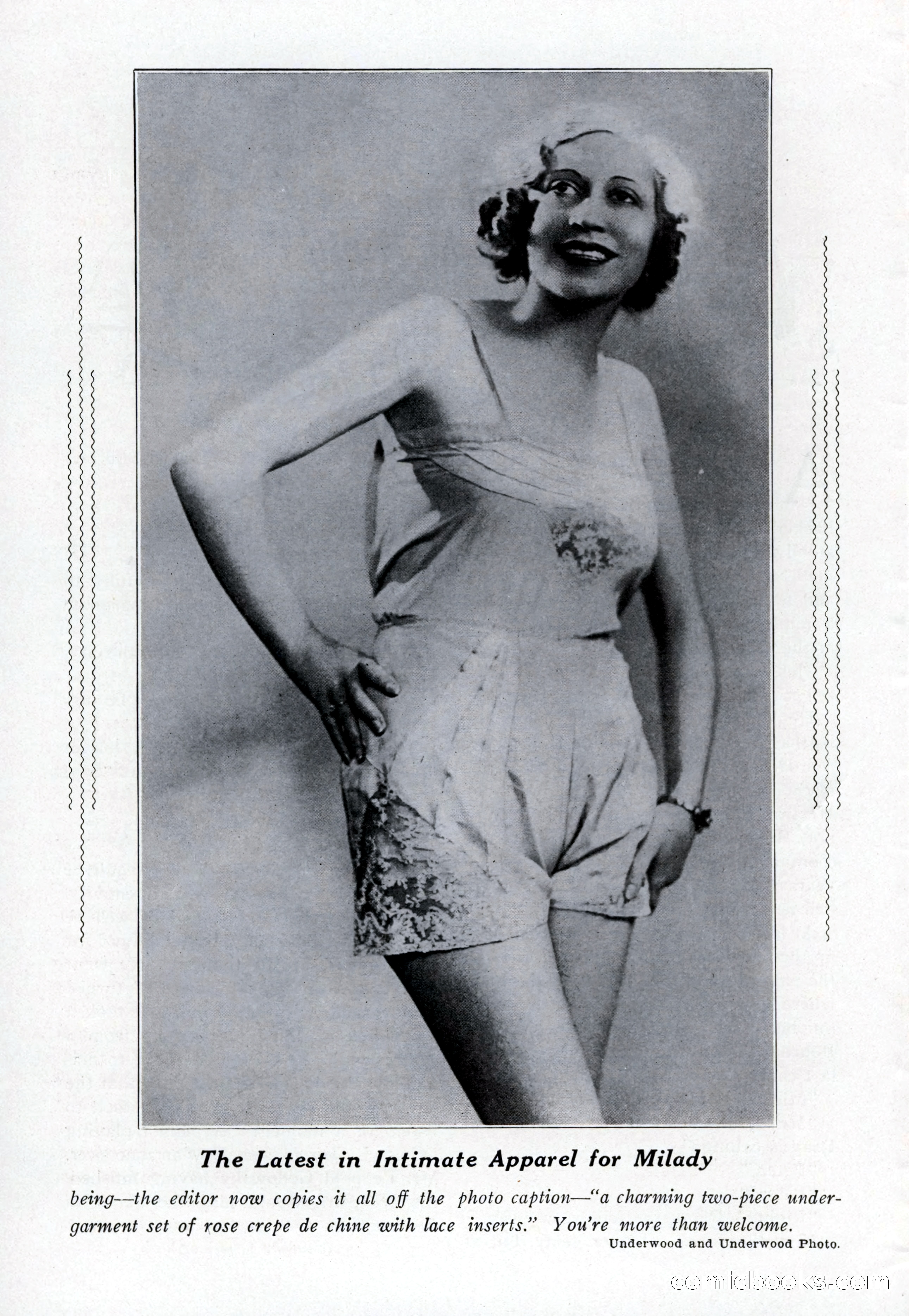
This page is an advertisement featuring a black and white photograph of a woman in intimate apparel. The caption indicates this is advertising "The Latest in Intimate Apparel for Milady" by what appears to be the Milady brand. The text below the image states the editor is copying the photo caption, describing it as "a charming two-piece undergarment set of rose crepe de chine with lace inserts." The photo credit reads "Underwood and Underwood Photo." This appears to be a vintage lingerie advertisement from an early-20th-century publication, presented as editorial content rather than traditional advertising.
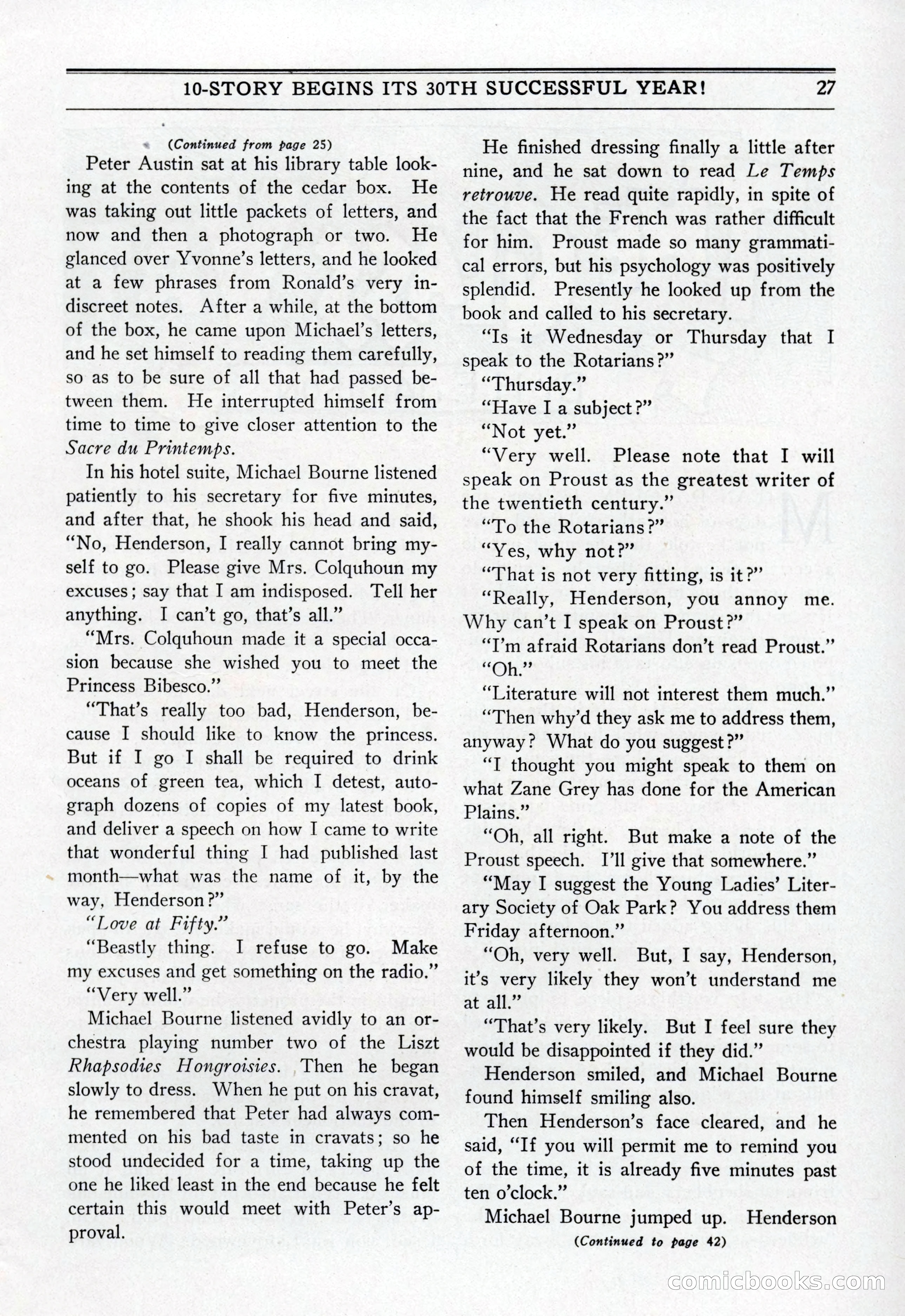
# Page 27: Story Prose This page contains continued narrative prose from a story that began on page 25. The text depicts two parallel scenes: Peter Austin examining letters in his library, and Michael Bourne in his hotel suite declining a social invitation to meet Princess Bibesco. The narrative then shifts to Bourne getting dressed while listening to Liszt's Rhapsodies Hongroises, followed by a conversation between Bourne and his secretary Henderson about speaking engagements—specifically a potential Rotarian Club talk about the writer Proust, and an alternative suggestion to address the Young Ladies' Literary Society of Oak Park. The page contains no illustrations, only text formatted in two columns.
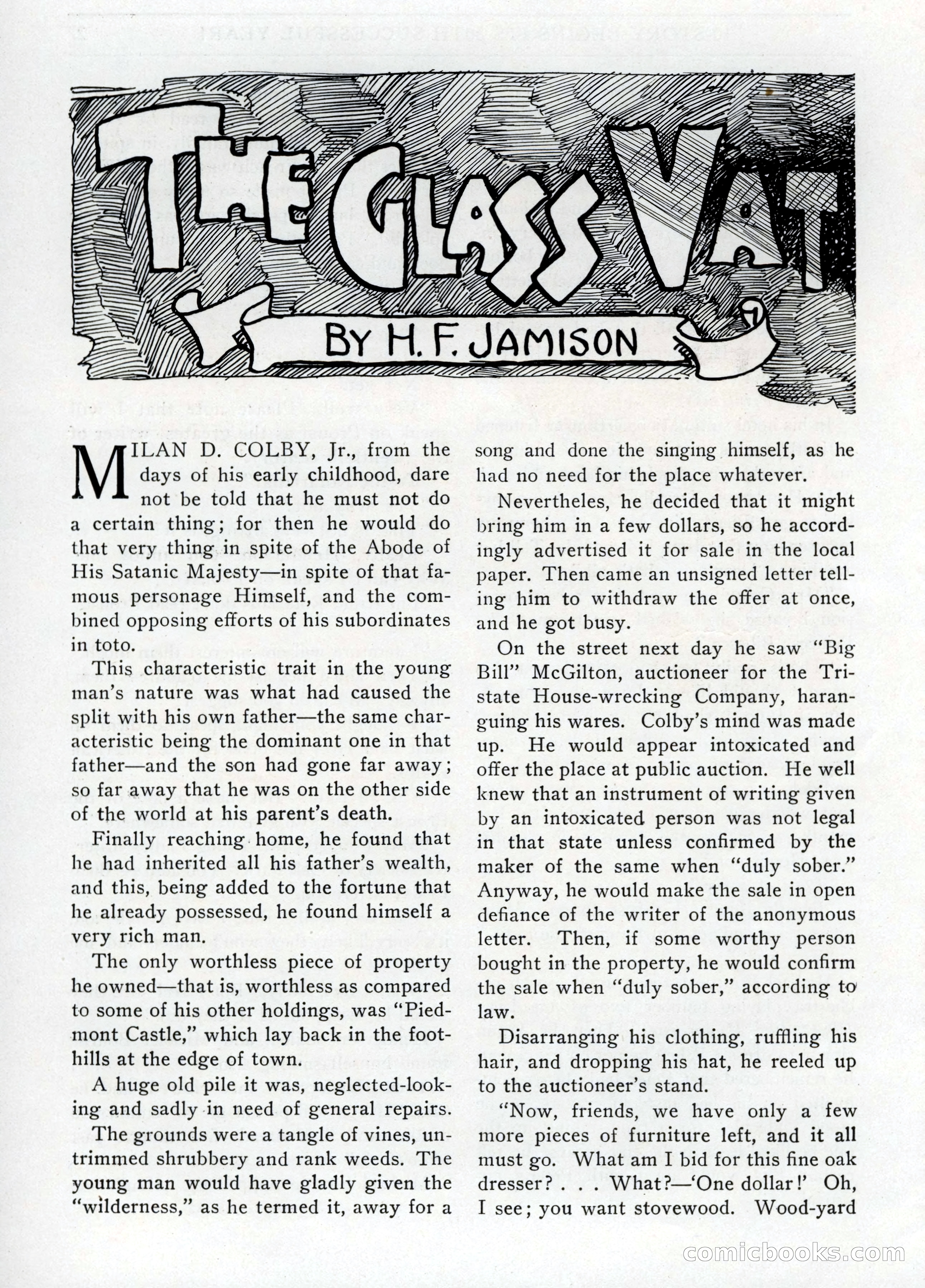
# Page Content Summary This is a story page, not a cover or illustration. The title "The Glass War" by H.F. Jamison appears at the top in decorative lettering. The visible text is the opening of a story about Milan D. Colby, Jr., a wealthy young man who has inherited his father's fortune but owns one worthless property called "Piedmont Castle"—a dilapidated estate in poor condition. The narrative describes how Colby, despite receiving an anonymous letter warning against it, decides to sell the property at public auction through an auctioneer named "Big Bill" McGilton. The story appears to be setting up a plot involving the attempted sale of this neglected property.
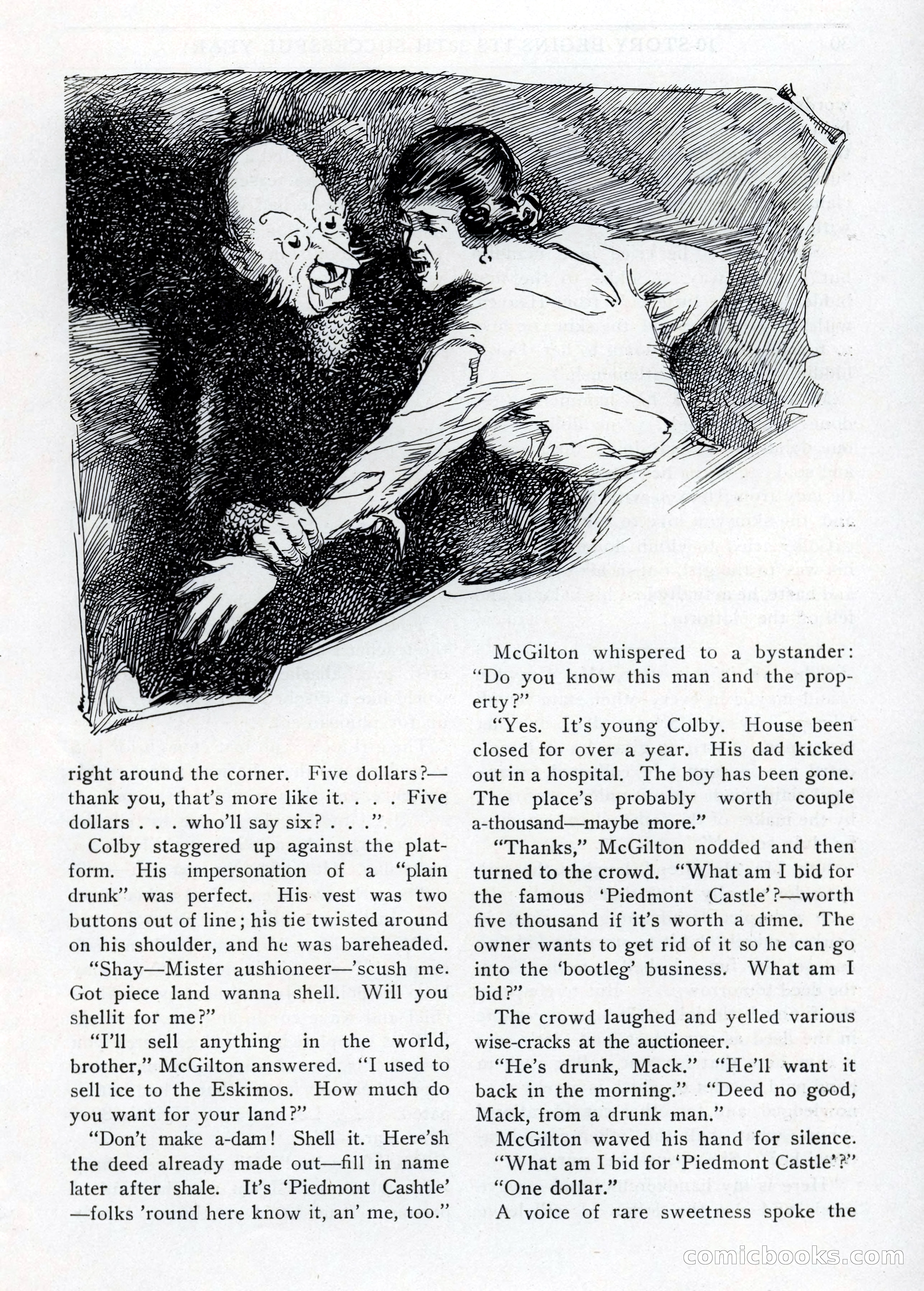
This is an interior story page from a pulp magazine, featuring both an illustration and prose text. The ink drawing shows two men in what appears to be an altercation or tense moment on a platform or bed. The story text describes a scene at an auction where a drunk man named Colby is attempting to sell property—specifically "Piedmont Castle"—to an auctioneer named McGilton. The narrative suggests this is a con or deception of some kind, with McGilton and Colby working together to sell questionable property to a crowd. The page appears to be part of a hardboiled crime or con-artist story, though the exact publication title and author are not visible.
# Page 30 of "10-Story" Magazine This page contains story prose from what appears to be a serialized narrative. The visible text depicts a dramatic auction scene where a character named McGilton auctions off a deed to a woman, followed by a separate scene at a schoolhouse where a young man named Colby visits teacher Miss Graydon to return a dollar and apologize for his previous drunken behavior. Miss Graydon coldly rejects his apology, insisting he keep the dollar and return only her handkerchief and comb, refusing to "true back" anything else. The dialogue suggests conflict between the characters over past events and questions of honor.
# Page 31: Story Prose This page contains story prose from what appears to be a serialized fiction narrative. The text shows a conversation between characters named Dorris Graydon and Colby regarding the transfer of property called "Piedmont Castle." Colby has presented Graydon with legal documents—a deed, abstract, and tax receipt—confirming her ownership of the land. The passage concludes with Colby asking to see Graydon that evening and hinting he has important information to share. A promotional banner at the page's bottom advertises an upcoming issue featuring "nothing but blondes." The text is formatted in two columns typical of pulp magazine layouts.
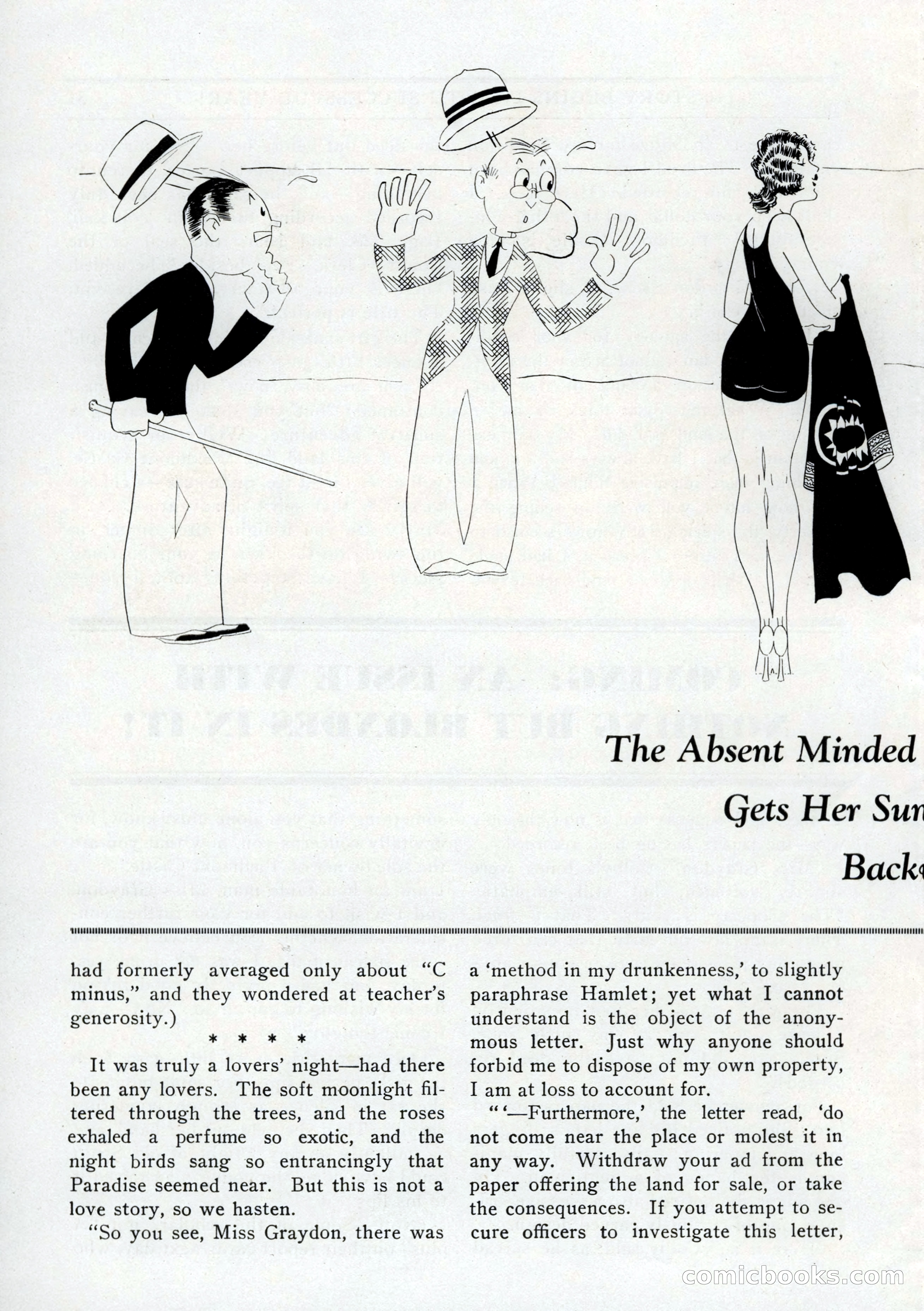
# Analysis of Page This is an interior story illustration and text page from an early-20th-century pulp magazine. The cartoon illustration at top, titled "The Absent Minded Gets Her Sum Back," depicts three figures in a humorous domestic scene—a man with a cane on the left, a distressed man in the center, and a woman on the right holding what appears to be a coat or garment. The prose text below discusses a romantic nighttime scene involving moonlight and roses, then shifts to address "Miss Graydon" regarding a property dispute. The narrative mentions an anonymous letter forbidding the sale of land and threatening consequences if the protagonist attempts to secure officers to investigate. The tone suggests this is from a mystery or dramatic fiction story.
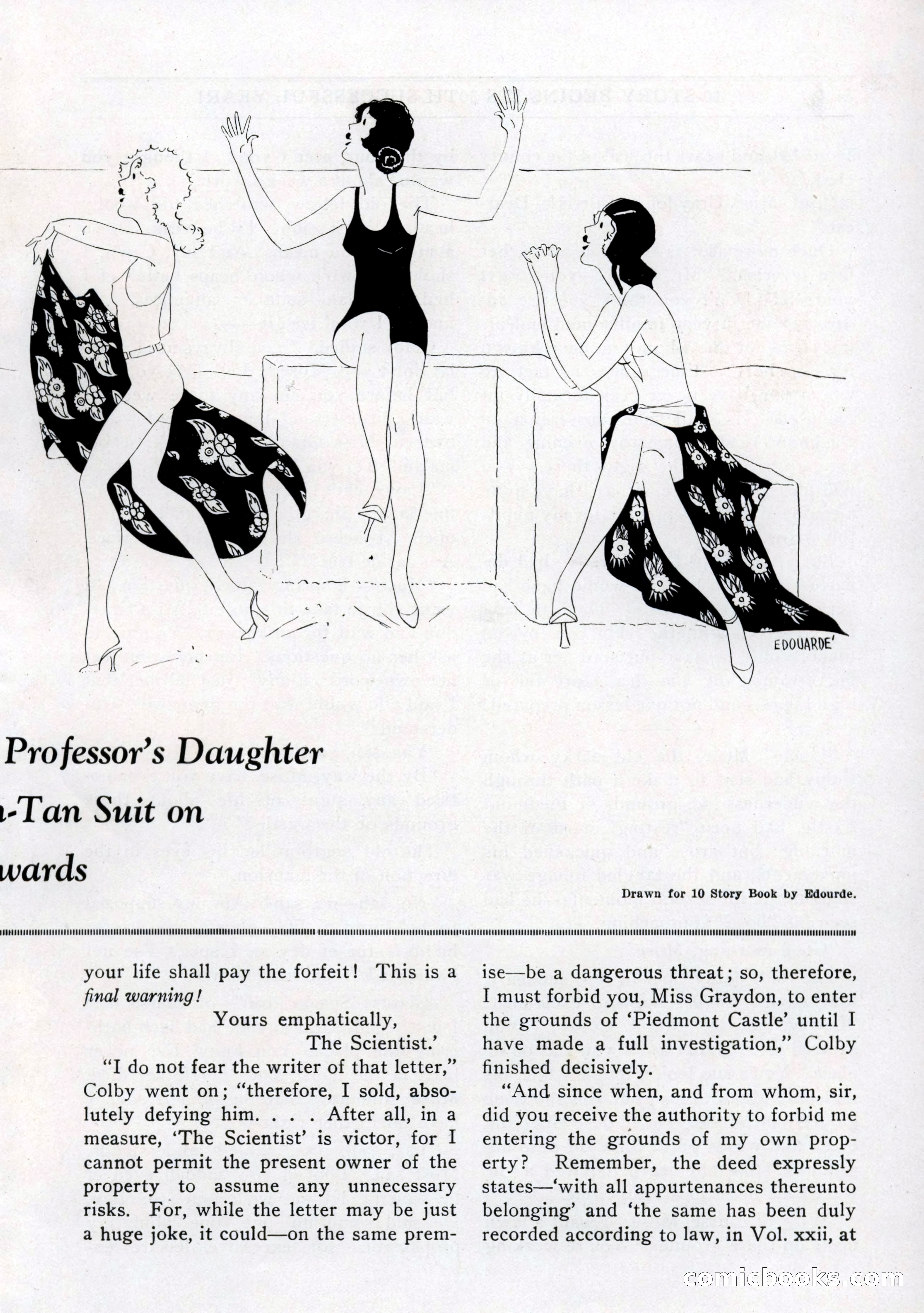
# Page Description This is an interior story illustration and prose page from a pulp magazine. The top features an art deco-style drawing by Edouarde showing three women in 1920s-style bathing suits and decorative wraps, titled "Professor's Daughter" and referencing a "Sun-Tan Suit on wards." The prose below depicts a dialogue between characters named Colby and Miss Graydon regarding a threatening letter from someone called "The Scientist." Colby has apparently purchased property and refuses to be intimidated by warnings, while asserting his legal ownership rights to the grounds of what appears to be "Piedmont Castle." The passage emphasizes property deed documentation.
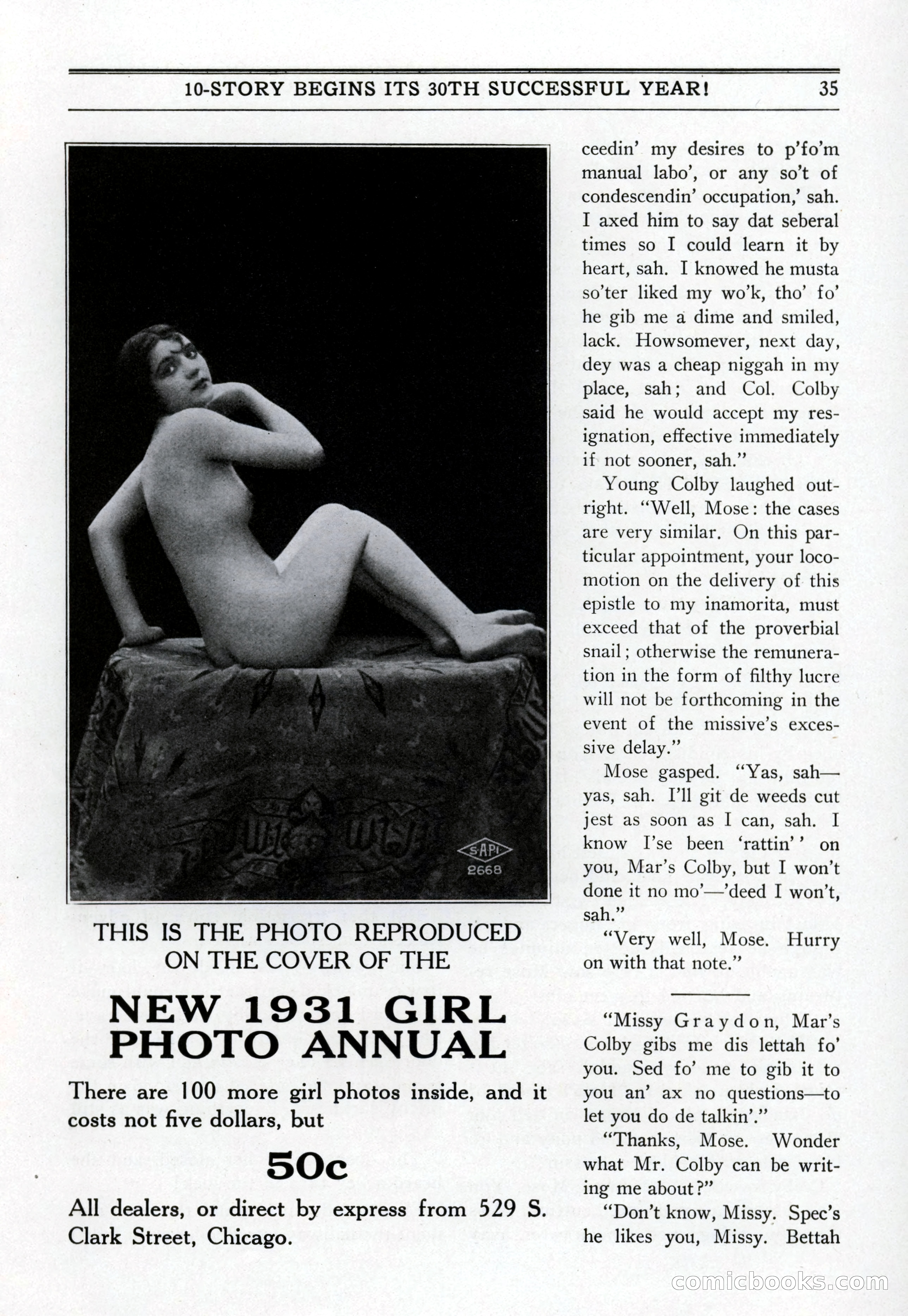
# Page Description This page contains an advertisement for the "New 1931 Girl Photo Annual," featuring a black-and-white photograph of a nude woman in a reclining pose. The ad emphasizes the publication contains "100 more girl photos inside" and costs 50 cents, available through dealers or by direct mail from Chicago. The right side of the page shows story prose in which characters named Mose, Young Colby, and Missy Graydon exchange dialogue. The conversation appears to involve Mose delivering a note and discussing payment, with Colby making remarks about Mose's slow delivery speed. The text uses dialect spelling typical of pulp fiction narratives from this era.
# Page 36: Story Prose This page contains story prose with no illustrations. The narrative depicts a mysterious nighttime scene at Piedmont Castle, where a character named Dorris Graydon approaches the old building despite warnings. After receiving a cautionary letter from Milan D. Colby, Jr., and instructions delivered through a servant named Mose, Graydon attempts to enter the castle. The passage builds suspense as she finds the door unlocked, enters the dark interior, and then hears a key turn in the lock behind her, followed by light flooding the hallway. The story appears to be a mystery or gothic tale involving trespassing and potentially dangerous circumstances.
# Page 37: Story Prose This page contains prose fiction—the continuation of a serialized story. The text describes a young woman named Dorris who has been kidnapped and locked in a barred room by a mysterious masked figure. She initially mistakes him for someone named Mr. Colby, but realizes he is a stranger with sinister intentions. The captor reveals he wants the property where she is held and claims he was advised by "Napoleon Bonaparte" to conquer the location. He indicates he intends to use her as a "subject for my most marvelous scientific work." The narrative focuses on Dorris's fear and attempts to escape.
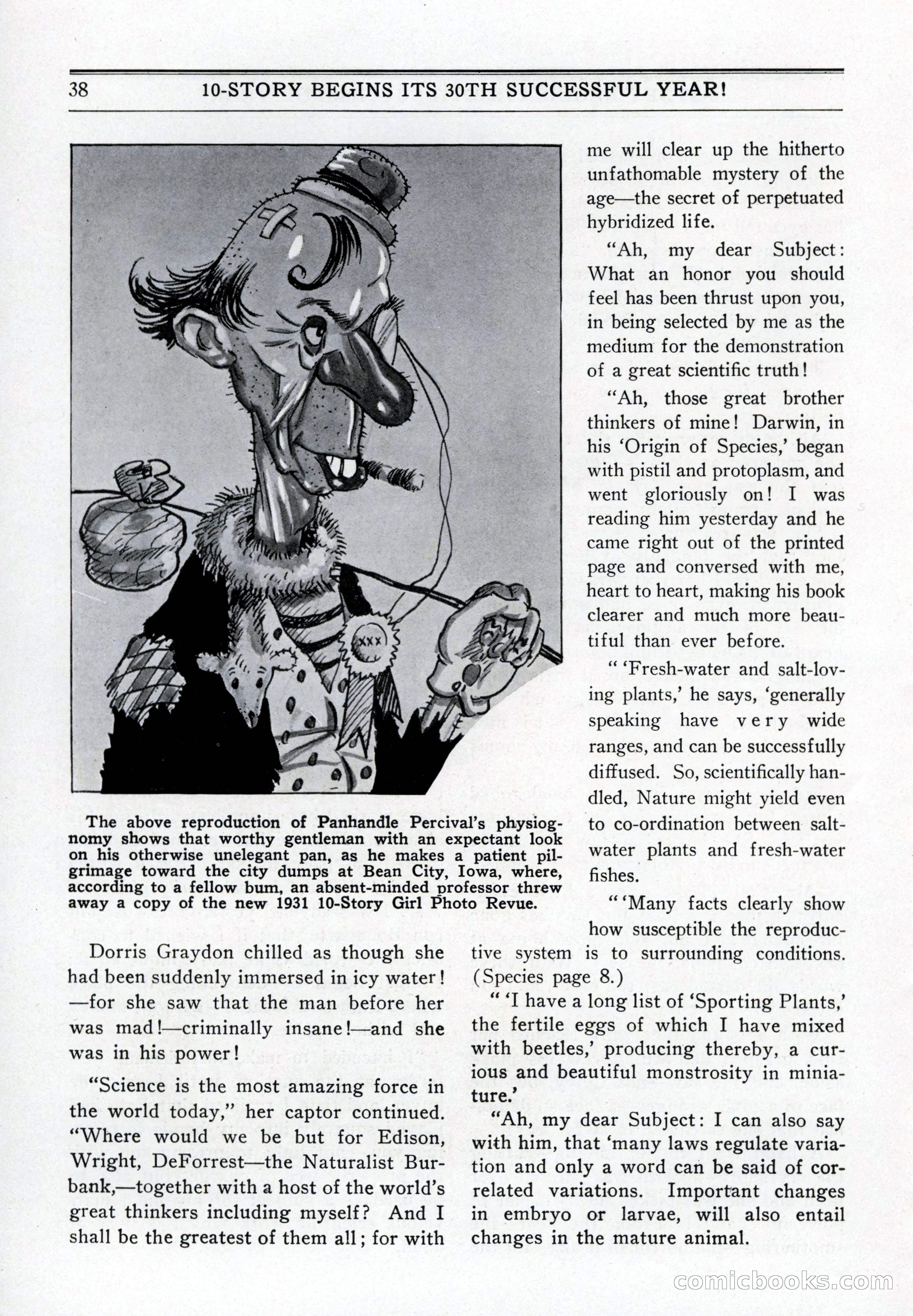
# Page 38 of 10-Story Magazine This is an interior story page featuring a satirical cartoon illustration of "Panhandle Percival's physiognomy" — a caricatured gentleman with an exaggerated expression, apparently heading toward Iowa's Bean City dumps. The accompanying prose depicts a mad scientist explaining to his captive subject Dorris Graydon that science is the greatest force in the world. The scientist rambles about great thinkers like Edison and Darwin, then discusses his bizarre experiments involving plants, beetles, and hybridized reproduction. The text suggests this is pulp science fiction with horror elements, though the exact story title and author remain unclear from this excerpt alone.
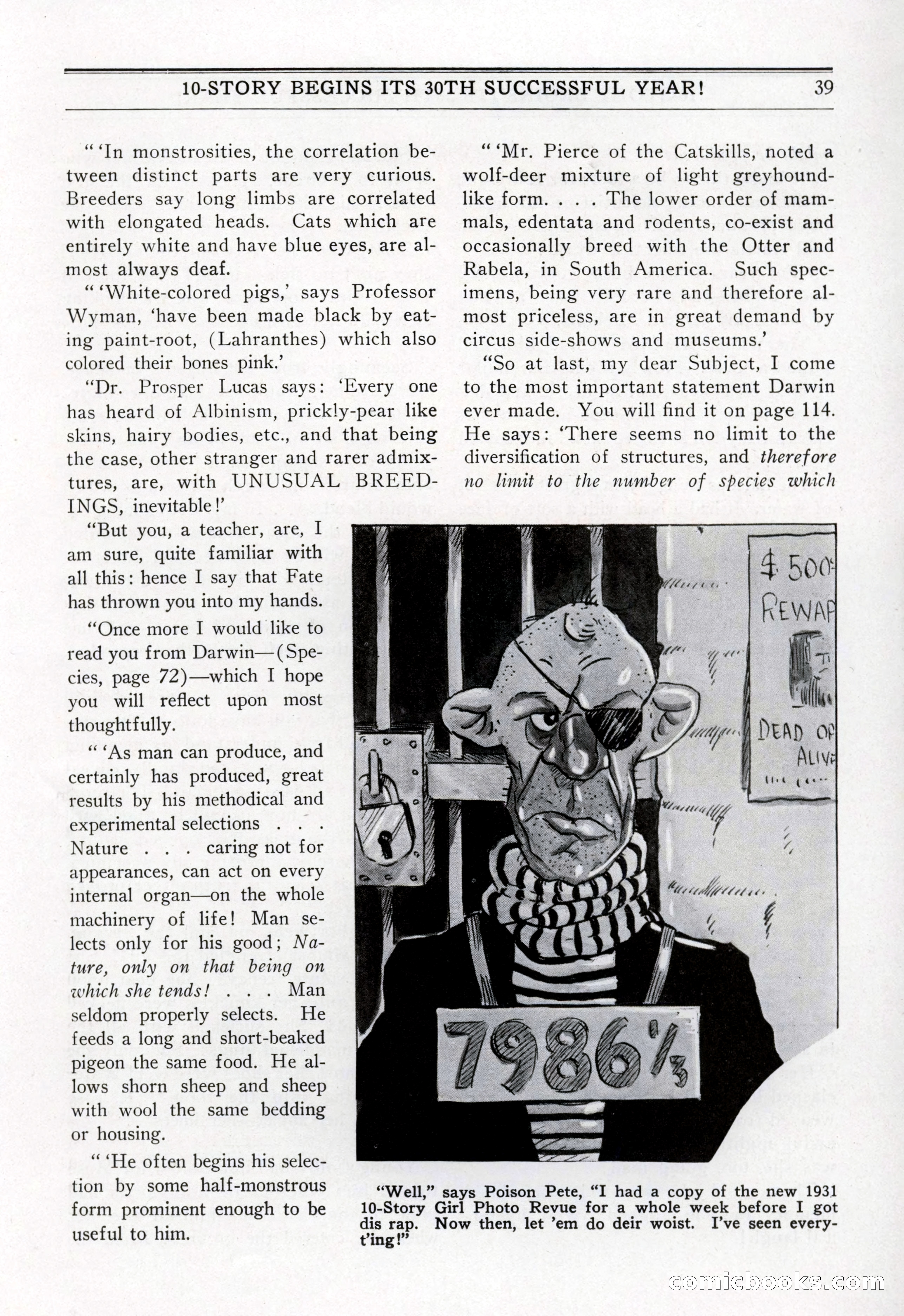
# Page Analysis This is a text page from a pulp magazine, primarily containing prose narrative. The visible text discusses Darwin's theories on biological diversity and species development, with quotes from various naturalists about unusual animal characteristics and breeding. An illustration on the right shows a grotesque carnival or sideshow figure with exaggerated features, wearing striped clothing, labeled "1986½" with a "$500 REWARD DEAD OR ALIVE" sign visible. A caption below the illustration references "Poison Pete" commenting on the 1931 10-Story Girl Photo Revue magazine. The page number indicates this is page 39 of the publication.
# Analysis This is a text-only page of prose fiction from a pulp magazine. The visible story depicts a mad scientist revealing his hybrid creature—a grotesque amalgamation of animal and human parts suspended in a glass vat of water—to a horrified female character named Dorris Graydon. The narrative then shifts to describe Dorris being trapped in a flooding chamber as part of the scientist's experiment, intercut with observations about a character named Young Colby witnessing her entry onto grounds. The prose employs dramatic, sensationalistic language typical of early pulp horror-science fiction, focusing on the grotesque creature's appearance and the mounting danger confronting the female protagonist.
# Page 41: Story Prose This page contains prose fiction from what appears to be a science-fiction or horror pulp story. The narrative describes an intense confrontation in which a man named Colby fights a monstrous creature—described as a reptilian "Terror" or "fiend"—that has imprisoned a girl named Dorris in a castle. The passage details violent combat between Colby and the beast, Colby's rescue of the unconscious girl, and ultimately the creature's destruction by explosion. The text mentions the "Scientist" and a "Frankenstein" are killed in the blast. The story concludes with Colby and Miss Graydon escaping with a water-moccasin that miraculously survived, though the snake subsequently kills them both.
# Page Analysis This is a story prose page from a pulp magazine, specifically the continuation of a story titled "Two Gentlemen at 40" (noted as continuing from page 27). The page contains two columns of text depicting a reunion between two middle-aged men, Peter Austin and Michael Bourne. The narrative focuses on their conversation as Michael visits Peter's home, their discussion of old photographs, and Michael's discovery of a photograph signed by someone named Robert. The prose explores themes of aging, nostalgia, and subtle romantic tension beneath their polite reunion dialogue. The page number is 42, and the magazine's header indicates this is the 30th year of publication for "10-Story" magazine.
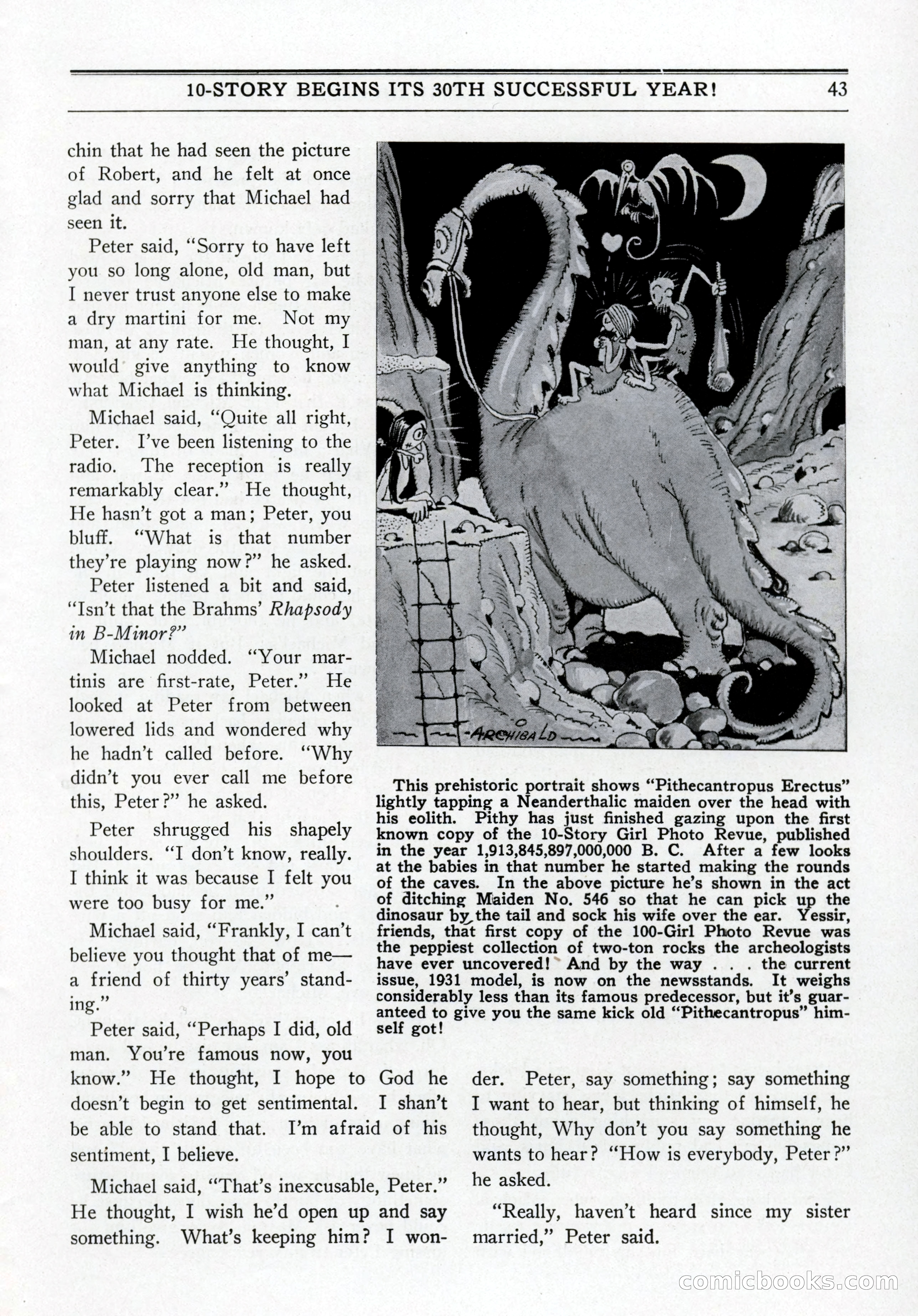
# Page 43: Story Prose with Illustration This page contains interior fiction prose alongside a black-and-white illustration. The story depicts a dialogue between two characters named Michael and Peter, with Michael apparently famous and Peter feeling he's been neglected. The conversation turns to martinis and radio reception. The illustration shows what the caption identifies as "Pitheacanthropus Erectus"—a prehistoric creature examining a Neanderthal maiden in a cave setting. The caption includes whimsical text about a "100-Girl Photo Revue" from the year 1,913,845,897,000,000 B.C., appearing to be humorous pulp-magazine content blending fiction with absurdist humor about prehistoric times.
# Page 44: Story Prose This page contains prose fiction text from what appears to be a romantic drama or literary story. The narrative depicts a conversation between two men named Michael and Peter, who appear to be reconnecting after years apart. Peter visits Michael at a hotel, and they discuss Michael's published works and Peter's ownership of copies. The passage explores Michael's internal conflict about his past relationship with Peter—he recalls an old kiss and struggles with whether to maintain distance or reconnect. The text suggests complex emotional history between the characters, touching on themes of love, regret, and difficult choices about relationships.
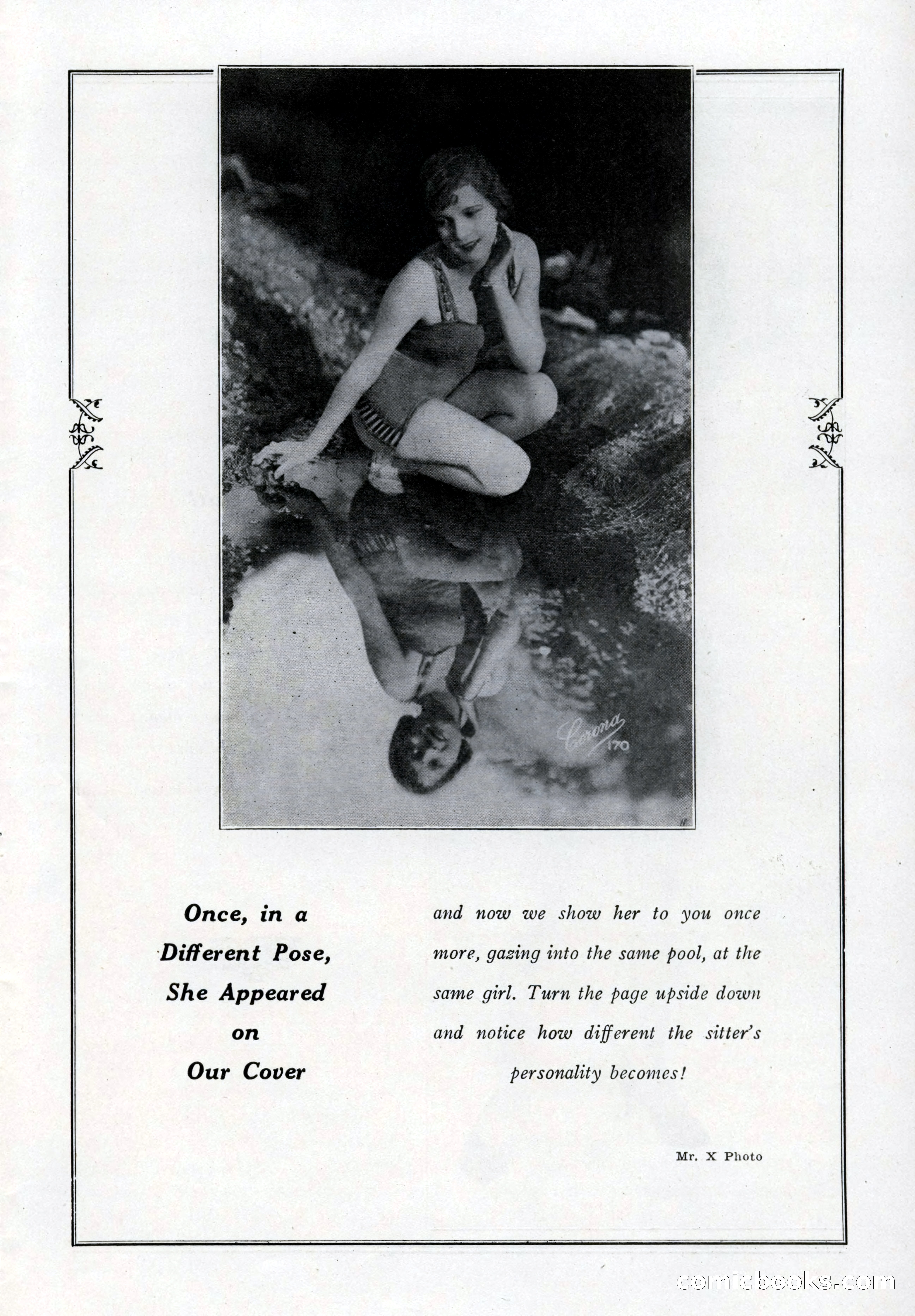
# Page Description This is an advertisement page from an early-20th-century pulp magazine. It features a black-and-white photograph of a woman in a bathing suit posing by what appears to be a pool or water feature, shown in two orientations to demonstrate how the same image appears different depending on perspective. The accompanying text suggests this is promotional material highlighting how changing one's pose or perspective can dramatically alter one's appearance or "personality." The page credits "Mr. X Photo" at the bottom. The layout uses decorative borders typical of pulp-era magazine design. The ad appears designed to showcase photographic techniques or demonstrate visual perception principles to readers.
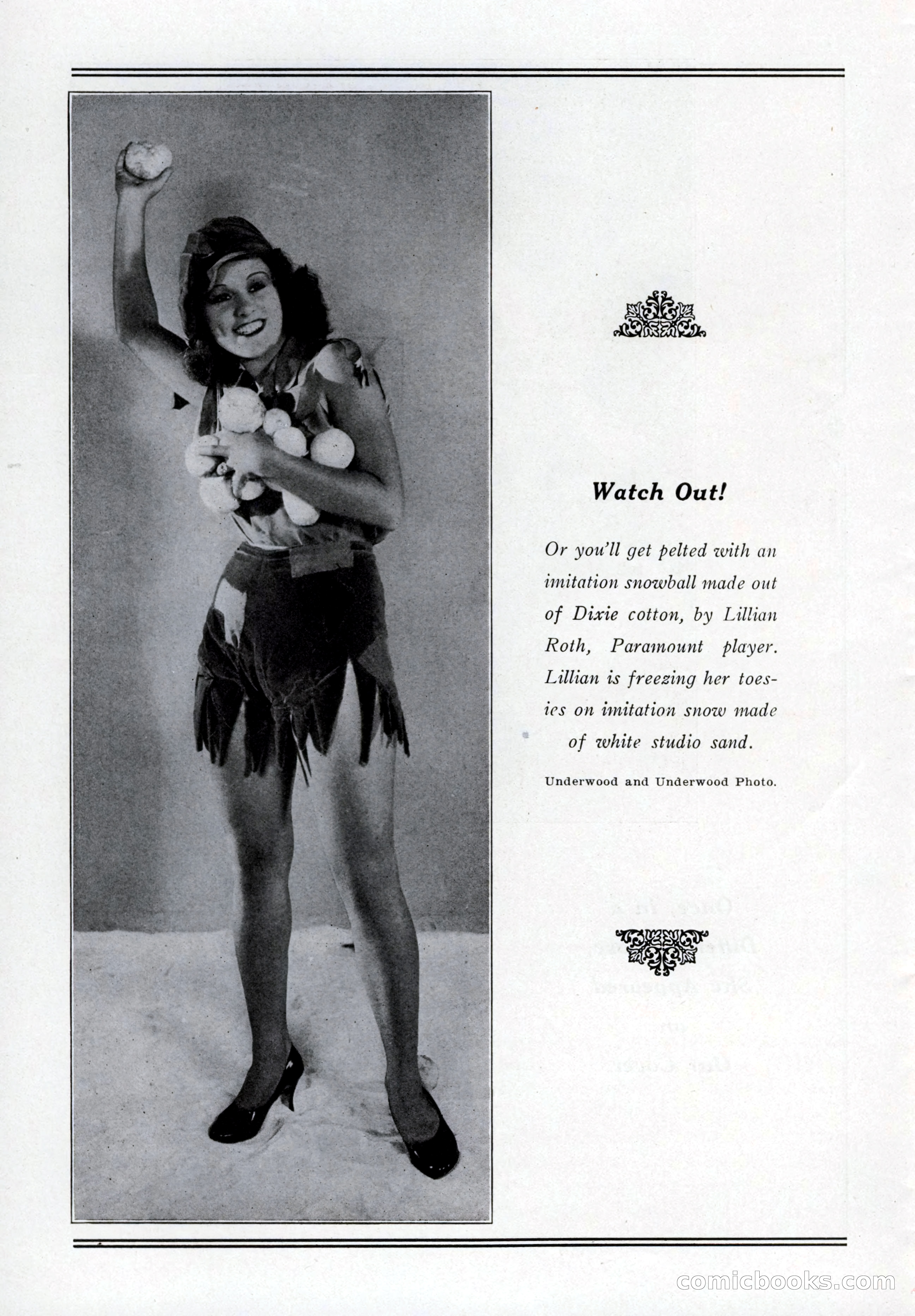
# Page Analysis This is an advertisement page featuring a full-length photograph of a woman in a tropical or island-themed costume, holding what appears to be imitation snowballs. The headline "Watch Out!" warns readers that they might be pelted with an imitation snowball made of Dixie cotton, attributed to Lillian Roth, identified as a Paramount player. The accompanying text notes that Lillian is freezing her toes on imitation snow made of white studio sand. The photograph credit reads "Underwood and Underwood Photo." This appears to be a promotional advertisement, likely for a Paramount film or publicity campaign.
# Page Content Description This is a story prose page from a pulp magazine featuring "Somebody Home: A 'Pete Paddley' Story" by Artemus Calloway. The page includes a small illustration at the top showing an elderly man's head in profile, smoking a pipe. The text depicts Pete, an older man, listening to Crystal Eubanks, a young woman from Mobile, Alabama, tell him about African American workers on fruit plantations in Central America. The narrative uses heavy dialect throughout. Pete then walks home to Tela, Honduras, reflecting on their conversation and observing the local scenery and animals around him. The story appears to be set in early-20th-century Central America and deals with themes of labor and racial identity.
# Page Analysis This is a **story prose page** from a pulp magazine, containing two continuous narrative sections about characters named Goodtimes and Pete in a place called Tela. The visible text depicts a dialogue-heavy scene where Pete confronts Goodtimes about locating a man named Potlicker Dan, who apparently owes Pete money. The narrative then shifts to explain Goodtimes' history—he was formerly employed as a bartender in a railroad saloon before the current proprietor fired him and "robbed" him of his girl. The page concludes by noting Pete's dislike of Goodtimes' dishonest nature and crooked gambling practices. The writing style and dialect suggest this is **hardboiled crime fiction**, likely from the early-to-mid 20th century.
This page contains story prose from a pulp magazine. The text depicts a conversation between characters named Pete, Kid Scoot, and Goodtimes Harris about money troubles and romantic entanglements. Pete owes Goodtimes money on a mortgage for a piece of land he owns near Tela, and the debt is coming due. The passage includes dialect-heavy dialogue where characters discuss Goodtimes' plans to marry a woman named Miss Crystal Eubanks to gain access to her savings, and mention of a man called Potlicker Dan. The narrative appears to be crime or adventure fiction set in a Caribbean or tropical location, though the exact genre and story title are not visible on this page.
# Page Analysis This is a story prose page (page 51) from what appears to be a pulp fiction magazine's 30th anniversary issue. The text continues a narrative involving characters named Pete, Goodtimes, Kid Scoot, and Potlicker Dan. The story concerns a deal where Pete agrees to locate and deliver Potlicker Dan in exchange for two hundred dollars from Goodtimes, with the agreement documented by clerk Phil Rozier. Kid Scoot learns of this arrangement and becomes angry, apparently viewing Goodtimes as disloyal. The narrative suggests Kid Scoot is "near crazy" and that Goodtimes is an experienced trader in the region who knows its inhabitants and geography well.
This page contains story prose from what appears to be a pulp fiction magazine celebrating its 30th year of publication. The text depicts a scene in Phil Rozier's office where multiple characters—including Goodtimes Harris, Pete, Kid Scoot, Crystal, and Potlicker Dan—negotiate over land ownership and money. The dialogue uses heavy dialect and describes a complex financial arrangement involving the sale of land, with characters discussing payments and debts. The prose is written in a colloquial style characteristic of early-20th-century pulp fiction, focusing on what appears to be a crime or con-related narrative involving these working-class or criminal characters.
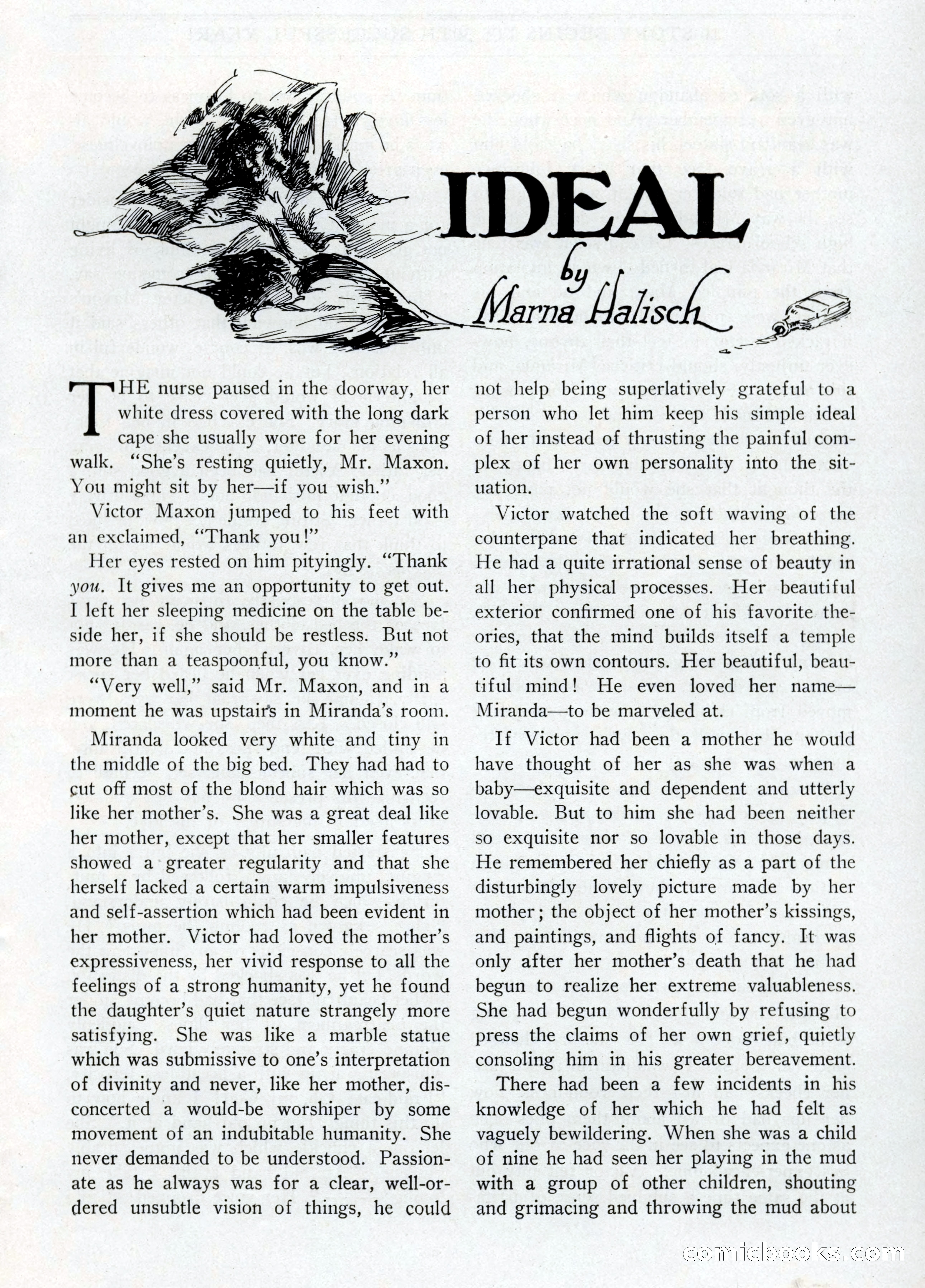
This page contains story prose from "Ideal" by Marna Halisch. The text describes a nurse entering a sickroom where a man named Victor Maxon sits with an ill woman named Miranda. The passage details Victor's reflections on Miranda's character and appearance—comparing her to her mother, whom he had loved for her expressiveness. The narrator notes Victor's appreciation for Miranda's quiet, marble-like nature and her dignified restraint, contrasting this with his recent realization of her value following her mother's death. The text explores Victor's complex feelings and a few childhood memories of Miranda.
# Page Analysis This is a text-only page (page 54) from a pulp fiction magazine titled "10-STORY BEGINS ITS 30TH SUCCESSFUL YEAR!" The page contains prose narrative focusing on a character named Victor and his ill daughter Miranda. The story depicts Victor sitting beside his feverish daughter's bedside, observing how her illness has changed her appearance—her face has become gaunt and aged. The passage describes his tender concern for her and her delirious state, including her whispered remarks and unexpected laughter. The narrative emphasizes Victor's emotional response to witnessing his daughter's physical deterioration during her illness.
# Page 55: Story Prose with Advertisement This page contains the continuation of a narrative story in prose form. The text depicts a dramatic scene between two characters—a fevered woman named Miranda and a man (apparently her father) who is troubled by her delirious utterances and physical condition. The passage explores his conflicted emotions regarding her illness and his imagined future anxieties. At the bottom of the page appears a small advertisement headlined "Those Things Happen—Be Careful Next Time, John," advertising a trade of a love hammock for a twin baby carriage, attributed to John C. Gambell of Sites, California, and credited as taken from a Trade magazine.
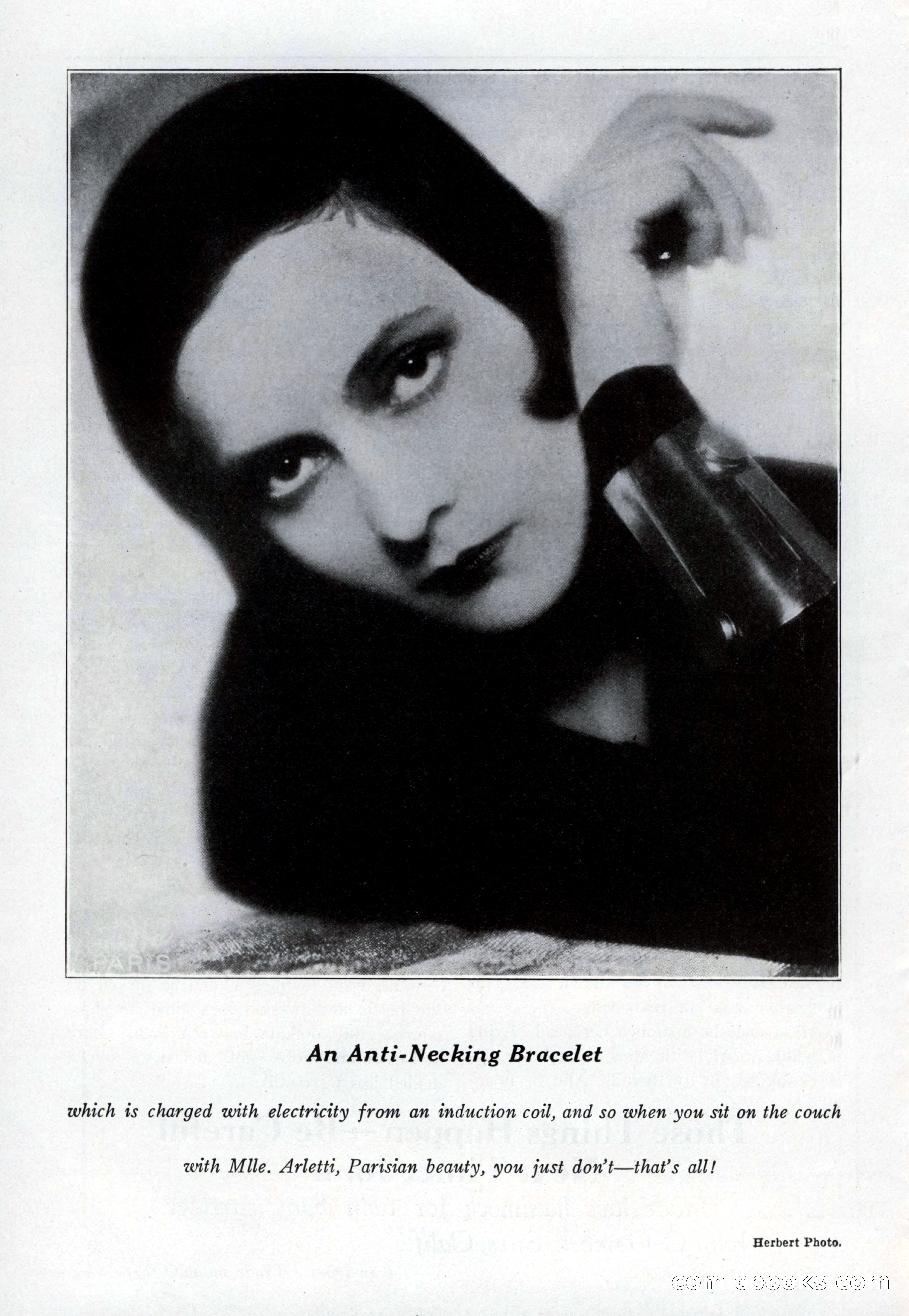
# Page Description This is an illustrated advertisement page from an early-20th-century pulp magazine. The black-and-white photograph shows a woman wearing what appears to be an ornate bracelet, positioned in a glamorous pose typical of period advertising. The caption describes "An Anti-Necking Bracelet" that is "charged with electricity from an induction coil," claiming it prevents unwanted physical contact when sitting on a couch. The text humorously suggests this device preserves the virtue of "Mile. Arletti, Parisian beauty." The page appears to advertise a novelty item with tongue-in-cheek humor typical of pulp magazine advertising. The "Herbert Photo" credit is visible at bottom right.
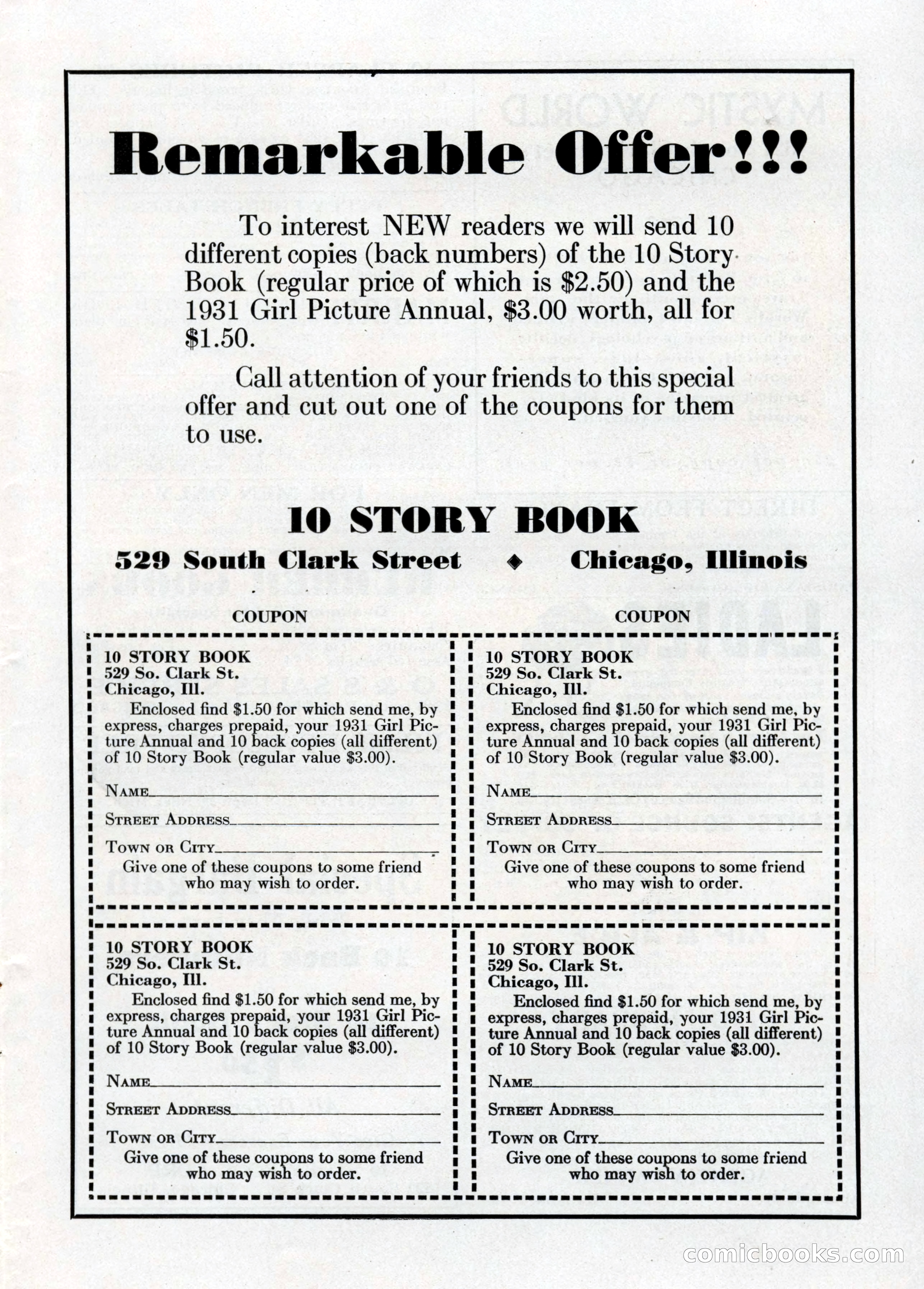
# Advertisement Page This page is a magazine advertisement for the "10 Story Book," a pulp publication based in Chicago, Illinois. The ad promotes a special offer to new readers: for $1.50, customers can receive 10 different back-number copies of the 10 Story Book (regularly $2.50 each) plus a 1931 Girl Picture Annual (worth $3.00). The page consists entirely of four identical coupons with tear-out perforations, each containing the offer details and spaces for the reader's name, street address, and town or city. The coupons encourage recipients to share extras with friends who might want to order.
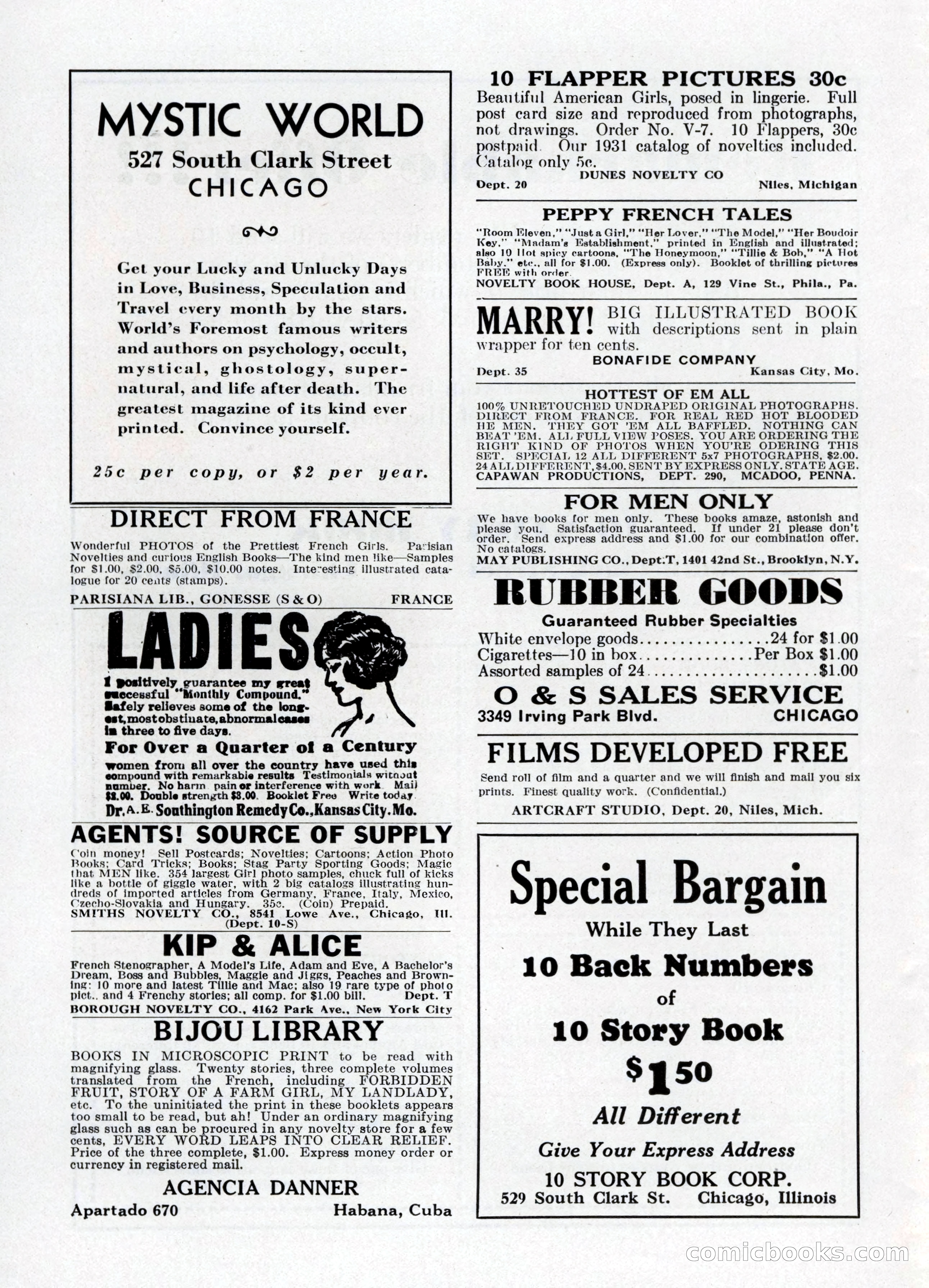
This is an advertising page from a pulp magazine, filled entirely with classified advertisements and mail-order offers. The ads promote various products and services: occult magazines and books from Mystic World (Chicago); French photographs and novelties; illustrated books about romance and relationships; rubber goods; film development services; and other mail-order items. Most advertisements cost between 25 cents and $2, with many offering photographs, books, or curiosities. The page represents typical pulp-magazine monetization through back-page classified ads targeting readers interested in occult subjects, romance, photography, and novelty items. The companies listed are scattered across America, from Chicago to New York to Cuba.
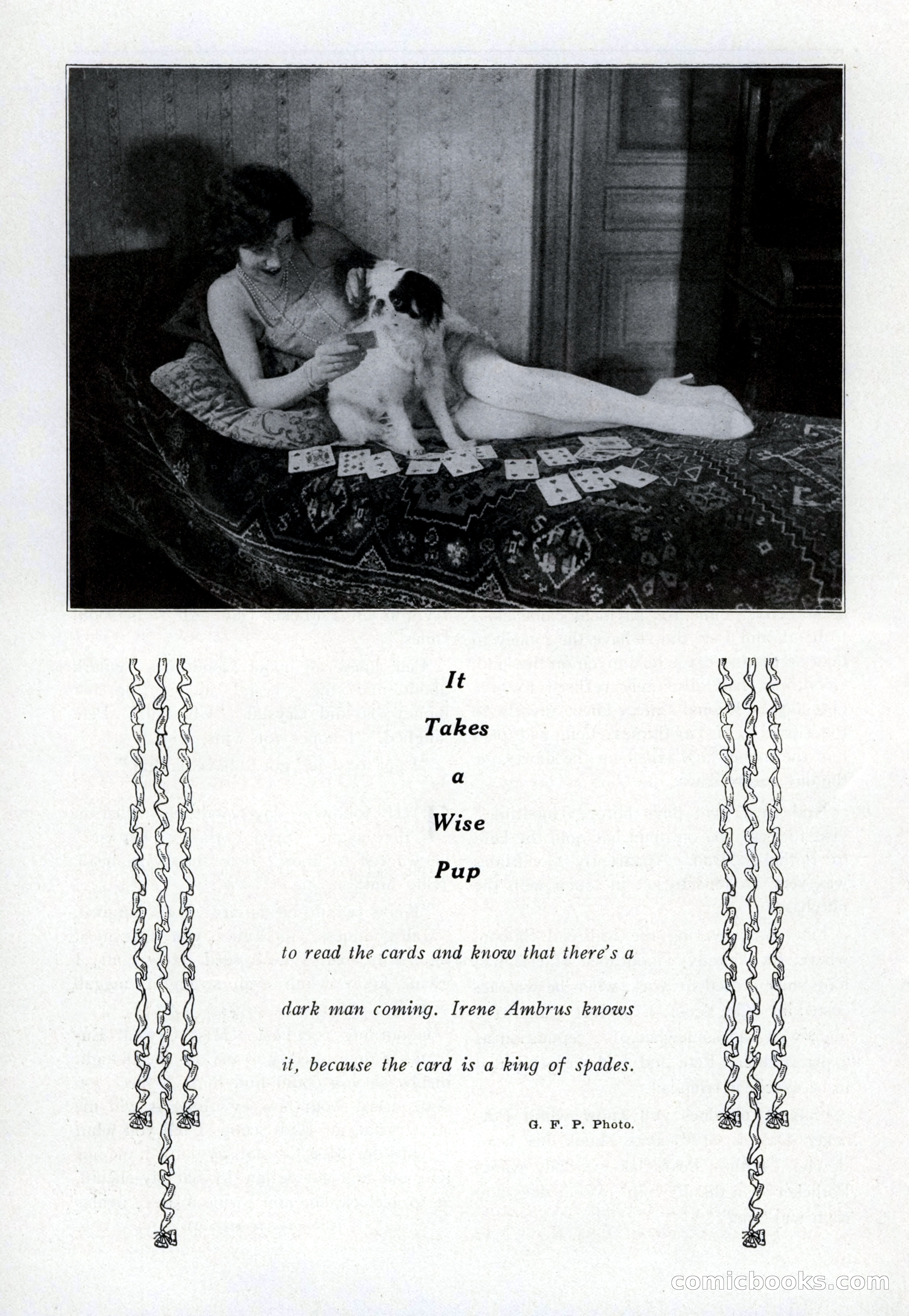
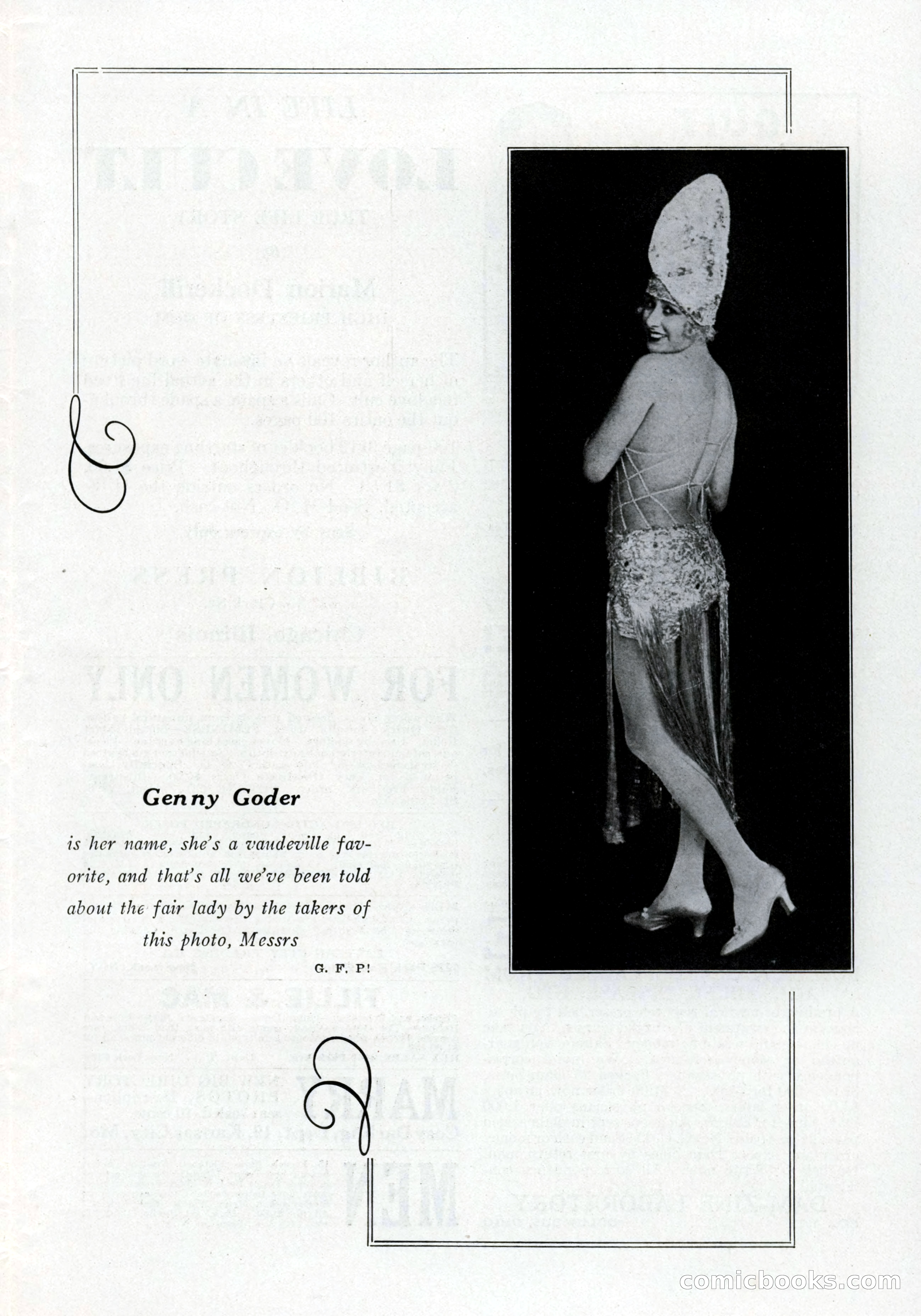
# Page Description This is an advertisement or promotional page featuring a black-and-white photograph of a performer named Genny Goder in vaudeville costume. She wears an elaborate headdress and a beaded, fringed performance outfit, photographed from behind in a theatrical pose. The accompanying text identifies her as "a vaudeville favorite" and notes that the photograph was taken by "Messrs" (a photography studio), though the text cryptically states that's "all we've been told about the fair lady." The page includes decorative flourishes and is signed "G. F. P!" The content appears designed to promote or showcase the performer within the magazine.
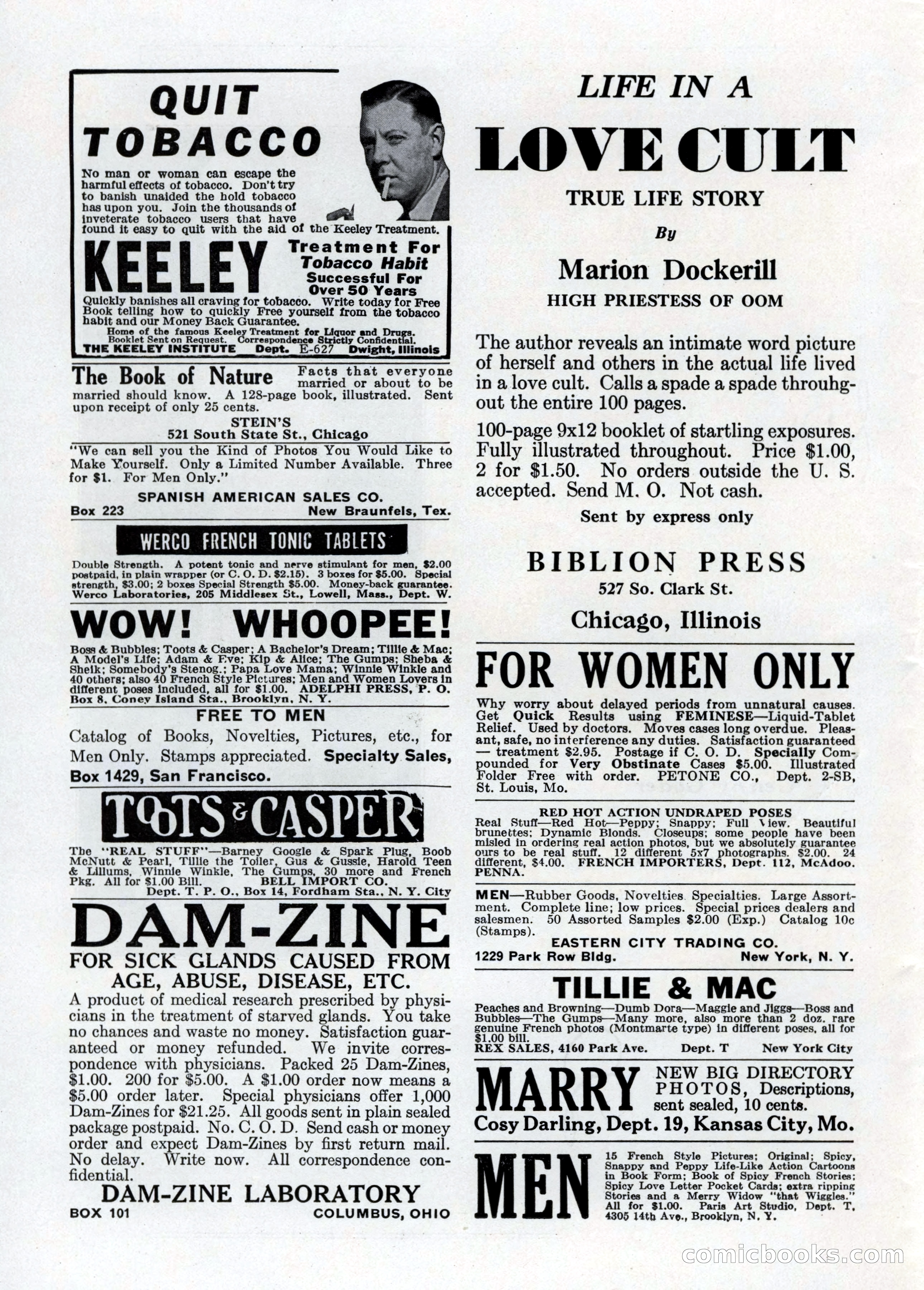
This page is primarily a collection of classified advertisements and mail-order product listings, not story content. The ads promote various dubious products and services typical of early pulp magazines, including tobacco cessation treatments, books on intimate subjects, photographs, tonics, and other items marketed to men and women separately. Notable advertisements include the "Keeley Treatment" for tobacco habits, "Dam-Zine" for glandular issues, and various photograph catalogs. The layout features multiple competing advertisements in different font sizes. There are no illustrations or narrative prose visible—this appears to be a typical back-page or interior advertising section from a pulp magazine designed to generate revenue through mail-order sales pitches.
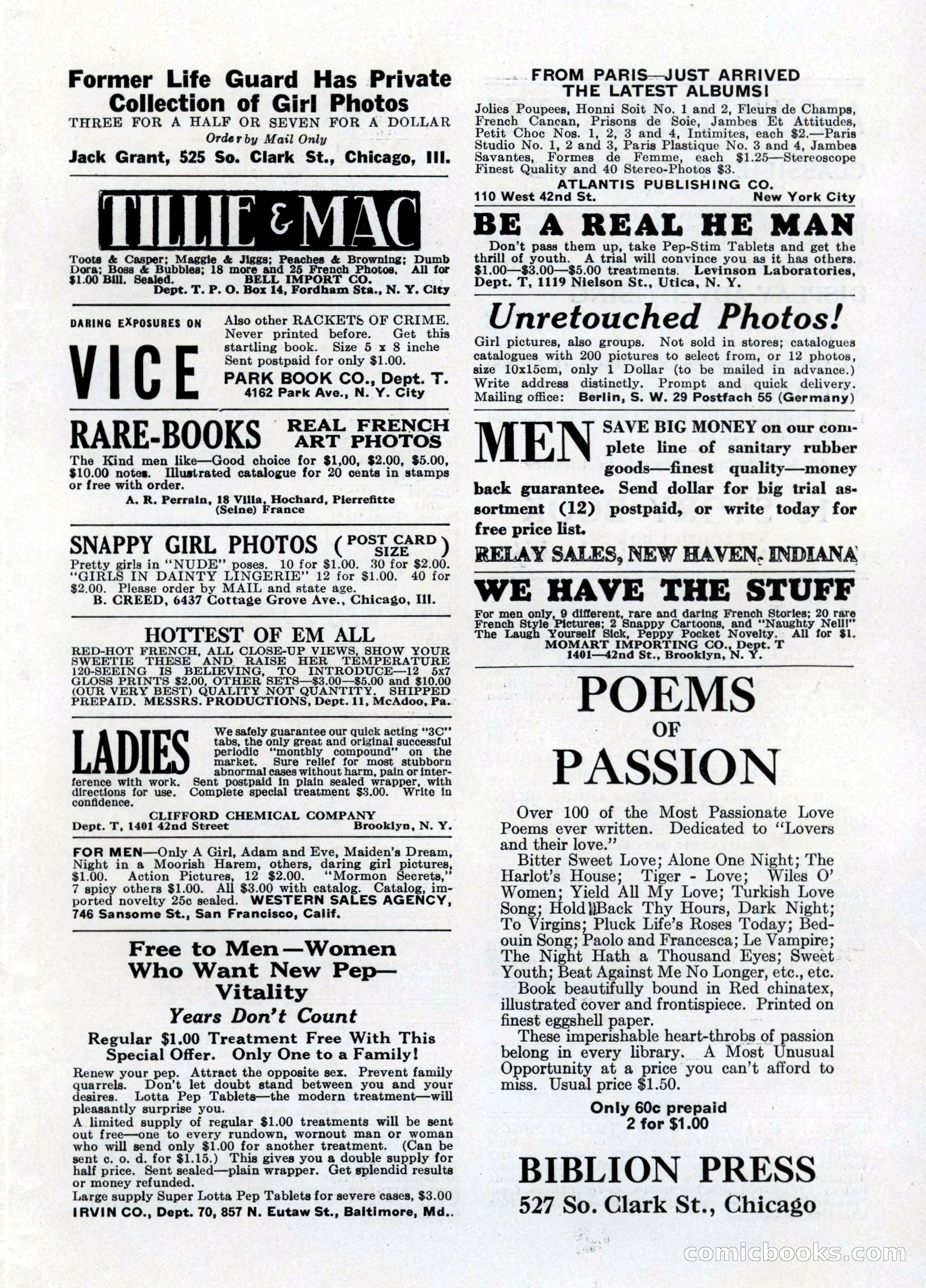
# Page Description This is an **advertising page** from an early-20th-century pulp magazine. The page contains numerous classified advertisements and mail-order offers, typical of pulp publications from this era. The visible ads promote various items including: photograph collections ("Tillie & Mac," "Vice," "Real French Art Photos"), books ("Poems of Passion" by Biblion Press), novelty items, and various products marketed toward male readers. Several ads appear to offer risqué or adult-oriented materials common to pulp magazines of the period. The layout is dense with small-print classified listings arranged in columns, characteristic of monetization strategies used by pulp publishers to generate additional revenue beyond subscription fees.
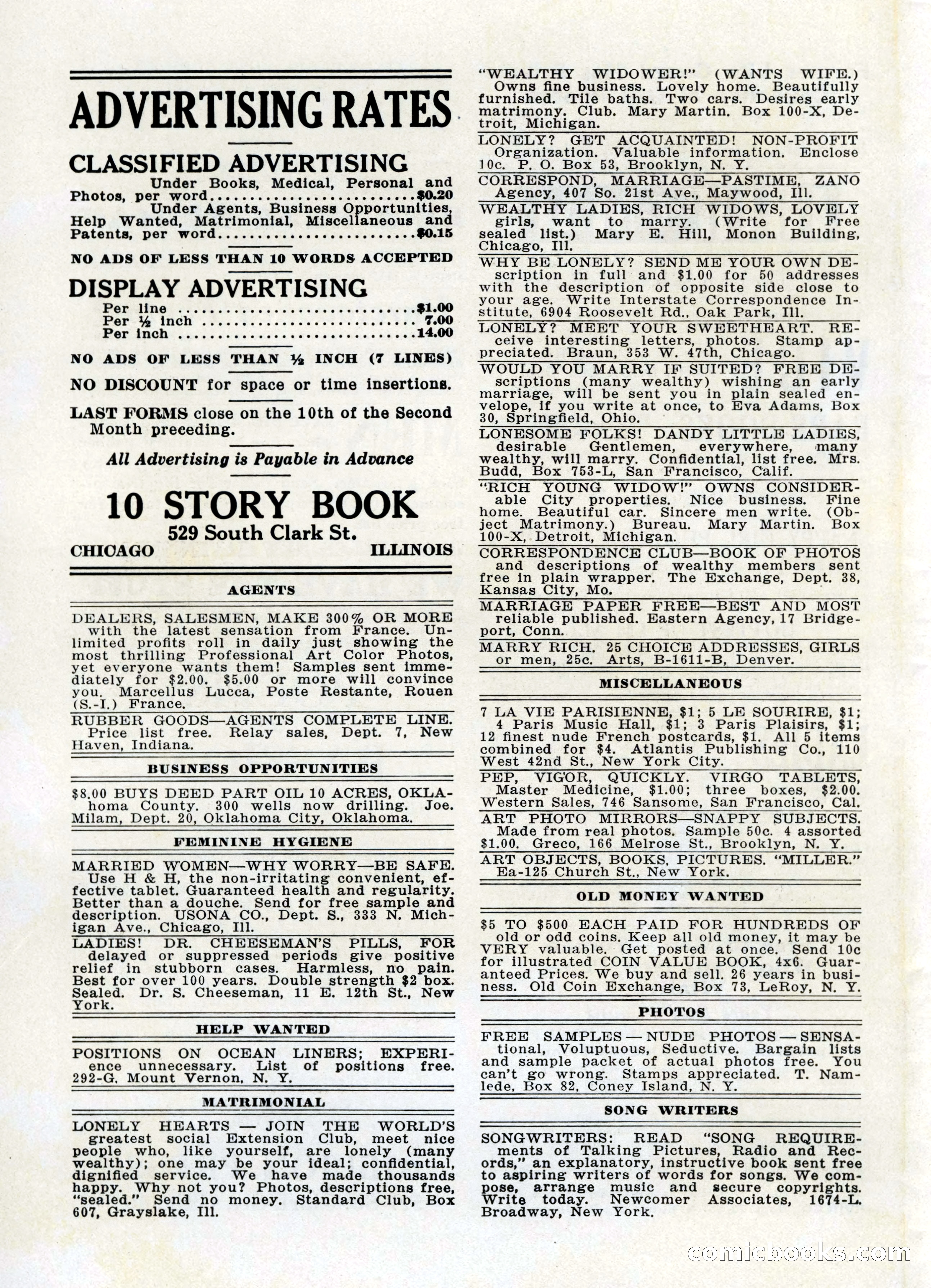
This page is entirely advertising and rates information from a pulp magazine. The top section displays classified and display advertising rates for "10 Story Book," published in Chicago, Illinois at 529 South Clark Street. Below that are various classified advertisements organized by category: agents offering business opportunities, feminine hygiene products, help wanted positions, matrimonial/lonely hearts services (seeking wealthy spouses), miscellaneous items for sale, old coins wanted, photographs, and songwriting services. The ads suggest this was a general-interest pulp magazine that accepted personals and small-business advertising alongside its fiction content.
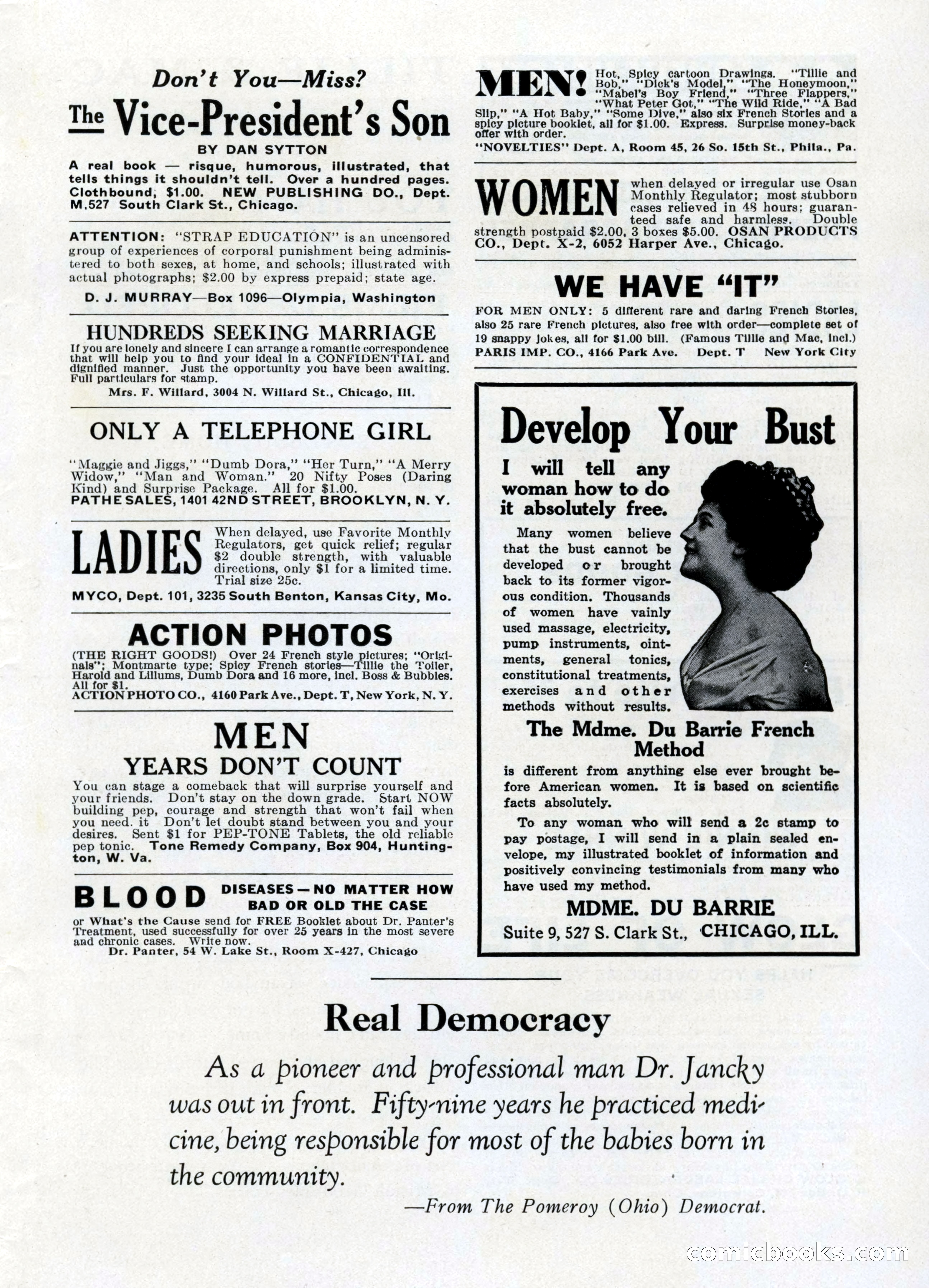
This is an **advertising page** from an early-20th-century pulp magazine, containing classified advertisements and display ads rather than story content. The page features numerous mail-order advertisements targeting readers seeking romance correspondence, physical development products, photographs, medical treatments, and various self-improvement services. Notable ads include "The Vice-President's Son" (a book), marriage correspondence services, French photographs and stories, a "Develop Your Bust" service by Mdme. Du Barrie promising free bust development advice, and medical treatments for various conditions. At the bottom, there's a brief editorial item about a Dr. Jancky, a physician. The advertisements reflect common pulp-magazine commerce of the era, targeting lonely readers and those seeking remedies or self-improvement.
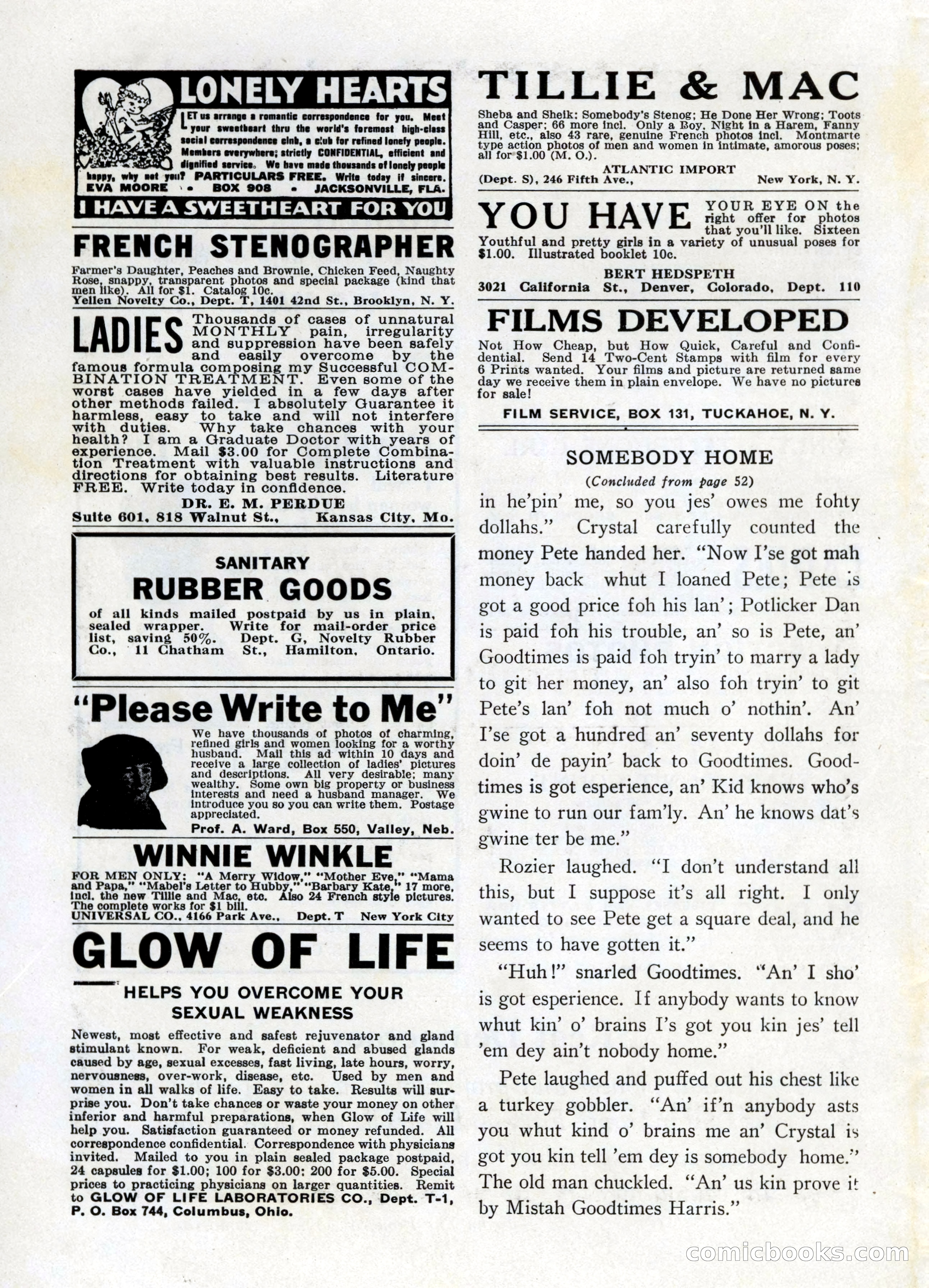
# Page Content Analysis This page is primarily **advertising and classified notices** on the left side, with **story prose** on the right. The left column contains various mail-order advertisements typical of early pulp magazines, including personal correspondence services ("Lonely Hearts"), French stenographer photos, a "Ladies" remedy product, rubber goods, and questionable medical/sexual enhancement products like "Glow of Life." The right side continues a story titled "**Somebody Home**" (concluded from page 52), depicting dialogue between characters named Crystal, Pete, Rozier, and Goodtimes discussing money owed, family matters, and what appears to be rural or working-class domestic affairs. The conversation is rendered in vernacular dialect. The page represents typical pulp-magazine layout: editorial content paired with exploitative classified advertising.
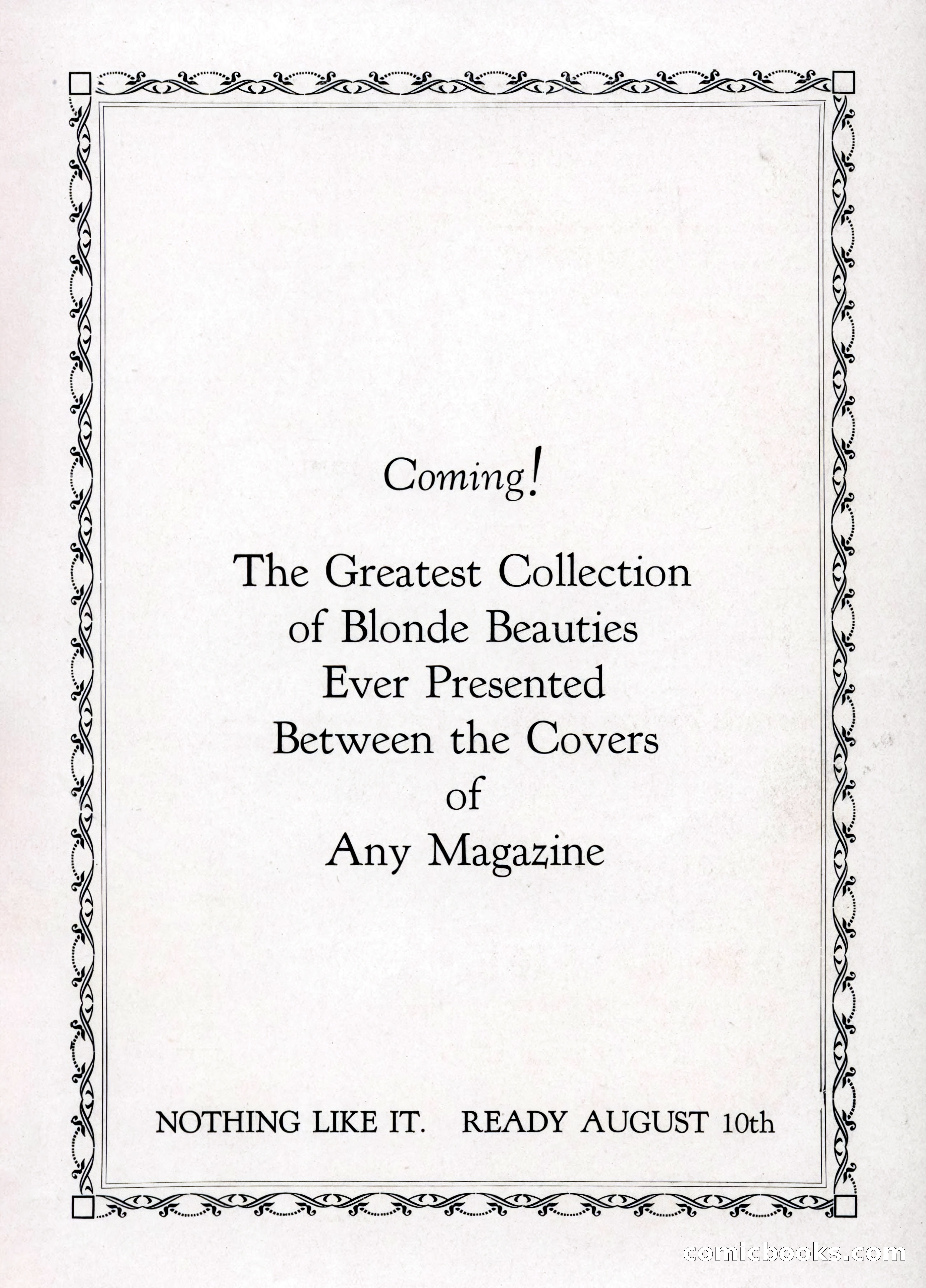
# Analysis This is an advertisement page (likely from inside a pulp magazine) with an ornate decorative border. The visible text announces an upcoming publication: "Coming! The Greatest Collection of Blonde Beauties Ever Presented Between the Covers of Any Magazine." The ad promises this collection will be "Nothing Like It" and states it will be "Ready August 10th." The advertisement uses formal typography and layout typical of early-20th-century pulp magazine promotions, clearly designed to entice readers about a forthcoming special issue or publication focused on photographs or illustrations of blonde women.
# Page Description This is a black-and-white photograph—likely a promotional or publicity portrait rather than story illustration—showing a smiling woman wearing a light-colored cloche hat and turtleneck, styled in the fashion of the 1920s-1930s era. The image quality and composition suggest it may be a magazine cover or frontispiece rather than interior story art. The OCR text provided is minimal and contains only a watermark attribution ("comicbooks.com"), offering no visible story content, headline, or caption to analyze. Without legible accompanying text on the page itself, the specific subject matter cannot be determined from what's shown.