
Pulp Fiction, 1931 · page 20 of 68
10-Story Book, July 1931 — page 20: what you’re looking at
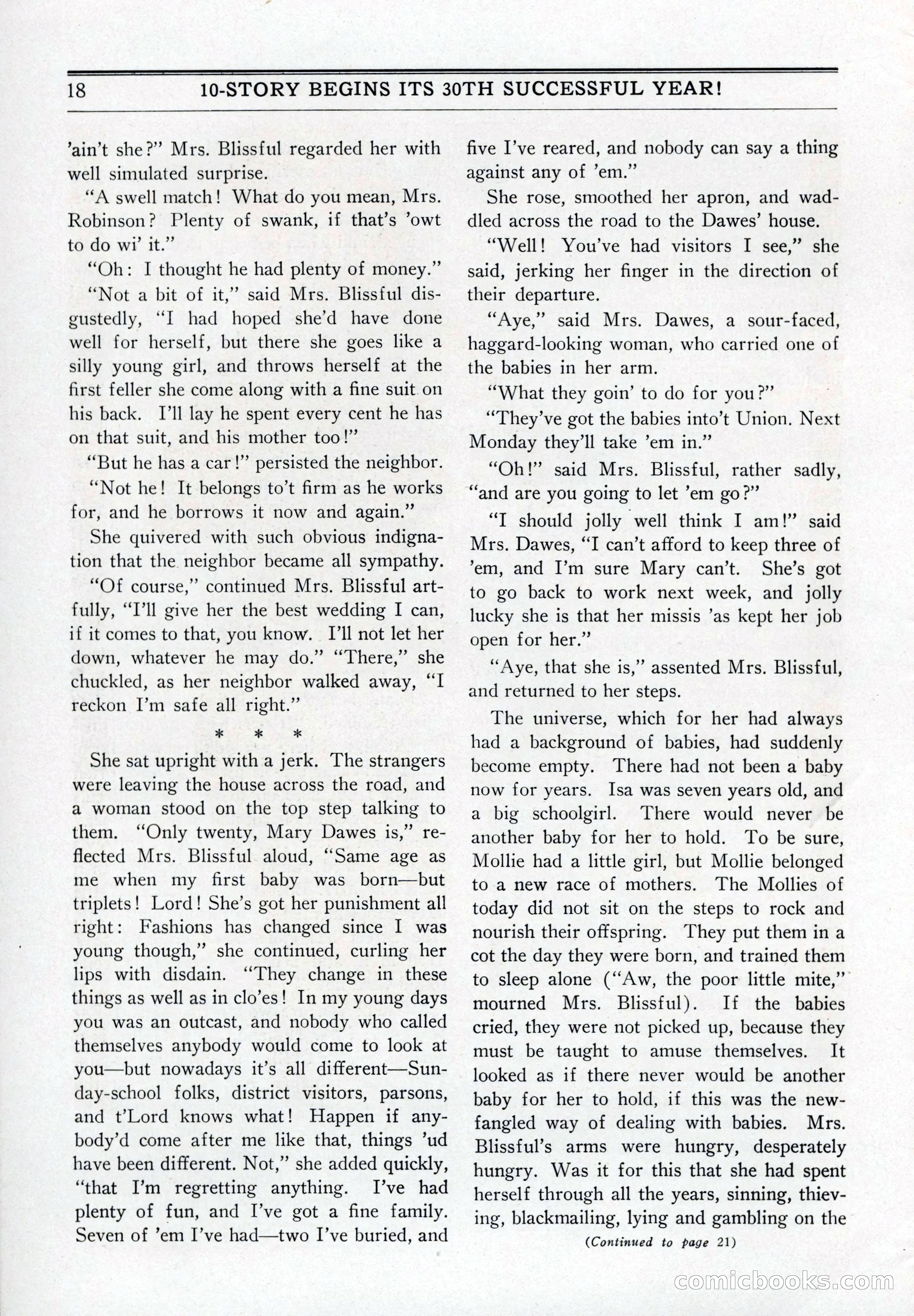
A restored page from Pulp Fiction, 1931. Page through the whole issue in the reader above.
📄 Transcribed text from this page (OCR, searchable)
Machine-transcribed from the original scan — historical spelling and the odd misread are preserved.
18 10-STORY BEGINS ITS 30TH SUCCESSFUL YEAR! ’ain’t she?” Mrs. Blissful regarded her with well simulated surprise. ‘““A swell match! What do you mean, Mrs. Robinson? Plenty of swank, if that’s ’owt to do wi’ it.” “Oh: I thought he had plenty of money.” “Not a bit of it,’ said Mrs. Blissful dis- gustedly, “I had hoped she’d have done well for herself, but there she goes like a silly young girl, and throws herself at the first feller she come along with a fine suit on his back. I’ll lay he spent every cent he has on that suit, and his mother too!” “But he has a car!” persisted the neighbor. “Not he! It belongs to’t firm as he works for, and he borrows it now and again.” She quivered with such obvious indigna- tion that the neighbor became all sympathy. “Of course,” continued Mrs. Blissful art- fully, “I'll give her the best wedding I can, if it comes to that, you know. I'll not let her down, whatever he may do.” “There,” she chuckled, as her neighbor walked away, “I reckon I’m safe all right.” tae HN She sat upright with a jerk. The strangers were leaving the house across the road, and a woman stood on the top step talking to them. “Only twenty, Mary Dawes is,” re- flected Mrs. Blissful aloud, “Same age as me when my first baby was born—but triplets! Lord! She’s got her punishment all right: Fashions has changed since I was young though,” she continued, curling her lips with disdain. ‘““They change in these things as well as in clo’es! In my young days you was an outcast, and nobody who called themselves anybody would come to look at you—but nowadays it’s all different—Sun- day-school folks, district visitors, parsons, and t’Lord knows what! Happen if any- body’d come after me like that, things ’ud have been different. Not,” she added quickly, “that I’m regretting anything. I’ve had plenty of fun, and I’ve got a fine family. Seven of ’em I’ve had—two I’ve buried, and five I’ve reared, and nobody can say a thing against any of ’em.” She rose, smoothed her apron, and wad- dled across the road to the Dawes’ house. “Well! You've had visitors I see,” she said, jerking her finger in the direction of their departure. “Aye,” said Mrs. Dawes, a sour-faced, haggard-looking woman, who carried one of the babies in her arm. “What they goin’ to do for you?” ‘““They’ve got the babies into’t Union. Next Monday they’ll take ’em in.” “Oh!” said Mrs. Blissful, rather sadly, “and are you going to let ’em go?” “T should jolly well think I am!” said Mrs. Dawes, “I can’t afford to keep three of ‘em, and I’m sure Mary can’t. She’s got to go back to work next week, and jolly lucky she is that her missis ’as kept her job open for her.” ‘Aye, that she is,’ assented Mrs. Blissful, and returned to her steps. The universe, which for her had always had a background of babies, had suddenly become empty. There had not been a baby now for years. Isa was seven years old, and a big schoolgirl. There would never be another baby for her to hold. To be sure, Mollie had a little girl, but Mollie belonged to a new race of mothers. The Mollies of today did not sit on the steps to rock and nourish their offspring. They put them in a cot the day they were born, and trained them to sleep alone (“Aw, the poor little mite,” mourned Mrs. Blissful). If the babies cried, they were not picked up, because they must be taught to amuse themselves. It looked as if there never would be another baby for her to hold, if this was the new- fangled way of dealing with babies. Mrs. Blissful’s arms were hungry, desperately hungry. Was it for this that she had spent herself through all the years, sinning, thiev- ing, blackmailing, lying and gambling on the (Continued to page 21) ECOMNICLOOKS.E© mn