
Pulp Fiction, 1931 · page 32 of 68
10-Story Book, July 1931 — page 32: what you’re looking at
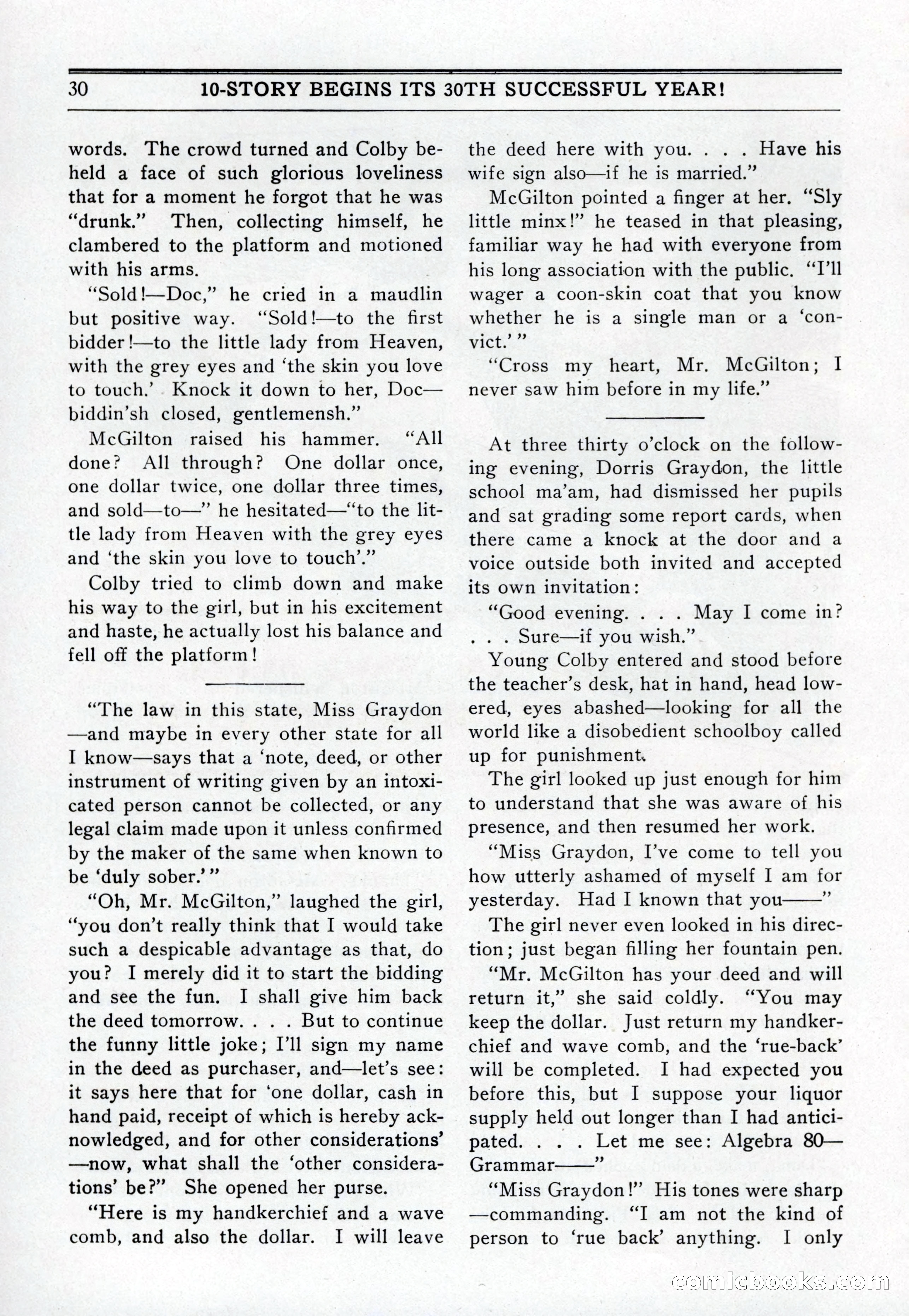
A restored page from Pulp Fiction, 1931. Page through the whole issue in the reader above.
📄 Transcribed text from this page (OCR, searchable)
Machine-transcribed from the original scan — historical spelling and the odd misread are preserved.
30 10-STORY BEGINS ITS 30TH SUCCESSFUL YEAR! words. The crowd turned and Colby be- held a face of such glorious loveliness that for a moment he forgot that he was “drunk.” Then, collecting himself, he clambered to the platform and motioned with his arms. “Sold!—Doc,” he cried in a maudlin but positive way. ‘“Sold!—to the first bidder !—to the little lady from Heaven, with the grey eyes and ‘the skin you love to touch.’ Knock it down to her, Doc— biddin’sh closed, gentlemensh.” McGilton raised his hammer. “All done? All through? One dollar once, one dollar twice, one dollar three times, and sold—to—’” he hesitated—‘to the lit- tle lady from Heaven with the grey eyes and ‘the skin you love to touch’.” Colby tried to climb down and make his way to the girl, but in his excitement and haste, he actually lost his balance and fell off the platform! “The law in this state, Miss Graydon —and maybe in every other state for all I know—says that a ‘note, deed, or other instrument of writing given by an intoxi- cated person cannot be collected, or any legal claim made upon it unless confirmed by the maker of the same when known to be ‘duly sober.’”’ “Oh, Mr. McGilton,” laughed the girl, “you don’t really think that I would take such a despicable advantage as that, do you? I merely did it to start the bidding and see the fun. I shall give him back the deed tomorrow. . . . But to continue the funny little joke; I’ll sign my name in the deed as purchaser, and—let’s see: it says here that for ‘one dollar, cash in hand paid, receipt of which is hereby ack- nowledged, and for other considerations’ —now, what shall the ‘other considera- tions’ be?” She opened her purse. “Here is my handkerchief and a wave comb, and also the dollar. I will leave the deed here with you. . . . Have his wife sign also—if he is married.” McGilton pointed a finger at her. “Sly little minx!” he teased in that pleasing, familiar way he had with everyone from his long association with the public. “T’ll wager a coon-skin coat that you know whether he is a single man or a ‘con- vict..” “Cross my heart, Mr. McGilton; I never saw him before in my life.” At three thirty o’clock on the follow- ing evening, Dorris Graydon, the little school ma’am, had dismissed her pupils and sat grading some report cards, when there came a knock at the door and a voice outside both invited and accepted its own invitation: “Good evening. . . . May I come in? . . . Sure—if you wish.” Young Colby entered and stood before the teacher’s desk, hat in hand, head low- ered, eyes abashed—looking for all the world like a disobedient schoolboy called up for punishment. The girl looked up just enough for him to understand that she was aware of his presence, and then resumed her work. “Miss Graydon, I’ve come to tell you how utterly ashamed of myself I am for yesterday. Had I known that you i The girl never even looked in his direc- tion; just began filling her fountain pen. “Mr. McGilton has your deed and will return it,’ she said coldly. “You may keep the dollar. Just return my handker- chief and wave comb, and the ‘rue-back’ will be completed. I had expected you before this, but I suppose your liquor supply held out longer than I had antici- pated. . . . Let me see: Algebra 80— Grammar 5 “Miss Graydon!” His tones were sharp —commanding. “I am not the kind of person to ‘rue back’ anything. I only COMIC OOOKS.CO a