
Pulp Fiction, 1931 · page 50 of 68
10-Story Book, July 1931 — page 50: what you’re looking at
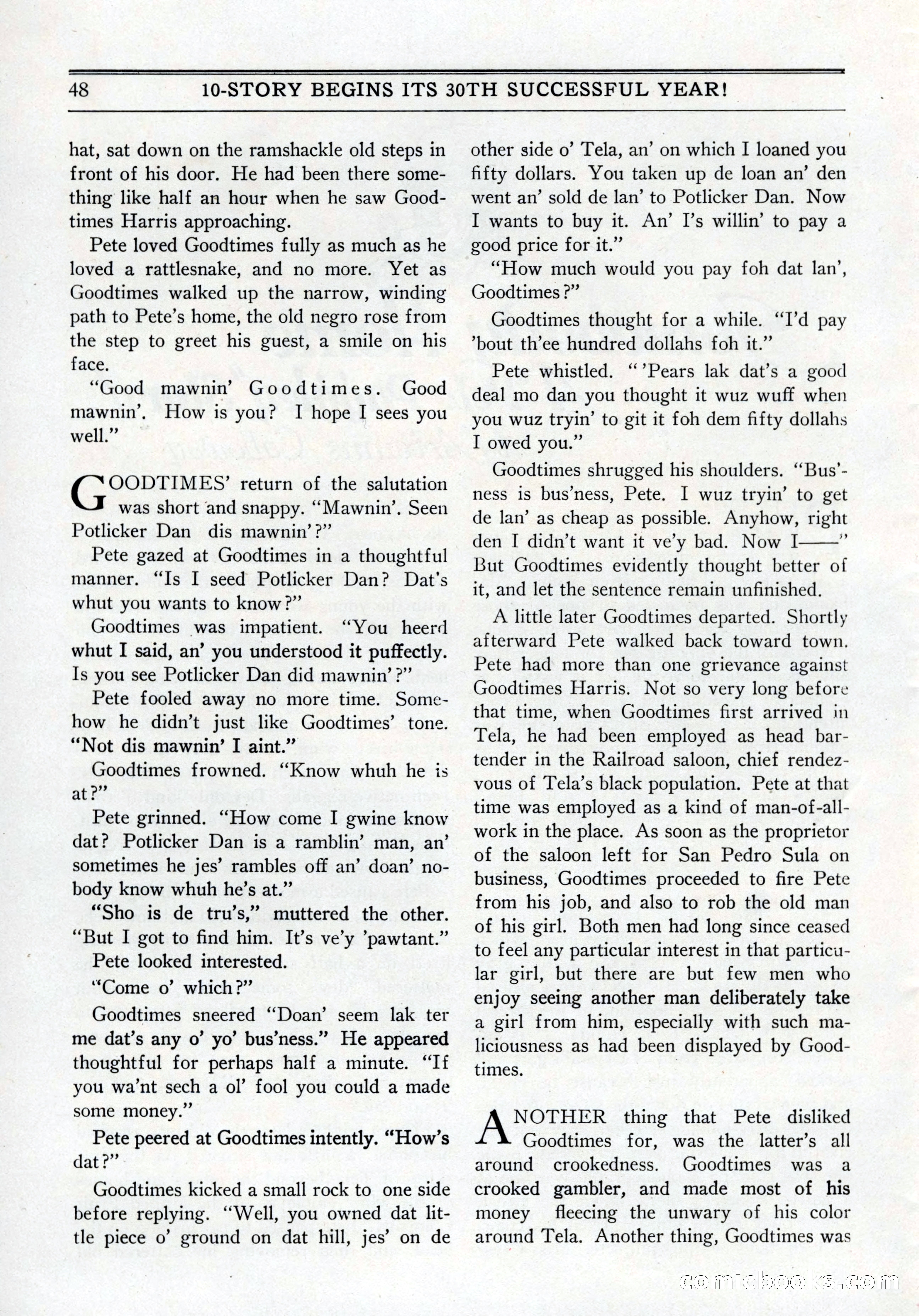
A restored page from Pulp Fiction, 1931. Page through the whole issue in the reader above.
📄 Transcribed text from this page (OCR, searchable)
Machine-transcribed from the original scan — historical spelling and the odd misread are preserved.
48 10-STORY BEGINS ITS 30TH SUCCESSFUL YEAR! hat, sat down on the ramshackle old steps in front of his door. He had been there some- thing like half an hour when he saw Good- times Harris approaching. Pete loved Goodtimes fully as much as he loved a rattlesnake, and no more. Yet as Goodtimes walked up the narrow, winding path to Pete’s home, the old negro rose from the step to greet his guest, a smile on his face. “Good mawnin’ Goodtimes. Good mawnin’, How is you? I hope I sees you well.” OODTIMES’ return of the salutation was short and snappy. ““Mawnin’. Seen Potlicker Dan dis mawnin’?” Pete gazed at Goodtimes in a thoughtful manner. “Is I seed Potlicker Dan? Dat’s whut you wants to know?” Goodtimes was impatient. ‘You heerd whut I said, an’ you understood it puffectly. Is you see Potlicker Dan did mawnin’ ?” Pete fooled away no more time. Some- how he didn’t just like Goodtimes’ tone. “Not dis mawnin’ I aint.” Goodtimes frowned. “Know whuh he is at?” Pete grinned. “How come I gwine know dat? Potlicker Dan is a ramblin’ man, an’ sometimes he jes’ rambles off an’ doan’ no- body know whuh he’s at.” “Sho is de tru’s,” muttered the other. “But I got to find him. It’s ve’y ’pawtant.” Pete looked interested. “Come o’ which?” Goodtimes sneered “Doan’ seem lak ter me dat’s any o’ yo’ bus’ness.” He appeared thoughtful for perhaps half a minute. “If you wa’nt sech a ol’ fool you could a made some money.” Pete peered at Goodtimes intently. “How’s dat?” Goodtimes kicked a small rock to one side before replying. ‘Well, you owned dat lit- tle piece o’ ground on dat hill, jes’ on de other side o’ Tela, an’ on which I loaned you fifty dollars. You taken up de loan an’ den went an’ sold de lan’ to Potlicker Dan. Now I wants to buy it. An’ I’s willin’ to pay a good price for it.” “How much would you pay foh dat lan’, Goodtimes ?” Goodtimes thought for a while. “I’d pay ‘bout th’ee hundred dollahs foh it.’ Pete whistled. “’Pears lak dat’s a good deal mo dan you thought it wuz wuff when you wuz tryin’ to git it foh dem fifty dollahs I owed you.” Goodtimes shrugged his shoulders. ‘Bus’- ness is bus’ness, Pete. I wuz tryin’ to get de lan’ as cheap as possible. Anyhow, right den I didn’t want it ve’y bad. Now I : But Goodtimes evidently thought better of it, and let the sentence remain unfinished. A little later Goodtimes departed. Shortly afterward Pete walked back toward town. Pete had more than one grievance against Goodtimes Harris. Not so very long before that time, when Goodtimes first arrived in Tela, he had been employed as head bar- tender in the Railroad saloon, chief rendez- vous of Tela’s black population. Pete at that time was employed as a kind of man-of-all- work in the place. As soon as the proprietor of the saloon left for San Pedro Sula on business, Goodtimes proceeded to fire Pete from his job, and also to rob the old man of his girl. Both men had long since ceased to feel any particular interest in that particu- lar girl, but there are but few men who enjoy seeing another man deliberately take a girl from him, especially with such ma- liciousness as had been displayed by Good- times. | NOTHER thing that Pete disliked Goodtimes for, was the latter’s all around crookedness. Goodtimes was a crooked gambler, and made most of his money fleecing the unwary of his color around Tela. Another thing, Goodtimes was ECONNICHOOOKS.EO©