
Pulp Fiction, 1931 · page 16 of 68
10-Story Book, July 1931 — page 16: what you’re looking at
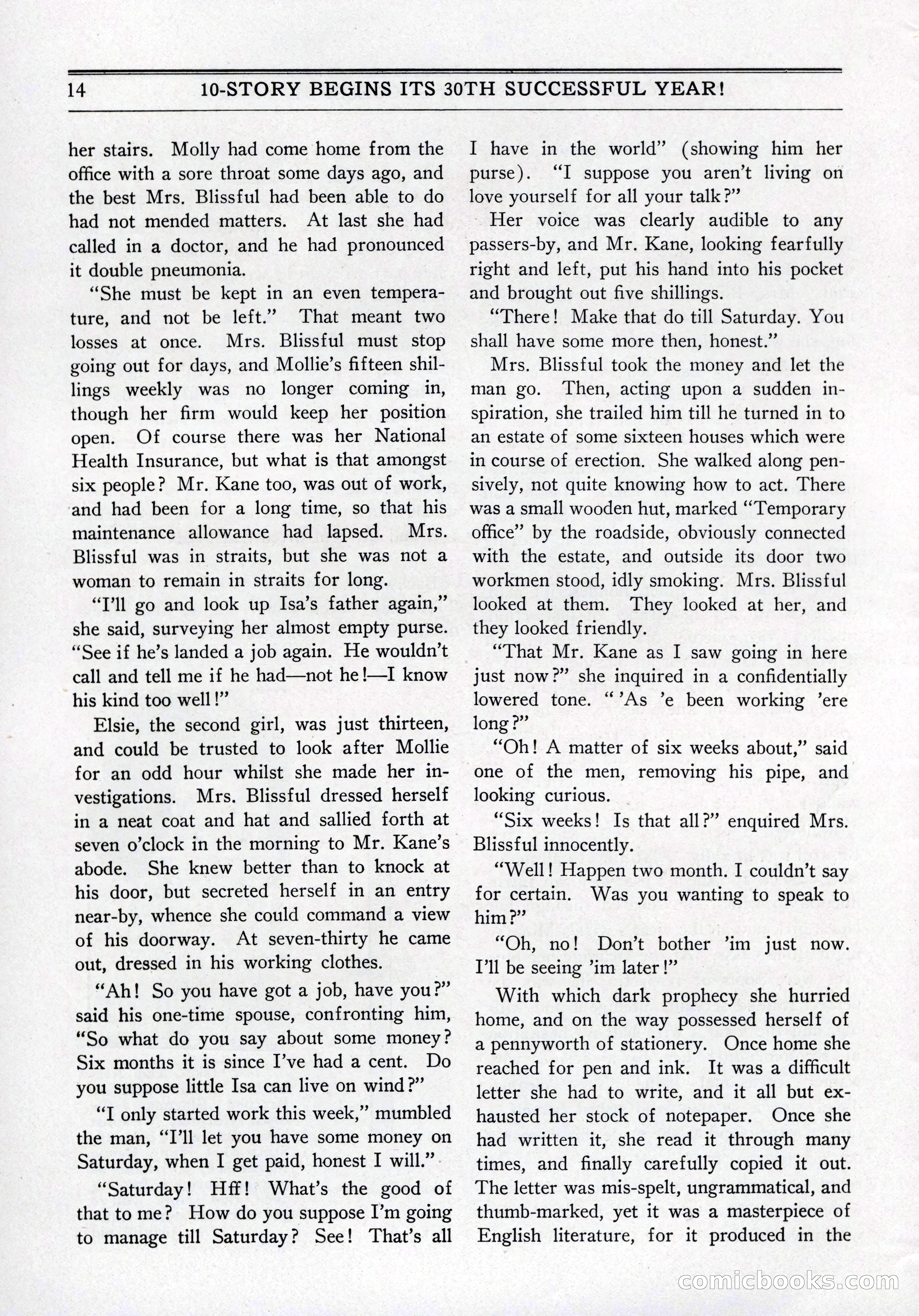
A restored page from Pulp Fiction, 1931. Page through the whole issue in the reader above.
📄 Transcribed text from this page (OCR, searchable)
Machine-transcribed from the original scan — historical spelling and the odd misread are preserved.
a a cm 14 10-STORY BEGINS ITS 30TH SUCCESSFUL YEAR! her stairs. Molly had come home from the office with a sore throat some days ago, and the best Mrs. Blissful had been able to do had not mended matters. At last she had called in a doctor, and he had pronounced it double pneumonia. “She must be kept in an even tempera- ture, and not be left.” That meant two losses at once. Mrs. Blissful must stop going out for days, and Mollie’s fifteen shil- lings weekly was no longer coming in, though her firm would keep her position open. Of course there was her National Health Insurance, but what is that amongst six people? Mr. Kane too, was out of work, and had been for a long time, so that his maintenance allowance had lapsed. Mrs. Blissful was in straits, but she was not a woman to remain in straits for long. “T’ll go and look up Isa’s father again,” she said, surveying her almost empty purse. “See if he’s landed a job again. He wouldn't call and tell me if he had—not he!—I know his kind too well !” Elsie, the second girl, was just thirteen, and could be trusted to look after Mollie for an odd hour whilst she made her in- vestigations. Mrs. Blissful dressed herself in a neat coat and hat and sallied forth at seven o’clock in the morning to Mr. Kane’s_ abode. She knew better than to knock at his door, but secreted herself in an entry near-by, whence she could command a view of his doorway. At seven-thirty he came out, dressed in his working clothes. “Ah! So you have got a job, have you?” said his one-time spouse, confronting him, “So what do you say about some money? Six months it is since I’ve had a cent. Do you suppose little Isa can live on wind?” “TI only started work this week,” mumbled the man, “I’ll let you have some money on Saturday, when I get paid, honest I will.” “Saturday! Hff! What’s the good of that to me? How do you suppose I’m going to manage till Saturday? See! That’s all I have in the world” (showing him her purse). “I suppose you aren’t living on love yourself for all your talk?” - Her voice was clearly audible to any passers-by, and Mr. Kane, looking fearfully right and left, put his hand into his pocket and brought out five shillings. “There! Make that do till Saturday. You shall have some more then, honest.” Mrs. Blissful took the money and let the man go. ‘Then, acting upon a sudden in- spiration, she trailed him till he turned in to an estate of some sixteen houses which were in course of erection. She walked along pen- sively, not quite knowing how to act. There was a small wooden hut, marked “Temporary office” by the roadside, obviously connected with the estate, and outside its door two workmen stood, idly smoking. Mrs. Blissful looked at them. They looked at her, and they looked friendly. “That Mr. Kane as I saw going in here just now?” she inquired in a confidentially lowered tone. “’As ’e been working ’ere long ?” “Oh! A matter of six weeks about,” said one of the men, removing his pipe, and looking curious. “Six weeks! Is that all?” enquired Mrs. Blissful innocently. “Well! Happen two month. I couldn’t say for certain. Was you wanting to speak to him P” “Oh, no! Don’t bother ’im just now. I’ll be seeing ’im later!” With which dark prophecy she hurried home, and on the way possessed herself of a pennyworth of stationery. Once home she reached for pen and ink. It was a difficult letter she had to write, and it all but ex- hausted her stock of notepaper. Once she had written it, she read it through many times, and finally carefully copied it out. The letter was mis-spelt, ungrammatical, and thumb-marked, yet it was a masterpiece of English literature, for it produced in the ECORAIC OOOKS.E@