
Pulp Fiction, 1931 · page 41 of 68
10-Story Book, July 1931 — page 41: what you’re looking at
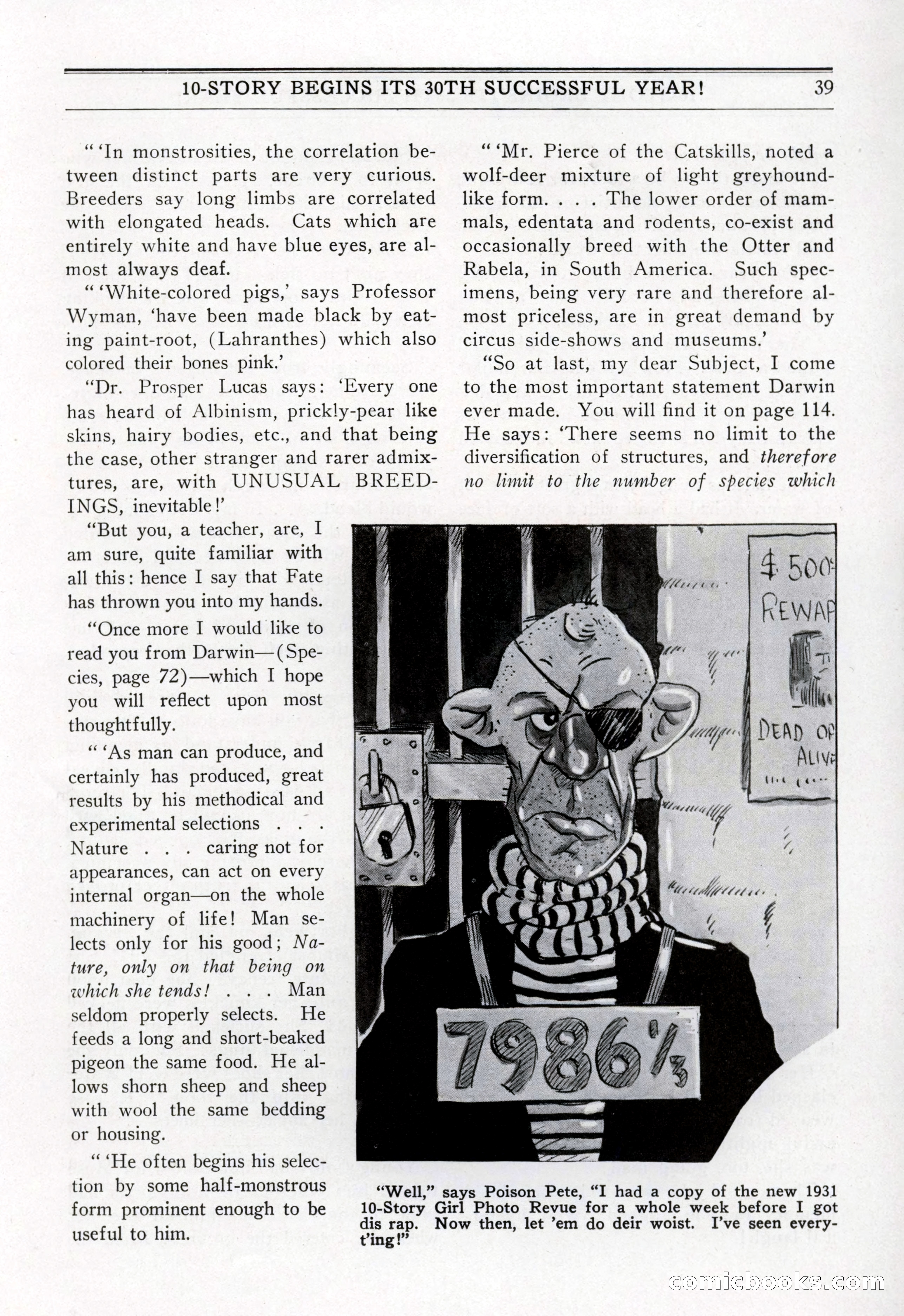
A restored page from Pulp Fiction, 1931. Page through the whole issue in the reader above.
📄 Transcribed text from this page (OCR, searchable)
Machine-transcribed from the original scan — historical spelling and the odd misread are preserved.
10-STORY BEGINS ITS 30TH SUCCESSFUL YEAR! ““Tn monstrosities, the correlation be- tween distinct parts are very curious. Breeders say long limbs are correlated with elongated heads. Cats which are entirely white and have blue eyes, are al- most always deaf. “*White-colored pigs,’ says Professor Wyman, ‘have been made black by eat- ing paint-root, (Lahranthes) which also colored their bones pink.’ “Dr...Frosper - Lucas. says:...-E-very one has heard of Albinism, prickly-pear like skins, hairy bodies, etc., and that being the case, other stranger and rarer admix- BREED- tures, are, with UNUSUAL INGS, inevitable!’ “But you, a teacher, are, I am sure, quite familiar with all this: hence I say that Fate has thrown you into my hands. “Once more I would like to read you from Darwin—(Spe- cies, page 72)—which I hope you will reflect upon most thoughtfully. “““As man can produce, and certainly has produced, great results by his methodical and experimental selections Nature caring not for appearances, can act on every internal organ—on the whole machinery of life! Man se- lects only for his good; Na- ture, only on that being on which she tends! Man seldom properly selects. He feeds a long and short-beaked pigeon the same food. He al- lows shorn sheep and sheep with wool the same bedding or housing. “ “He often begins his selec- tion by some half-monstrous form prominent enough to be useful to him. ting!” 39 ““Mr. Pierce of the Catskills, noted a wolf-deer mixture of light greyhound- like form. . . . The lower order of mam- mals, edentata and rodents, co-exist and occasionally breed with the Otter and Rabela, in South America. Such spec- imens, being very rare and therefore al- most priceless, are in great demand by circus side-shows and museums.’ “So at last, my dear Subject, I come to the most important statement Darwin ever made. You will find it on page 114. He says: “There seems no limit to the diversification of structures, and therefore no linut to the number of species which 4. Bow KEWAP White f tts? “id hs / : ry “agg W YERD OF 4 Wr, ll lt Y f f 1, “Well,” says Poison Pete, “I had a copy of the new 1931 10-Story Girl Photo Revue for a whole week before I got dis rap. Now then, let ’em do deir woist. I’ve seen every- CONnicloooks @ (CO) 5}