
Pulp Fiction, 1931 · page 19 of 68
10-Story Book, July 1931 — page 19: what you’re looking at
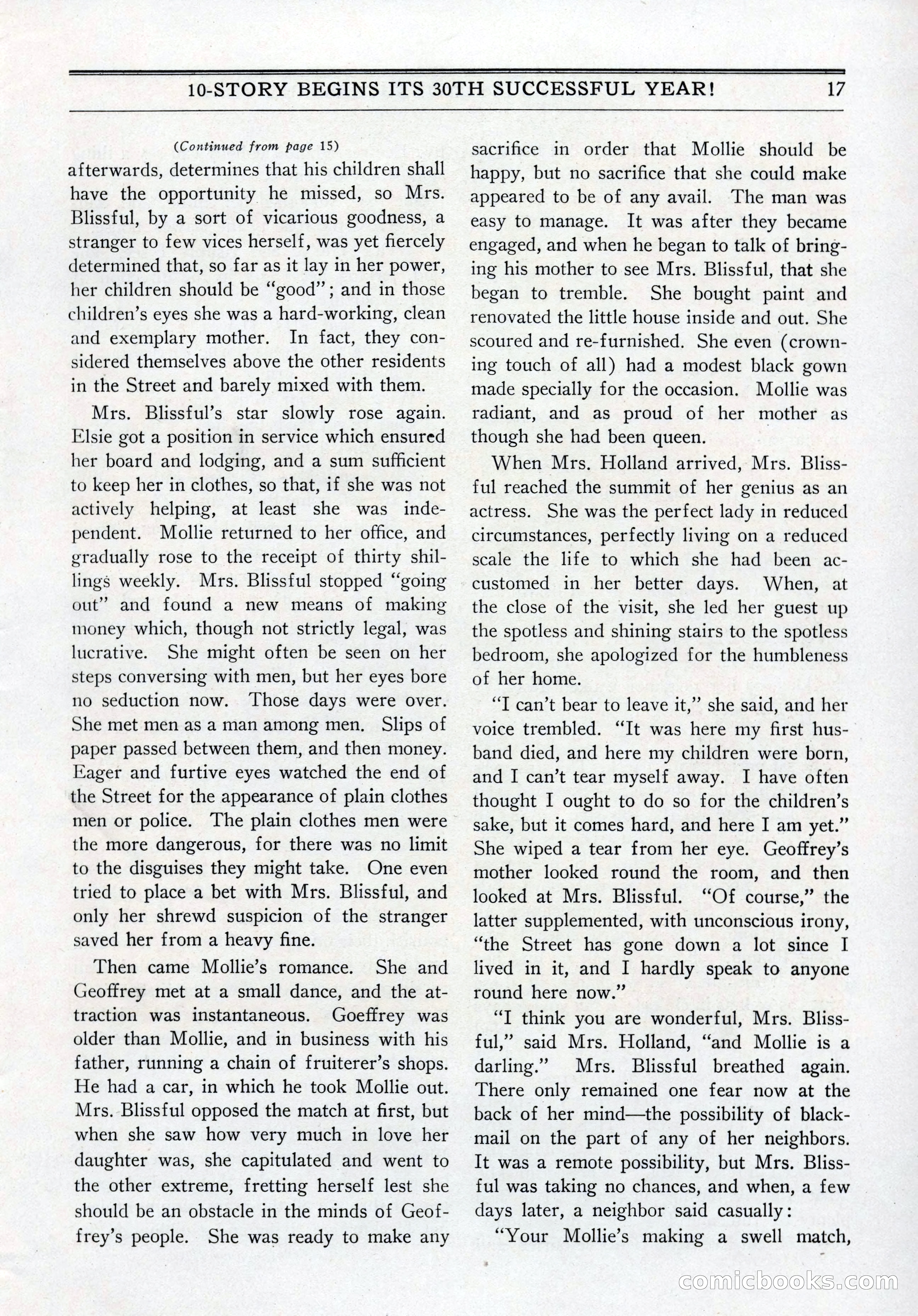
A restored page from Pulp Fiction, 1931. Page through the whole issue in the reader above.
📄 Transcribed text from this page (OCR, searchable)
Machine-transcribed from the original scan — historical spelling and the odd misread are preserved.
a 10-STORY BEGINS ITS 30TH SUCCESSFUL YEAR! 17 (Continued from page 15) afterwards, determines that his children shall have the opportunity he missed, so Mrs. Blissful, by a sort of vicarious goodness, a stranger to few vices herself, was yet fiercely determined that, so far as it lay in her power, her children should be “good’’; and in those children’s eyes she was a hard-working, clean and exemplary mother. In fact, they con- sidered themselves above the other residents in the Street and barely mixed with them. Mrs. Blissful’s star slowly rose again. Elsie got a position in service which ensured her board and lodging, and a sum sufficient to keep her in clothes, so that, if she was not actively helping, at least she was inde- pendent. Mollie returned to her office, and gradually rose to the receipt of thirty shil- lings weekly. Mrs. Blissful stopped “going out” and found a new means of making money which, though not strictly legal, was lucrative. She might often be seen on her steps conversing with men, but her eyes bore no seduction now. ‘Those days were over. She met men as aman among men. Slips of paper passed between them, and then money. Eager and furtive eyes watched the end of the Street for the appearance of plain clothes men or police. The plain clothes men were the more dangerous, for there was no limit to the disguises they might take. One even tried to place a bet with Mrs. Blissful, and only her shrewd suspicion of the stranger saved her from a heavy fine. Then came Mollie’s romance. She and Geoffrey met at a small dance, and the at- traction was instantaneous. Goeffrey was older than Mollie, and in business with his father, running a chain of fruiterer’s shops. He had a car, in which he took Mollie out. Mrs. Blissful opposed the match at first, but when she saw how very much in love her daughter was, she capitulated and went to the other extreme, fretting herself lest she should be an obstacle in the minds of Geof- frey’s people. She was ready to make any sacrifice in order that Mollie should be happy, but no sacrifice that she could make appeared to be of any avail. The man was easy to manage. It was after they became engaged, and when he began to talk of bring- ing his mother to see Mrs. Blissful, that she began to tremble. She bought paint and renovated the little house inside and out. She scoured and re-furnished. She even (crown- ing touch of all) had a modest black gown made specially for the occasion. Mollie was radiant, and as proud of her mother as though she had been queen. When Mrs. Holland arrived, Mrs. Bliss- ful reached the summit of her genius as an actress. She was the perfect lady in reduced circumstances, perfectly living on a reduced scale the life to which she had been ac- customed in her better days. When, at the close of the visit, she led her guest up the spotless and shining stairs to the spotless bedroom, she apologized for the humbleness of her home. “T can’t bear to leave it,” she said, and her voice trembled. “It was here my first hus- band died, and here my children were born, and I can’t tear myself away. I have often thought I ought to do so for the children’s sake, but it comes hard, and here I am yet.” She wiped a tear from her eye. Geoffrey’s mother looked round the room, and then looked at Mrs. Blissful. “Of course,” the latter supplemented, with unconscious irony, “the Street has gone down a lot since I lived in it, and I hardly speak to anyone round here now.” “TI think you are wonderful, Mrs. Bliss- ful,’ said Mrs. Holland, “and Mollie is a darling.” Mrs. Blissful breathed again. There only remained one fear now at the back of her mind—the possibility of black- mail on the part of any of her neighbors. It was a remote possibility, but Mrs. Bliss- ful was taking no chances, and when, a few days later, a neighbor said casually: “Your Mollie’s making a swell match, ECORNICLOOKS.E© m