
Pulp Fiction, 1931 · page 55 of 68
10-Story Book, July 1931 — page 55: what you’re looking at
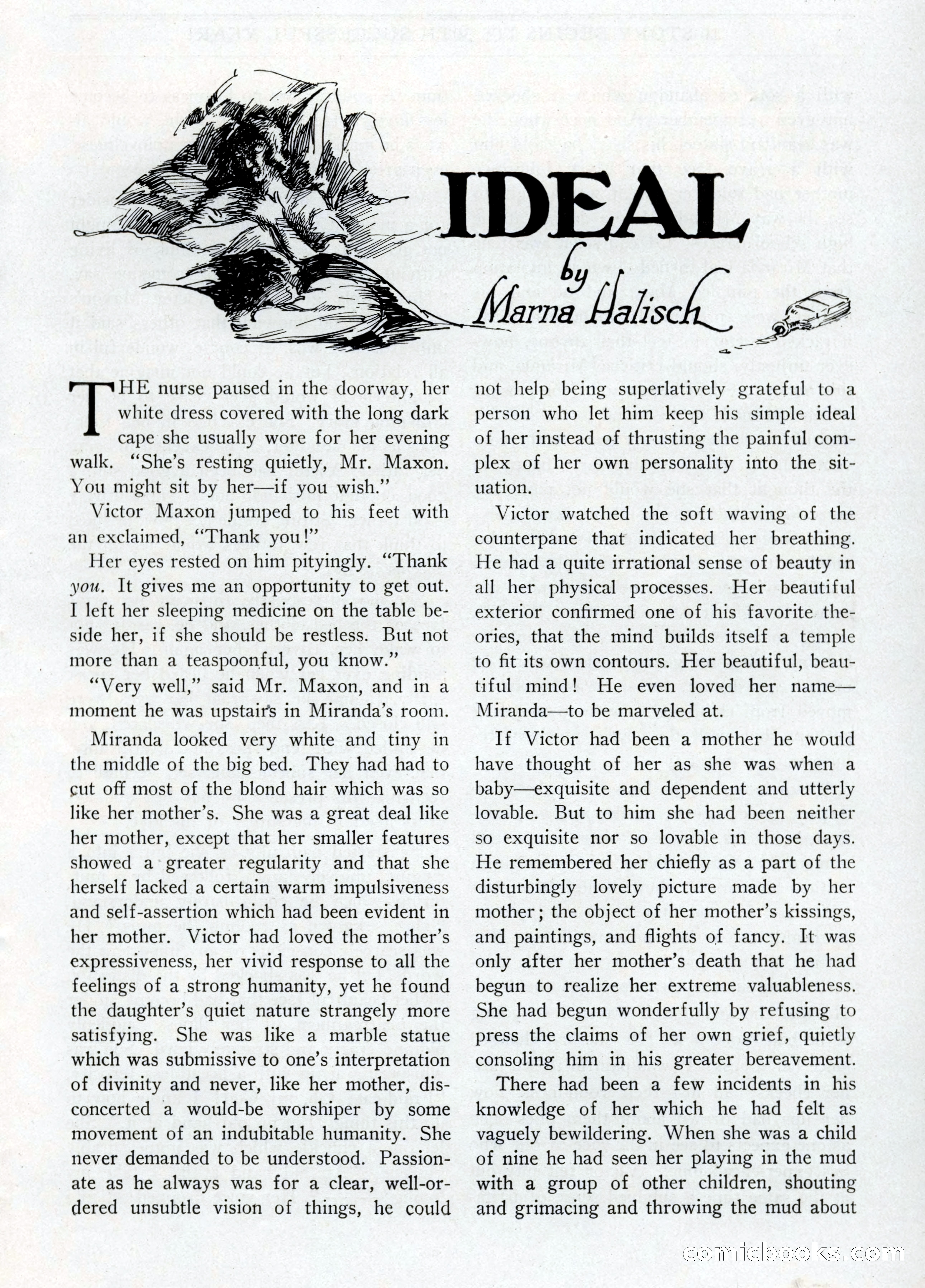
A restored page from Pulp Fiction, 1931. Page through the whole issue in the reader above.
📄 Transcribed text from this page (OCR, searchable)
Machine-transcribed from the original scan — historical spelling and the odd misread are preserved.
white dress covered with the long dark cape she usually wore for her evening walk. “She’s resting quietly, Mr. Maxon. You might sit by her—if you wish.” Victor Maxon jumped to his feet with an exclaimed, “Thank you!” Her eyes rested on him pityingly. “Thank you. It gives me an opportunity to get out. I left her sleeping medicine on the table be- side her, if she should be restless. But not more than a teaspoonful, you know.” “Very well,’ said Mr. Maxon, and in a moment he was upstairs in Miranda’s room. Ta nurse paused in the doorway, her Miranda looked very white and tiny in the middle of the big bed. They had had to cut off most of the blond hair which was so like her mother’s. She was a great deal like her mother, except that her smaller features showed a greater regularity and that she herself lacked a certain warm impulsiveness and self-assertion which had been evident in her mother. Victor had loved the mother’s expressiveness, her vivid response to all the feelings of a strong humanity, yet he found the daughter’s quiet nature strangely more satisfying. She was like a marble statue which was submissive to one’s interpretation of divinity and never, like her mother, dis- concerted a would-be worshiper by some movement of an indubitable humanity. She never demanded to be understood. Passion- ate as he always was for a clear, well-or- dered unsubtle vision of things, he could a Maras: biol DEAL ~ _ ed <L not help being superlatively grateful to a person who let him keep his simple ideal of her instead of thrusting the painful com- plex of her own personality into the sit- uation. Victor watched the soft waving of the counterpane that indicated her breathing. He had a quite irrational sense of beauty in all her physical processes. Her beautiful exterior confirmed one of his favorite the- ories, that the mind builds itself a temple to fit its own contours. Her beautiful, beau- tiful mind! He even loved her name— Miranda—to be marveled at. If Victor had been a mother he would have thought of her as she was when a baby—exquisite and dependent and utterly lovable. But to him she had been neither so exquisite nor so lovable in those days. He remembered her chiefly as a part of the disturbingly lovely picture made by her mother ; the object of her mother’s kissings, and paintings, and flights of fancy. It was only after her mother’s death that he had begun to realize her extreme valuableness. She had begun wonderfully by refusing to press the claims of her own grief, quietly consoling him in his greater bereavement. There had been a few incidents in his knowledge of her which he had felt as vaguely bewildering. When she was a child of nine he had seen her playing in the mud with a group of other children, shouting and grimacing and throwing the mud about CORNICIHOOKS.EO