
Pulp Fiction, 1931 · page 10 of 68
10-Story Book, July 1931 — page 10: what you’re looking at
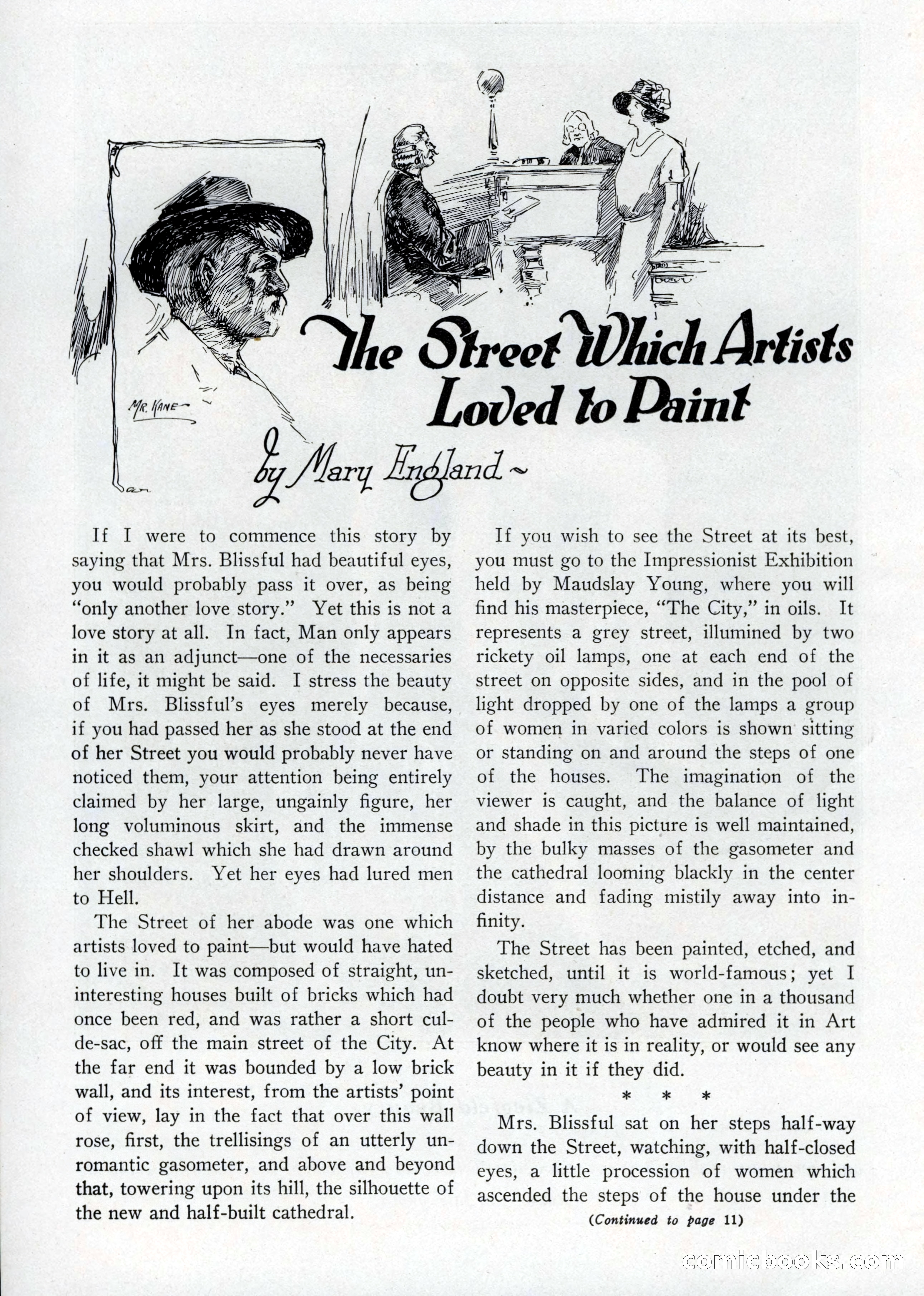
A restored page from Pulp Fiction, 1931. Page through the whole issue in the reader above.
📄 Transcribed text from this page (OCR, searchable)
Machine-transcribed from the original scan — historical spelling and the odd misread are preserved.
° SAN SS \ / _-, = \ Bn ZF Ze me 7 ae | If I were to commence this story by saying that Mrs. Blissful had beautiful eyes, you would probably pass it over, as being “only another love story.” Yet this is not a love story at all. In fact, Man only appears in it as an adjunct—one of the necessaries of life, it might be said. I stress the beauty of Mrs. Blissful’s eyes merely because, if you had passed her as she stood at the end of her Street you would probably never have noticed them, your attention being entirely claimed by her large, ungainly figure, her long voluminous skirt, and the immense checked shawl which she had drawn around her shoulders. Yet her eyes had lured men to Hell. The Street of her abode was one which artists loved to paint—but would have hated to live in. It was composed of straight, un- interesting houses built of bricks which had once been red, and was rather a short cul- de-sac, off the main street of the City. At the far end it was bounded by a low brick wall, and its interest, from the artists’ point of view, lay in the fact that over this wall rose, first, the trellisings of an utterly un- romantic gasometer, and above and beyond that, towering upon its hill, the silhouette of the new and half-built cathedral. ; rr a eS aS e Sheet al Artists Loved to Paint 2 Mary Fndfand ~ If you wish to see the Street at its best, you must go to the Impressionist Exhibition held by Maudslay Young, where you will find his masterpiece, “The City,” in oils. It represents a grey street, illumined by two rickety oil lamps, one at each end of the street on opposite sides, and in the pool of light dropped by one of the lamps a group of women in varied colors is shown sitting or standing on and around the steps of one of the houses. The imagination of the viewer is caught, and the balance of light and shade in this picture is well maintained, by the bulky masses of the gasometer and the cathedral looming blackly in the center distance and fading mistily away into in- finity. The Street has been painted, etched, and sketched, until it is world-famous; yet I doubt very much whether one in a thousand of the people who have admired it in Art know where it is in reality, or would see any beauty in it if they did. aves ae Mrs. Blissful sat on her steps half-way down the Street, watching, with half-closed eyes, a little procession of women which ascended the steps of the house under the (Continued to page 11) EORNICMHOOKS.EO© mn