
Pulp Fiction, 1931 · page 15 of 68
10-Story Book, July 1931 — page 15: what you’re looking at
A restored page from Pulp Fiction, 1931. Page through the whole issue in the reader above.
📄 Transcribed text from this page (OCR, searchable)
Machine-transcribed from the original scan — historical spelling and the odd misread are preserved.
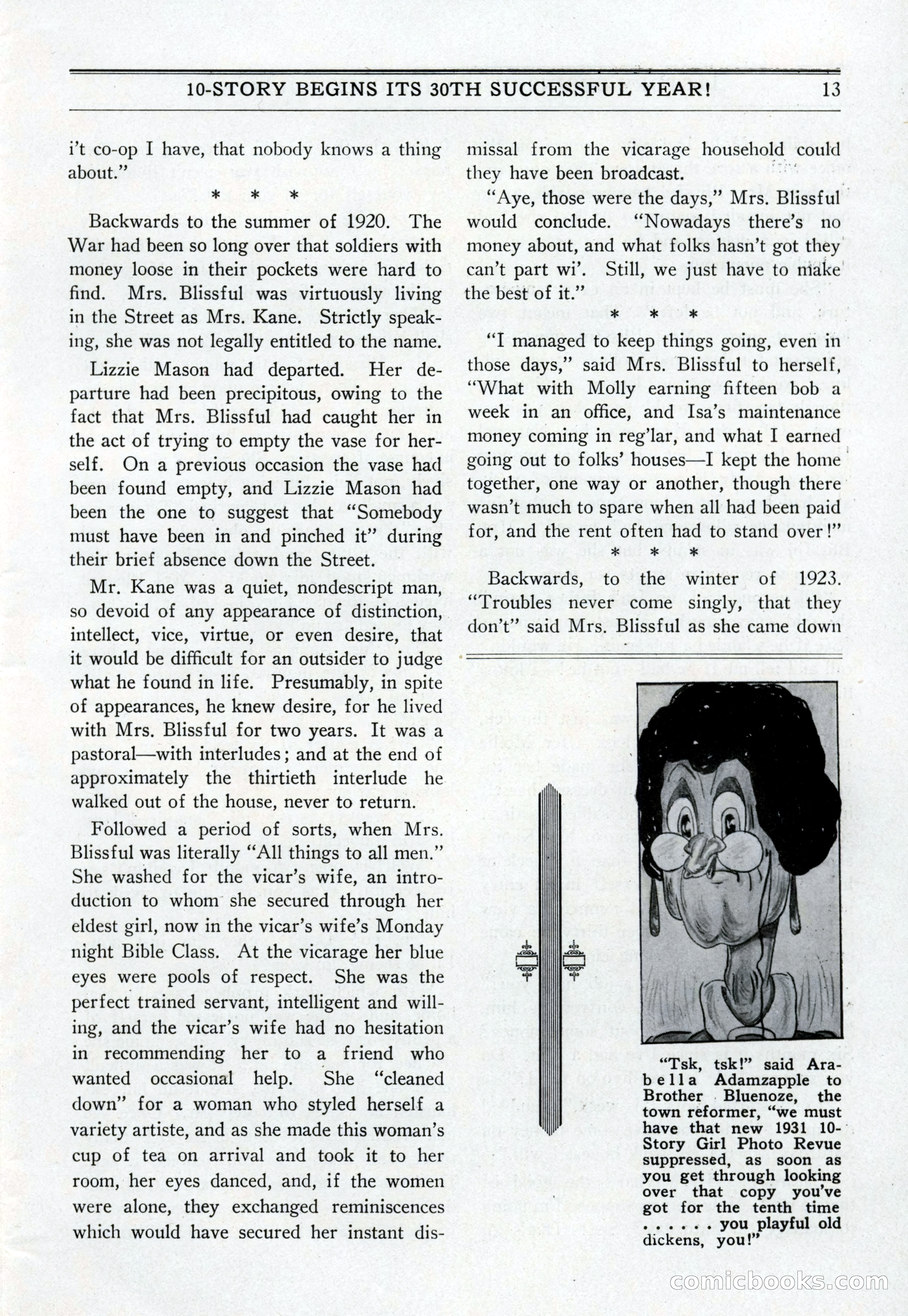
10-STORY BEGINS ITS 30TH SUCCESSFUL YEAR! 13 i't co-op I have, that nobody knows a thing about.” et. poe Backwards to the summer of 1920. The War had been so long over that soldiers with money loose in their pockets were hard to find. Mrs. Blissful was virtuously living in the Street as Mrs. Kane. Strictly speak- ing, she was not legally entitled to the name. Lizzie Mason had departed. Her de- parture had been precipitous, owing to the fact that Mrs. Blissful had caught her in the act of trying to empty the vase for her- self. On a previous occasion the vase had been found empty, and Lizzie Mason had been the one to suggest that “Somebody must have been in and pinched it” during their brief absence down the Street. Mr. Kane was a quiet, nondescript man, so devoid of any appearance of distinction, intellect, vice, virtue, or even desire, that it would be difficult for an outsider to judge what he found in life. Presumably, in spite of appearances, he knew desire, for he lived with Mrs. Blissful for two years. It was a pastoral—with interludes; and at the end of approximately the thirtieth interlude he walked out of the house, never to return. Followed a period of sorts, when Mrs. Blissful was literally “All things to all men.” She washed for the vicar’s wife, an intro- duction to whom she secured through her eldest girl, now in the vicar’s wife’s Monday night Bible Class. At the vicarage her blue eyes were pools of respect. She was the perfect trained servant, intelligent and will- ing, and the vicar’s wife had no hesitation in recommending her to a friend who wanted occasional help. She “cleaned down” for a woman who styled herself a variety artiste, and as she made this woman’s cup of tea on arrival and took it to her room, her eyes danced, and, if the women were alone, they exchanged reminiscences which would have secured her instant dis- missal from the vicarage household could they have been broadcast. AP ‘Aye, those were the days,” Mrs. Blissful | would conclude. “Nowadays there’s no money about, and what folks hasn’t got they can’t part wi’. Still, we just have to miake the best of it.” eo estate “T managed to keep things going, even in those days,’ said Mrs. Blissful to herself, “What with Molly earning fifteen bob a week in an office, and Isa’s maintenance money coming in reg’lar, and what I earned going out to folks’ houses—I kept the home together, one way or another, though there wasn’t much to spare when all had been paid for, and the rent often had to stand over!” ee ek Backwards, to the winter of 1923. “Troubles never come singly, that they don’t” said Mrs. Blissful as she came down || Fe “Tsk, tsk!” said Ara- bella Adamzapple to Brother . Bluenoze,_ the town reformer, “we must have that new 1931 10- Story Girl Photo Revue suppressed, as soon as you get through looking over that copy you've got for the tenth time si tovand . you playful old dickens, you!” ECORNICIOOKS.E©