
Pulp Fiction, 1931 · page 56 of 68
10-Story Book, July 1931 — page 56: what you’re looking at
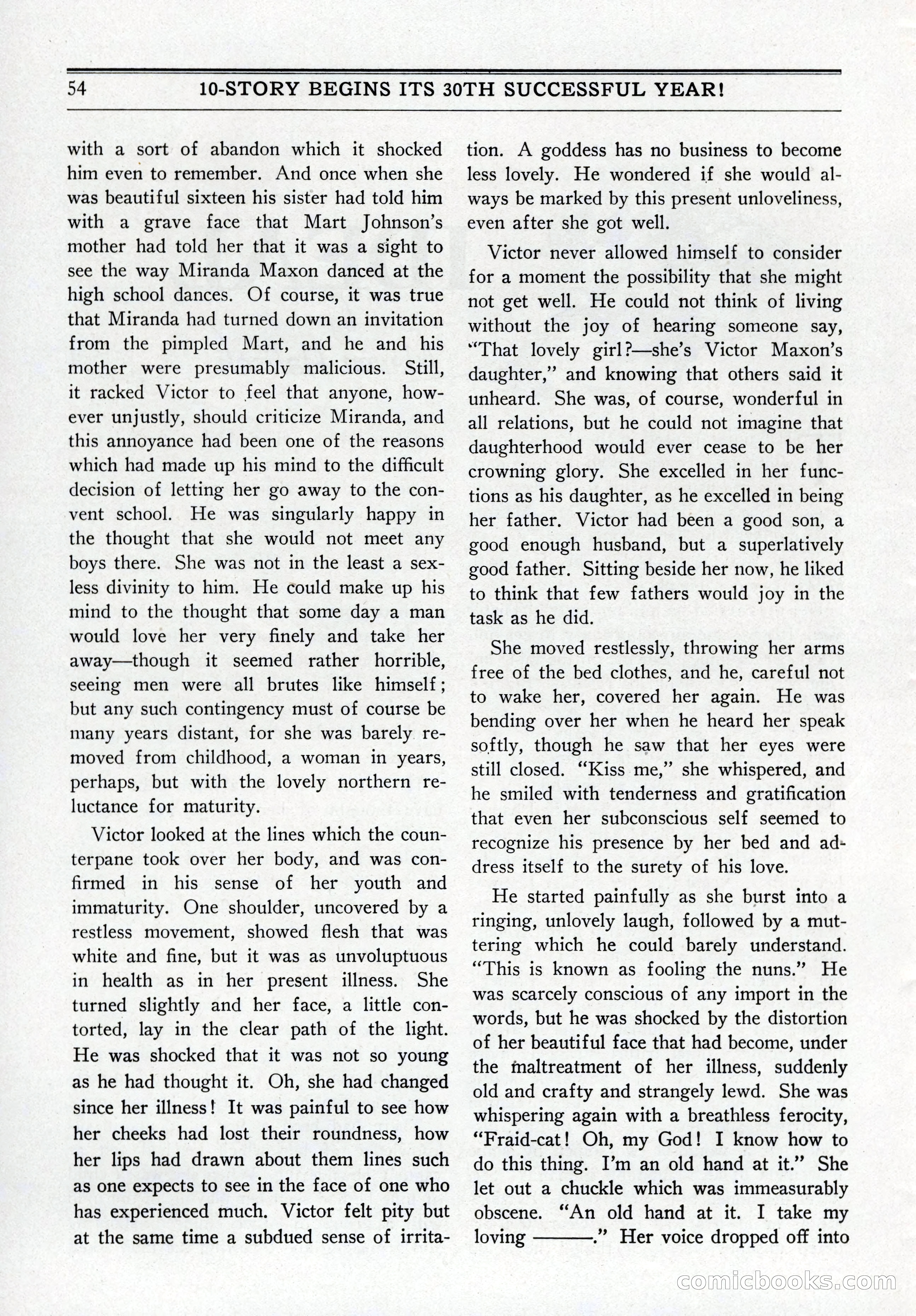
A restored page from Pulp Fiction, 1931. Page through the whole issue in the reader above.
📄 Transcribed text from this page (OCR, searchable)
Machine-transcribed from the original scan — historical spelling and the odd misread are preserved.
54 10-STORY BEGINS ITS 30TH SUCCESSFUL YEAR! with a sort of abandon which it shocked him even to remember. And once when she was beautiful sixteen his sister had told him with a grave face that Mart Johnson’s mother had told her that it was a sight to see the way Miranda Maxon danced at the high school dances. Of course, it was true that Miranda had turned down an invitation from the pimpled Mart, and he and his mother were presumably malicious. Still, it racked Victor to feel that anyone, how- ever unjustly, should criticize Miranda, and this annoyance had been one of the reasons which had made up his mind to the difficult decision of letting her go away to the con- vent school. He was singularly happy in the thought that she would not meet any boys there. She was not in the least a sex- less divinity to him. He could make up his mind to the thought that some day a man would love her very finely and take her away—though it seemed rather horrible, seeing men were all brutes like himself; but any such contingency must of course be many years distant, for she was barely re- moved from childhood, a woman in years, perhaps, but with the lovely northern re- luctance for maturity. Victor looked at the lines which the coun- terpane took over her body, and was con- firmed in his sense of her youth and immaturity. One shoulder, uncovered by a restless movement, showed flesh that was white and fine, but it was as unvoluptuous in health as in her present illness. She turned slightly and her face, a little con- torted, lay in the clear path of the light. He was shocked that it was not so young as he had thought it. Oh, she had changed since her illness! It was painful to see how her cheeks had lost their roundness, how her lips had drawn about them lines such as one expects to see in the face of one who has experienced much. Victor felt pity but at the same time a subdued sense of irrita- tion. A goddess has no business to become less lovely. He wondered if she would al- ways be marked by this present unloveliness, even after she got well. Victor never allowed himself to consider for a moment the possibility that she might not get well. He could not think of living without the joy of hearing someone say, “That lovely girl?—she’s Victor Maxon’s daughter,” and knowing that others said it unheard. She was, of course, wonderful in all relations, but he could not imagine that daughterhood would ever cease to be her crowning glory. She excelled in her func- tions as his daughter, as he excelled in being her father. Victor had been a good son, a good enough husband, but a superlatively good father. Sitting beside her now, he liked to think that few fathers would joy in the task as he did. She moved restlessly, throwing her arms free of the bed clothes, and he, careful not to wake her, covered her again. He was bending over her when he heard her speak softly, though he saw that her eyes were still closed. “Kiss me,” she whispered, and he smiled with tenderness and gratification that even her subconscious self seemed to recognize his presence by her bed and ad- dress itself to the surety of his love. He started painfully as she burst into a ringing, unlovely laugh, followed by a mut- tering which he could barely understand. “This is known as fooling the nuns.” He was scarcely conscious of any import in the words, but he was shocked by the distortion of her beautiful face that had become, under the maltreatment of her illness, suddenly old and crafty and strangely lewd. She was whispering again with a breathless ferocity, “Fraid-cat! Oh, my God! I know how to do this thing. I’m an old hand at it.”’ She let out a chuckle which was immeasurably obscene. “An old hand at it. I take my loving .’ Her voice dropped off into CORNICMOOKS.EO im