
A complete issue · 20 pages · 1878
Puck — February 6, 1878
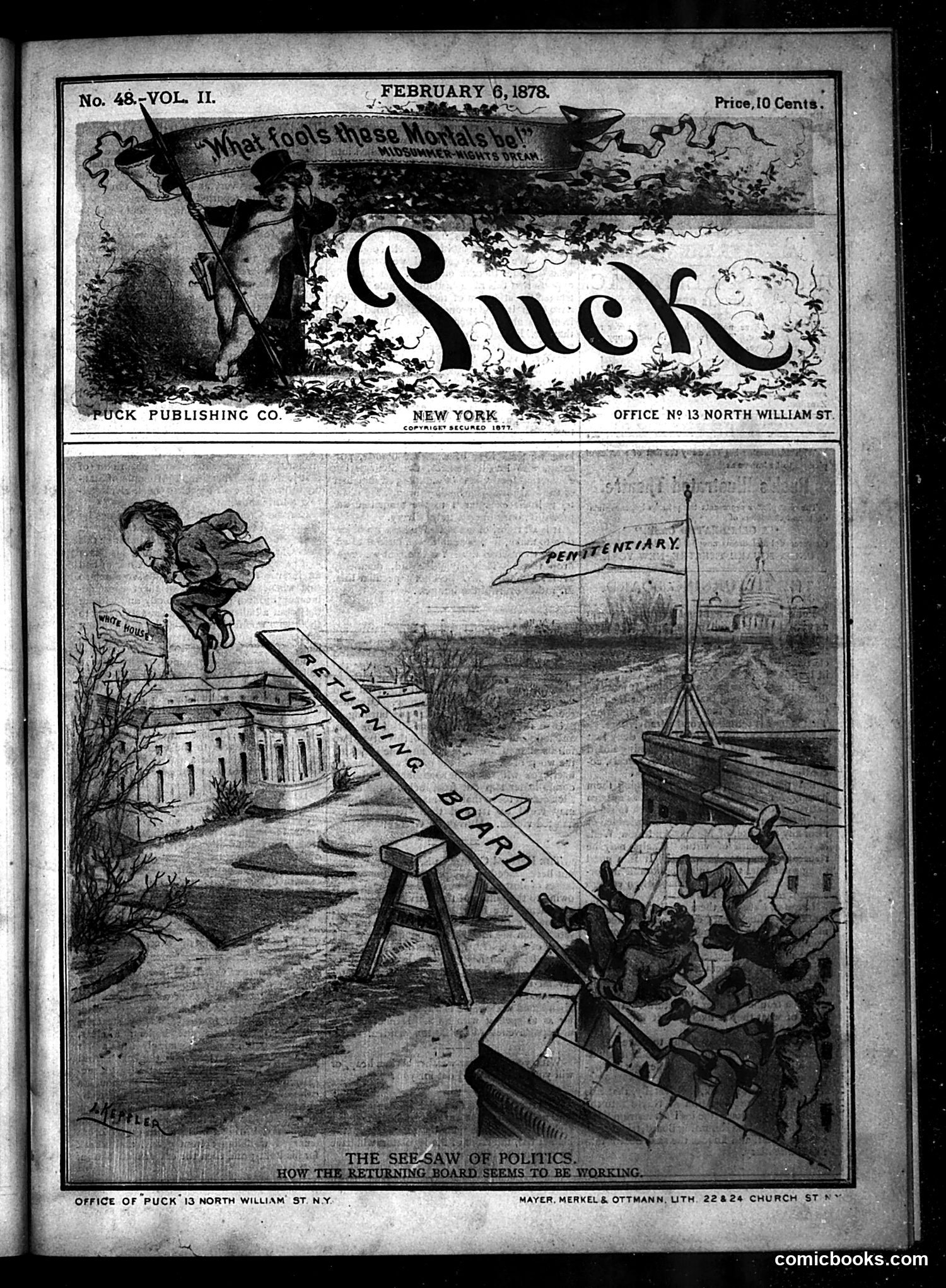
This February 6, 1878 *Puck* cartoon satirizes political instability through a see-saw metaphor. A figure labeled "Returning Board" (likely referring to election officials determining contested results) operates the mechanism, while two groups of men appear on opposite ends—one labeled "Penitentiary" on the right. The White House is visible in the background, and a ship flies a "Penitentiary" flag. The cartoon suggests that political power is being manipulated by the Returning Board for corrupt purposes, with the implication that political rivals face imprisonment rather than fair electoral competition. This likely references post-Reconstruction era election disputes and concerns about governmental corruption during the Hayes administration (1877-1881).
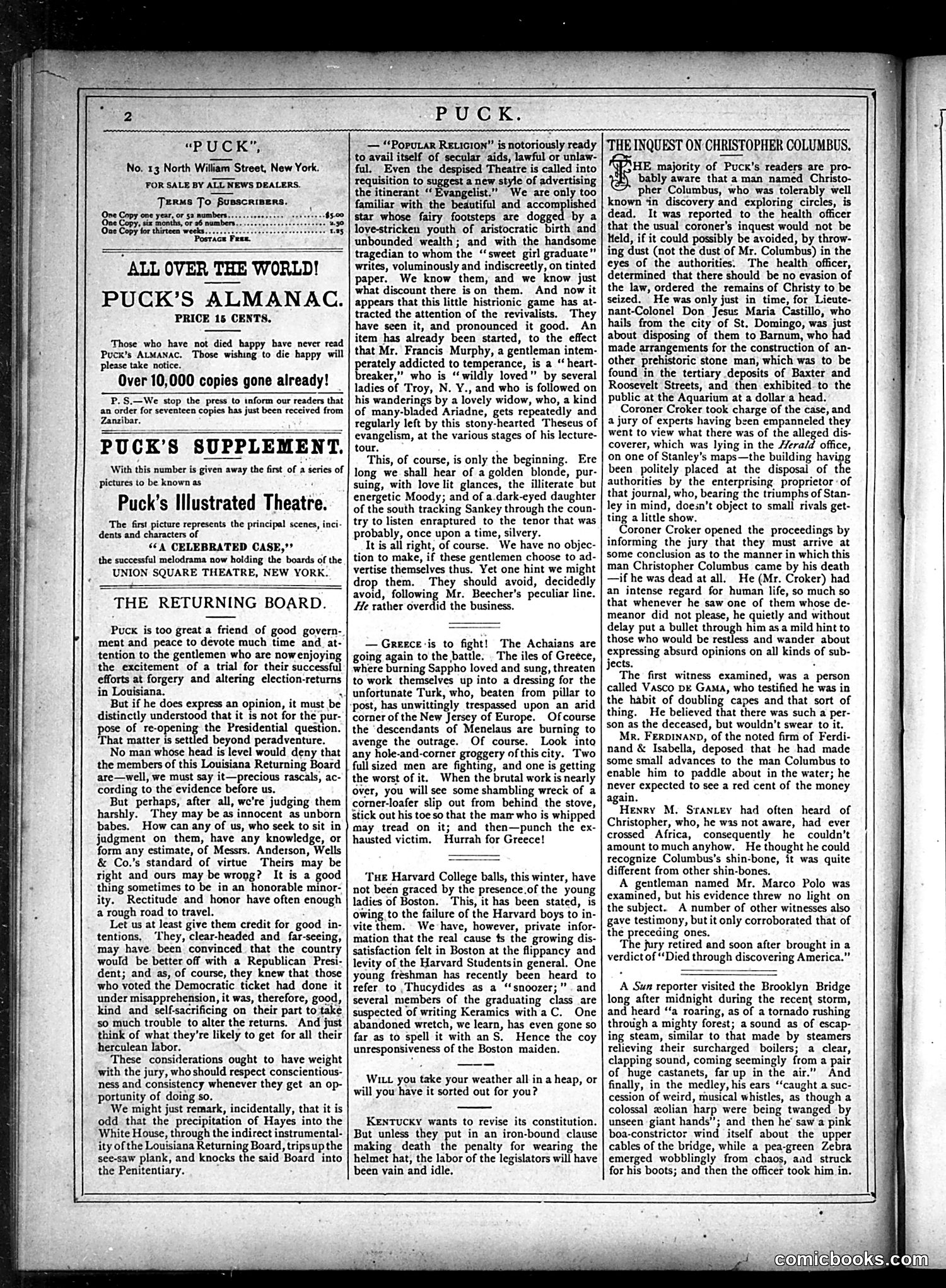
This page is primarily **text-based editorial content** rather than illustrated cartoons. The main articles discuss: 1. **"Popular Religion"** - Satirizing theatrical advertising and sensationalism in religious revival meetings 2. **"The Inquest on Christopher Columbus"** - A lengthy satirical piece about a coroner's inquest into Columbus's death, examining various witnesses who dispute claims about his remains and legacy. This appears to reference real 19th-century debates about where Columbus was actually buried. 3. **Various short political commentaries** on Louisiana politics, the Democratic Party, and election-related issues 4. **Social satire** regarding Harvard College scandals and Kentucky constitutional revision The page functions as opinion/commentary journalism rather than visual political cartooning. The Columbus piece is the most substantive satire, using absurdist humor to mock historical disputes and competing claims about American heritage.
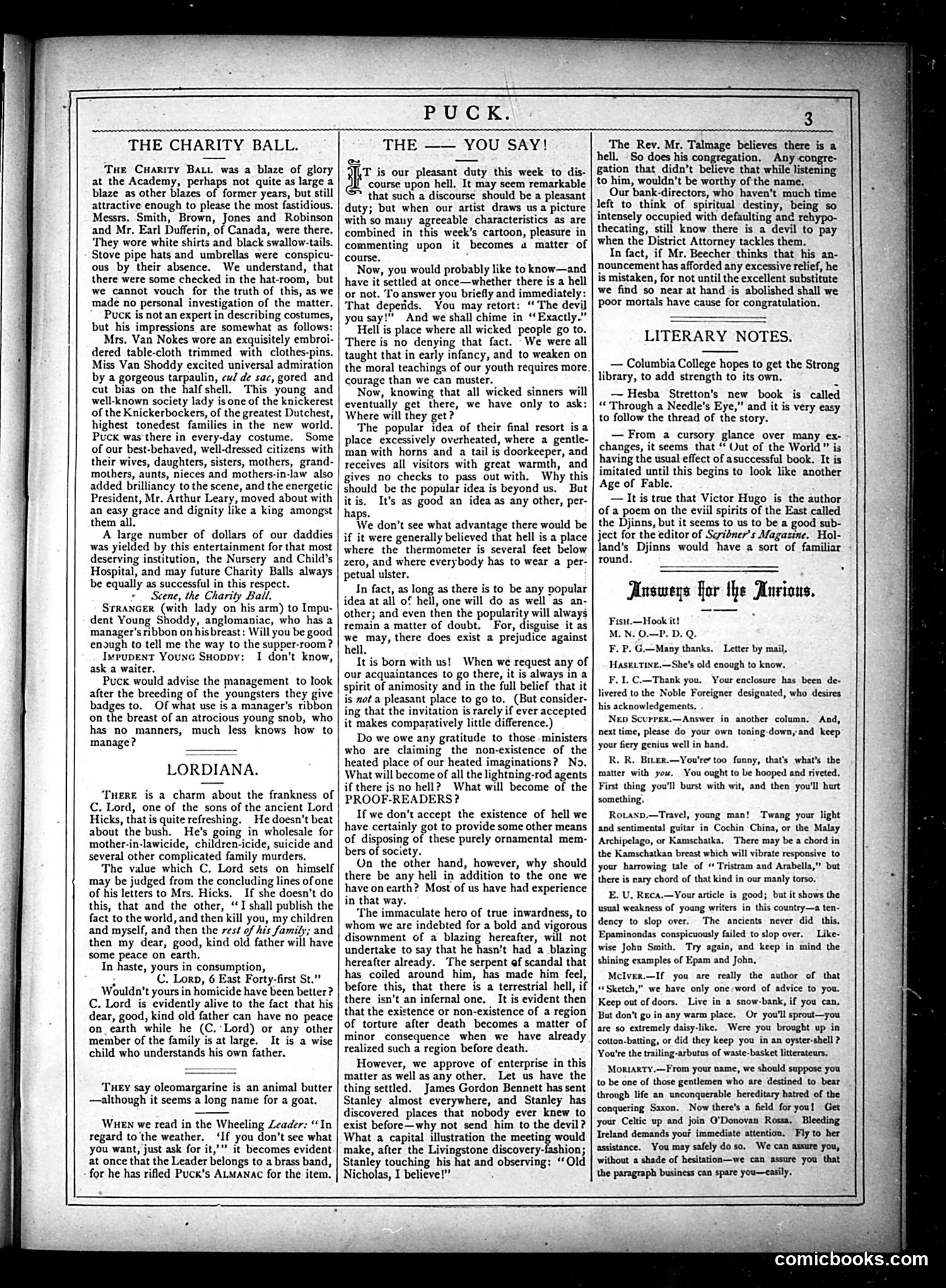
This page contains three distinct sections: "The Charity Ball," "The—You Say!" and "Lordiana," along with a "Literary Notes" column and reader responses. The main content critiques contemporary society through satirical commentary rather than visual cartoons. "The Charity Ball" mocks the pretensions of wealthy socialites hosting charity events, suggesting their motives are self-aggrandizement rather than genuine philanthropy. "Lordiana" appears to reference the British aristocratic class system, with humorous observations about family hierarchies and inheritance. "The—You Say!" engages in theological debate about hell's existence, satirizing popular religious beliefs of the era. The tone throughout is witty social commentary typical of Puck's approach to dissecting Victorian-era hypocrisy and class consciousness, rather than political cartooning.
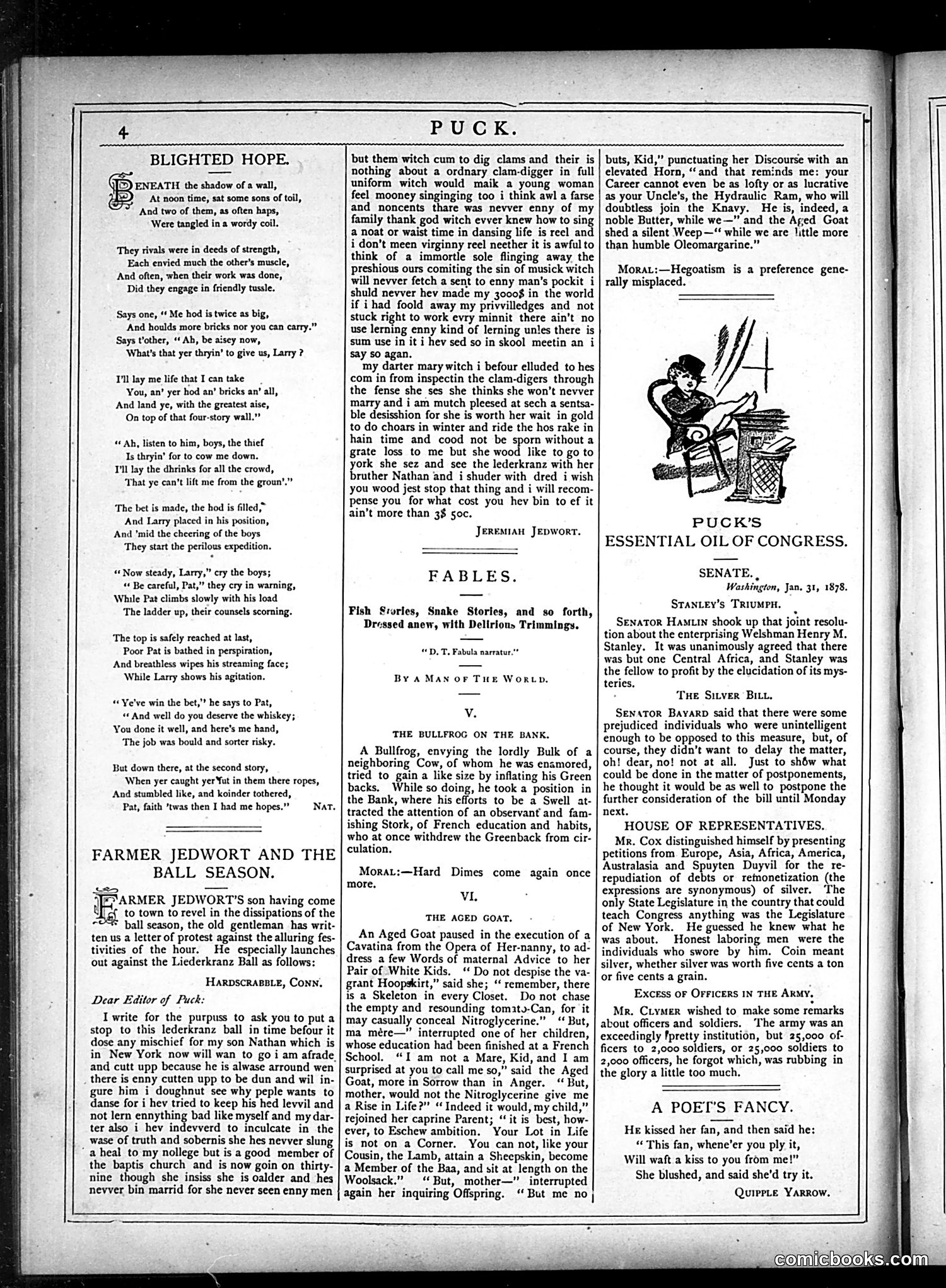
This page contains primarily **literary content** rather than political cartoons. The main pieces are: 1. **"Blighted Hope"** - A humorous poem about courting and dancing 2. **"Fables"** - Stories including "The Bullfrog on the Bank" and "The Aged Goat" 3. **"Farmer Jedwort and the Ball Season"** - A letter-to-editor piece complaining about his son attending social balls instead of farm work The small cartoon illustration labeled **"Puck's Essential Oil of Congress"** shows a caricatured figure in what appears to be a political context, but the image quality and lack of identifying details make it difficult to determine the specific legislative subject or figures referenced. The page represents Puck's mix of satirical humor, verse, and social commentary typical of 19th-century American periodicals.
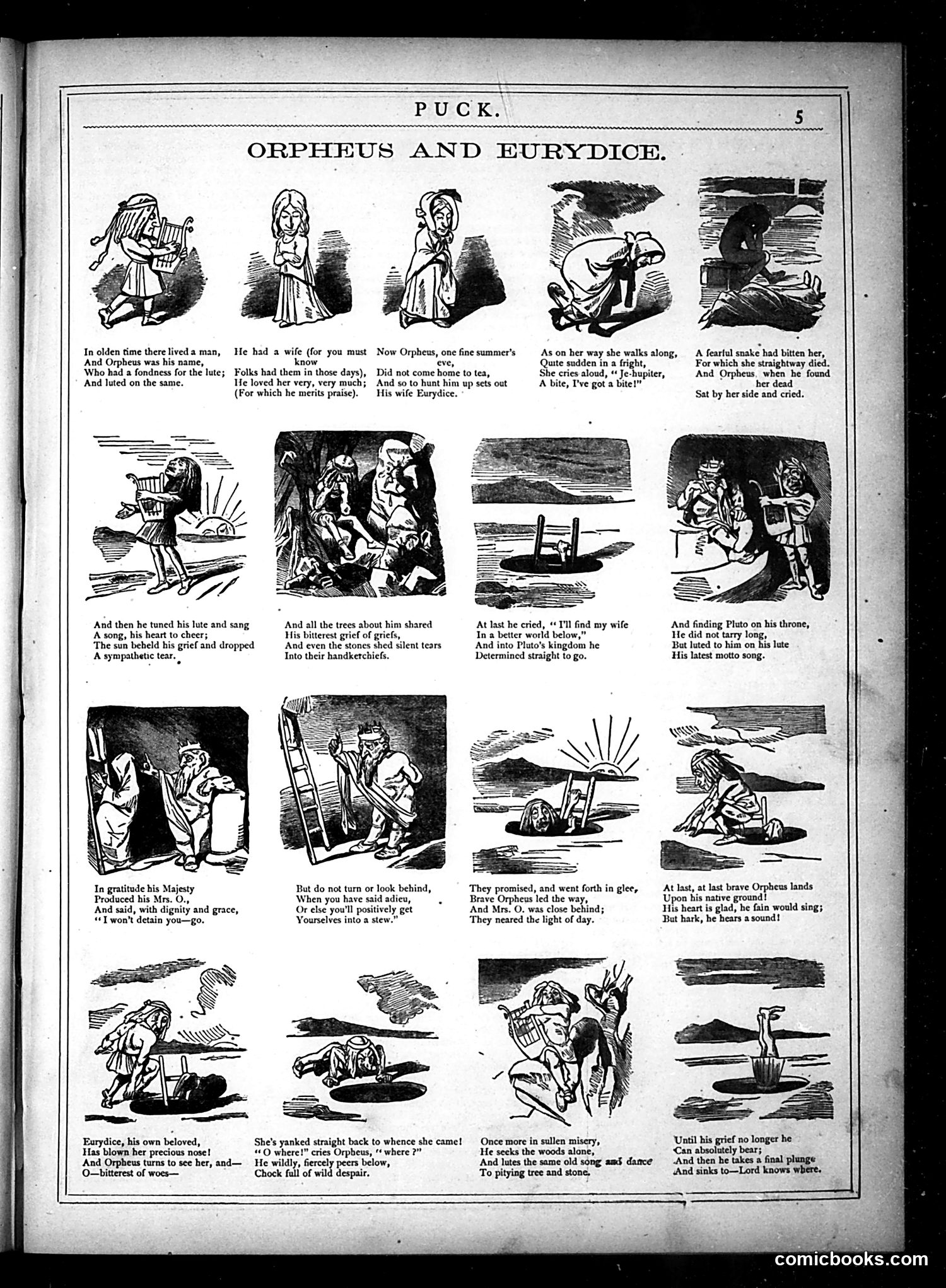
This page presents a comic retelling of the classical myth through sequential illustration panels. The story follows Orpheus, a legendary musician, as he attempts to rescue his wife Eurydice from the underworld after a snake bite kills her. The satire appears to mock the famous myth's tragic ending: Orpheus is instructed not to look back at Eurydice while leading her from Hades, but he disobeys at the final moment, causing her to vanish forever. Each panel progresses through key moments—Orpheus's grief, his musical plea to the gods, their descent, and ultimately his failure. The humor likely derives from treating this classical tragedy as domestic comedy, with Eurydice portrayed as a nagging wife and Orpheus as a bumbling husband, making the eternal myth relatable to contemporary readers through Victorian-era domestic situations.
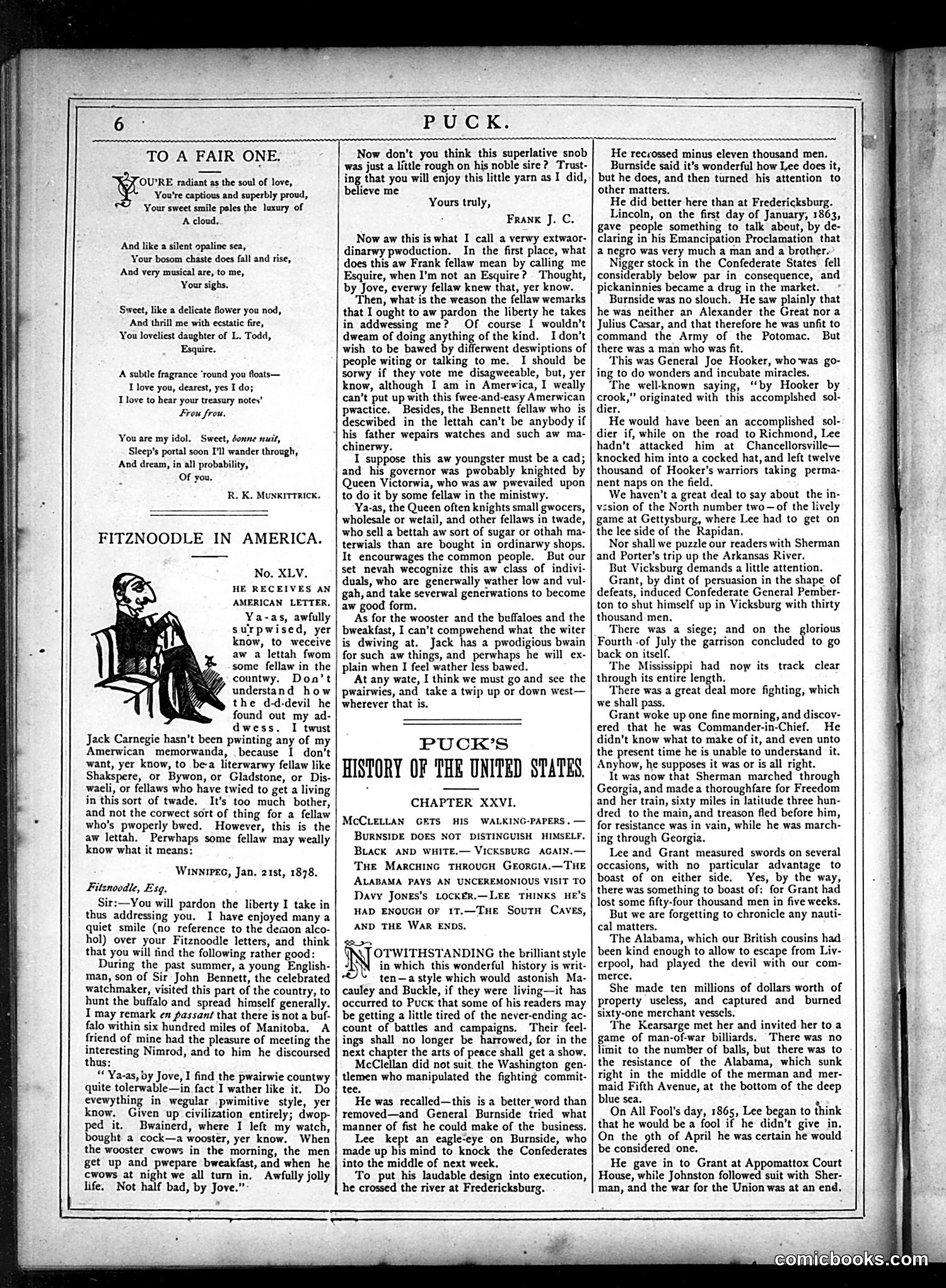
This page contains literary pieces and serialized satirical content rather than political cartoons. The main illustrated section, "Fitznoodle in America" (No. XLV), shows a caricatured figure—likely an exaggerated Irish immigrant or working-class character based on the art style—receiving a letter from America. The accompanying text humorously mocks an Irish correspondent's naive observations about American democracy and society, particularly poking fun at his misunderstanding of American customs and politics. The "Puck's History of the United States" section recounts Civil War events (McClellan, Burnside, Vicksburg, Sherman campaigns) with satirical commentary on military incompetence and the war's brutality. The satire targets both military leadership's failures and the endless nature of Civil War carnage. The page primarily uses written humor rather than visual satire.
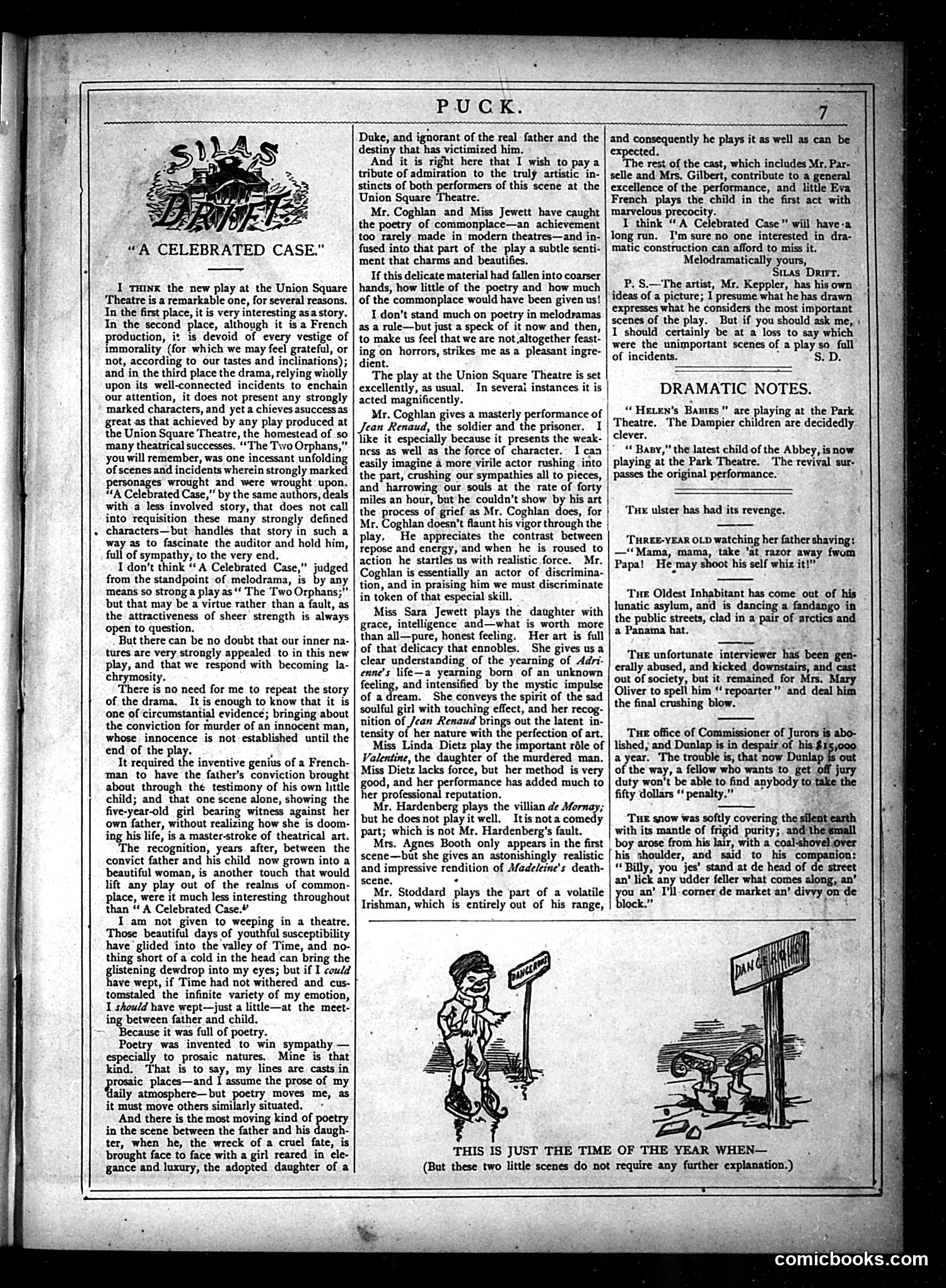
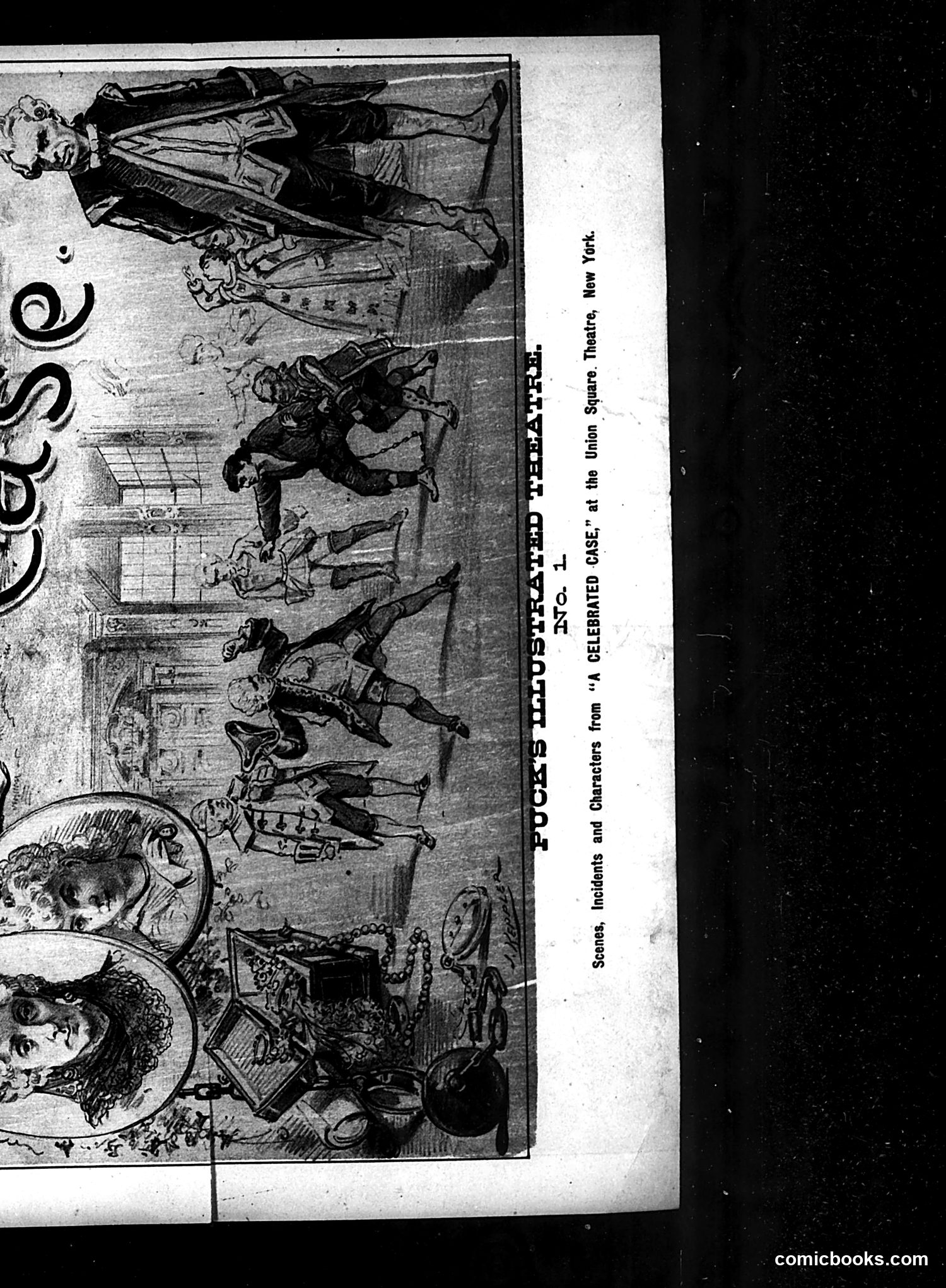
This is a theater review page from *Puck* magazine discussing a play at the Union Square Theatre. The main text is a lengthy critical review of "A Celebrated Case," praising its production quality and the performances of actors Mr. Coglan and Miss Jewett. At the bottom is a small cartoon showing a figure at a signpost labeled "DANGER" with the caption "THIS IS JUST THE TIME OF THE YEAR WHEN— (But these two little scenes do not require any further explanation.)" The cartoon appears to be a seasonal joke, likely referencing winter hazards or holiday-related dangers—possibly ice, snow, or travel risks—that would be obvious to contemporary readers without explanation. The exact reference is unclear without additional context about what specific seasonal danger was topical when this issue was published.
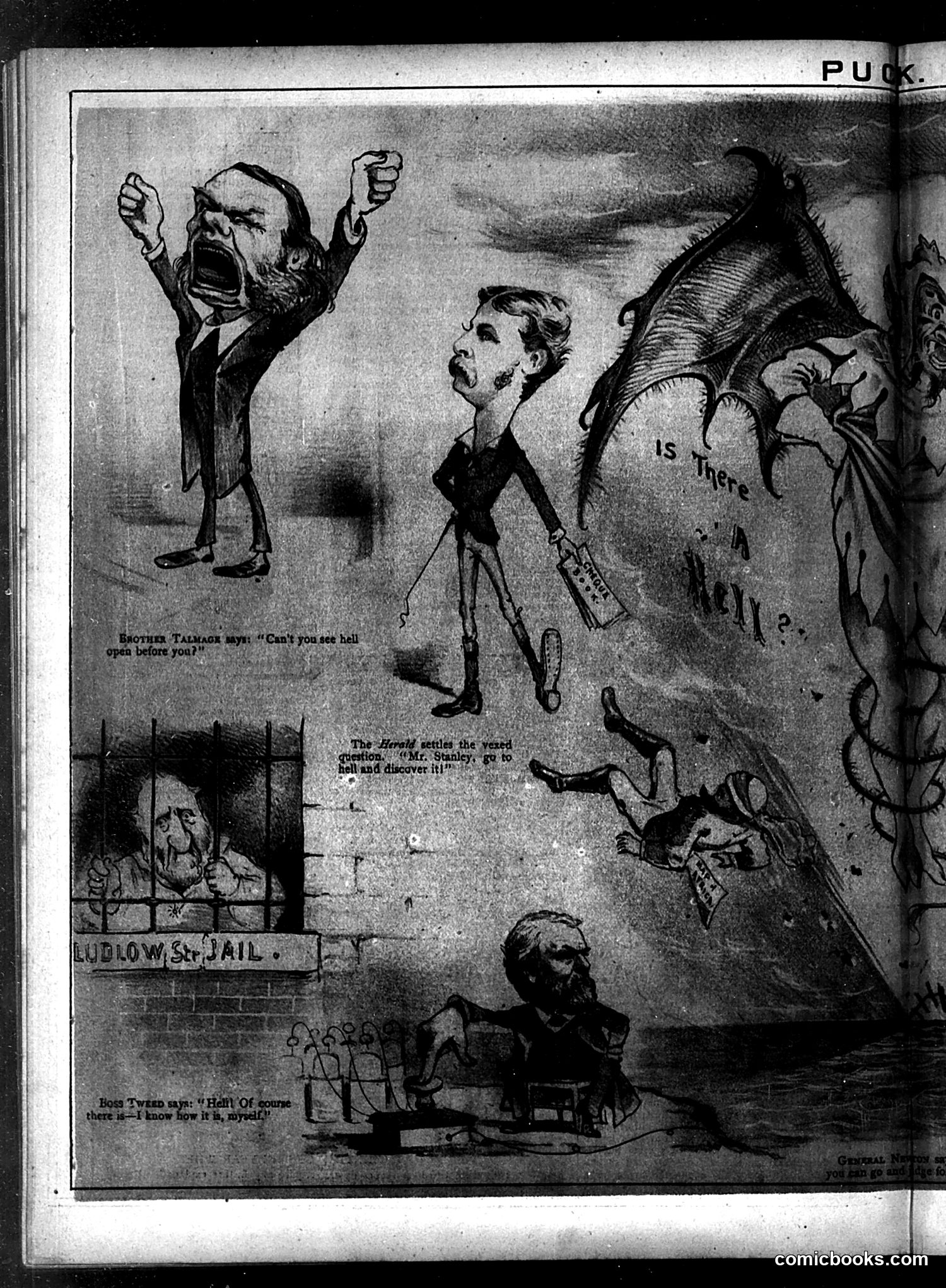
This appears to be a political satire cartoon featuring several figures. The top panel shows "Brother Talmage" (likely referring to a religious figure) exclaiming with raised fists, while a middle figure holds what appears to be a ball or object. A large demonic or threatening figure looms on the right with text reading "Is there no law?" The lower left panel shows someone behind bars labeled "LUDLOW ST. JAIL," while the bottom panel includes "Boss Tweed" saying "Hell! Of course there is—I know how it is, boys!" The cartoon appears to satirize corruption and selective justice in the legal system, suggesting that powerful figures like Tweed evade accountability while ordinary citizens face imprisonment. The religious figure's outrage contrasts with the cynical acceptance of legal corruption.
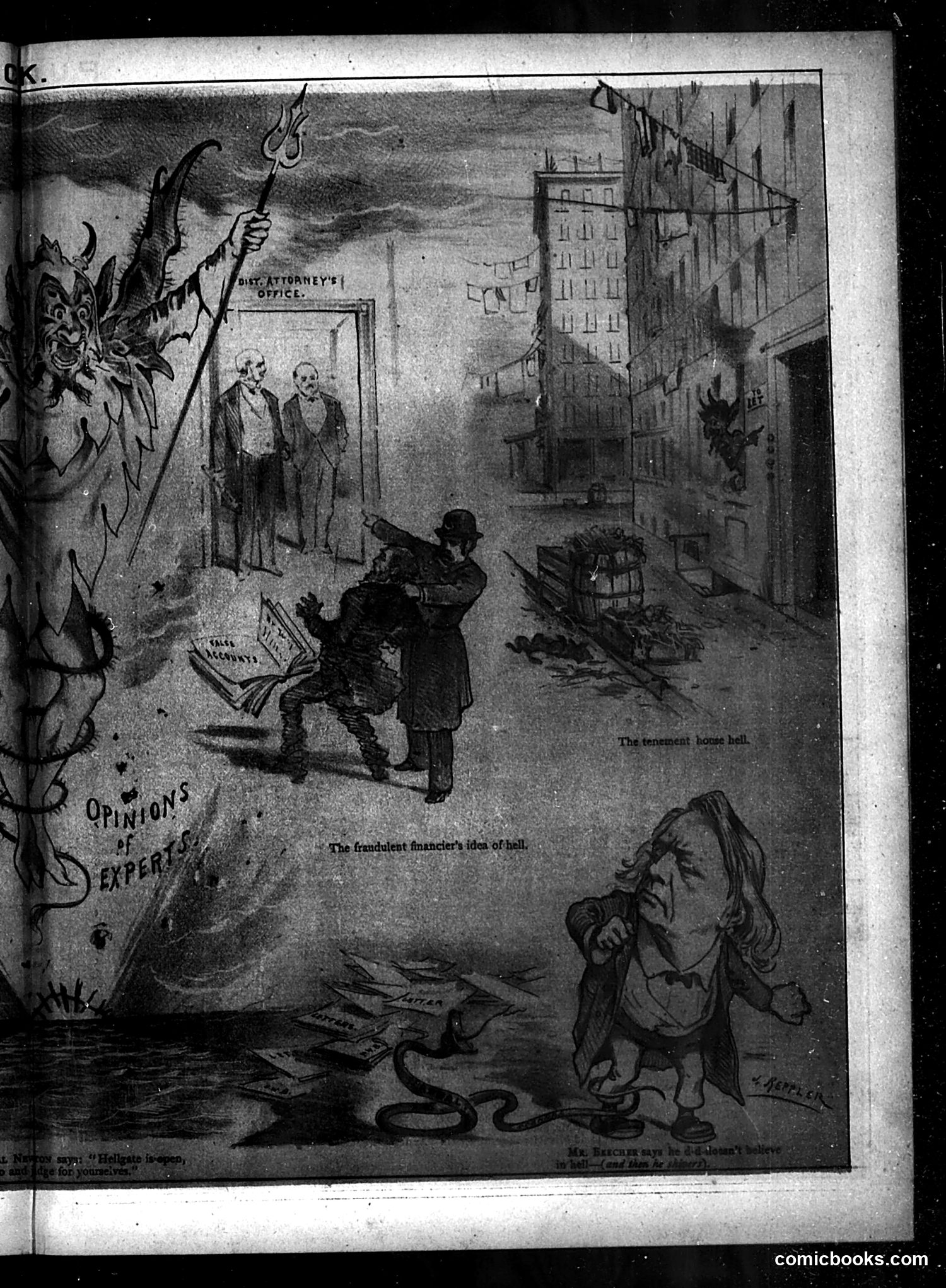
This Puck cartoon satirizes different perspectives on what constitutes "hell." The page contrasts three figures' viewpoints: 1. **Upper panel**: A tenement house bell and "The fraudulent financier's idea of hell" — showing a poor urban neighborhood, apparently mocking wealthy financiers' conception of suffering. 2. **Lower panel**: "The tenement house bell" caption, with a figure (appears to be a working-class person) depicted amid snakes and demons, representing their actual lived experience. The cartoon critiques wealth inequality by suggesting that privileged fraudsters imagine poverty as hell, yet remain insulated from genuine hardship. The "opinions of experts" title sarcastically positions financial criminals as authorities on suffering they don't experience. The satire exposes class disconnect and moral hypocrisy in Gilded Age America.
This page presents a romantic comedy narrative rather than a political cartoon. The story depicts dialogue between characters including Sylvia, Gabrielle, Mr. Smith, and Miss Hardinge, centered on matters of courtship and affection. The humor appears to derive from miscommunication and romantic entanglement: characters misunderstand each other's intentions regarding love declarations, while a subplot involves sheep and their peculiar behavior (apparently they won't jump fences properly). The satire seems gentle rather than biting—poking fun at romantic conventions, the earnestness of suitors, and the complications of Victorian courtship rituals. The incongruous inclusion of sheep management suggests absurdist humor mixing pastoral concerns with matters of the heart.
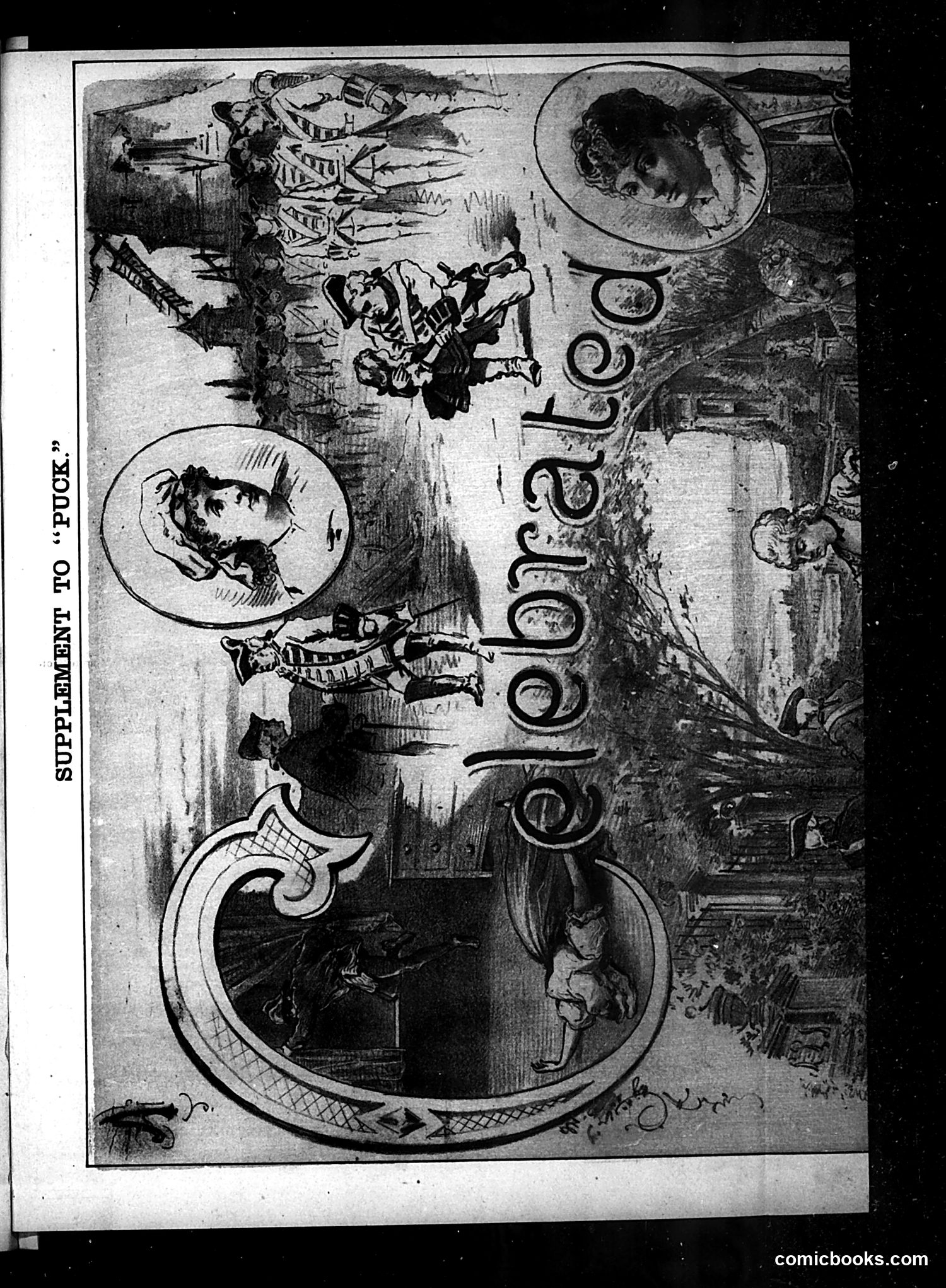
This appears to be a supplement cover featuring satirical illustrations arranged around decorative lettering. The image shows multiple caricatured figures in 19th-century dress engaged in various scenes. While the OCR text only provides the header "SUPPLEMENT TO 'PUCK,'" the visual composition suggests political or social satire typical of Puck magazine's style. The caricatures appear to depict public figures or types of the era, but without clearer labeling or additional text visible in this reproduction, I cannot definitively identify the specific individuals or the exact political event being satirized. The ornate lettering and multi-panel layout were characteristic of Puck's elaborate satirical presentations. To accurately explain this cartoon's specific meaning would require either clearer text or additional contextual documentation.
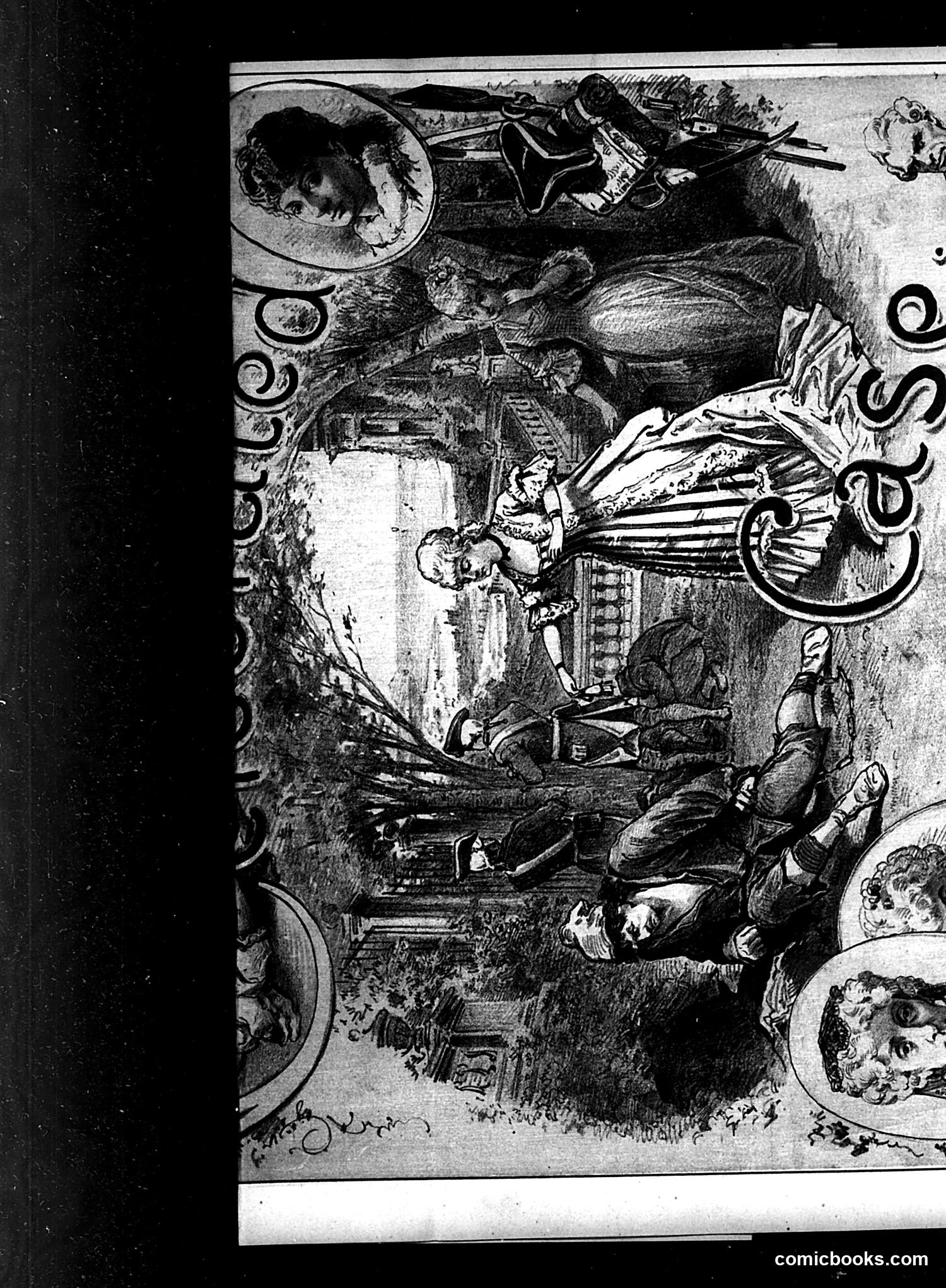
I can see this is a Puck magazine page with intricate satirical illustrations arranged around decorative circular vignettes, but the OCR text provided appears to be blank or unreadable. From the IMAGE alone, I can observe multiple figures in period dress (appearing 19th century), elaborate architectural settings, and ornamental borders typical of Puck's style. However, without legible text identifying the specific figures, events, or political references being satirized, I cannot reliably explain what this cartoon means to a modern reader. To provide accurate analysis as requested, I would need either: clearer OCR text identifying the cartoon's title and subject matter, or visible text labels within the illustration itself. I cannot responsibly guess at identities or political references without textual support.
This page appears to be primarily blank or contains only faint markings and circular stamp impressions, likely from archival handling. There is barely legible text running vertically along the left margin, but it's too faint to read with confidence in this image quality. Without clear visual content or legible text, I cannot reliably identify specific cartoons, political figures, or satirical commentary that would have been present on this Puck magazine page. The page may be a title page, advertisement, or the image quality/age of the document makes the original content insufficiently visible for accurate historical analysis. To provide proper context about the satire and references, a clearer image or higher-resolution scan would be needed.
This page contains **dramatic dialogue text only** — no visible cartoons or illustrations. It appears to be a theatrical script or serialized story titled "Puck," featuring characters named Gabrielle, Mr. Smith, Miss Joscelyn, and Miss Hardinge. The dialogue suggests a **romantic melodrama**: Mr. Smith demands Gabrielle leave with him, while she insists on obeying her own will. Miss Joscelyn and others intervene with moral arguments about duty and sacrifice. References to "going away," conditions, and commands suggest coercive pressure on the female character. Without visible illustrations, I cannot identify specific caricatures or political references. This reads as **serialized fiction rather than political satire**, which was common in Puck alongside its cartoons.
This page contains serialized fiction rather than political cartoons. The visible content includes: **"The Duel in Horse Wood"** — a continuing story by Wilkie Collins about an encounter involving Captain Varleigh and a woman named Miss Duval. The narrative describes a dramatic confrontation where Varleigh appears to have killed a rival in a duel, with subsequent complications involving concealment and confession. **"No. 4—The Reverend Alfred Loring, Rector of Nettlesgrove"** — the start of another serial piece describing events in October 1817 when a woman named Miss Duval arrives at a country house. These are literary serials typical of Puck's content mix, not satirical political cartoons. Without visible illustrations accompanying the text, this represents the magazine's fiction publication rather than its satirical commentary function.
This page consists primarily of **"Puck's Brevities"** — a column of short satirical jokes and quips rather than illustrated cartoons. The content targets various contemporary topics: - **Political figures**: References to President Cleveland's customs at the White House - **Social commentary**: Critiques of anonymous letter-writers, clerical hypocrisy, and marital disputes (including a joke about expensive divorces) - **Cultural observations**: Jabs at Chinese immigrant housing conditions in San Francisco, old busts of Cicero, and Kansas college administrators The humor relies on wordplay, irony, and brief anecdotes mocking public figures, social pretensions, and current events. Without illustrations, the satire depends entirely on textual wit. The page demonstrates Puck's approach to political and social criticism through accessible, often cutting remarks rather than complex visual metaphors.
This page is primarily **advertising and announcements**, not a satirical cartoon spread. The left column contains brief humor items and news snippets typical of Puck's style—short jokes about various social absurdities (tax collectors, vice, religious hypocrisy, etc.). These are mild satirical jabs at everyday American life rather than targeting specific political figures. The dominant content announces Puck Publishing Company's opening of a **General Designing Office**, featuring cartoonist **Joseph Keppler**. The office offers commercial illustration services—theatrical portraits, lithographic work, and general artistic commissions. The page concludes with a memorial notice for **Brigham Young**, the Mormon leader who had recently died, noting the publication of commemorative illustrations. This is essentially a **business promotion page** with light humor sidebars, not a political satire piece.
This page is primarily **advertising and promotional content** rather than political cartoons. The advertisements include: - Compressed yeast and theatrical venues (Aberle's Tivoli Theatre) - Tailoring services (Nicoll the Tailor) - Glass letter company - Printing inks and supplies - Gentlemen's hats The main editorial content advertises **Puck's Almanac for 1878** as "just out" and "the most remarkable ever published" (15 cents). A satirical illustration shows crowded urban chaos, likely mocking the almanac's ambitious claims or contemporary life. The page reflects 1870s New York commerce and entertainment culture but contains no identifiable political figures or satirical commentary about current events.
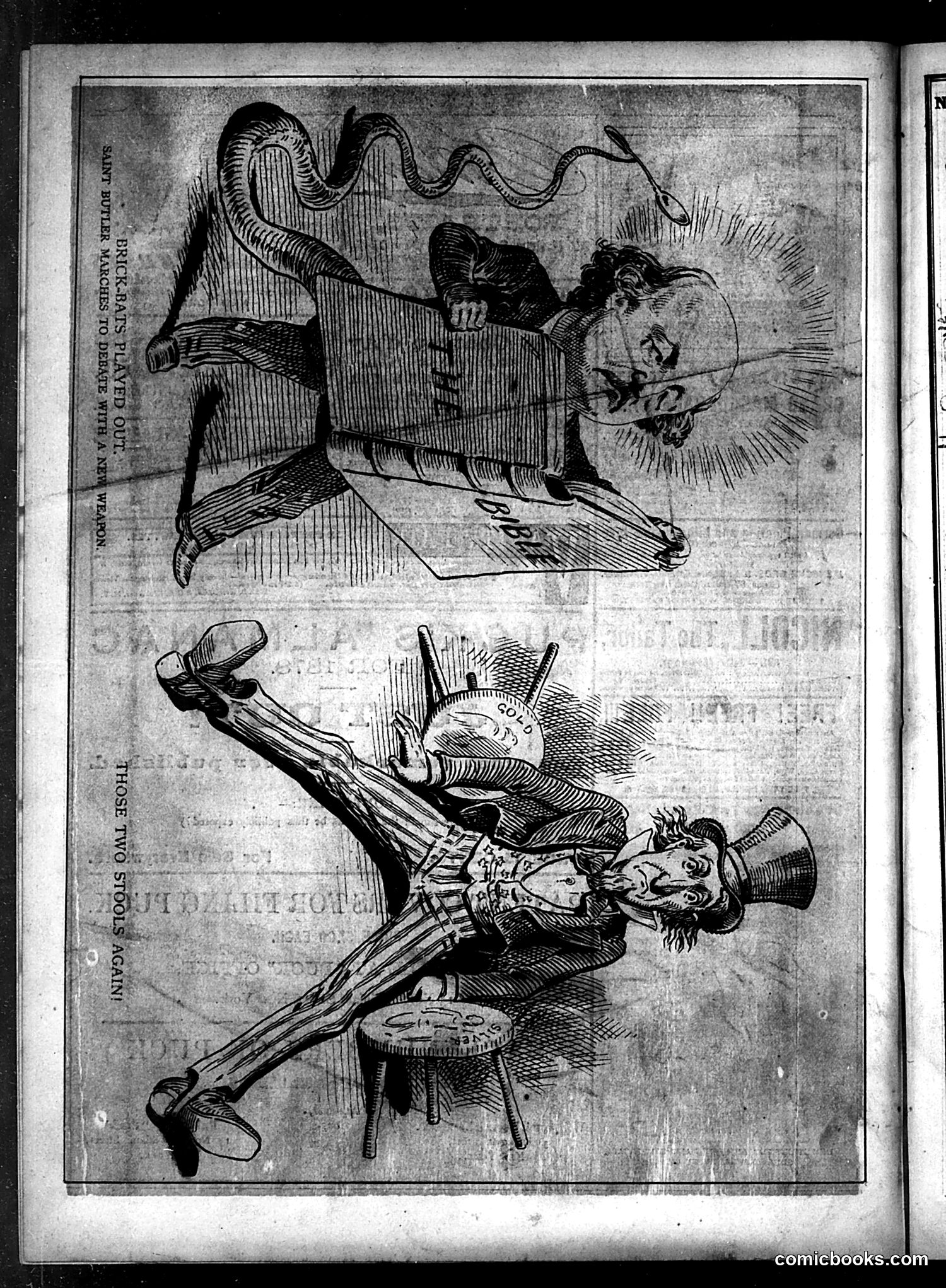
This page contains two satirical illustrations from *Puck* magazine. The top cartoon depicts a winged demon or devil figure carrying away a man in formal dress, suggesting corruption or moral downfall. The bottom image shows a man in a top hat seated at a table with what appears to be a globe or celestial sphere, engaged in some form of scheme or manipulation. Without clearer text identification on the visible portions, I cannot definitively name the specific political figures or events being satirized. The imagery suggests themes of political corruption, greed, or backroom dealing typical of Gilded Age *Puck* satire. The formal dress and symbolic objects (globe, demon) indicate commentary on powerful figures or institutions, but the precise target requires legible caption text to confirm accurately.