
Puck, 1878-02-06 · page 17 of 20
Puck — February 6, 1878 — page 17: what you’re looking at
What you’re looking at
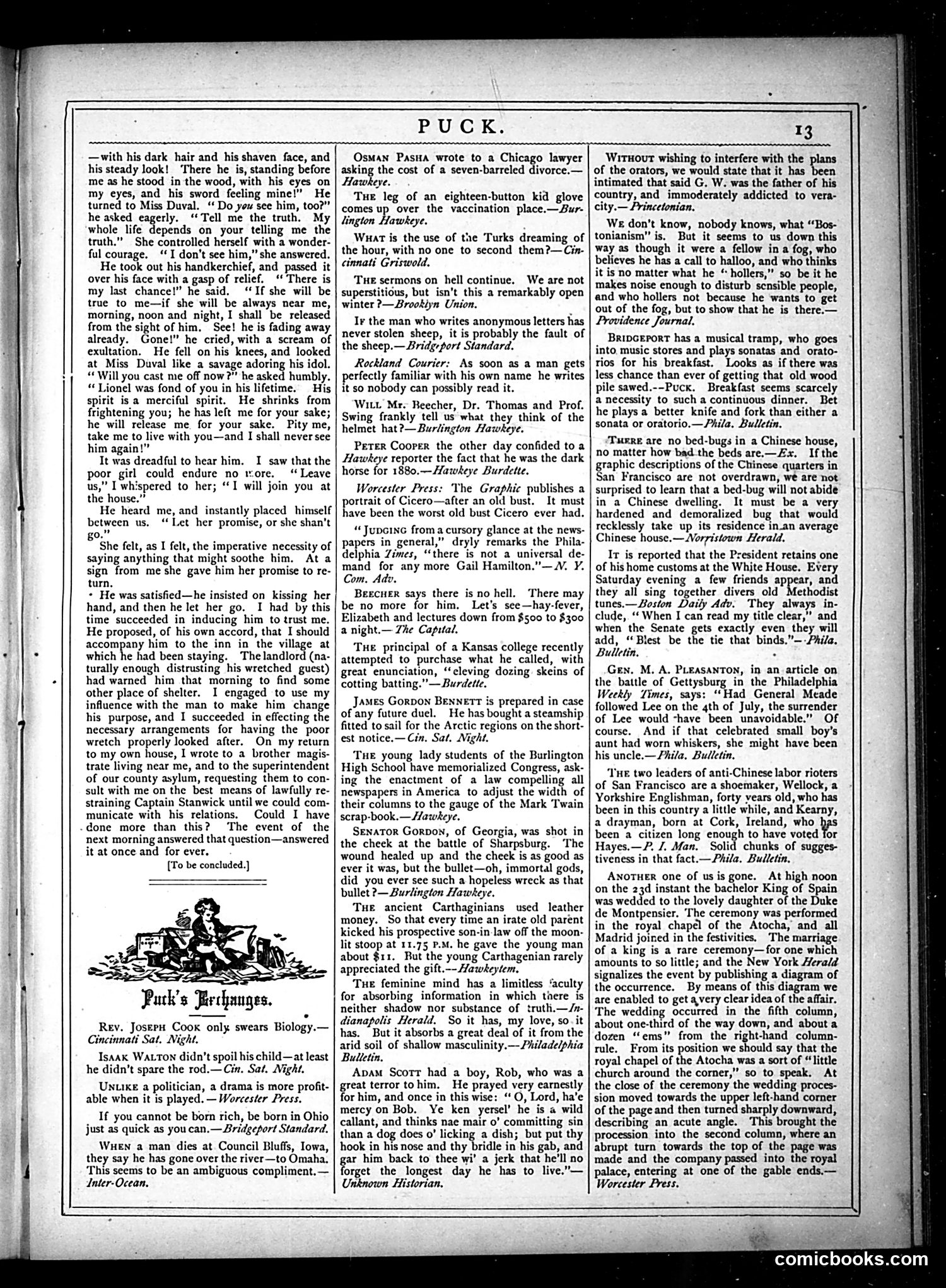
This page consists primarily of **"Puck's Brevities"** — a column of short satirical jokes and quips rather than illustrated cartoons. The content targets various contemporary topics: - **Political figures**: References to President Cleveland's customs at the White House - **Social commentary**: Critiques of anonymous letter-writers, clerical hypocrisy, and marital disputes (including a joke about expensive divorces) - **Cultural observations**: Jabs at Chinese immigrant housing conditions in San Francisco, old busts of Cicero, and Kansas college administrators The humor relies on wordplay, irony, and brief anecdotes mocking public figures, social pretensions, and current events. Without illustrations, the satire depends entirely on textual wit. The page demonstrates Puck's approach to political and social criticism through accessible, often cutting remarks rather than complex visual metaphors.
📄 Transcribed text from this page (OCR, searchable)
Machine-transcribed from the original scan — historical spelling and the odd misread are preserved.
-done more than this? PUCK. —with his dark hair and his shaven face, and his steady look! There he is, standing before me as he stood in the wood, with his eyes on my eyes, and his sword feeling mine!” He turned to Miss Duval. “Do you see him, too?” he asked eagerly. “Tell me the truth. My whole life depends on your telling me the truth.” She controlled herself with a wonder- ful courage. ‘I don't see him,” she answered. He took out his handkerchief, and passed it over his face with a gasp of relief. ‘ There is my last chance!” he said. ‘If she will be true to me—if she will be always near me, morning, noon and night, I shall be released from the sight of him. See! he is fading away already. Gone!” he cried, with a scream of exultation. He fell on his knees, and looked at Miss Duval like a savage adoring his idol. “ Will you cast me off now?” he asked humbly. “Lionel was fond of you in his lifetime. His spirit is a merciful spirit. He shrinks from frightening you; he has left me for your sake; he will release me for your sake. Pity me, take me to live with you—and I shall never see him again!” It was dreadful to hear him. I saw that the poor girl could endure no wore. “Leave us,” I whispered to her; “I will join you at the house.” He heard me, and instantly placed himself between us. ‘Let her promise, or she shan't She felt, as I felt, the imperative necessity of saying anything that might soothe him. At a sign from me she gave him her promise to re- turn, + He was satisfied—he insisted on kissing her hand, and then he let her go. I had by this time succeeded in inducing him to trust me. He proposed, of his own accord, that I should accompany him to the inn in the village at which he had been staying. The landlord (na- turally enough distrusting his wretched guest) had warned him that morning to find some other place of shelter. 1 engaged to use my influence with the man to make him change his purpose, and I succeeded in effecting the necessary arrangements for having the poor wretch properly looked after. On my return to my own house, I wrote to a brother magis- trate living near me, and to the superintendent of our county asylum, requesting them to con- sult with me on the best means of lawfully re- straining Captain Stanwick until we could com- municate with his relations. Could I have The event of the next morning answered that question—answered it at once and for ever. [To be concluded] Rey. Josep Coox only swears Biology.— Cincinnati Sat. Night. Isaak Watton didn’t spoil his child—at least he didn’t spare the rod.— Cin. Sat. Night. Unuike a politician, a drama is more profit- able when it is played. — Worcester Press. If you cannot be born rich, be born in Ohio just as quick as you can.— Bridgeport Standard, Wuen a man dies at Council Bluffs, Iowa, they say he has gone over the river—to Omaha. This seems to be an ambiguous compliment.— Inter-Ocean, Osman PasHa wrote to a Chicago lawyer asking the cost of a seven-barreled divorce.— Hawkeye. Tue leg of an eighteen-button kid glove comes up over the vaccination place.—Bur- lington Hawkeye. Wuart is the use of the Turks dreaming of the hour, with no one to second them?—Cin- cinnati Griswold. THe sermons on hell continue. We are not superstitious, but isn’t this a remarkably open winter ?—Brookiyn Union. Ir the man who writes anonymous letters has never stolen sheep, it is probably the fault of the sheep.—Bridgrport Standard. Rockland Courier: As soon as a man gets rfectly familiar with his own name he writes it so nobody can possibly read it. Witt Mr. Reecher, Dr. Thomas and Prof. Swing frankly tell us what they think of the helmet hat?—Burlington Hawkeye, Peter Cooper the other day confided to a Hawkeye reporter the fact that he was the dark horse for 1880.—Hawkeye Burdette, Worcester Press: The Graphic publishes a portrait of Cicero—after an old bust. It must have been the worst old bust Cicero ever had. “Jupoinc froma cursory glance at the news- papers in general,” dryly remarks the Phila- delphia Zimes, “there is not a universal de- mand for any more Gail Hamilton."—. ¥. Com. Adv. Beecuer says there is no hell. There may be no more for him, Let's see—hay-fever, Elizabeth and lectures down from $500 to $300 a night.— Zhe Capital. Tue principal of a Kansas college recently attempted to purchase what he called, with great enunciation, ‘cleving dozing. skeins of cotting batting.” — Burdette. James Gorvon Bennett is prepared in case of'any future duel. He has bought a steamship fitted to sail for the Arctic regions on the short- est notice.— Cin, Sat, Night. Tue young lady students of the Burlington High School have memorialized Congress, ask- ing the enactment of a law compelling all newspapers in America to adjust the width of their columns to the gauge of the Mark Twain scrap-book.— Hawkeye. Senator Gorvon, of Georgia, was shot in the cheek at the battle of Sharpsburg. The wound healed up and the cheek is as good as ever it was, but the bullet—oh, immortal gods, did you ever see such a hopeless wreck as that bullet ?—Burlington Hawkeye. Tue ancient Carthaginians used leather money. So that every time an irate old parent kicked his prospective son-in-law off the moon- lit stoop at 11.75 p.m. he gave the young man about $11. But the young Carthagenian rarely appreciated the gift.--Hawkeytem, Tue feminine mind has a limitless ‘aculty for absorbing information in which there is neither shadow nor substance of truth.—/n- dianapolis Herald. So it has, my love, so.it has. But it absorbs a great deal of it from the arid soil of shallow masculinity.—Philade/phia Bulletin, Apam Scotr had a boy, Rob, who was a great terror tohim. He prayed very earnestly for him, and once in this wise: ‘ O, Lord, ha’e mercy on Bob. Ye ken yersel’ he is a wild callant, and thinks nae mair o’ committing sin than a dog does o’ licking a dish; but put thy hook in his nose and thy bridle in his gab, and ar him back to thee wi’ a jerk that he’ll no forget the longest day he has to live.”— Unknown Historian, Wrruout wishing to interfere with the of the orators, we would state that it has n intimated that said G. W. was the father of his country, and immoderately addicted to vera- city.— Princetonian, We don’t know, nobody knows, what ‘“Bos- tonianism” is. But it seems to us down this way as though it were a fellow in a fog, who believes he has a call to halloo, and who thinks it is no matter what he “ hollers,” so be it he makes noise enough to disturb scnsible people, and who hollers not because he wants to get out of the fog, but to show that he is there.— Providence Journal, Bripceport has a musical tramp, who goes into. music stores and plays sonatas and orato- tios for his breakfast. Looks as if there was less chance than ever of getting that old wood pile sawed.--Puck. Breakfast seems scarcely a necessity to such a continuous dinner. Bet he plays a better knife and fork than either a sonata or oratorio.— Phila. Bulletin, ‘Turre are no bed-bugs in a Chinese house, no matter how bad the beds are.—£x. Ifthe graphic descriptions of the Chinese quarters in San Francisco are not overdrawn, we are not surprised to learn that a bed-bug will not abide in a Chinese dwelling. It must be a very hardened and demoralized bug that would recklessly take up its residence in-an average Chinese house.—Noryistown Herald. Ir is reported that the President retains one of his home customs at the White House. Every Saturday evening a few friends appear, and they all sing together divers old Methodist tunes.—oston Daily Adv. They always in- clude, ‘When I can read my title clear,” and when the Senate gets exactly even they will add, ‘Blest be the tie that binds.”—-Phi/a. Bulletin. . Gen. M. A. PLeasanton, in an article on the battle of Gettysburg in the Philadelphia Weekly Times, says: ‘Had General Meade followed Lee on the 4th of July, the surrender of Lee would -have been unavoidable.” Of course. And if that celebrated small boy’s aunt had worn whiskers, she might have been his uncle.—Fhila, Bulletin, ‘THe two leaders of anti-Chinese labor rioters of San Francisco are a shoemaker, Wellock, a Yorkshire Englishman, forty vears old, who has been in this country a little while, and Kearny, a drayman, born at Cork, Ireland, who ys been a citizen long enough to have voted for Hayes.—P. /. Man. Solid chunks of sugges- tiveness in that fact.— Phila, Bulletin, ANOTHER one of us is gone. At high noon on the 23d instant the bachelor King of Spain was wedded to the lovely daughter of the Duke de Montpensier. ‘The ceremony was performed in the royal chapel of the Atocha, and all Madrid joined in the festivities. The marriage of a king is a rare ceremony—for one which amounts to so little; and the New York Hera/d signalizes the event by publishing a diagram of the occurrence. By means of this diagram we are enabled to get avery clear idea of the affair. The wedding occurred in the fifth column, about one-third of the way down, and about a dozen “ems” from the right-hand column- rule. From its position we should say that the royal chapel of the Atocha was a sort of “little church around the corner,” so to speak. At the close of the ceremony the wedding proces- sion moved towards the upper left-hand corner of the page and then turned sharply downward, describing an acute angle. This brought the procession into the second column, where an abrupt turn towards the top of the page was made and the company into the royal palace, entering at one of the gable ends.— Worcester Press. ‘: -etiifar. a) eR comicbooks.com