
Puck, 1878-02-06 · page 10 of 20
Puck — February 6, 1878 — page 10: what you’re looking at
What you’re looking at
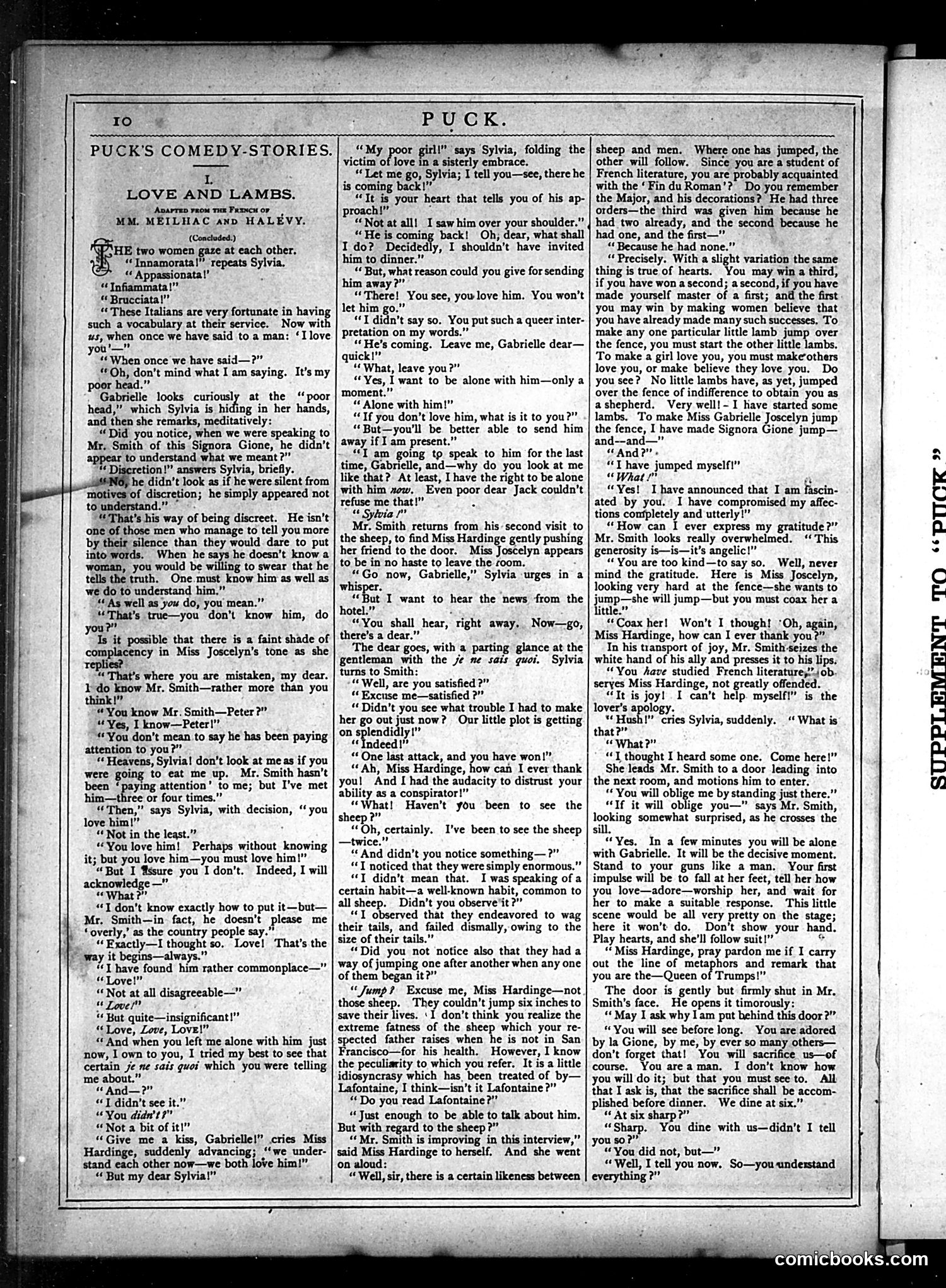
This page presents a romantic comedy narrative rather than a political cartoon. The story depicts dialogue between characters including Sylvia, Gabrielle, Mr. Smith, and Miss Hardinge, centered on matters of courtship and affection. The humor appears to derive from miscommunication and romantic entanglement: characters misunderstand each other's intentions regarding love declarations, while a subplot involves sheep and their peculiar behavior (apparently they won't jump fences properly). The satire seems gentle rather than biting—poking fun at romantic conventions, the earnestness of suitors, and the complications of Victorian courtship rituals. The incongruous inclusion of sheep management suggests absurdist humor mixing pastoral concerns with matters of the heart.
📄 Transcribed text from this page (OCR, searchable)
Machine-transcribed from the original scan — historical spelling and the odd misread are preserved.
PUCK. PUCK'S COMEDY-STORIES. L : LOVE AND LAMBS. Avarrap yrom Hm FRINCH OF MM. MEILHAC anp HALEVY. (Conctuded.) 'HE two women at each other, ‘“Innamoratal” ‘repeats Sylvia. ‘ Appassionata!’ d “Tnfiammata!” “Brucciata!” “These Italians are very fortunate in having such a vocabulary at their service. Now with us, when once we have said to a man: ‘I love on “¢ When once we have said—?” mind what I am saying. It’s my Gabrielle looks curiously at the ‘poor head,” which Sylvia is hiding in her hands, and then she remarks, meditatively: “Did you notice, when we were speaking to Mr, Smith of this Signora Gione, he didn’t appear to understand what we meant?” * Discretion!” answers Sylvia, briefly. he didn’t look as if he were silent from motives of discretion; he simply appeared not ” to understand. ‘That's his way of being discreet. He isn't one of those men who manage to tell you more by their silence than they would dare to put into'words. When he says he doesn’t know a woman, you would be willing to swear that he tells the truth. One.must know him as well as we do to understand him.” “© As well as you do, you mean.” “'That’s true—you don’t know him, do 7 ? ge it possible that there is a faint shade of come in Miss Joscelyn’s tone as she i ‘That’s where you are mistaken, my dear. Ido know Mr. Smith—rather more than you think!” “You know Mr. Smith—Peter ?” “Ves, I know—Peter!”” : «You don’t mean to say he has been paying attention to you?” «* Heavens, Sylvia! don’t look at meas if you were going to eat me up. Mr. Smith hasn’t been ‘paying attention’ to me; but I've met him—three or four times.” “Then,” says Sylvia, with decision, “ you love him!” . “Not in the least.” “You love him! Perhaps without knowing it; but you love him—you must love him!” “But I Bssure you I don’t. Indeed, I will acknowledge —” «What ?”” “TY don’t know exactly how to put it—but— Mr. Smith—in fact, he doesn’t please me ‘overly,’ as the country people say.” “Fxactly—I thought so. Love! That’s the ~ way it begins—always.” “have found him rather commonplace—” “Love!” “Not at all disagreeable—” “ Lover" “ But quite—insignificant!” “Love, Love, Love!” “And when you left me alone with him just now, I own to you, I tried my best to see that certain je ne sais guoi which you were telling me about.” “ And—?” “I didn’t see it.” “You didn't?” “Not a bit of it!” “Give me a kiss, Gabrielle!” cries Miss Hardinge, suddenly advancing; ‘we under- stand each other now—we both love him!” «But my dear Sylvia!” «My r girl” says Sylvia, folding the victim of love in a sisterly embrace. ‘Let me go, Sylvia; I tell you—see, there he is coming back!’’ “It is your heart that tells you of his ap- proach!” 3 “Not at all! I saw him over your shoulder.” “He is coming back! Oh; dear, what shall I do? Deci -dly, I shouldn’t have invited him to dinner.” “But, what reason could you give for sending him away?” “There! You see, yowlove him. You won't let him go.” “I didn’t say so. You put such a queer inter- pretation on my words.” ‘* He's coming. Leave me, Gabrielle dear— quick!” “What, leave you?” “Yes, I want to be alone with him—only a moment.” “Alone with him!” “Tf you don’t love him, what is it to you?” “«But—you'll be better able to send him away if I am present.” “I am going tp speak to him for the last time, Gabrielle, and—why do you look at me like that? At least, I have the right to be alone with him zew. Even poor dear Jack couldn’t refuse me that!" 5 “ Sylvia!” Mr. Smith returns from his-second visit to the sheep, to find Miss Hardinge gently pushing her friend to the door. Miss Joscelyn appears to be in no haste to leave the room. “Go now, Gabrielle,” Sylvia urges in a whisper. “But I want to hear the news from the hotel.” : “You shall hear, right away. Now—go, there’s a dear.”” The dear goes, with a parting glance at the gentleman with the je ne sais quoi. Sylvia turns to Smith: “Well, are you satisfied ?” “Excuse me—satisfied ?” “Didn't you see what trouble I had to make her go oat now? Our little plot is getting on splendidly!” “Indeed!” “One last attack, and you have won!’’ “Ah, Miss Hardinge, how can I ever thank you! And I had the audacity to distrust your ability as a conspirator!” “What! Haven’t you been to see the sheep ?” “Oh, certainly. I’ve been to see the sheep —twice.”” “And didn’t you notice something—?” “T noticed that they were simply enormous.” “1 didn't mean that. I was speaking of a certain habit—a well-known habit, common to all sheep. Didn't you observe'it ?” ‘(I observed that they endeavored to wag their tails, and failed dismally, owing to the size of their tails.” “Did you not ‘notice also that they hada way of jumping one after another when any one of them began it?” “Jump? Excuse me, Miss Hardinge—not those sheep. They couldn't jump six inches to save their lives. ‘I don’t think you realize the extreme fatness of the sheep which your re- spected father raises when he is not in San Francisco—for his health. However, I know the peculiarity to which you refer. It is a little idiosyncrasy which has, been treated of by— Lafontaine, I think—isn’t it Lafontaine?” “Do you read Lafontaine?’’ “Just enough to be able to talk about him. But with regard to the sheep ?” “Mr. Smith is improving in this interview,” said Miss Hardinge to herself. And she went on aloud: “Well, sir, there is a certain likeness between sheep and men. Where one has jumped, the other will follow. Since you are a student of French literature, you are probably acquainted with the “Fin du Roman’? Do you remember the Major, and his decorations? He had three orders—the third was given him because he had two already, and the second because he had one, and the first-—” “‘ Because he had none. “Precisely. With a slight variation the same. thing is true of hearts. You may win a third, if you have won a second; a second, if you have made yourself master of a first; and the first you may win by making women believe that you have already made many such successes, To make any one particular little lamb jump over the fence, you must start the other little lambs, To make a girl love you, you must make-others love you, or make believe they love you. Do you see? No little lambs have, as yet, jumped over the fence of indifference to obtain you as ashepherd. Very well!-I have started some lambs. To make Miss Gabrielle Joscelyn jump the fence, I have made Signora Gione jump— and-—-and—” “And?"+ “Thave jumped myself!” “What!” oe ge “Yes! I have announced that I am fascin- ated by you. I have compromised my affec- tions confpletely and utterly!” “How can I ever express my gratitude?” Mr. Smith looks really overwhelmed. ‘This generosity is—is—it’s angelic!” “You are too kind—to say so. Well, never mind the gratitude. Here is Miss Joscelyn, looking very hard at the fence—she wants to jump—she will jump—but you must coax her a little.” ‘Coax her! Won't I though! ‘Oh, again, Miss Hardinge, how can I ever thank you?” In his transport of joy, Mr. Smith:seizes the white hand of his ally and presses it to his lips. “You have studied French literaturey”j ob. seryes Miss Hardinge, not greatly offended. “Tt is joy! I can’t help. myself!” is the lover’s apology. cries Sylvia, suddenly. _“‘ What is “What?” “I thought I heard some one. Come here!” She leads Mr. Smith to a door leading into the next room, and motions him to enter. ‘You will oblige me by standing just there.”” “Tf it will oblige you—” says Mr. Smith, looking somewhat surprised, as he crosses the sill. “Yes. In a few minutes you will be alone with Gabrielle. It will be the decisive moment. Stand to your guns like a man. Your first impulse will be to fall at her feet, tell her how you love—adore—worship her, and wait for her to make a suitable response. This little scene would be all very pretty on the stage; here it won't do. Don't show your hand. Play hearts, and she'll follow suit!” ¥, “Miss Hardinge, pray pardon me if I carry out the line of metaphors and remark that you are the—Queen of Trumps!” The door is gently but firmly shut in Mr. Smith’s face. He opens it timorously: “May I ask why Iam put behind this door?” * You will see before long. You are adored by la Gione, by me, by ever so many others— don’t forget that! You will sacrifice us—of course. You area man. I don’t know how you will do it; but that you must see to. All that I ask is, that the sacrifice shall be accom- plished before dinner. We dine at six.” “ At six sharp?” “Sharp. You dine with us—didn’t I tell you so?” “You did not, but—” “Well, I tell you now. So—you understand everything ?”” “par » STPPILL.EMENT TO “comicbooks com