
Puck, 1878-02-06 · page 6 of 20
Puck — February 6, 1878 — page 6: what you’re looking at
What you’re looking at
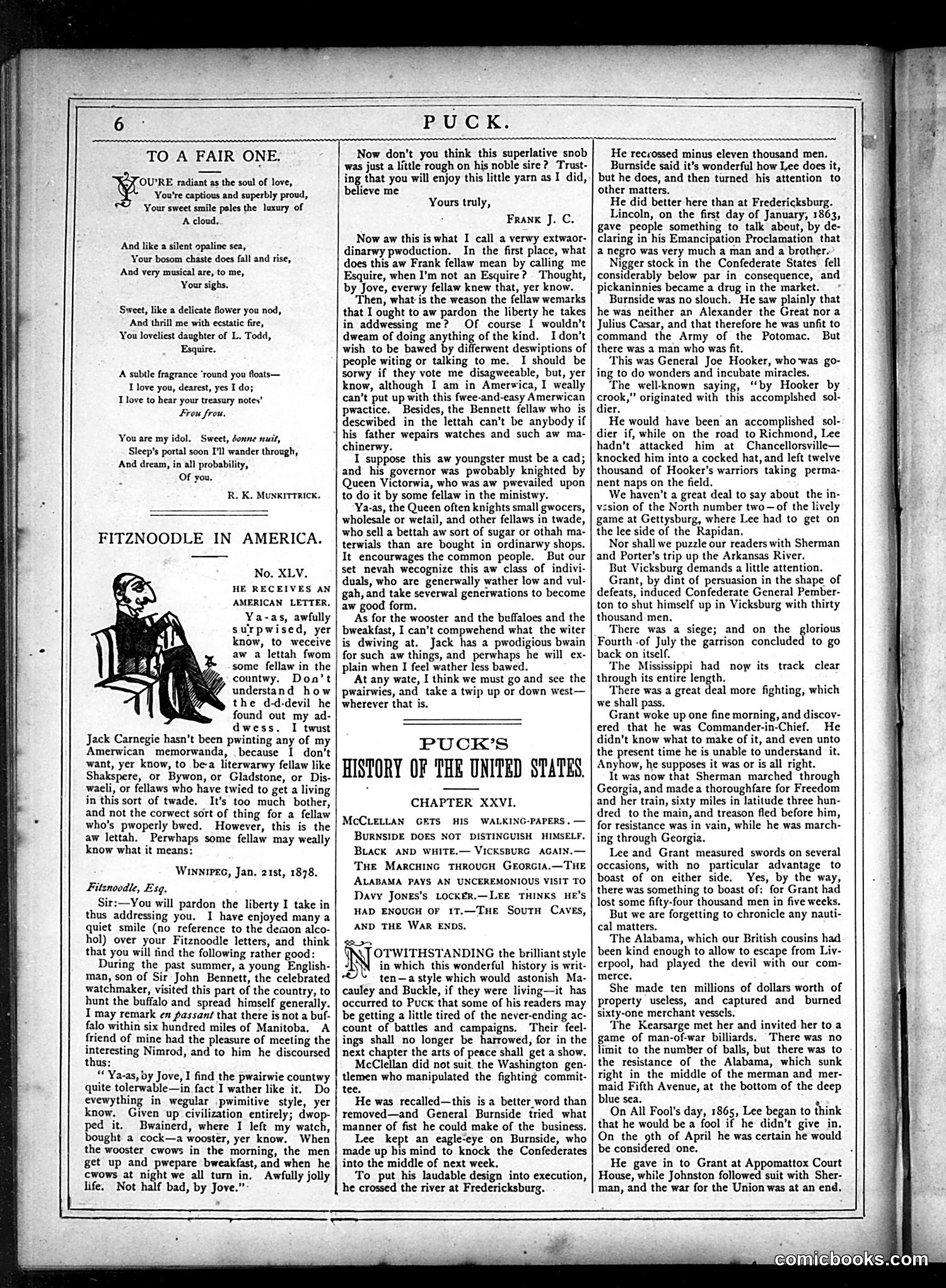
This page contains literary pieces and serialized satirical content rather than political cartoons. The main illustrated section, "Fitznoodle in America" (No. XLV), shows a caricatured figure—likely an exaggerated Irish immigrant or working-class character based on the art style—receiving a letter from America. The accompanying text humorously mocks an Irish correspondent's naive observations about American democracy and society, particularly poking fun at his misunderstanding of American customs and politics. The "Puck's History of the United States" section recounts Civil War events (McClellan, Burnside, Vicksburg, Sherman campaigns) with satirical commentary on military incompetence and the war's brutality. The satire targets both military leadership's failures and the endless nature of Civil War carnage. The page primarily uses written humor rather than visual satire.
📄 Transcribed text from this page (OCR, searchable)
Machine-transcribed from the original scan — historical spelling and the odd misread are preserved.
PUCK. TO A FAIR ONE. URE radiant 69 the soul of love, 01 y You're captious and superbly proud, Your sweet smile poles the luxury of ‘A cloud. And like a silent opaline sea, Your bosom chaste docs fall and rise, ‘And very musical are, to me, Your sighs. Sweet, like a delicate flower you nod, And thrill me with ecstatic fire, You loveliest daughter of L. Todd, Esquire. A subtle fragrance ‘round you floats— I love you, dearest, yes I do; T love to hear your treasury notey’ Frou frou. You are my idol. Sweet, donne nuit, Sleep’s portal soon I'll wander through, ‘And dream, in all probability, Of you. R. K. Munxrttrick. FITZNOODLE IN AMERICA. No. XLV. HE RECEIVES AN AMERICAN LETTER. Ya-as, awfully surpwised, yer know, to weceive aw a lettah fwom some fellaw in the countwy. Don't understand how the d-d-devil he found out my ad- dwess. I twust Jack Carnegie hasn't been pwinting any of my Amerwican memorwanda, because I don’t want, yer know, to be-a literwarwy fellaw like Shakspere, or Bywon, or Gladstone, or Dis- waeli, or fellaws who have twied to get a living in this sort of twade. It’s too much bother, and not the corwect sort of thing for a fellaw who's pwoperly bwed. However, this is the aw lettah. Perwhaps some fellaw may weally know what it means: Wiyniree, Jan, 21st, 1878. Fitsnoodle, Esq. Sir:—You will pardon the liberty I take in thus addressing you. I have enjoyed many a quiet smile (no reference to the demon alco- hol) over your Fitznoodle letters, and think that you will tind the following rather good: During the past summer, a young English- man, son of Sir John Bennett, the celebrated watchmaker, visited this part of the country, to hunt the buffalo and spread himself generally. I may remark en passant that there is not a buf- falo within six hundred miles of Manitoba. A friend of mine had the pleasure of meeting the interesting Nimrod, and to him he discoursed us: “ Ya-as, by Jove, I find the pwairwie countwy quite tolerwable—in fact I wather like it. Do evewything in wegular pwimitive style, yer know. Given up civilization entirely; dwop- ped it. Bwainerd, where I left my watch, bought a cock—a wooster, yer know. When the wooster cwows in the morning, the men get up and pwepare bweakfast, and when he cwows at night we all turn in. Awfully jolly life. Not half bad, by Jove.” Now don’t you think this superlative snob was just a little rough on his noble sire? Trust- ing that you will enjoy this little yarn as I did, lieve me Yours truly, Frank J. C. Now aw this is what I call a verwy extwaor- dinarwy pwoduction. In the first place, what does this aw Frank fellaw mean by calling me Esquire, when I’m not an Esquire? Thought, by Jove, everwy fellaw knew that, yer know. Then, what-is the weason the fellaw wemarks that I ought to aw pardon the liberty he takes in addwessing me? Of course I wouldn’t dweam of doing anything of the kind. Idon’t wish to be bawed by differwent deswiptions of people witing or talking to me. I should be sorwy if they vote me disagweeable, but, yer know, although I am in Amerwica, I weally can’t put up with this fwee-and-easy Amerwican pwactice. Besides, the Bennett fellaw who is descwibed in the lettah can’t be anybody if his father wepairs watches and such aw ma- chinerwy. I suppose this aw youngster must be a cad; and his governor was pwobably knighted by Queen Victorwia, who was aw pwevailed upon to do it by some fellaw in the ministwy. Ya-as, the Queen often knights small gwocers, wholesale or wetail, and other fellaws in twade, who sell a bettah aw sort of sugar or othah ma- terwials than are bought in ordinarwy shops. It encourwages the common people. But our set nevah wecognize this aw class of indivi- duals, who are generwally wather low and vul- gah, and take severwal generwations to become aw good form. As for the wooster and the buffaloes and the bweakfast, I can’t compwehend what the witer is dwiving at. Jack has a pwodigious bwain for such aw things, and perwhaps he will ex- plain when I feel wather less bawed. At any wate, I think we must go and sce the pwairwies, and take a twip up or down west— wherever that is. PUCK’S HISTORY OF THE UNITED STATES. CHAPTER XXVI. MCCLELLAN GETS HIS WALKING-PAPERS. — BURNSIDE DOES NOT DISTINGUISH HIMSELF. BLACK AND WHITE.— VICKSBURG AGAIN.— THE MARCHING THROUGH GEoRGIA.—THE ALABAMA PAYS AN UNCEREMONIOUS VISIT TO Davy Jones’s LockER.—LEE THINKS HE’S HAD ENOUGH OF 1T.—THE SouTH Caves, AND THE War ENDS. by SRaeeaaiu the brilliant style in which this wonderful history is writ- ten—a style which would astonish Ma- cauley and Buckle, if they were living—it has occurred to Puck that some of his readers may be getting a little tired of the never-ending ac- count of battles and campaigns. Their feel- ings shall no longer be harrowed, for in the next chapter the arts of peace shall get a show. McClellan did not suit. the Washington gen- tlemen who manipulated the fighting commit- tee, He was recalled—this is a better word than removed—and General Burnside tried what manner of fist he could make of the business. Lee kept an eagle-eye on Burnside, who made up bis mind to knock the Confederates into the middle of next week. To put his laudable design into execution, He recrossed minus eleven thousand men. Burnside said it's wonderful how Lee does it, but he does, and then turned his attention to other matters, He did better here than at Fredericksburg. Lincoln, on the first day of January, 1863, gave people something to talk about, by de- claring in his Emancipation Proclamation that a negro was very much a man and a brother. Nigger stock in the Confederate States fell considerably below par in consequence, and pickaninnies became a drug in the market. Burnside was no slouch. He saw plainly that he was neither an Alexander the Great nora Julius Casar, and that therefore he was unfit to command the Army of the Potomac. But there was a man who was fit. ‘This was General Joe Hooker, who-was go- ing to do wonders and incubate miracles. The well-known saying, “by Hooker by rook,” originated with this accomplshed sol- ier. He would have been an accomplished sol- dier if, while on the road to Richmond, Lee hadn’t attacked him at Chancellorsville— knocked him into a cocked hat, and left twelve thousand of Hooker's warriors taking perma- nent naps on the field. We haven't a great deal to say about the in- vzsion of the North number two—of the lively game at Gettysburg, where Lee had to get on the lee side of the Rapidan, Nor shall we puzzle our readers with Sherman and Porter's trip up the Arkansas River. But Vicksburg demands a little attention. Grant, by dint of persuasion in the shape of defeats, induced Confederate General Pember- ton to shut himself up in Vicksburg with thirty thousand-men. There was a siege; and on the Fourth -of July the garrison conclude: back on itself. The Mississippi had now its track clear through its entire length. ‘There was a great deal more fighting, which we shall pass, Grant woke up one fine morning, and discov- ered that he was Commander-in-Chief. He didn’t know what to make of it, and even unto the present time he is unable to understand it. Anyhow, he supposes it was or is all right. It was now that Sherman marched through Georgia, and made a thoroughfare for Freedom and her train, sixty miles in latitude three hun- dred to the main, and treason fled before him, for resistance was in vain, while he was march- ing through Georgia. Lee and Grant measured swords on several occasions, with no particular advantage to boast of on either side. Yes, by the way, there was something to boast of: for Grant had lost some fifty-four thousand men in five weeks. But we are forgetting to chronicle any nauti- cal matters. The Alabama, which our British cousins had been kind enough to allow to escape from Liv- erpool, had played the devil with our com- merce. She made ten millions of dollars worth of property useless, and captured and burned sixty-one merchant vessels. The Kearsarge met her and invited her to a game of man-of-war billiards. There was no limit to the number of balls, but there was to the resistance of the Alabama, which sunk right in the middle of the merman and mer- maid Fifth Avenue, at the bottom of the deep blue sea. ‘ On All Fool's day, 1865, Lee began to think that he would be a fool if he didn’t give in. On the oth of April he was certain he would be considered one. A He gave in to Grant at Appomattox Court House, while Johnston followed suit with Sher- lorious to go he crossed the river at Fredericksburg. man, and the war for the Union was at an end.