
Puck, 1878-02-06 · page 5 of 20
Puck — February 6, 1878 — page 5: what you’re looking at
What you’re looking at
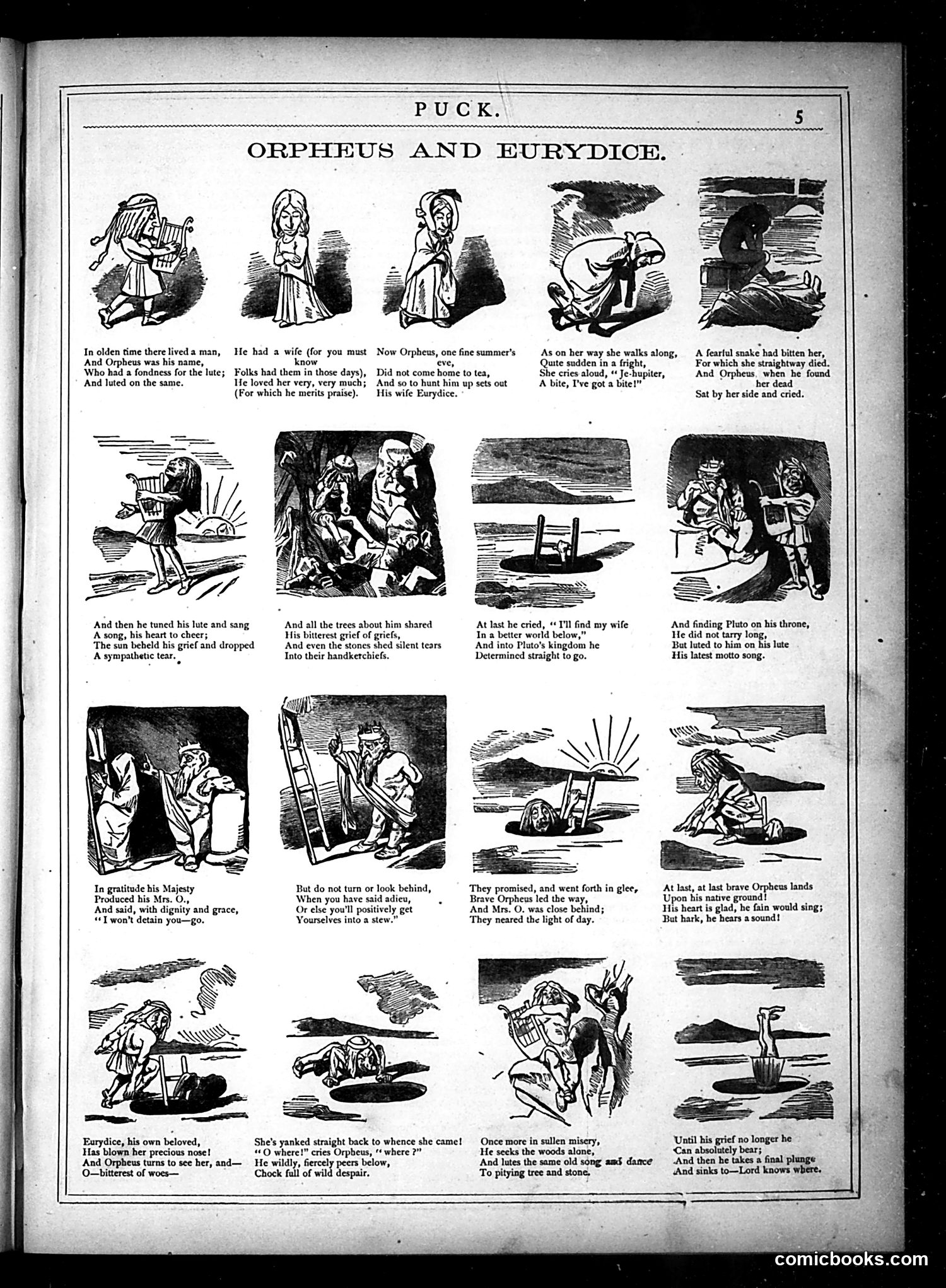
This page presents a comic retelling of the classical myth through sequential illustration panels. The story follows Orpheus, a legendary musician, as he attempts to rescue his wife Eurydice from the underworld after a snake bite kills her. The satire appears to mock the famous myth's tragic ending: Orpheus is instructed not to look back at Eurydice while leading her from Hades, but he disobeys at the final moment, causing her to vanish forever. Each panel progresses through key moments—Orpheus's grief, his musical plea to the gods, their descent, and ultimately his failure. The humor likely derives from treating this classical tragedy as domestic comedy, with Eurydice portrayed as a nagging wife and Orpheus as a bumbling husband, making the eternal myth relatable to contemporary readers through Victorian-era domestic situations.
📄 Transcribed text from this page (OCR, searchable)
Machine-transcribed from the original scan — historical spelling and the odd misread are preserved.
PUCK. AND EURYDICE. A fearful snake had bitten her, For which she straightway died. ‘And Orpheus, when he found ‘As on her way she walks along, Quite sudden in a fright, She cries aloud, “ Je-hupiter, In olden time there liveda man, He had a wife (for you must Now Orpheus, one fine summer's ‘And Orpheus was his name, know ‘eve, Who had a fondness for the lute; Folks had them in those days), Did not come home to tea, And luted on the same. And then he tuned his lute and sang ‘A song, his heart to cheer; ‘The sun beheld his grief and dropped A sympathetic tear. | In gratitude his Majesty Produced his Mrs. O., And said, with dignity and grace, «T won't detain you—go. Eurydice, his own beloved, Has blown her precious nose! And Orpheus turns to see her, and— O—bitterest of woes— Me loved her very, very much; (For which he merits praise). His wife Eurydice. And all the trees about him shared His bitterest grief of griefs, And even the stones shed silent tears Into their handkerchiefs. But do not turn or look behind, When you have said adieu, Or else you'll positively get Yourselves into a stew.” And so to hunt him up sets out She's yanked straight back to whence she came! “O where!” cries Orpheus, “ where 2” He wildly, fiercely peers below, Chock full of wild despair. A bite, I've got a bite!” At last he cried, «I'l find my wife In a better world below,” And into Pluto’s kingdom he Determined straight to go. ‘They promised, and went forth in glee, Brave Orpheus led the way, And Mrs. O. was close behind; They neared the light of day. Once more in sullen misery, He seeks the woods alone, And lutes the same old song ami dance To pitying tree and stone. her dead Sat by her side and cried. ‘And finding Pluto on his throne, He did not tarry long, But luted to him on his lute His latest motto song. At last, at last brave Orpheus lands Upon his native ground! His heart is glad, he fain would sing; But hark, he hears a sound! —— ee Until his grief no longer he Can absolutely bear; -And then he takes a final plunge (And sinks to—Lord knows where.