
Puck, 1878-02-06 · page 16 of 20
Puck — February 6, 1878 — page 16: what you’re looking at
What you’re looking at
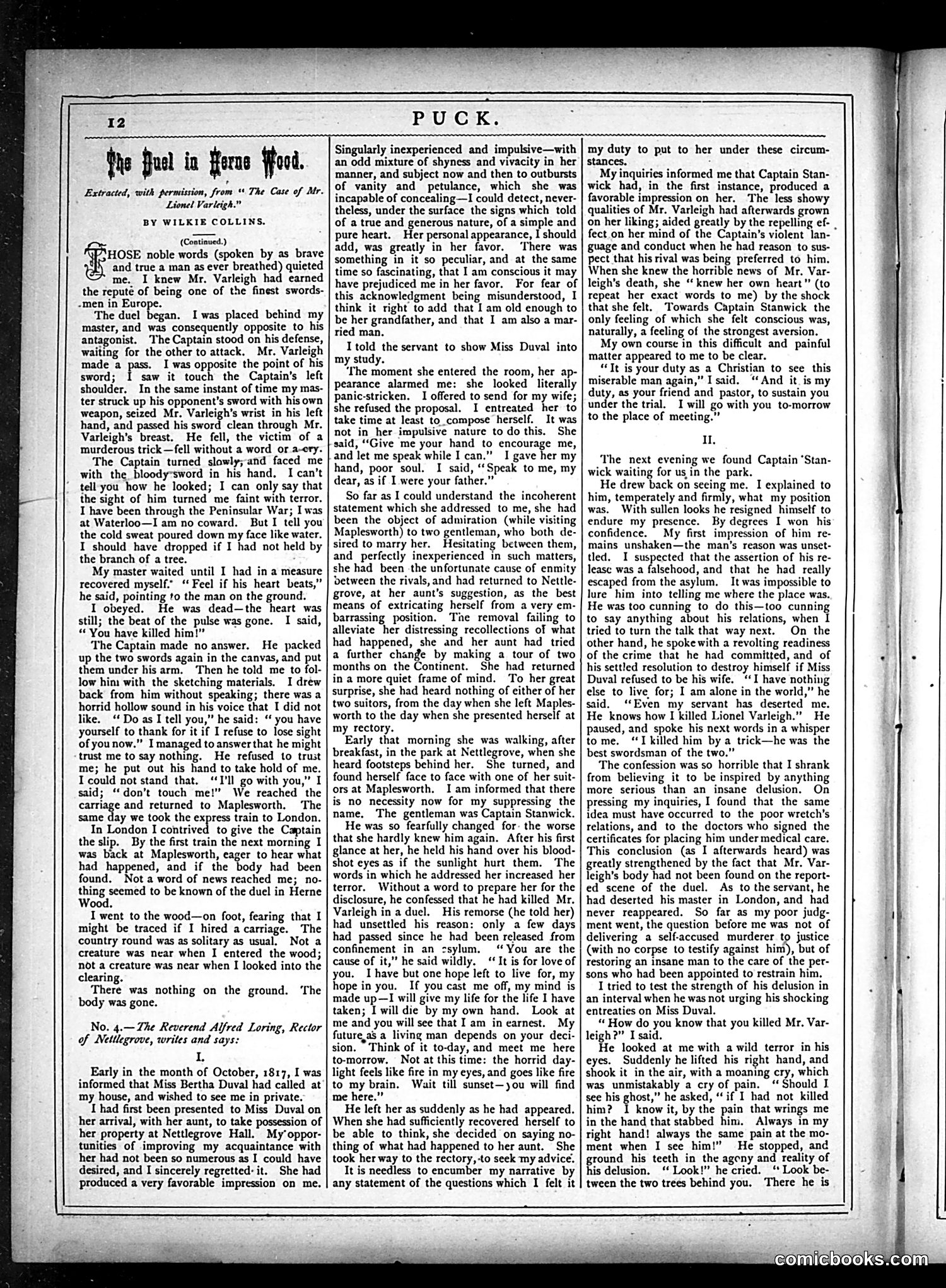
This page contains serialized fiction rather than political cartoons. The visible content includes: **"The Duel in Horse Wood"** — a continuing story by Wilkie Collins about an encounter involving Captain Varleigh and a woman named Miss Duval. The narrative describes a dramatic confrontation where Varleigh appears to have killed a rival in a duel, with subsequent complications involving concealment and confession. **"No. 4—The Reverend Alfred Loring, Rector of Nettlesgrove"** — the start of another serial piece describing events in October 1817 when a woman named Miss Duval arrives at a country house. These are literary serials typical of Puck's content mix, not satirical political cartoons. Without visible illustrations accompanying the text, this represents the magazine's fiction publication rather than its satirical commentary function.
📄 Transcribed text from this page (OCR, searchable)
Machine-transcribed from the original scan — historical spelling and the odd misread are preserved.
PUCK. Phe fuel ia fferae ffovd. Extracted, with permission, from “ The Case of Mr. Lionel Varleigh.” BY WILKIE COLLINS. (Continued.) HOSE noble words (spoken by as brave and true a man as ever breathed) quieted me. I knew Mr. Varleigh had earned the reputé of being one of the finest swords- -men in Europe. The duel an. Iwas placed behind my master, and was consequently opposite to his antagonist. ‘The Captain stood on his defense, waiting for the other to attack. Mr. Varleigh made a pass. I was opposite the point of his sword; I saw it touch the Captain’s left shoulder. In the same instant of time my mas- ter struck up his opponent's sword with his own weapon, seized Mr. Varleigh’s wrist in his left hand, and passed his sword clean through Mr. Varleigh’s breast. He fell, the victim of a murderous trick —fell without a word or a-cry. The Captain turned slowly;and faced me with the bloody-sword in his hand, I can’t tell you how he looked; I can only say that the sight of him turned me faint with terror. I have been through the Peninsular War; I was at Waterloo—I am no coward. But I tell you the cold sweat poured down my face like water. I should have dropped if I had not held by the branch of a tree. My master waited until I had in a measure recovered myself.” ‘Feel if his heart beats,” he said, pointing to the man on the ground. I obeyed. He was dead—the heart was still; the beat of the pulse was gone. I said, “You have killed him!” ‘The Captain made no answer. He packed up the two swords again in the canvas, and put them under his arm. Then he told me to fol- low him with the sketching materials. I drew back from him without speaking; there was a horrid hollow sound in his voice that I did not like.“ Do as I tell you,” he said: “ you have yourself to thank for it if I refuse to lose sight of younow.” I managed to answer that he might trust me to say nothing. He refused to trust me; he put out his hand to take hold of me. I could not stand that. ‘I'll go with you,” I said; ‘don’t touch me!” We reached the camage and returned to Maplesworth. ‘The same day we took the express train to London. In London I contrived to give the Captain the slip. By the first train the next morning I was back at Maplesworth, eager to hear what had happened, and if the body had been found. Not a word of news reached me; _no- thing seemed to be known of the duel in Herne We I went to the wood—on foot, fearing that I might be traced if I hired a carriage. The country round was as solitary as usual, Not a creature was near when I entered the wood; not a creature was near when I looked into the clearing. There was nothing on the ground. body was gone. ‘The No. 4.—The Reverend Alfred Loring, Rector of Netllegrove, writes and says: I Early in the month of October, 1817, I was informed that Miss Bertha Duval had called at my house, and wished to see me in private. Thad first been presented to Miss Duval on her arrival, with her aunt, to take possession of her property at Nettlegrove Hall. My“oppor- tunities of improving my acquaintance with her had not been so numerous as I could have desired, and I sincerely regretted: it. She had ] Singularly inexperienced and impulsive—with an odd mixture of shyness and vivacity in her manner, and subject now and then to outbursts of vanity and petulance, which she was incapable of concealing—I could detect, never- theless, under the surface the signs which told of a true and generous nature, of a simple and pure heart. Her personal appearance, I should add, was greatly in her favor. ‘There was something in it so peculiar, and at the same time so fascinating, that I am conscious it may have prejudiced me in her favor. For fear of this acknowledgment being misunderstood, I think it right to add that I am old enough to be her grandfather, and that I am also a mar- ried man. I told the servant to show Miss Duval into my study. ‘The moment she entered the room, her ap- pearance alarmed me: she looked literally panic-stricken. I offered to send for my wife; she refused the proposal. I entreated her to take time at least to_compose herself. It was not in her impulsive nature to do this. She said, “Give me your hand to encourage me, and let me speak while I can.” I gave her my hand, poor soul. I said, ‘Speak to me, my dear, as if I were your father.” So far as I could understand the incoherent statement which she addressed to me, she had been the object of admiration (while visiting Maplesworth) to two gentleman, who both de- sired to marry her. Hesitating between them, and perfectly inexperienced in such matters, she had been the unfortunate cause of enmity between the rivals, and had returned to Nettle- grove, at her aunt's suggestion, as the best means of extricating herself from a very em- barrassing position. Tae removal failing to alleviate her distressing recollections of what had happened, she and her aunt had tried a further change by making a tour of two months on the Continent. She had returned in a more quiet frame of mind. To her great surprise, she had heard nothing of either of her two suitors, from the day when she left Maples- worth to the day when she presented herself at my rectory. Early that morning she was walking, after breakfast, in the park at Nettlegrove, when she heard footsteps behind her. She turned, and found herself face to face with one of her suit- ors at Maplesworth. I am informed that there is no necessity now for my suppressing the name, The gentleman was Captain Stanwick. He was so fearfully changed for: the worse that she hardly knew him again. After his first glance at her, he held his hand over his blood- shot eyes as if the sunlight hurt them. ‘The words in which he addressed her increased her terror. Without a word to prepare her for the disclosure, he confessed that he had killed Mr. Varleigh in a duel. His remorse (he told her) had unsettled his reason: only ‘a few days had passed since he had been released from confinement in an csylum. ‘You are the cause of it,” he said wildly. ‘It is for love of you. Ihave but one hope left to live for, my hope in you. If you cast me off, my mind is made up—I will give my life for the life I have taken; I will die by my own hand. Look at me and you will see that I am in earnest. My future,as a living man depends on your deci- sion. * Think of it to-day, and meet me here to-morrow. Not at this time: the horrid day- light feels like fire in my eyes, and goes like fire to my brain, Wait till sunset—you will find me here.” He left her as suddenly as he had appeared. When she had sufficiently recovered herself to be able to think, she decided on saying no- thing of what had happened to her aunt. She took her way to the rectory,-to seek my advice. It is needless to encumber my narrative by my duty to put to her under these circum- stances. My inquiries informed me that Captain Stan- wick had, in the first instance, produced a favorable impression on her. The less showy qualities of Mr. Varleigh had afterwards grown on her liking; aided greatly by the repelling ef- . fect.on her mind of the Captain’s violent lan- guage and conduct when he had reason to sus- pect that his rival was being preferred to him. When she knew the horrible news of Mr. Var- leigh’s death, she “knew her own heart” (to repeat her exact words to me) by the shock that she felt. Towards Captain Stanwick the only feeling of which she felt conscious was, naturally, a feeling of the strongest aversion. My own course in this difficult and painful matter appeared to me to be clear. “It is your duty as a Christian to see this miserable man again,” I said.“ And it. is my duty, as your friend and pastor, to sustain you under the trial. I will go with you to-morrow to the place of meeting.” I. The next evening we found Captain ‘Stan- wick waiting for usin the park. He drew back on seeing me. I explained to him, temperately and firmly, what my position was. With sullen looks he resigned himself to endure my presence. By degrees I won his confidence. My first impression of him re- mains unshaken—the man’s reason was unset- tled. I suspected that the assertion of his re- lease was a falsehood, and that he had really escaped from the asylum, It was impossible to lure him into telling me where the place was. He was too cunning to do this—too cunning to say anything about his relations, when I tried to turn the talk that way next. On the other hand, he spoke with a revolting readiness of the crime that he had committed, and of his settled resolution to destroy himself if Miss Duval refused to be his wife. ‘I have nothing else to live for; I am alone in the world,” he said. ‘Even my servant has deserted me. He knows how I killed Lionel Varleigh.” He paused, and spoke his next words in a whisper tome. “I killed him by a trick—he was the best swordsman of the two.” The confession was so horrible that I shrank from believing it to be inspired by anything more serious than an insane delusion. On pressing my inquiries, I found that the same idea must have occurred to the poor wretch’s relations, and to the doctors who signed the certificates for placing him under medical care. This conclusion (as I afterwards heard) was reatly strengthened by the fact that Mr. Var- leigh's body had not been found on the report- ed scene of the duel. As to the servant, he had deserted his master in London, and had never reappeared. So far as my poor judg- ment went, the question before me was not of delivering a self-accused murderer to justice (with no corpse to testify against him), but of restoring an insane man to the care of the per- sons who had been appointed to restrain him, I tried to test the strength of his delusion in an interval when he was not urging his shocking entreaties on Miss Duval. “ How do you know that you killed Mr. Var- leigh?” I said. He looked at me with a wild terror in his eyes. Suddenly he lifted his right hand, and shook it in the air, with a moaning cry, which was unmistakably a cry of pain. “Should I see his ghost,” he asked, “if I had not killed him? bi know it, by the pain that wrings me in the hand that stabbed him. Always in my right hand! always the same pain at the mo- ment when I see him!” He stopped, and ground his teeth in the agony and reality of his delusion. ‘ Look!” he cried. _‘ Look be- produced a very favorable impression on me. | any statement of the questions which I felt it | tween the two trees behind you. There he is ==comicbooks:com