
Puck, 1878-02-06 · page 7 of 20
Puck — February 6, 1878 — page 7: what you’re looking at
What you’re looking at
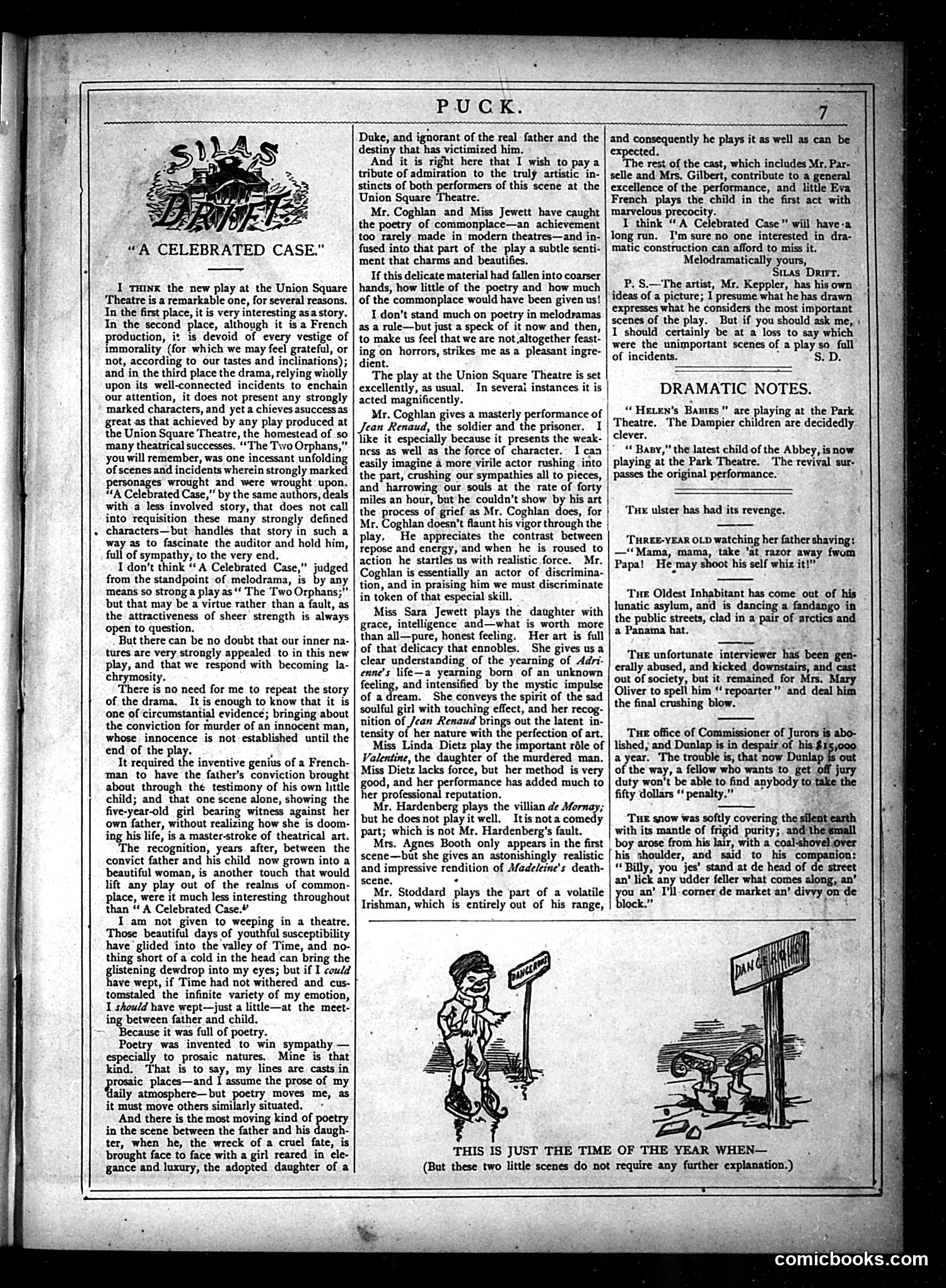
This is a theater review page from *Puck* magazine discussing a play at the Union Square Theatre. The main text is a lengthy critical review of "A Celebrated Case," praising its production quality and the performances of actors Mr. Coglan and Miss Jewett. At the bottom is a small cartoon showing a figure at a signpost labeled "DANGER" with the caption "THIS IS JUST THE TIME OF THE YEAR WHEN— (But these two little scenes do not require any further explanation.)" The cartoon appears to be a seasonal joke, likely referencing winter hazards or holiday-related dangers—possibly ice, snow, or travel risks—that would be obvious to contemporary readers without explanation. The exact reference is unclear without additional context about what specific seasonal danger was topical when this issue was published.
📄 Transcribed text from this page (OCR, searchable)
Machine-transcribed from the original scan — historical spelling and the odd misread are preserved.
PUCK. ““—A CELEBRATED CASE.” I tHInx the new play at the Union Square Theatre is a remarkable one, for several reasons. In the first place, it is very interesting asa story. In the second place, although it is a French roduction, it is devoid of every vestige of immorality (for which we may feel grateful, or not, according to our tastes and inclinations); and in the third place the drama, relying wholly upon its well-connected incidents to enchain our attention, it does not present any strongly marked characters, and yet a chieves asuccessas great as that achieved by any play produced at the Union Square Theatre, the homestead of so many theatrical successes. “The Two Orphans,” you will remember, was one incessant unfolding of scenes and incidents wherein strongly marked personages wrought and were wrou; hes upon. “A Celebrated Case,” by the same autho! with a less involved story, that does Be: at into requisition these many strongly defined characters—but handlés that story in such a may as to fascinate the auditor and hold him, full of sympathy, to the very end. I don’t think ‘A Celebrated Case,” judged from the standpoint of melodrama, is by any means so strong a play as“ The Two Orphans;” but that may be a virtue rather than a fault, as the attractiveness of sheer strength is always open to question. But there can be no doubt that our inner na- tures are very strongly appealed to in this new play, and that we respond with becoming la- chrymosity. There is no need for me to repeat the story of the drama. It is enough to know that it is one of circumstantial evidence; bringing about the conviction for murder of an innocent man, whose innocence is not established until the end of the Play. It required the inventive genius of a French- man to have the father’s conviction brought about through the testimony of his own little child; and that one scene alone, showing the five-year-old girl bearing witness against her own father, without realizing how she is doom- ing his life, is a master-stroke of theatrical art. The recognition, years after, between the convict father and his child now grown into a beautiful woman, is another touch that would lift any play out of the realms uf common- place, were it much less interesting throughout than “ A Celebrated Case.” I am not given to weeping in a theatre. Those beautiful days of youthful susceptibility have glided into the valley of Time, and no- thing short of a cold in the head can bring the glistening dewdrop into my eyes; but if I could have wept, if Time had not withered and cus- tomstaled the infinite variety of my emotion, I should have wept—just a little—at the meet- ing between father and child. Because it was full of poetry. Poetry was invented to win sympathy — especially to Prosaic natures, Mine is that kind. That is to say, my lines are casts in rosaic places—and I assume the prose of my Gaily atmosphere—but poetry moves me, as it must move others similarly situated. - And there is the most moving kind of poetry in the scene between the father and his daugh- ter, when he, the wreck of a cruel fate, is brought face to face with a girl reared in ele- gance and luxury, the adopted daughter of a Duke, and ignorant of the real father and the destiny that has victimized him. And it is right here that I wish to pay a tribute of admiration to the truly artistic in- stincts of both performers of this scene at the Union Square Theatre. Mr. Coghlan and Miss Jewett have caught the poetry of commonplace—an achievement too rarely made in modern theatres—and in- fused into that part of the play a subtle senti- ment that charms and beautifies. If this delicate material had fallen into coarser hands, how little of the poetry and how much of the commonplace would have been given us! I don’t stand much on poetry in melodramas as a rule—but just a speck of it now and then, to make us feel that we are not altogether feast- ing on horrors, strikes me as a pleasant ingre- dient. The play at the Union Square Theatre is set excellently, as usual. In severai instances it is acted magnificently. Mr. Coghlan gives a masterly performance of Jean Renaud, the soldier and the prisoner. I like it especially because it presents the weak- ness as well as the force of character. I can easily imagine a more virile actor rushing into the part, crushing our sympathies all to pieces, and harrowing our souls at the rate of forty | miles an hour, but he couldn't show by his art the process of grief as Mr. Coghlan Mr. Coghlan doesn’t flaunt his vigor through the play. He appreciates the contrast between repose and energy, and when he is roused to action he startles us with realistic force. Mr. Coghlan is essentially an actor of discrimina- tion, and in praising him we must discriminate in token of that especial skill. Miss Sara Jewett plays the daughter with grace, | intelligence and—what is worth more than all—pure, honest feeling. Her art is full of that delicacy that ennobles. She gives us a clear understanding of the yearning of Adri- enne’s life—a yearning born of an unknown feeling, and intensified by the mystic impulse of adream. She conveys the spirit of the sad soulful girl with touching effect, and her recog- nition of Jean Renaud brings out the latent in- tensity of her nature with the perfection of art. Miss Linda Dietz play the important réle of Valentine, the daughter of the murdered man. Miss Dietz lacks force, but her method is very good, and her performance has added much to her professional reputation. Mr. Hardenberg plays the villian de Mornay; but he doesnot play it well. Itis not a comedy part; which is not Mr. Hardenberg’s fault. Mrs. Agnes Booth only appears in the first scene—but she gives an astonishingly realistic and impressive rendition of Madeleine's death- scene. Mr. Stoddard plays the part of a volatile Irishman, which is entirely out of his range, oes, for | and souequently he plays it as well as can ber expected. The rest of the cast, which includes Mr, pate selle and Mrs. Gilbert, contribute to a excellence of the performance, and little Eva French plays the child in the first act with: marvelous precocity. I think “A Celebrated Case” will have-a long run. I’m sure no one interested in dra- matic construction can afford to miss it. Melodramatically yours, Sttas Drirr. P. S.—The artist, Mr. Keppler, has his own: ideas of a picture; I presume what he has drawn expresses what he considers the most important scenes of the play. But if you should ask me, ; I should certainly be at a loss to say which were the unimportant scenes of a play so full of incidents. S. D. DRAMATIC NOTES. “Heten’s Bangs” are playing at the Park Theatre. The Dampier children are decidedly | clever. “ Basy,” the latest child of the Abbey, isnow playing at the Park Theatre. The revival sur- passes the original performance. ‘Tue ulster has had its revenge. "THREE-YEAR OLD watching her father shaving: —‘‘Mama, mama, take ‘at razor away fwom Papa! He may shoot his self whiz it!”” Tue Oldest Inhabitant has come out of his lunatic asylum, and is dancing a fandango in the public streets, clad in a pair of arctics and a Panama hat. : ‘Tue unfortunate interviewer has been gen- erally abused, and kicked downstairs, and cast out of society, but it remained for Mrs. Mary Oliver to spell him ‘‘ repoarter” and deal him the final crushing blow. ‘Tue office of Commissioner of Jurors is abo- lished, and Dunlap is in despair of his $15,000 ayear. The trouble i is, that now Dunlap of the way, a fellow who wants to get « Sed duty won't be able to. find anybody to, take the fifty dollars “‘ penalty.” THE snow was softly covering naa with its mantle of frigid purity; sie boy arose from his lair, with a coal-sh hi shoulder, and said to his companion: pis Billy, you jes’ stand at de head of de street an’ lick ¢ any udder feller what comes an” ee en T'll. corner de market an’ bos on se lock. THIS IS JUST THE TIME OF THE YEAR WHEN— (But these two little scenes do not require any further explanation.) ~ comicbooks.com