
Puck, 1878-02-06 · page 15 of 20
Puck — February 6, 1878 — page 15: what you’re looking at
What you’re looking at
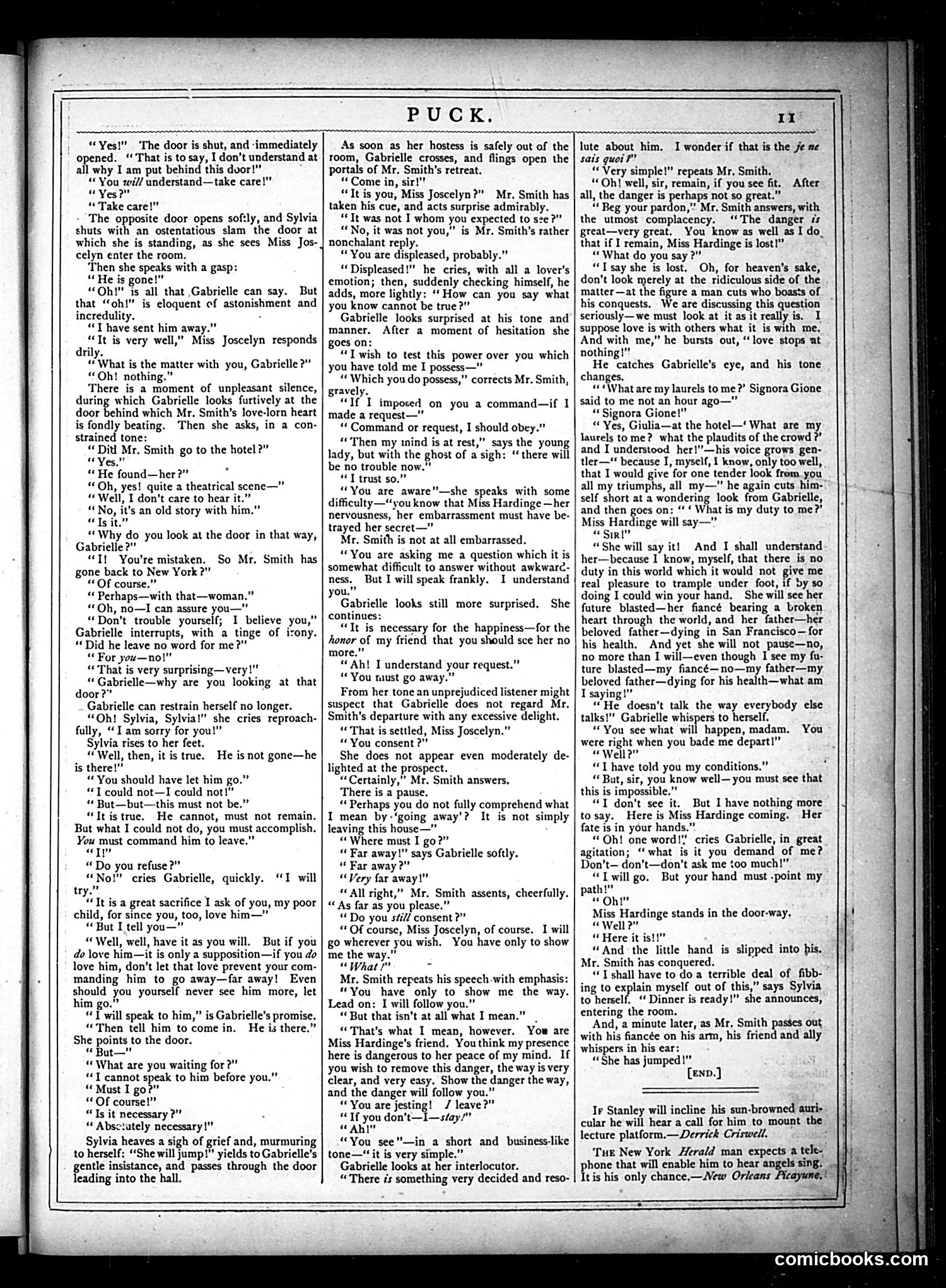
This page contains **dramatic dialogue text only** — no visible cartoons or illustrations. It appears to be a theatrical script or serialized story titled "Puck," featuring characters named Gabrielle, Mr. Smith, Miss Joscelyn, and Miss Hardinge. The dialogue suggests a **romantic melodrama**: Mr. Smith demands Gabrielle leave with him, while she insists on obeying her own will. Miss Joscelyn and others intervene with moral arguments about duty and sacrifice. References to "going away," conditions, and commands suggest coercive pressure on the female character. Without visible illustrations, I cannot identify specific caricatures or political references. This reads as **serialized fiction rather than political satire**, which was common in Puck alongside its cartoons.
📄 Transcribed text from this page (OCR, searchable)
Machine-transcribed from the original scan — historical spelling and the odd misread are preserved.
PUCK. 11 Yes!" ‘The door is shut, and -immediately opened. “That is to say, I don’t understand at all why I am put behind this door!” “You wil/ understand—take care!” “Yes?” “ Take care!” The opposite door opens softly, and Sylvia shuts with an ostentatious slam the door at which she is standing, as she sees Miss Jos- | celyn enter the room. ‘Then she speaks with a gasp: “He is gone!” “Oh!” is all that Gabrielle can say. But that “oh!” is eloquent of astonishment and incredulity. . “T have sent him away.” “Tt is very well,” Miss Joscelyn responds drily. “What is the matter with you, Gabrielle?” “Oh! nothing.” There is a moment of unpleasant silence, during which Gabrielle looks furtively at the door behind which Mr. Smith's love-lorn heart is fondly beating. Then she asks, in a con- strained tone: “Ditl Mr. Smith go to the hotel?” Yes," “He found—her?” . “Oh, yes! quite a theatrical “Well, I don’t care to hear i' “No, it’s an old story with him, “Ts it.” “Why do you look at the door in that way, Gabrielle?” “I! You're mistaken. gone back to New York?” “ Of course.” “ Perhaps—with that—woman.” “Oh, no—I can assure you—" “Don't trouble yourself; I believe you,” Gabrielle interrupts, with a tinge of irony. “Did he leave no word for me?” “For you—nol” “That is very surprising—very!”" “ Gabrielle—why are you looking at that door?” Gabrielle can restrain herself no longer. “Oh! Sylvia, Sylvia!” she cries reproach- fully, “Iam sorry for you!” Sylvia rises to her feet. “Well, then, it is true. is there!” “You should have let him go.”” “T could not—I could not!” “ But—but—this must not be.” “Tt is true. He cannot, must not remain. But what I could not do, you must accomplish. You must command him to leave.” ayy “Do you refuse?” “Not” cries Gabrielle, quickly. try.” “Tt is a great sacrifice I ask of you, my poor child, for since you, too, love him—"” “But I tell you—” “Well, well, have it as you will. But if you do love him—it is only a supposition—if you do love him, don’t let that love prevent your com- manding him to go away—far away! Even should you yourself never see him more, let him go.” “T will speak to him,” is Gabrielle’s promise. “Then tell him to come in. He is there.” She points to the door. « But—" “What are you waiting for?” “T cannot speak to him before you.” “ Must I go?” “Of course!” “Is it necessary?” “ Absctutely necessary!” Sylvia heaves a sigh of grief and, murmuring to herself: ‘She will jump!" yields to Gabrielle’s gentle insistance, and passes through the door leading into the hall. So Mr. Smith has He is not gone—he “T will As soon as her hostess is safely out of the room, Gabrielle crosses, and flings open the portals of Mr. Smith’s retreat. “Come in, sir!’" “Tt is you, Miss Joscelyn?” Mr. Smith has taken his cue, and acts surprise admirably. “Tt was not I whom you expected to sz?” “No, it was not you,” is Mr. Smith's rather nonchalant reply. “You are displeased, probably.” “Displeased!” he cries, with all a lover's emotion; then, suddenly checking himself, he adds, more lightly: ‘How can you say what you know cannot be true ?” Gabrielle looks surprised at his tone and manner. After a moment of hesitation she goes on: “T wish to test this power over you which you have told me I possess—” “Which you do possess,” corrects Mr. Smith, gravely. “If I imposed on you a command—if 1 made a request—” “Command or request, I should obey.” “Then my inind is at rest,” says the young lady, but with the ghost of a sigh: ‘there will be no trouble now.” “T trust so.” “You are aware”—she speaks with some difficulty—“you know that Miss Hardinge —her nervousness, her embarrassment must have be- trayed her secret—"” Mr. Smith is not at all embarrassed. “You are asking me a question which it is somewhat difficult to answer without awkwarc- ness. But I will speak frankly, I understand Gabrielle looks still more surprised. She continues: “It is necessary for the happiness—for the honor of my friend that you should sce her no more.” “Ah! I understand your request.” “You must go away.”” From her tone an unprejudiced listener might suspect that Gabrielle does not regard Mr. Smith’s departure with any excessive delight. “That is settled, Miss Joscelyn.” “You consent ?”” She does not appear even moderately de- lighted at the prospect. “Certainly,” Mr. Smith answers, There is a pause, “ Perhaps you do not fully comprehend what I mean by:‘going away’? It is not simply leaving this house—" “Where must I go?” “ Far away!” says Gabrielle softly. “ Far away?” “Very far away!" “All right,” Mr. Smith assents, cheerfully. “As far as you please.” “Do you sti’ consent ?” “Of course, Miss Joscelyn, of course. I will go wherever you wish. You have only to show me the way.” “What!” - Mr. Smith repeats his speech with emphasis: “You have only to show me the way. Lead on: I will follow you.” “But that isn’t at all what I mean.” | “That’s what I mean, however. Yow are Miss Hardinge’s friend. You think my presence here is dangerous to her peace of my mind. If you wish to remove this danger, the way is very clear, and very easy. Show the danger the way, and the danger will follow you.” “You are jesting! / leave?” “If you don't—I—stay?” “An” “You see’—in a short and business-like tone—‘ it is very simple.” Gabrielle looks at her interlocutor. “There is something very decided and reso- lute about him. sais quoi?” “Very simple!” repeats Mr. Smith, ‘Oh! well, sir, remain, if you see fit. After all, the danger is perhaps not so great.” “Beg your pardon,” Mr. Smith answers, with the utmost complacency. ‘The danger és great—very great. You know as well as I do that if I remain, Miss Hardinge is lost!" “What do you say 2” “Tsay she is lost. Oh, for heaven's sake, don’t look merely at the ridiculous side of the matter —at the figure a man cuts who boasts of his conquests. We are discussing this question ~ seriously—we must look at it as it really is. 1 suppose love is with others what it is with me, And with me,” he bursts out, “love stops at nothing!” He catches Gabrielle's eye, and his tone changes. «««What are my laurels to me?’ Signora Gione said to me not an hour ago—” “ Signora Gione!” “ Yes, Giulia—at the hotel—‘ What are my laurels to me? what the plaudits of the crowd ?” and I understood her!""—his voice grows gen- tler—* because I, myself, I know, only too well, that I would give for one tender look from.you all my triumphs, all my—" he again cuts him- self short at a wondering look from Gabrielle, and then goes on: “ ‘ What is my duty to me?” Miss Hardinge will say—” “Siri? “She will say it! And I shall understand her—because I know, myself, that there is no duty in this world which it would not give me real pleasure to trample under foot, if by so doing I could win your hand. She will see her future blasted—her fiancé bearing a broken heart through the world, and her father—her beloved father—dying in San Francisco—for his health. And yet she will not pause—no, no more than I will—even though I see my fu- ture blasted—my fiancé—no—my father—my. beloved father—dying for his health—what am I saying!” “He doesn’t talk the way everybody else talks!” Gabrielle whispers to herself. “You see what will happen, madam. You were right when you bade me depart!” Well et: “T have told you my conditions.” “But, sir, you know well—you must see that this is impossible.” “I don't see it. tosay. Here is Miss Hardinge coming. fate is in your hands.” “Oh! one word!"’ cries Gabrielle, in great agitation; “what is it you demand of me? Don’t— don’t—don't ask me too much!”” “Twill go. But your hand must -point my path!” “Oh!” Miss Hardinge stands in the door-way. “Well 2” “Here it ist!” “And the little hand is slipped into his. Mr. Smith has conquered. “T shall have to do a terrible deal of fibb- ing to explain myself out of this,” says Sylvia to herself. ‘Dinner is ready!” she announces, entering the room. And, a minute later, as Mr, Smith passes out with his fiancée on his arm, his friend and ally whispers in his ear: “She has jumped!" [enp.] I wonder if that is the je ne But I have nothing more Her Ir Stanley will incline his sun-browned auri- cular he will hear a call for him to mount the lecture platform.—Derrick Criswell. ‘Tur New York Herald man expects a tele phone that will enable him to hear angels sing. Itis his only chance.—New Orleans Picayune, :