
Puck, 1878-02-06 · page 3 of 20
Puck — February 6, 1878 — page 3: what you’re looking at
What you’re looking at
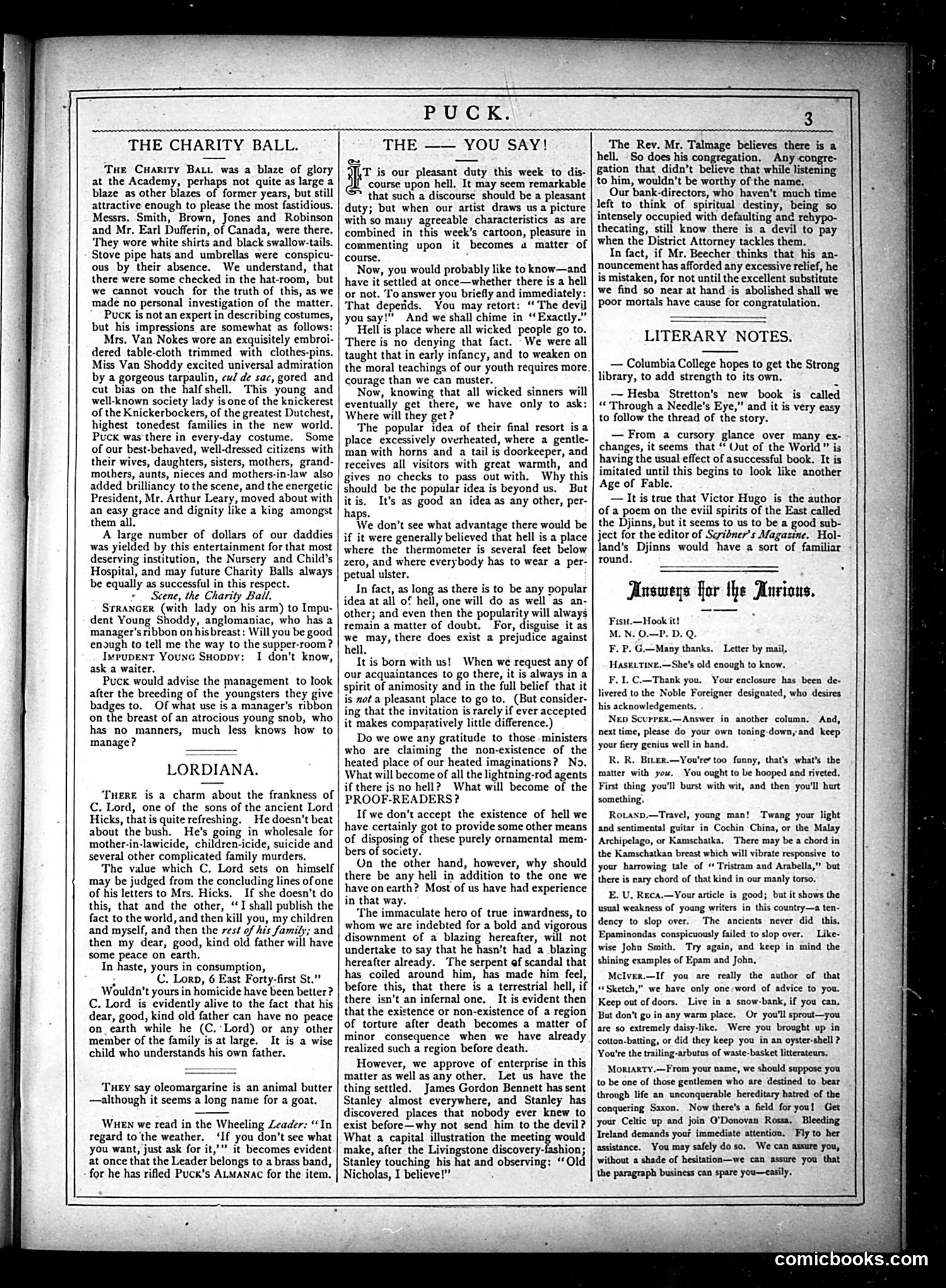
This page contains three distinct sections: "The Charity Ball," "The—You Say!" and "Lordiana," along with a "Literary Notes" column and reader responses. The main content critiques contemporary society through satirical commentary rather than visual cartoons. "The Charity Ball" mocks the pretensions of wealthy socialites hosting charity events, suggesting their motives are self-aggrandizement rather than genuine philanthropy. "Lordiana" appears to reference the British aristocratic class system, with humorous observations about family hierarchies and inheritance. "The—You Say!" engages in theological debate about hell's existence, satirizing popular religious beliefs of the era. The tone throughout is witty social commentary typical of Puck's approach to dissecting Victorian-era hypocrisy and class consciousness, rather than political cartooning.
📄 Transcribed text from this page (OCR, searchable)
Machine-transcribed from the original scan — historical spelling and the odd misread are preserved.
———————————— PUCK. THE CHARITY BALL. Tue Cuarity Batt was a blaze of glory at the Academy, perhaps not quite as large a blaze as other blazes of former years, but still attractive enough to please the most fastidious. Messrs. Smith, Brown, Jones and Robinson and Mr. Earl Dufferin, of Canada, were there. They wore white shirts and black swallow-tails. Stove pipe hats and umbrellas were conspicu- ous by their absence. We understand, that there were some checked in the hat-room, but we cannot vouch for the truth of this, as we made no personal investigation of the matter. Puck is not an expert in describing costumes, but his impressions are somewhat as follows: Mrs, Van Nokes wore an exquisitely embroi- dered table-cloth trimmed with clothes-pins. Miss Van Shoddy excited universal admiration by a gorgeous tarpaulin, cu/ de sac, gored and cut bias on the halfshell. This young and well-known society lady is one of the knickerest of the Knickerbockers, of the greatest Dutchest, highest tonedest families in the new world. Puck was'there in every-day costume. Some of our best-behaved, well-dressed citizens with their wives, daughters, sisters, mothers, grand- mothers, aunts, nieces and mothers-in-law also added brilliancy to the scene, and the energetic President, Mr. Arthur Leary, moved about with an easy grace and dignity like a king amongst them all. A large number of dollars of our daddies was yielded by this entertainment for that most deserving institution, the Nursery and Child’s Hospital, and may future Charity Balls always be equally as successful in this respect. + Scene, the Charity Ball. Srrancer (with lady on his arm) to Impu- dent Young Shoddy, anglomaniac, who has a manager's ribbon on his breast: Will you be good enough to tell me the way to the supper-room? Impupent YounG Suoppy: I don’t know, ask a waiter. Puck would advise the management to look after the breeding of the youngsters they give badges to. Of what use is a manager's ribbon on the breast of an atrocious young snob, who has no manners, much less knows how to manage? LORDIANA. ‘THere is a charm about the frankness of C. Lord, one of the sons of the ancient Lord Hicks, that is quite refreshing. He doesn’t beat about the bush. He's going in wholesale for mother-in-lawicide, children-icide, suicide and several other complicated family murders. The value which C. Lord sets on himself may be judged from the concluding lines of one of his letters to Mrs. Hicks. If she doesn’t do this, that and the other, ‘I shall publish the fact to the world, and then kill you, my children and myself, and then the rest of his family; and then my dear, good, kind old father will have some peace on earth. In haste, yours in consumption, A C. Lorp, 6 East Forty-first St.” Wouldn't yours in homicide have been better? C. Lord is evidently alive to the fact that his dear, good, kind old father can have no peace on earth while he (C.*Lord) or any other member of the family is at large. It is a wise child who understands his own father, ‘Tuey say oleomargarine is an animal butter —although it seems a long name for a goat. Wuen we read in the Wheeling Leader: “In regard to the weather, ‘If you don’t see what you want, just ask for it,’” it becomes evident at once that the Leader belongs to a brass band, for he has rifled Puck’s ALMANAC for the item, THE YOU SAY! es is our pleasant duty this week to dis- course upon hell. It may seem remarkable that such a discourse should be a pleasant duty; but when our artist draws us a picture with so many agreeable characteristics as are combined in this week’s cartoon, pleasure in commenting upon it becomes a matter of course. Now, you would probably like to know—and have it settled at once—whether there is a hell or not, ‘To answer you briefly and immediately: ‘That depends. You may retort: “ The devil you say!” And we shall chime in “Exactly.” Hell is place where all wicked people go to. There is no denying that fact. "We were all taught that in early infancy, and to weaken on the moral teachings of our youth requires more. courage than we can muster. Now, knowing that all wicked sinners will eventually get there, we have only to ask: Where will they get? The popular idea of their final resort isa place excessively overheated, where a gentle- man with horns and a tail is doorkeeper, and receives all visitors with great warmth, and gives no checks to pass out with. Why this should be the popular idea is beyond us. But it is. It's as good an idea as any other, per- haps. We don’t see what advantage there would be if it were generally believed that hell is a place where the thermometer is several feet below zero, and where everybody has to wear a per- petual ulster. In fact, as long as there is to be any popular idea at all of hell, one will do as well as an- other; and even then the popularity will always remain a matter of doubt. For, disguise it as we may, there does exist a prejudice against hell. It is born with us! When we request any of our acquaintances loge there, it is always ina spirit of animosity and in the full belief that it is not a pleasant place to go to. (But consider- ing that the invitation is rarely if ever accepted it makes comparatively little difference.) Do we owe any gratitude to those ministers who are claiming the non-existence of the heated place of our heated imaginations? No. What will become of all the lightning-rod agents if there is no hell? What will become of the PROOF-READERS? If we don’t accept the existence of hell we have certainly got to provide some other means of disposing of these purely ornamental mem- bers of society. On the other hand, however, why should there be any hell in addition to the one we have on earth? Most of us have had experience in that way. ‘The immaculate hero of true inwardness, to whom we are indebted for a bold and vigorous disownment of a blazing hereafter, will not undertake to say that he hasn’t had a blazing hereafter already. The serpent of scandal that has coiled around him, has made him feel, before this, that there is a terrestrial hell, if there isn’t an infernal one. It is evident then that the existence or non-existence of a region of torture after death becomes a matter of minor consequence when we have already realized such a region before death. However, we approve of enterprise in this matter as well as any other. Let us have the thing settled. James Gordon Bennett has sent Stanley almost everywhere, and Stanley has discovered places that nobody ever knew to exist before—why not send him to the devil? What a capital illustration the meeting would make, after the Livingstone discovery-fashion; Stanley touching his hat and observing: ‘Old Nicholas, I believe!” x The Rev. Mr. Talmage believes there is a hell. So does his congregation. Any congre- gation that didn’t believe that while listening to him, wouldn’t be worthy of the name. Our bank-directors, who haven’t much time left to think of spiritual destiny, being so intensely occupied with defaulting and rehypo- thecating, still know there is a devil to pay when the District Attorney tackles them. In fact, if Mr. Beecher thinks that his an- nouncement has afforded any excessive relief, he is mistaken, for not until the excellent substitute we find so near at hand is abolished shall we poor mortals have cause for congratulation, LITERARY NOTES. — Columbia College hopes to get the Strong library, to add strength to its own. — Hesba Stretton’s new book is called “Through a Needle’s Eye,” and it is very easy to follow the thread of the story. — From a cursory glance over many ex- changes, it seems that ‘ Out of the World” is having the usual effect of asuccessful book. It is imitated until this begins to look like another Age of Fable. — It is true that Victor Hugo is the author of a poem on the eviil spirits of the East called the Djinns, but it seems to us to be a good sub- ject for the editor of Scribner's Magazine. Hol- land’s Djinns would have a sort of familiar round. Answers for the Ruvious, Fisut.—Hook it! M.N. O.—P. D. Q. F. P. G.—Many thanks, Letter by mail, HasELTiNe.—She’s old enough to know, F. I. C.—Thank you. Your enclosure has been de- livered to the Noble Foreigner designated, who desires his acknowledgements. Nep Scurrex.—Answer in another column. And, next time, please do your own toning-down, and keep your fiery genius well in hand. R. R. BiLer.—You're’ too funny, that's what's the matter with you. You ought to be hooped and riveted. First thing you'll burst with wit, and then you'll hurt something. Rotaxp.—Travel, young man! Twang your light and sentimental guitar in Cochin China, or the Malay Archipelago, or Kamschatka. There may be a chord in the Kamschatkan breast which will vibrate responsive to your harrowing tale of “Tristram and Arabella,” but there is rary chord of that kind in our manly torso. E. U. Reca.—Your article is good; but it shows the usual weakness of young writers in this country—a ten- dency to slop over. The ancients never did this. Epaminondas conspicuously failed to slop over. Like- wise John Smith, Try again, and keep in mind the shining examples of Epam and John, McIver.—If you are really the author of that “Sketch,” we have only one word of advice to you. Keep out of doors. Live in a snow-bank, if you can. But don’t go in any warm place. Or you'll sprout—you are so extremely daisy-like. Were you brought up in cotton. batting, or did they keep you in an oyster-shell ? You're the trailing-arbutus of waste-basket litterateurs. Moniaxty.—From your name, we should suppose you to be one of those gentlemen who are destined to bear throngh life an unconquerable hereditary hatred of the conquering Saxon. Now there’s a field for you! Get your Celtic up and join O'Donovan Rossa. Bleeding Ireland demands you immediate attention. Fly to her assistance. You may safely do so. We can assure you, without a shade of hesitation—we can assure you that the paragraph business can spare you—easily.