
A complete issue · 36 pages · 1928
Life — September 21, 1928
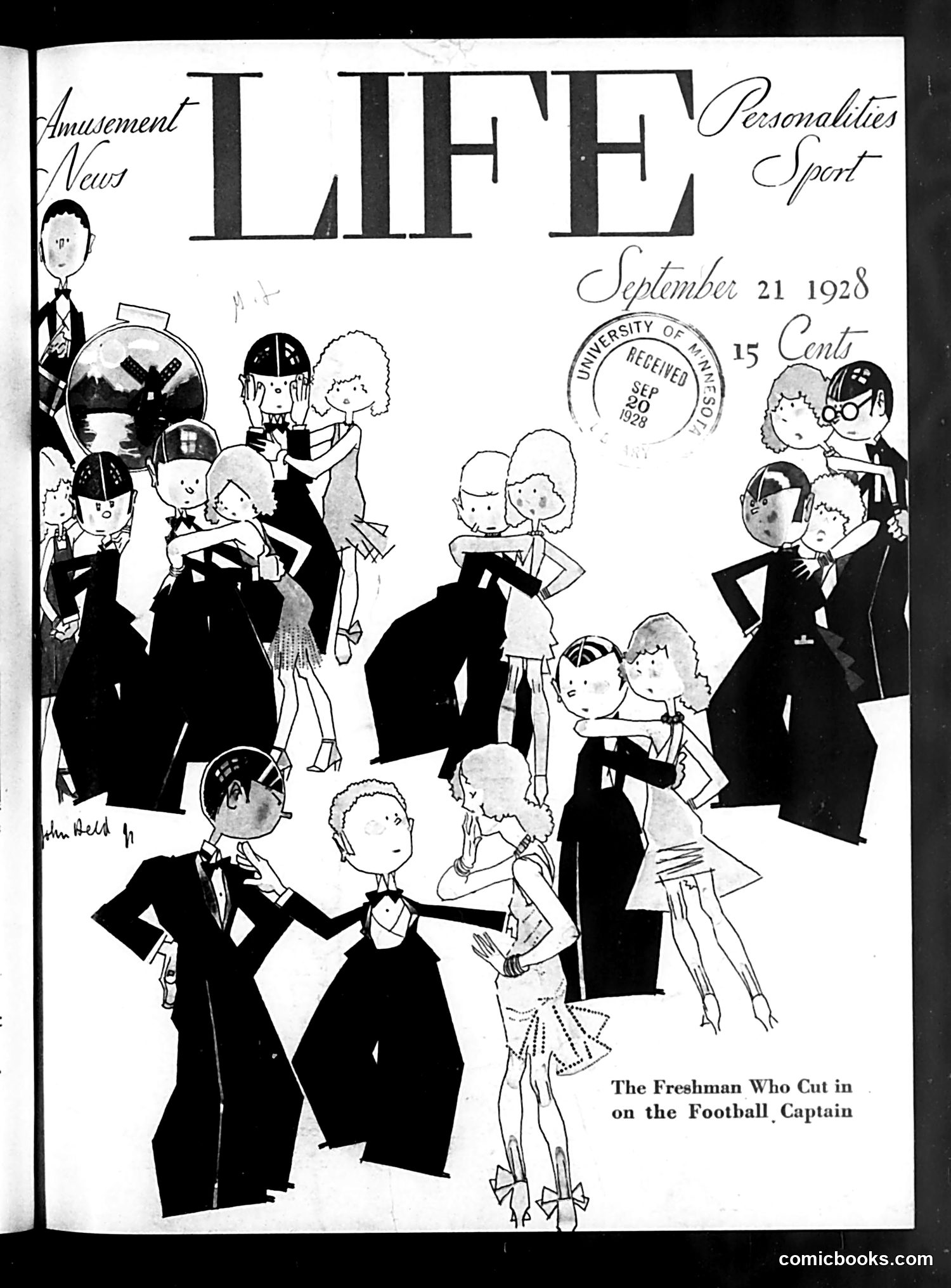
This cover satirizes college social hierarchies through a party scene. Well-dressed men in tuxedos tower over younger figures—likely freshmen or underclassmen—depicted as smaller, childlike characters. The caption "The Freshman Who Cut in on the Football Captain" references the social transgression of a lower-status student interrupting a dance with someone of higher status (the football captain). The satire mocks the rigid pecking order of 1920s college life, where football players held celebrity status and freshmen occupied the bottom rung. The visual exaggeration—tiny freshmen dwarfed by towering upperclassmen—emphasizes how humbling and presumptuous such a social breach would be considered.
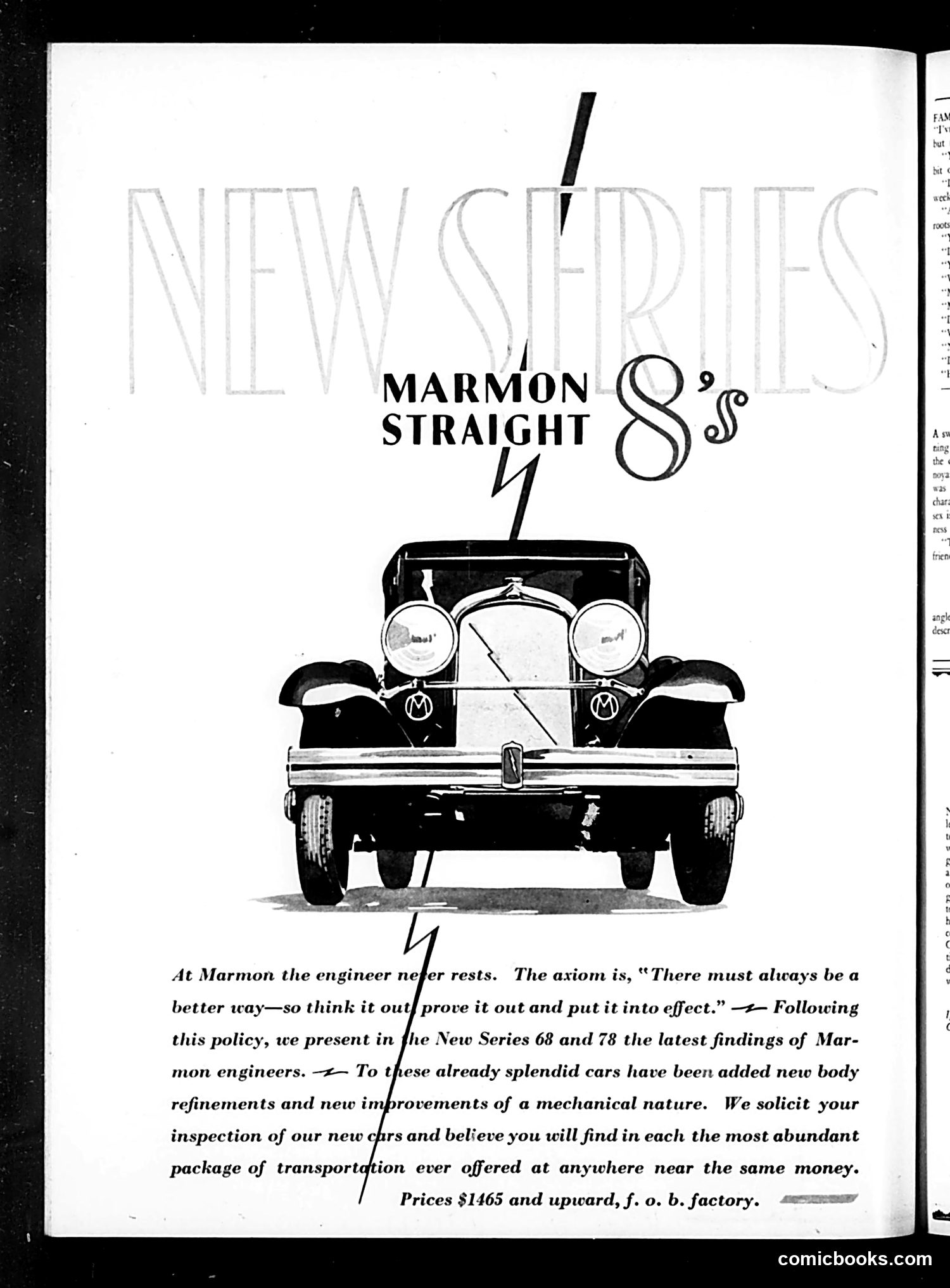
This is a **Marmon automobile advertisement**, not political satire. The page promotes Marmon's "Straight 8" cars (Series 68 and 78 models), featuring a front-view illustration of the vehicle with prominent headlights and the characteristic "M" badging. The ad emphasizes Marmon's engineering philosophy: continuous improvement ("There must always be a better way"). It highlights new body refinements and mechanical improvements added to already "splendid cars," positioning these as superior value compared to competitors at similar prices ($1,465 and up). The lightning bolt graphic reinforces the "straight 8" engine theme, suggesting power and efficiency. This is straightforward commercial advertising rather than satirical commentary—typical of 1920s-era magazine ads promoting American automobiles.
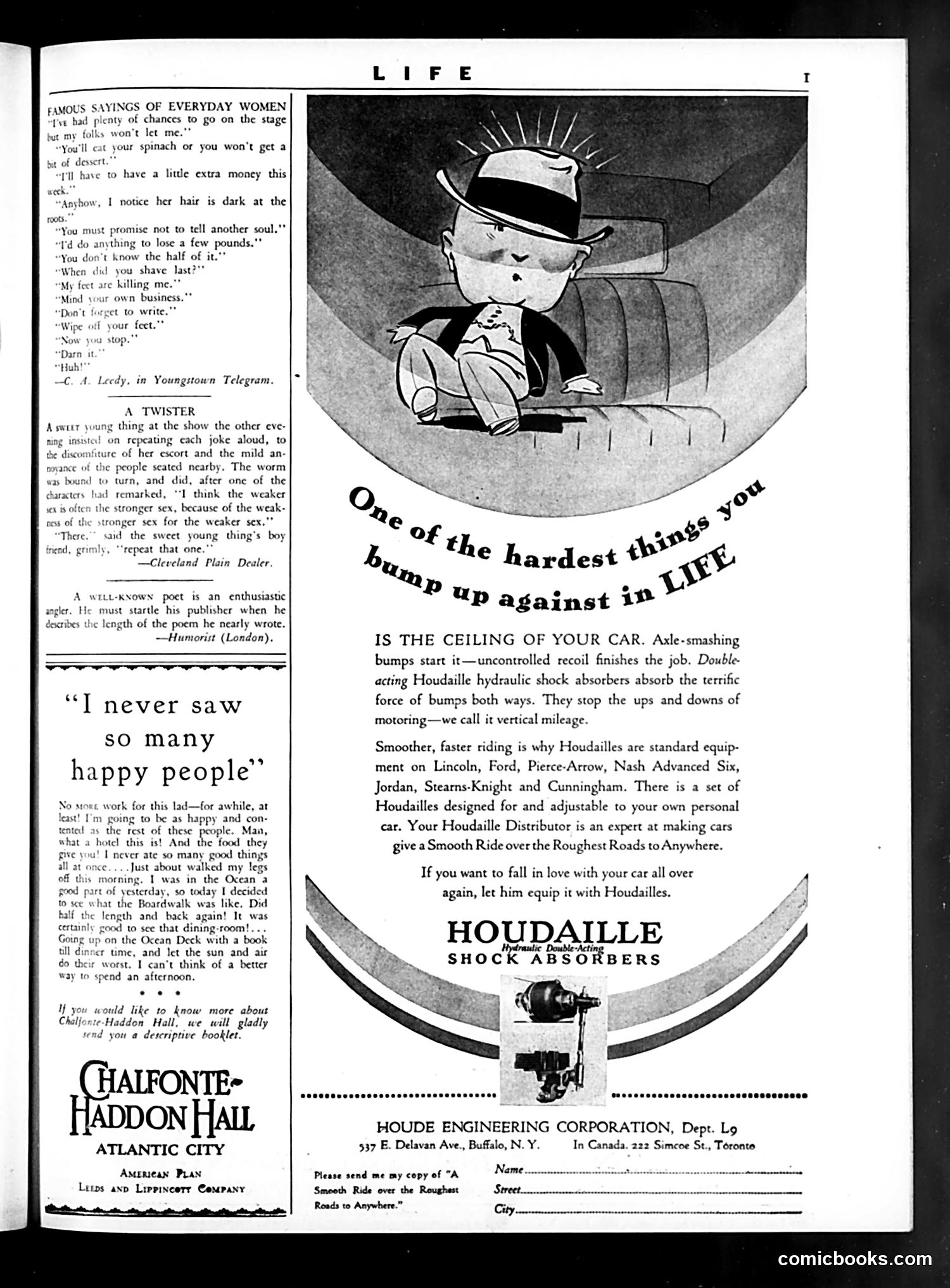
This page is primarily an **advertisement for Houdaille shock absorbers**, not political satire. The small cartoon at top-left ("A Twister") appears to be humorous social commentary about gender dynamics at theater venues—describing how a young woman's repeated jokes annoyed her escort, leading him to reflect that women might be "the stronger sex." The main illustration shows a cartoonish figure being thrown upward by a car bump, with text claiming uncontrolled bumps are "one of the hardest things you bump up against in LIFE." The ad promotes Houdaille's hydraulic shock absorbers as a solution for smoother driving. The page also includes a brief testimonial quote ("I never saw so many happy people") and an unrelated hotel advertisement for Chalfonte-Haddon Hall in Atlantic City.
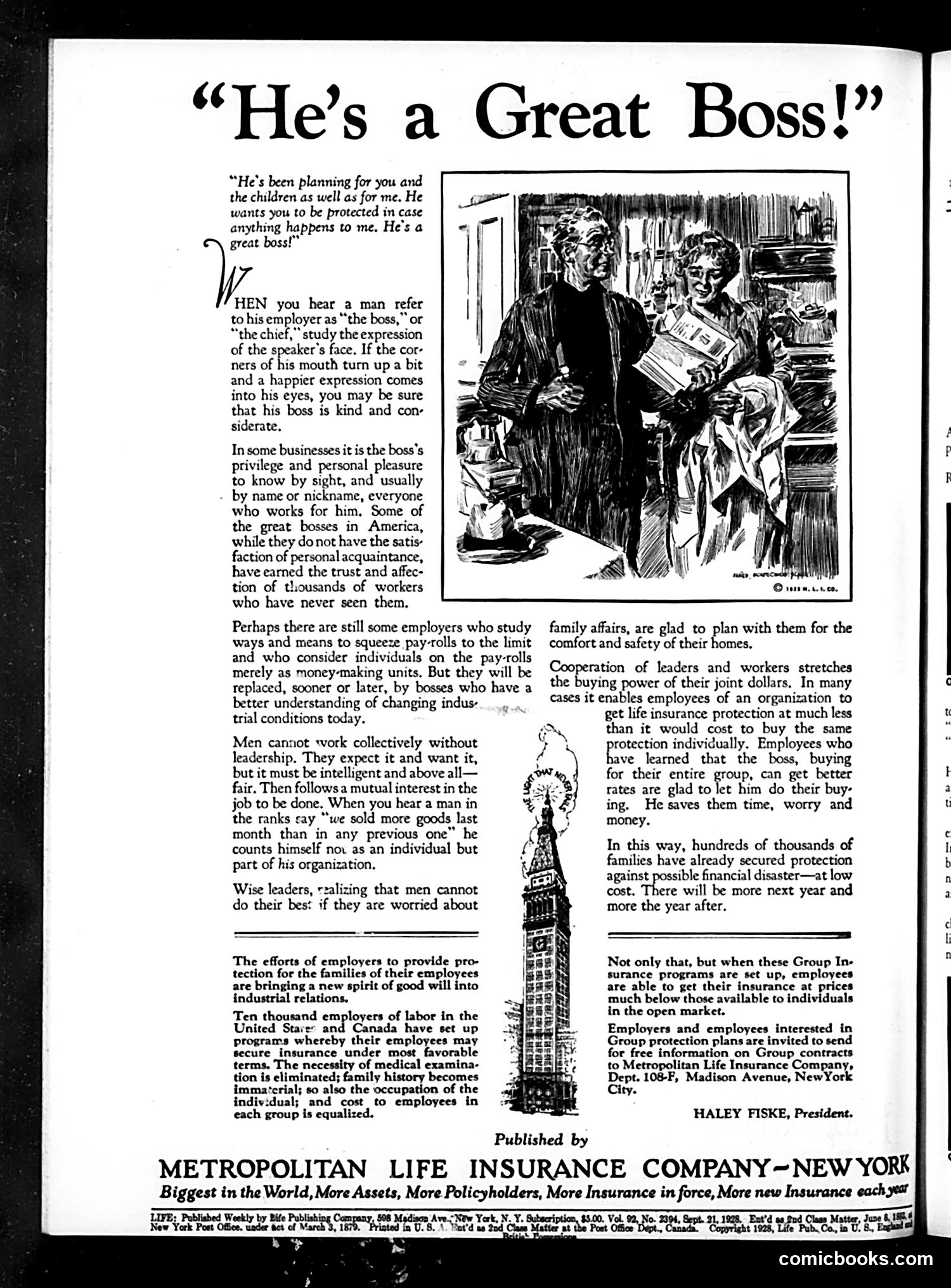
This is **not satire but straightforward advertising** for Metropolitan Life Insurance Company disguised as editorial content. The page promotes group life insurance programs for employers. The illustration shows a boss and employee reviewing insurance paperwork—depicting the employer as a "great boss" who provides this benefit. The text argues that good bosses personally know their workers and care about their welfare. It frames group insurance as enlightened business practice: employers buying coverage for entire workforces receive better rates than individual policies, benefiting employees financially while appearing generous. The page promotes sending away for information about group contracts, positioning Metropolitan Life as enabling paternalistic employer-employee relationships through insurance protection. This represents 1920s-era corporate messaging emphasizing workplace welfare capitalism.
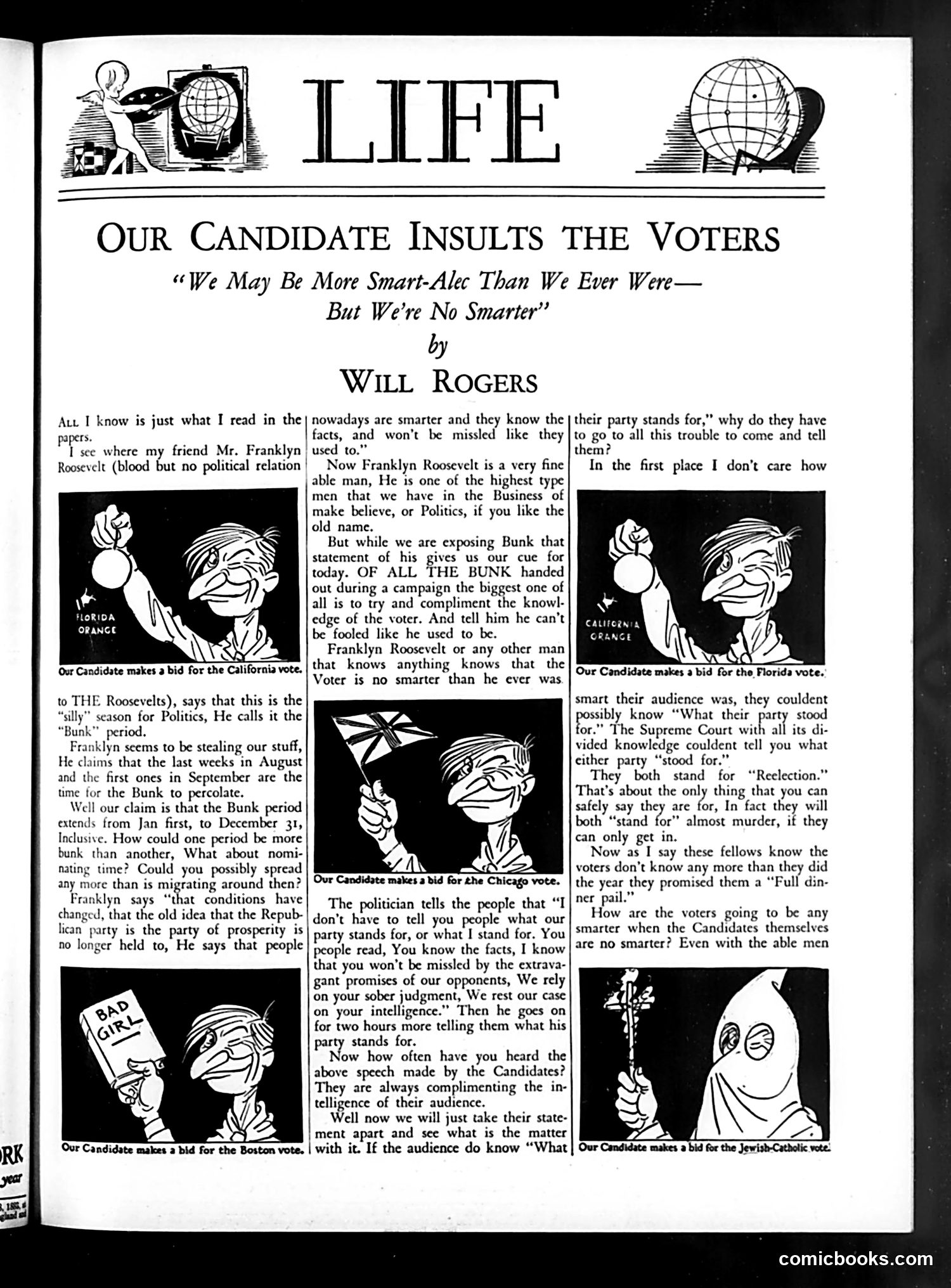
This 1932 Will Rogers satire mocks political candidates who insult voters' intelligence during campaigns. Rogers criticizes how candidates patronizingly flatter voters while making vague promises about party positions. The cartoon shows a caricatured candidate appealing to voters in different regions (California, Florida, Chicago, Boston, and Jewish-Catholic constituencies), adapting his message to each audience—suggesting dishonest pandering. Rogers argues that candidates claim voters are intelligent yet simultaneously treat them as ignorant by: 1. Making contradictory promises to different groups 2. Speaking for two hours without clarity 3. Assuming voters won't notice inconsistencies The satire's core complaint: politicians insult voter intelligence by assuming they can be easily deceived through appeals tailored to regional or religious identity rather than offering genuine policy positions.
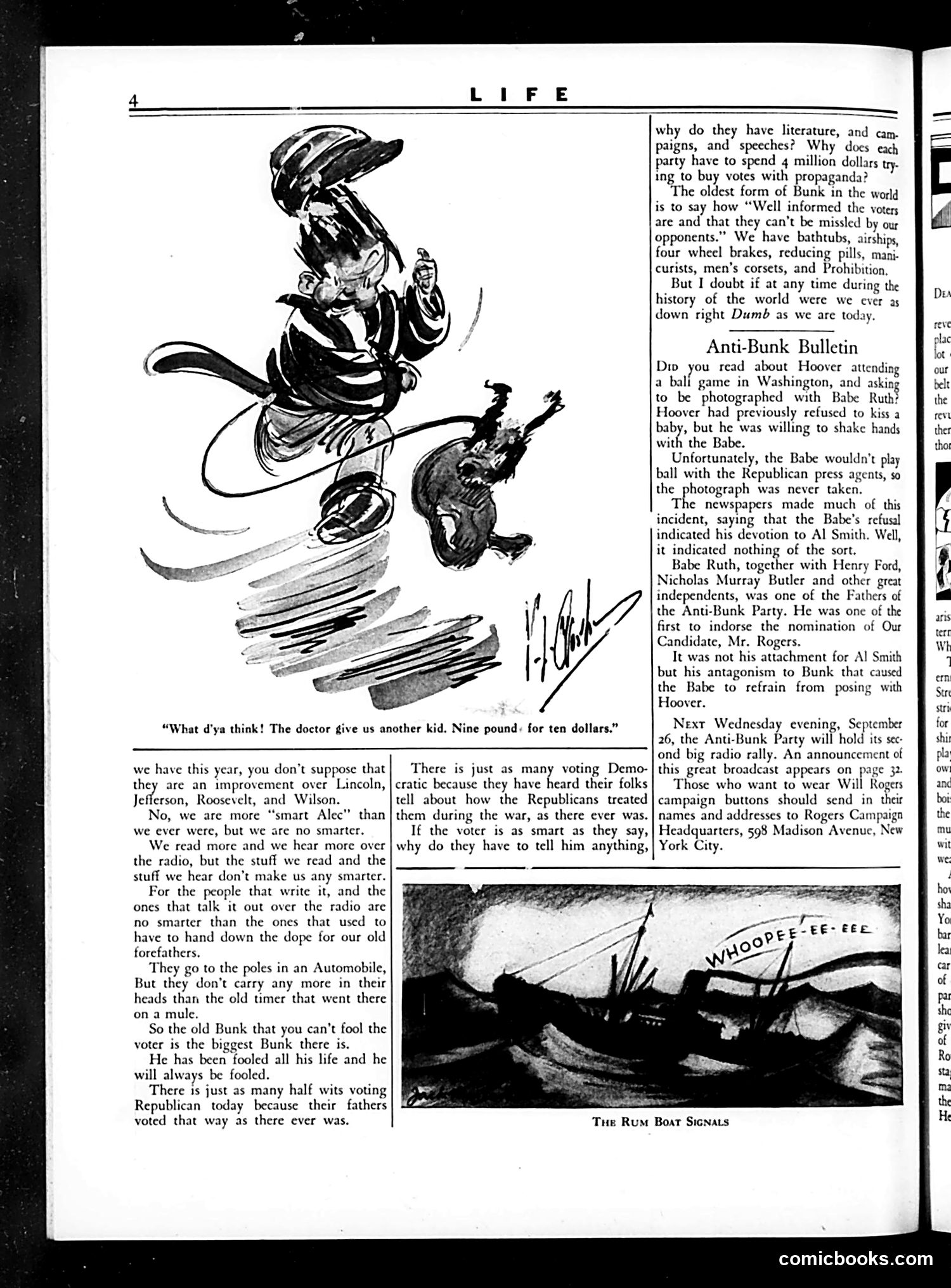
The main cartoon depicts a caricatured figure (likely representing a political opponent or "bunk" peddler) being kicked or ejected violently, with the caption: "What d'ya think? The doctor give us another kid. Nine pound—for ten dollars." The accompanying text discusses the "Anti-Bunk Bulletin," criticizing what it calls misleading campaign rhetoric and political propaganda. It references an incident involving President Hoover, baseball player Babe Ruth, and political candidate Rogers, suggesting the press manipulated a photograph to imply Ruth's support. The satire targets voters gullible enough to believe political "bunk"—exaggerated claims and propaganda. The cartoon's crude humor reinforces the magazine's contemptuous view of those who spread political misinformation and the voters who accept it uncritically.
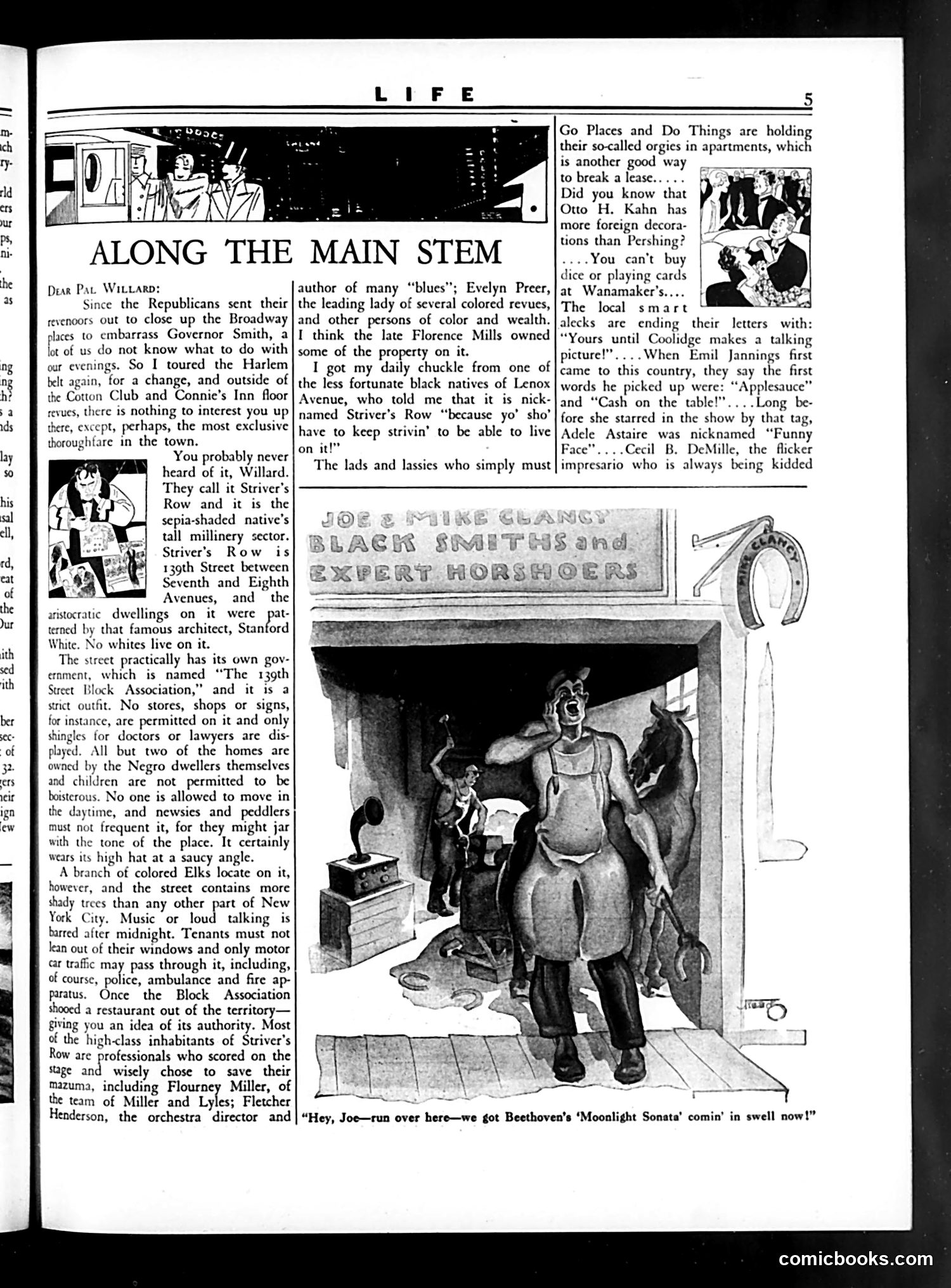
This page satirizes Harlem's "Strivers' Row," a prestigious African American neighborhood on West 139th Street in Manhattan. The letter mocks the area's strict social exclusivity: residents enforced rigid codes prohibiting noise, visible laundry, and certain types of people. The author notes that only professionals—doctors, lawyers, entertainers—could afford or were permitted to live there, creating an "aristocratic" Black enclave that barred working-class African Americans. The cartoon caption jokes about classical music preference as a status marker: "Hey, Joe—run over here—we got Beethoven's 'Moonlight Sonata' comin' in swell now!" The satire targets how Strivers' Row residents used European high culture as proof of refinement and social superiority within their own community.
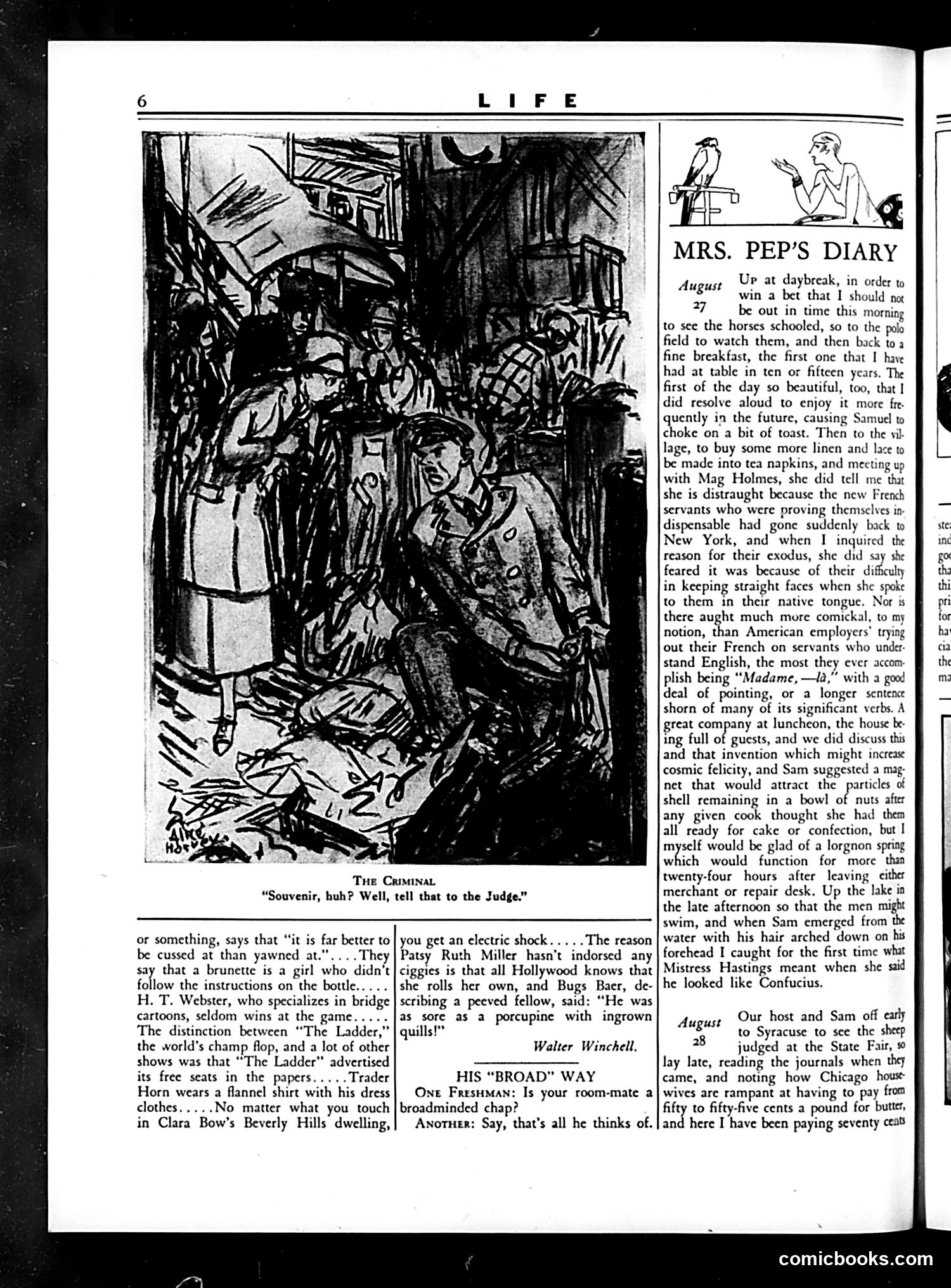
This cartoon depicts a chaotic courtroom scene with the caption "Souvenir, huh? Well, tell that to the Judge." The image shows what appears to be a crowded, disorderly legal proceeding with multiple figures in period dress. The accompanying text references various entertainment industry figures and disputes, including mentions of Patsy Ruth Miller, Bugs Baer, and discussions about "The Ladder" (apparently an advertisement or show). The humor appears to target Hollywood's legal troubles and disputes of the era, satirizing the entertainment industry's scandals and courtroom drama. The exact identity of "the criminal" remains unclear from the image alone, though the chaotic courtroom setting suggests satire of sensationalized legal proceedings common in 1920s popular culture and entertainment news.
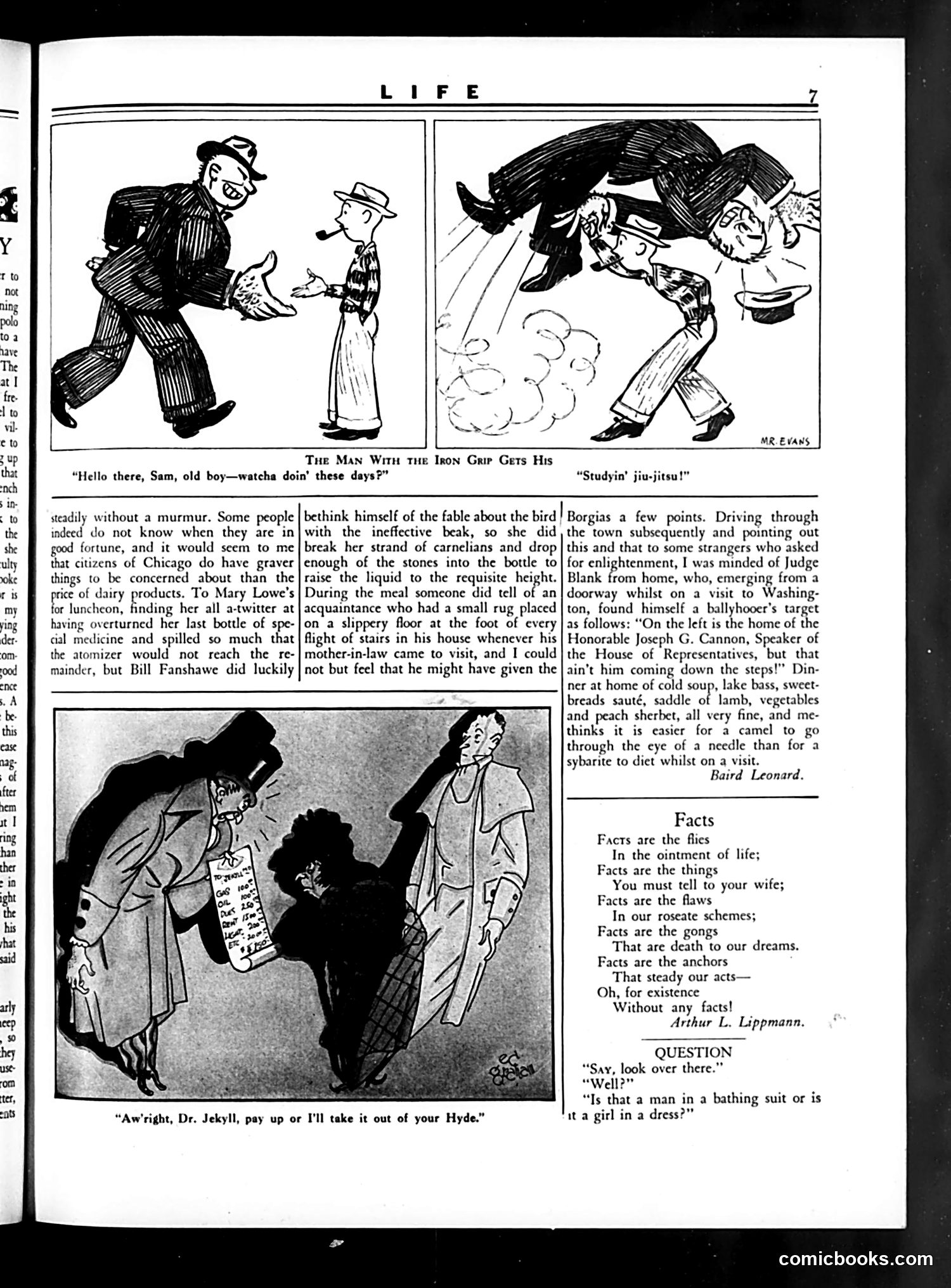
This page contains three separate comic illustrations satirizing everyday social situations. The top cartoons mock familiar encounters: "Hello there, Sam, old boy—watcha doin' these days?" depicts a contrived street greeting, while "Studyin' jiu-jitsu!" shows a man being thrown by his opponent, suggesting the speaker was using martial arts as an excuse for his bruised appearance. The larger middle cartoon titled "Aw'right, Dr. Jekyll, pay up or I'll take it out of your Hyde" references Robert Louis Stevenson's *Jekyll and Hyde* novel. It depicts what appears to be a debt collector confronting a man, with the caption making a pun: the debtor's "other side" (Hyde) will be violent if payment isn't made. The page concludes with a brief poem "Facts" and a visual riddle question about distinguishing genders in bathing attire—reflecting early 20th-century fashion ambiguity concerns.
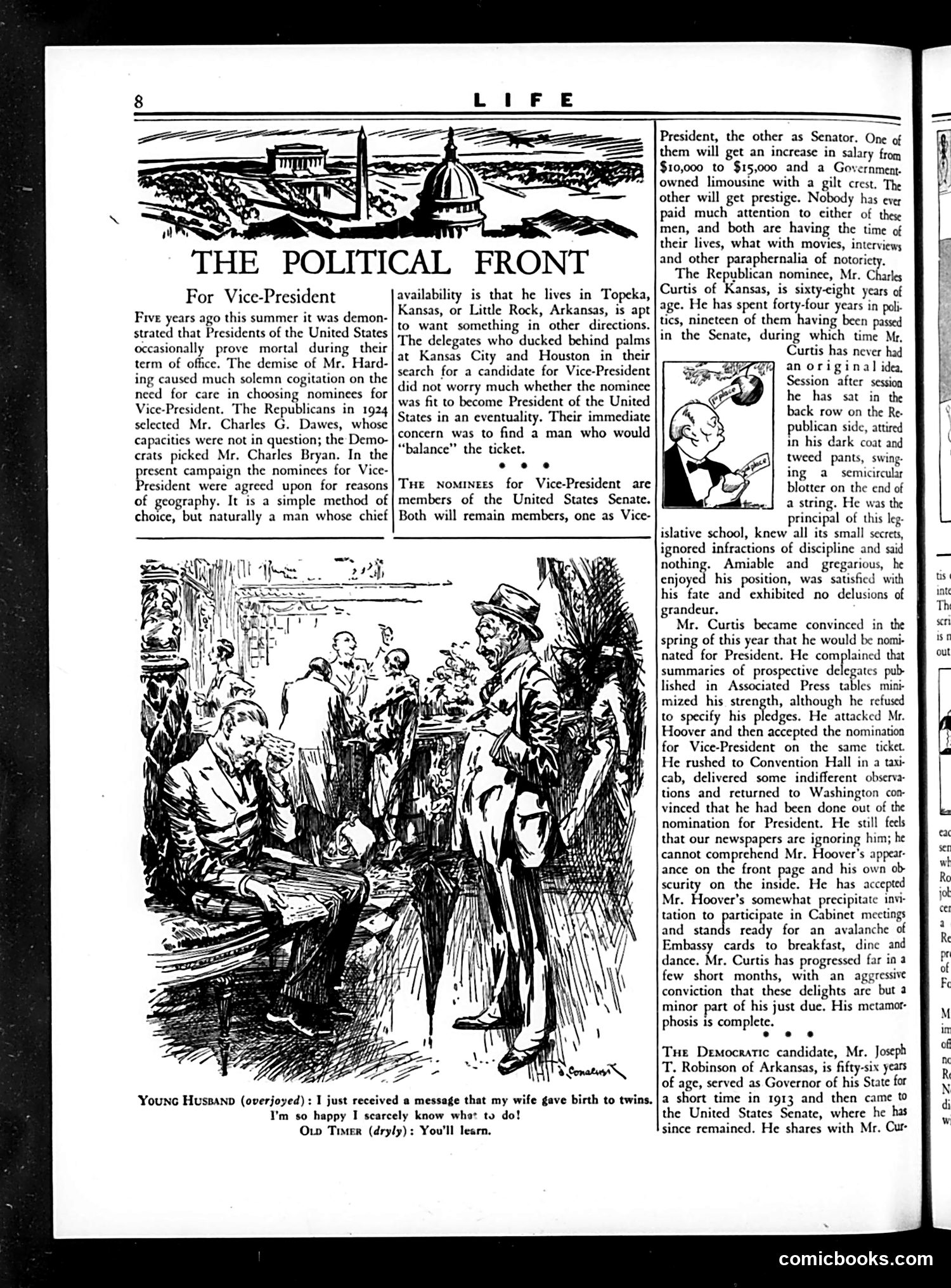
This page satirizes the 1928 vice-presidential nomination process. The main cartoon depicts political delegates in crowded, chaotic discussion—suggesting backroom dealing and confusion. The text criticizes how presidential nominees choose running mates based on geography rather than merit. It names two candidates: **Charles G. Dawes** (Republican) and **Joseph T. Robinson** (Democratic, from Arkansas). The smaller cartoon below mocks a "Young Husband" receiving news of twins—a joke about not understanding what's happening, paralleling political delegates' supposed confusion about vice-presidential selection. The satire targets the arbitrary, non-transparent nature of VP nomination: choosing candidates primarily for regional "balance" rather than qualifications or fitness for the presidency.
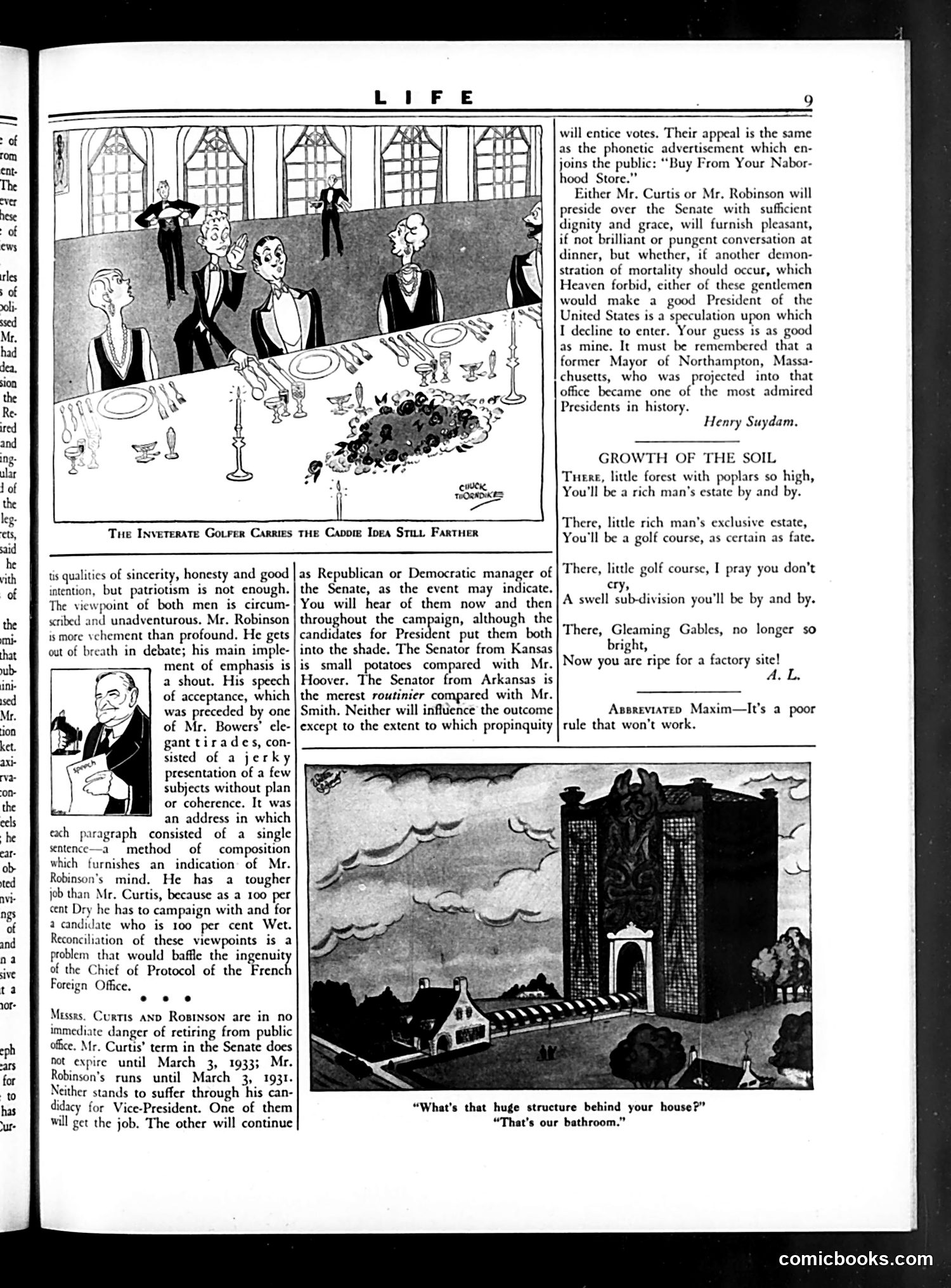
The top cartoon depicts a formal Senate dinner where one guest has brought an enormous pile of what appears to be potatoes—labeled "The Inverterate Golfer Carries the Caddie Idea Still Farther." This satirizes two competing 1932 Senate candidates discussed in the text below: Mr. Curtis and Mr. Robinson. The joke compares their campaign tactics to a golfer absurdly carrying excessive baggage (the potatoes symbolizing political "baggage" or campaign promises). The accompanying text criticizes both candidates' Senate campaign speeches as lacking coherence and substance, comparing Robinson's approach to a "jerky presentation" lacking plan. The bottom cartoon is a separate domestic humor joke: when asked about a huge structure behind a house, the owner replies it's merely a bathroom—satirizing the era's trend toward increasingly elaborate home fixtures.
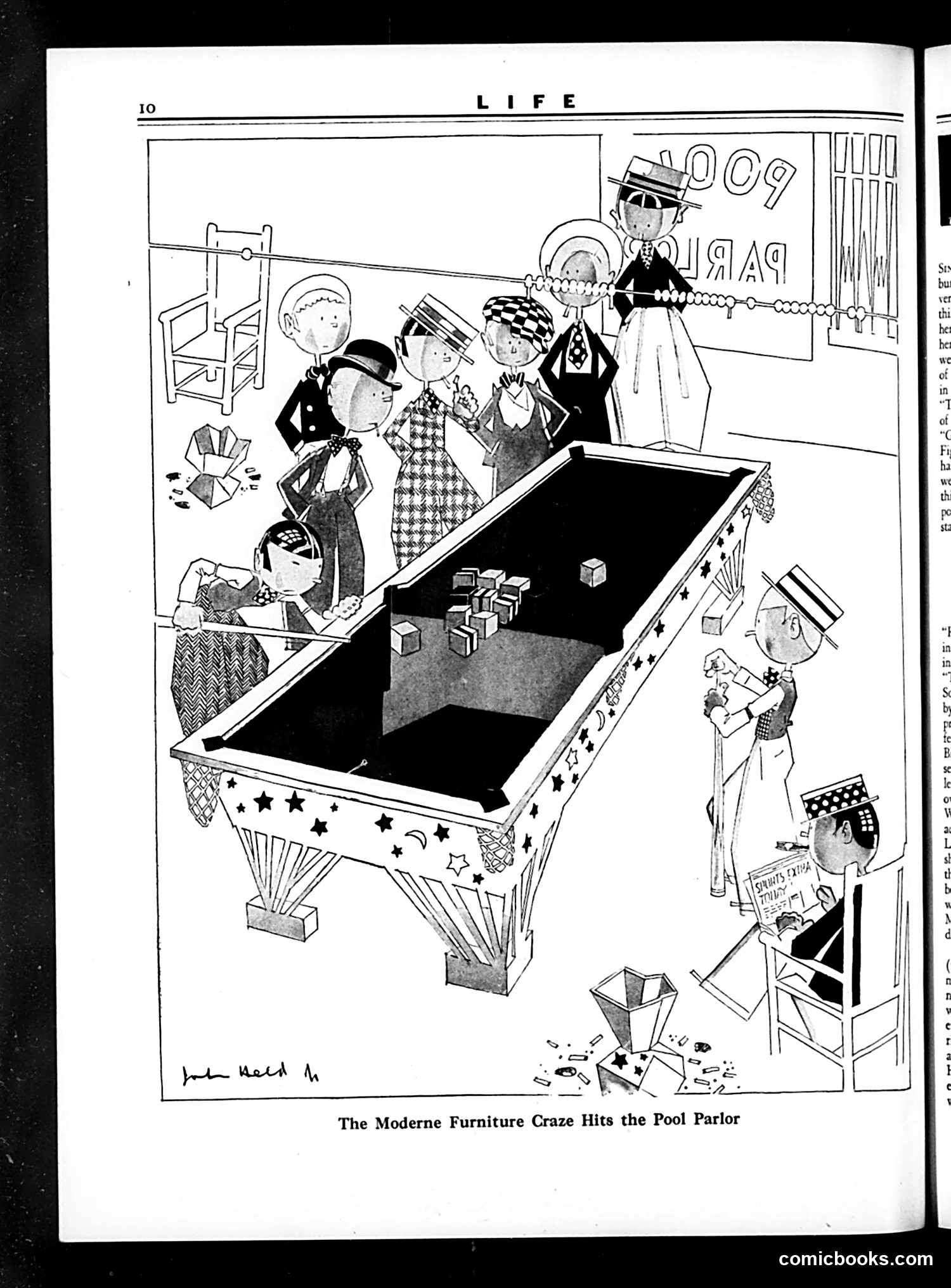
This satirical cartoon depicts a fashionable pool hall where patrons have adopted contemporary modernist furniture and decor. The pool table itself features decorative stars and celestial motifs—characteristic of 1920s-30s Art Deco style. Well-dressed figures in formal attire and hats gather around, with the space decorated in the "moderne" (streamlined modernism) aesthetic that was trendy among affluent Americans. The satire mocks how aggressively the modernist design trend was penetrating everyday spaces, even traditionally working-class venues like pool parlors. By showing upscale furniture and decor in this casual setting, the cartoonist humorously comments on how pervasive and somewhat absurd the fashion craze had become—applied indiscriminately wherever possible.
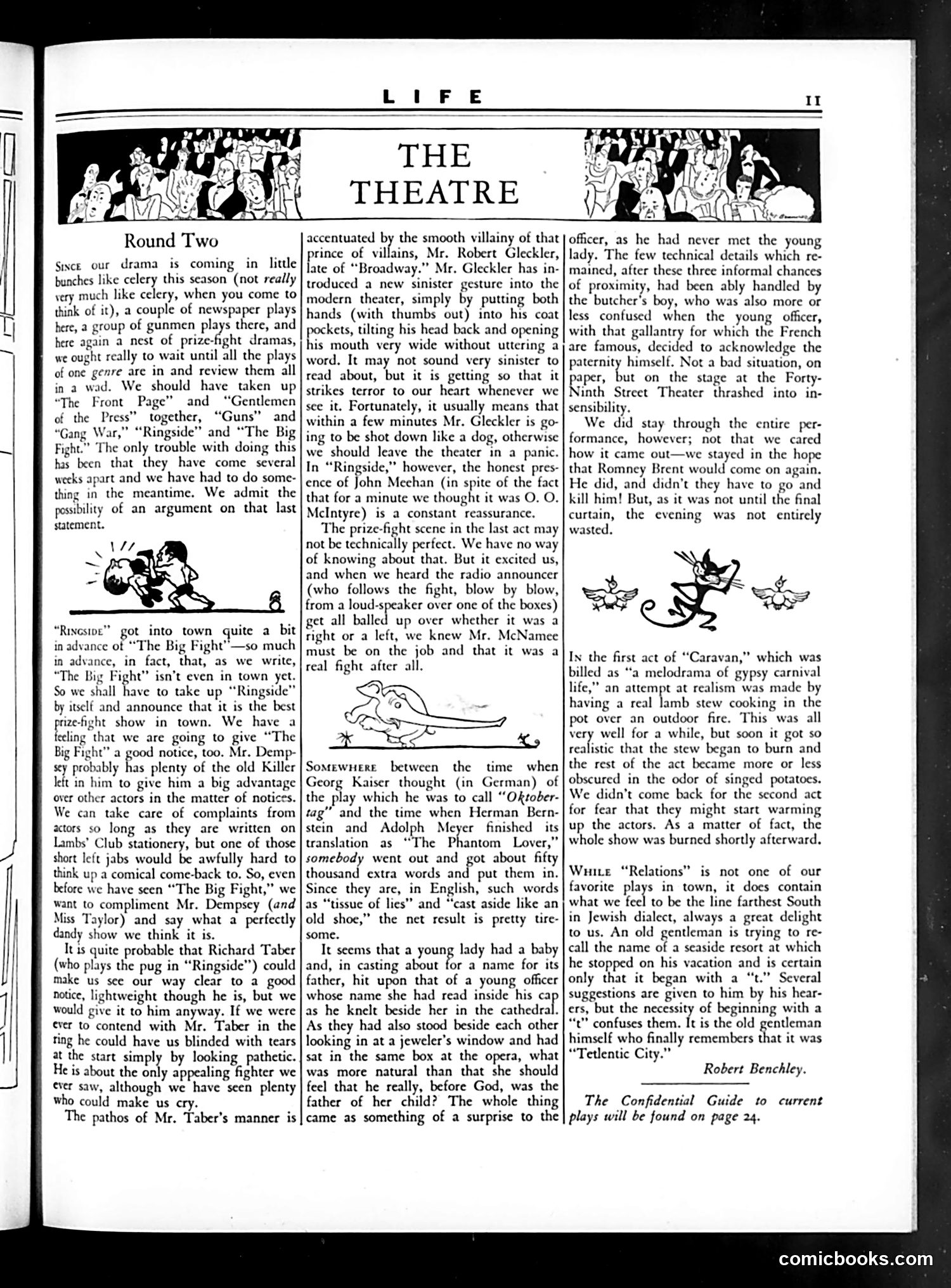
This page reviews Broadway plays, including "The Big Fight" and "Rinside." The critic discusses Robert Gleckler's villainous performance in a new sinister gesture—putting his thumbs in his coat pockets while tilting his head back with mouth open, creating an menacing effect. The text humorously describes staying through a performance of "Rinside" hoping boxer Romney Brent would return for an encore, only to leave disappointed when he didn't reappear. The small cartoon illustrations appear to be decorative comedy sketches accompanying the theater criticism. The page is primarily a written theater column rather than political satire, offering typical 1920s-30s Broadway commentary with light humor about actors' techniques and audience experiences.
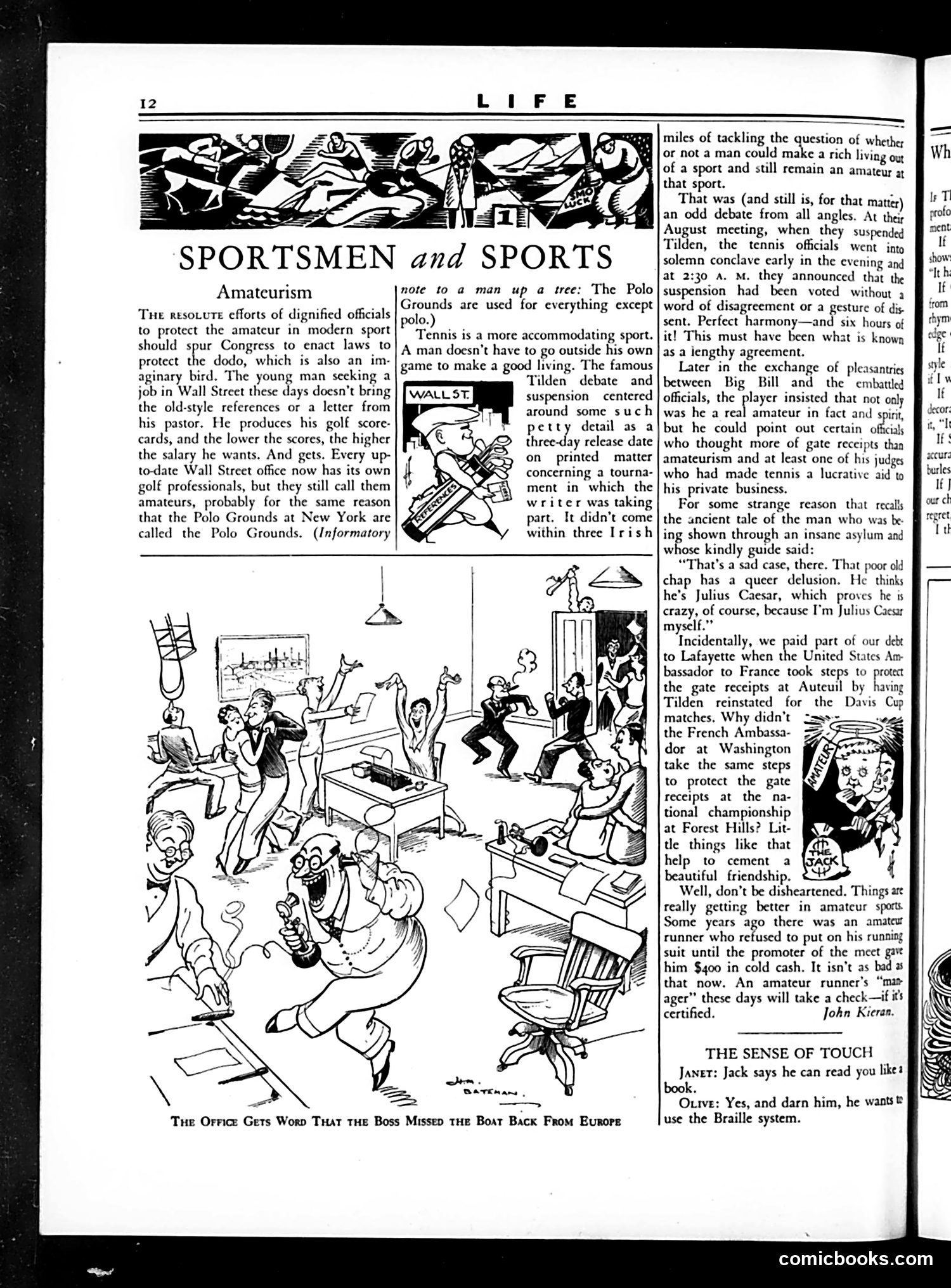
This page satirizes debates over amateurism in sports, particularly tennis and golf. The article discusses whether amateurs can earn money and remain "amateur" in status—a genuine controversy of the era. The large cartoon depicts office chaos: workers have abandoned desks, with papers flying and people in disarray. The caption reads "The Office Gets Word That the Boss Missed the Boat Back From Europe," suggesting workplace pandemonium when leadership is absent. The text references the "Tilden debate," likely about tennis player Bill Tilden, and disputes over gate receipts and Davis Cup matches. The article's tone is gently mocking, questioning the arbitrary distinctions between amateur and professional status in sports while acknowledging real tensions between officials and athletes over compensation and eligibility.
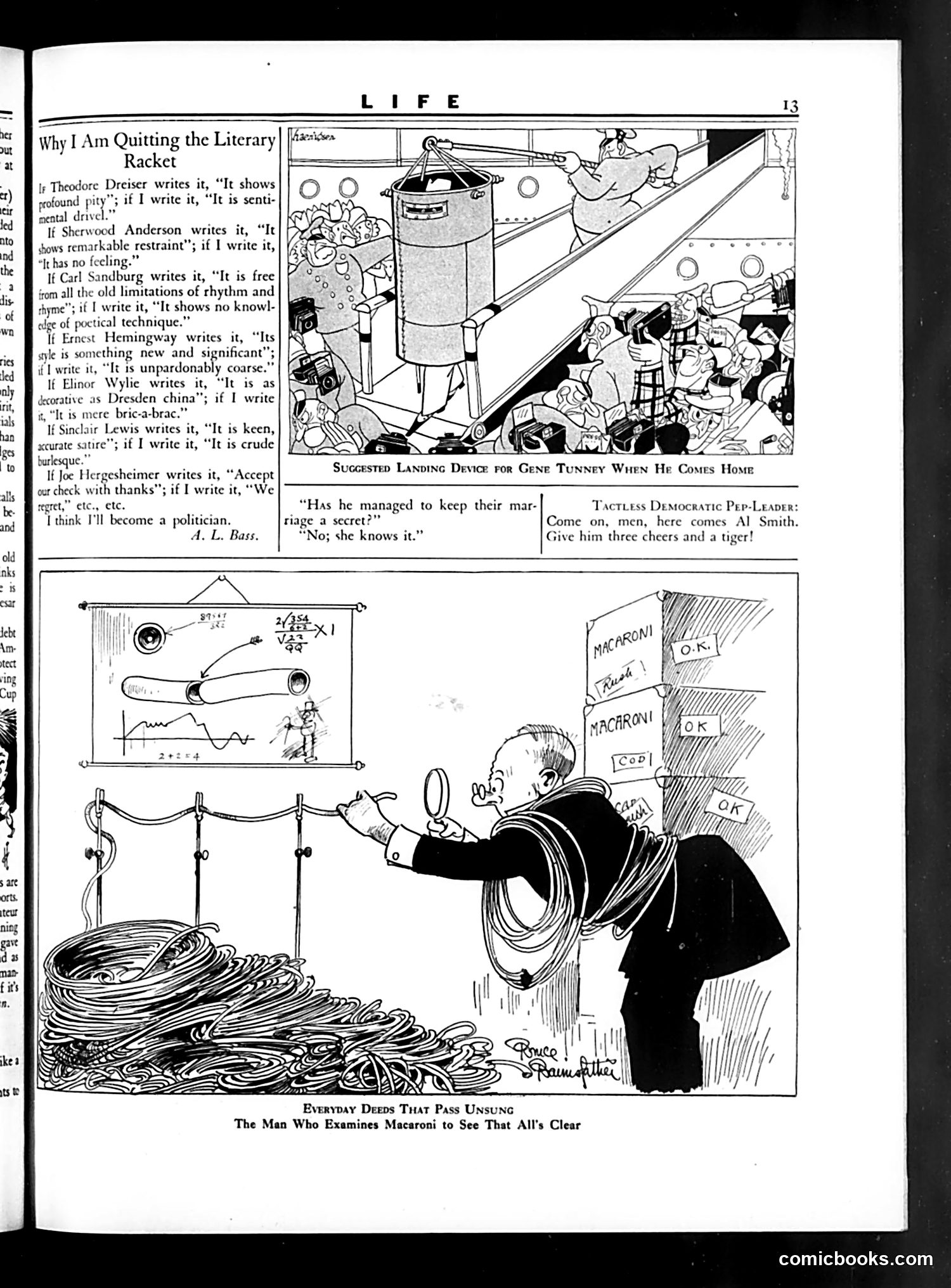
**Top Section:** "Why I Am Quitting the Literary Racket" presents famous authors (Dreiser, Anderson, Sandburg, Hemingway, Lewis, Wylie, Hergeshimer) each critiquing their own writing styles with self-deprecating humor—a satire on literary pretension and artistic self-doubt. **Bottom Cartoon:** Titled "The Man Who Examines Macaroni to See That All's Clear," depicts a bureaucrat inspecting pasta boxes marked "OK" and "PASSED." This satirizes government food inspectors and regulatory oversight—likely referencing post-Prohibition bureaucratic expansion or food safety regulations. The inspector's meticulous examination of mundane products mocks the absurdity of excessive government oversight and red tape in everyday commerce.
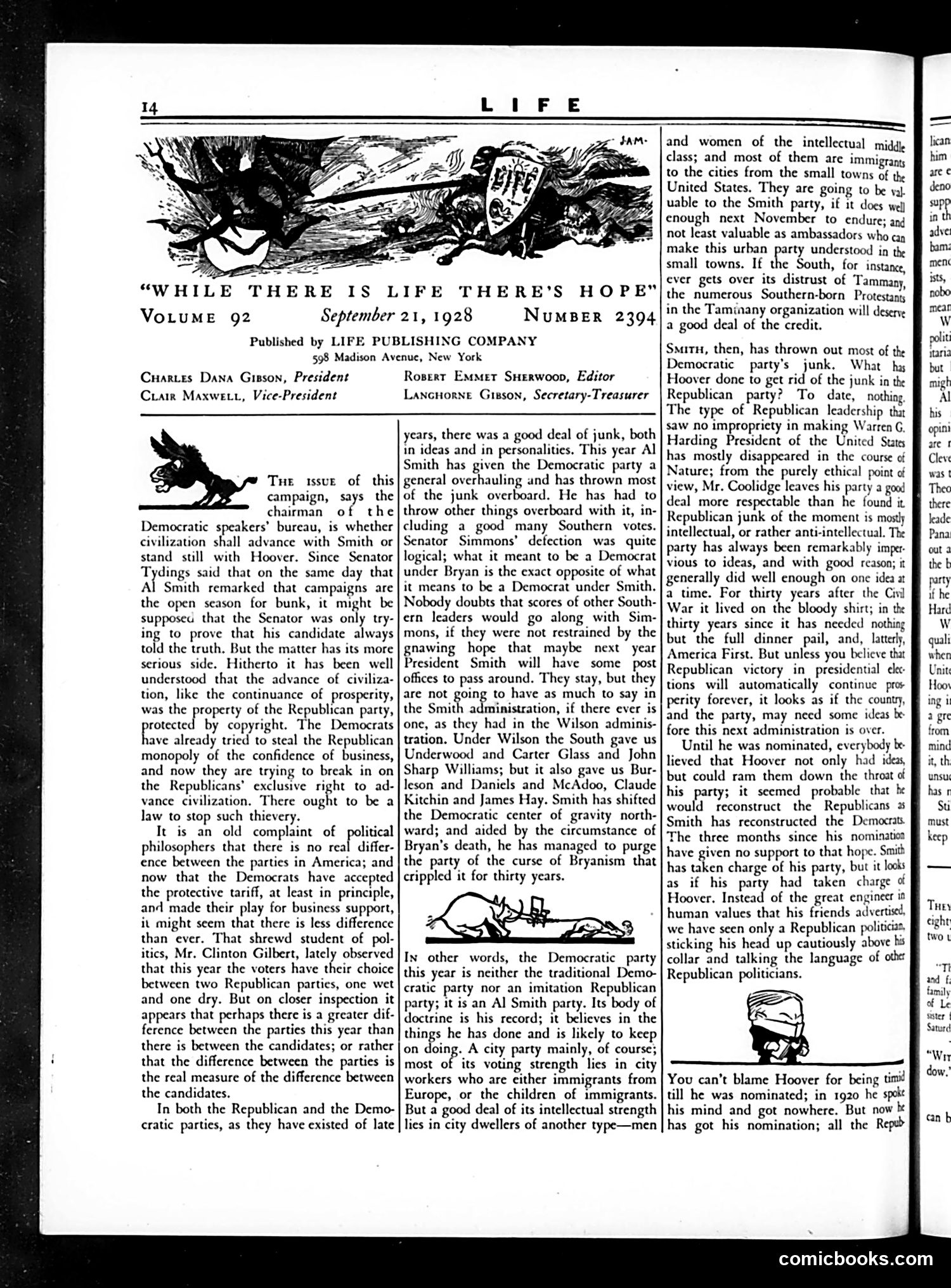
This Life magazine page (September 21, 1928) critiques Al Smith's Democratic campaign and the party's direction. The editorial argues that Smith has "thrown out most of the Democratic party's junk," removing outdated ideas and personalities. However, it contends Smith hasn't fundamentally changed the party's character—it remains the "Smith party," not a true alternative to Hoover's Republicans. The accompanying cartoon (lower left) depicts a sinking ship, likely representing Democratic prospects or party troubles. The text suggests both parties are similar on fundamental issues, with real differences lying mainly in candidates rather than ideology or policy. This reflects skepticism about meaningful party distinctions in the 1928 presidential race.
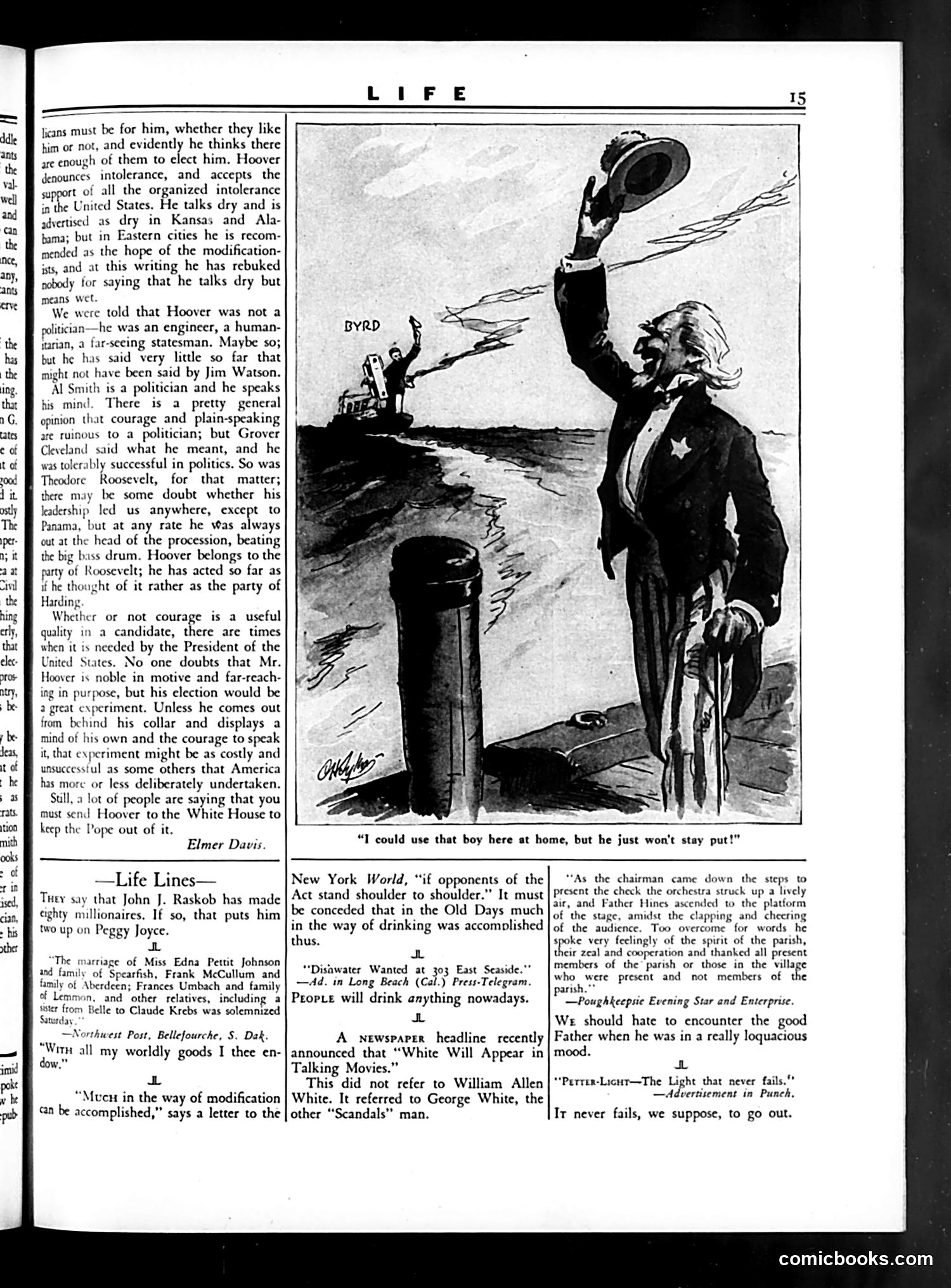
The main cartoon by Byrd depicts a figure labeled with a star (appearing to represent the Pope or Catholic Church authority) being ejected or "put out" from what seems to be an American home or institution. A man in formal dress says: "I could use that boy here at home, but he just won't stay put!" This satirizes anxieties about Catholic influence in America during the early 20th century. The "boy" reference appears to mock papal authority as uncontrollable or unwilling to remain confined to its proper sphere. The cartoon reflects Protestant-dominant American concerns about Catholic institutional power and the Pope's perceived interference in domestic affairs—a common nativist political anxiety of the era.
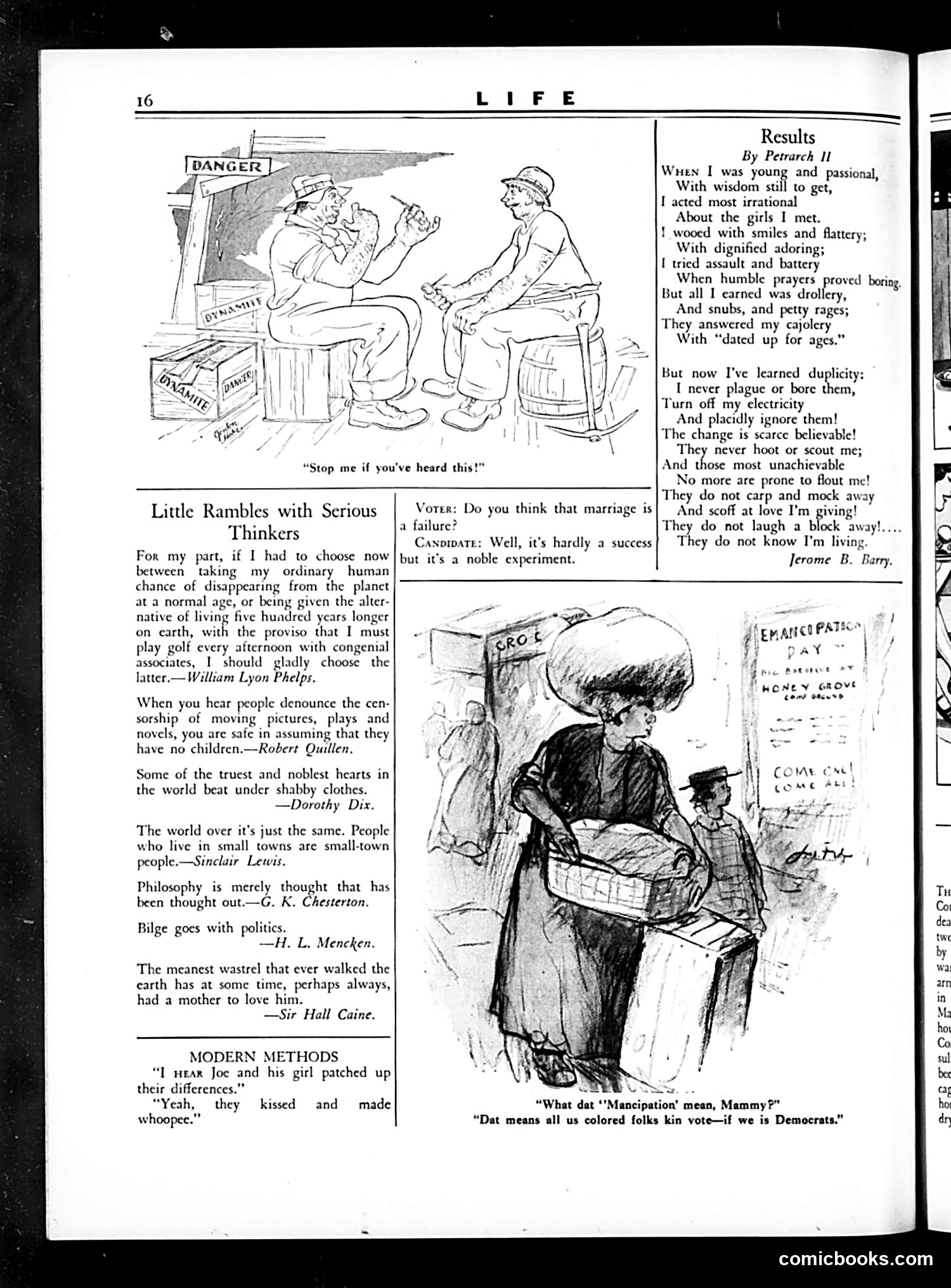
The page contains two main cartoons and several quoted observations. **Top cartoon**: Shows a man and woman in conversation near boxes labeled "DYNAMITE" and "DANGER," with the man saying "Stop me if you've heard this!" — a visual pun on the danger of repetitive, tedious conversation as explosive risk. **Bottom cartoon**: Depicts a woman and child at what appears to be a polling place or civic registration. The child asks about "Emancipation," and the mother explains it means "all us colored folks kin vote—if we is Democrats." This satirizes restrictions on Black voting rights and the political conditions attached to voting access during this era of disenfranchisement. The page also includes aphoristic quotes on various social topics and a brief humor piece titled "Modern Methods" about conflict resolution through kissing.
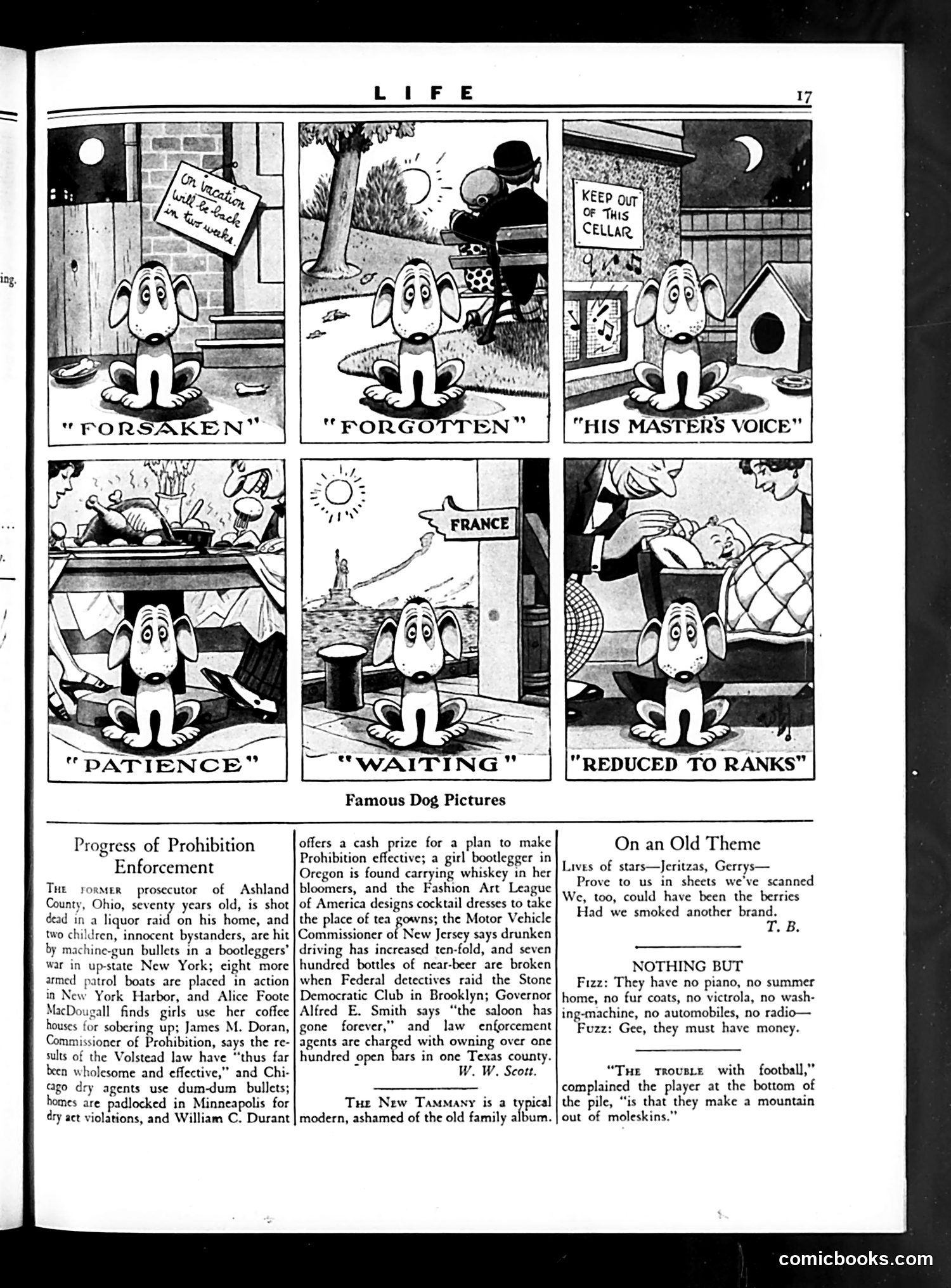
This six-panel cartoon depicts a dog's emotional journey through Prohibition enforcement. The dog experiences abandonment ("Forsaken"), memory loss ("Forgotten"), isolation from his owner ("His Master's Voice"—a reference to the famous RCA Victor trademark), then endures hardship with "Patience," "Waiting," and finally degradation ("Reduced to Ranks"). The implicit satire: the dog represents ordinary Americans suffering under Prohibition laws (1920-1933). The progression humorously dramatizes how the policy separated families, caused economic hardship, and reduced citizens' status. The accompanying news items about Prohibition enforcement—bootleggers, confiscated whiskey, and Federal raids—reinforce the cartoon's criticism of the era's unpopular alcohol ban and its disruptive social consequences.
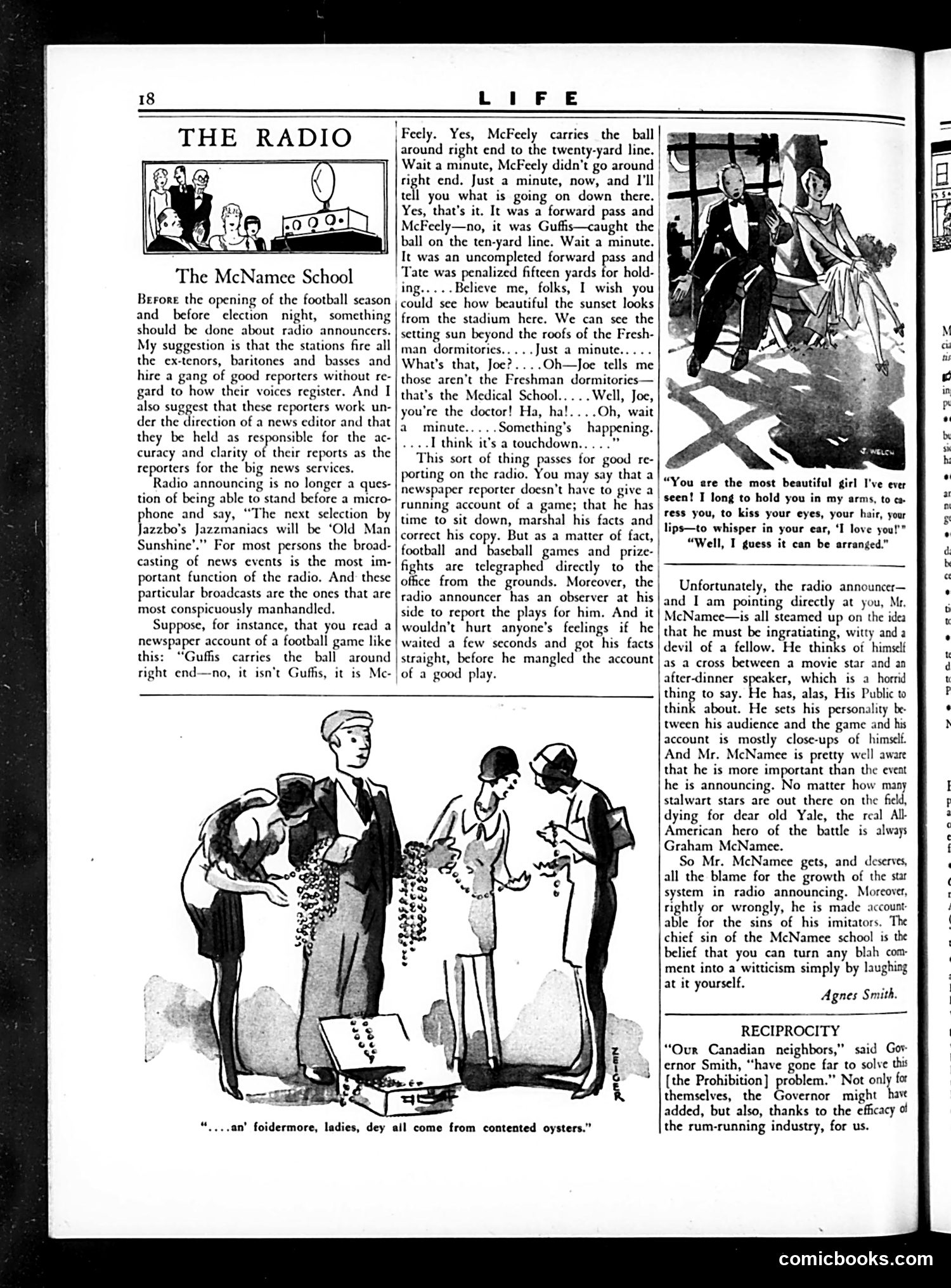
This article satirizes **Graham McNamee**, a prominent 1920s radio sports announcer, for his self-centered broadcasting style. The author criticizes radio announcers generally for prioritizing entertainment and personality over accurate reporting—a new problem since radio broadcasts events live, unlike newspapers. The specific complaint: McNamee constantly interrupts game coverage with tangents (describing sunsets, making jokes, correcting himself), prioritizes his own charm over the sport, and believes he's more important than the athletes competing. The cartoon below mocks vague radio language ("an' foidermore...oysters"), while the photo shows a radio couple's romance, satirizing McNamee's tendency to inject romantic sentimentality into broadcasts. The author argues radio stations should hire trained reporters under editorial supervision, not former singers with pleasing voices but poor accuracy. McNamee exemplifies the problem: he's made himself the "real All-American hero" rather than letting the game speak for itself.
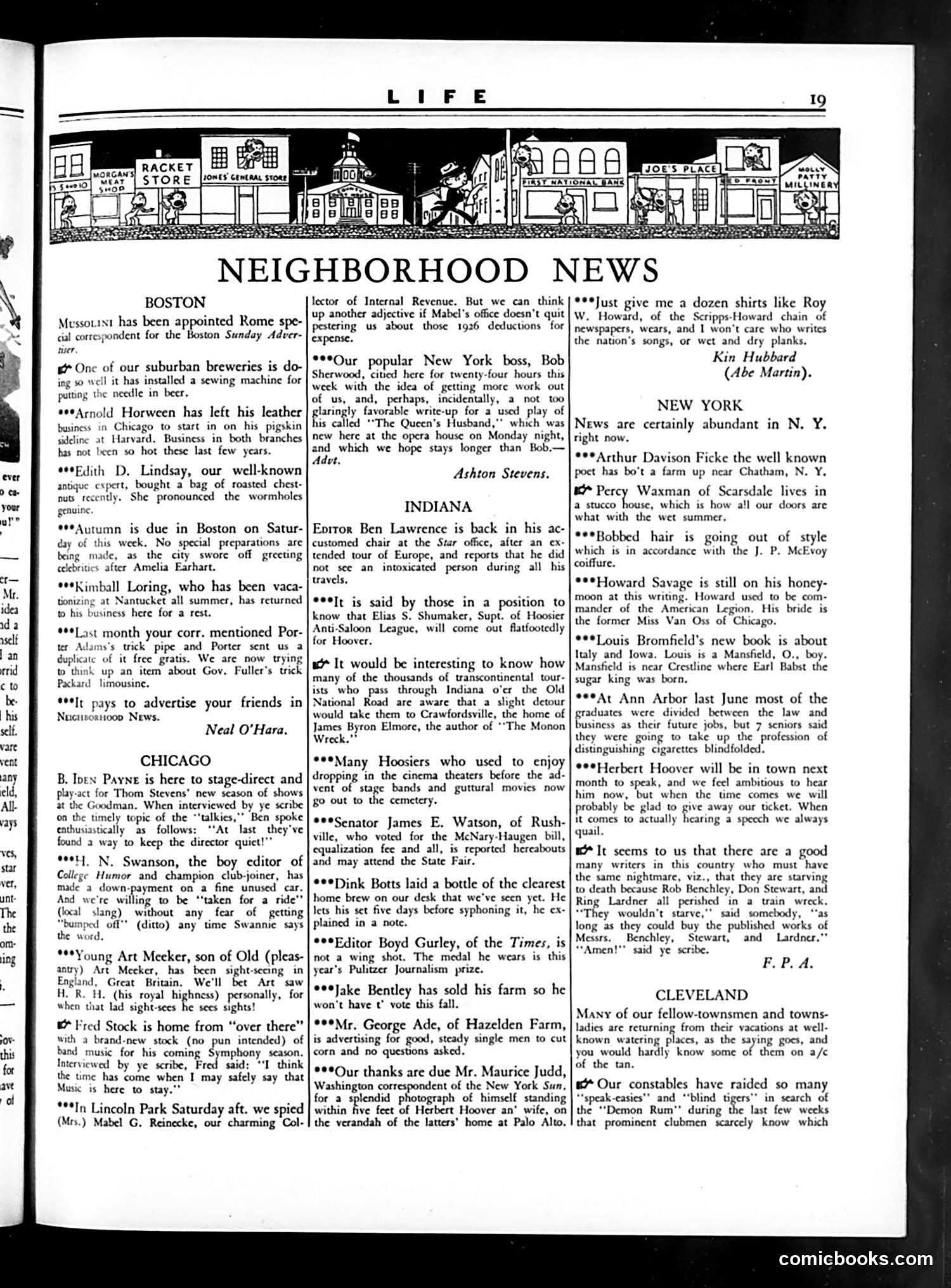
This page from Life magazine consists entirely of "Neighborhood News"—a satirical gossip column format divided by city (Boston, Chicago, Indiana), with no cartoons visible. The humor is light and local, mocking minor figures from regional newspapers and businesses through brief zingers. Key satirical points include: mocking Prohibition-era beer production ("needle in beer"), academics leaving for business ("leather business to pigskin sideline"), and cultural fashions. The note about Autumn arriving in Boston without "special preparations" after "greeting celebrities" like Amelia Earhart references the recent transatlantic flight (1928). References to "talkies" (early talking pictures) and the "Anti-Saloon League" reflect current 1928-1929 topics. The humor is primarily insulting to local figures unknown to modern readers, rather than explaining significant political events. The tone is gossipy and mildly mean-spirited.
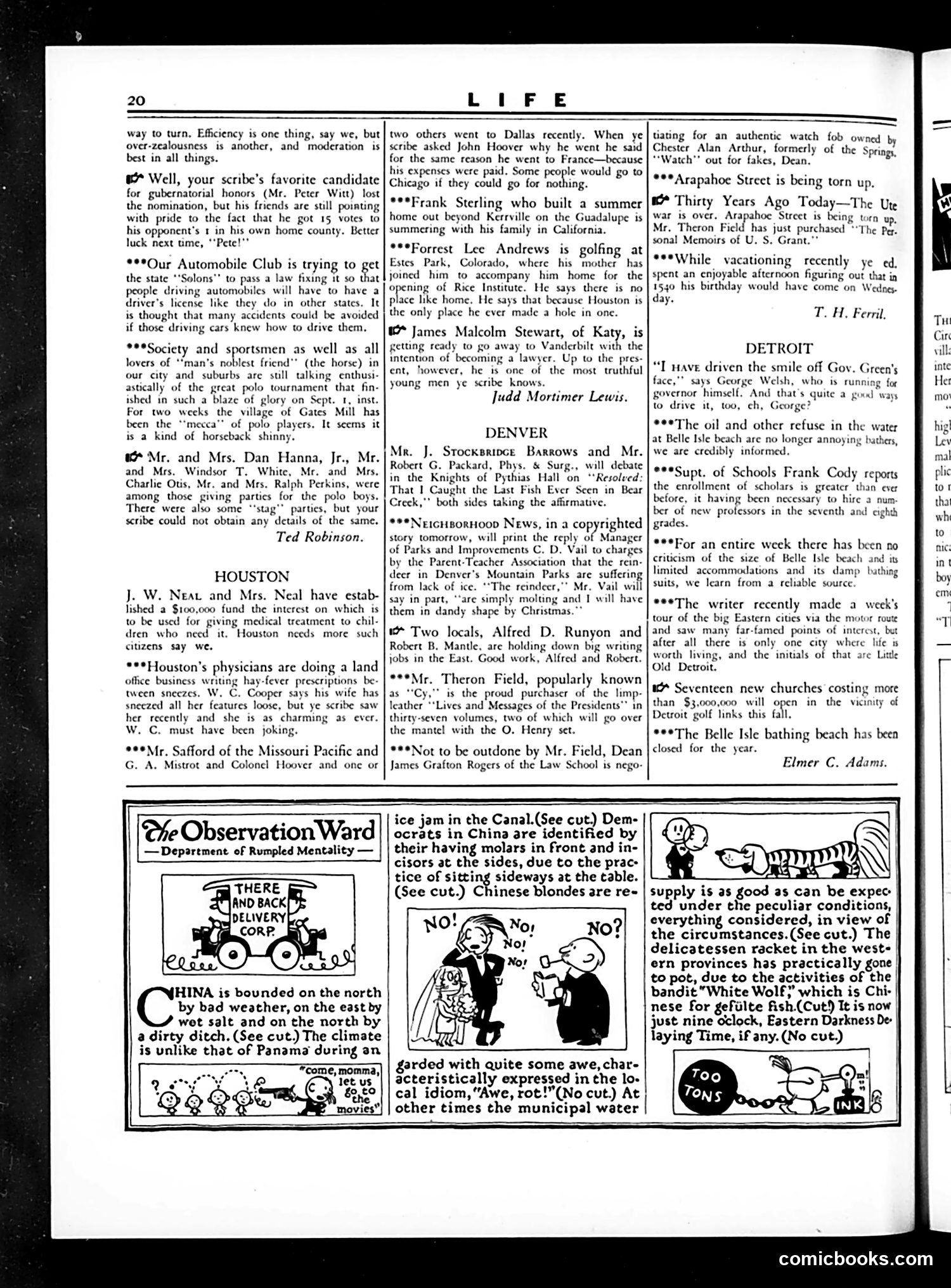
This is a satirical humor section titled "The Observation Ward—Department of Rumpled Mentality," featuring commentary on China with accompanying cartoons. The main joke appears to reference geographic and cultural absurdities: China is described as bounded by "bad weather" on the north, "wet salt" on the east, and a "dirty ditch" on the north—clearly nonsensical descriptions replacing actual geography, used for comedic effect. The cartoon panels show: people in a canal jam in China identified by their molars (satirizing racist stereotypes about physical differences), a figure repeatedly saying "No!" to various requests (appears to mock Chinese negotiation or communication styles), and a reference to "Chinese blondes" as an oxymoron joke. The humor relies on period stereotypes about China and Chinese people—common in early 20th-century American satirical magazines. The "Delicatessen rocket" reference is unclear without additional context. This represents the casual, often offensive ethnic humor typical of *Life* magazine's era.
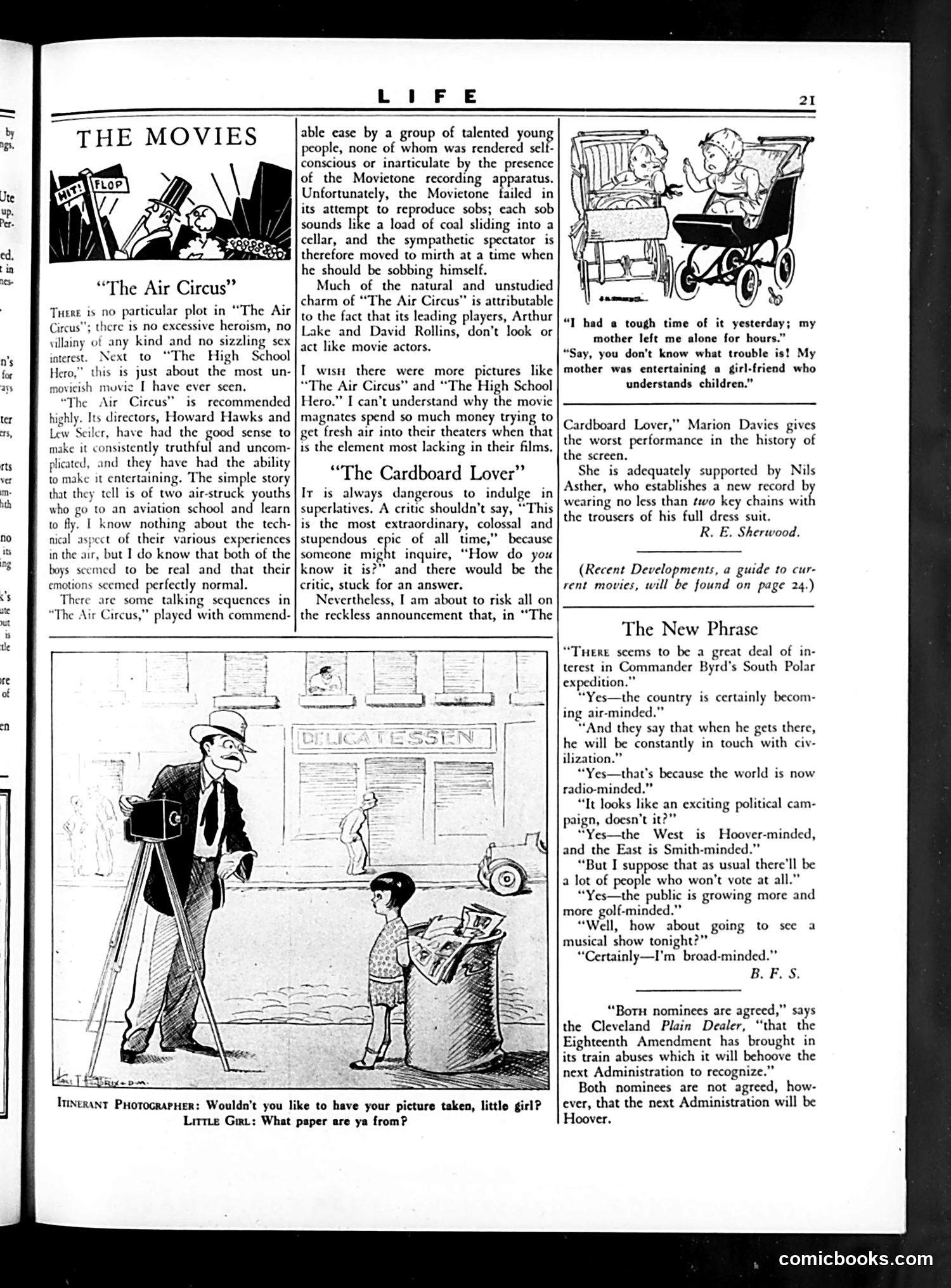
This page contains film criticism and social satire from what appears to be the late 1920s. **The main cartoon** depicts an itinerant photographer attempting to photograph a street child, asking "What paper are ya from?" The child's response exposes the photographer's deception—he's posing as a newspaper worker to gain access to the child. This satirizes predatory behavior disguised as legitimate work. **The movie reviews** discuss "The Air Circus" and "The Cardboard Lover," praising the former for realistic authenticity and condemning the latter as Marion Davies's worst performance. Critic R.E. Sherwood humorously mocks actor Nils Asther's wardrobe choice. **"The New Phrase" section** satirizes contemporary American preoccupations through wordplay: "air-minded" (aviation interest), "radio-minded" (technology fascination), "Hoover-minded" and "Smith-minded" (the 1928 presidential election), and "golf-minded" (leisure culture). The humor lies in how every concern becomes reformulated through current obsessions, ending with "broad-minded" applied to attending musicals.
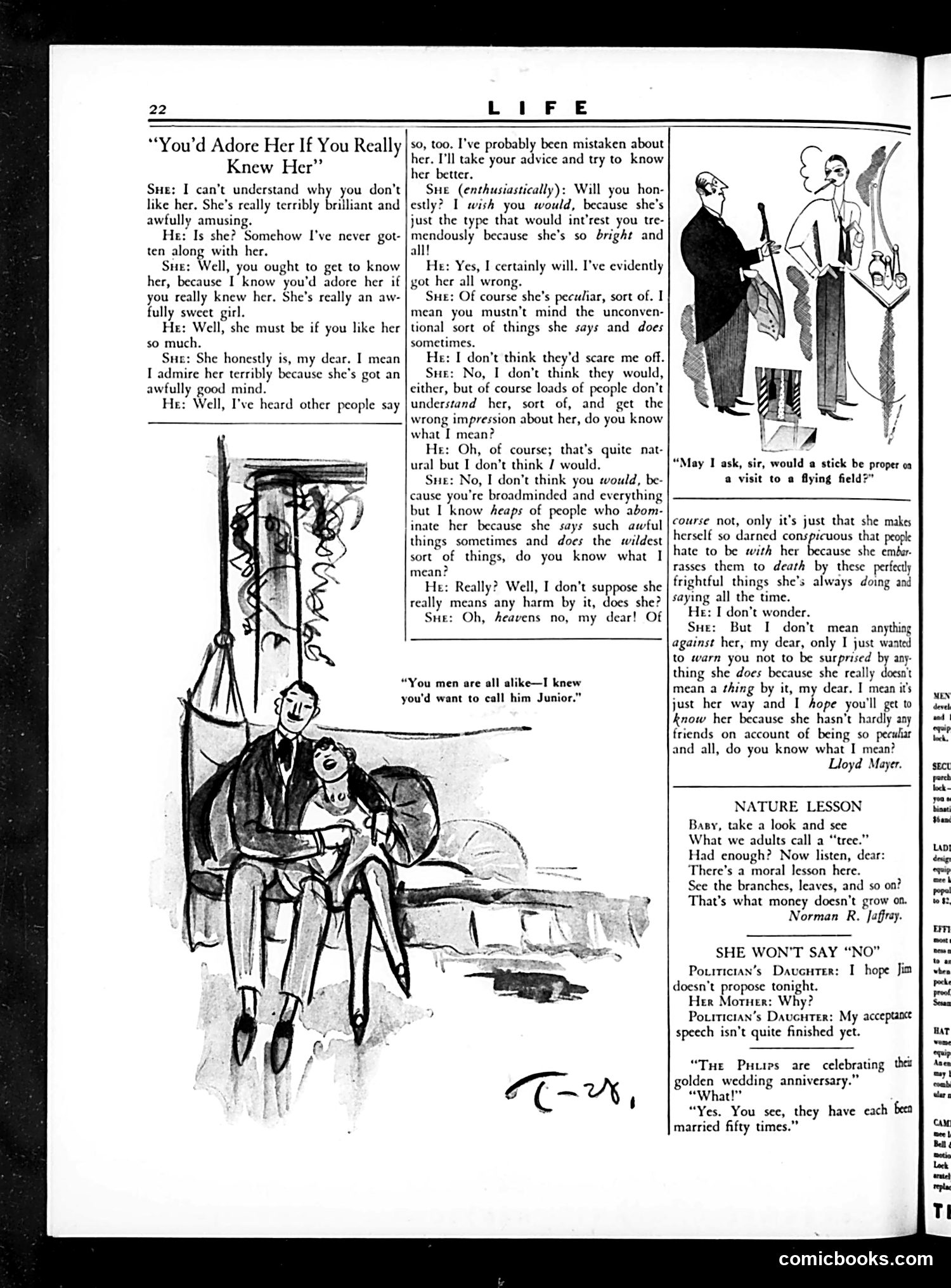
This page contains three distinct satirical pieces: **Main Cartoon: "You'd Adore Her If You Really Knew Her"** (by Lloyd Mayer) Sue attempts to convince her friend to befriend a woman by praising her intelligence while simultaneously undermining her—describing her as "peculiar," socially awkward, and someone who "embarrasses" people. The satire mocks how people use backhanded compliments and contradictory arguments to manipulate others into accepting unpopular individuals. The illustration shows a couple on what appears to be a motorcycle or bicycle, supporting the theme of forced companionship. **"Nature Lesson"** (by Norman R. Jaffray) A simple poem explaining that money "doesn't grow on" trees—satirizing adults' tendency to use nature metaphors to teach obvious lessons to children. **Two Brief Jokes** One about a politician's daughter preparing an "acceptance speech" for a proposal she expects to refuse, and another about a couple celebrating their "golden anniversary" after being married "fifty times" each—both poking fun at marriage and vanity.
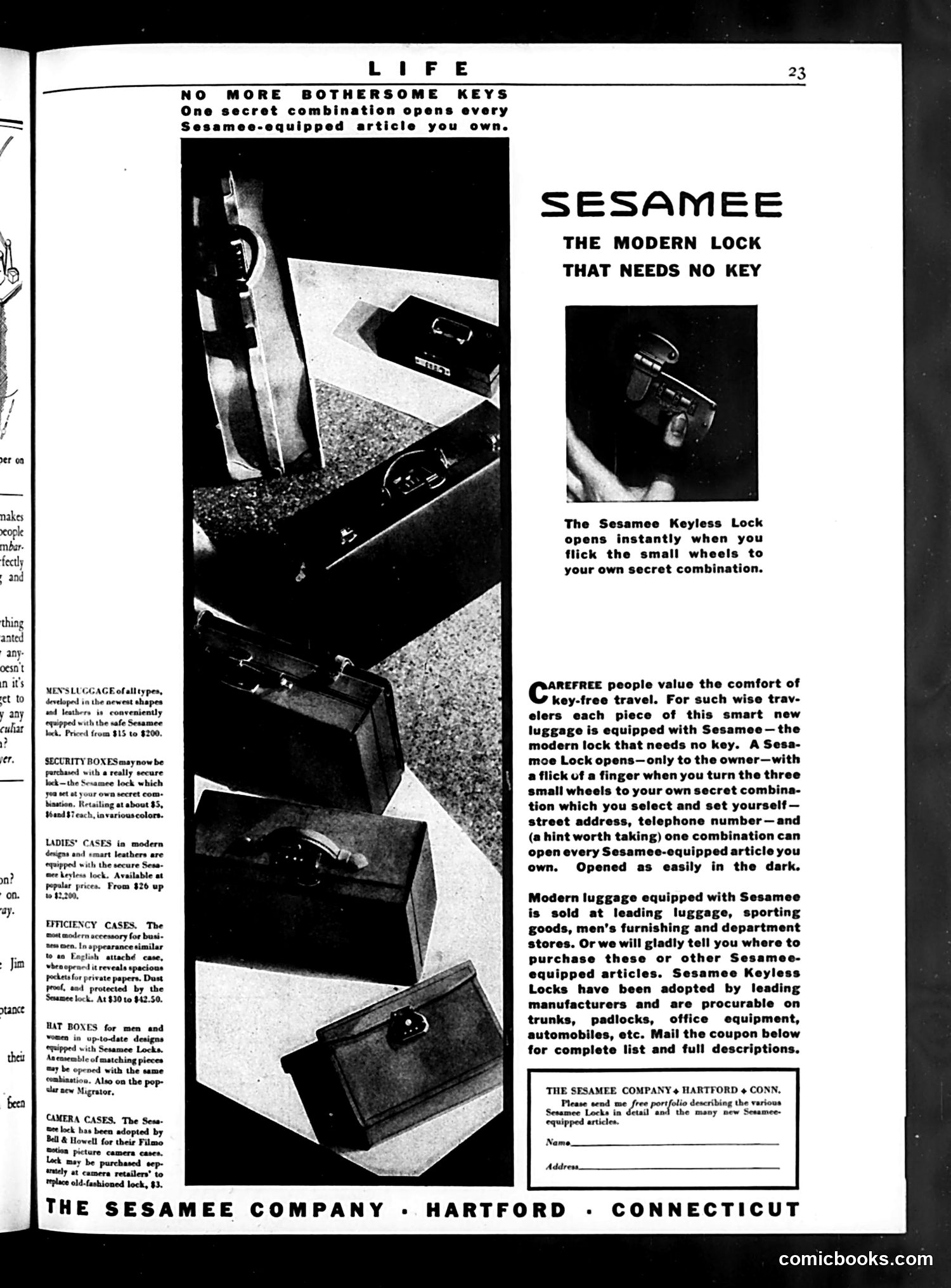
This page is entirely **product advertising**, not political satire or comics. It promotes the Sesamee keyless lock—a combination padlock invented in the early 20th century that uses rotating numbered wheels instead of a traditional key. The advertisement targets affluent travelers concerned about luggage security. The appeal is practical: one secret combination unlocks all your Sesamee-equipped belongings (luggage, briefcases, hat boxes, camera cases), eliminating the need to carry multiple keys. The lock opens "as easily in the dark," addressing traveler anxieties. The page includes product testimonials and lists applications: men's luggage, security boxes, ladies' cases, efficiency cases, and hat boxes, with prices ranging from $3 to $200. A coupon invites readers to request a portfolio describing available Sesamee-equipped articles. This reflects early 20th-century consumer culture emphasizing modern convenience and security for the traveling professional or leisure class.
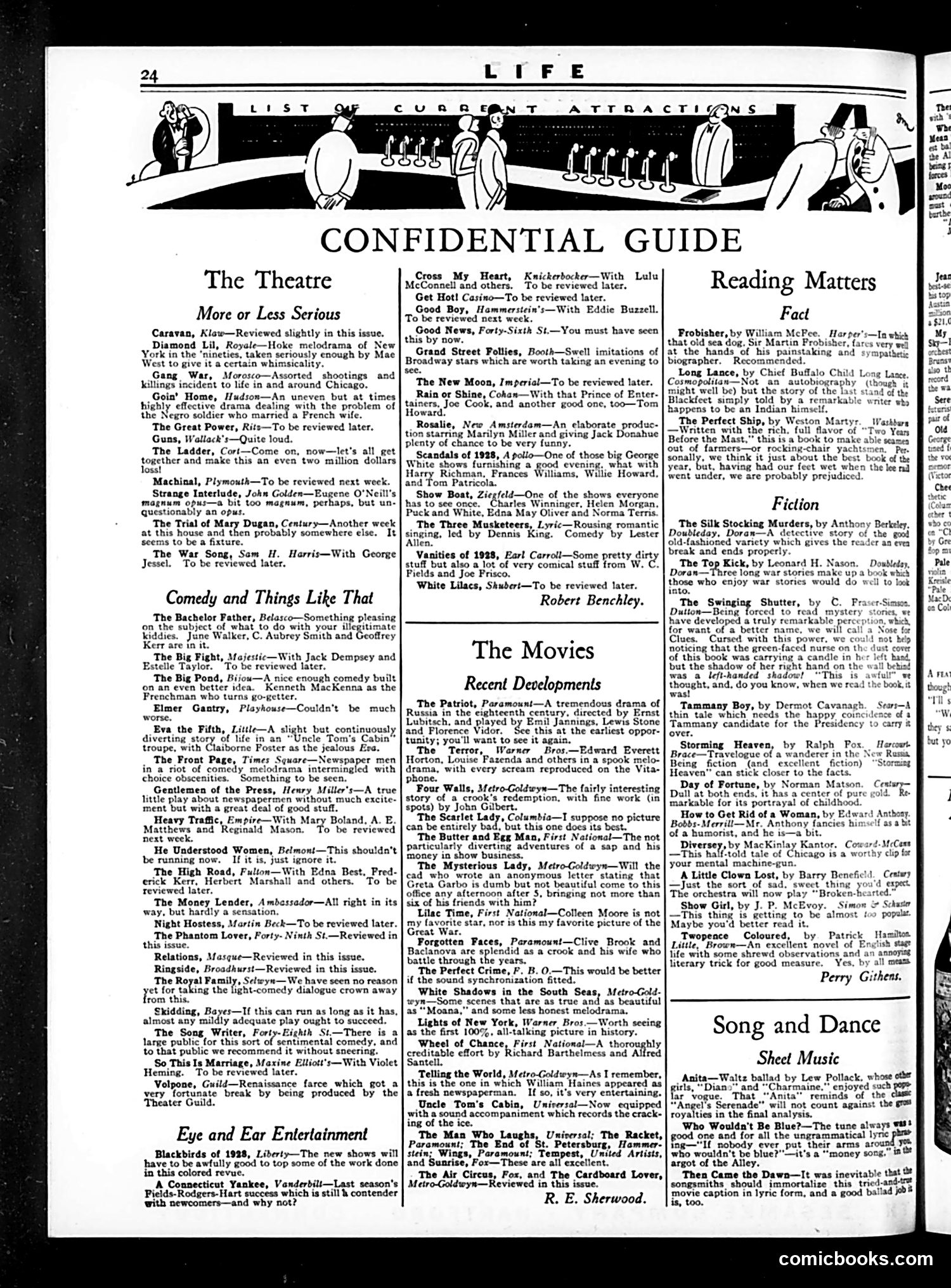
This page is a **theatre and entertainment guide**, not a political cartoon. It's a "Confidential Guide" listing current Broadway productions with brief critical assessments—typical of Life's entertainment coverage in the 1920s. The header illustration is decorative, showing stylized theatrical figures and props, not satirical commentary. The reviews themselves are satirical in *tone* rather than political. For example, the write-up for "The Ladder" at the Cort Theatre reads: "Come on, now—let's all get together and make this an even two million dollars loss!"—mocking the show's financial failure with dark humor. The reviews employ Life's characteristic wit to skewer poorly-reviewed productions ("Elmer Gantry, Playhouse—Couldn't be much worse"). This reflects 1920s entertainment journalism's snide, knowing attitude toward Broadway's commercial machinery. **No identifiable political figures or events appear here.**
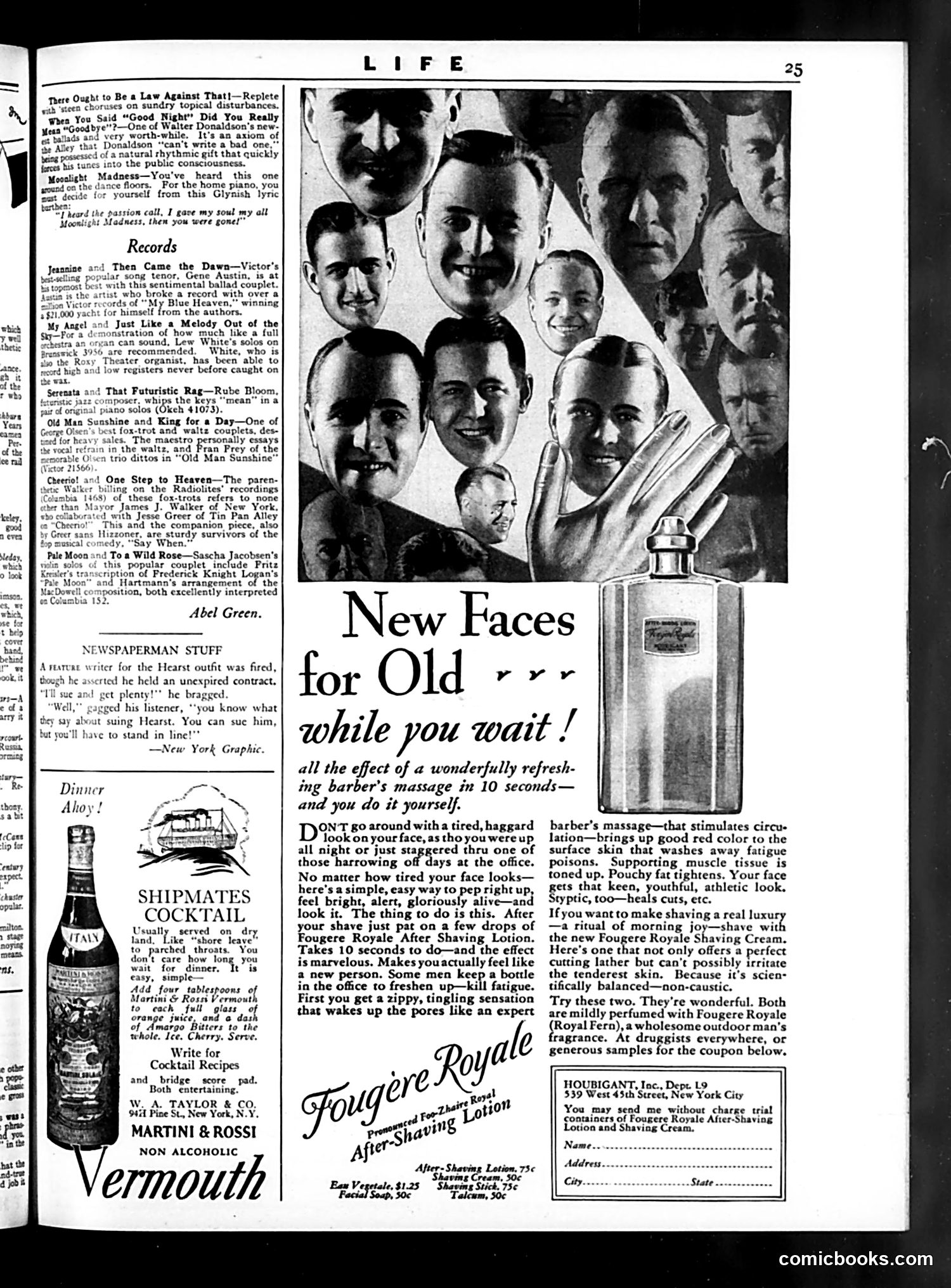
This page is primarily **advertisements and entertainment reviews**, not political satire. The main content includes: **Upper left**: Record and music reviews (Victor, Okeh labels), discussing popular songs of the era—sentimental ballads and jazz compositions. **"Newspaperman Stuff" joke**: A cynical quip about suing William Randolph Hearst (the powerful newspaper magnate). The humor: firing someone without cause is so common at Hearst's papers that lawsuits form a waiting line. **Right side**: The large ad for "Fougere Royale After-Shaving Lotion" shows nine male faces with the pitch that the product refreshes tired-looking men in seconds—mock-heroic marketing typical of 1920s advertising. **Lower left**: Ads for Shipmates Cocktail and Martini & Rossi vermouth, reflecting Prohibition-era drinking culture. The page reflects **1920s consumer culture and entertainment**, not political commentary.
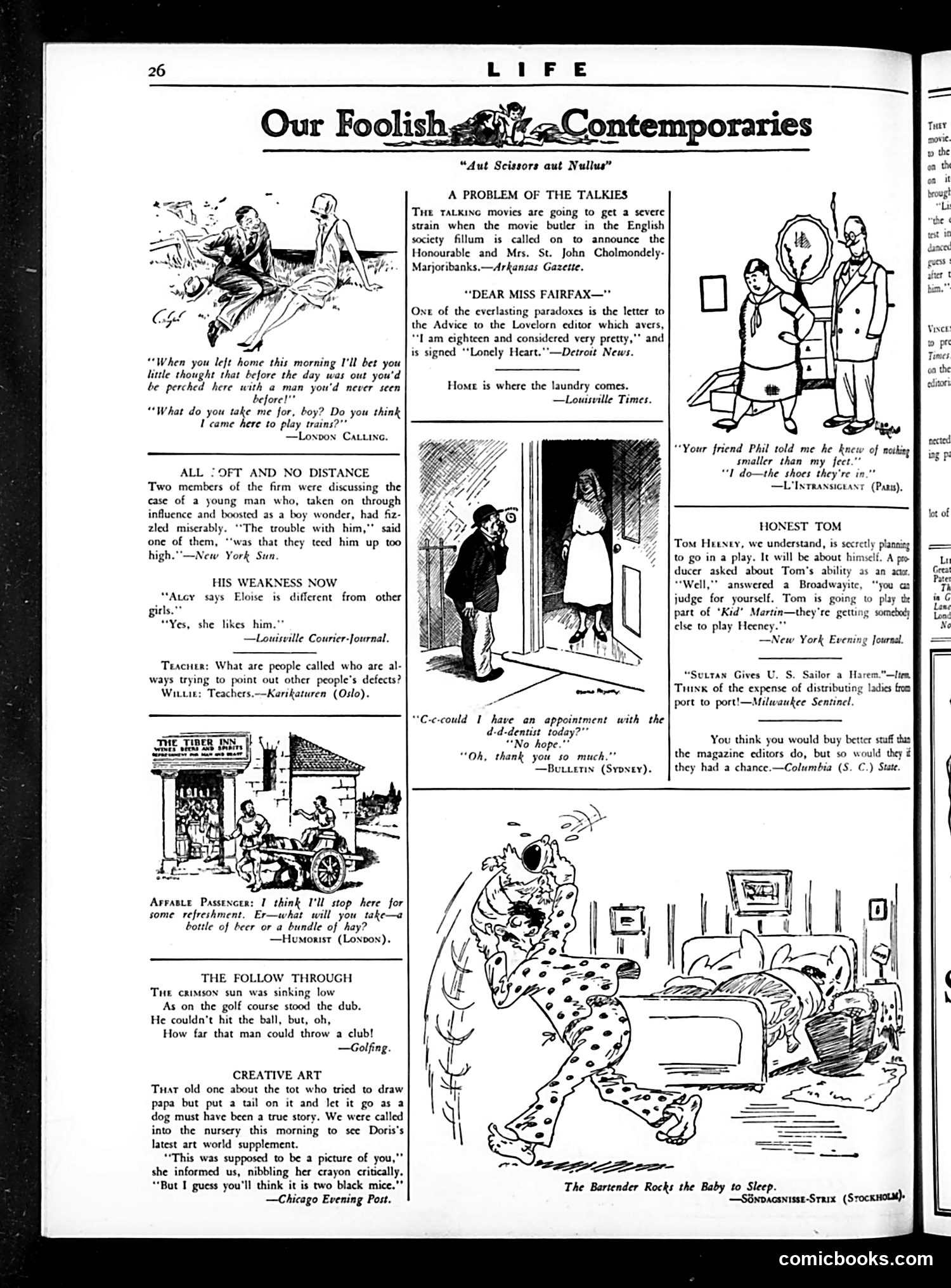
This is a humor page collecting short jokes and satirical observations from various newspapers. The content targets social absurdities of the era: **Key satirical items:** - **"A Problem of the Talkies"**: Mocks the difficulty British actors will face pronouncing aristocratic names like "Cholmondely-Marjoribanks" in talking pictures—a contemporary concern as sound film was new. - **"Dear Miss Fairfax"**: Ridicules advice-column clichés where young women claim to be "eighteen and considered very pretty" while signing as "Lonely Heart." - **"Honest Tom"**: Parodies actor Tom Henley's upcoming play about himself, suggesting he's untalented and they need to cast someone else in the lead role. - **Various one-liners**: Target golf incompetence, pretentious social behavior, and children's bad drawings. The cartoons illustrate these jokes with simple line drawings. The overall tone is gentle mockery of everyday human folly and contemporary fads like talking movies and gossip columns.
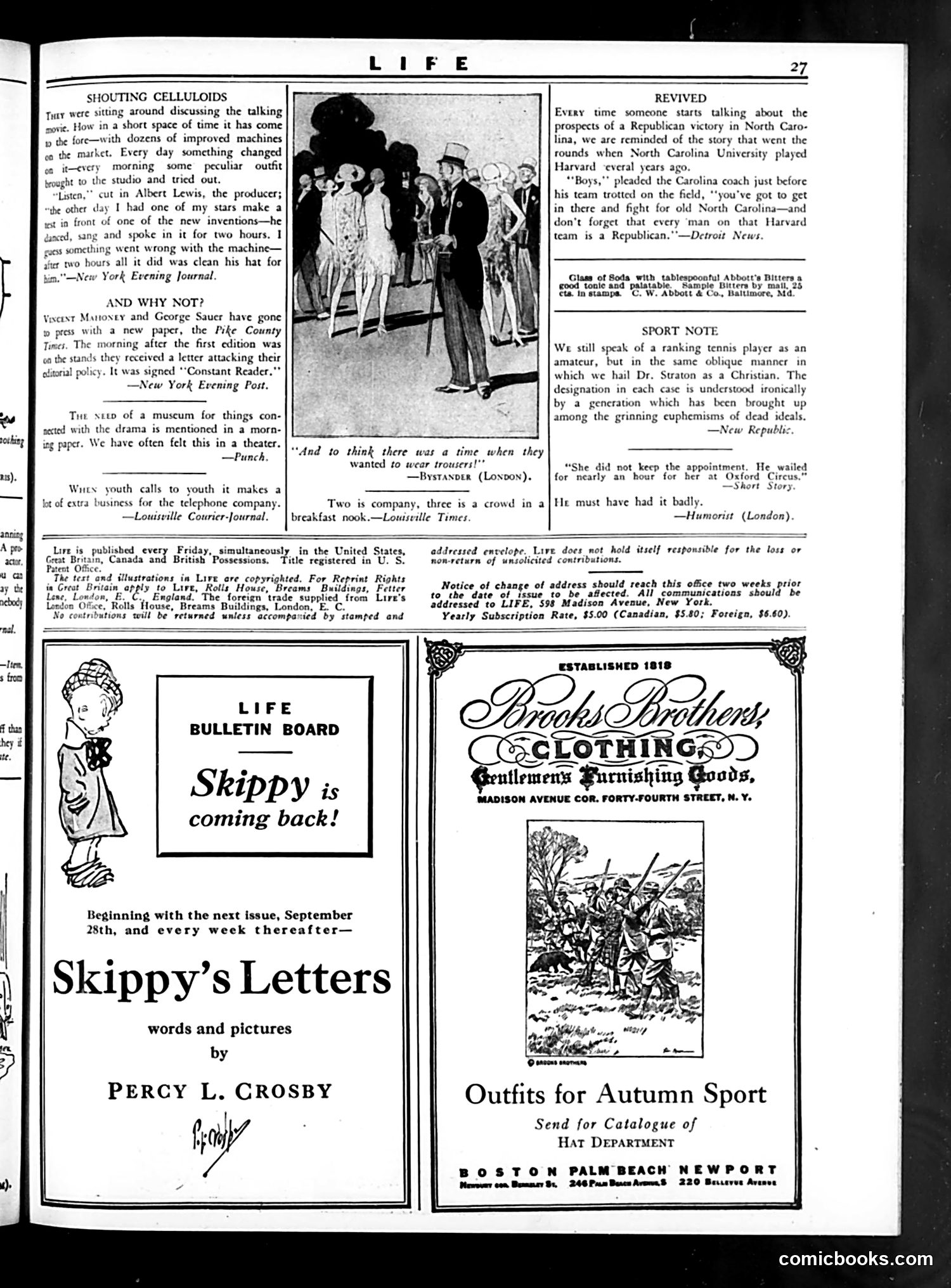
This page from *Life* magazine (likely early 1920s, based on references to talking movies) contains several brief humorous anecdotes and advertisements rather than a single coherent cartoon. The main satirical content includes: **"Shouting Celluloids"**: A joke about early sound-film technology malfunctioning—an actor performs for two hours but the machine only records him cleaning his hat, mocking the primitive state of talking pictures. **"Revived"**: A political joke referencing Republican vs. Democratic rivalry in North Carolina college sports, playing on regional partisan tensions. **"Sport Note"**: Social commentary on hypocrisy—calling amateur tennis players "amateurs" while knowing they're paid professionals, compared to calling Dr. Straton (likely a prominent figure) "Christian" ironically. The page also advertises the return of "Skippy's Letters," a comic strip by Percy L. Crosby, and includes Brooks Brothers clothing advertisements. The humor is gentle, topical commentary on technology, politics, and social pretense rather than sharp political satire.
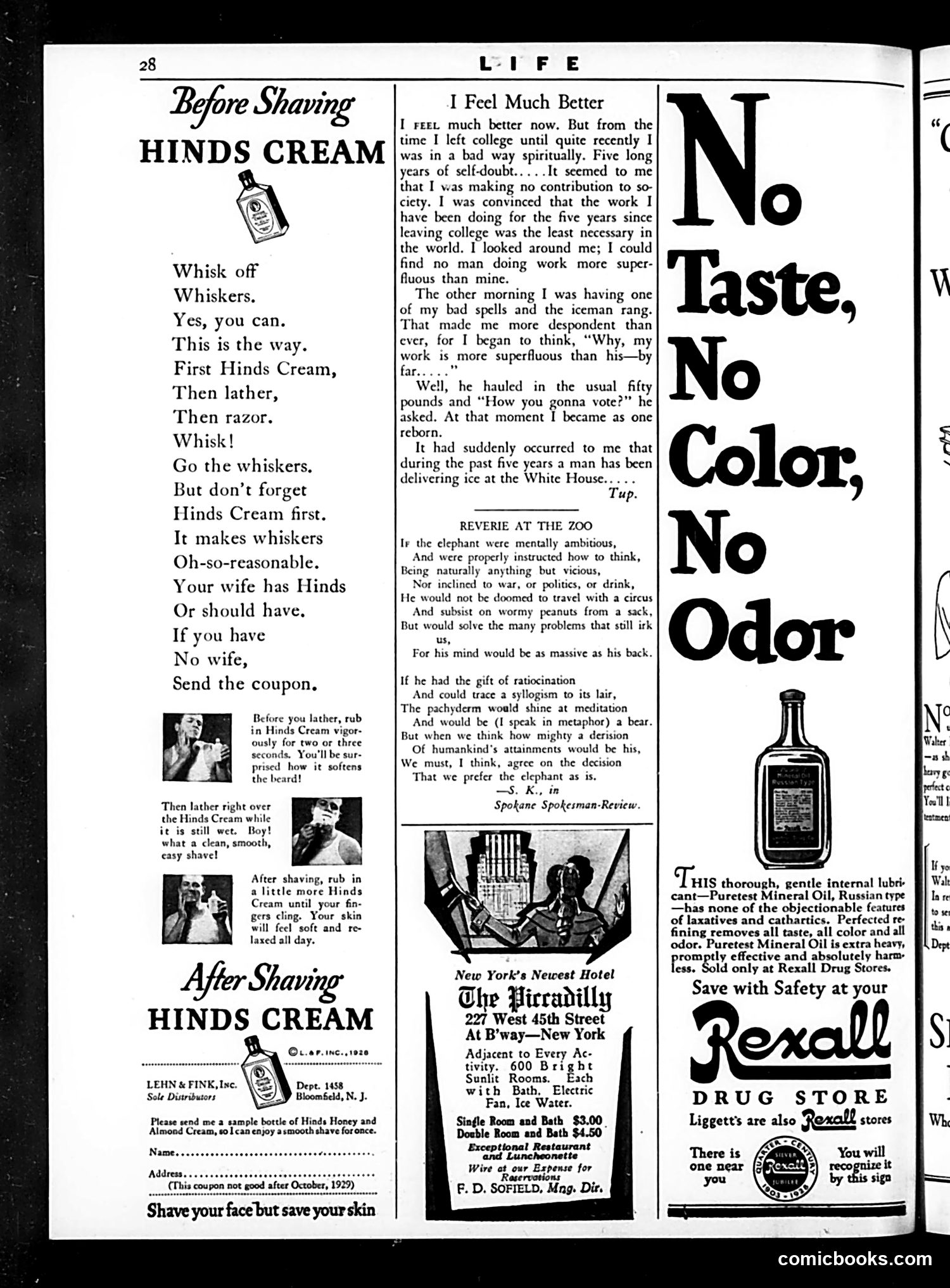
This page is primarily **advertising** interspersed with light satirical content typical of Life magazine's format. The main advertisements are for **Hinds Cream** (a shaving product) and **Rexall Drug Store** items. The Hinds ads use humor to pitch the cream's softening benefits for whiskers. The satirical content includes: 1. **"I Feel Much Better"** — A humorous first-person piece where someone suffering from post-college depression ("five years of self-doubt") is suddenly reinvigorated upon realizing an ice deliveryman has been working at the White House for five years. The joke appears to be about finding purpose through comparing one's supposedly meaningless work to others' jobs. 2. **"Reverie at the Zoo"** — A light poem imagining if an elephant possessed human rationality. The satire suggests that an intellectually superior elephant would be horrified by humanity's follies, so it's better the elephant remains as nature made it. Both pieces reflect 1920s-era gentle, philosophical humor rather than sharp political commentary.
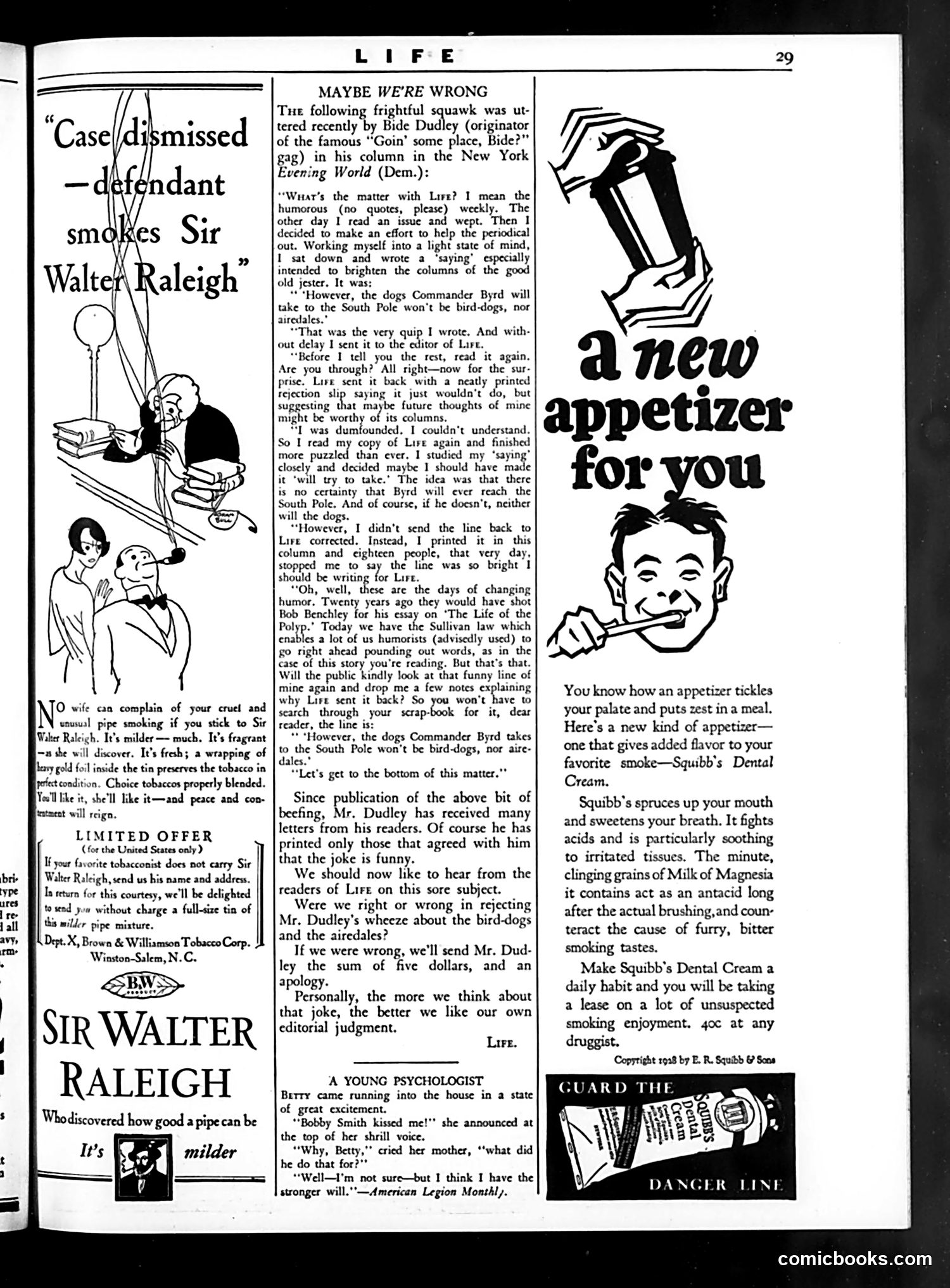
This page satirizes the editorial judgment of *Life* magazine itself. Humorist Bide Dudley submitted a joke to *Life*'s editors, who rejected it. The joke plays on Commander Byrd's South Pole expedition: the dogs won't be "bird-dogs, nor airedales"—a pun suggesting uncertainty that Byrd will reach his destination. *Life*'s editors rejected the submission, but when Dudley published it in his newspaper column, eighteen readers praised it as hilarious. *Life* now invites readers to judge whether they made the right call—while defensively asserting they still think their own editorial judgment was sound. The satire targets editorial pretension and the subjective nature of humor. The accompanying illustration shows a pipe-smoking man with books, representing the literary world's self-importance. This is partly advertising copy for Sir Walter Raleigh pipe tobacco, which frames smoking as compatible with intellectual pursuits.
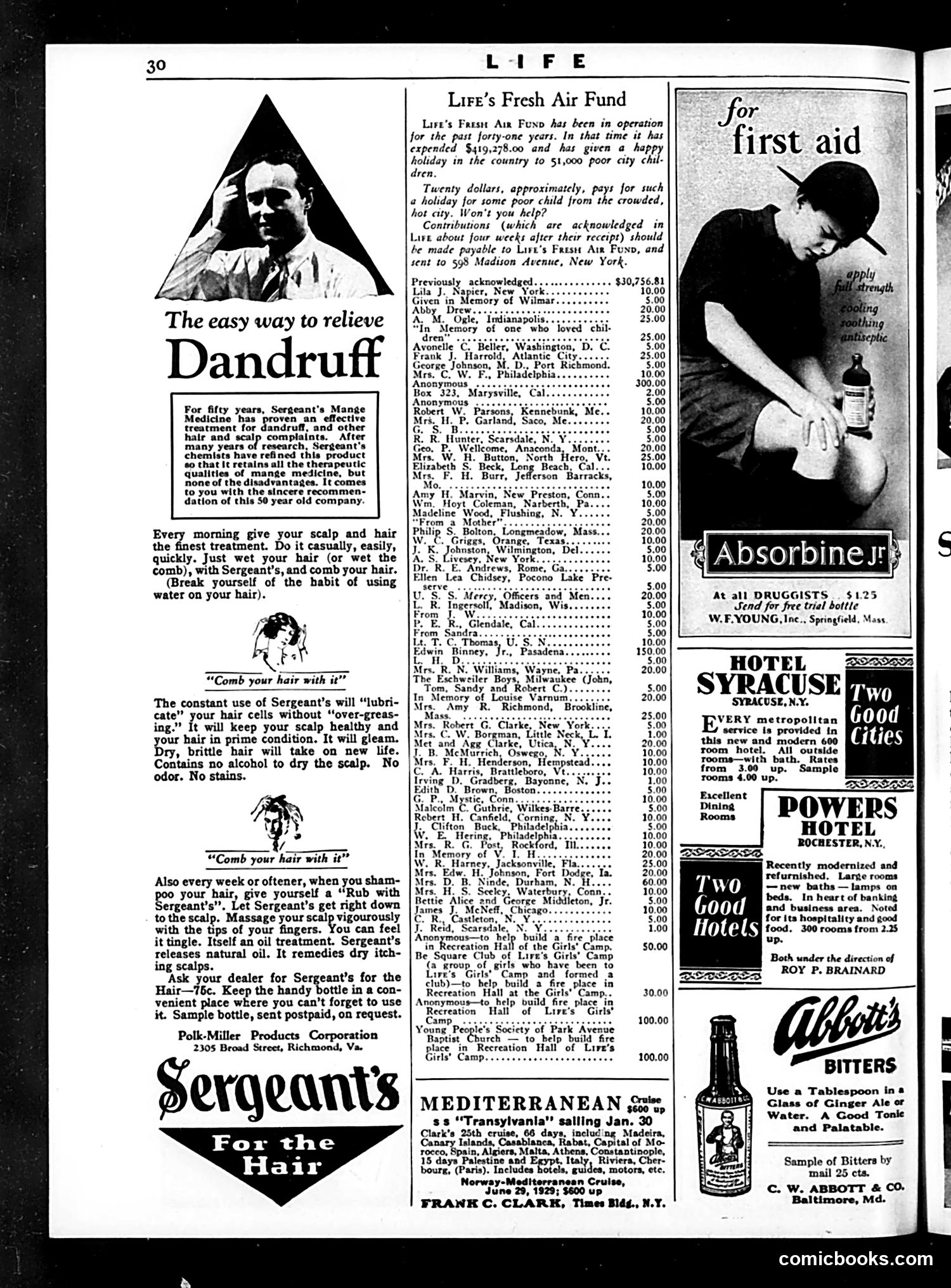
This page is primarily **advertising and charitable fundraising**, not political satire. It contains: **Main Content:** - **Life's Fresh Air Fund** appeal: A legitimate charity that for 41 years has given poor urban children country holidays. The page solicits donations ($20 per child) with a list of contributors. **Advertisements:** - **Sergeant's Mange Medicine** (left): A 50-year-old hair treatment product. The repeated slogan "Comb your hair with it" appears almost comical by modern standards—the product seems primarily designed for dandruff and scalp conditions, though "mange" medicine language is archaic. - **Absorbine Jr.** (right): A topical pain reliever advertised with a muscular man applying it. - **Hotel Syracuse, Powers Hotel** (right): Regional hotel advertisements. - **Abbott's Bitters** (bottom right): An alcoholic beverage marketed as a medicinal tonic. **Historical Context:** This reflects 1920s-era advertising where medicinal products made broad health claims, and charitable giving was publicized via donor lists—now considered privacy violations.
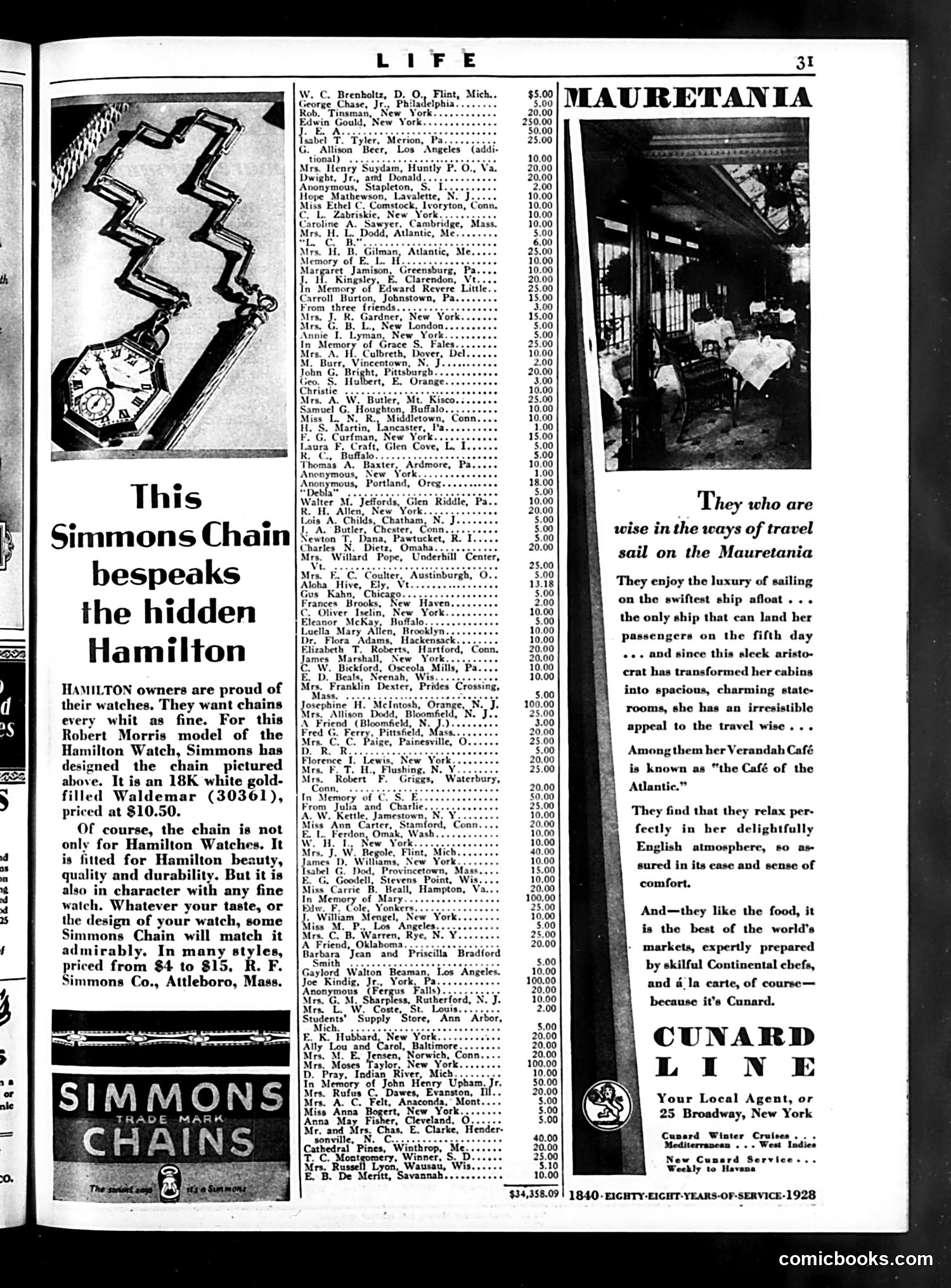
This page is primarily **advertising and donor acknowledgments**, not editorial content requiring political interpretation. The main advertisement features a **Simmons Chain** designed for Hamilton Watches—a luxury goods pitch emphasizing that fine watch owners deserve equally fine chains. The copy appeals to affluent consumers by highlighting craftsmanship and status ("Hamilton owners are proud"). On the right, a **Cunard Line advertisement** promotes the RMS Mauretania ocean liner, emphasizing luxury travel. It describes the ship's speed, elegant cabins, dining ("Café of the Atlantic"), and appeals to the "travel wise"—affluent transatlantic passengers. The bulk of the page lists **donors or subscribers**, likely to a charitable cause or publication drive (total: $34,338.09 at bottom). This represents 1928 advertising culture: luxury goods marketed to wealthy Americans during the prosperous pre-Depression era. No political satire or caricature is present—the page reflects Life magazine's commercial side, not its editorial cartooning.
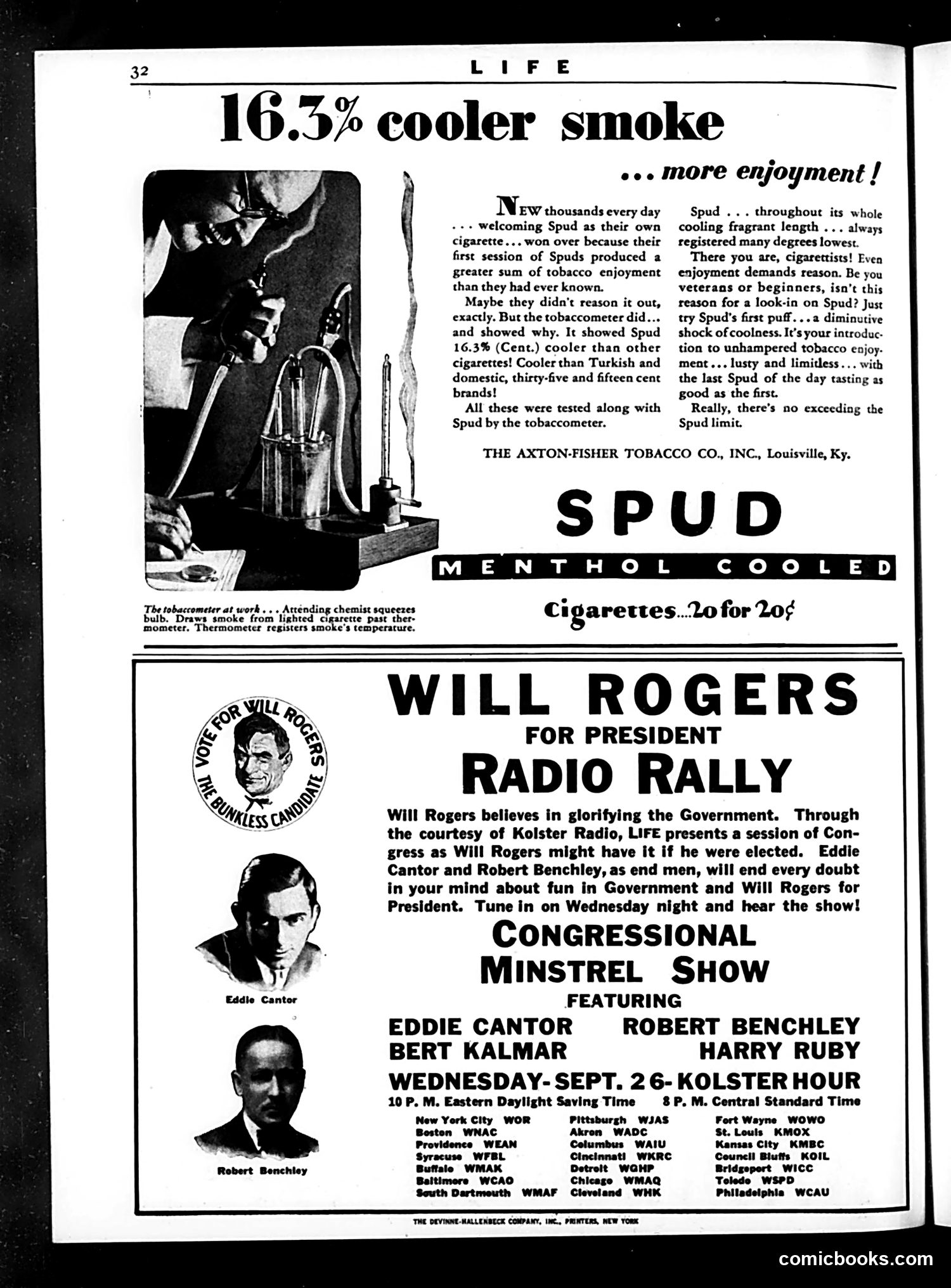
This page contains two distinct advertisements from what appears to be the 1920s-30s era. **Top: Spud Cigarette Ad** A product advertisement claiming Spud menthol cigarettes are "16.3% cooler" than competitors, supported by scientific testing with a "tobaccometer." The image shows someone conducting the test. This represents early cigarette marketing using pseudo-scientific claims to differentiate products—a common practice before modern advertising regulations. **Bottom: Will Rogers Radio Rally** A political satire advertisement promoting a radio broadcast of a "Congressional Minstrel Show" featuring comedians Eddie Cantor, Robert Benchley, Bert Kalmar, and Harry Ruby. It presents a humorous mock-Congress as if Will Rogers (the famous humorist and social commentator) were president. This satirizes government inefficiency through comedy—a form of political commentary typical of Rogers, who was known for critiquing politicians and institutions through humor. Both ads reflect 1920s-30s popular culture and early mass media entertainment.
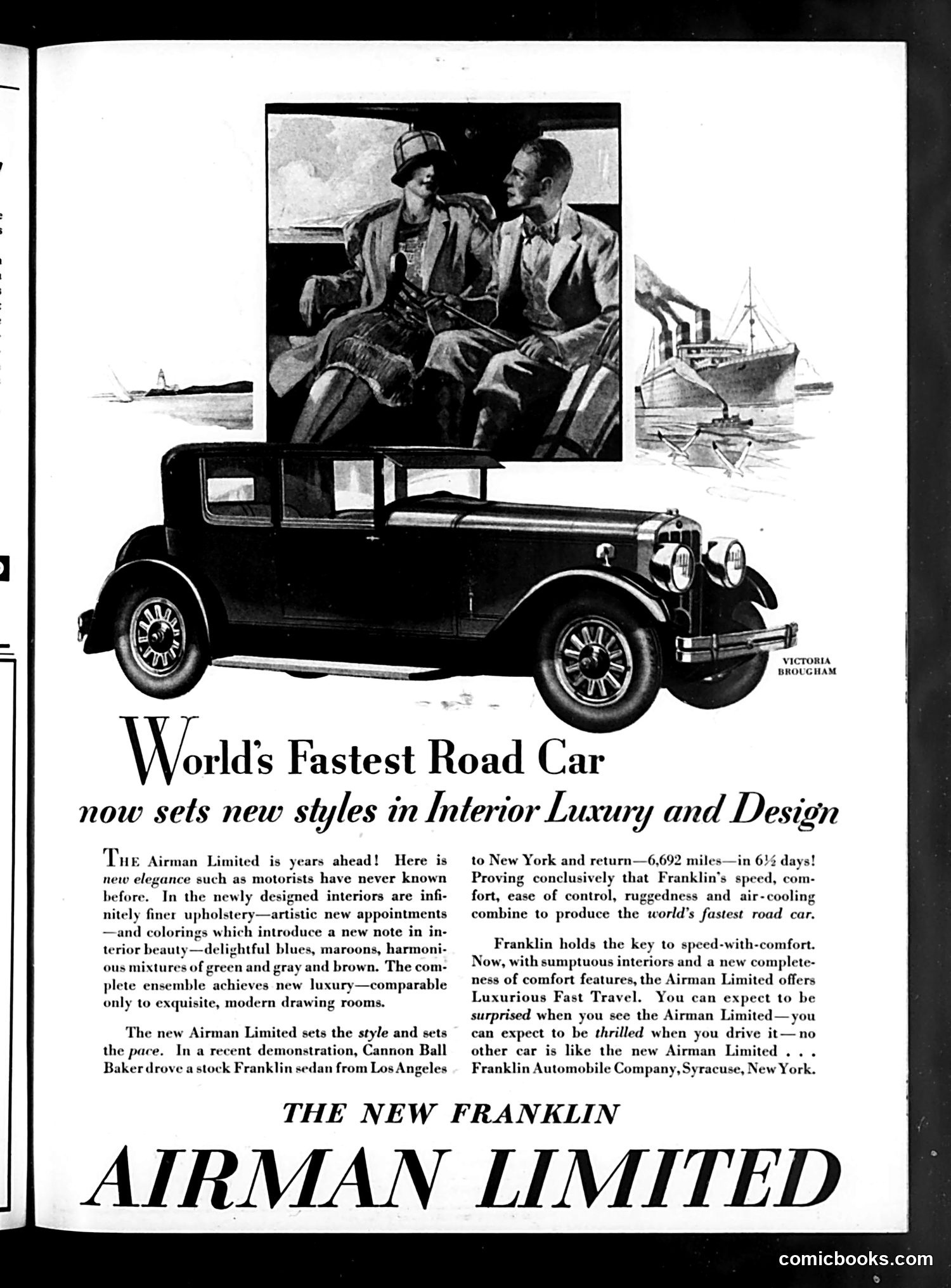
This isn't a political cartoon or satire—it's a straight automobile advertisement for the Franklin Airman Limited, published in Life magazine. The page advertises a luxury car by claiming it's the "World's Fastest Road Car." The advertisement features a vintage automobile illustration and a scene of two men in conversation (likely meant to suggest casual, sophisticated comfort). The main sales pitch centers on a real (or claimed) endurance test: racing driver Cannon Ball Baker drove a Franklin sedan from Los Angeles to New York and back—6,692 miles in 6½ days—to demonstrate speed combined with comfort and reliability. The ad emphasizes interior luxury details: fine upholstery, artistic appointments, and color schemes (blues, maroons, greens, grays, browns) comparable to "modern drawing rooms." This is product marketing, not editorial content or satire.
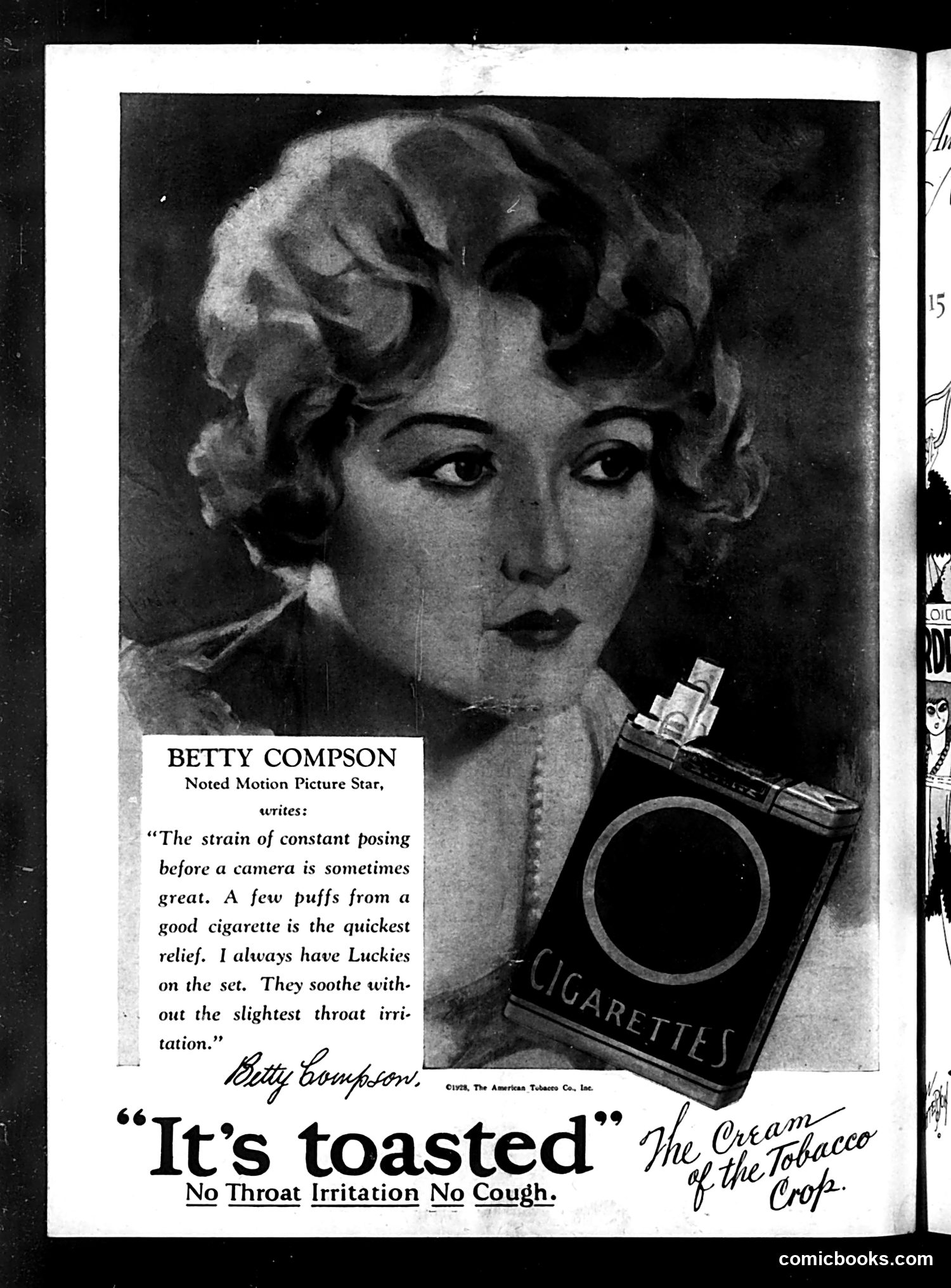
This is a cigarette advertisement, not political satire. It features actress **Betty Compson**, a prominent silent-film star of the 1920s, endorsing Lucky Strike cigarettes. The ad uses a common marketing strategy of that era: celebrity endorsement with a testimonial claiming health benefits. Compson claims cigarettes relieve stress during filming and cause "no throat irritation"—a selling point emphasizing the product's supposed mildness. The slogan "It's toasted"—referring to Lucky Strike's roasting process—was a major marketing claim, implying superior quality and reduced irritation. By modern standards, this advertisement is remarkable for openly promoting cigarettes' purported therapeutic effects and featuring a prominent entertainer making unsubstantiated health claims—practices now illegal in most countries.