
Life, 1928-09-21 · page 17 of 36
Life — September 21, 1928 — page 17: what you’re looking at
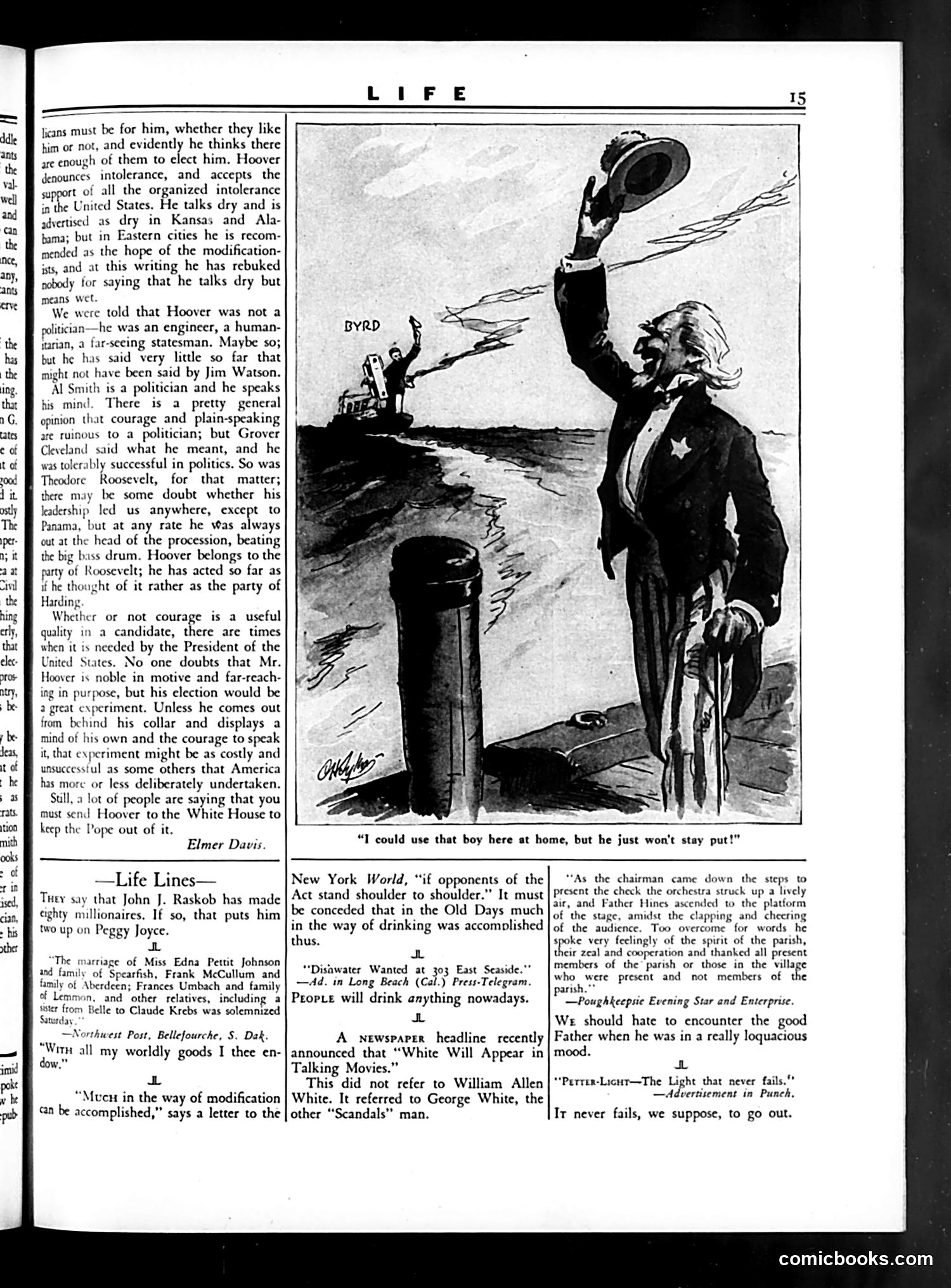
What you’re looking at
The main cartoon by Byrd depicts a figure labeled with a star (appearing to represent the Pope or Catholic Church authority) being ejected or "put out" from what seems to be an American home or institution. A man in formal dress says: "I could use that boy here at home, but he just won't stay put!" This satirizes anxieties about Catholic influence in America during the early 20th century. The "boy" reference appears to mock papal authority as uncontrollable or unwilling to remain confined to its proper sphere. The cartoon reflects Protestant-dominant American concerns about Catholic institutional power and the Pope's perceived interference in domestic affairs—a common nativist political anxiety of the era.
📄 Transcribed text from this page (OCR, searchable)
Machine-transcribed from the original scan — historical spelling and the odd misread are preserved.
— licans must be for him, whether they like him or not, and evidently he thinks there are enough of them to elect him, Hoover denounces intolerance, and accepts the support of all the organized intolerance in the United States. He talks dry and is advertised as dry in Kansas and Ala- tama; but in Eastern cities he is recom- mended as the hope of the modification- sts, and at this writing he has rebuked nobody for saying that he talks dry but means wet. We were told that Hoover was not a politician: he was an engineer, a human- iarian, a far-seeing statesman. Maybe so; but he has said very little so far that might not have been said by Jim Watson. Al Smith is a politician and he speaks his mind. There is a pretty general opinion that courage and plain-speaking are ruinous to a politician; but Grover Cleveland said what he meant, and he was tolerably successful in politics. So was Theodore Roosevelt, for that matter; there may be some doubt whether his leadership led us anywhere, except to Panama, but at any rate he was always out at the head of the procession, beating the big bass drum. Hoover belongs to the rty of Roosevelt; he has acted so far as if he thought of it rather as the party of Harding. Whether or not courage is a useful quality in a candidate, there are times when it is needed by the President of the United States. No one doubts that Mr. Hoover is noble in motive and far-reach- ing in purpose, but his election would be a great experiment. Unless he comes out from behind his collar and displays a mind of his own and the courage to speak it, that experiment might be as costly and unsuccessiul as some others that America has more or less deliberately undertaken. Still, a lot of people are saying that you must send Hoover to the White House to keep the Pope out of it. Elmer Davis. “I could use that boy here at home, but he just won't stay put!” —Life Lines— Tuey say that John J. Raskob has made cighty millionaires, If so, that puts him two up on Peggy Joyce. JL “The marriage of Miss Edna Pettit Johnson and family of Spearfish, Frank McCullum and fimily of Aberdeen; Frances Umbach and family emmon, and ‘other relatives, including a Belle to Claude Krebs was solemnized Northwest Post, Bellefourche, S. Dak. “Winn all my worldly goods I thee en- dow,” L “Mucn in the way of modification can be accomplished,” says a letter to the New York World, “if opponents of the Act stand shoulder to shoulder.”” It must be conceded that in the Old Days much in the way of drinking was accomplished thus. aL “Dishwater Wanted at 303 East Seaside."* —dd. in Long Beach (Cal.) Press-Telegram. Propte will drink anything nowadays. iL A newspaper headline recently announced that “White Will Appear in Talking Movies.” This did not refer to William Allen White. It referred to George White, the other “Scandals” man. “As the chairman came down the steps to present the check the orchestra struck up a lively air, and Father Hines ascended to the platform of the stage, amidst the clapping and cheering of the audience. Too overcome for words he spoke very feclingly of the spirit of the parish, their zeal and cooperation and thanked all present members of the’ parish or those in the village who were present and not members of the parish.” —Poughkeepsie Evening Star and Enterprise. We should hate to encounter the good Father when he was in a really loquacious mood. LL “Perren-Licut—The Light that never fails." —Advertisement in Punch, Ir never fails, we suppose, to go out. comicbooks.com