
Life, 1928-09-21 · page 16 of 36
Life — September 21, 1928 — page 16: what you’re looking at
What you’re looking at
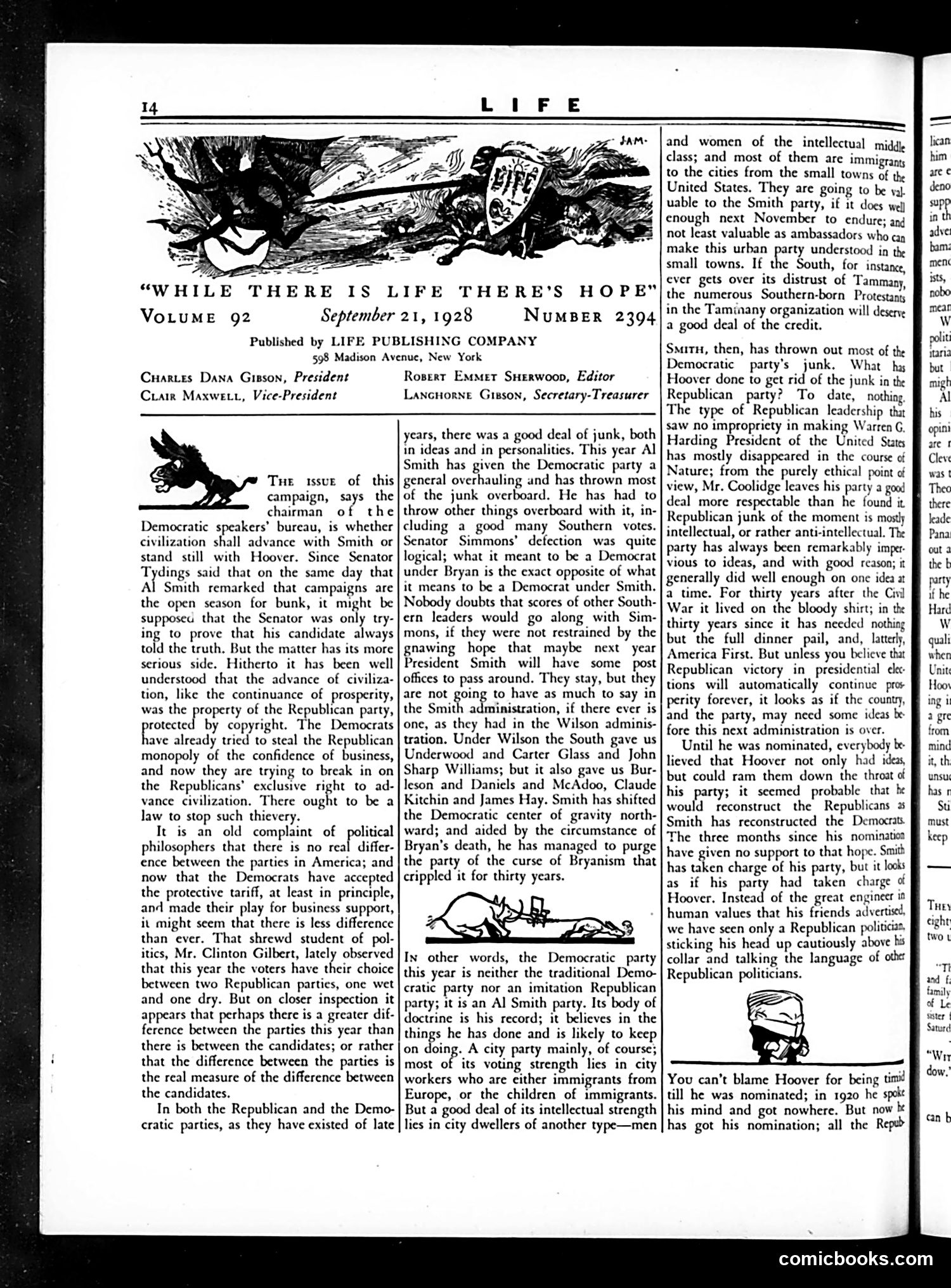
This Life magazine page (September 21, 1928) critiques Al Smith's Democratic campaign and the party's direction. The editorial argues that Smith has "thrown out most of the Democratic party's junk," removing outdated ideas and personalities. However, it contends Smith hasn't fundamentally changed the party's character—it remains the "Smith party," not a true alternative to Hoover's Republicans. The accompanying cartoon (lower left) depicts a sinking ship, likely representing Democratic prospects or party troubles. The text suggests both parties are similar on fundamental issues, with real differences lying mainly in candidates rather than ideology or policy. This reflects skepticism about meaningful party distinctions in the 1928 presidential race.
📄 Transcribed text from this page (OCR, searchable)
Machine-transcribed from the original scan — historical spelling and the odd misread are preserved.
“WHILE THERE IS LIFE THERE’S HOPE" VoLUME 92 September 21, 1928 NuMBER 2394 Published by LIFE PUBLISHING COMPANY 598 Madison Avenue, New York Cuartes Dana Gipson, President Crain Maxwetu, Vice-President Tue issue of this campaign, says the chairman of the Democratic speakers’ bureau, is whether civilization shall advance with Smith or stand still with Hoover. Since Senator Tydings said that on the same day that al Smith remarked that campaigns are the open season for bunk, it might be supposea that the Senator was only try- ing to prove that his candidate always told the truth. But the matter has its more serious side. Hitherto it has been well understood that the advance of civiliza- tion, like the continuance of prosperity, was the property of the Republican party, rotected by copyright. The Democrats ave already tried to steal the Republican monopoly of the confidence of business, and now they are trying to break in on the Republicans’ exclusive right to ad- vance civilization, There ought to be a law to stop such thievery. It is an old complaint of political philosophers that there is no real differ- ence between the parties in America; and now that the Democrats have accepted the protective tariff, at least in principle, and made their play for business support, it might seem that there is less difference than ever. That shrewd student of pol- itics, Mr. Clinton Gilbert, lately observed that this year the voters have their choice between two Republican parties, one wet and one dry. But on closer inspection it appears that perhaps there is a greater dif- ference between the parties this year than there is between the candidates; or rather that the difference between the parties is the real measure of the difference between the candidates. In both the Republican and the Demo- cratic parties, as they have existed of late Rosert Emmet Suerwoon, Editor Lancuorne Ginson, Secretary-Treasurer years, there was a good deal of junk, both in ideas and in personalities. This year Al Smith has given the Democratic party a general overhauling and has thrown most of the junk overboard. He has had to throw other things overboard with it, in- cluding a good many Southern votes. Senator Simmons’ defection was quite logical; what it meant to be a Democrat under Bryan is the exact opposite of what it means to be a Democrat under Smith. Nobody doubts that scores of other South- ern leaders would go along with Sim- mons, if they were not restrained by the gnawing hope that maybe next year President Smith will have some post offices to pass around. They stay, but they are not going to have as much to say in the Smith administration, if there ever is one, as they had in the Wilson adminis- tration. Under Wilson the South gave us Underwood and Carter Glass and John Sharp Williams; but it also gave us Bur- leson and Daniels and McAdoo, Claude Kitchin and James Hay. Smith has shifted the Democratic center of gravity north- ward; and aided by the circumstance of Bryan’s death, he has managed to purge the party of the curse of Bryanism that crippled it for thirty years. In other words, the Democratic party this year is neither the traditional Demo- cratic party nor an imitation Republican party; it is an Al Smith party. Its body of doctrine is his record; it believes in the things he has done and is likely to keep on doing. A city party mainly, of course; most of its voting strength lies in city workers who are either immigrants from Europe, or the children of immigrants. But a good deal of its intellectual strength lies in city dwellers of another type—men and women of the intellectual middle class; and most of them are immigrants to the cities from the small towns of the United States, They are going to be yal. uable to the Smith party, if it does wel) enough next November to endure; and not least valuable as ambassadors who cag make this urban party understood in th small towns. If the South, for instance, ever gets over its distrust of Tammany, the numerous Southern-born Protestants in the Taminany organization will deserve a good deal of the credit. Ssutn, then, has thrown out most of the Democratic party's junk. What has Hoover done to get rid of the junk in the Republican party? To date, nothing. The type of Republican leadership thit saw no impropriety in making Warren G, Harding President of the United States has mostly disappeared in the course of Nature; from the purely ethical point of view, Mr. Coolidge leaves his party a good deal more respectable than he found it Republican junk of the moment is most} intellectual, or rather anti-intellectual. The party has always been remarkably imper- vious to ideas, and with good reason; it generally did well enough on one idea x a time. For thirty years after the Civil War it lived on the bloody shirt; in th thirty years since it has needed nothing but the full dinner pail, and, latterly, America First. But unless you believe that Republican victory in presidential ele tions will automatically continue prov perity forever, it looks as if the county, and the party, may need some ideas be fore this next administration is over. Until he was nominated, everybody be lieved that Hoover not only had ideas, but could ram them down the throat of his party; it seemed probable that he would reconstruct the Republicans 3 Smith has reconstructed the Democrats The three months since his nominator have given no support to that hope. Smith has taken charge of his party, but it looks as if his party had taken charge o Hoover, Instead of the great engineer 0 human values that his friends advertised, we have seen only a Republican politics, sticking his head up cautiously above his collar and talking the language of ocx: Republican politicians. a—~ You can’t blame Hoover for being timid till he was nominated; in 1920 he spoke his mind and got nowhere. But now k has got his nomination; all the Repub eight Saturd “Wr can b comicbooks.com