
Life, 1928-09-21 · page 13 of 36
Life — September 21, 1928 — page 13: what you’re looking at
What you’re looking at
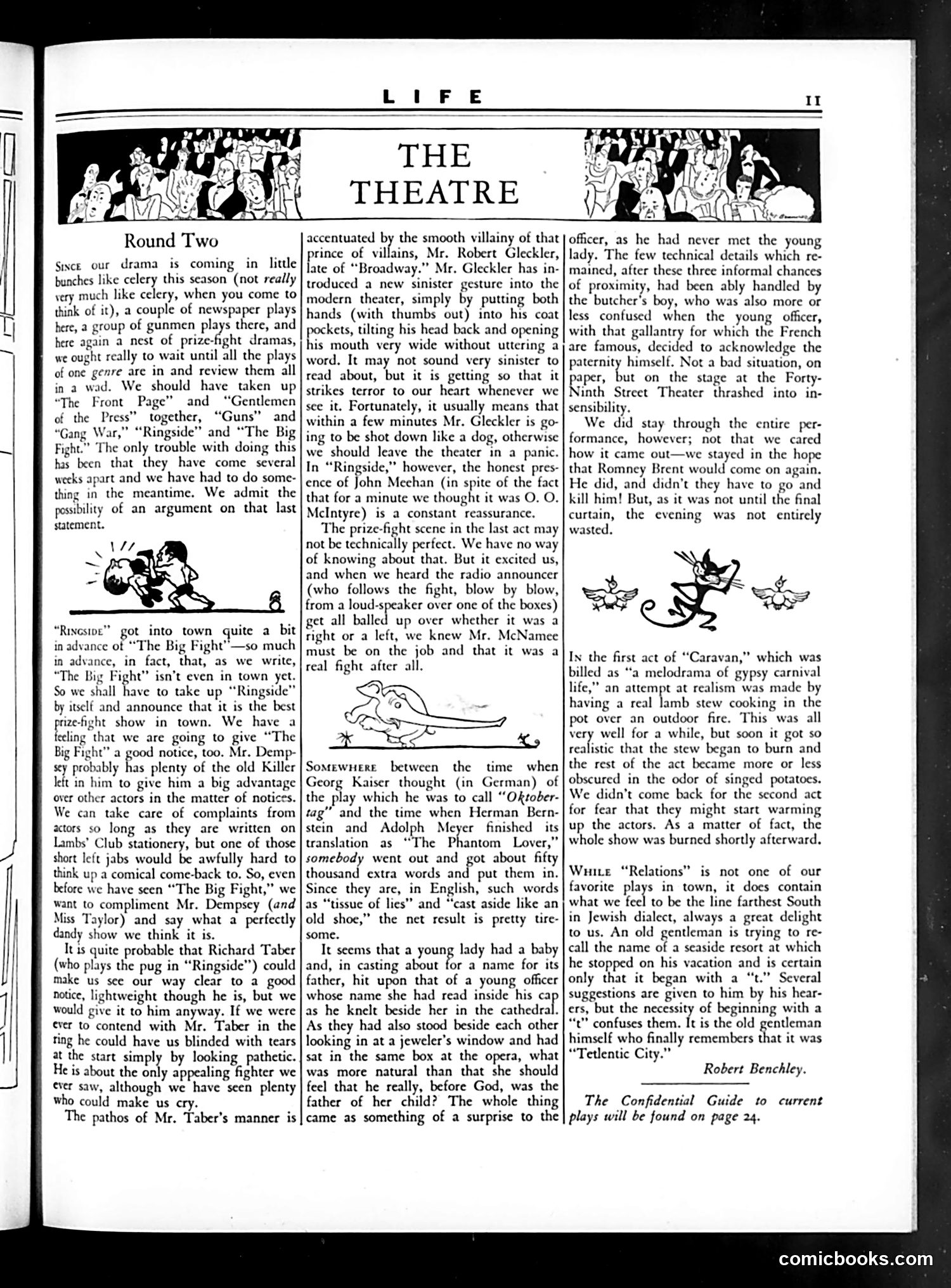
This page reviews Broadway plays, including "The Big Fight" and "Rinside." The critic discusses Robert Gleckler's villainous performance in a new sinister gesture—putting his thumbs in his coat pockets while tilting his head back with mouth open, creating an menacing effect. The text humorously describes staying through a performance of "Rinside" hoping boxer Romney Brent would return for an encore, only to leave disappointed when he didn't reappear. The small cartoon illustrations appear to be decorative comedy sketches accompanying the theater criticism. The page is primarily a written theater column rather than political satire, offering typical 1920s-30s Broadway commentary with light humor about actors' techniques and audience experiences.
📄 Transcribed text from this page (OCR, searchable)
Machine-transcribed from the original scan — historical spelling and the odd misread are preserved.
MV SE Round Two Since our drama is coming in litle bunches like celery this season (not really very much like celery, when you come to think of it), a couple of newspaper plays here, a group of gunmen lai there, and here again a nest of prize-fght dramas, we ought really to wait until all the plays of one genre are in and review them all in a wad. We should have taken up “The Front Page” and “Gentlemen of the Press” together, “Guns” and “Gang War,” “Ringside” and “The Big Fight.” The only trouble with doing this has been that they have come several weeks apart and we have had to do some- thing in the meantime. We admit the possibility of an argument on that last statement. “Rixcsive” got into town quite a bit in advance of “The Big Fight—so much in advan n fact, that, as we write, “The Big Fight” isn’t even in town yet. So we shall have to take up “Ringside” by itself and announce that it is the best prize-fight show in town. We have a feeling that we are going to give “The Big Fight” a good notice, too. Mr. Demp- sey probably has plenty of the old Killer keft in him to give him a big advantage over other actors in the matter of notices. We can take care of complaints from actors so long as they are written on Lambs’ Club stationery, but one of those short left jabs would be awfully hard to think up a comical come-back to, So, even before we have seen “The Big Fight,” we want to compliment Mr. Dempsey (and Miss Taylor) and say what a perfectly dandy show we think it is. Itis quite probable that Richard Taber (who plays the pug in “‘Ringside’’) could make us see our way clear to a good Notice, lightweight though he is, but we would give it to him anyway. If we were €ver to contend with Mr. Taber in the ting he could have us blinded with tears at the start simply by looking pathetic. He is about the only appealing fighter we ever saw, although we have seen plenty who could make us cry. The pathos of Mr. Taber's manner is accentuated by the smooth villainy of that prince of villains, Mr. Robert Gleckler, late of “Broadway.” Mr. Gleckler has in- troduced a new sinister gesture into the modern theater, simply by putting both hands (with thumbs out) into his coat pockets, tilting his head back and opening his mouth very wide without uttering a word, It may not sound very sinister to read about, but it is getting so that it strikes terror to our heart whenever we see it. Fortunately, it usually means that within a few minutes Mr. Gleckler is go- ing to be shot down like a dog, otherwise we should leave the theater in a panic. In “Ringside,” however, the honest pres- ence of John Mechan (in spite of the fact that for a minute we thought it was O. O. McIntyre) is a constant reassurance. The prize-fight scene in the last act may not be technically perfect. We have no way of knowing about that. But it excited us, and when we heard the radio announcer (who follows the fight, blow by blow, from a loud-speaker over one of the boxes) get all balled up over whether it was a right or a left, we knew Mr. McNamee must be on the job and that it was a real fight after all. Somewnere between the time when Georg Kaiser thought (in German) of the play which he was to call “Oktober- tag” and the time when Herman Bern- stein. and Adolph Meyer finished its translation as “The Phantom Lover,” somebody went out and got about fifty thousand extra words ant put them in. Since they are, in English, such words as “tissue of lies” and “cast aside like an old shoe,” the net result is pretty tire- some. It seems that a young lady had a baby and, in casting about for a name for its father, hit upon that of a young officer whose name she had read inside his ca as he knelt beside her in the cathedral. As they had also stood beside each other looking in at a jeweler’s window and had sat in the same box at the opera, what was more natural than that she should feel that he really, before God, was the father of her child? The whole thing came as something of a surprise to the officer, as he had never met the young lady. The few technical details which re- mained, after these three informal chances of proximity, had been ably handled by the butcher's boy, who was also more or less confused when the young officer, with that gallantry for which the French are famous, decided to acknowledge the paternity himself. Not a bad situation, on aper, but on the stage at the Forty- Ninth Street Theater thrashed into in- sensibility. We did stay through the entire per- formance, however; not that we cared how it came out—we stayed in the hope that Romney Brent would come on again. He did, and didn’t they have to go and kill him! But, as it was not until the final curtain, the evening was not entirely wasted, In the first act of “Caravan,” which was billed as “a melodrama of gypsy carnival life,” an attempt at realism was made by having a real lamb stew cooking in the pot over an outdoor fire. This was all very well for a while, but soon it got so realistic that the stew began to burn and the rest of the act became more or less obscured in the odor of singed potatoes. We didn’t come back for the second act for fear that they might start warming up the actors. As a matter of fact, the whole show was burned shortly afterward. Wuite “Relations” is not one of our favorite plays in town, it does contain what we feel to be the line farthest South in Jewish dialect, always a great delight to us. An old gentleman is trying to re- call the name of a seaside resort at which he stopped on his vacation and is certain only that it began with a “t.” Several suggestions are given to him by his hear- ers, but the necessity of beginning with a “v" confuses them. It is the old gentleman himself who finally remembers that it was “Tetlentic City.” Robert Benchley. The Confidential Guide to current plays will be found on page 24. comicbooks.com