
Life, 1928-09-21 · page 20 of 36
Life — September 21, 1928 — page 20: what you’re looking at
What you’re looking at
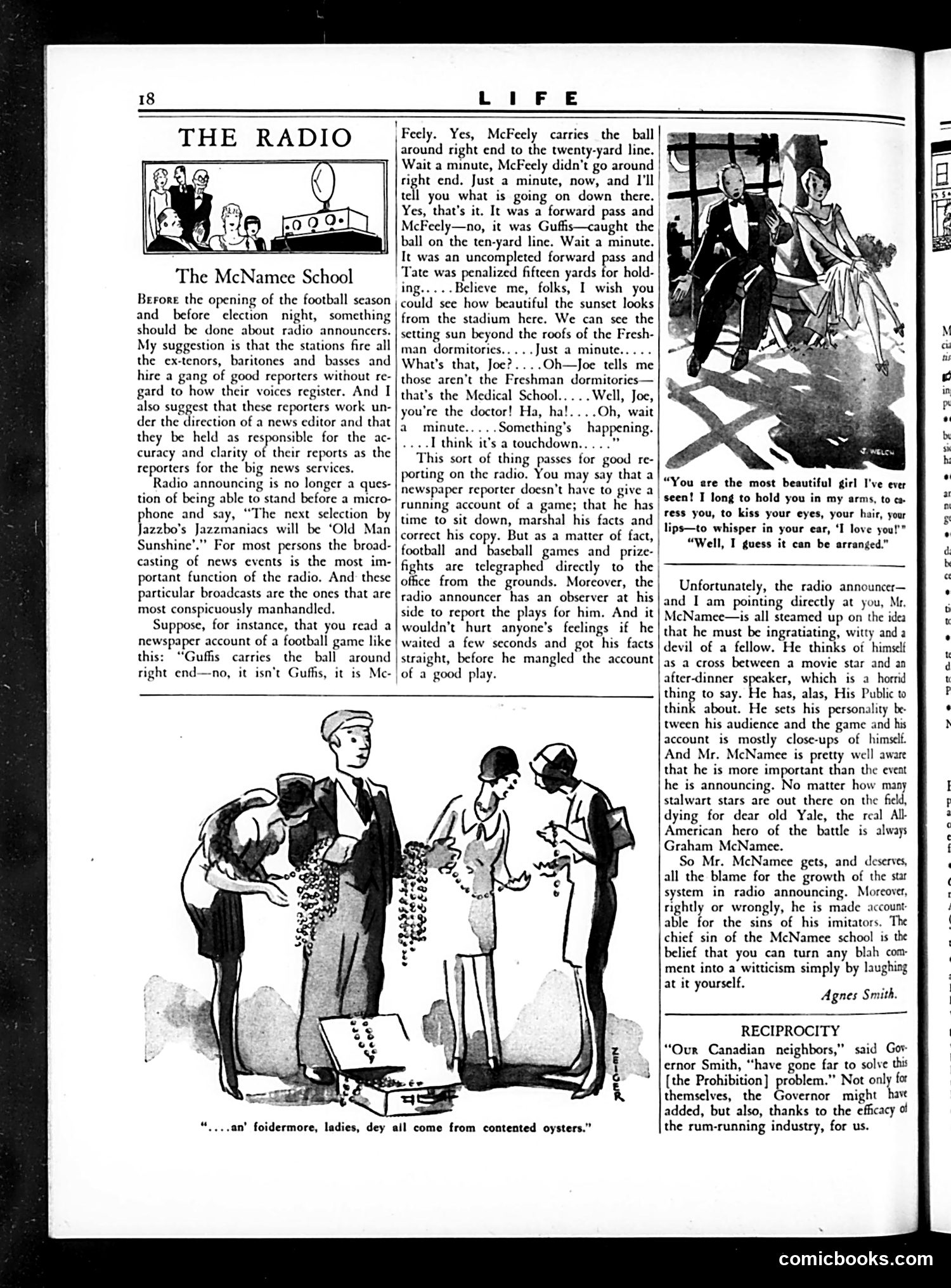
This article satirizes **Graham McNamee**, a prominent 1920s radio sports announcer, for his self-centered broadcasting style. The author criticizes radio announcers generally for prioritizing entertainment and personality over accurate reporting—a new problem since radio broadcasts events live, unlike newspapers. The specific complaint: McNamee constantly interrupts game coverage with tangents (describing sunsets, making jokes, correcting himself), prioritizes his own charm over the sport, and believes he's more important than the athletes competing. The cartoon below mocks vague radio language ("an' foidermore...oysters"), while the photo shows a radio couple's romance, satirizing McNamee's tendency to inject romantic sentimentality into broadcasts. The author argues radio stations should hire trained reporters under editorial supervision, not former singers with pleasing voices but poor accuracy. McNamee exemplifies the problem: he's made himself the "real All-American hero" rather than letting the game speak for itself.
📄 Transcribed text from this page (OCR, searchable)
Machine-transcribed from the original scan — historical spelling and the odd misread are preserved.
LIFE The McNamee School Berore the opening of the football season and before election night, something should be done about radio announcers. My suggestion is that the stations fire all the ex-tenors, baritones and basses and hire a gang of good reporters without re- gard to how their voices register. And I also suggest that these reporters work un- der the direction of a news editor and that they be held as responsible for the ac- curacy and clarity of their reports as the reporters for the big news services. Radio announcing is no longer a ques- tion of being able to stand before a micro- phone and say, “The next selection by Jazzbo's Jazzmaniacs will be ‘Old Man Sunshine’.”” For most persons the broad- casting of news events is the most im- portant function of the radio. And: these particular broadcasts are the ones that are most conspicuously manhandled. Suppose, for instance, that you read a newspaper account of a football game like this: “Guffis carries the ball around right end—no, it isn’t Gufhs, it is Me- | Feely. Yes, McFeely carries the ball around right end to the twenty-yard line. Wait a minute, McFeely didn’t go around right end. Just a minute, now, and I'll! tal you what is going on down there. Yes, that’s it. It was a forward pass and McFeely—no, it was Guffis—caught the ball on the ten-yard line. Wait a minute. | It was an uncompleted forward pass and Tate was penalized fifteen yards tor hold- ing.....Believe me, folks, I wish you could see how beautiful the sunset looks from the stadium here. We can see the setting sun beyond the roofs of the Fresh- man dormitories... ..Just a minute... .. What's that, Joe?....Oh—Joe tells me those aren't the Freshman dormitories— that’s the Medical School.....Well, Joe, you're the doctor! Ha, ha!....Oh, wait a minute... ..Something’s happening. ..+.T think it’s a touchdown.. ...” This sort of thing passes for good re- porting on the radio. You may say that a newspaper reporter doesn’t have to give a | running account of a game; that he has time to sit down, marshal his facts and correct his copy. But as a matter of fact, | football and baseball games and _prize- | fights are telegraphed directly to the | office from the grounds. Moreover, the radio announcer has an observer at his side to report the plays for him. And it wouldn’t hurt anyone's feelings if he waited a few seconds and got his facts straight, before he mangled the account of a good play. “...,an’ foidermore, ladies, dey all come from contented oysters.” | thin ‘You are the most beautiful girl I've ever seen! I long to hold you in my arms, to co ress you, to kiss your eyes, your hair, your lips—to whisper in your ear, ‘I love you!'" “Well, I guess it can be arranged.” Unfortunately, the radio announcer— and I am pointing directly at you, Mr. McNamee—is all steamed up on the idea that he must be ingratiating, witty and a devil of a fellow. He thinks of himsdf as a cross between a movie star and an after-dinner speaker, which is a horrid to say. He has, alas, His Public t think about. He sets his personality be tween his audience and the game and his account is mostly close-ups of himself. And Mr. McNamee is pretty well aware that he is more important than the event he is announcing. No matter how many stalwart stars are out there on the field, dying for dear old Yale, the rcal All American hero of the battle is always Graham McNamee. So Mr. McNamee gets, and deserves, all the blame for the growth of the star system in radio announcing. Moreover, rightly or wrongly, he is made account: able for the sins of his imitators. The chief sin of the McNamee school is the belief that you can turn any blah com ment into a witticism simply by laughing at it yourself. Agnes Smith. RECIPROCITY “Our Canadian neighbors,” said Gor ernor Smith, “have gone far to solve this [the Prohibition] problem.” Not only for themselves, the Governor might have added, but also, thanks to the efficacy 4 the rum-running industry, for us. comicbooks.com