
Life, 1928-09-21 · page 26 of 36
Life — September 21, 1928 — page 26: what you’re looking at
What you’re looking at
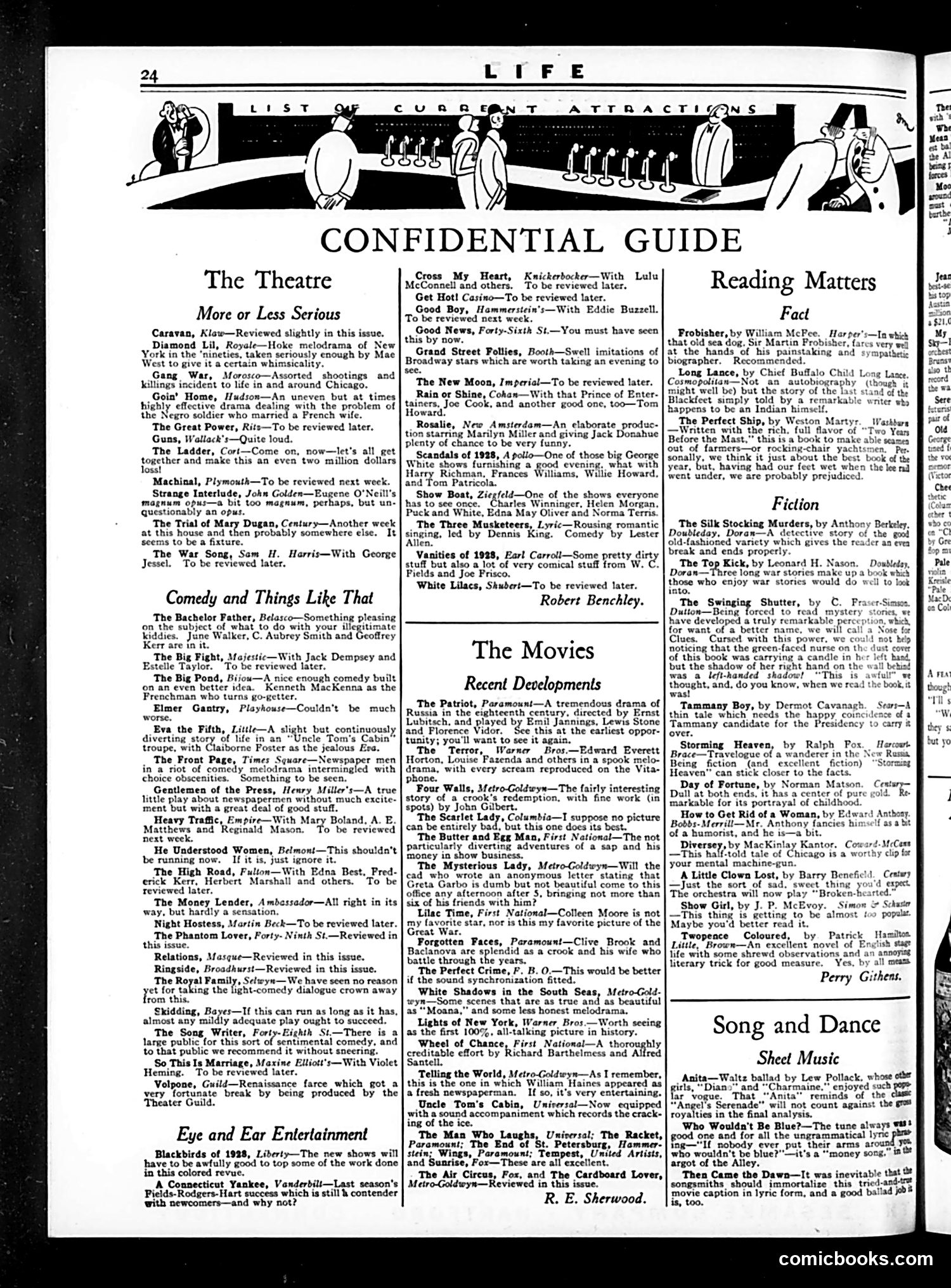
This page is a **theatre and entertainment guide**, not a political cartoon. It's a "Confidential Guide" listing current Broadway productions with brief critical assessments—typical of Life's entertainment coverage in the 1920s. The header illustration is decorative, showing stylized theatrical figures and props, not satirical commentary. The reviews themselves are satirical in *tone* rather than political. For example, the write-up for "The Ladder" at the Cort Theatre reads: "Come on, now—let's all get together and make this an even two million dollars loss!"—mocking the show's financial failure with dark humor. The reviews employ Life's characteristic wit to skewer poorly-reviewed productions ("Elmer Gantry, Playhouse—Couldn't be much worse"). This reflects 1920s entertainment journalism's snide, knowing attitude toward Broadway's commercial machinery. **No identifiable political figures or events appear here.**
📄 Transcribed text from this page (OCR, searchable)
Machine-transcribed from the original scan — historical spelling and the odd misread are preserved.
CONFIDENTIAL GUIDE The Theatre More or Less Serious Caravan, Klow—Reviewed slightly in this issue. Diamond Lil, Royale—Hoke melodrama of New York in the ‘nineties, taken seriously enough by Mae West to give it a certain whimsicality. Gang War, Morosco—Assorted shootings and killings incident to life in and around Chicago. Goin’ Home, Hudson—An uneven but at times highly effective drama dealing with the problem of the Negro soldier who married a Prench wife. The Great Power, Rit2—To be reviewed later. Guns, Wallack’s—Quite loud. The Ladder, Cort—Come on, now—let’s all get together and riake this an even’ two million dollars oss! Machinal, Plymouth—To be reviewed next Strange Interlude, John Golden—Eugene O'Neill's magnum opus—a bit too magnum, perhaps, but un- questionably an opus. The Trial of Mary Dugan, Century—Another week at this house and then probably somewhere else. seems to be a fixture. The War Song, Som H. Harris—With George Jessel. To be reviewed later. Comedy and Things Like That The Bachelor Father, Belasco—Something pleasing on the subject of what to do with your illegitimate kiddies. June Walker, C. Aubrey Smith and Geoffrey Kerr are in it. The Big Fight, Majestic—With Jack Dempsey and Estelle Taylor. To be reviewed later. The Big Pond, Bijou—A nice enough comedy built on an even better idea. Kenneth MacKenna as the Frenchman who turns go-ge! ,. Eimer Gantry, Playhouse—Couldn’t be much worse, reek. Eva the Fifth, Littl—A slight but continuously diverting story of life in an “Uncle Tom's Cabin” troupe, with Claiborne Poster as the jealous Eva. The Front Page, Times Square—Newspaper men in a riot of comedy melodrama intermingled with choice obscenities. Something to be seen. Gentlemen of the Press, Henry Miller's—A true little play about newspapermen without much excite- ment but with a great deal of good stuff. Heavy Traffic, Empire—With Mary Boland, A. E. Matthews and Reginald Mason. To be reviewed next week. He Understood Women, Belmon!—This shouldn't be running now. If it is, just ignore it. The High Road, Fulton—With Edna Best, Pred- erick Kerr, Herbert Marshall and others. ‘To be reviewed later. The Money Lender, Ambcssedor—All right in its way, but hardly a sensation. Night Hostess, Martin Beck—To be reviewed later. The Phantom Lover, Forty- ith St.—Reviewed in this issue. Relations, Masque—Reviewed in this issue. Ringside, Broadhurst—Reviewed in this issue. The Royal Family, Seltwyn— We have seen no reason yet for taking the light-comedy dialogue crown away ‘rom this. Skidding, Boyes—If this can run as long as it has, almost any mildly adequate play ought to succeed. The Song Writer, Forty-Eighth St—There is a large public for this sort ‘of sentimental comedy, and to that public we recommend it without sneering. So This Is Marriage, Maxine Elliott's—With Violet Heming. To be reviewed later. Volpone, Guild—Renaissance farce which got a very fortunate break by being produced by the Theater Guild. Eye and Ear Entertainment Blackbirds of 1928, Liberty—The new shows will hhave to be awfully good to top some of the work done in oe colored revue. A Connecticut Yankee, Vanderbili—Last season's Fields-Rodgers-Hart success which is still h contender with newcomers—and why not? Cross My Heart, Knickerbocker—With Lulu McConnell and others. To be reviewed later. Get Hot! Casino—To be reviewed later. Good Boy, Hammerstein's—With Eddie Buzzell. To be reviewed next week. Good News, Forty-Sixth St—You must have seen this by now. Grand Street Follies, Booth—Swell imitations of Broadway stars which are worth taking an evening to see. The New Moon, Imperial—To be reviewed later. Rain or Shine, Cohan—With that Prince of Enter- tainers, Joe yk, and another good one, too—Tom Howard, Rosalie, New Amsterdam—An elaborate produc- tion starring Marilyn Miller and giving Jack Donahue plenty of chance to be very funny. Scandals of 1928, A pollo—One of those big George White shows furnishing a good evening. what with Harry Richman, Prances Williams, Willie Howard, and Tom Patricola. Show Boat, Zicg/eld —One of the shows everyone has to see once. harles Winninger, Helen Morgan, Puck and White, Edna May Oliver and Norma Ternis. The Three Musketeers, Lyric—Rousing romantic | singing, led by Dennis King. Comedy by Lester en. Vanities of 1928, Parl Carroll—Some pretty dirty shud, but also a lot'of very comical stuff from W. Fields and Joe Frisco, White Lilacs, Shubert—To be reviewed later. Robert Benchley. The Movies Recent Developments The Patriot, Paramount—A tremendous drama of Russia in the eighteenth century, directed by Ernst Lubitsch, and played by Emil Jannings, Lewis Stone and Florence Vidor. Sce this at the earliest oppor- tunity; you'll want to see it again. The Terror, Warner Bros.—Edward Everett Horton, Louise Fazenda and others in a spook melo- drama, with every scream reproduced on the Vita- phone. Four Walls, Metro-Goldwyn—The fairly interesting story of a crook’s redemption, with fine work (in spots) by John Gilbert. The Scarlet Lady, Columbio—T suppose no picture can be entirely bad, but this one does its The Butter and Egg Man, First National—The not particularly diverting adventures of a sap and his money in show business. The Mysterious Lady, Metro-Goldwyn—Will the cad who wrote an anonymous letter stating that G Garbo is dumb but not beautiful come to this office any afternoon after S, bringing not more than six of his friends with him? Lilac Time, First National—Colleen Moore is not my favorite star, nor is this my favorite picture of the Great War. Forgotten Faces, Paramount—Clive Brook and Baclanova are splendid as a crook and his wife who battle through the years, The Pertect Crime, F, B. 0.—This would be better if the sound synchronization fitted. White Shadows in the South Seas, Metro-Gold- weyn—Some scenes that are as true and as beautiful as “Moana,” and some less honest melodrama. Lights of New York, Warner Bros.—Worth seeing as the first 100%, all-talking picture in history. ‘Wheel of Chance, First National—A thoroughly creditable effort by Richard Barthelmess and Alfred Santell. Telling the World, Metro-Goldwyn—As I remember, this is the one in which William Haines appeared as afresh newspaperman. If so, it’s very entertaining. Uncle Tom's Cabin, Unirersal—Now equip} with a sound accompaniment which records the crack- ing of the ice. The Man Who Laughs, Uninersal: The, Racket Paramount; The End of St. Petersburg, stein; Wings, Paramount; Tempest, United Artists, and Sunrise, Fox—These are all excellent. The Air Circus, Fox, and The Cardboard Lover, Metro-Goldwyn—Reviewed in this issue. R. E. Sherwood. Reading Matters Fact Frobisher, by William McPee. Har per's—In which that old sea dog. Sir Martin Frobisher, fa at the hands of his painstaking and biographer. Recommended. Long Lance, by Chief Buffalo Child L Cosmopolitan—Not an autobiography might well be) but the story of the 1: Blackfeet simply told by a remarkab happens to be an Indian himself, The Perfect Ship, by Weston M. Washbara —Wniten with the rich, full flavor of “Two Yan Before the Mast,” this is'a book to make able seamea out of farmers—or rocking-chair yachtsmen. Pee sonally. we think it just about the best book of the year, but, having had our fect wet when the le nd went under, we are probably prejudiced. Fiction The Silk Stocking Murd Doubleday, Doran—A detective st old-fashioned variety which gives the reader an evea break and ends properly. The Top Kicks by Leonard H. Nason Doran—Three long war stories make up ab those who enjoy war stories would do » into. The Swing’ Shutter, Dutton—Being forced have developed a truly rem: for want of a better name, we will c: Clues. Cursed with this power, we could noticing that the green-faced nurse on th of this book was carrying a candle in he but the shadow of her right hand on the o was a left-handed shadow! “This is awful thought, and, do you know, when we read the was! by Tammany Boy, by Dermot Cavanagh. Sears—A thin tale which ‘needs the happy. coincidence of a Tammany candidate for the Presidency to carry & over. Storming Heaven, by Ralph Pox. Harcowt Brace—Travelogue of a wanderer in the New Rema Being fiction (and excellent fiction) “Storming Heaven" can stick closer to the facts. Day of Fortune, by Norman Matson. Cesterp— Dall at both ends” it has a center of pure cold. Re markable for its portrayal of childhood How to Get Rid of a Woman, by Ewa Bobbs-Merrill—Me. Anthony fancies bi of a humorist, and he is—a bit. Diversey, by MacKinlay Kantor. Cows This half-told tale of Chicago is a wo your mental machine-gun. A Little Clown Lost, by Barry Beneficld, Cestery Just the sort of sad, sweet thing you'd expect The orchestra will now play arted. Show Girl, by J. P. McEvoy. Simo’ —This thing is getting to be almost Maybe you'd better read it. Twopence Coloured, by Patrick Hamilton Little, Browr—An excellent novel of En«'is! iife with some shrewd observations and an annoys literary trick for good measure. Song and Dance Sheet Music d by Lew Pollack, whose ott Charmaine,” enjoyed sach fa Anita” reminds of the ¢ ‘As not count against the gr royalties ia the Baal analysis, Who Wouldn't Be Blue?—The tune always was? good one and for all the ungrammatical lyne fos “If nobody ever put their arms ari ho wosidn’t be blue?"—it's a “maney S008, argot of the Then coe a Dawo—It was inevitable that St songsmiths should immortalize this tried-and-t movie caption in lyric form, and a good ballad joo is, too. inte comicbooks.com