
A complete issue · 40 pages · 1928
Life — September 14, 1928
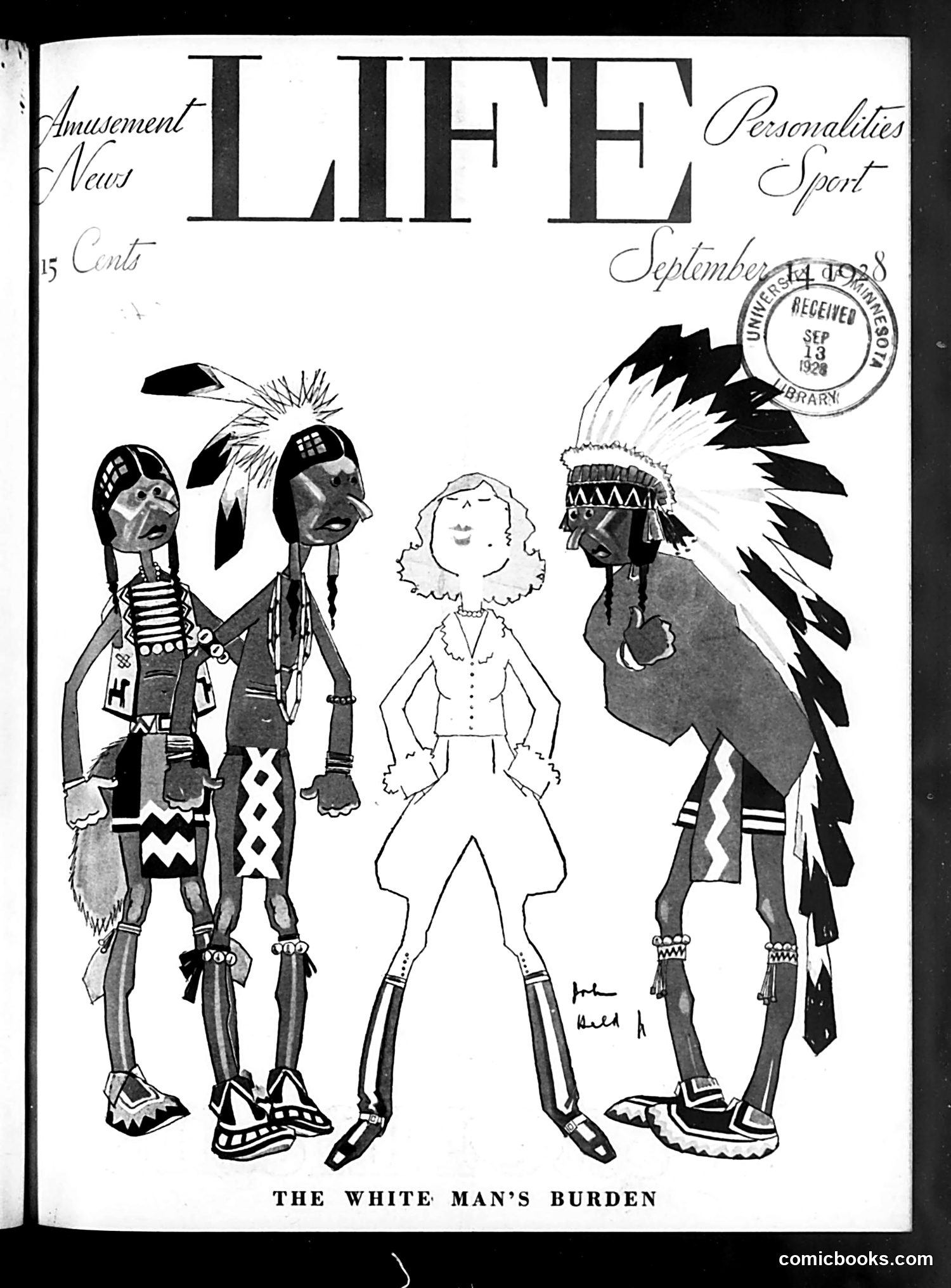
This satirical cover depicts a white woman in the center surrounded by three Indigenous men in stereotypical regalia. The caption reads "THE WHITE MAN'S BURDEN." The cartoon inverts Kipling's famous 1899 imperialist poem justifying Western expansion. Rather than portraying colonization as a noble burden, Life's satire suggests white Americans face the "burden" of managing Indigenous peoples—here visualized as the woman surrounded by Native men. The imagery relies on racist caricature and stereotyping common to 1920s media. The satire likely critiques contemporary debates over Indigenous affairs or federal policy, though the specific political reference remains unclear without additional context. The cover exemplifies how mainstream publications casually weaponized both racist imagery and imperialist rhetoric during this period.
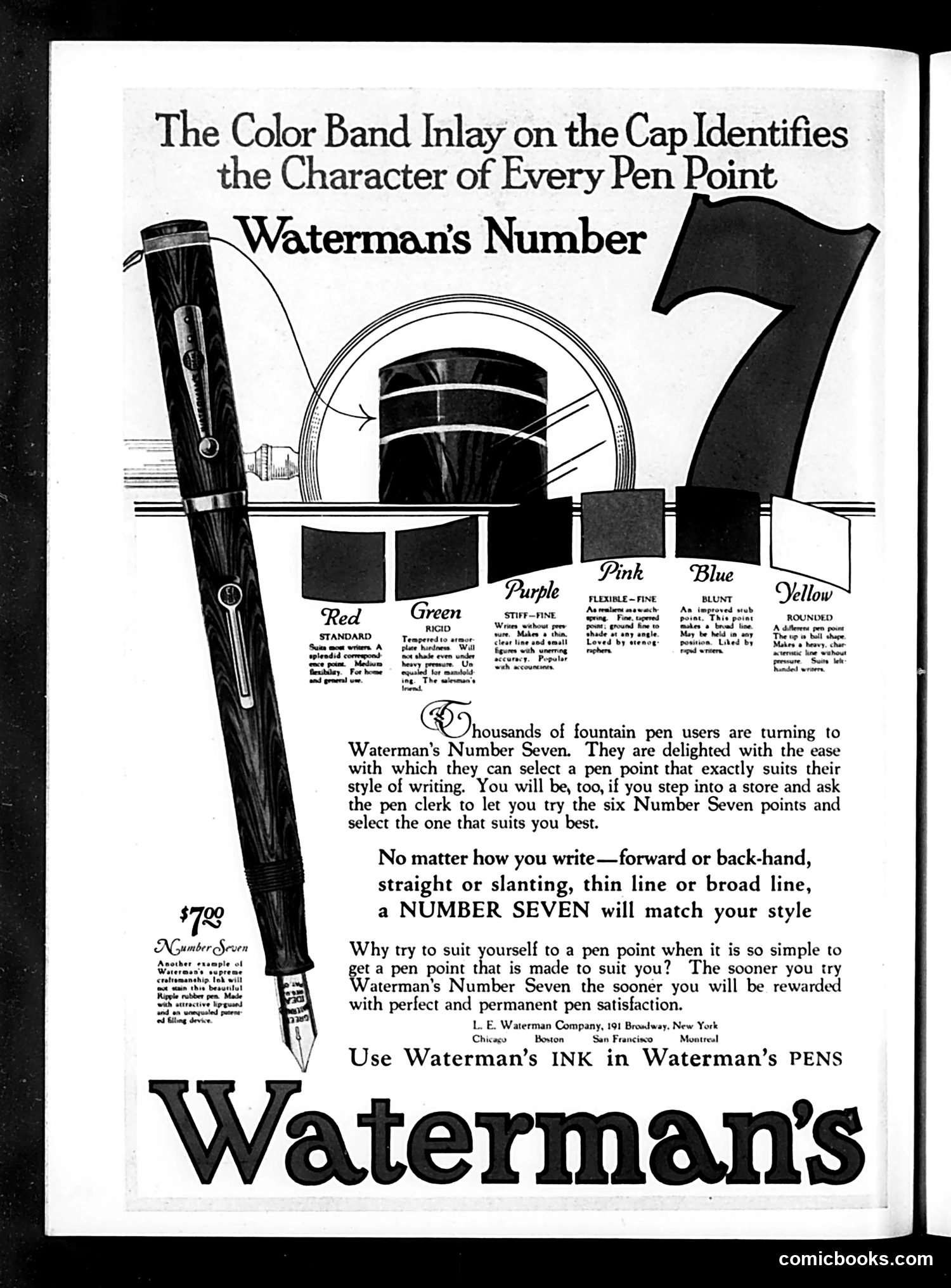
This page is **primarily an advertisement**, not satire or political commentary. It promotes Waterman's fountain pens, specifically the "Number Seven" model priced at $7.00. The ad highlights a practical consumer benefit: the pen's color-coded band on the cap identifies six different pen points (Red, Green, Purple, Pink, Blue, Yellow) suited to various writing styles—from "standard" to "flexible-fine" to "blunt." The key marketing message is convenience: customers can select a pen point matching their personal writing preferences without trial-and-error. The ad emphasizes this removes the friction from fountain pen selection, promising "perfect and permanent pen satisfaction." There is no political or satirical content here—it's straightforward product advertising from the early-to-mid 20th century.
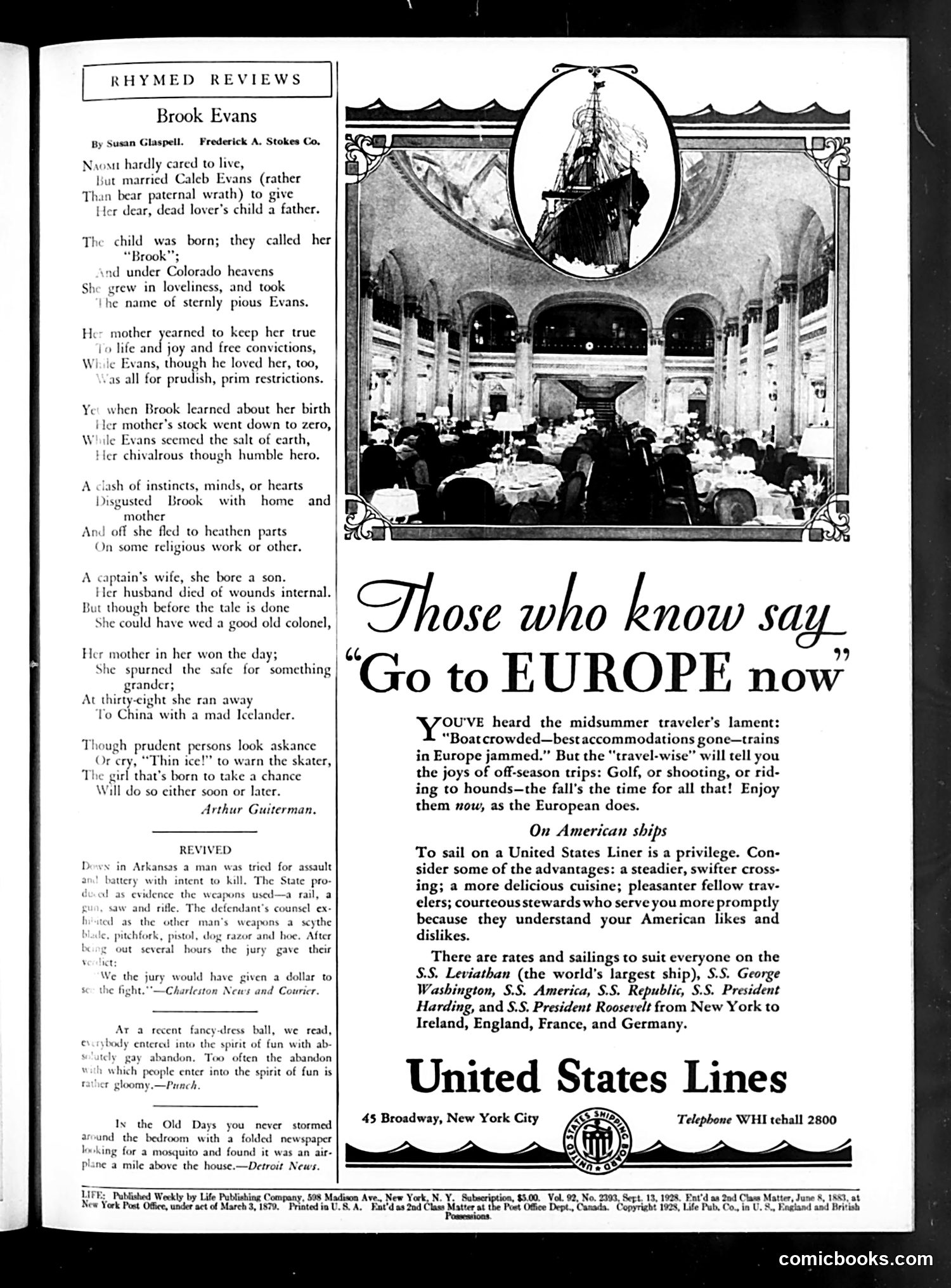
This page contains two distinct elements: **Left side:** A rhymed literary review of "Brook Evans" by Susan Glaspell, published by Frederick A. Stokes Co. The poem summarizes the novel's plot about an illegitimate child born to an unmarried woman in Colorado. Below that is a brief "Revived" section noting a legal case in Arkansas. The literary content appears straightforward without obvious satire. **Right side:** A United States Lines shipping advertisement featuring an ocean liner dining room photograph. The ad promotes off-season European travel on American ships, emphasizing amenities and comfort. It lists specific vessels like the S.S. Leviathan and S.S. George Washington. The page juxtaposes serious literature with commercial tourism advertising—typical of Life magazine's mixed editorial and advertising format from this era (1928, based on the masthead).
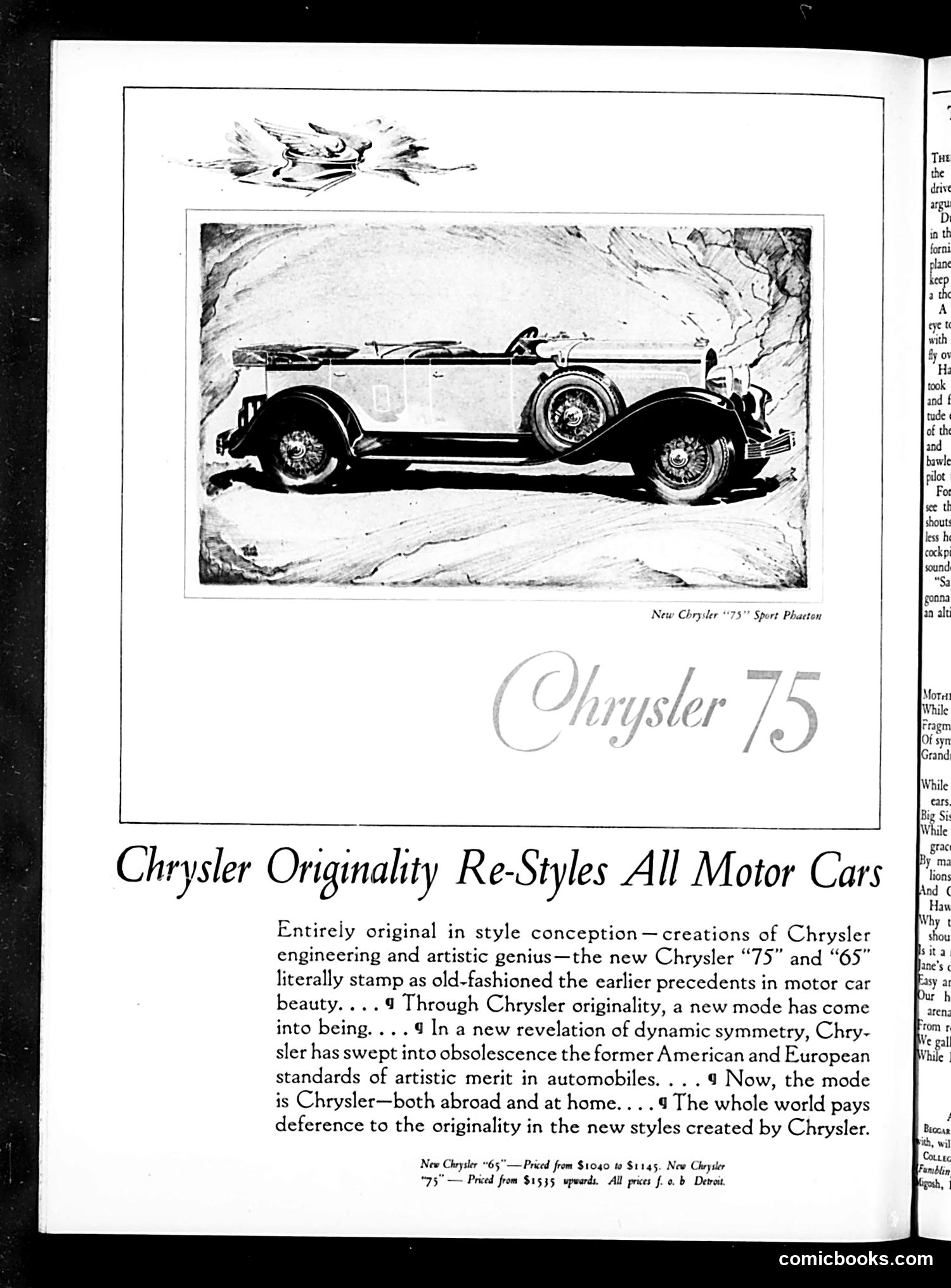
This page is **primarily an advertisement**, not satire or editorial content. It promotes the Chrysler "75" Sport Phaeton automobile. The small sketch at the top appears to be a decorative vignette, possibly showing the car in motion or a design flourish—its purpose is unclear from the image alone. The main content showcases a side-profile photograph of the 1920s-era convertible and emphasizes Chrysler's claim to automotive originality. The accompanying text argues that Chrysler's styling innovations have made competing American and European designs obsolete, establishing new standards of "artistic merit in automobiles." Pricing information indicates the "65" model started at $1,040-$1,145, while the "75" began at $1,515. This represents straightforward commercial promotion rather than political or social commentary.
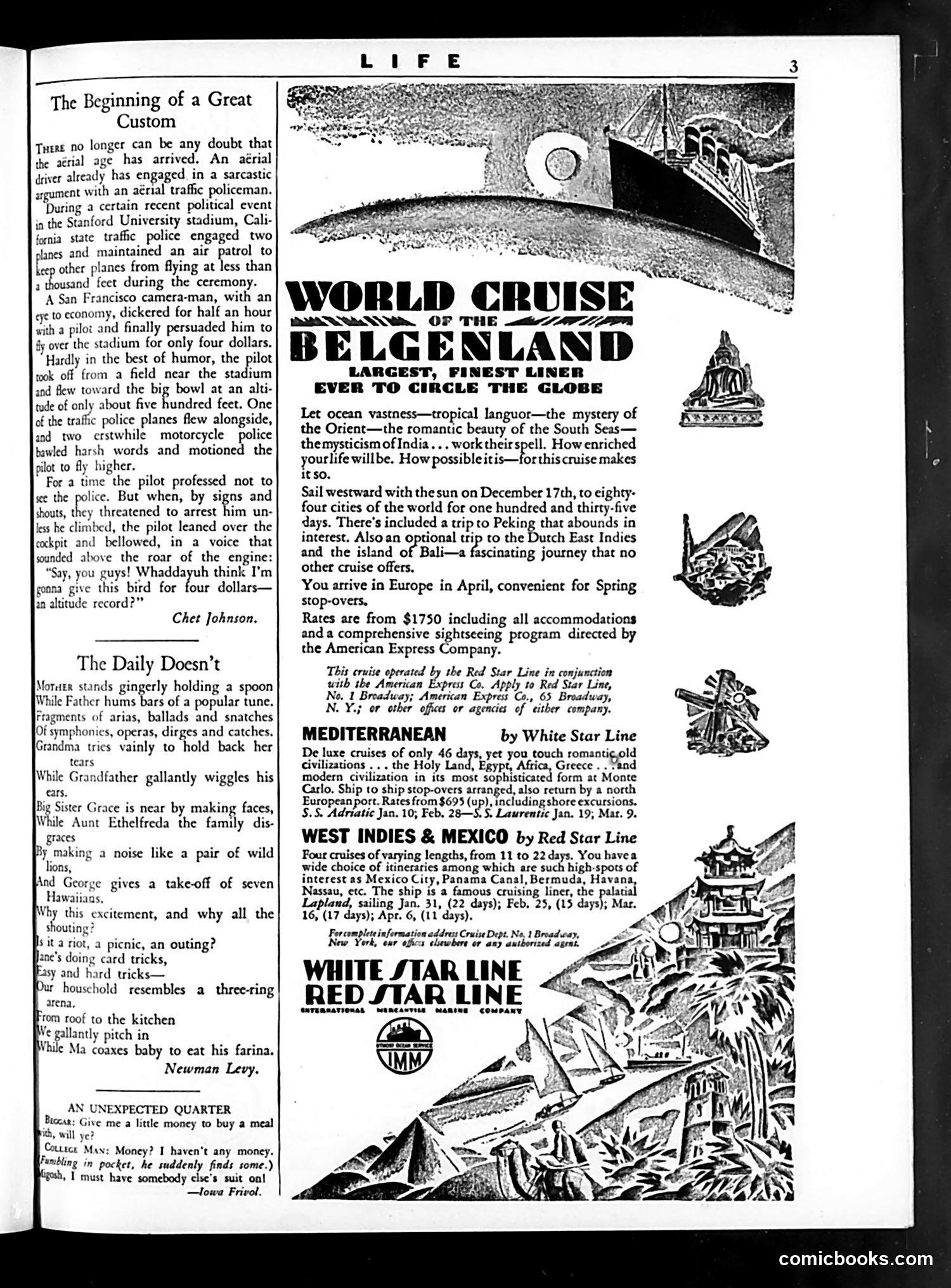
This page is primarily **advertising**, not political cartoon content. The dominant feature is a large cruise ship advertisement for the "Belgenland" operated by the Red Star Line—promoted as "the largest, finest liner ever to circle the globe." The left column contains **humorous domestic sketches** by Newman Levy and others about family life (mothers, fathers, aunts, household dynamics)—standard satirical fare for Life magazine. The aerial traffic control story at the top references a recent Stanford University stadium event where California state traffic police monitored aircraft, apparently arguing about traffic safety. This appears to be gentle satire about mundane bureaucracy rather than serious political commentary. The page reflects 1920s leisure culture and advertising priorities more than satirical social critique.
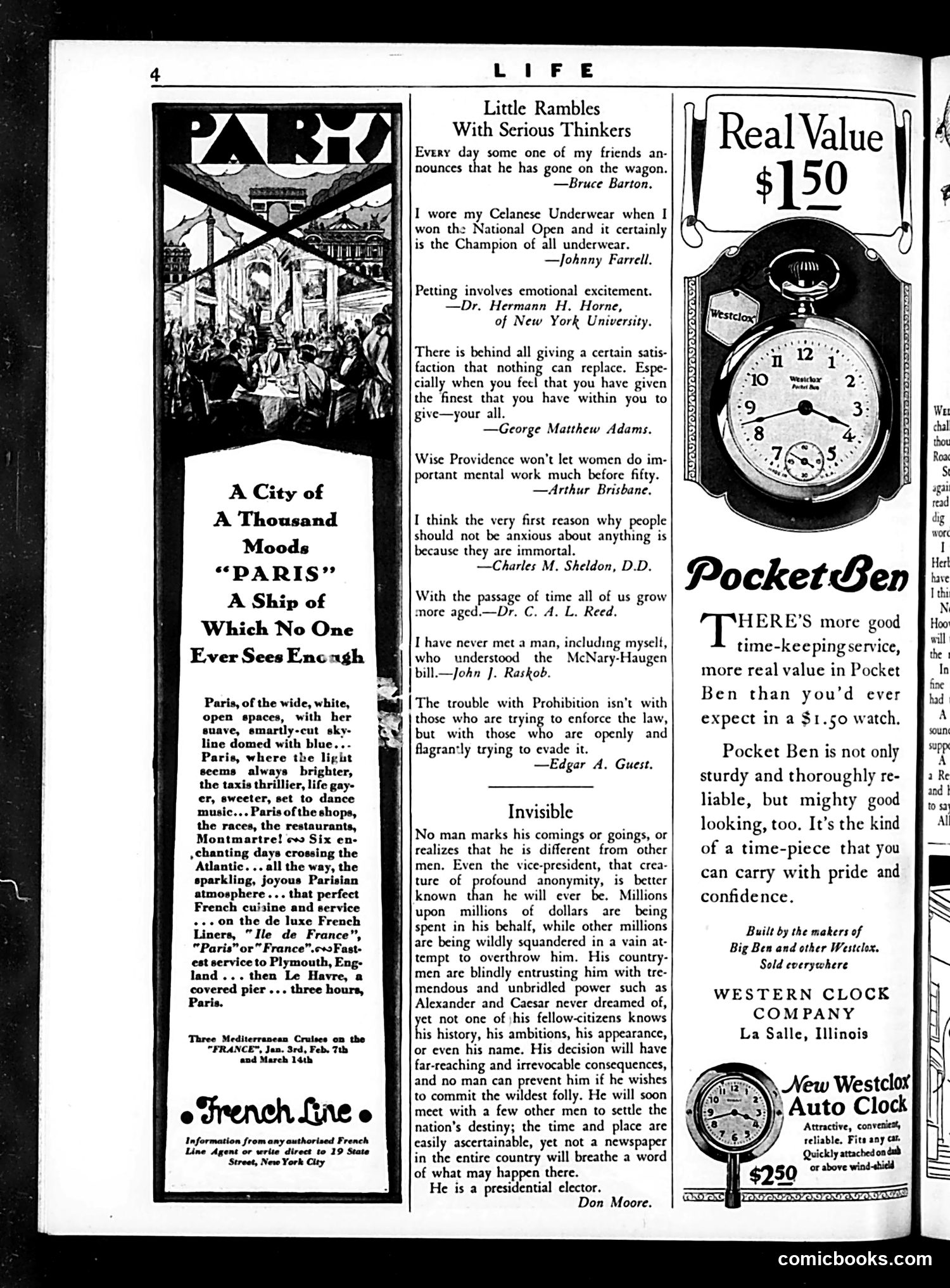
This page is primarily **advertising and editorial content**, not political satire. The left side features a **French Line cruise ship advertisement** celebrating Paris as "A City of A Thousand Moods," marketing luxury ocean travel to France during the 1920s-30s era. The center column, "Little Rambles With Serious Thinkers," collects quotations from various public figures (Bruce Barton, Johnny Farrell, Dr. Hermann Horne, etc.) on topics like giving, aging, and Prohibition—representing typical editorial filler common to magazines of this period. The right side advertises **Pocket Ben and Westclox Auto Clock** watches, emphasizing their reliability and value ($1.50 and $2.50 respectively). There is **no political cartoon present**. This is a standard magazine layout mixing advertisements with light philosophical commentary.
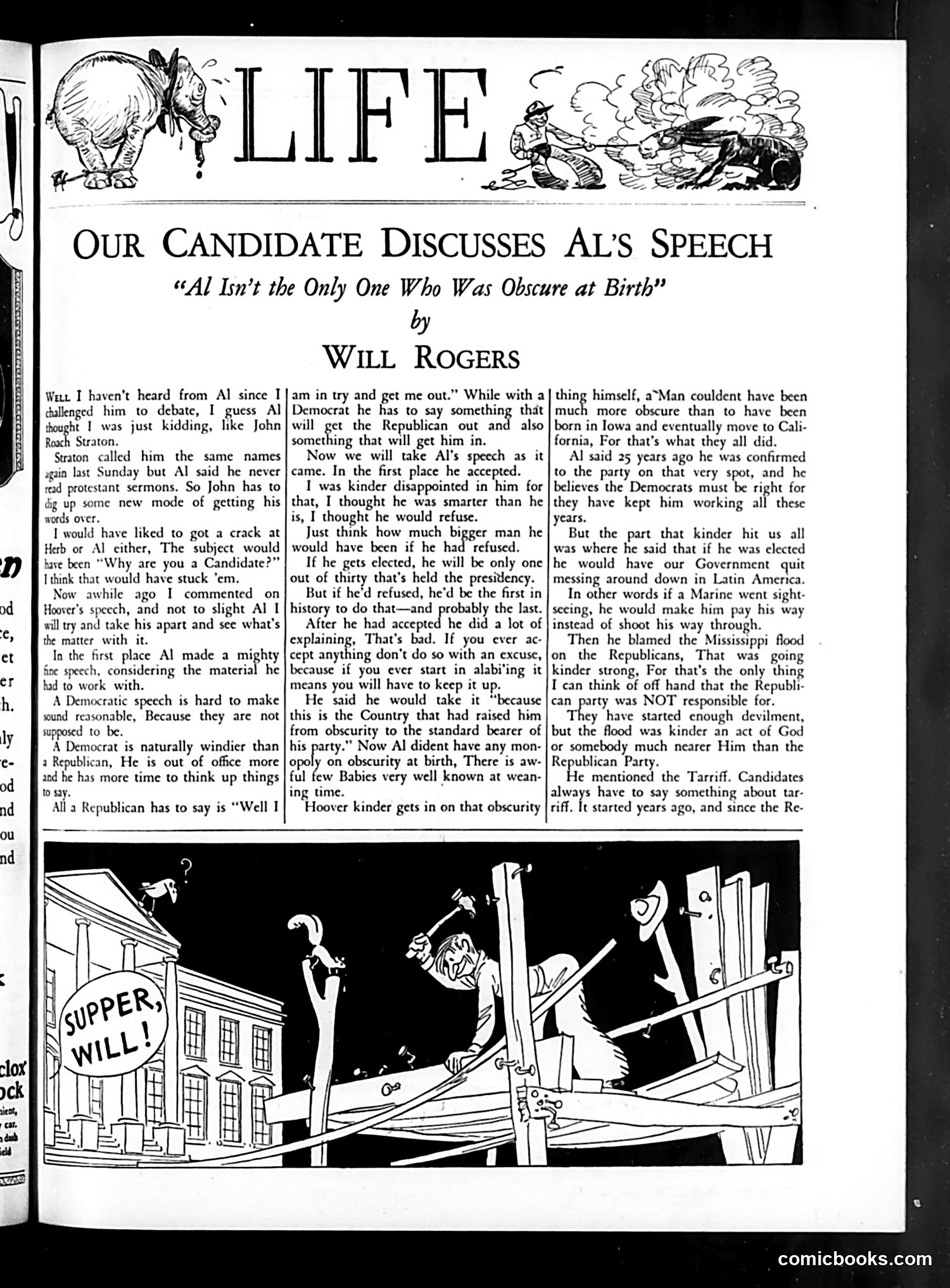
This page features Will Rogers' satirical commentary on a political candidate's speech titled "Al Isn't the Only One Who Was Obscure at Birth." The text discusses "Al" (likely Al Smith, Democratic presidential candidate), criticizing his political positions and obscure background. Rogers humorously contrasts Democratic and Republican strategies. The bottom cartoon depicts a chaotic construction scene labeled "Supper Will!" showing workers in disarray—likely satirizing government inefficiency or political broken promises. The visual chaos suggests bumbling leadership or failed policies. Rogers employs his characteristic folksy humor to critique both political parties, though the piece particularly targets Democratic vulnerabilities regarding tariffs and political credibility. The humor relies on contemporary political knowledge now obscure to modern readers.
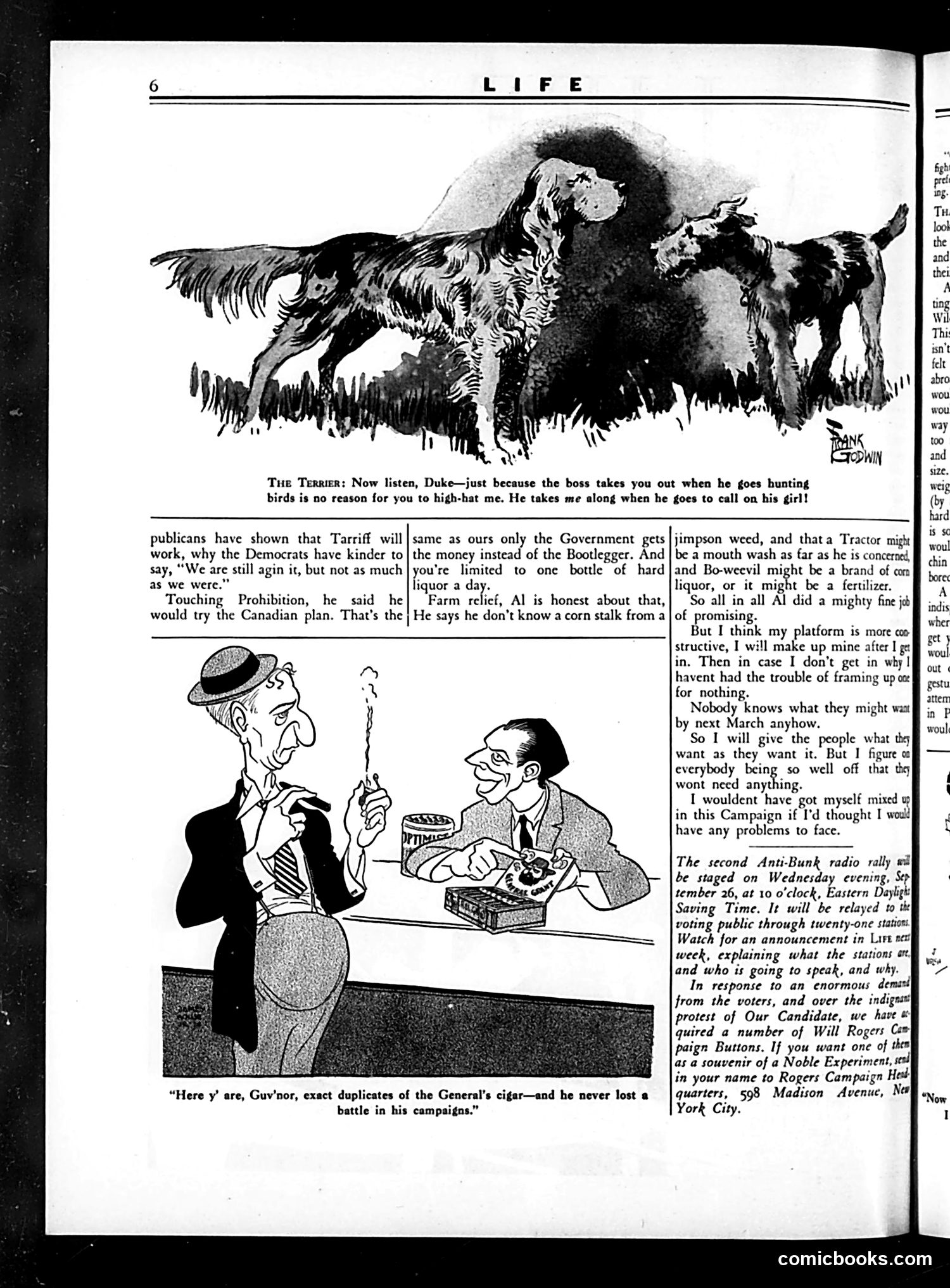
**Top Cartoon (Dog Illustration):** A terrier scolds a Duke, arguing that being taken hunting by the boss doesn't justify unequal treatment. The satire mocks class distinctions—even a dog recognizes the unfairness of privilege based on social standing rather than merit. **Bottom Cartoon:** A politician offers cigars to a governor, claiming they're "exact duplicates of the General's cigar" and promising he'll "never lost a battle in his campaigns." This satirizes political patronage and corruption: politicians offer bribes (cigars) while making grandiose, empty promises about electoral success. The joke suggests politicians trade favors and make unrealistic campaign guarantees. Both cartoons critique inequality and political dishonesty through humor.
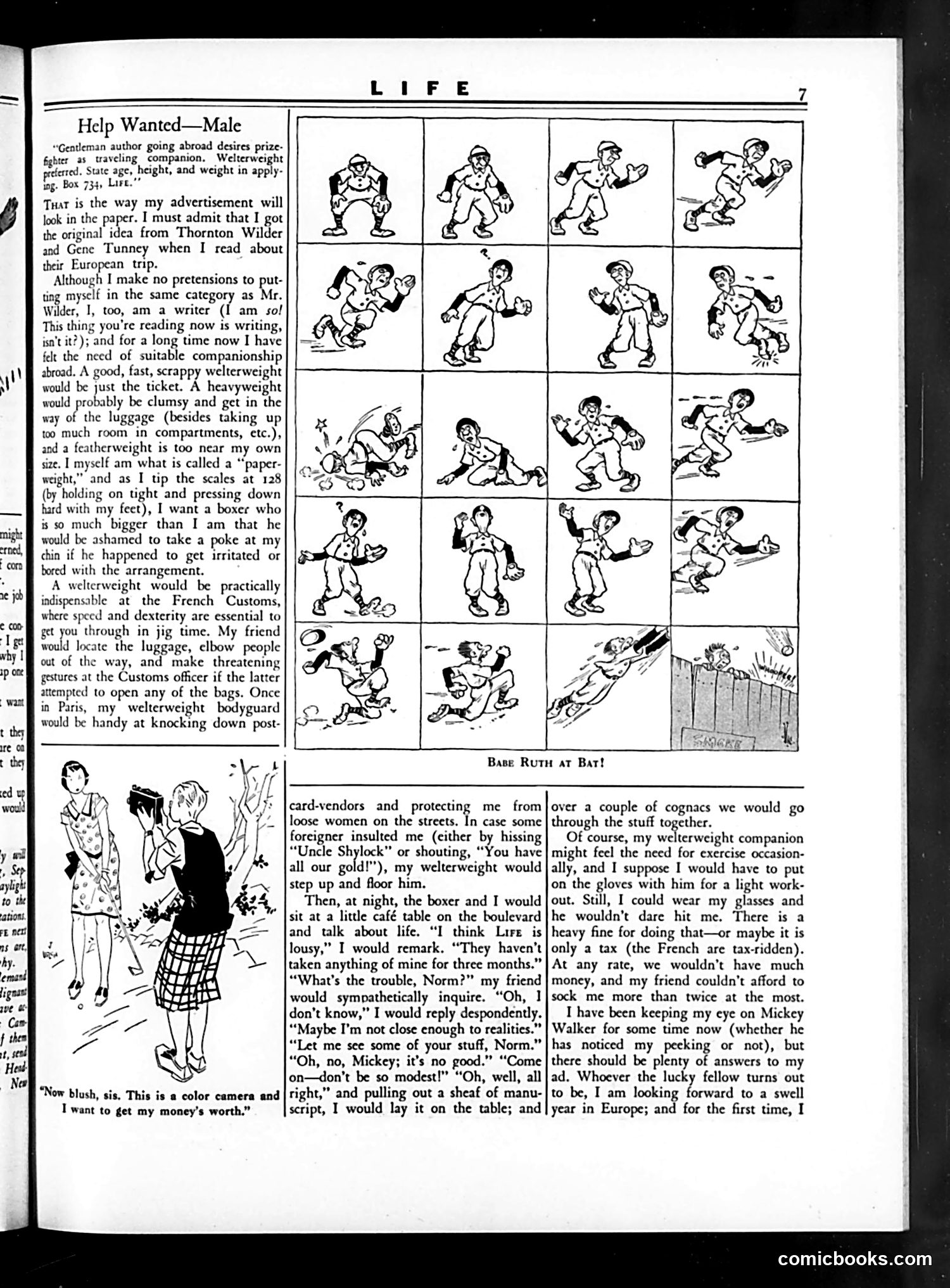
This page contains a humorous "Help Wanted" personal ad from a writer seeking a male traveling companion for a European trip. The main comic strip (titled "BABE RUTH AT BAT!") depicts sequential panels showing a baseball player's batting stance and swing, clearly referencing the famous baseball star Babe Ruth through the exaggerated athletic poses. Below this is a separate cartoon showing three women on a street, with one commenting on a color camera, saying "Now blush, sis. This is a color camera and I want to get my money's worth." This jokes about early color photography technology and vanity. The satire throughout reflects 1920s-30s American preoccupations: travel abroad (exotic and desirable), celebrity sports figures, and emerging consumer technologies like color cameras.
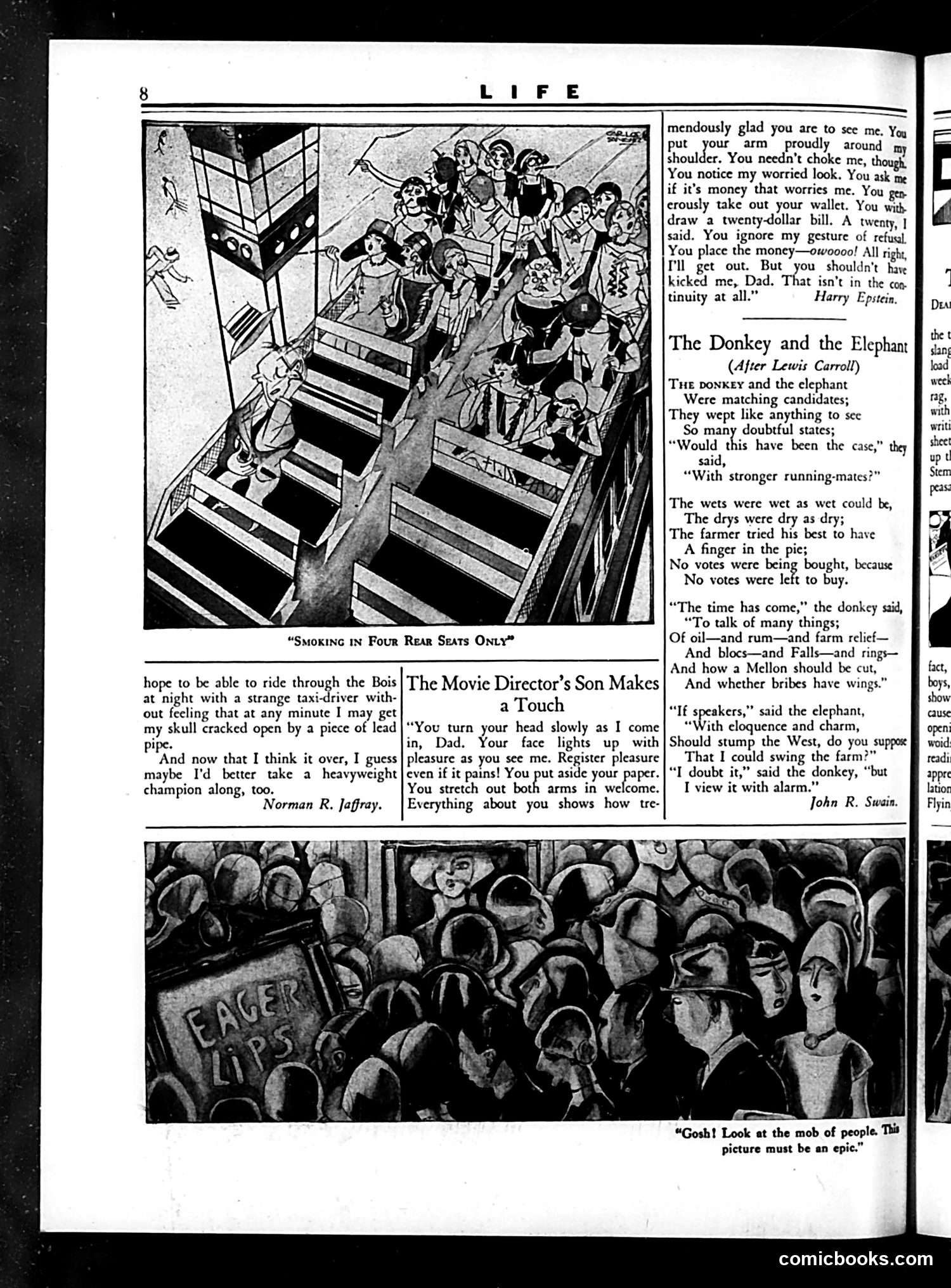
This page contains three separate pieces of humorous content: 1. **"Smoking in Four Rear Seats Only"** - A cartoon depicting an crowded elevator or transit vehicle, satirizing public smoking restrictions and the physical impossibility of enforcing such rules in cramped spaces. 2. **"The Movie Director's Son Makes a Touch"** - A brief comedic piece by Norman M. Jeffray about a son asking his father for money, playing on the common stereotype of wealthy Hollywood producers' sons as freeloaders. 3. **"The Donkey and the Elephant"** - A political allegory (after Lewis Carroll) using these animals as metaphors for political candidates or parties during an election, discussing campaign strategies and vote-buying. 4. **Bottom image** - Depicts a crowded mob scene labeled "Eager Lips," likely satirizing mob behavior or crowd mentality at public events. The page reflects early-to-mid 20th century American social concerns: public behavior, wealth disparities, and political corruption.
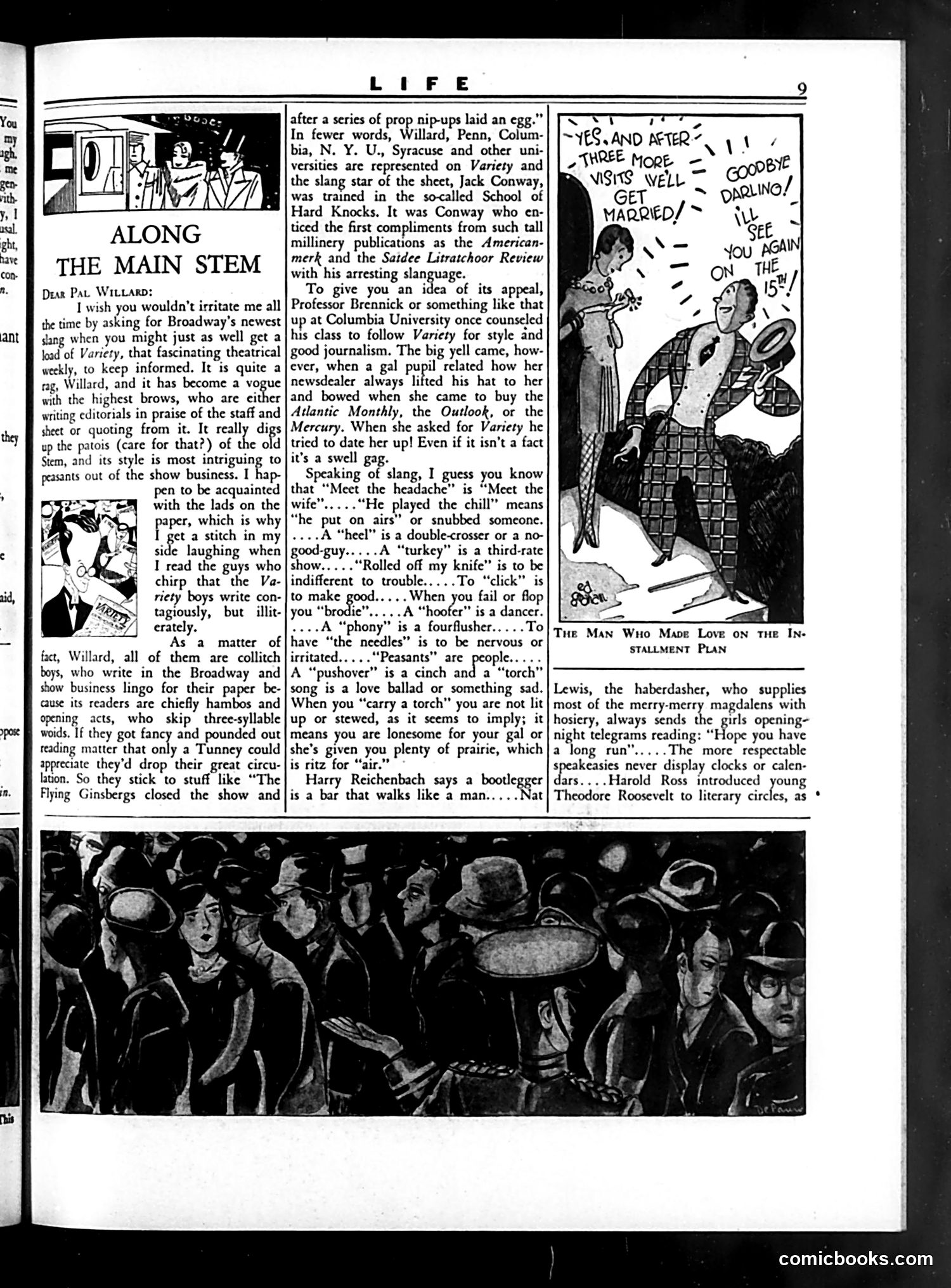
This page contains a theater column titled "Along the Main Stem" by columnist Willard, discussing Broadway and theatrical slang. The main cartoon depicts a man saying goodbye to a woman at a doorway, with the caption "The Man Who Made Love on the Installment Plan." The joke plays on financial terminology—the man's romantic departure ("see you on the 15th") suggests he's pursuing courtship in scheduled payments rather than all at once, treating romance like a debt repayment plan. This satirizes both commercialism creeping into personal relationships and perhaps the casual dating habits of the era. The column discusses theatrical vernacular and reviews of Broadway productions, providing contemporary entertainment industry context.
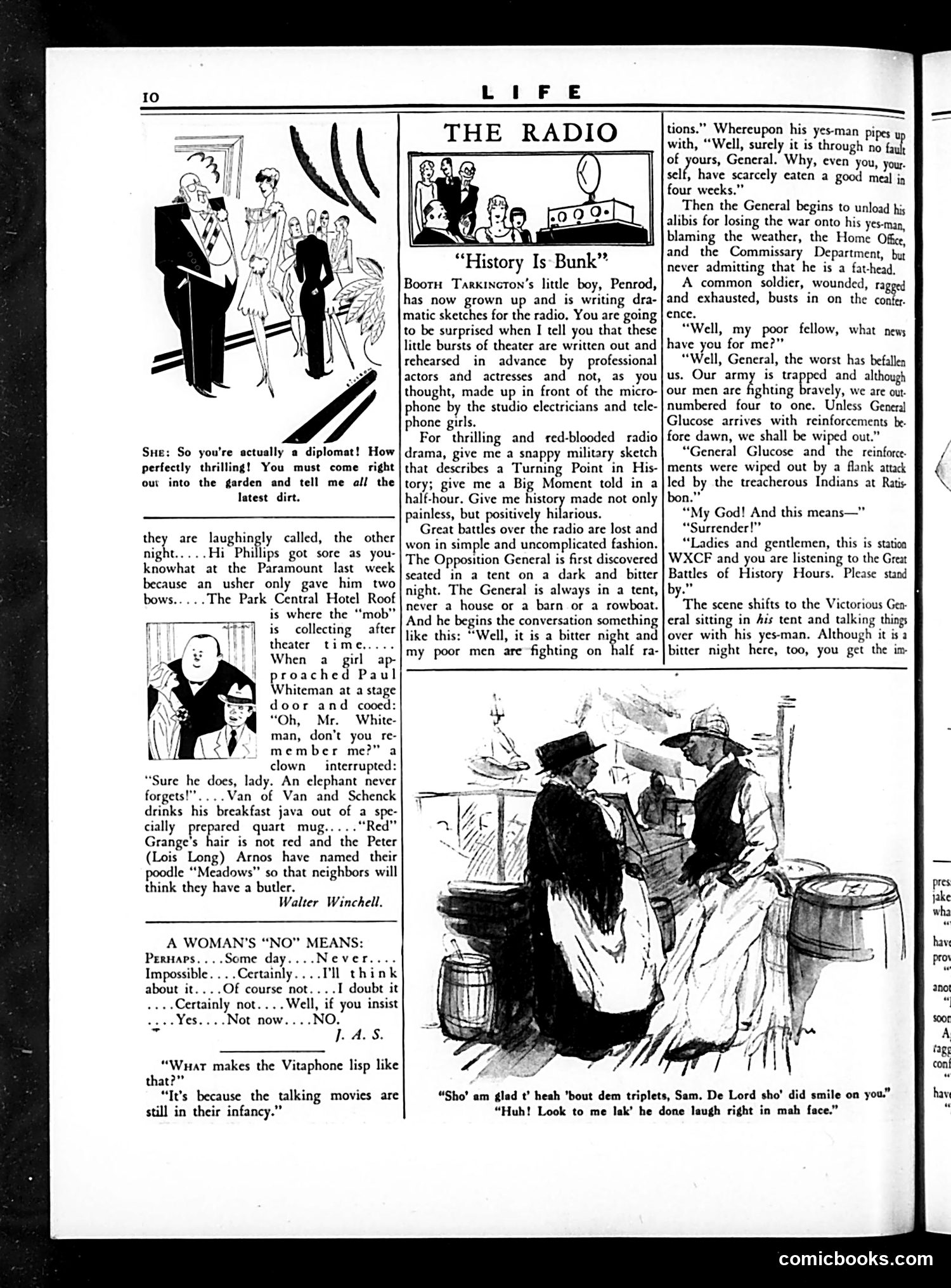
This page satirizes early radio drama production. The main article "History Is Bunk" mocks radio's pretensions: it describes how radio stations produce scripted "dramatic sketches" with professional actors and actresses, treating them as serious theater despite their limited, invisible format. The cartoons highlight the absurdity of this medium. The top left shows a diplomat at a social gathering—the joke being that radio creates artificial "diplomacy" between studios and listeners. The lower illustration depicts dock workers discussing a radio drama about "triplets," suggesting that ordinary working people are now consuming manufactured theatrical content through this new technology. The satire targets radio's theatrical pretensions and the gap between production effort and the intimate, invisible nature of the broadcast medium itself.
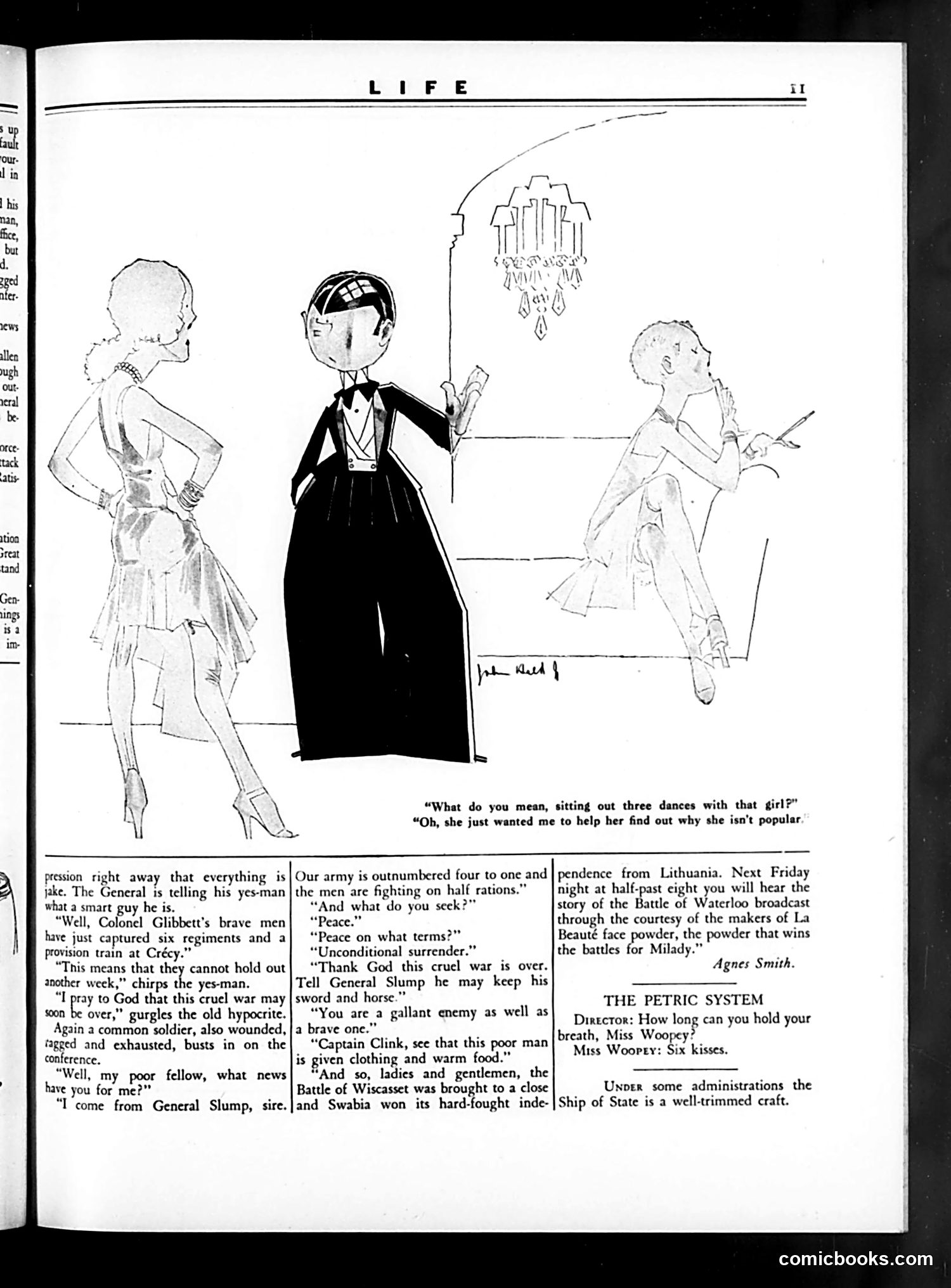
This page from *Life* magazine contains a single-panel cartoon about social dynamics and popularity. The illustration shows three figures at what appears to be a formal event (indicated by the chandelier and evening wear): two women in stylish dresses flanking a man in a tuxedo. The caption reveals the joke: a man explains he's been "sitting out three dances with that girl" to "help her find out why she isn't popular." The humor satirizes male social maneuvering—the man is publicly ignoring the woman, ostensibly doing her a favor by making her unpopularity obvious to others, when he's actually humiliating her. It mocks both male condescension and the superficial social hierarchies governing 1920s courtship and popularity contests among the wealthy.
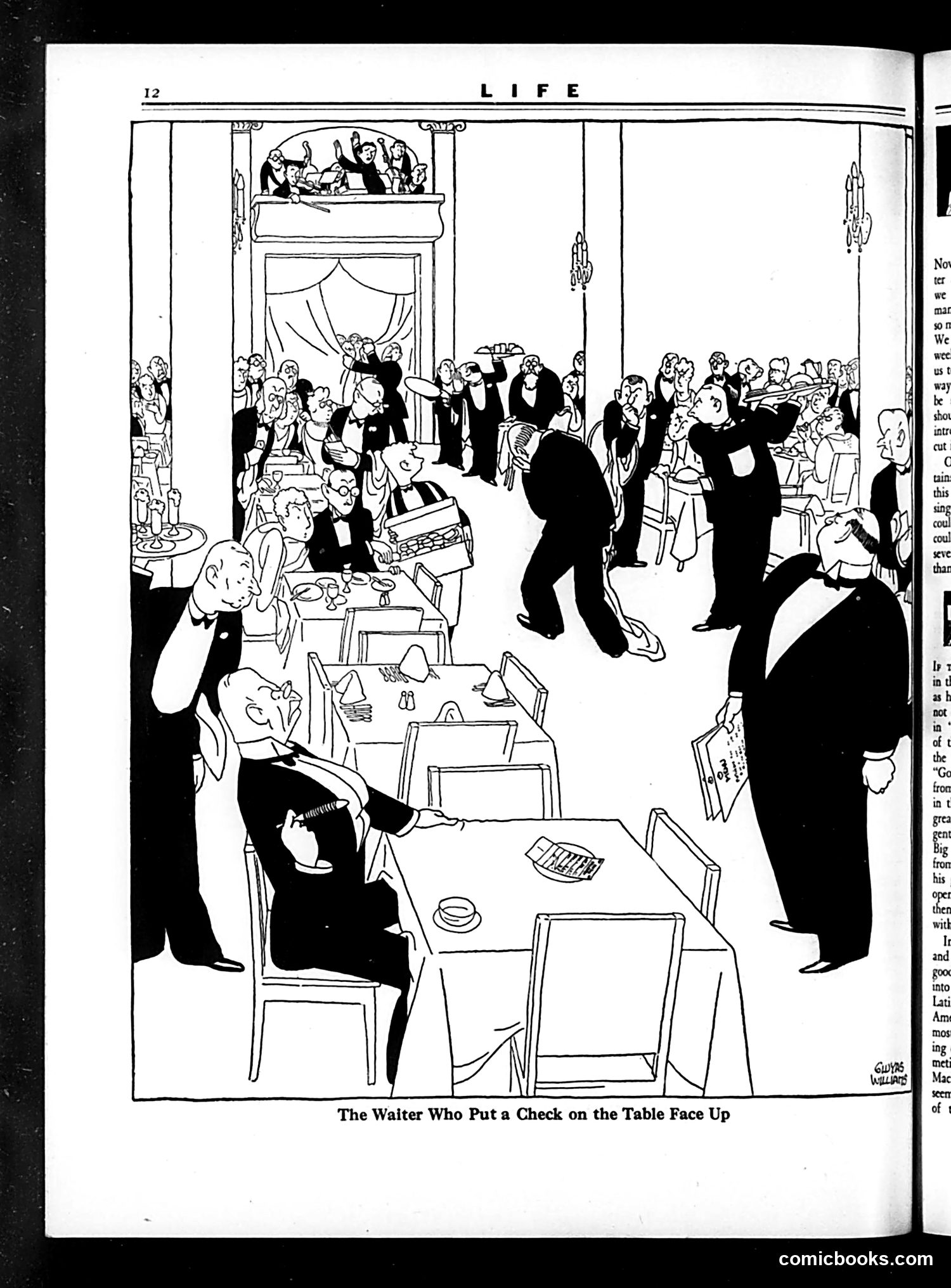
This is a humorous cartoon about restaurant etiquette from Life magazine's satirical archives. The scene depicts a formal dining establishment where a waiter has committed a social faux pas by placing the bill on the table in full view of all guests—an embarrassing breach of proper service standards. In early-to-mid 20th-century fine dining, presenting the check was meant to be discreet. Placing it face-up publicly humiliated diners by making their financial transaction visible to other patrons. The cartoon mocks this workplace gaffe, showing the resulting awkwardness among the assembled guests and staff. The humor derives from the violation of unspoken restaurant conventions regarding discretion and dignity.
This page reviews contemporary theatrical productions. The text discusses "The Big Pond," "Goin' Home," and "Gentlemen of the Press"—plays criticized for being poorly written and directed despite featuring notable actors. The small cartoon appears to depict theater-goers in a dramatic moment, likely satirizing audience reactions or theatrical conventions of the era. The author (Robert Benchley) argues these plays have untrustworthy critics and flawed execution. He notes the cast includes Kenneth McKenna and Richard Hale in a "Negro role," reflecting the casual racial casting of 1920s theater. The central satirical point: despite Broadway's prestige and high ticket prices, audiences are suffering through mediocre productions written by and featuring untalented performers—a commentary on commercialism over artistic quality in American theater.
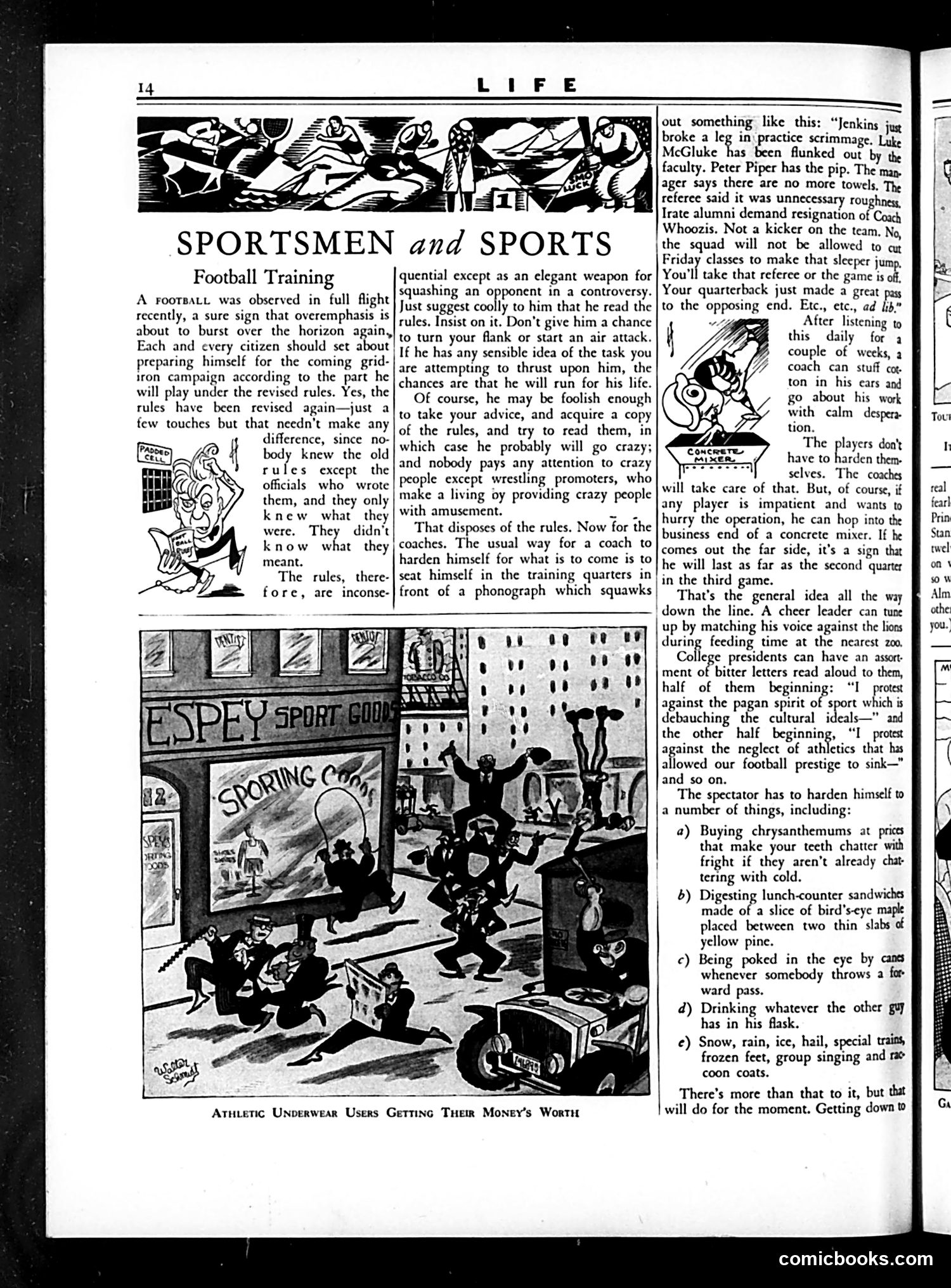
This page satirizes football coaching practices and spectator culture. The main cartoon depicts athletic underwear shops as sites of chaos, with men in various states of undress engaged in physical comedy—labeled "Athletic Underwear Users Getting Their Money's Worth." The accompanying article criticizes over-emphasis on physical roughness in football, arguing rules have been revised but coaches and officials still misunderstand them. It mocks "crazy" rule interpretations and suggests coaches train by listening to phonograph recordings rather than understanding actual regulations. The satire targets both the commercialization of sports (underwear marketing) and the general confusion around football rules, portraying athletic culture as simultaneously absurd and poorly informed.
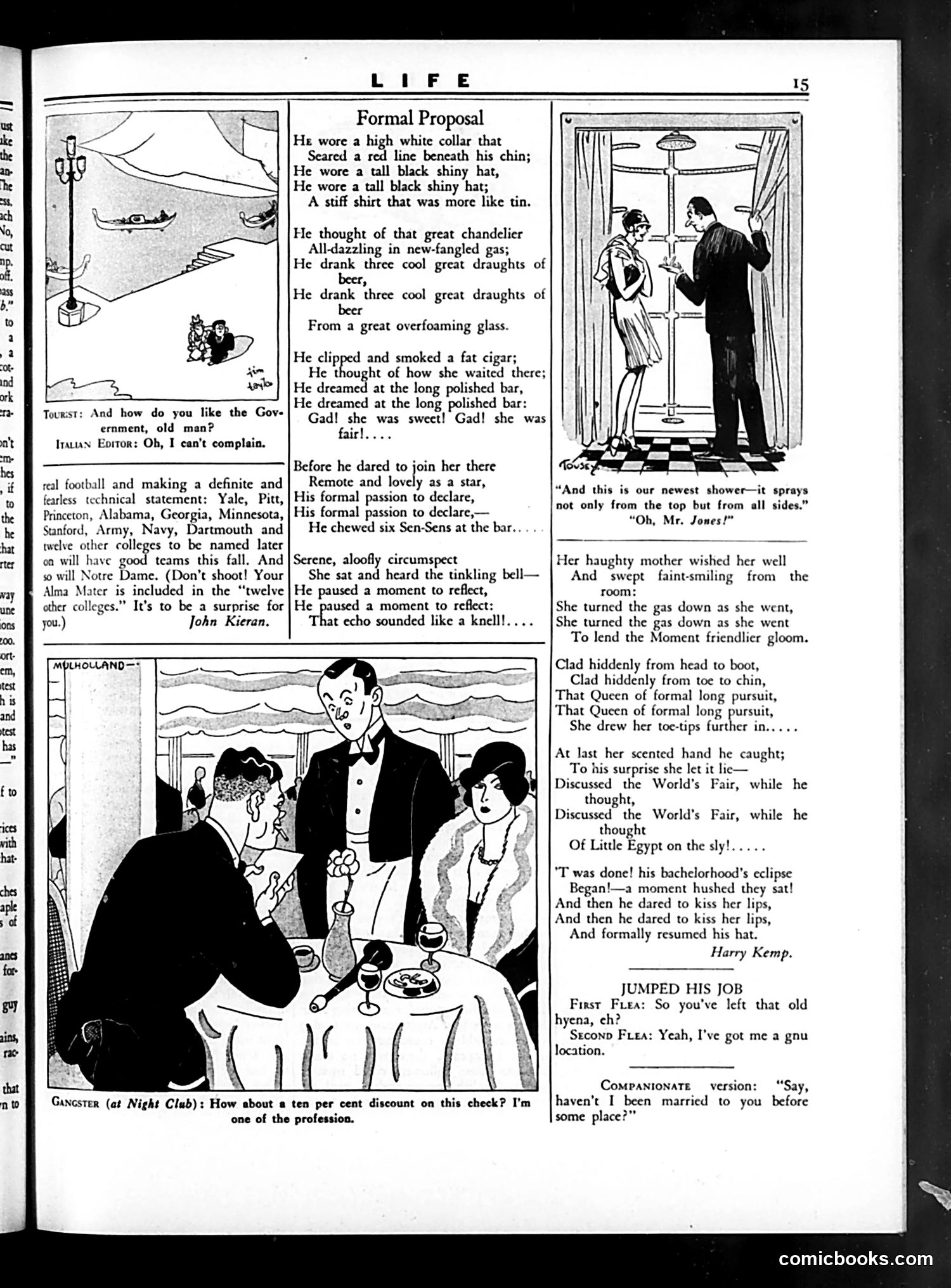
This page satirizes formal courtship rituals of the early 20th century. The poem "Formal Proposal" by Harry Kemp mocks an overdressed suitor—wearing a high white collar, stiff shirt, and tall black hat—who must work up courage to propose to a woman at a bar. The humor derives from the contrast between his elaborate formal appearance and his anxiety. He fantasizes about her while smoking cigars and drinking, finally kissing her after discussing the World's Fair. The poem suggests that despite rigid social conventions requiring formal dress and ceremonial behavior, courtship remains fundamentally awkward and emotionally messy. The accompanying cartoons (including one captioned about a "Gangster at Night Club") appear to illustrate urban social scenes of the Jazz Age, contrasting formal pretense with casual reality.
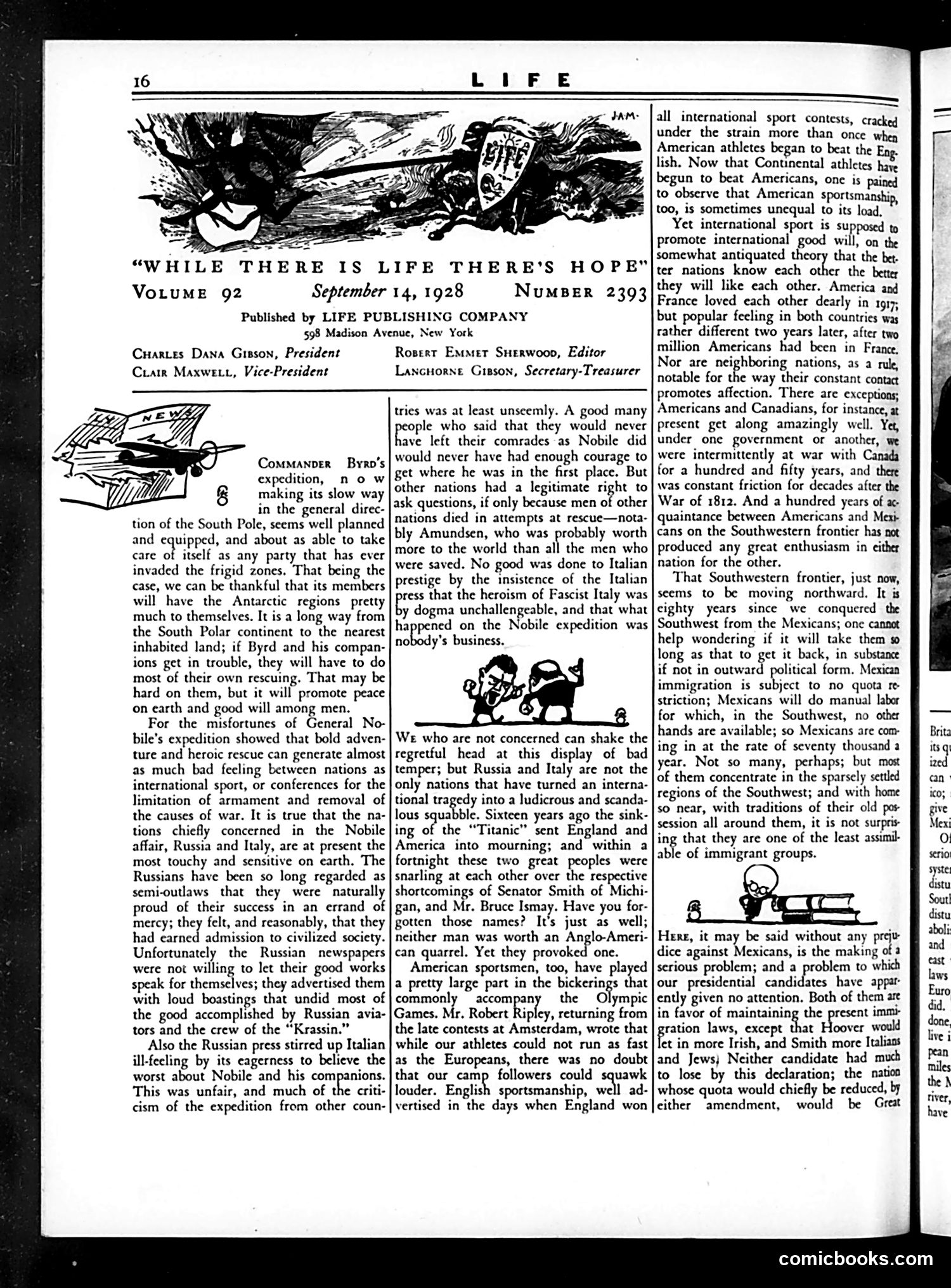
This page discusses international sports competitions and their diplomatic implications. The text criticizes how nations use athletic achievement for propaganda, citing recent tensions between Russia, Italy, and other countries. Two cartoon illustrations appear to show caricatured figures in conflict—likely representing different nations competing or quarreling. The text specifically mentions Russia and Italy stirring up "ill-feeling" through press coverage of athletic events, and references England's past Olympic victories being used for national prestige. The broader satire targets how governments exploit sports to advance nationalist agendas and generate international tensions, rather than promoting genuine goodwill. The cartoons appear to depict this competitive hostility between nations using sports as a proxy for larger geopolitical disputes.
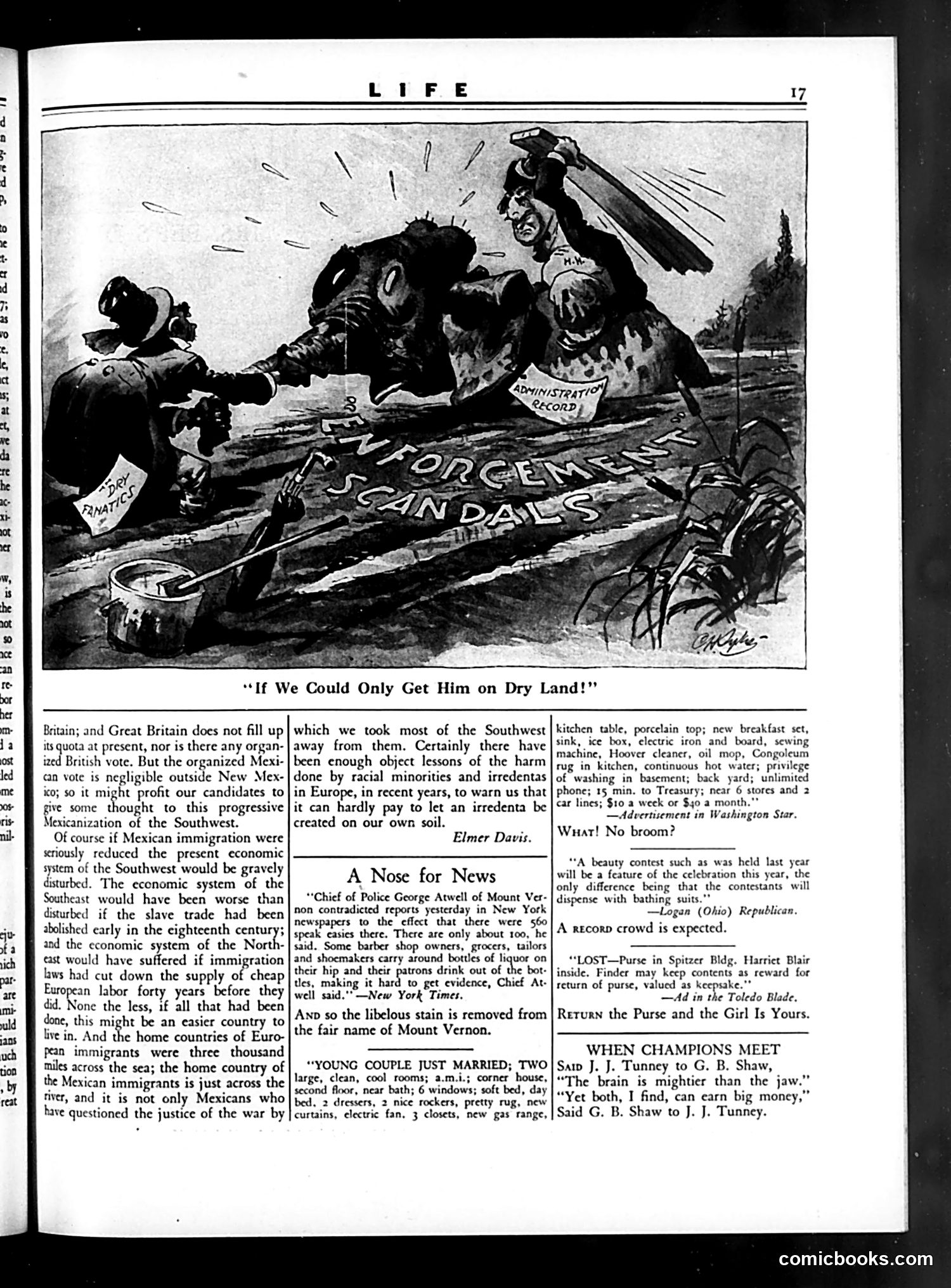
This cartoon satirizes fears about Mexican immigration and alleged "foreign scandals" affecting American politics. The caricatured figures—appearing to represent political opponents or ethnic stereotypes—are depicted struggling to contain or manage something labeled "Foreign Scandals" that's partially submerged in water. The accompanying text by Elmer Davis discusses concerns about Mexican immigration's economic impact on the American Southwest, referencing debates about labor competition and cultural assimilation. The cartoon's aquatic setting likely metaphorically represents the difficulty of controlling immigration or external political influences—suggesting that these "foreign" problems persist despite attempts to manage them. The satire reflects 1920s-era anxieties about immigration and foreign entanglements in American politics.
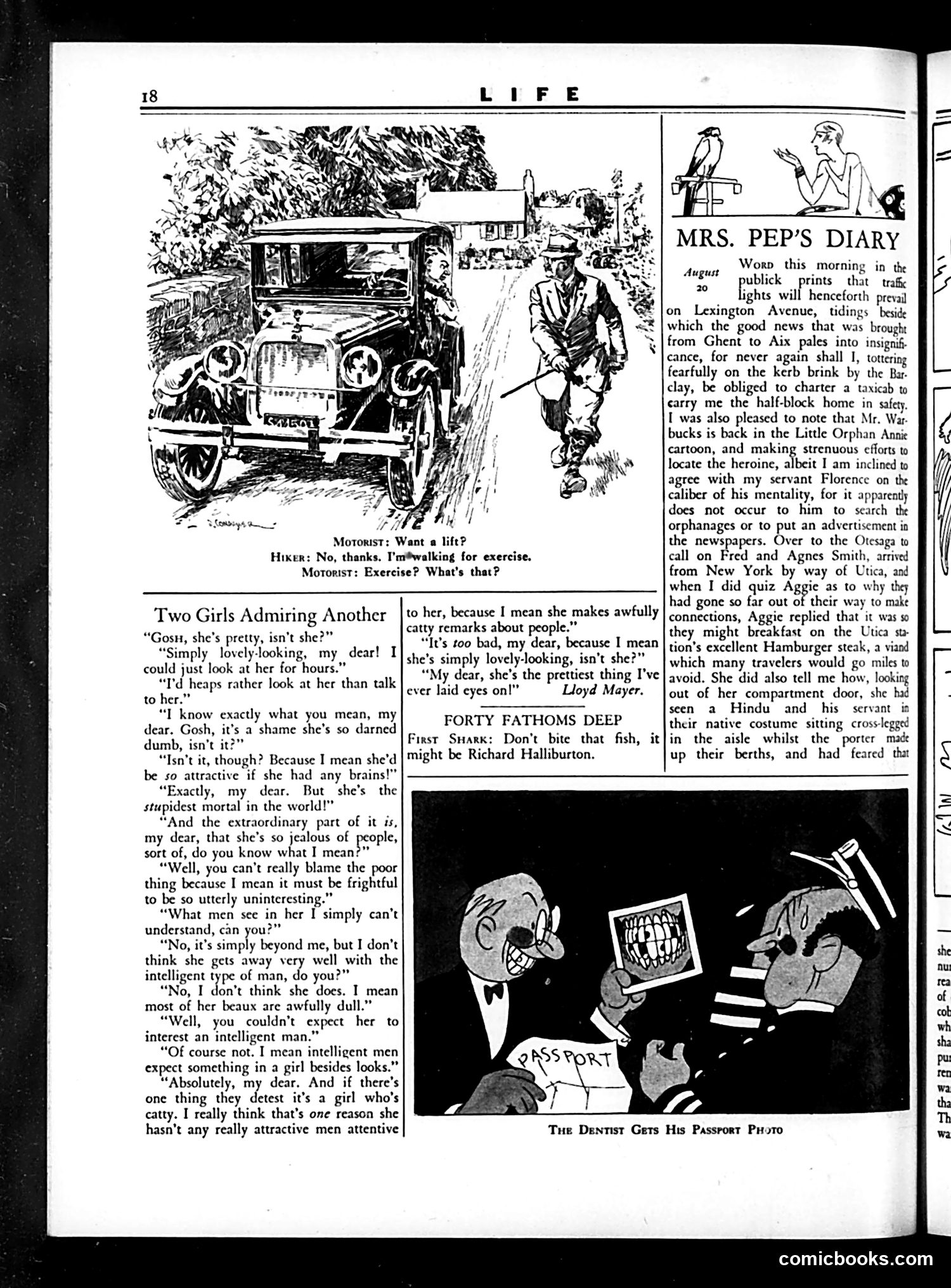
This Life magazine page contains three satirical pieces: **"Two Girls Admiring Another"**: A dialogue skewering female cattiness and hypocrisy. Two women repeatedly praise a third woman's beauty while simultaneously insulting her intelligence, dullness, and jealousy—then circle back to praising her looks. The satire exposes how women can be simultaneously envious and dismissive, and how appearance-obsession conflicts with valuing intellect. **"Motorist" cartoon**: A simple joke about the decline of exercise culture—the hiker claims to be "walking for exercise," which the motorist finds so absurd he questions what exercise even is, reflecting 1920s-30s automobile culture replacing pedestrian activity. **"Forty Fathoms Deep"**: An obscure reference, likely to adventurer Richard Halliburton (a famous 1920s-30s traveler), warning against eating mysterious fish that might be him—dark humor about his mysterious disappearance or reputation. **"Mrs. Pep's Diary"**: Society gossip mixed with pop-culture references (Little Orphan Annie cartoon) and travel anecdotes, typical of the era's light satirical commentary.
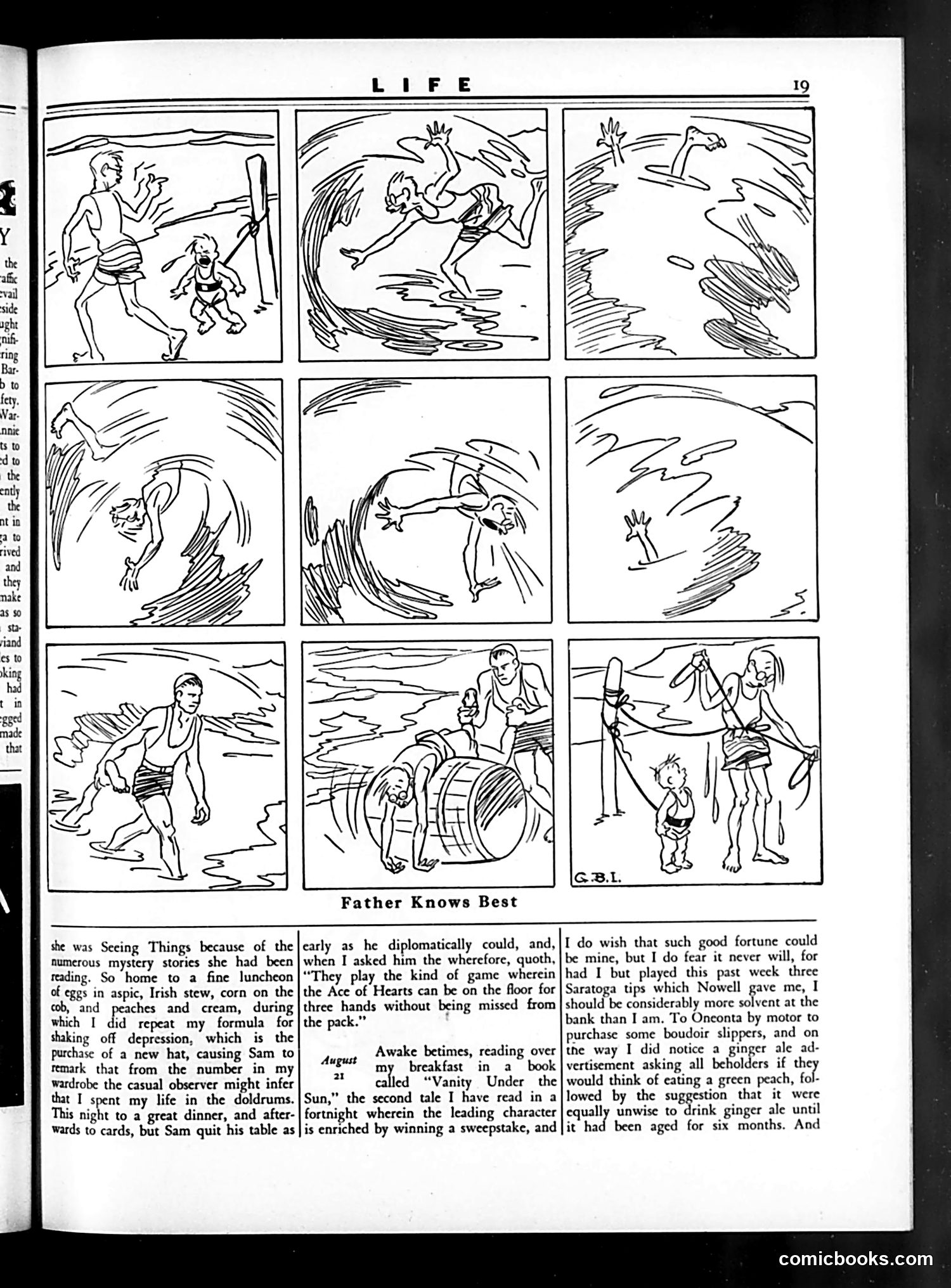
This page contains a comic strip titled "Father Knows Best" (visible at bottom) depicting domestic scenes of parents and children at play and leisure activities—swimming, surfing, playing with barrels, and jump rope. The accompanying text is a diary entry dated August 21, written in a humorous, gossipy tone about mundane daily life: lunch menus, depression remedies (buying hats), card games, and reading fiction. The writer mentions a husband named Sam who observes that her hat collection suggests she lives in "doldrums," and notes his skepticism about a card game where the Ace of Hearts can sit on the floor unnoticed. **For modern readers:** This satirizes upper-middle-class leisure anxieties and domestic routines of early 20th-century America—the obsession with shopping, sweepstakes fantasies, and marital dynamics where husbands gently mock their wives' spending habits. The diary format creates gentle satire of women's concerns and consumer culture rather than sharp political commentary.
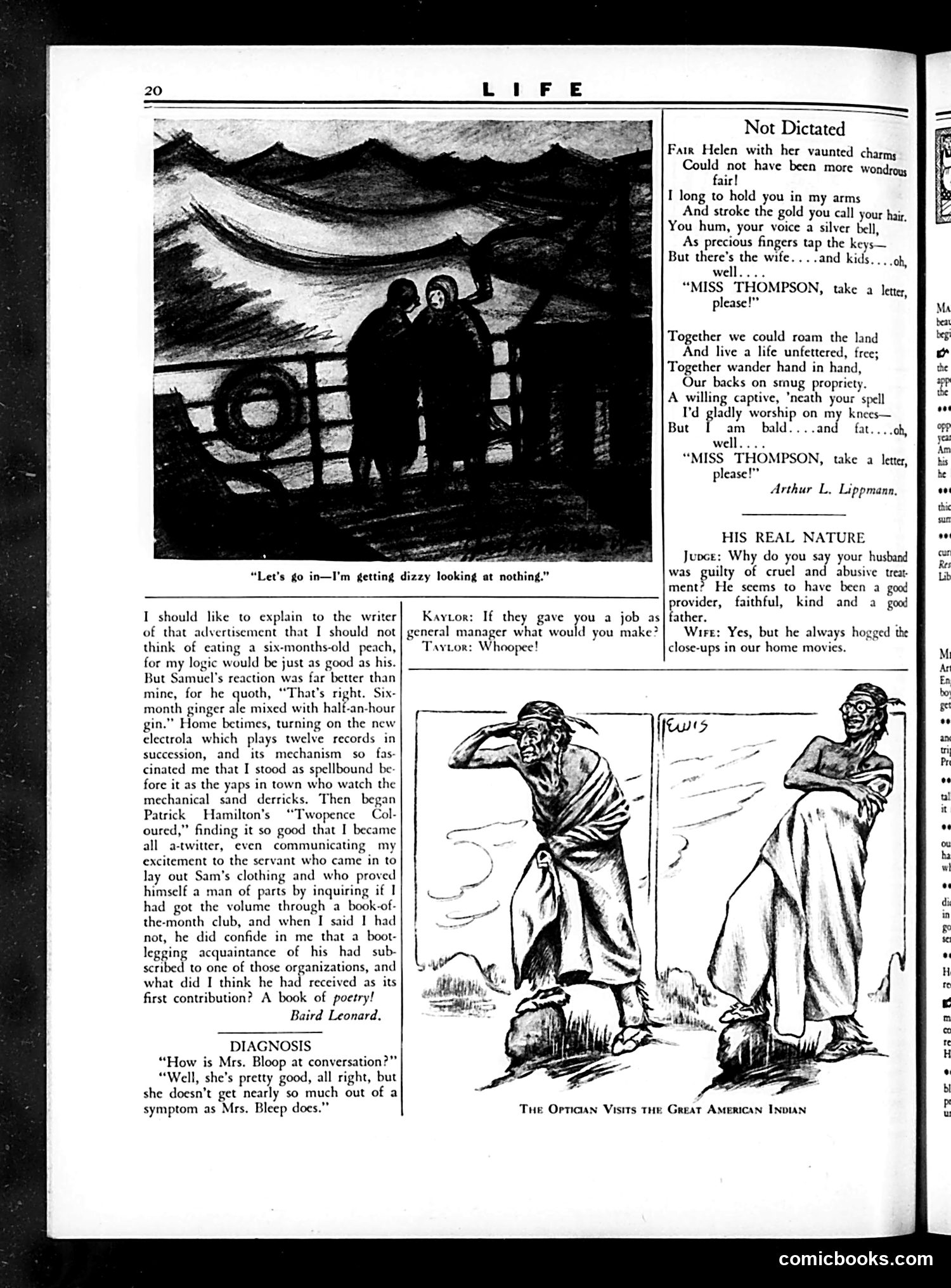
This page contains several satirical pieces typical of 1920s-30s Life magazine humor: **Top cartoon**: Shows a couple at a railing looking at nothing, satirizing modern entertainment and passive leisure—getting "dizzy looking at nothing" mocks contemporary consumerism and novelty-seeking. **"Not Dictated"**: A poem by Arthur L. Lippmann satirizing office romance. A man fantasizes about his secretary Miss Thompson but is constrained by marriage, baldness, and fatness. The repeated refrain "take a letter, please!" undercuts romantic notions with mundane workplace reality—a common theme mocking unfulfilled desires and social propriety. **"His Real Nature"**: A brief joke about marital discord where a wife claims her "good provider" husband was cruel—his crime being hogging camera close-ups in home movies. This satirizes the emerging vanity of home film-making and suggests priorities are comically inverted. **Bottom cartoon**: "The Optician Visits the Great American Indian"—likely satirizing Native American stereotypes and modern eyewear sales, though specific reference is unclear. The overall tone mocks modern consumer culture, workplace dynamics, and domestic life.
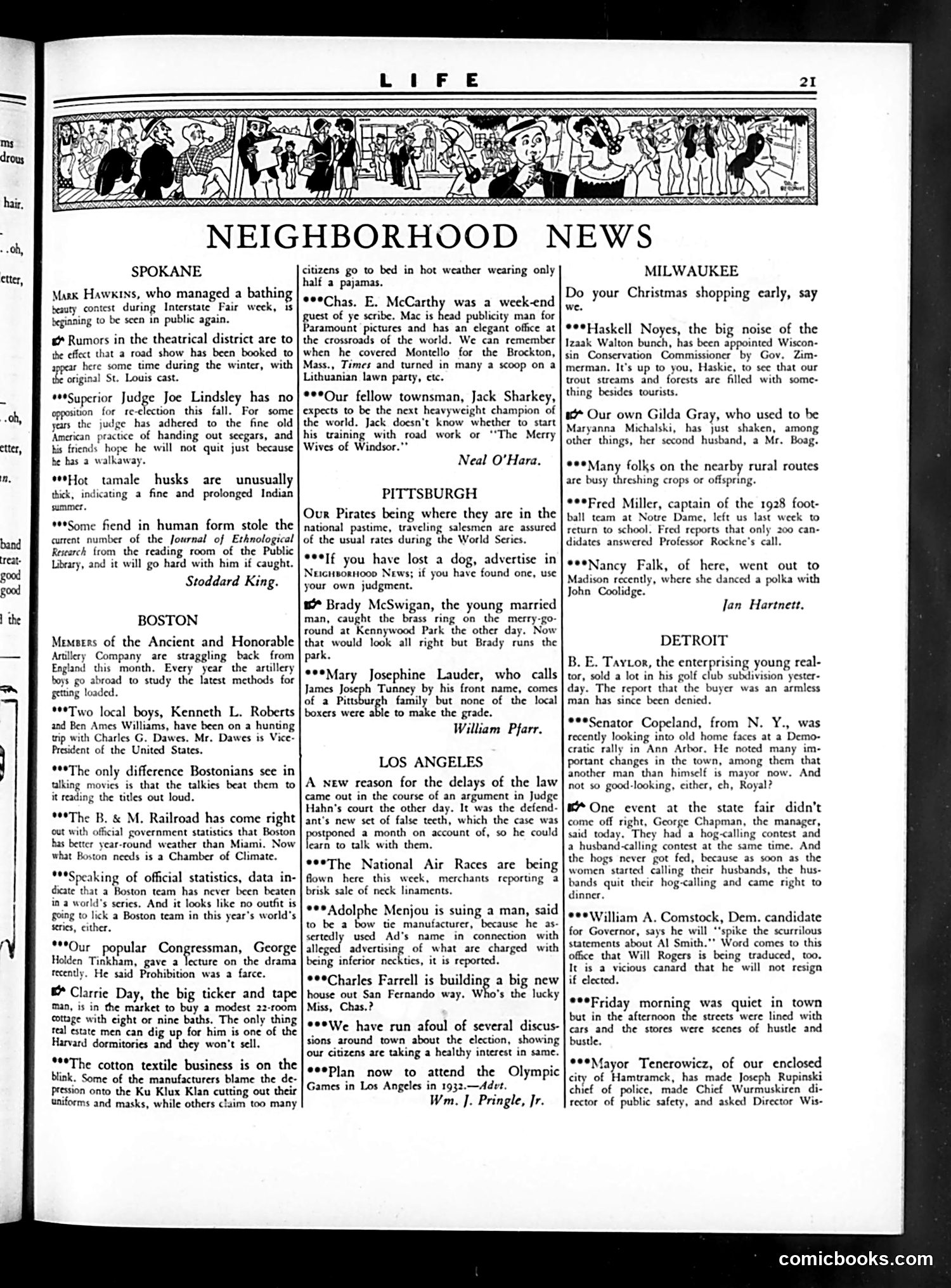
This page contains **no political cartoons**—only a decorative masthead illustration showing social scenes. The content is a "Neighborhood News" column featuring local gossip and humor from five American cities: Spokane, Boston, Pittsburgh, Los Angeles, and Milwaukee. The jokes rely on early 1930s context: - References to **Prohibition** (alcohol ban) and speakeasies - **Vice President Charles Dawes** mentioned as hunting companion - **Jack Sharkey**, a contemporary heavyweight boxer - **Judge Hahn's court delays** in Los Angeles (specific local reference) - **James Joseph Tunney**, likely boxer Gene Tunney The humor is mild social satire: judges handing out cigars, stolen library journals, hot tamale husks predicting Indian summers, Boston's weather vanity, and cotton textile industry depression. The tone is affectionate small-town gossip rather than cutting political commentary. This represents *Life* magazine's lighter content—witty local observations for a national audience seeking amusement during the Great Depression.
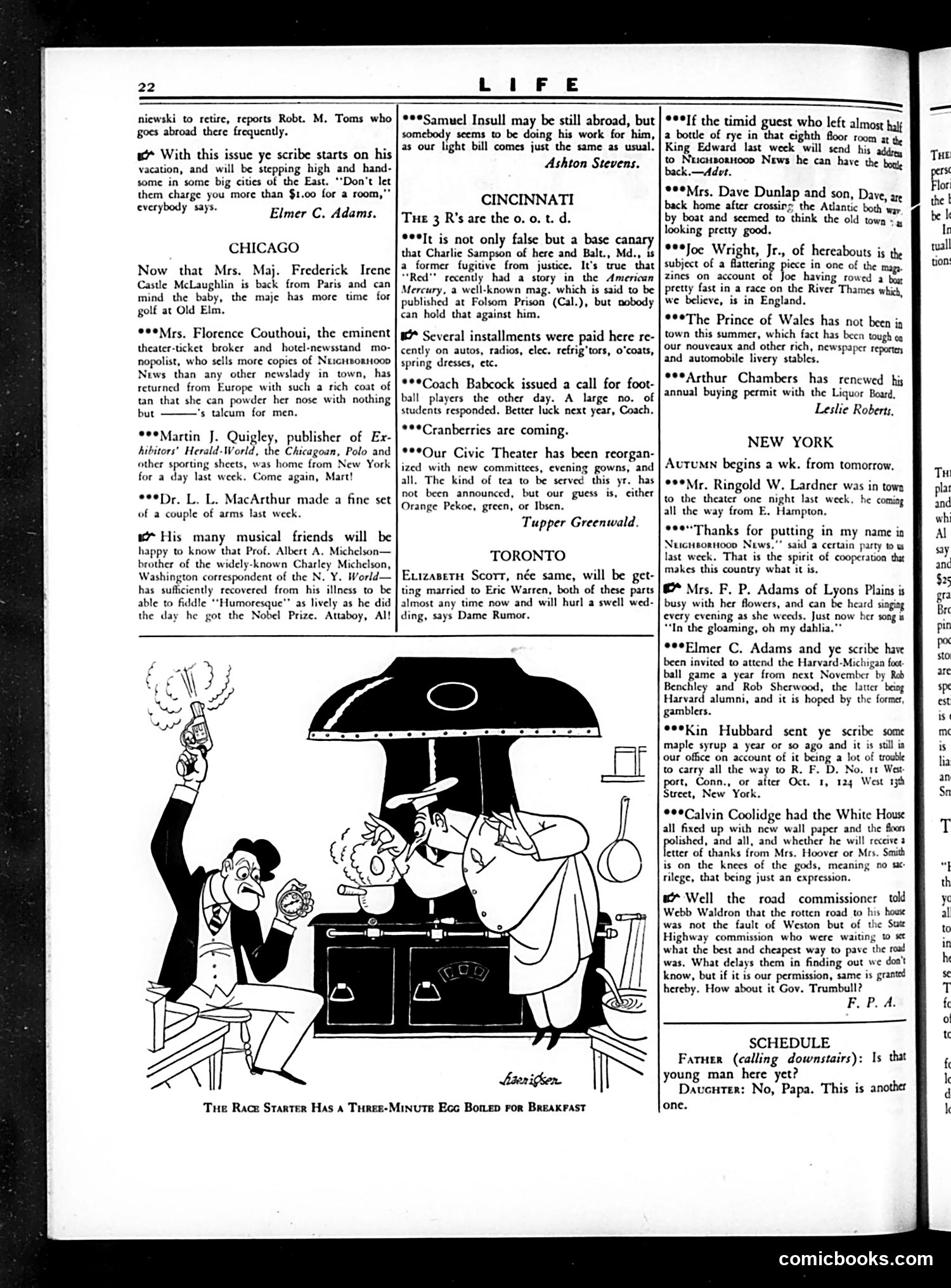
This page from Life magazine contains regional gossip columns from Chicago, Cincinnati, Toronto, and New York, typical of the publication's satirical format. The main cartoon depicts a race starter preparing a three-minute boiled egg for breakfast—a visual joke about precision timing. The absurdist humor reflects Life's comedic style. The text items are brief, gossipy observations about local figures and events. Notable references include Samuel Insull (appearing to be a wealthy businessman whose power persists even while abroad), and the Prince of Wales's absence from town supposedly disappointing wealthy socialites and newspaper reporters. Several items mock minor scandals or pretensions: a false claim about someone being a "fugitive from justice," sarcasm about a civic theater's reorganization, and humor about debts on consumer goods (cars, radios, refrigerators). The overall tone is lighthearted mockery of small-town and urban society figures, emphasizing vanity, social climbing, and minor scandals—characteristic of Life's satirical approach to American life in this era.
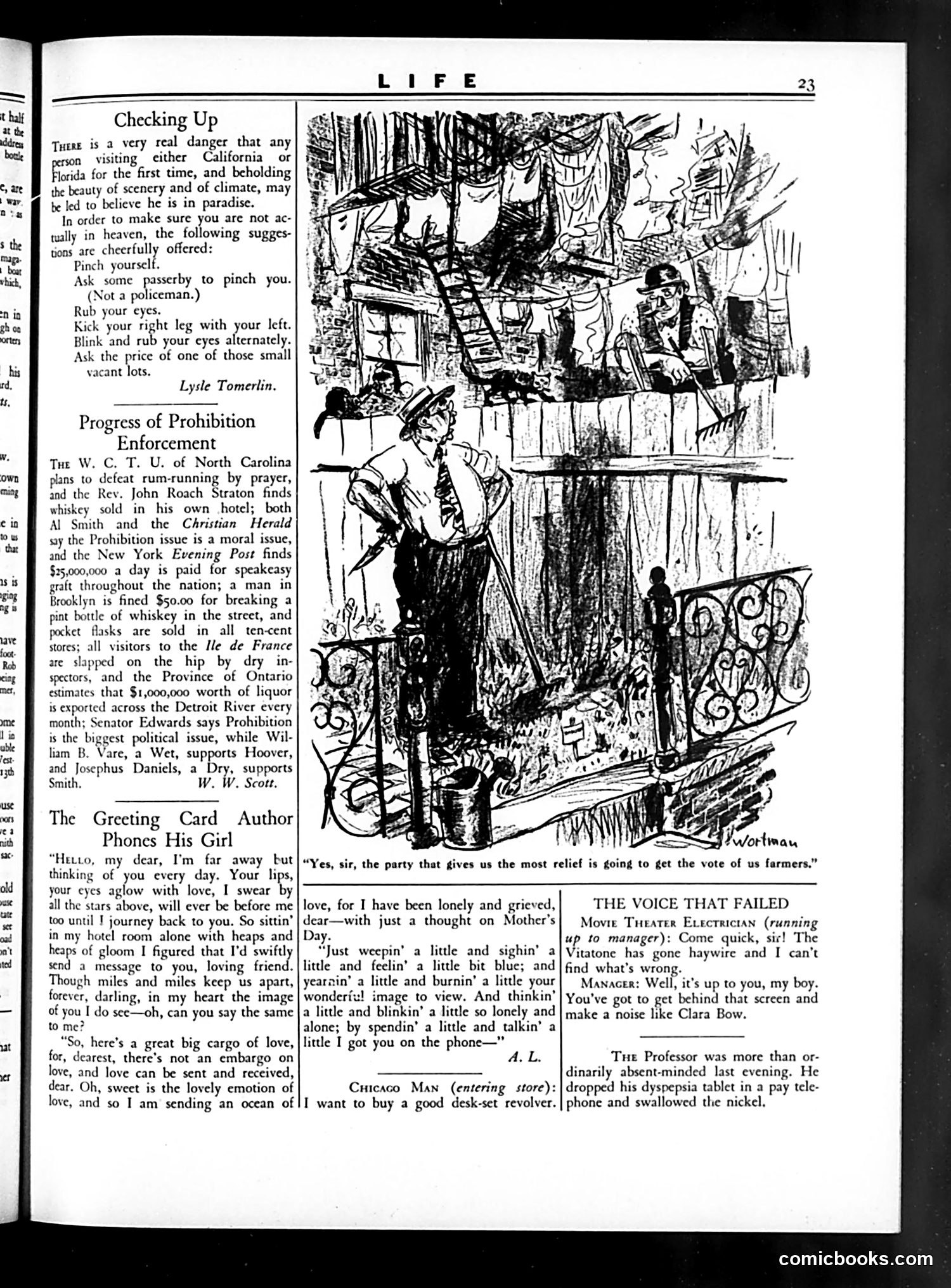
This page contains several satirical pieces typical of 1920s American humor: **"Checking Up"** mocks California and Florida tourism, suggesting visitors verify they're not in heaven by checking real estate prices—implying the paradise-like scenery masks expensive, ordinary land. **"Progress of Prohibition Enforcement"** catalogs the absurd contradictions of Prohibition enforcement under the WCTU (Women's Christian Temperance Union). It contrasts religious groups' moral crusades against alcohol with widespread corruption: $25 million daily in speakeasy graft, $1 million monthly liquor smuggling from Canada, and minor offenders fined while politicians debate the issue. The piece satirizes Prohibition's failure despite aggressive enforcement. **The cartoon** depicts a farmer telling a politician that whichever party provides "the most relief" gets farm votes—referencing Depression-era agricultural hardship and farm subsidies becoming political currency. **Other brief gags** mock greeting-card sentimentality and early "talking picture" technology failures, when synchronization problems required sound engineers to improvise noises behind the screen.
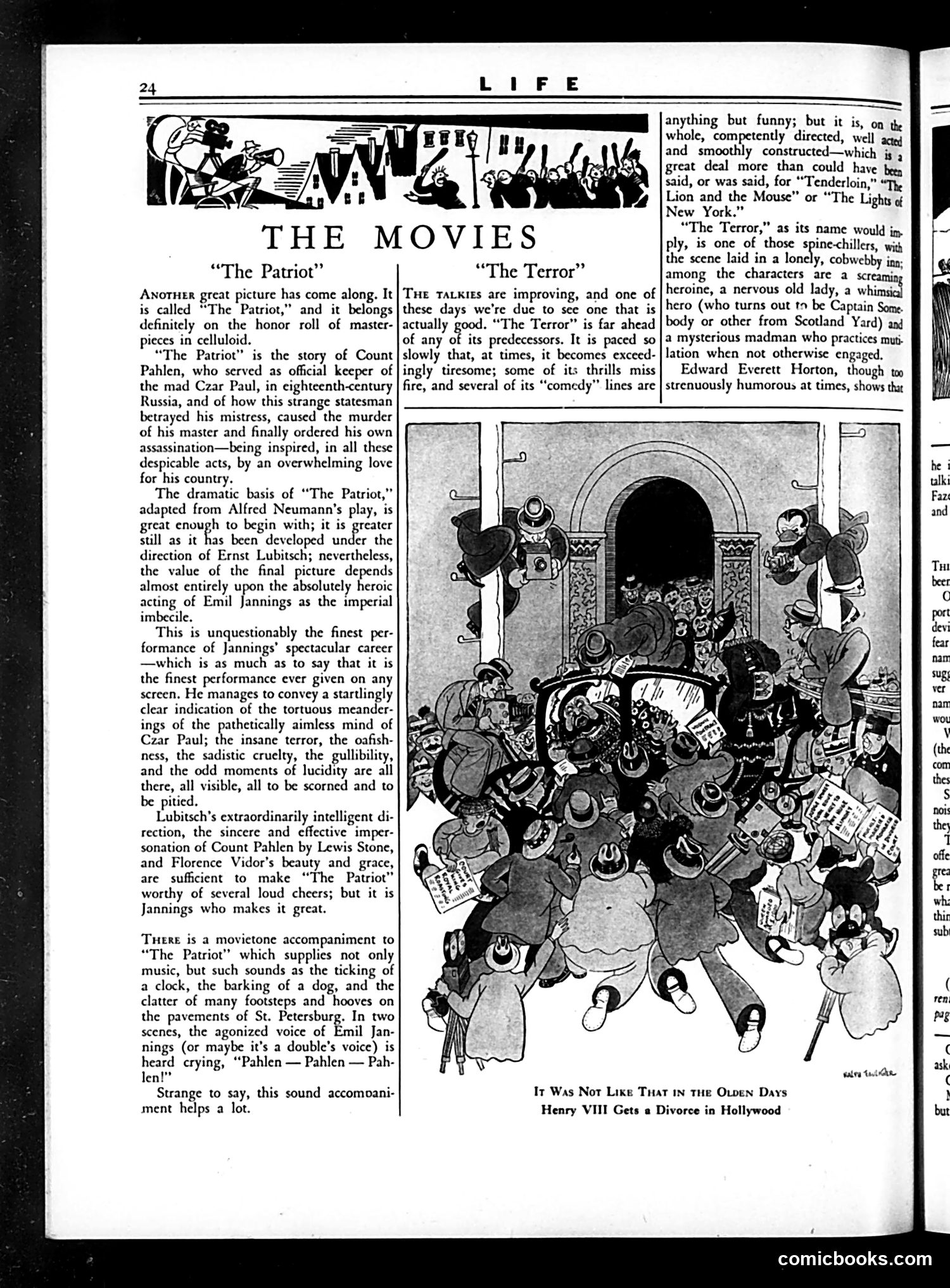
This page reviews two early sound films. "The Patriot" is praised as a masterpiece about an 18th-century Russian Count who betrays his mistress and orders his ruler's murder—all supposedly for patriotic reasons. The review credits Emil Jannings's acting as exceptional for conveying Czar Paul's mental deterioration and cruelty. "The Terror" is a "talkies" (sound film) thriller set in a haunted inn, featuring standard horror-genre characters: a screaming heroine, nervous old lady, mysterious hero, and a murderous madman. The review notes the film is competently made but slow-paced, with some failed attempts at comedy. The caption references "Henry VIII Gets a Divorce in Hollywood," suggesting Hollywood is treating historical material with irreverent modernization. The cartoon (not fully visible) likely satirizes this anachronistic approach to serious subjects.
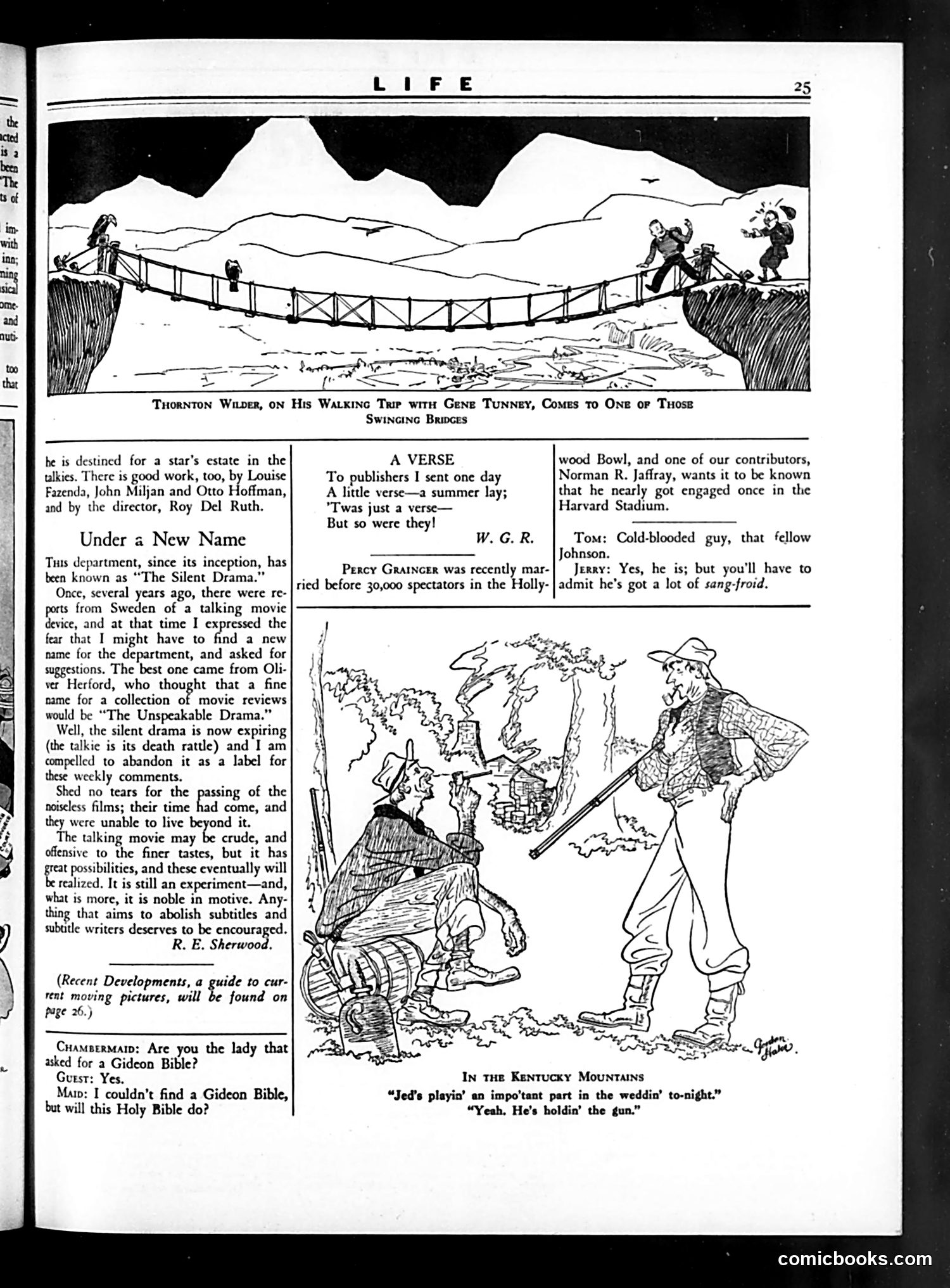
This page contains several brief satirical pieces typical of Life's humor magazine format: **Top illustration:** Shows Thornton Wilder (author) meeting boxer Gene Tunney while crossing a suspension bridge—a visual joke about their respective public profiles. **"Under a New Name":** Film critic R.E. Sherwood discusses renaming the "Silent Drama" column as talking pictures (talkies) replace silent films. He humorously recalls Oliver Herford's suggestion: "The Unspeakable Drama." The piece celebrates sound film as an improvement, praising its potential despite current crudeness, and celebrating the abolition of subtitles. **Sidebar jokes:** Brief gags including a hotel chambermaid/Bible mix-up and a quip about boxer Johnson's "sang-froid" (literally "cold blood"). **Kentucky Mountains cartoon:** Rural satire depicting a wedding where someone's primary role is "holdin' the gun"—likely a joke about hillbilly violence or shotgun weddings. The page reflects 1920s-era entertainment industry transition and period stereotypes about rural Americans.
This is not a political cartoon but rather a **theater and entertainment listings page** from Life magazine's "Confidential Guide" section. The header illustration depicts various theatrical and entertainment figures in a decorative banner, but these are generic representations rather than caricatures of specific people. The content consists of **brief, sardonic reviews** of Broadway shows and movies then running, written in Life's characteristic witty, irreverent style. Examples of the satire include mocking descriptions like "Diamond Lil"—noting Mae West taking herself "very seriously as an old-time Bowery hostess"—and "Gang War," described simply as showing "ill-feeling between Chicago citizens, evidenced by loud bangs and frequent deaths." The tone is gossipy and dismissive toward popular entertainment, reflecting 1920s cultural commentary. This page serves as a contemporary guide for readers seeking entertainment recommendations with satirical commentary rather than straightforward reviews.
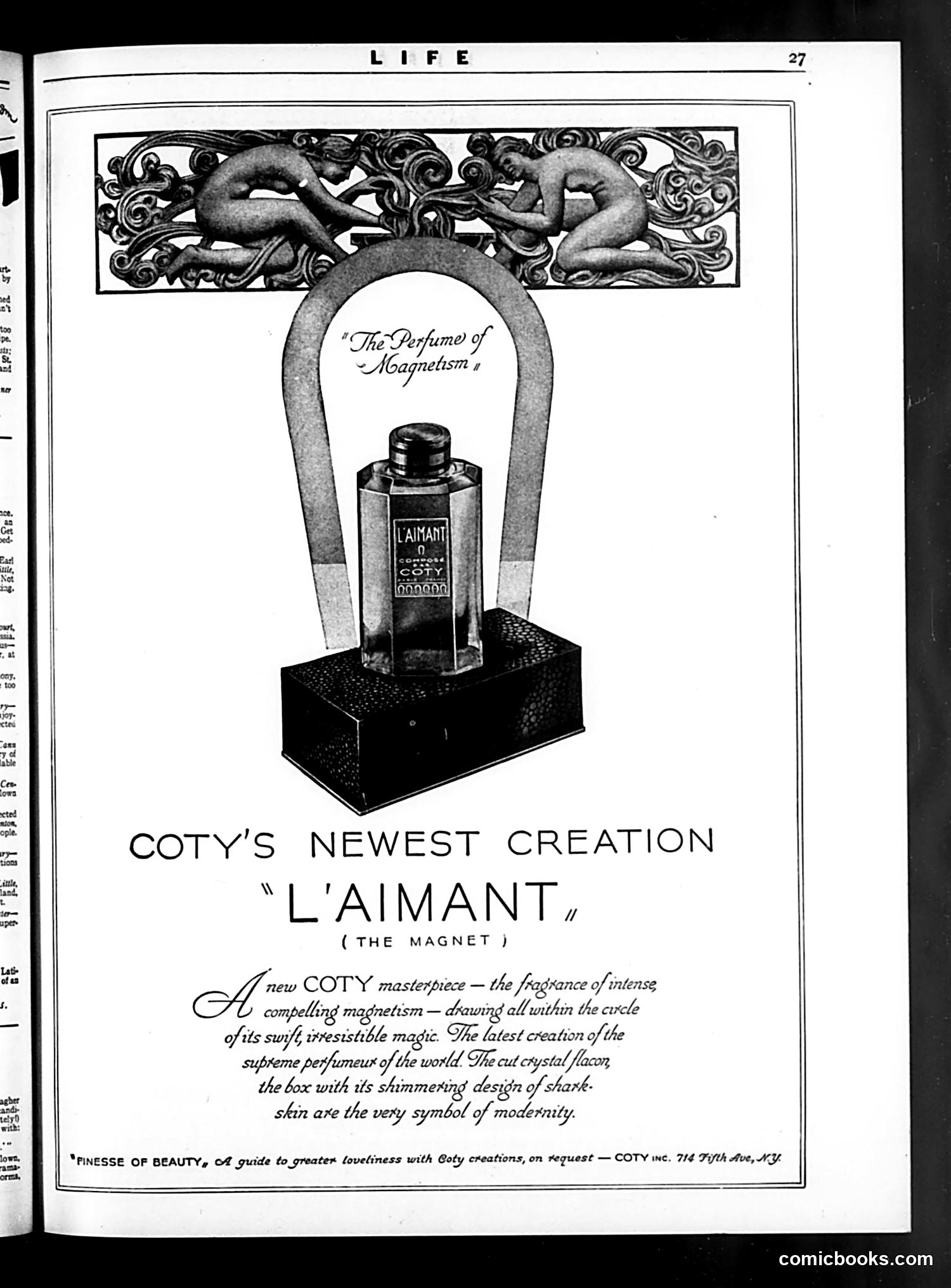
This is not a cartoon or satire—it's a **perfume advertisement** for Coty's "L'Aimant" (French for "The Magnet"), published in *Life* magazine. The page features a product display ad showing a rectangular perfume bottle in a black presentation box, topped with an ornamental horseshoe magnet design. The decorative header depicts classical cherub figures in an art nouveau style. The ad copy uses metaphorical language typical of 1920s-30s luxury marketing: the perfume promises "intense compelling magnetism" and claims to draw people "within the circle of its swift, irresistible magic." The design elements—cut crystal bottle and "shimmering" box—are presented as symbols of "modernity." This represents straightforward commercial advertising presented as editorial content, common in *Life*'s sponsored pages. There is no political commentary or satire intended. The "magnet" concept is purely a marketing hook about the perfume's romantic appeal.
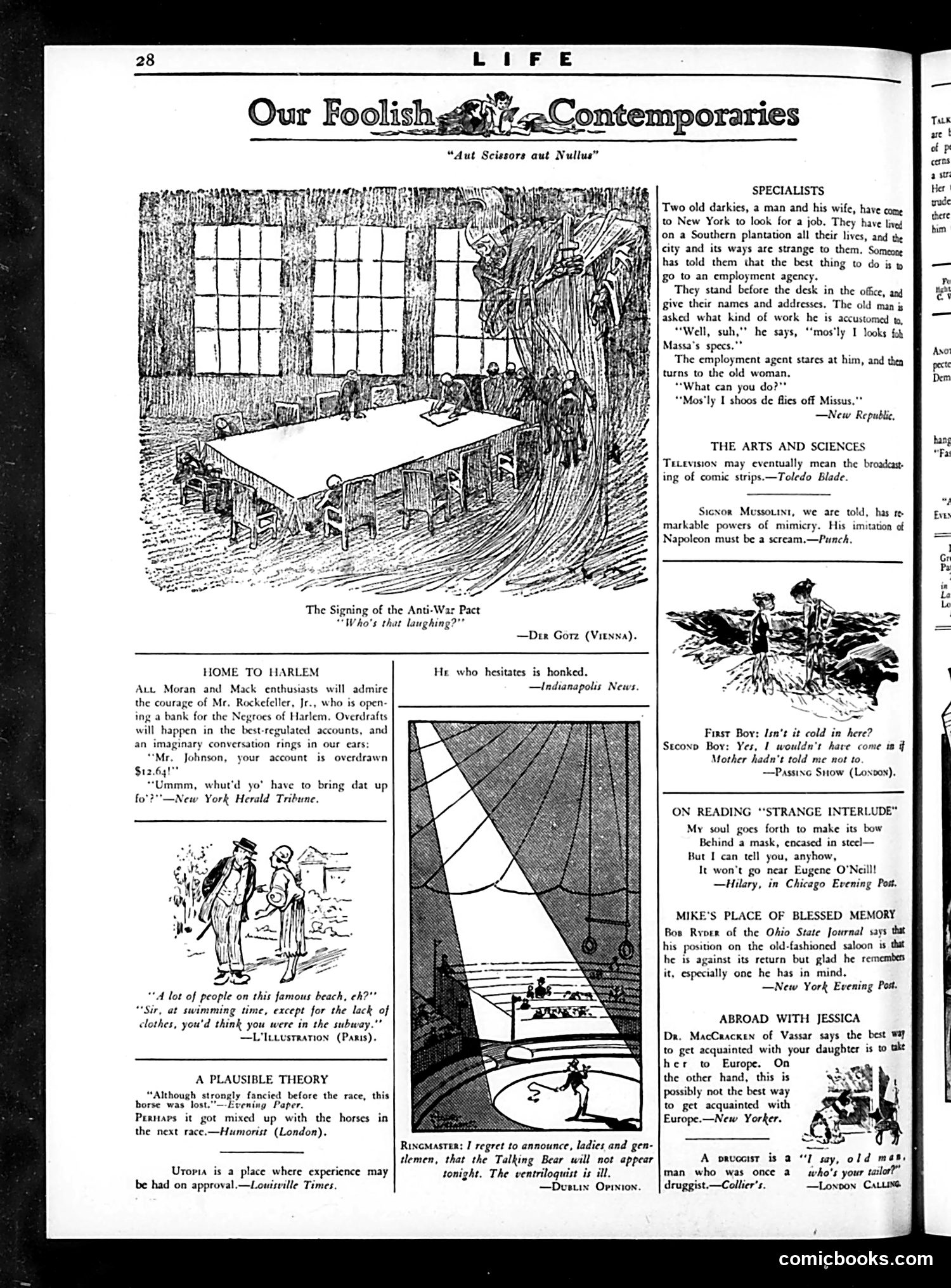
This page collects brief satirical jokes and observations from various newspapers and magazines, mocking contemporary figures and social trends of the era. The main cartoon depicts "The Signing of the Anti-War Pact," showing officials at a desk while someone laughs offstage—satirizing the apparent hypocrisy or futility of peace treaties. Other items mock: Rockefeller Jr.'s bank for Harlem residents (implying skepticism about the venture); a conversation between newly-arrived Black Southern migrants unfamiliar with Northern employment agencies, presented in heavy dialect for comedic effect; and contemporary figures like Mussolini and playwright Eugene O'Neill. The page reflects 1920s-era satire: some jokes target technological change (television broadcasting comics), others mock social pretension and absurdity. The racial humor, while typical of the period, reflects deeply offensive stereotyping now recognized as bigotry. The overall tone mocks institutional folly, affectation, and contemporary celebrity.
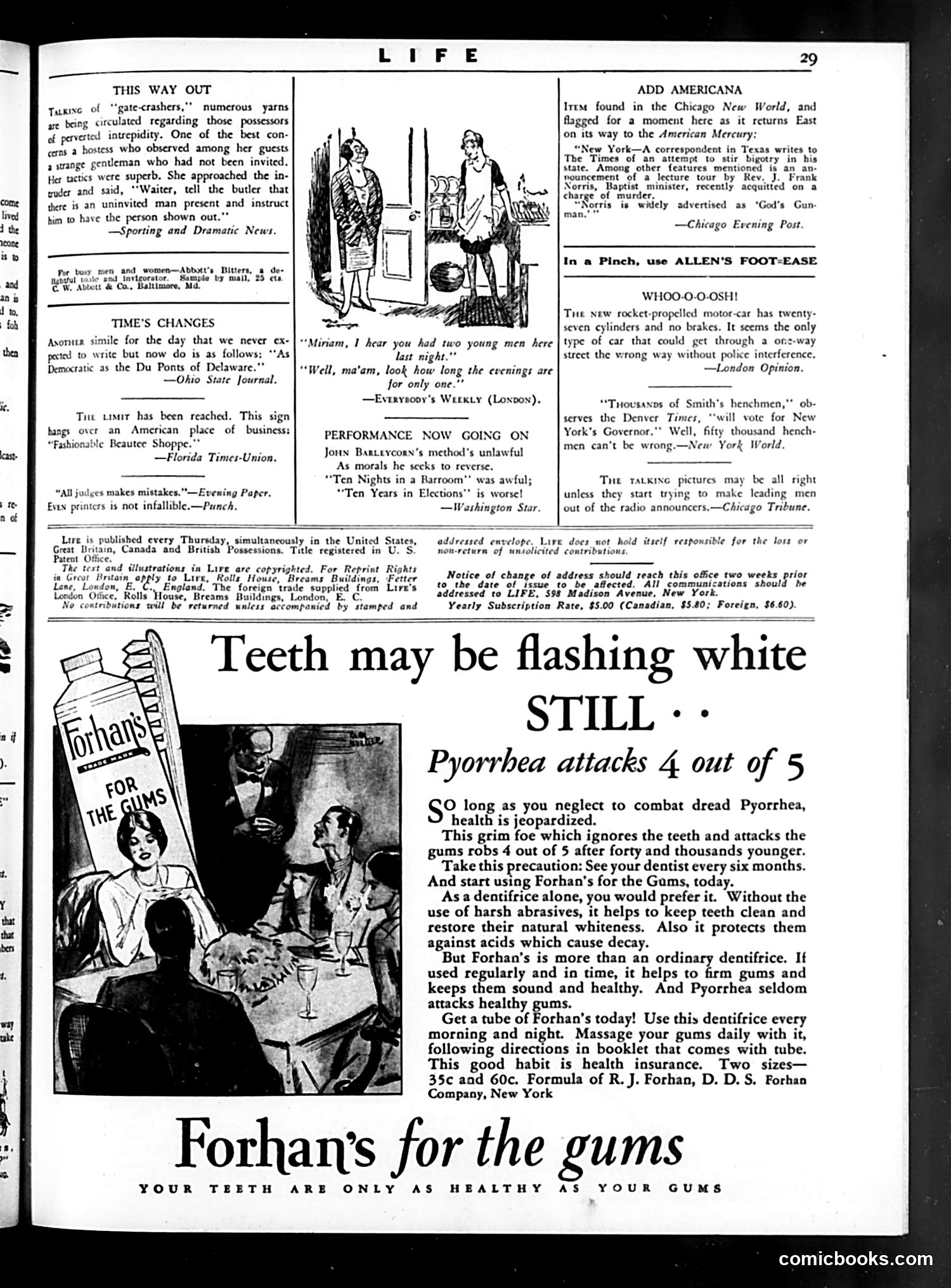
This page contains satirical humor pieces and advertisements typical of 1920s Life magazine. The cartoons and jokes mock social pretensions and modern absurdities: **"This Way Out"** ridicules "gate-crashers"—uninvited party guests—through a anecdote where a clever hostess exposes an intruder by addressing him as "Waiter," forcing him to leave. **"Time's Changes"** includes jokes about shifting social norms, including a quip that the Du Ponts are now "as Democratic" as the general public—satirizing wealthy industrialists' political positioning. **"Performance Now Going On"** references John Barrymore's controversial acting methods, suggesting theatrical morality is questionable. **"Add Americana"** mocks a Texas pastor (Rev. J. Frank Norris) being advertised as "God's Gunman" despite recent murder charges—critiquing religious hypocrisy and sensationalism. Other jokes target modern inconveniences (fast cars without brakes, radio announcers as leading men). The dominant advertisement promotes Forhan's toothpaste for gum disease (pyorrhea), a common health concern of the era.
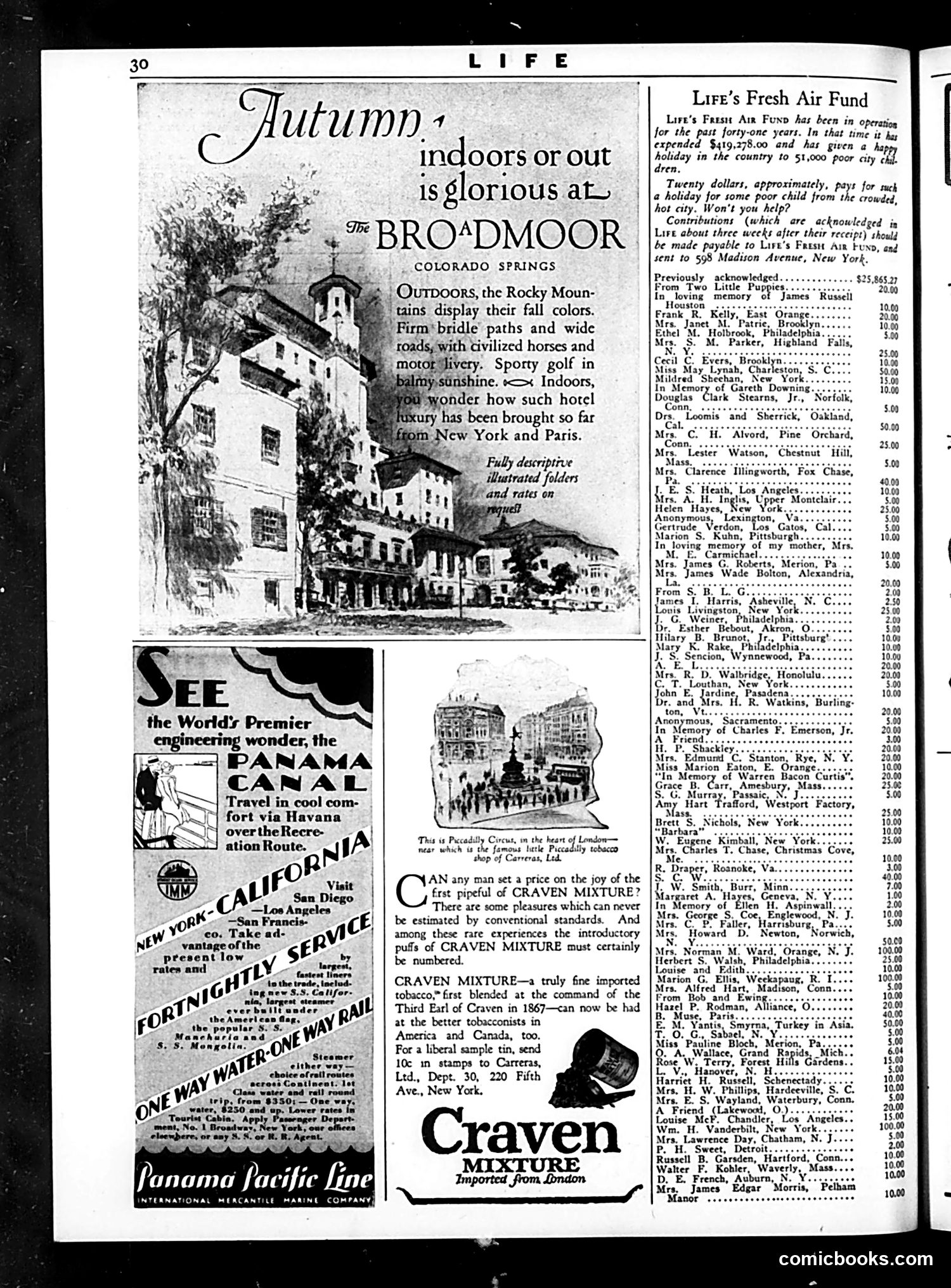
This page from Life magazine is primarily **advertising and philanthropic content**, not political satire. The main elements are: 1. **The Broadmoor Hotel advertisement** (top): A travel ad for Colorado Springs resort, highlighting autumn scenery and luxury amenities—typical hospitality marketing of the era. 2. **Transportation ads** (left): Panama Canal promotion and railroad/steamship travel services, reflecting early 20th-century tourism marketing. 3. **Craven Mixture tobacco ad** (center-right): A British tobacco product advertisement claiming aristocratic origins (supposedly blended for the Third Earl of Craven in 1867). This is straightforward product marketing. 4. **Life's Fresh Air Fund** (right): The dominant content—a charity fund listing donors who contributed to send poor city children on country holidays. The fund had operated 41 years, spent $419,278, and helped 51,000 children. There is **no political cartoon or satirical content** on this page. It's a standard magazine spread combining travel/product advertising with charitable donation acknowledgments.
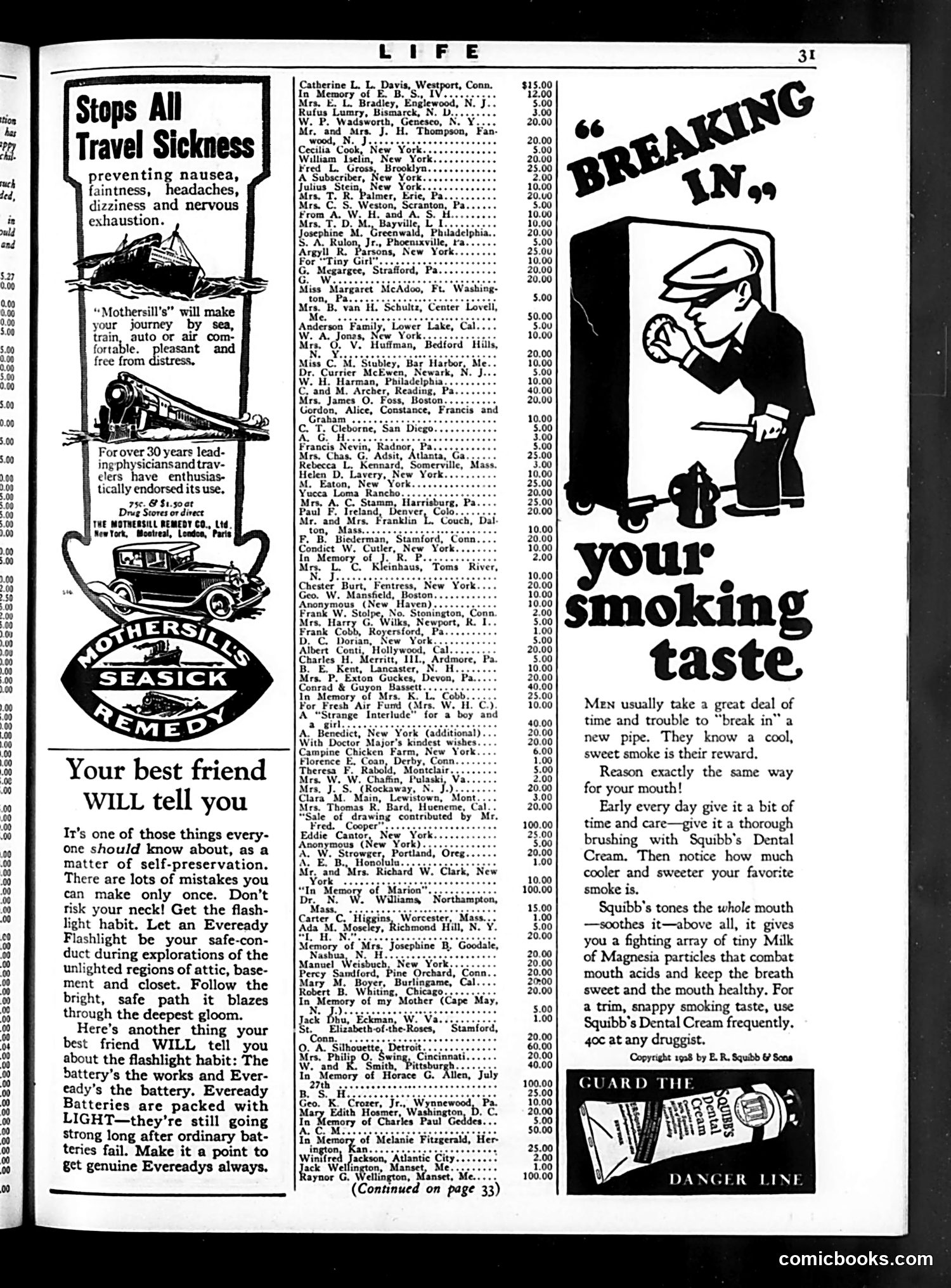
This page contains **primarily advertisements and donor listings**, not political cartoons requiring historical interpretation. The visible ads include: 1. **"Stops All Travel Sickness"** (Mothersills Remedy) — a patent medicine ad promising relief from nausea and dizziness during travel, endorsed by physicians and travelers. Reflects early-20th-century marketing of dubious remedies. 2. **"Breaking In Your Smoking Taste"** — promotes Squibb's Dental Cream for pipe smokers, advising men to "break in" new pipes properly. References contemporary male smoking culture. 3. **"Your Best Friend Will Tell You"** — Eveready Flashlight ad emphasizing battery reliability and safety in dark spaces (attics, basements, closets). The bulk of the page lists **donors and their contributions**, suggesting this issue included a charitable fundraiser, possibly for a hospital, relief fund, or similar cause. No political satire or historical figures are depicted; this is a commercial/informational page typical of 1920s-30s magazine layout.
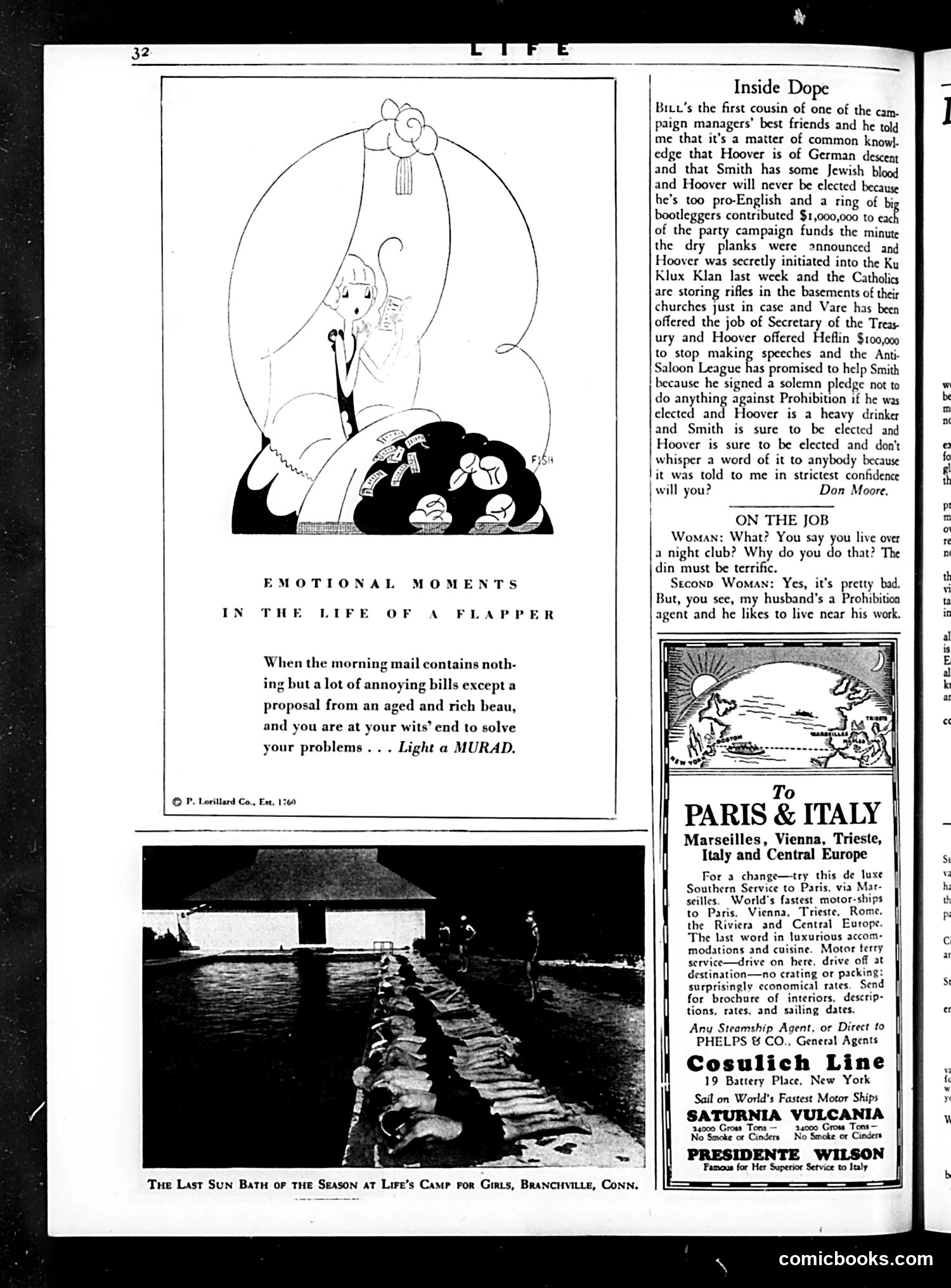
**Top Cartoon ("Emotional Moments in the Life of a Flapper"):** A stylized illustration shows a young woman receiving a marriage proposal from a wealthy older man. The joke: when facing bills and financial troubles, she considers marrying him—the caption suggests lighting a Murad cigarette to calm her nerves. This mocks 1920s "flapper" culture and women's economic dependence on marriage. **"Inside Dope" Column:** Political gossip about the 1928 U.S. presidential race between Herbert Hoover and Al Smith. The satirist lists absurd, contradictory rumors: Hoover has German descent/is too pro-English, Smith has Jewish blood, both are supposedly receiving illegal campaign funds, Hoover joined the KKK, Catholics are stockpiling weapons, etc. The satire mocks how baseless political rumors spread and how voters believe unverified "inside information." **"On the Job" Joke:** A Prohibition-era quip about a woman living above a nightclub because her husband, a federal Prohibition enforcement agent, needs proximity to his work—implying he raids illegal speakeasies. The page is primarily advertising (ocean liners, cigarettes).
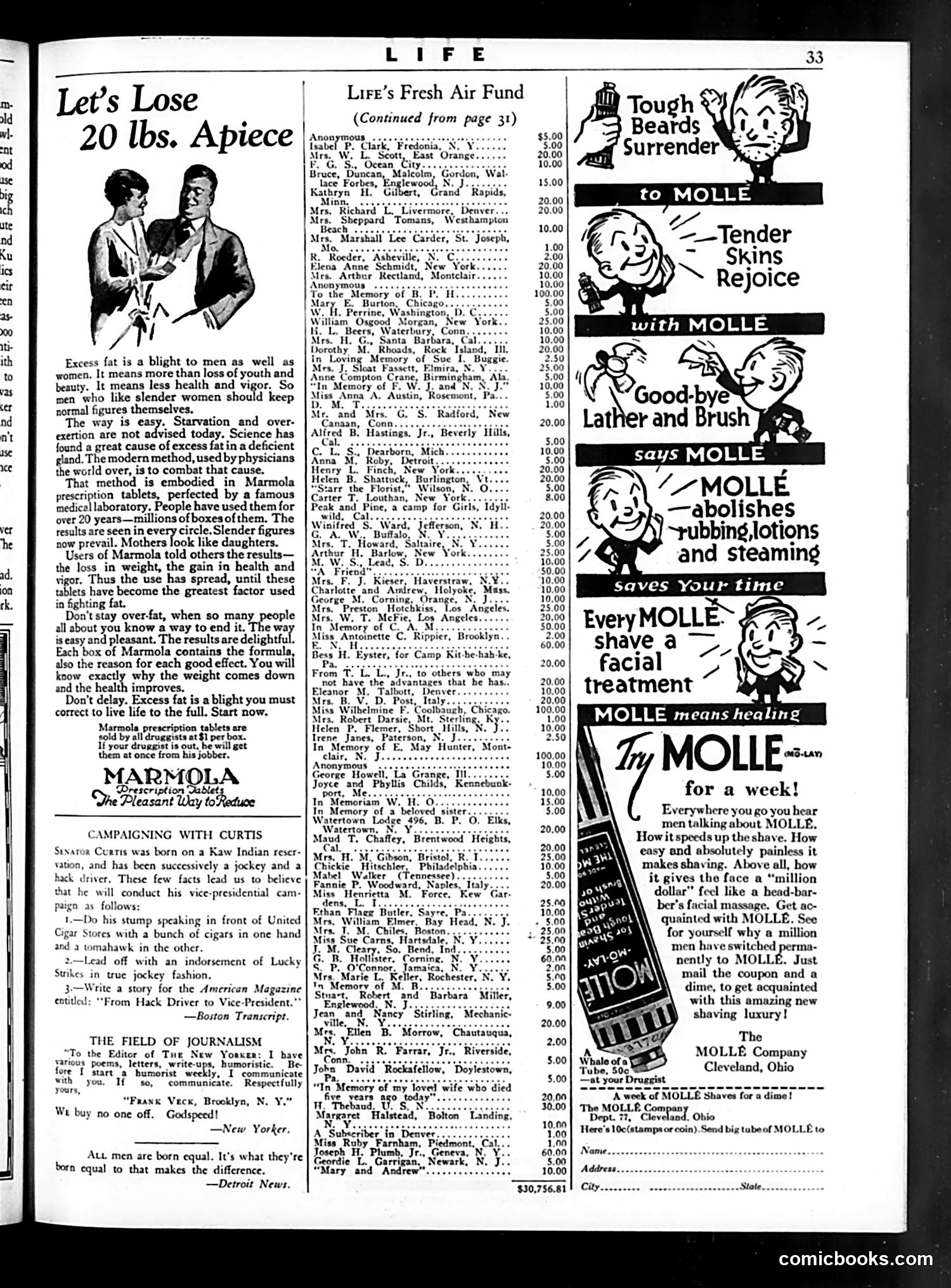
This page is primarily **advertising and fundraising content**, not political satire. The left side features a **diet advertisement for Marmola prescription tablets**, targeting both men and women to lose weight. The pitch appeals to vanity and health, claiming the tablets combat a "deficient gland" causing excess fat—reflecting 1920s-era medical pseudoscience about weight loss. The right side displays **MOLLÉ shaving product advertisements** with cartoon mascots promoting various grooming benefits ("Tender Skins Rejoice," "Good-bye Lather and Brush," etc.). Below these ads is the **Life's Fresh Air Fund** continuation—a charitable donation list of contributors' names and amounts, a common feature in early Life magazine supporting children's camps and outdoor recreation programs. The scattered humorous items (Curtis campaign satire, journalism letters, equality quips) are filler content typical of the era's magazine layout, not the page's focus.
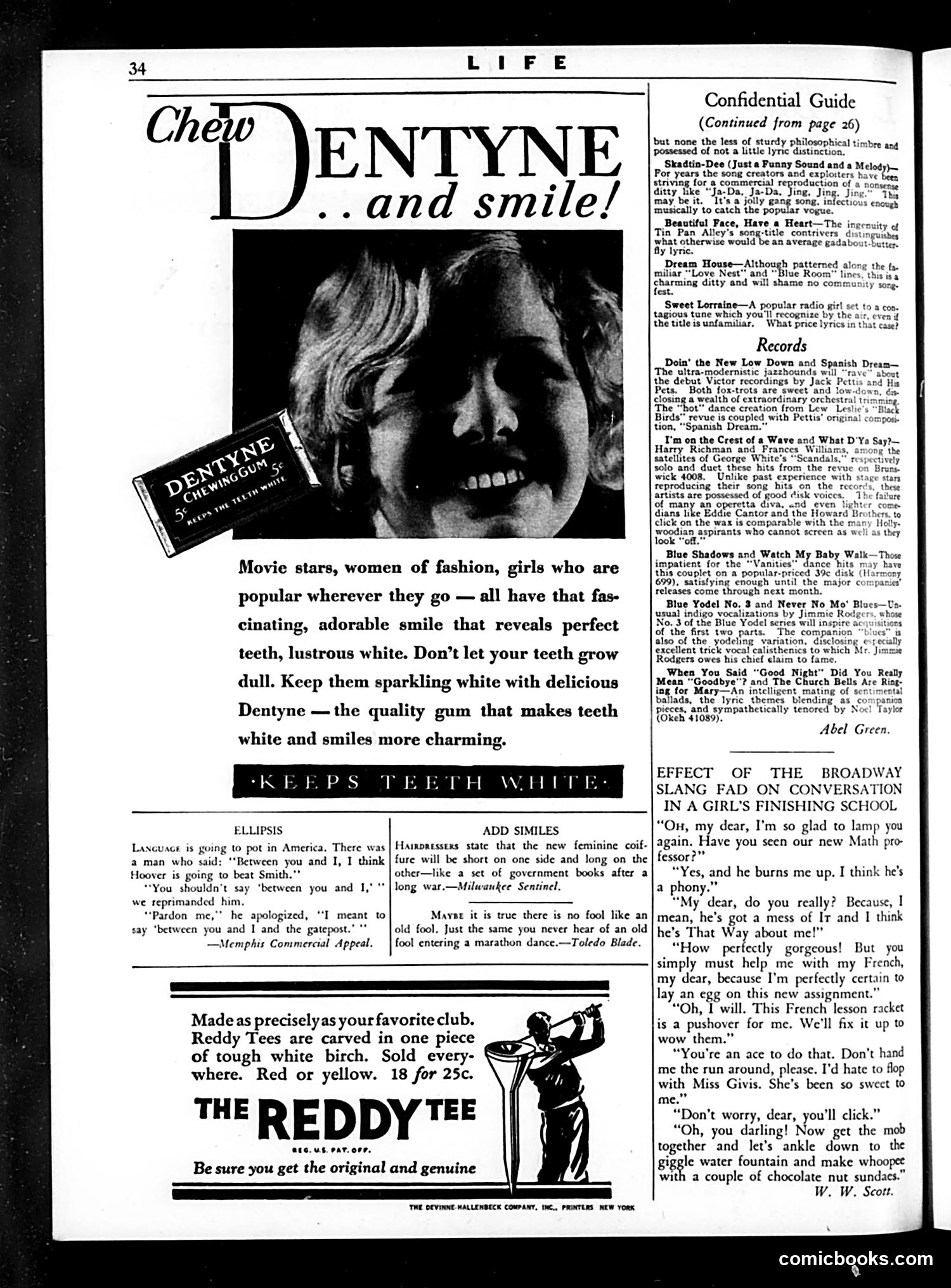
This page combines advertising with satirical humor typical of Life magazine's format. **Main Content:** The Dentyne gum advertisement dominates, featuring a glamorous woman's smile. The copy appeals to popular culture by referencing "movie stars, women of fashion" — suggesting that perfect teeth signal social status and desirability. **Satire Section ("Ellipsis" and "Add Similes"):** Brief humorous observations mock contemporary language and social behavior. One joke references Herbert Hoover versus Al Smith (likely the 1928 presidential election), poking fun at grammatical pedantry. Another satirizes government inefficiency through a joke about "government books." A final quip about "marathon dances" references the 1920s fad of endurance dancing competitions. **The Reddy Tee Advertisement:** Golf tees carved from birch wood, priced accessibly (18 for 25¢). **Right Column:** Music reviews and a comedic dialogue mocking how Broadway slang infiltrates finishing school conversation among wealthy girls. The page reflects 1920s consumer culture, emerging mass entertainment, and social anxieties about language and class.
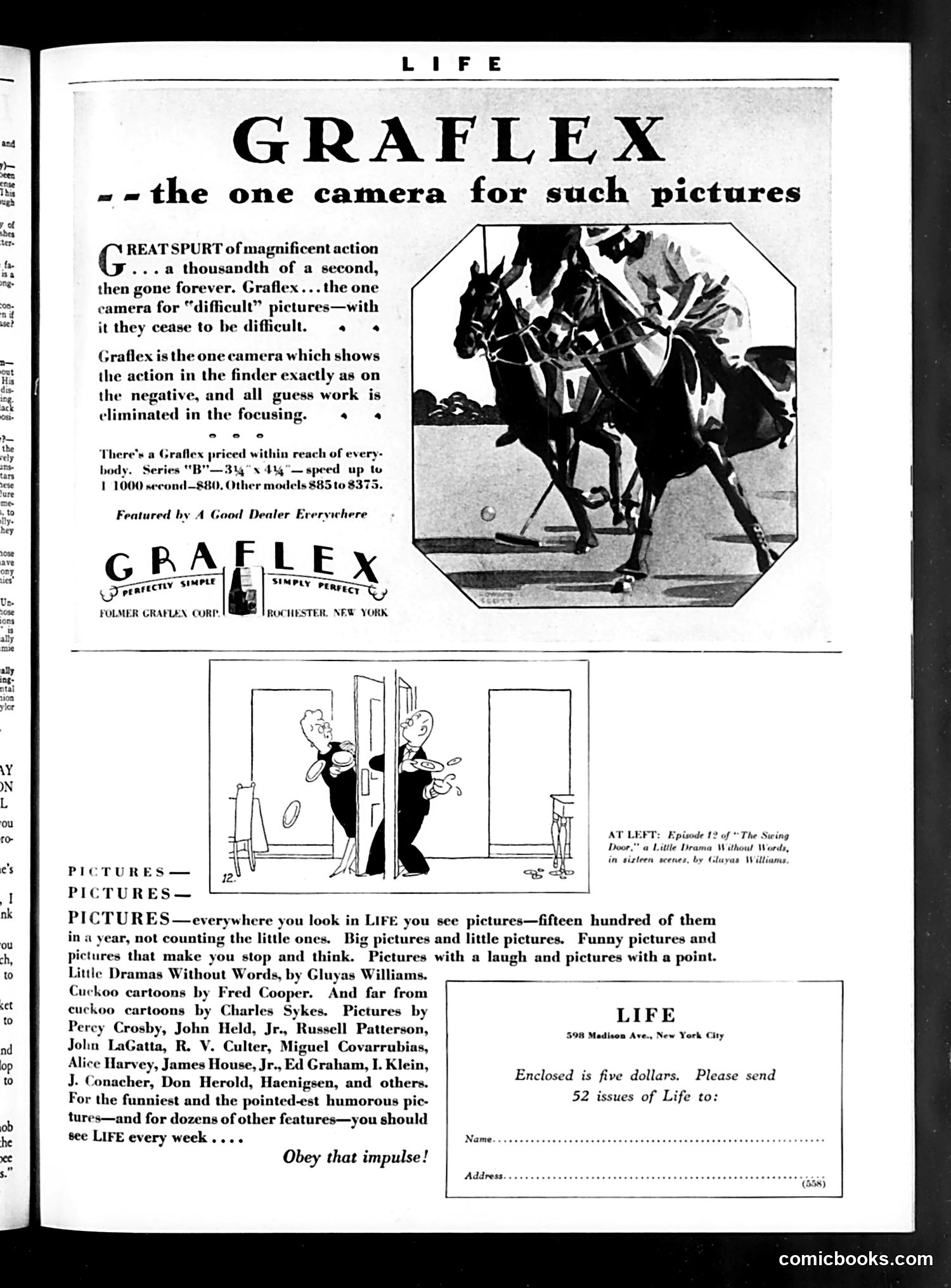
This page is primarily **advertising**, not political satire. It contains two distinct ads: **Top section:** A Graflex camera advertisement highlighting the camera's ability to capture fast-action photography ("a thousandth of a second, then gone forever"), with an image of a polo player on horseback demonstrating action photography. **Bottom section:** A subscription promotion for *Life* magazine itself, listing the publication's regular contributors and cartoon features (including "Little Dramas Without Words" by Gluyas Williams, cartoons by Fred Cooper and Charles Sykes, and work by illustrators like John Held Jr.). The ad emphasizes *Life's* variety of humorous and pointed pictorial content, encouraging readers to subscribe for 52 issues for five dollars. The page reflects *Life's* identity as a **humor and satire magazine** built on visual content—cartoons, illustrations, and photographs—rather than containing specific political commentary itself.
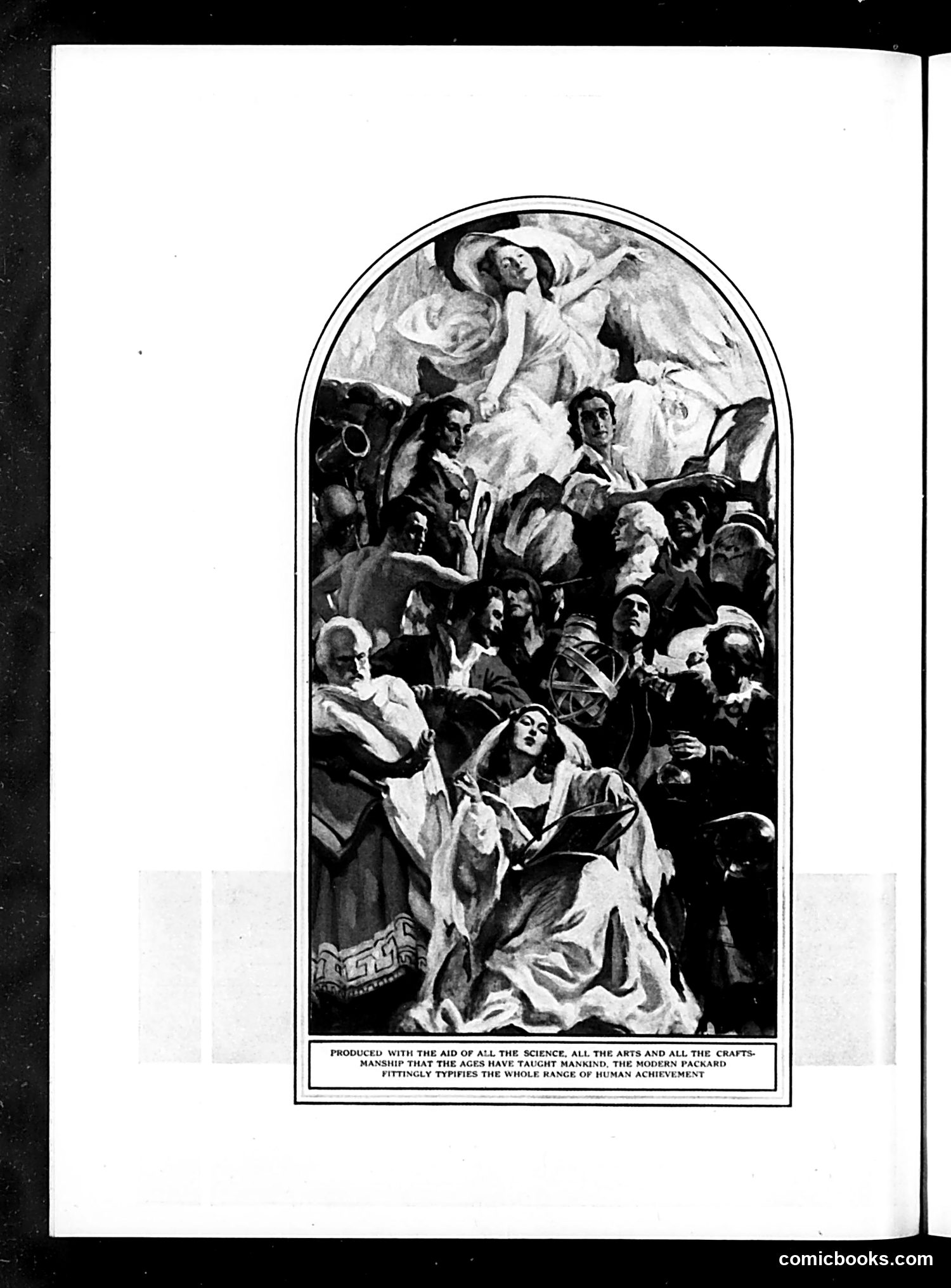
This appears to be an advertisement for a Packard automobile, not political satire. The image shows an allegorical composition with a divine or angelic figure at top overlooking a crowd of earthly figures below—a classical artistic arrangement representing human progress and achievement. The caption claims the Packard car represents "the whole range of human achievement," suggesting it embodies all scientific, artistic, and craftsman knowledge accumulated throughout history. This is hyperbolic advertising rhetoric typical of early 20th-century luxury car marketing: positioning an expensive automobile as the pinnacle of civilization itself. The ornate arch frame and grandiose imagery mock this inflated claim through juxtaposition—equating a consumer product with humanity's greatest accomplishments.
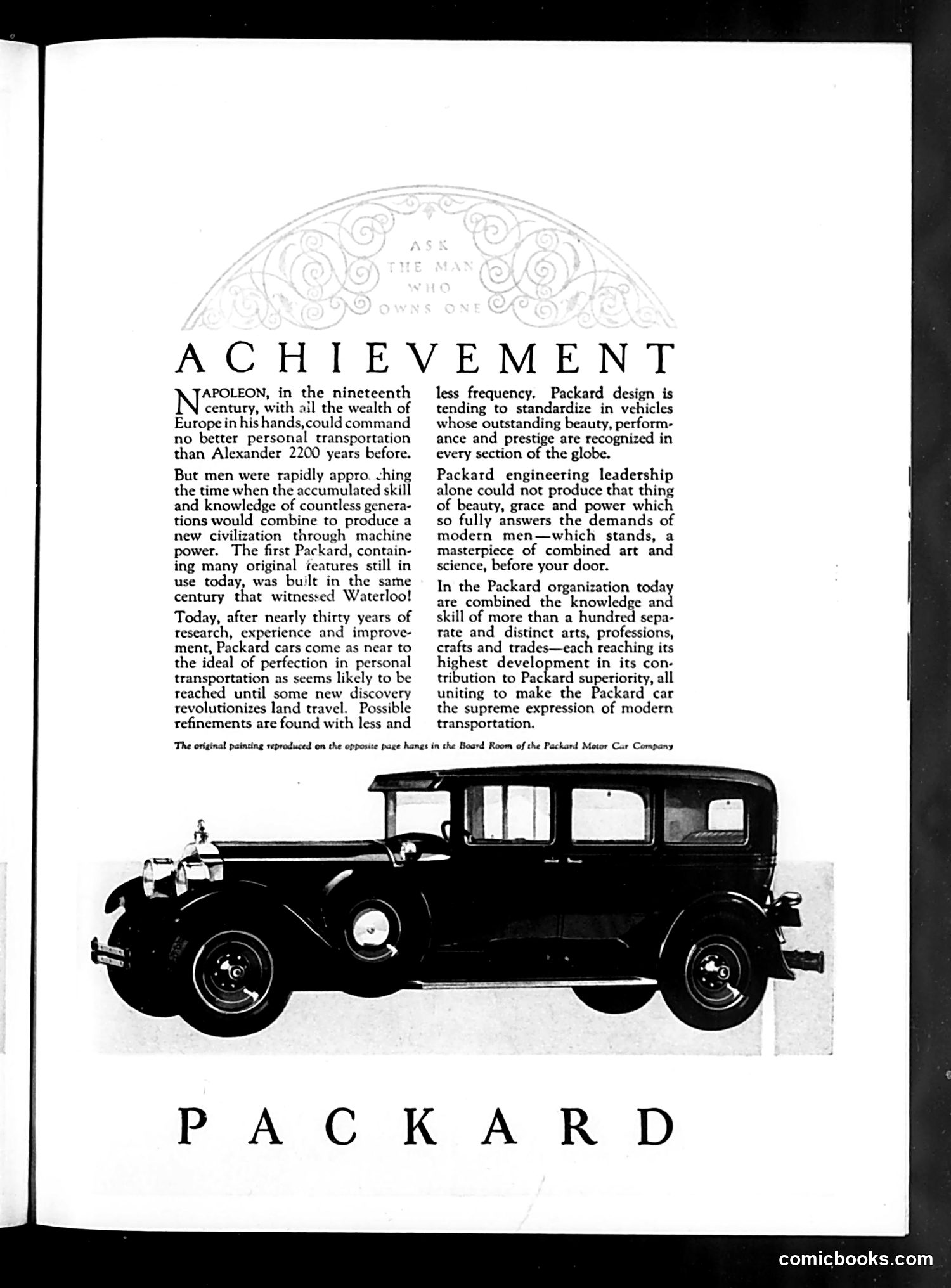
This is **not a cartoon or satire** — it's a luxury automobile advertisement for Packard automobiles disguised as editorial content. The text uses historical comparison to establish prestige: Napoleon had inferior transportation compared to modern Packard cars, despite his vast wealth. The piece claims Packard achieved near-perfection through thirty years of research and engineering, combining "a hundred separate and distinct arts, professions, crafts and trades." The accompanying image shows a sleek 1920s-era Packard automobile in profile. This represents **aspirational advertising common to the 1920s-30s**, appealing to wealthy readers by equating car ownership with civilization's progress and personal achievement. The elaborate framing as an "achievement" essay rather than straightforward advertisement reflects marketing practices of the era, where luxury brands positioned themselves as cultural accomplishments rather than mere commodities.
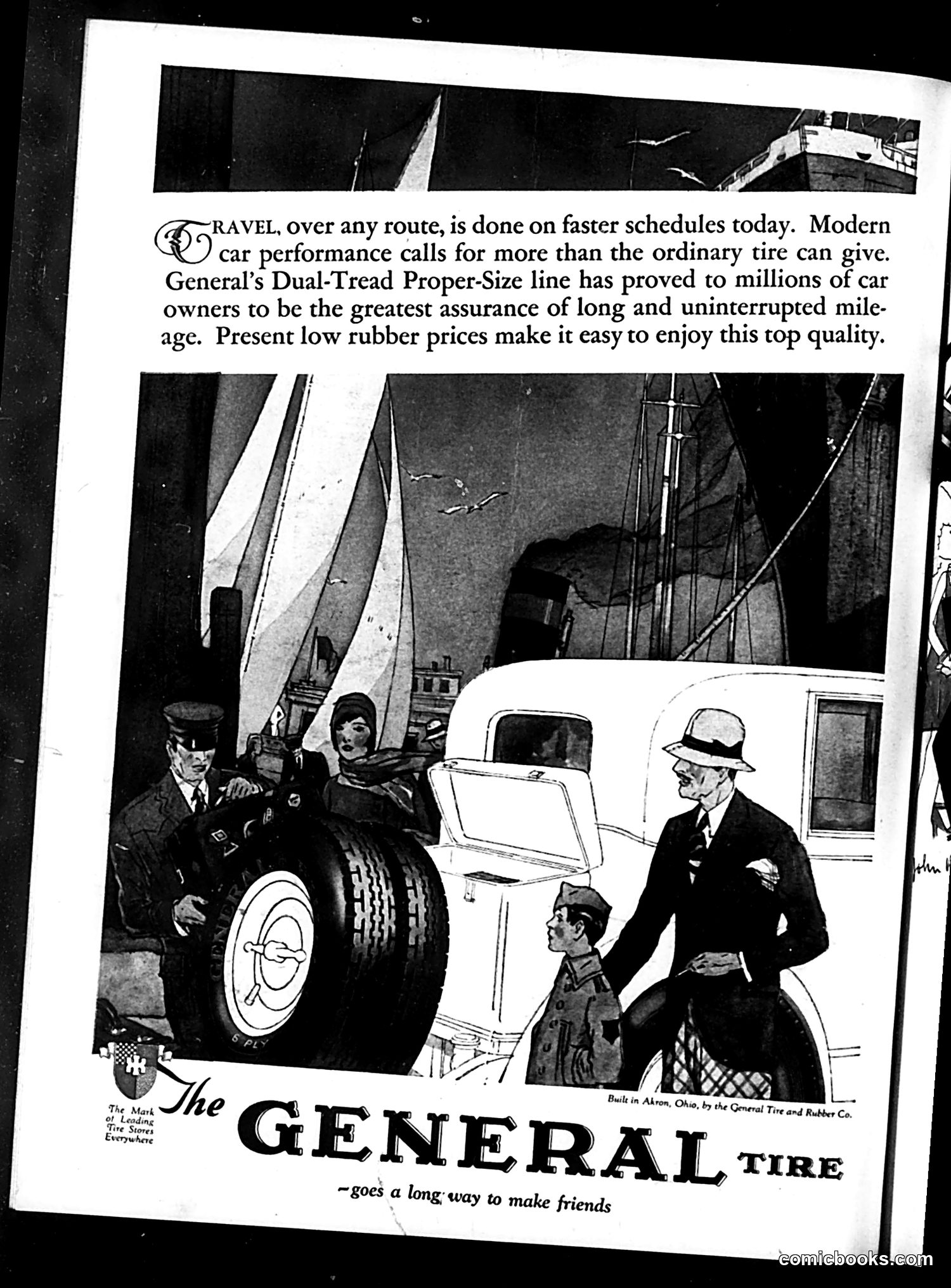
This is a General Tire advertisement, not political satire. It promotes General's "Dual-Tread Proper-Size" tires by depicting well-dressed travelers (a captain, woman, man, and child) admiring a large tire displayed near boats and docks. The ad's tagline—"goes a long way to make friends"—suggests that quality tires enable pleasant travel experiences that strengthen relationships. The image appeals to middle-class consumers by associating the product with leisure travel and family togetherness. The text emphasizes durability and affordability ("present low rubber prices"), positioning General tires as practical luxury during what appears to be an era of economic accessibility to automobile travel.