
Life, 1928-09-14 · page 18 of 40
Life — September 14, 1928 — page 18: what you’re looking at
What you’re looking at
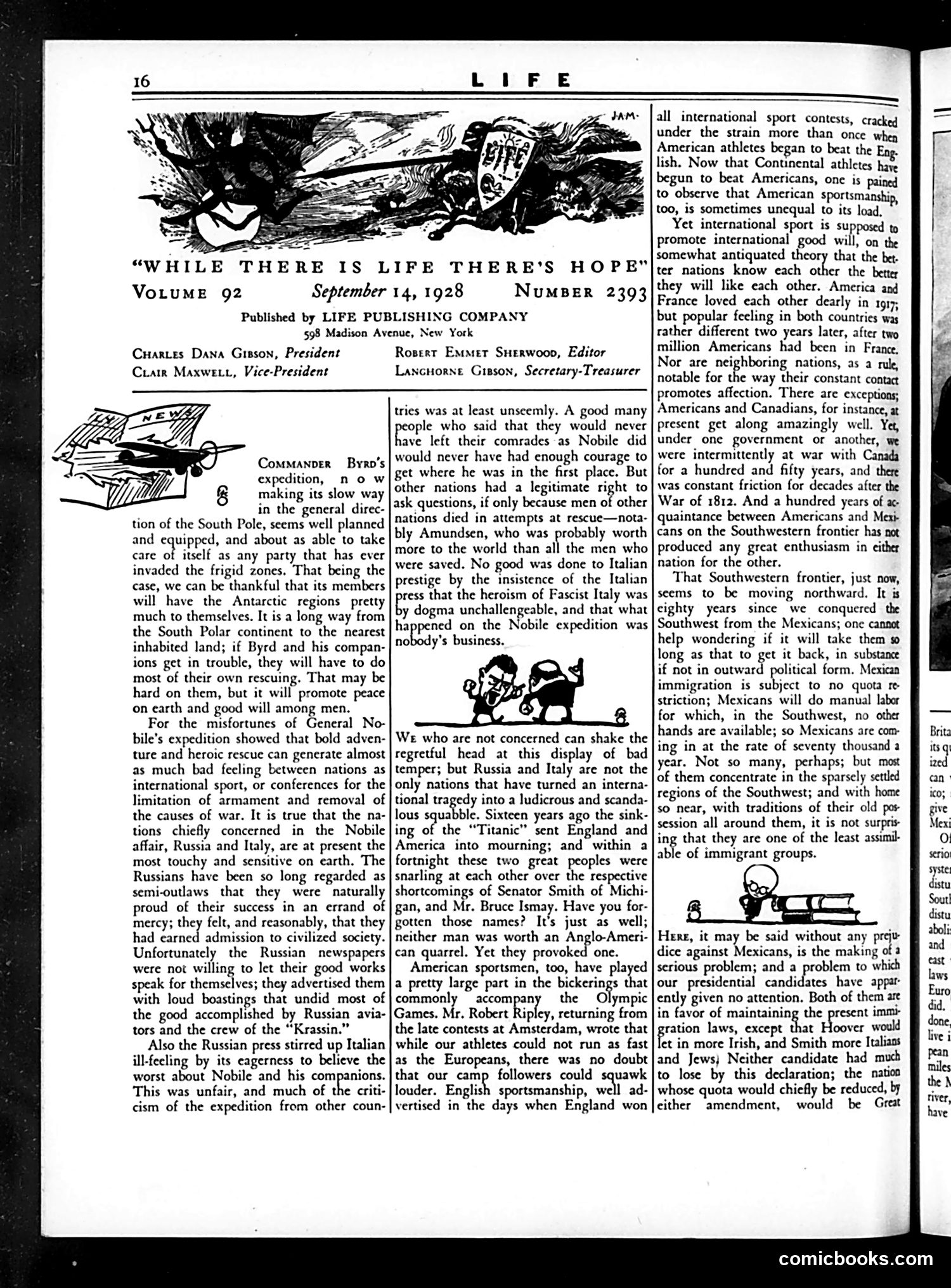
This page discusses international sports competitions and their diplomatic implications. The text criticizes how nations use athletic achievement for propaganda, citing recent tensions between Russia, Italy, and other countries. Two cartoon illustrations appear to show caricatured figures in conflict—likely representing different nations competing or quarreling. The text specifically mentions Russia and Italy stirring up "ill-feeling" through press coverage of athletic events, and references England's past Olympic victories being used for national prestige. The broader satire targets how governments exploit sports to advance nationalist agendas and generate international tensions, rather than promoting genuine goodwill. The cartoons appear to depict this competitive hostility between nations using sports as a proxy for larger geopolitical disputes.
📄 Transcribed text from this page (OCR, searchable)
Machine-transcribed from the original scan — historical spelling and the odd misread are preserved.
VoLUME 92 September 14, 1928 NuMBER 2393 Published by LIFE PUBLISHING COMPANY 598 Madison Avenue, New York Cuartes Dana Giason, President Crain Maxwet, Vice-President Commanver Byro’s expedition, no w making its slow way in the general direc- tion of the South Pole, seems well planned and equipped, and about as able to take care of itself as any party that has ever invaded the frigid zones. That being the case, we can be thankful that its members will have the Antarctic regions pretty much to themselves. It is a long way from the South Polar continent to the nearest inhabited land; if Byrd and his compan- ions get in trouble, they will have to do most of their own rescuing. That may be hard on them, but it will promote peace on earth and good will among men. For the misfortunes of General No- bile’s expedition showed that bold adven- ture and heroic rescue can generate almost as much bad feeling between nations as international sport, or conferences for the limitation of armament and removal of the causes of war. It is true that the na- tions chiefly concerned in the Nobile affair, Russia and Italy, are at present the most touchy and sensitive on earth. The Russians have been so long regarded as semi-outlaws that they were naturally proud of their success in an errand of mercy; they felt, and reasonably, that they had earned admission to civilized society. Unfortunately the Russian newspapers were not willing to let their good works speak for themselves; they advertised them with loud boastings that undid most of the good accomplished by Russian avia- tors and the crew of the “Krassin.” Also the Russian press stirred up Italian ill-feeling by its eagerness to believe the worst about Nobile and his companions. This was unfair, and much of the criti- cism of the expedition from other coun- Rosert Emater SHerwooo, Editor LancHorneé Giason, Secretary-Treasurer tries was at least unseemly. A good many people who said that they would never ave left their comrades as Nobile did would never have had enough courage to get where he was in the first place. But other nations had a legitimate right to ask questions, if only because men of other nations died in attempts at rescue—nota- bly Amundsen, who was probably worth more to the world than ah the men who were saved. No good was done to Italian prestige by the insistence of the Italian ress that the heroism of Fascist Italy was By dogma unchallengeable, and that what happened on the Nobile expedition was nobody's business. We who are not concerned can shake the regretful head at this display of bad temper; but Russia and Italy are not the only nations that have turned an interna- tional tragedy into a ludicrous and scanda- lous squabble. Sixteen years ago the sink- ing of the “Titanic” sent England and America into mourning; and within a fortnight these two great peoples were snarling at each other over the respective shortcomings of Senator Smith of Michi- gan, and Mr. Bruce Ismay. Have you for- gotten those names? It’s just as well; neither man was worth an Anglo-Ameri- can quarrel. Yet they provoked one. American sportsmen, too, have played a pretty large part in the bickerings that commonly accompany the Olympic Games. Mr. Robert Ripley, returning from the late contests at Amsterdam, wrote that while our athletes could not run as fast as the Europeans, there was no doubt that our camp followers could squawk louder. English sportsmanship, well ad- vertised in the days when England won all international sport contests, cracked under the strain more than once when American athletes began to beat the lish. Now that Continental athletes have begun to beat Americans, one is pained to observe that American sportsmanshi too, is sometimes unequal to its load, Yet international sport is supposed to promote international good will, on the somewhat antiquated theory that the bet- ter nations know each Sher the better they will like each other. America and France loved each other dearly in 1917; but popular feeling in both countries was rather different two years later, after two million Americans had been in France, Nor are neighboring nations, as a rule, notable for he way their constant contact promotes affection. There are exceptions; Americans and Canadians, for instance, at present get along amazingly well. Yer, under one government or another, we were intermittently at war with Canada for a hundred and fifty years, and there was constant friction for decades after the War of 1812. And a hundred years of ac quaintance between Americans and Mex- cans on the Southwestern frontier has not produced any great enthusiasm in either nation for the other. That Southwestern frontier, just now, seems to be moving northward. It is cighty years since we conquered the Southwest from the Mexicans; one cannot help wondering if it will take them 9 long as that to get it back, in substance if not in outward political form. Mexican immigration is subject to no quota re striction; Mexicans will do manual labor for which, in the Southwest, no other hands are available; so Mexicans are com- ing in at the rate of seventy thousand a year. Not so many, perhaps; but most of them concentrate in the sparsely settled regions of the Southwest; and with home so near, with traditions of their old por session all around them, it is not surpris ing that they are one of the least assimil- able of immigrant groups. Here, it may be said without any preju- dice against Mexicans, is the making of a serious problem; and a problem to which our presidential candidates have appat- ently given no attention. Both of them are in favor of maintaining the present immi- ration laws, except that Hoover would let in more Irish, and Smith more Italiass and Jews} Neither candidate had much to lose by this declaration; the nation whose quota would chiefly be reduced, by cither amendment, would be Great comicbooks.com ine |