
Life, 1928-09-14 · page 15 of 40
Life — September 14, 1928 — page 15: what you’re looking at
What you’re looking at
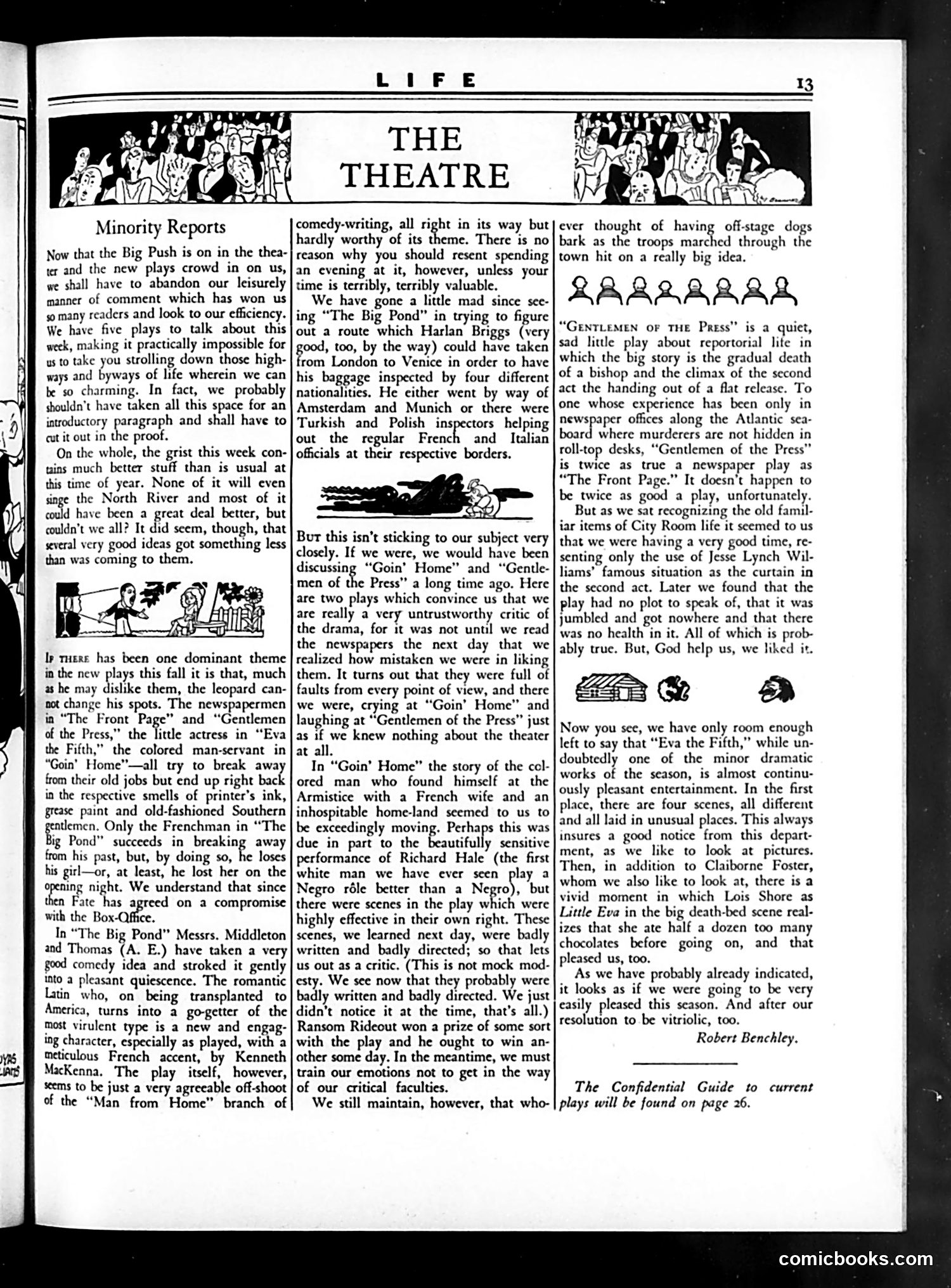
This page reviews contemporary theatrical productions. The text discusses "The Big Pond," "Goin' Home," and "Gentlemen of the Press"—plays criticized for being poorly written and directed despite featuring notable actors. The small cartoon appears to depict theater-goers in a dramatic moment, likely satirizing audience reactions or theatrical conventions of the era. The author (Robert Benchley) argues these plays have untrustworthy critics and flawed execution. He notes the cast includes Kenneth McKenna and Richard Hale in a "Negro role," reflecting the casual racial casting of 1920s theater. The central satirical point: despite Broadway's prestige and high ticket prices, audiences are suffering through mediocre productions written by and featuring untalented performers—a commentary on commercialism over artistic quality in American theater.
📄 Transcribed text from this page (OCR, searchable)
Machine-transcribed from the original scan — historical spelling and the odd misread are preserved.
Pours ind CS Minority Reports Now that the Big Push is on in the thea- ter and the new plays crowd in on us, we shall have to abandon our leisurely manner of comment which has won us so many readers and look to our efficiency. We have five plays to talk about this week, making it practically impossible for us to take you strolling down those high- ways and byways of life wherein we can be so charming. In fact, we probably shouldn't have taken all this space for an introductory paragraph and shall have to cut it out in the proof. On the whole, the grist this week con- tains much better stuff than is usual at this time of year. None of it will even singe the North River and most of it could have been a great deal better, but couldn’t we all? It did seem, though, that several very good ideas got something less than was coming to them, Ip mire has been one dominant theme in the new plays this fall it is that, much as he may dislike them, the leopard can- not change his spots. The newspapermen in “The Front Page” and ‘Gentlemen of the Press,” the little actress in “Eva the Fifth,” the colored man-servant in “Goin’ Home"—all try to break awa from their old jobs but end up right back in the respective smells of printer's ink, grease paint and old-fashioned Southern foo. Only the Frenchman in “The ig Pond” succeeds in breaking away from his past, but, by doing so, he loses his girl—or, at least, he lost her on the ning night. We understand that since then Fate has agreed on a compromise with the Box- In “The Big Pond” Messrs. Middleton and Thomas (A. E.) have taken a very good comedy idea and stroked it gently nto a pleasant quiescence. The romantic Latin who, on being transplanted to America, turns into a go-getter of the most virulent type is a new and engag- ing character, especially as played, with a meticulous French accent, by Kenneth MacKenna. The play itself, however, seems to be just a very agreeable off-shoot of the “Man from Home” branch of comedy-writing, all right in its way but hardly worthy of its theme. There is no reason why you should resent spending an evening at it, however, unless your time is terribly, terribly valuable. We have gone a little mad since see- ing “The Big Pond” in trying to figure out a route which Harlan Briggs (very good, too, by the way) could have taken from London to Venice in order to have his baggage inspected by four different nationalities. He either went by way of Amsterdam and Munich or there were Turkish and Polish inspectors helping out the regular French and _ Italian officials at their respective borders. "Dae Bur this isn’t sticking to our subject very closely. If we were, we would have been discussing ‘Goin’ Home” and “Gentle- men of the Press” a long time ago. Here are two plays which convince us that we are really a very untrustworthy critic of the drama, for it was not until we read the newspapers the next day that we realized how mistaken we were in liking them. It turns out that they were full of faults from every point of view, and there we were, crying at “Goin’ Home” and laughing at “Gentlemen of the Press” just as ov knew nothing about the theater at all. In “Goin’ Home” the story of the ccl- ored man who found himself at the Armistice with a French wife and an inhospitable home-land seemed to us to be exceedingly moving. Perhaps this was due in part to the beautifully sensitive performance of Richard Hale (the first white man we have ever seen play a Negro réle better than a Ne Ay but there were scenes in the play which were highly effective in their own right. These scenes, we learned next day, were badly written and badly directed; so that lets us out as a critic. (This is not mock mod- esty. We see now that they probably were badly written and badly directed. We just didn’t notice it at the time, that’s all.) Ransom Rideout won a prize of some sort with the play and he ought to win an- other some day. In the meantime, we must train our emotions not to get in the way of our critical faculties. We still maintain, however, that who- He ever thought of having off-stage dogs bark as the troops marched through the town hit on a really big idea. RAAZARAA “GENTLEMEN OF THE Press” is a quict, sad litle play about reportorial lite in which the big story is the gradual death of a bishop and the climax of the second act the handing out of a flat release. To one whose experience has been only in newspaper offices along the Adantic sea- board where murderers are not hidden in roll-top desks, “Gentlemen of the Press” is twice as true a newspaper play as “The Front Page.” It doesn’t happen to be twice as good a play, unfortunately. But as we sat recognizing the old famil- iar items of City Room life it seemed to us that we were having a very good time, re- senting only the use of Jesse Lynch Wil- liams’ famous situation as the curtain in the second act. Later we found that the play had no plot to speak of, that it was jumbled and got nowhere and that there was no health in it. All of which is prob- ably true. But, God help us, we liked it. “ane Now you see, we have only room enough left to say that “Eva the Fifth,” while un- doubtedly one of the minor dramatic works of the season, is almost continu- ously pleasant entertainment. In the first place, there are four scenes, all different and all laid in unusual places. This always insures a good notice from this depart- ment, as we like to look at pictures. Then, in addition to Claiborne Foster, whom we also like to look at, there is a vivid moment in which Lois Shore as Little Eva in the big death-bed scene real- izes that she ate half a dozen too many chocolates before going on, and that pleased us, too. As we have probably already indicated, it looks as if we were going to be very easily pleased this season. And after our resolution to be vitriolic, too. Robert Benchley. The Confidential Guide to current plays will be found on page 26. comicbooks.com