
Life, 1928-09-14 · page 10 of 40
Life — September 14, 1928 — page 10: what you’re looking at
What you’re looking at
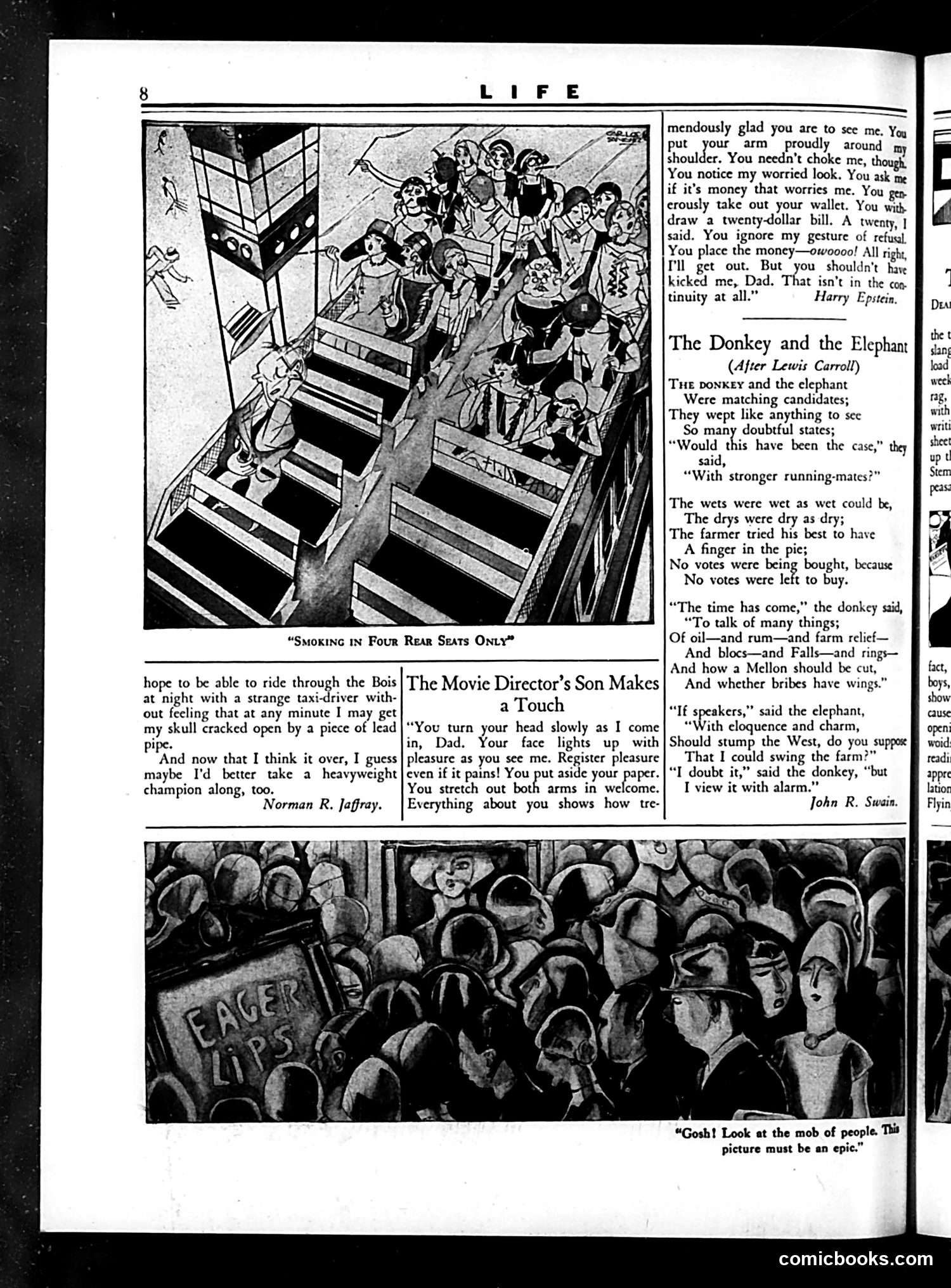
This page contains three separate pieces of humorous content: 1. **"Smoking in Four Rear Seats Only"** - A cartoon depicting an crowded elevator or transit vehicle, satirizing public smoking restrictions and the physical impossibility of enforcing such rules in cramped spaces. 2. **"The Movie Director's Son Makes a Touch"** - A brief comedic piece by Norman M. Jeffray about a son asking his father for money, playing on the common stereotype of wealthy Hollywood producers' sons as freeloaders. 3. **"The Donkey and the Elephant"** - A political allegory (after Lewis Carroll) using these animals as metaphors for political candidates or parties during an election, discussing campaign strategies and vote-buying. 4. **Bottom image** - Depicts a crowded mob scene labeled "Eager Lips," likely satirizing mob behavior or crowd mentality at public events. The page reflects early-to-mid 20th century American social concerns: public behavior, wealth disparities, and political corruption.
📄 Transcribed text from this page (OCR, searchable)
Machine-transcribed from the original scan — historical spelling and the odd misread are preserved.
“Smokinc IN Four Rear Seats ONLY” hope to be able to ride through the Bois at night with a strange taxi-driver with- out feeling that at any minute I may get my skull cracked open by a piece of lead pe. MXnd now that I think it over, I guess maybe I'd better take a heavyweight champion along, too. Norman R, Jaffray. The Movie Director’s Son Makes a Touch “You turn your head slowly as I come in, Dad. Your face lights up with pleasure as you see me. Register pleasure even if it pains! You put aside your paper. You stretch out both arms in welcome. Everything about you shows how tre- mendously glad you are to see me, You put your arm proudly around shoulder. You needn't choke me, though, You notice my worried look. You ask me if it’s money that worries me. You erously take out your wallet. You with draw a twenty-dollar bill. A twenty, | said. You ignore my gesture of refusal, You place the money—owoo00! All right, I'll get out. But you shouldn't have kicked me, Dad. That isn’t in the con. tinuity at all.” Harry Epstein, The Donkey and the Elephant (After Lewis Carroll) Tue ponxey and the elephant Were matching candidates; They wept like anything to see So many doubtful states; “Would this have been the case,” they said, “With stronger running-mates?” The wets were wet as wet could be, The drys were dry as dry; The farmer tried his best to have A finger in the pie; No votes were being bought, because No votes were lett to buy. “The time has come,” the donkey said, “To talk of many things; Of oil—and rum—and farm relief— And blocs—and Falls—and rings— And how a Mellon should be cut, And whether bribes have wings.” “If speakers,” said the elephant, th eloquence and charm, Should stump the West, do you suppox That I could swing the farm?” “I doubt it,” said the donkey, “but I view it with alarm.” John R. Swain. “Gosh! Look at the mob of people. This picture must be an epic.” comicbooks.com